| 0 | PI 607459 | Pop 57 | Amaranthus arenicola I. M. Johnst. | Kansas, United States | NC7 |  | | 1999 | COLLECTED | 09/27/1998 | South bank of Arkansas River, near bridge of Highway 83, south of Garden City, Section 20, T24S, R32W, Finney County. | 37.95000000, -100.84000000 | | Sandy river bank. | Wild material | | 1575369 | PI 607459 |
| 1 | PI 658732 | Index Seminum 109 | Amaranthus graecizans L. subsp. silvestris (Vill.) Brenan | Coimbra, Portugal | NC7 |  | | 1998 | COLLECTED | 09/15/1997 | Alfarelos, in the vicinity of Coimbra. | 40.15000000, -8.65000000 | | | Wild material | An erect plant with blades widest at the base end (observed in a greenhouse in Ames, Iowa David Brenner) | 1558984 | PI 658732 |
| 2 | PI 603873 | Pop 26 | Amaranthus tuberculatus (Moq.) J. D. Sauer | Nebraska, United States | NC7 | | | 1998 | COLLECTED | 10/02/1996 | 1/4 mile north of Dunbar on Highway 2 on Road 67, NE 1/4 of Section 11, T8N, R12E, Dunbar Quad, Otoe County. | 40.67500000, -96.03333333 | 335 | Soybean field and roadside. | Wild material | | 1558503 | PI 603873 |
| 3 | PI 603881 | Pop 34 | Amaranthus tuberculatus (Moq.) J. D. Sauer | Indiana, United States | NC7 | | | 1998 | COLLECTED | 09/29/1997 | Along Indiana Highway 154, 4 miles from Graysville (between Graysville and the Wabash River), Section 21, Turman Township, T8N, R11W, Meron Quad, Sullivan County. | 39.11666667, -87.61666667 | 134 | Weedy area by corn field margin. | Wild material | | 1558533 | PI 603881 |
| 4 | PI 595319 | DB 955 | Amaranthus californicus (Moq.) S. Watson | California, United States | NC7 |  | | 1995 | COLLECTED | 12/04/1995 | Santa Clara County. North-west side of Lexington Reservoir, east of Rt. 17. | 37.18333333, -122.00000000 | 197 | In associated with coclebur (Xanthium) in periodically inundated areas within the reservoir basin near the level of the over-flow. | Wild material | Plants prostrate, stems fleshy, dead at the time of collection. | 1508809 | PI 595319 |
| 5 | PI 633582 | AMA 14 | Amaranthus crispus (Lesp. & Thévenau) A. Braun ex J. M. Coult. & S. Watson | Hajdú-Bihar, Hungary | NC7 |  | | 1993 | DONATED | PRE 12/07/1993 | | | | | Wild material | | 1087018 | PI 633582 |
| 6 | PI 633583 | AMA 95 | Amaranthus muricatus (Moq.) Hieron. | Andalucía, Spain | NC7 | | | 1993 | COLLECTED | PRE 12/07/1993 | | | | | Wild material | A prostrate plant that continues to flower after first seed maturity. The root is thick and could be a storage organ. Observed by David Brenner, 1994, in a greenhouse in Iowa. | 1087019 | PI 633583 |
| 7 | PI 566897 | 'Kerala Red' | Amaranthus cruentus L. | Kerala, India | NC7 |  | | 1991 | DEVELOPED | PRE 09/22/1991 | | | | | Cultivated material | Intense red coloring on stems, petioles, leaf blades and flowers. Late flowering plant. Stems thin and branched. Leaves lanceolate. Inflorescence has short branches. Seeds black. Plants were said to volunteer from a planting the previous year. A second collection of this accession was done on 10/19/91 for additional seed. The harvests were combined | 1461868 | PI 566897 |
| 8 | PI 568124 | Ames 14359 | Amaranthus cannabinus (L.) J. D. Sauer | Virginia, United States | NC7 |  | | 1990 | COLLECTED | 09/22/1990 | Plants found growing in mud. Collected where George Washington Memorial Parkway crosses a tidal estuary of Potomac River, combined w/ a collection from Potomac River bank 2km N. Belle View, Fairfax County. | 38.78333333, -77.05000000 | | | Wild material | The leaf blades were two inches long. Outcrossing dioecious species. | 1463095 | PI 568124 |
| 9 | PI 605738 | RRC 1135 | Amaranthus fimbriatus (Torr.) Benth. ex S. Watson | Sonora, Mexico | NC7 |  | | 1990 | COLLECTED | PRE 12/01/1982 | Suvuk, Pinacate Desert National Park. | 31.75000000, -113.50000000 | 120 | Lava-cinder and sand wash, where air temperatures reach 121 F and soil 155 F. Less than 5 inches of rain per year | Wild material | The seeds are black. RRC was unable to increase; the seeds did not germinate. Observations from the Rodale Research Center, 1988 Rodale Amaranth Germplasm Catalog. Emmaus, PA. Quick growing ephemeral with extremely narrow leaves. Tepals white and fimbriate at the edge. Tepals spread from the utricle so that the flower is 4mm wide. | 1071019 | PI 605738 |
| 10 | PI 605739 | RRC 1380 | Amaranthus standleyanus Parodi ex Covas | La Pampa, Argentina | NC7 |  | | 1990 | COLLECTED | PRE 01/01/1989 | | -36.51666667, -64.01666667 | 200 | | Wild material | The seeds are black, flowers green, leaves green. In the greenhouse it flowerd in the leaf axils and the seed was indehiscent. Observations from the Rodale Research Center, 1988 Rodale Amaranth Germplasm Catalog. Emmaus, PA. A decumbent wild plant. | 1071049 | PI 605739 |
| 11 | PI 572261 | AMA 57/81 | Amaranthus powellii S. Watson subsp. bouchonii (Thell.) Costea & Carretero | Germany | NC7 |  | | 1990 | COLLECTED | | Priesitz, Wittenberg. | | | | Wild material | This accession includes plants with utricles that do not split at their equators but abscise with their tepals. The non-splitting could be useful for reduced shattering in grain production. observed by David Brenner | 1467232 | PI 572261 |
| 12 | PI 608663 | AMA 66/89 | Amaranthus blitoides S. Watson | Canada | NC7 |  | | 1990 | COLLECTED | | | | | | Wild material | A prostrate spreading annual herb. | 1064840 | PI 608663 |
| 13 | PI 633576 | AMA 76 | Amaranthus deflexus L. | Portugal | NC7 |  | | 1990 | COLLECTED | | | | | | Wild material | | 1064786 | PI 633576 |
| 14 | PI 633578 | AMA 56 | Amaranthus acutilobus Uline & W. L. Bray | Copenhagen, Denmark | NC7 |  | | 1990 | DONATED | PRE 05/30/1990 | | | | | Wild material | The leaf blade is deeply notched at the apex. | 1064811 | PI 633578 |
| 15 | PI 633579 | AMA 63 | Amaranthus acutilobus Uline & W. L. Bray | Nordrhein-Westfalen, Germany | NC7 |  | | 1990 | DONATED | PRE 05/30/1990 | | | | | Wild material | The petiole is as long or longer than the blade. The blade has a distinctive 0.5 cm notch at the apex. | 1064821 | PI 633579 |
| 16 | PI 538323 | K 432 | Amaranthus hybr. | Pennsylvania, United States | NC7 |  | | 1990 | DONATED | 02/23/1990 | | | | | Breeding material | Plant height 1.5m. Flowers green or pink. Seed white. | 1433259 | PI 538323 |
| 17 | PI 538324 | K 433 | Amaranthus hybr. | Pennsylvania, United States | NC7 |  | | 1990 | DONATED | 02/23/1990 | | | | | Breeding material | Plant height 1.5m. Flowers green. Seed white. | 1433260 | PI 538324 |
| 18 | PI 553076 | Giant Amaranth | Amaranthus australis (A. Gray) J. D. Sauer | Florida, United States | NC7 |  | | 1989 | COLLECTED | 09/21/1989 | Levee edges and in standing water in a fertile fresh water wetland. One and one half kilometers south west of Alachua Sink in Paynes Prairie State Park, near Gainesville in Alachua County. | 29.58397000, -82.32418300 | 17 | | Wild material | Large plants, up to 485 cm tall. Basal circumference 24 to 56 cm. The stems are hollow, with stem walls 1.5 cm thick, purple-red or green. If water level is high, roots grow out of the stem. Plants dioecious, still in flower at collection time. Low water level during germination is said to favor establishment. Frosts in October are said to kill the plants yearly. | 1448048 | PI 553076 |
| 19 | PI 553078 | DB 8916 | Amaranthus floridanus (S. Watson) J. D. Sauer | Florida, United States | NC7 |  | | 1989 | COLLECTED | 09/20/1989 | Construction site, full sun with annual weeds, exposed soil derived from sea shells. Casey Key Estates, 50 meters east of Casey Key road, at address #1106. Less than 3 km north of Albee road. Casey Key, near Nokomis, in Sarasota County. | 27.13845600, -82.47376300 | 4 | | Wild material | After drying the stems are still flexible and therefore easy to thresh. At collection time, males still in bloom, most leaves had fallen. Plants 25 to 50 cm tall, most have one erect stem and approximately nine horizontal stems. Varying amounts of red coloring on stems, utricles, and male tepals. Sample size 15 plants. Plants dioecious. | 1448050 | PI 553078 |
| 20 | PI 553079 | DB 8901 | Amaranthus blitoides S. Watson | Iowa, United States | NC7 |  | | 1989 | COLLECTED | 08/13/1989 | Urban roadsides, especially pavement cracks. Welch Avenue, south of Lincoln Way, and north of Hwy. 30, Ames, in Story County. | 42.01666667, -93.65000000 | 290 | | Wild material | Continuous flowering and fruiting. Plants 15 cm tall, sprawling to 200 cm wide. Some stems are thickened, red colored, small leaved, and could be diseased. Sample size 100, population size thousands. | 1448051 | PI 553079 |
| 21 | PI 572263 | DB 8921 | Amaranthus retroflexus L. | Iowa, United States | NC7 |  | | 1989 | COLLECTED | 10/08/1989 | Weed of a construction site and soybean field. Near "Country Kitchen" restaurant, at 16th and Duff streets. Ames, in Story County. | 42.01666667, -93.61666667 | 270 | | Wild material | Isolated from cultivated Amaranthus species by distance (no known cultivated Amaranthus in 2 km). The plants were dry and shattering at collection time, less than 1 meter tall. Sample size 18, population size hundreds. | 1467234 | PI 572263 |
| 22 | PI 642738 | 403 | Amaranthus tamaulipensis Henrickson | La Habana, Cuba | NC7 |  | | 1989 | COLLECTED | PRE 1988 | Havana. | 23.13333333, -82.36666667 | | Ruderal sites (weedy). | Wild material | | 1052375 | PI 642738 |
| 23 | PI 606282 | Lal Shak | Amaranthus blitum L. subsp. oleraceus (L.) Costea | Bangladesh | NC7 |  | | 1986 | COLLECTED | PRE 03/01/1981 | Maijdi. | 22.86666667, 91.10000000 | | | Landrace | The seeds are black, flowers red, leaves amaranthine. Local name is Lal Shak. It is said to be a cultivated vegetable. It is fairly prolific and very coarse with large seeds. Observations from the Rodale Research Center, 1988 Rodale Amaranth Germplasm Catalog. Emmaus, PA. This taxonomic type is rare in the NPGS collection. It is a cultivated vegetable with black seeds, and red-purple leaves and flowers. (Dave Brenner) | 1031345 | PI 606282 |
| 24 | PI 607447 | Calaloo | Amaranthus retroflexus L. | Jamaica | NC7 |  | | 1986 | COLLECTED | PRE 11/09/1979 | | | | | Wild material | The seeds are black, flowers green, leaves green. The RRC class type is: weed. Caribbean pigweed, local name 'Calaloo.' It is said to be a wild variety eaten by humans, pigs, and chickens. Observations from the Rodale Research Center, 1988 Rodale Amaranth Germplasm Catalog. Emmaus, PA. Vegetable use is unusual for this species. | 1031113 | PI 607447 |
| 25 | PI 628784 | RRC 1139 | Amaranthus cruentus L. | Puebla, Mexico | NC7 |  | | 1986 | COLLECTED | PRE 09/01/1982 | | | | | Landrace | Seeds are light tan, flowers red, leaves rufescent. The RRC class type is: unique. The plants are tall and basically unbranched with Mexican grain type flower heads. It matures mid-season and there was some lodging. Observations from the Rodale Research Center, 1988 Rodale Amaranth Germplasm Catalog. Emmaus, PA. | 1032622 | PI 628784 |
| 26 | PI 628793 | 'Lenga-lenga' | Amaranthus cruentus L. | Shaba, Democratic Republic of the Congo | NC7 | 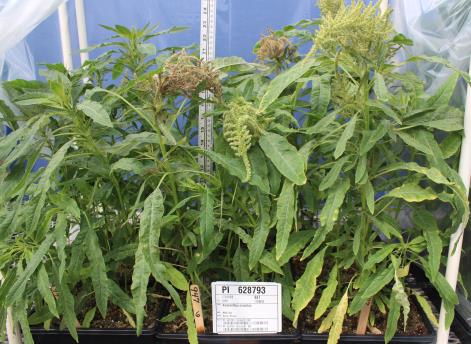 | | 1986 | COLLECTED | PRE 04/01/1981 | North Shaba Province. | | | | Cultivar | The seeds are black, flowers pinkish brown, leaves pinkish green. The RRC class type is unique. 'Lenga-lenga' It is a cultivated vegetable with distinctive elongated leaves. It is unbranched with some seed production in the field in Pennsylvania, USA. Observations from the Rodale Research Center, 1988 Rodale Amaranth Germplasm Catalog. Emmaus, PA. | 1031353 | PI 628793 |
| 27 | PI 632235 | RRC 686 | Amaranthus palmeri S. Watson | Arizona, United States | NC7 |  | | 1986 | COLLECTED | 05/01/1981 | Tucson. | 32.25000000, -111.00000000 | | | Wild material | The seeds are black, flowers green, leaves shiny green. The RRC class type is: weed. It exhibited some lygus resistance and matured in the field. Observations from the Rodale Research Center, 1988 Rodale Amaranth Germplasm Catalog. Emmaus, PA. | 1031358 | PI 632235 |
| 28 | PI 633589 | Guegui | Amaranthus hypochondriacus L. | Chihuahua, Mexico | NC7 |  | | 1986 | COLLECTED | 11/01/1978 | Rancho el Mesquite near Chinipas. | 27.41666667, -108.50000000 | | | Landrace | The seeds are white, flowers red and green, leaves rufescent. The RRC class type is: mercado. It is used as a vegetable when young and is short for this type. Observations from the Rodale Research Center, 1988 Rodale Amaranth Germplasm Catalog. Emmaus, PA. Cultivated by Warihio Indians. Used as a leafy vegetable in early stage (3-5 weeks) and as grain for tamales, atole, pinole. | 1031091 | PI 633589 |
| 29 | PI 643039 | RRC 415 | Amaranthus cruentus L. | Morelos, Mexico | NC7 |  | | 1986 | COLLECTED | 08/05/1979 | Hualzurco area, 1.3 km from Amayuca. | 18.70000000, -98.76666667 | 1200 | Field of a forage legume and interplant of tomatillos and beans. | Landrace | The seeds are white, glowers red-purple, leaves rufescent. The RRC class type is: Mexican. Branches mature at the same time as main head; taller than most Mexican grain types. Observations from the Rodale Research Center, 1988 Rodale Amaranth Germplasm Catlaog. Emmaus, PA. | 1030484 | PI 643039 |
| 30 | PI 649521 | RRC 768 | Amaranthus cruentus L. | Morelos, Mexico | NC7 |  | | 1986 | COLLECTED | 11/05/1981 | Amilzingo | 18.75000000, -98.75000000 | | | Landrace | The seeds are white, flowers green and marbled, leaves green. The RRC class type is: Mexican. The plants are fairly uniform and lodged. Observations from the Rodale Research Center, 1988 Rodale Amaranth Germplasm Catalog. Emmaus, PA. | 1031901 | PI 649521 |
| 31 | PI 649589 | RRC 720 | Amaranthus hypochondriacus L. | Oaxaca, Mexico | NC7 |  | | 1986 | COLLECTED | 10/29/1981 | Peras | 15.95000000, -96.75000000 | | | Landrace | The seeds are tan and dark brown, flowers light pink and dark pink, leaves variegated. The RRC class type is: mixteco. It is predominately tan-seeded, of uniform type and is uneven in height. Observaitons from the Rodale Research Center, 1988 Rodale Amaranth Germplasm Catalog. Emmaus, PA. | 1031797 | PI 649589 |
| 32 | PI 658726 | Guegui | Amaranthus hypochondriacus L. | Chihuahua, Mexico | NC7 |  | | 1986 | COLLECTED | PRE 01/05/1979 | Municipio de Chinipas | 27.41666667, -108.50000000 | | | Landrace | The seed is light gold, flowers pink, leaves green. The RRC class type is: unique. It is a Warihio Indian cultivar. The plants are bushy and late maturing with erect flowers. It resembles RRC 364 and RRC 540. Observations from the Rodale Research Center, 1988 Rodale Amaranth Germplasm Catalog. Emmaus, PA. Growth habit is uniform with erect flowers and pink stems. | 1030357 | PI 658726 |
| 33 | PI 658727 | RRC 384 | Amaranthus cruentus L. | Guatemala | NC7 |  | | 1986 | COLLECTED | 05/07/1979 | | | | | Landrace | The seeds are light tan, flowers green and marbled, leaves green. The RRC class type is: Guatemalan. Observations from the Rodale Research Center, 1988 Rodale Amaranth Germplasm Catalog. Emmaus, PA. | 1030397 | PI 658727 |
| 34 | PI 698387 | RRC 1148 | Amaranthus cruentus L. | Sonora, Mexico | NC7 |  | | 1986 | COLLECTED | PRE 12/1982 | Rio Sonora, Mexico, near Arizpe | 30.33594500, -110.16656400 | | Collected from farm storage of the1982 crop of amaranth grown by mestizo farmers way out of its traditional range. | | The seeds are dark brown, flowers red, leaves light rufescent. The RRC class type is: Mexican. The plants were uniform with huge flowers heads. Observations from the Rodale Research Center, 1988 Rodale Amaranth Germplasm Catalog. Emmaus, PA. | 1032676 | PI 698387 |
| 35 | PI 511745 | Sangorache | Amaranthus quitensis Kunth | Ecuador | NC7 |  | | 1984 | COLLECTED | 07/25/1979 | Municipal market, Riobamba | | 2750 | | Cultivated material | Used medicinally | 1406681 | PI 511745 |
| 36 | PI 604196 | Ames 12990 | Amaranthus graecizans L. subsp. silvestris (Vill.) Brenan | Ecuador | NC7 |  | | 1984 | COLLECTED | 07/25/1979 | Riobamba municipal market. | -1.66666667, -78.63333333 | 2750 | | Wild material | Separated from a grow-out of PI 511745. It could have been from weed seeds that came with the greenhouse soil, but most likely the seeds came with an original sample from Ecuador. | 1062100 | PI 604196 |
| 37 | PI 490609 | Quinoa dulce | Amaranthus caudatus L. | Azuay, Ecuador | NC7 |  | | 1984 | COLLECTED | 1979 | Caruncay, Caruncay District | -2.93652900, -78.96316400 | 2588 | From a family farm | | The seeds are light tan, flowers pink, leaves green. The RRC class type is: South American. It is said to be used as grain and is very uniform. Observations from the Rodale Research Center, 1988 Rodale Amaranth Germplasm Catalog. Emmaus, PA. Collected by H. Hauptli. Local name Quinoa dulce. | 1385545 | PI 490609 |
| 38 | PI 490642 | LSK 462 | Amaranthus caudatus L. | Peru | NC7 | | | 1984 | COLLECTED | | Ayacucho, Ayacucho District, Ayacucho Department | | 2600 | | | Collected by C. Arbizu. Local name Achita. | 1385578 | PI 490642 |
| 39 | PI 481134 | IC-42255-5 | Amaranthus hypochondriacus L. | India | NC7 |  | | 1983 | COLLECTED | | Pauri, Pauri | 30.14600000, 78.77900000 | | | Landrace | Collected by B.D. Joshi. Used for baking bread. Popped seeds eaten with milk and sugar, sugar, or syrup. Leaves used as vegetable and as purgative. Dried stems burned (folklore). Local name Marchu. | 1376070 | PI 481134 |
| 40 | PI 490298 | WS80-192 | Amaranthus blitum L. subsp. oleraceus (L.) Costea | Kenya | NC7 |  | | 1983 | COLLECTED | | Abaluhya tribe, Kakamega market, Western Province | 0.30000000, 34.76666667 | | | Landrace | Erect, single stem plants, with green leaves, as observed in a greenhouse in Ames, Iowa 1999 by David Brenner. | 1385234 | PI 490298 |
| 41 | PI 482057 | TGR 340 | Amaranthus spinosus L. | Zimbabwe | NC7 | | | 1983 | COLLECTED | 04/30/1982 | Backyard, 10km S of Zaka, Victoria Province | -20.41666667, 31.41666667 | 720 | | | Leaves burnt and mixed for snuff. Infloresence pink pigmented. | 1376993 | PI 482057 |
| 42 | PI 477916 | RRC 1023 | Amaranthus hypochondriacus L. | Mexico | NC7 |  | | 1982 | COLLECTED | | | | | | Cultivar | The seeds are white, flowers green, leaves green. The RRC class type is: mercado. The original selection was gold and white-seeded; it has been reselected for all white. It is a typical mercado type. Observations from the Rodale Research Center, 1988 Rodale Amaranth Germplasm Catalog. Emmaus, PA. Yields high. Seed quality excellent. Adapted to mechanical harvest. Lodging resistant. Observations from the USDA Plant Inventory No. 191. | 1372852 | PI 477916 |
| 43 | PI 477917 | RRC 1024 | Amaranthus hypochondriacus L. | Mexico | NC7 |  | | 1982 | COLLECTED | | | | | | Cultivar | The seeds are gold, flowers green, leaves green. The RRC class type is: mercado. It is a typical mercado grain type and uniform. Observations from the Rodale Research Center, 1988 Rodale Amaranth Germplasm Catalog. Emmaus, PA. Morphology similar to 81S-1023. Yields high. Seed gold-colored. Imparts pleasant color to baked goods. May be used as flour mixed with corn flour products. Observations from the USDA Plant Invertory No. 191. | 1372853 | PI 477917 |
| 44 | PI 477918 | Hin Choi | Amaranthus tricolor L. | Unknown | NC7 |  | | 1982 | COLLECTED | PRE 06/01/1981 | | | | | Landrace | The seeds are black, leaves variegated. The RRC class type is: cultivated vegetable. "Hin Choy.' It is marked like 'tiger leaf' and is uniform. Observations from the Rodale Research Center, 1988 Rodale Amaranth Germplasm Catalog. Emmaus, PA Origin unknown possibly China. Tiger leaf vegetable type. Yields high. Leaves green and red variegated. (Dave Brenner) | 1372854 | PI 477918 |
| 45 | PI 540445 | AVRDC 75-75 | Amaranthus viridis L. | Jawa, Indonesia | NC7 |  | | 1981 | COLLECTED | | Bogor | | | | Wild material | The seeds are black, flowers rust orange, leaves green. The RRC class type is: weed. Observations from the Rodale Research Center, 1988 Rodale Amaranth Germplasm Catalog. Emmaus, PA. | 1435381 | PI 540445 |
| 46 | PI 566899 | 'Co. 2' | Amaranthus tricolor L. | Tamil Nadu, India | NC7 |  | | 1981 | DEVELOPED | PRE 02/20/1981 | | | | | Cultivar | The seeds are black, flowers green, leaves green. The RRC class type is: weedy. Cultivar "Co. 2" from Tamil Nadu University, Coimbatore, India. Observations from Rodale Research Center, 1988 Rodale Amaranth Germplasm Catalog. Emmaus, PA. | 1461870 | PI 566899 |
| 47 | PI 608661 | RRC 104 | Amaranthus graecizans L. | India | NC7 |  | | 1981 | COLLECTED | PRE 09/01/1977 | | | | | Cultivated material | The seeds are black, flowers red, leaves amaranthine (dark reddish purple). The RRC class type is: horsetooth. The dark red-purple leaf color is unusual for this species. Observations from the Rodale Research Center, 1988 Rodale Amaranth Germplasm Catalog. Emmaus, PA. The utricles open on a circumscissile seam, and the leaves are ovate as observed by Brenner, Oct. 2011. | 1017785 | PI 608661 |
| 48 | PI 451711 | Quequi | Amaranthus cruentus L. | Mexico | NC7 |  | | 1980 | COLLECTED | PRE 09/1980 | Baroguate, near Alamos | | | | Landrace | Leaves, inflorescence red. Local names Alegria, Grain amaranth, Guegui and Weywi. | 1346647 | PI 451711 |
| 49 | PI 288277 | TOT2273 | Amaranthus graecizans L. subsp. aschersonianus (Thell.) Costea et al. | India | NC7 |  | | 1963 | COLLECTED | | Junagadh suburbs, Junagadh District. | | | | | The seeds are black, flowers green, leaves green. The RRC class type is: horsetooth. Observations from the Rodale Research Center, 1988 Rodale Amaranth Germplasm Catalog. Emmaus, PA. | 1218227 | PI 288277 |
| 50 | PI 274279 | TOT2289 | Amaranthus hypochondriacus L. | Himachal Pradesh, India | NC7 |  | | 1961 | COLLECTED | PRE 09/01/1977 | Cornfield near Pachlan, Upper Kulu Valley. | | | | | The seeds are white, flowers green, leaves green . The RRC class type is: Nepal. Derived from PI 274279. Same as RRC 84. Observations from the Rodale Research Center, 1988 Rodale Amarnth Germplasm Catalog. Emmaus, PA. | 1205885 | PI 274279 |