| 0 | Ames 35746 | Guye Woods | Acer saccharum Marshall subsp. nigrum (F. Michx.) Desmarais | Iowa, United States | NC7 |  | | 2021 | COLLECTED | 09/08/2021 | Guye Woods County Park located 6.0 miles northeast of Winterset, T76N R27W NE1/4 Sec. 4 | 41.41235000, -93.96373000 | 278 | Moist deciduous maple, oak, hickory forest, northwest facing slope above the North River. | Wild material | Multiple specimens in this population were observed to be 24" diameter at breast height (DBH) or larger with the largest specimen encountered at the time of collection measuring 36.5" DBH.
Morphological traits of leaves suggests sampled specimens are true to type of Acer saccharum subsp. nigrum including leaves with three distinct points, leathery/thick, and drooping in appearance. On September 25, 2020 (Schmitz, A., personal communication, 31 January 2022), peak fall color on Acer saccharum subsp. nigrum at Guye Woods was observed with specimens having a clean yellow fall color, also indicative of Acer saccharum subsp. nigrum.
| 2122010 | Ames 35746 |
| 1 | Ames 28311 | JDC-0012006 | Acer saccharum Marshall subsp. nigrum (F. Michx.) Desmarais | Iowa, United States | NC7 |  | | 2006 | COLLECTED | 09/08/2006 | Front yard of 811 Kellogg Avenue, back yard of 904 Kellogg Avenue, and front yard of 915 Douglas Avenue, Ames, SE 1/4 of NW 1/4 of Section 2, T84N, R24W, Ames East Quad. | 42.03027778, -93.61333333 | 271 | Home garden setting. Full sun with no slope. Occasional population abundance. | Cultivated material | 811 Kellogg Avenue site: tree approximately 2-3 feet in diameter, growing in very dry conditions, quite thin throughout, very open branching, approximately 30-50% filled seed collected, leaves are much smaller (5-10 cm), petioles are shorter in length as well, edges of leaves starting to turn brown due to drought, no signs of fall color. 904 Kellogg Avenue site: tree approximately 4 feet in diameter, fairly good health, approximately 50-70% filled seed collected, a few leaves (5%) in bright yellow fall color, very clean leaves, no signs of drought stress, a few branches shaded in tree were starting to die. 915 Douglas Avenue site: tree approximately 4 feet in diameter, tree in very good health, full canopy, approximately 50-60% filled seed collected, nice leathery dark green leaves, no signs of drought stress, no fall color yet (still very green). | 1707770 | Ames 28311 |
| 2 | NA 70391 | Ames 26093 | Acer saccharum Marshall subsp. nigrum (F. Michx.) Desmarais | Iowa, United States | NA | | | 2000 | COLLECTED | 09/26/2000 | 3 miles south of Portland on S56, 2 miles east on B43, north on gravel, then east on gravel 0.5 mile to parking on north side of road, Claybanks Forest County Conservation Area, NW 1/4 of SW 1/4 o Section 42, T96N, R19W, Cerro Gordo County. | 43.08722222, -93.07305556 | 338 | Mixed hardwood forest of basswood, bur oak, green ash, black maple, bitternut, gooseberry, wild ginger, and poison ivy. 1 to 3% slope with a northern aspect. Jacwin silt clay loam with good drainage. | Wild material | | 1603969 | NA 70391 |
| 3 | NA 60794 | NA 60794 | Acer saccharum Marshall subsp. nigrum (F. Michx.) Desmarais | Iowa, United States | NA | | | 1988 | COLLECTED | PRE 10/15/1988 | Johnston, Iowa. | 41.64209000, -91.60041000 | | | Wild material | Drought tolerant, tolerant to higher alkaline soils. | 1111910 | NA 60794 |
| 4 | PI 664818 | PA2 | Actaea racemosa L. | Pennsylvania, United States | NC7 | | | 2005 | | | | | | | Wild material | | 1698895 | PI 664818 |
| 5 | PI 649702 | 12 | Physocarpus opulifolius (L.) Maxim. | Iowa, United States | NC7 | | | 2003 | COLLECTED | 09/14/2003 | 100 meters south of campground at North Bear Creek, west side of Quandahl Road, Bear Creek Wildlife Area, Highlandville, NW 1/4 of SE 1/4 of Section 25, T100N, R7W, Dorchester Quad, Winneshiek County. | 43.44833333, -91.61861111 | 265 | Limestone road cut. Mostly sunny. Steep slope with an eastern aspect. Thin soil with high stoniness, well drained. | Wild material | Medium sized shrubs with arching stems. | 1649462 | PI 649702 |
| 6 | PI 662016 | Ames 27280 | Cornus drummondii C. A. Mey. | Iowa, United States | NC7 | | | 2003 | COLLECTED | 09/02/2003 | South side of Skunk River, Oakland Mills County Park, SW 1/4 of SE 1/4 of Section 24, T71N, R7W, Mount Pleasant Quad, Henry County. | 40.93222222, -91.61055556 | 184 | Limestone ridge along ravine. | Wild material | Large shrubs to small trees to 3.5 meters tall. | 1648648 | PI 662016 |
| 7 | Ames 38800 | Camp Mitigwa | Amelanchier arborea (F. Michx.) Fernald | Iowa, United States | NC7 |  | | 2026 | COLLECTED | 06/01/2026 | Mitigwa Scout Camp located on west side of Des Moines River watershed approximately 7.50 miles south, southwest of Boone, T82N R26W N 1/4 Sec. 5 and T83N R26W S 1/4 Sec. 32. | 41.94894500, -93.90537200 | 310 | High-quality white oak - ironwood, mature woods. | Wild material | The native range of Amelanchier arborea is concentrated in the eastern half of the U.S. (Little, 1977). This accession represents a collection of A. arborea germplasm from the western edge of the species native range, specifically central Iowa. Specimens sampled at the collection site in nature were small to medium understory or woodland edge single and/or multi-trunked trees with a few trees getting close to being deemed as canopy specimens. Bark smooth and light grey in color. Specimens sampled in nature ranging 15-50' in height. Peak flowering occurred on 8 April 2026 with white flowers appearing prior to leaf expansion. Fall colors ranging from orange to orange-red peaking typically at the end of September (central Iowa). Fruits, dark-pink to red, maturing in early June (peak in 2026 occurred on 2 June) averaging 8 mm in diameter, except for mother tree #6 that had rather large fruits at 11 mm in diameter. | 2197049 | Ames 38800 |
| 8 | Ames 36073 | JDC/UT/2022/028/1009 | Ulmus thomasii Sarg. | Iowa, United States | NC7 |  | | 2023 | COLLECTED | 06/05/2023 | Ledges State Park approximately 4.75 miles south of Boone, T83N R26W (Madrid NW Quad.) near center of SE ¼ Sec. 16 and also NW ¼ SW ¼ Sec. 21. | 41.99780200, -93.87967900 | 288 | Moist deciduous woods typically on mid-slopes to base of slopes and also well-drained floodplains. | Wild material | Ulmus thomasii (Rock elm) is an underutilized tree species both in conservation and in the urban landscape. Charles Sprague Sargent (first director of the Arnold Arboretum of Harvard University, Boston, MA) described the wood of Rock Elm as "heavy, hard, very strong and tough, closely grained, and susceptible of receiving a beautiful polish". Historically noted for a variety of uses in woodworking including furniture, heavy agricultural implements, timber frame buildings, pianos, hockey sticks, and hand tools. U. thomasii is extremely drought tolerant, adaptable to very calcareous soils, and compared to U. americana or U. rubra has a very conservative growth rate requiring minimal attention in regards to pruning. Rock elm naturally tends to develop into a nice structural specimen in the landscape, unlike other fast growing U. americana cultivars in the nursery trade needing frequent attention. Rock elm has very fissured bark and is well known for maintaining a strong central leader resulting in a very attractive, pyramidal form. Despite many literature sources stating that "wings" on the stems are a key identifiying characteristic, this trait is not reliable and many genotypes may completely lack "wings" on the stems. While growth habit and morphology of dormant buds (very pointy) are good traits to help aid in identification, fruits are the best way to confirm identity. Fruits are densly pubescent, often described as "inflated" and generally reach maturity a couple weeks after U. rubra and U. americana. U. thomasii flowering in central Iowa typically occurs the last week in April into the first week in May and are rather distinguishable from other Ulmus in being pendulous. Fruits are extremely prized treats for many birds, where fruits are often "robbed" prior to full maturity. Fruits are also highly prized by many other animals such as mice, squirrels, chipmunks, turkeys, etc. and are generally consumed within hours after fruit abscission. The native range of U. thomasii is concentrated in the northeastern United States and into Canada with disjunct populations documented in northwestern Missouri and northwestern Arkansas (Little, E. L. Jr. 1971). In the 1895 Silva of North America (vol. 7) it was stated that, “The value of the wood of the Rock Elm threatens its extinction and most of the large trees have already been cut.” Today, since rock elm is rather rare, especially in areas near the edges of its range, many states list the species as endangered or threatened warranting preservation efforts. Genetics of this accession would be representative of the species southwestern edge of its native range. At the collection site in nature (Ledges State Park), out of approximately 100 specimens noted only 1-2% of specimens had characteristic "wings" on the stems. Research was executed (Moore, P., 2024) involving the core sampling of U. thomasii and U. americana specimens in Ledges State Park to make growth ring widths and basal area increment comparisons. Results determined that the average age of cored trees U. thomasii (n=4) and U. americana (n=4) of both species was roughly 80 years, excluding the exceptional case of tree #007 (Ames 36073 23ncao02 SD). Tree #007 was aged at 300 years of age and currently (2025) ranks as the 14th largest U. thomasii in Iowa measuring 21" DBH with a height of 75' 5" and a spread of 43' 5" totalling 152.21 points (Rouw, M., personal communication, 4 May 2022). The computed mean density at 𝑀𝑀 = 12% for U. thomasii was 0.80 g/cm3, and for U. americana was 0.672 g/cm3. These values are both higher than the representative values inferred from the Woods Database which are 0.755 g/cm3 for U. thomasii and 0.56 g/cm3 for U. americana. To date, there is little to no information regarding U. thomasii resistance to Dutch Elm Disease. Collections of U. thomasii at the Arnold Arboretum have over-time succumbed to DED (Pruka, B., 2016). However, data recorded by Moore (2024) indicates that U. thomasii growing in central Iowa can surpass 300 years in age verifying it's long-term utilization in the landscape. | 2142915 | Ames 36073 |
| 9 | Ames 35919 | AS/VO/2022/066/197 | Viburnum opulus L. var. americanum Aiton | Iowa, United States | NC7 |  | | 2022 | COLLECTED | 09/22/2022 | Collected from two locations (13.5 miles apart): North Bear Creek Wildlife Management Area located 1.80 miles east of Highlandville along South Bear Creek (one plant sampled) and Bluffton Fir Stand State Preserve located 9.00 miles northwest of Decorah along Upper Iowa River (two plants sampled), T100N R7W NW ¼ Sec. 35 and T99N R9W SW ¼ Sec. 10, respectively. | 43.43762000, -91.63512800 | 266 | Steep, rocky slopes and cliffs above river. | Wild material | Formerly known as Viburnum trilobum, American highbush cranberry (V. opulus var. americanum) is a North American native shrub that is utilized as an important ornamental and conservation plant that is also harvested as a minor fruit crop (jams/jellies). In nature, this variety is generally found in moist habitats typically along stream banks and swamps where ample moisture is readily available. The native range of V. opulus var. americanum is concentrated in the northeastern United States and into Canada (Little, E. L. Jr. 1977). Attractive ornamental characteristics includes showy lacecap flowers in spring and bright red fruits and foliage in the fall. Fruits are tart with a hint of sweetness. The European highbush cranberry (V. opulus var. opulus) is nearly identical to American highbush cranberry other than small glands (<1 mm) on the petiole making the exact determination very challenging resulting in common misidentifications. A major difference between the American and European highbush cranberries is that the European variety produces unpalatable fruit. Recent research has shown that American and European highbush cranberries are genetically distinct and that plants of hybrid origin are uncommon (Tork et al. 2025). Vigorous early spring growth and good tolerance to late spring frosts. Genetic analysis from Tork et al. 2025 confirmed that genetics of this accession represents American highbush Cranberry (Viburnum opulus var. americanum). This accession represents genetics from northeast Iowa and thus the extreme western edge of the species native range. | 2139681 | Ames 35919 |
| 10 | WLP 2704 | AS/CV/2022/028/159 | Chionanthus virginicus L. | Arkansas, United States | NA |  | | 2022 | COLLECTED | 08/08/2022 | Just south and southwest of Potter Junction by approximately 1.1 miles; along Highway 59 and Highway 78 | 34.53717900, -94.31379200 | 336 | Roadside, moist woods. | Wild material | Specimens in nature peaked flower on 29 April (2022). | 2140549 | WLP 2704 |
| 11 | OPGC 7574 | Ledges State Park | Solidago ulmifolia Muhl. ex Willd. | Iowa, United States | OPGC |  | | 2021 | COLLECTED | 09/15/2021 | Ledges State Park, approximately 4.5 miles south of Boone, T83N R26W Sec. 20 | 41.98266200, -93.89314800 | 287 | Understory of hardwood forest. | Wild material | Plants in nature were generally two to three feet in height, growing in sparsely spreading colonies. This population has a large amount of diversity for flowering time with the first plants in the population beginning to flower on 22 July 2021 and the last plants to flower were still blooming at the end of September. Some plants in the population had a muted red fall foliage color at the end of October 2021. This accession represents genetics from near the northwest edge of the species range of occurence. | 2132828 | OPGC 7574 |
| 12 | OPGC 7575 | Ledges State Park | Solidago flexicaulis L. | Iowa, United States | OPGC |  | | 2021 | COLLECTED | 10/03/2021 | Ledges State Park, approximately 4.5 miles south of Boone, T83N R26W Sec. 21 | 41.98338100, -93.89052800 | 288 | Understory of hardwood forest. | Wild material | Plants in nature ranged in height from approximately one to three feet, growing in sparsely spreading colonies. Peak bloom in 2021 occurred near 15 September. Several specimens had branched inflorescences. | 2132829 | OPGC 7575 |
| 13 | OPGC 7576 | McFarland Park | Solidago flexicaulis L. | Iowa, United States | OPGC |  | | 2021 | COLLECTED | 09/26/2021 | McFarland Park just north, northeast of Ames, T84N R23W Sec. 7 | 42.09667500, -93.57083500 | 288 | Moist areas near streambanks and bottomlands in hardwood forest understory. | Wild material | Plants in nature ranged in height from approximately one to three feet, growing as spreading clumps. Peak flowering in 2021 occurred near 18 September. | 2132830 | OPGC 7576 |
| 14 | Ames 33991 | JDC/FQ/2017/047/801 | Fraxinus quadrangulata Michx. | Ohio, United States | NC7 | 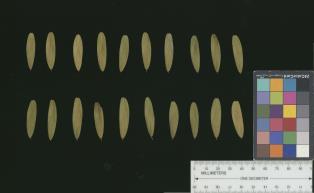 | | 2017 | COLLECTED | 07/15/2017 | Near Seymour Woods State Preserve along Olentangy River watershed approximately 4.7 miles south of Delaware, T4N R19W, Delaware County | 40.24709800, -83.05712000 | 252 | Deciduous woods, mostly found along steep (45-50 degree) slopes adjacent to watershed. | Wild material | | 1950074 | Ames 33991 |
| 15 | Ames 29616 | JDC/FN/2008/019/089 | Fraxinus americana L. | Iowa, United States | NC7 |  | | 2008 | COLLECTED | 10/01/2008 | Perimeter and adjacent areas of Honey Creek Golf Course, Boone, N 1/2 of Section 8, Boone West Quad, Boone County. | 42.01777778, -93.90694444 | 328 | Majority collected from higher elevations, but also lower valleys. Course constructed by clearing existing trees; all collections from native specimens; no trees have been planted on course. | Wild material | At time of collection, ~1/5 of population had some orangish-red fall color; remaining population exhibited greenish-yellow fall colors; some specimens were completely defoliated. | 1786595 | Ames 29616 |
| 16 | Ames 29615 | JDC/FN/2008/018/088 | Fraxinus nigra Marshall | Iowa, United States | NC7 |  | | 2008 | COLLECTED | 09/24/2008 | Adjacent to Des Moines River, along Dolliver Park Avenue between Prairie Creek and Bone Yard Hollow, Dolliver State Park, W 1/2 of Section 35, Webster County. | 42.39750000, -94.07583333 | 289 | Open picnic/campground/park areas, flood plain, mesic forest. | Wild material | Some of the largest specimens sampled in nature at collection site were approximately 2.0' DBH and 100+ feet in height. | 1786594 | Ames 29615 |
| 17 | Ames 29376 | APS/GD/2009/009/018 | Gymnocladus dioicus (L.) K. Koch | Iowa, United States | NC7 |  | | 2008 | COLLECTED | 02/03/2008 | Skunk River Watershed. T85N R23W W 1/2 of Sec. 19 Story City Quad; T84N R24W NW 1/4 of Sec. 7 and T84N R23W SE 1/4 of Sec. 12 Ames East Quad, Story County | 42.10222222, -93.57944444 | 280 | Floodplain/bottomland forest. | Wild material | In 2012, a total of 59 mature specimens (d.b.h. of approximately 12" or greater) of Gymnocladus dioicus were noted growing along a 5 mile linear stretch along the Skunk River with 37 specimens recorded as females and 22 recorded as non-fruiting. Considering that seed production was very poor in 2012, some specimens recorded as non-fruiting (potentially males) may actually be females. The SE 1/4 of Sec. 12 seemed to have a fair amount of G. dioicus regeneration with very small (6-24" tall) seedlings present along with an abundant number of Celtis occidentalis in the area of various sizes. Two very large (20-24" d.b.h. specimens of G. dioicus recently dropped to the ground, most likely the result of strong winds. This area also seems to represent two, distinctly different "clones" of males based on morphological branching structure. The SW 1/4 of Sec. 19 has an abundant population of Tilia americana that were significant in size (20-24" d.b.h. and approximately 70' in height). The largest specimen of G. dioicus found in this area is approximately 90' in height and 40' in width and 35.5" in diameter. | 1749824 | Ames 29376 |
| 18 | Ames 27312 | 6 | Staphylea trifolia L. | Iowa, United States | NC7 |  | | 2003 | COLLECTED | 09/13/2003 | Malanaphy Springs State Preserve near Decorah, T99N R8W NW 1/4 of SE 1/4 and SW 1/4 of NE 1/4 of Sec. 31, Winneshiek County | 43.34888889, -91.83638889 | 293 | Along trail near spring, half shaded. Gradual slope with a northwestern aspect. Organic soil over limestone with high stoniness, well to good drainage | Wild material | Shrubs to small trees to 3 meters tall. Some plants had very large pods. | 1649469 | Ames 27312 |
| 19 | WLP 766 | 8 | Carpinus caroliniana Walter | Iowa, United States | NA | | | 2003 | COLLECTED | 09/14/2003 | South Bear Creek Wildlife Area, Highlandville, T100N R7W, SW 1/4 of NE 1/4, Section 35, Highlandville Quad, Winneshiek County. | 43.43888889, -91.64861111 | 296 | Partial sun. 20% slope with a western aspect. Organic soil over limestone with some stoniness. Associated with Acer nigrum, Ulmus, Quercus ellipsoidalis, and Xanthoxylum. | Wild material | Small tree to 4 meters tall. | 1649452 | WLP 766 |
| 20 | WLP 767 | 19 | Carpinus caroliniana Walter | Iowa, United States | NA | | | 2003 | COLLECTED | 09/15/2003 | Bixby State Park, Edgewood, T91N R5W, SW corner of SE 1/4 of NW 1/4, Section 26, Edgewood Quad, Clayton County. | 42.66694444, -91.40333333 | 329 | Forest edge. Half shaded. 20% slope with a western aspect. Associated with Acer nigrum, Cornus alternifolia, Quercus rubra, and Rubus occidentalis. | Wild material | Small tree. | 1649453 | WLP 767 |