| 0 | PI 658369 | 'China S-8' | Citrus ×aurantium L. var. chrysocarpa (Hassk.) ined. | Hubei Sheng, China | RIV | | | 2007 | COLLECTED | 08/1995 | | | | | Cultivar | Rated by the collector as having "good" tree vigor and cold hardiness and "very good" fruit quality. Additional information on the Chinese satsumas is available in this summary of a conversation between Tracy Kahn and Billl Dozier. (RR Krueger, 08/2006) | 1724149 | PI 658369 |
| 1 | PI 658370 | 'China S-15' | Citrus ×aurantium L. var. chrysocarpa (Hassk.) ined. | Hubei Sheng, China | RIV | | | 2007 | COLLECTED | 08/1995 | | | | | Cultivar | Collector rated tree vigor and fruit quality as "good" and and cold hardiness as "very good". Additional information on the Chinese satsumas is available in this summary of a conversation between Tracy Kahn and Billl Dozier. (RR Krueger, 08/2007) | 1724150 | PI 658370 |
| 2 | PI 658371 | 'China S-17' | Citrus ×aurantium L. var. chrysocarpa (Hassk.) ined. | Sichuan Sheng, China | RIV | | | 2007 | COLLECTED | 08/1995 | | | | | Cultivar | Rated by the collector as having "acceptable" tree vigor, fruit quality, and cold hardiness. Additional information on the Chinese satsumas is available in this summary of a conversation between Tracy Kahn and Billl Dozier. (RR Krueger, 04/2007) | 1724151 | PI 658371 |
| 3 | PI 658372 | 'China 6-15' | Citrus ×aurantium L. var. chrysocarpa (Hassk.) ined. | China | RIV | | | 2007 | COLLECTED | 10/1998 | | | | | Cultivar | The second set of 5 satsumas from PR China via Auburn University was received in California with less information than the first set. However, the variety is said to be cold tolerant. Additional information on the Chinese satsumas is available in this summary of a conversation between Tracy Kahn and Billl Dozier. (RR Krueger, 12/2006) | 1724148 | PI 658372 |
| 4 | PI 139623 | 'Bahianinha Araras ' | Citrus ×aurantium L. var. sinensis L. | São Paulo, Brazil | RIV | | | 2006 | DONATED | 12/20/1940 | | | | | Cultivar | According to the Citrus Industry, Vol 1, P 480 (1967) and Saunt (Citrus Varieties of the World, 2000), 'Bahianinha' differs from 'Parent Washington' in having smaller, more oval-shaped fruit with a smaller, closed navel and a thinner rind. It is stated to be productive but smaller and less vigorous than 'Parent Washington'. It is 1 - 2 weeks earlier than 'Parent Washington' and has good fruit quality when grown on an appropriate rootstock. It is stated to be less prone to alternate bearing than 'Parent Washington'. These differences are stated to be less pronouced in California as compared to Brazil. 'Bahianinha Piracicaba' became popular in Brazil due to its desirable size for the export market. It is better adapted to hot, tropical climates than is 'Parent Washington' and has more recently been planted extensively in the Corrientes Province of neighboring Argentina due to this characteristic. This accession is stated to be an example of the 'Araras' strain but little information is available as to how this differs from the standard 'Bahianinha'. There have been various other selections recently brought into the US that are probably quite similar: 'Bahianinha' (PI 133261), 'Bahianinha' (RCRC 4167), and 'Bahianinha Monte Parnazo' (RRUT 184). (RRK, 12/2006) | 1518432 | PI 139623 |
| 5 | PI 658354 | 'China S-11' | Citrus ×aurantium L. var. chrysocarpa (Hassk.) ined. | Hubei Sheng, China | RIV | | | 2006 | COLLECTED | 08/1995 | | | | | Cultivar | Collector rated tree vigor and cold hardiness as "very good" and fruit quality as "good". Additional information on the Chinese satsumas is available in this summary of a conversation between Tracy Kahn and Billl Dozier. (RR Krueger, 08/2006) | 1715782 | PI 658354 |
| 6 | PI 658357 | 'Avana tardivo di Ciaculli' | Citrus ×aurantium L. var. chrysocarpa (Hassk.) ined. | Sicilia, Italy | RIV | | | 2006 | DEVELOPED | | | | | | Cultivar | The 'avana' group of mandarins are the Italian versions of the common Mediterranean/Willowleaf/Comun types. This selection has become the most popular in recent years (Saunt 2000). As indicated by its name, it is a late-maturing selection. Saunt (2000) states that it is up to 2 months later maturing than other 'Avana' selections. Information from Australia states that it is 6 - 8 weeks later than 'Imperial' (which has a maturity similar to 'Owari' satsuma). The fruit are sweet, low seeded, have reduced "bores" (central columns), are somewhat flat, and have a pale orange or yellow rind. This accession was selected for introduction to the US during a visit to Corsica during the 1997 ISCN conference. (RRK, 12/2006) | 1715785 | PI 658357 |
| 7 | PI 658358 | 'Avana apireno' | Citrus ×aurantium L. var. chrysocarpa (Hassk.) ined. | Sicilia, Italy | RIV | | | 2006 | DEVELOPED | | | | | | Cultivar | The 'avana' group of mandarins are the Italian versions of the common Mediterranean/Willowleaf/Comun types. This selection is fairly commonly grown in Sicily (particularly the area near Catana). As indicated by the name, this selection has few seeds. Information from Australia indicates that it is 3 - 5 weeks later than 'Imperial' mandarin (which matures similar to 'Owari' satsuma). It was selected for introduction to the US during a visit to Corsica during the 1997 ISCN conference. (RR Krueger, 12/2006) Regarding the origin of this accession, the INRA San Giuliano website, 'Avana apireno' originated in 1810 in Italy (most probably Sicily). However, Russo et al (1977), referencing Russo et al (1975), state: "The 'Avana Apireno' mandarin was discovered in a 'Avana' orchard in the Picanello area of Catania 1962. At that time 3 trees that produced fruit with few seeds were recognized. From that time, the clonal offspring of those trees tested for many years in different places of Southern Italy have confirmed this quality...The production and quality of the fruit are similar to that of the 'Avana' and the 'Avana Apireno'...A nucellar line produced from one of the 3 original trees in 1962 has confirmed the low seediness of the mother tree. However the nucellar line has fewer seed per fruit than the mother tree..." (RR Krueger, 03/21/2008) | 1715786 | PI 658358 |
| 8 | PI 658359 | 'Myrtle-leaf (C myrtifolia) ' | Citrus ×aurantium L. var. aurantium | Turkey | RIV | | | 2006 | DONATED | 04/28/1997 | | | | | Cultivar | The myrtle-leaf group of sour oranges represents a distinctive type. It is currently unclear how the present selection may differ from other myrtle-leaf types in the collection. (RRK, 12/2006) | 1715787 | PI 658359 |
| 9 | PI 658361 | 'Bahianinha ' | Citrus ×aurantium L. var. sinensis L. | São Paulo, Brazil | RIV | | | 2006 | DEVELOPED | | | | | | Cultivar | According to the Citrus Industry, Vol 1, P 480 (1967) and Saunt (Citrus Varieties of the World, 2000), 'Bahianinha' differs from 'Parent Washington' in having smaller, more oval-shaped fruit with a smaller, closed navel and a thinner rind. It is stated to be productive but smaller and less vigorous than 'Parent Washington'. It is 1 - 2 weeks earlier than 'Parent Washington' and has good fruit quality when grown on an appropriate rootstock. It is stated to be less prone to alternate bearing than 'Parent Washington'. These differences are stated to be less pronouced in California as compared to Brazil. 'Bahianinha Piracicaba' became popular in Brazil due to its desirable size for the export market. It is better adapted to hot, tropical climates than is 'Parent Washington' and has more recently been planted extensively in the Corrientes Province of neighboring Argentina due to this characteristic. Another recent introduction (to NPGS) of 'Bahianinha' is PI 133261. In addition, there have been various other selections recently brought into the US that are probably quite similar: 'Bahianinha Araras' (PI 139623) and 'Bahianinha Monte Parnazo' (RRUT 184). (RRK, 12/2006) | 1715790 | PI 658361 |
| 10 | PI 658364 | 'Ugli' | Citrus ×aurantium L. | Jamaica | RIV | | | 2006 | DEVELOPED | | | | | | Cultivar | The 'Ugli' tangelo was apparently so-called due to its unattractive appearance. Since the fruit quality was high (particularly for export), this was later used as a marketing "hook". The fruit are slightly larger than a grapefruit and somewhat pear-shaped. The apex is flattened and depressed and the stem end is noticeable and strongly furrowed. The peel is rough, uneven, very thick, and (in the tropics) not well colored at maturity. There are about a dozen segments and a large open axis. Although sometimes seedy, 'Ugli' generally has few if any seeds. The seeds are monoembryonic. Fruit grown in the tropics are never acidic and have a good flavor. In subtropical regions, the fruit is generally acidic and lacking in sweetness. (Information from The Citrus Industry, 1967, 1:530 and Saunt, Citrus Varieties of the World, 2000, p. 107). It is not known how this selection differs from the older 'Ugli' accession (PI 132372/RCRC 2780). The older accession was accessed directly from Jamaica (in fact from F.G. Sharp of Trout Hall, who originally popularized this variety), whereas the present accession was accessed from New Zealand. If any selecting was done in NZ, which has a cool climate, it may have resulted in a selection that obtains better quality in less tropical conditions. However, this is not known at this time. (RRK, 12/2006) Information on 'Ugli' from the UC Riverside Citrus Clonal Protection Program. | 1715792 | PI 658364 |
| 11 | PI 658348 | 'China S-5' | Citrus ×aurantium L. var. chrysocarpa (Hassk.) ined. | Hunan Sheng, China | RIV | | | 2006 | COLLECTED | 08/1995 | | | | | Cultivar | This selection was rated by the collector as having "good" tree vigor and cold hardiness and "very good" fruit quality. Additional information on the Chinese satsumas is available in this summary of a conversation between Tracy Kahn and Billl Dozier. (RR Krueger, 12/2006) | 1715776 | PI 658348 |
| 12 | PI 658349 | 'China S-12' | Citrus ×aurantium L. var. chrysocarpa (Hassk.) ined. | Sichuan Sheng, China | RIV | | | 2006 | COLLECTED | 08/1995 | | | | | Cultivar | Collector rated tree vigor and fruit quality as "acceptable" and cold hardiness as "good". Additional information on the Chinese satsumas is available in this summary of a conversation between Tracy Kahn and Billl Dozier. (RR Krueger, 08/2006) | 1715777 | PI 658349 |
| 13 | PI 658350 | 'China S-18' | Citrus ×aurantium L. var. chrysocarpa (Hassk.) ined. | Hunan Sheng, China | RIV | | | 2006 | COLLECTED | 08/1995 | | | | | Cultivar | Collector rated tree vigor, fruit quality, and cold hardiness as "good". Additional information on the Chinese satsumas is available in this summary of a conversation between Tracy Kahn and Billl Dozier. (RR Krueger, 08/2006) | 1715778 | PI 658350 |
| 14 | PI 658351 | 'Boukhobza' | Citrus ×aurantium L. var. sinensis L. | L'Ariana, Tunisia | RIV | | | 2006 | DEVELOPED | | | | | | Cultivar | According to Saunt (2000), 'Boukhobza' is "[a]n early maturing, low acid selection [of Maltaise Sanguine] which is reportedly more decay-prone and does not ship well." It was selected for introduction to the US on a visit to Corsica associated with the 1997 ISCN conference. (RR Krueger, 12/2006) 'Maltaise (demi-) sanguine' is maintained as PI 654873 (RCRC 4085) and RCRC 4224. Those records have links to additional information on 'Maltaise (demi-) sanguine' that also contain some incidental information on 'Boukhobza'. (RR Krueger, 07/08/2011) | 1715779 | PI 658351 |
| 15 | PI 658352 | 'Bouquetier de Nice ' | Citrus ×aurantium L. | Navarra, Comunidad Foral de, Spain | RIV | | | 2006 | DEVELOPED | | | | | | Cultivar | The bouquetiers represent a distinctive group of bigards (sour oranges). They are generally small trees with few thorns and many flowers. They are grown primarily for their perfumy flowers, which are used in the production of high quality neroli oil and its byproduct of orange flower-water. ''Bouquetier de Nice' is vigorous and upright growing. The flowers are double with a very large pistil, which gives rise to a flat fruit of medium size that is also double, having a secondary fruit deeply embedded within the primary fruit. The leaves are large, broad, and slightly tapered. See The Citrus Industry, 1967, 1:491, and Chapot, 1964, Les Bigardiers Bouquetiers, 1 Partie, Al Awamia, 10:55-95. Important note for fans of funky fruit: this selection was chosen for introduction to the US due to the cute horned fruits observed during the ISCN post-conference tour to Corsica in 1997. However, 'Bouquetier de Nice' is consistently described and shown in the literature as having flattened fruit (also refer to the alternate cultivar name of 'Bouquetier de Nice a Fruits Plats'). It is possible that this will end up not having horned fruits. It is also possible that the Corsica selection was mislabelled and did indeed represent a corniculated selection. In any event, there are other corniculated sour oranges presently under quarantine so at some point our desire for them should be satiated. (RRK, 12/2006) | 1715780 | PI 658352 |
| 16 | PI 658353 | 'China S-1' | Citrus ×aurantium L. var. chrysocarpa (Hassk.) ined. | China | RIV | | | 2006 | COLLECTED | 10/1998 | | | | | Cultivar | The second set of 5 satsumas from PR China via Auburn University was received in California with less information than the first set. However, the variety is said to be cold tolerant. Additional information on the Chinese satsumas is available in this summary of a conversation between Tracy Kahn and Billl Dozier. (RR Krueger, 12/2006) | 1715781 | PI 658353 |
| 17 | PI 658346 | 'Apopka nucellar' | Citrus ×aurantium L. var. sinensis L. | Florida, United States | RIV | | | 2006 | DEVELOPED | | | | | | Cultivar | Not much is known about this accession. It was probably received about 1965, based upon it being received as seed with budded trees planted in 1976 (Nauer et al, 1985). Its area of origin as stated in the source history is based upon its name. No documentation is currently available at the Repository or the CRC. 'Apopka' is not grown commercially in California nor to best knowledge in Florida. Based upon its receipt as seed, it is quite possible that it was never considered a cultivar in Florida. In a trial at Lindcove Field Station (Tulare County, California), 'Apopka' was compared with established California navel budlines. "Although ['Apopka'] had the largest total yield, its small fruit size effectively rules it out as a commercially useful strain for California. It is similar to the high-acid navel variant which was a considerable problem in California in the 1960's..." (Nauer et al, 1985) (RR Krueger, 03/17/2008) | 1751617 | PI 658346 |
| 18 | PI 654907 | 'Hongjian' | Citrus ×aurantium L. var. sinensis L. | Taiwan | RIV | | | 2003 | DONATED | 02/14/1997 | | | | | Cultivar | 'Hongjiang' is one of the major cultivars in western Guangdong Province, PRC. It has an orange-red peel and red pulp and ripens in December. See Zhong, Proc Int Citrus Symp, Guangzhou, PRC, Nov 1990, pp 149-154. (RRK, 08/2006) | 1705130 | PI 654907 |
| 19 | PI 654910 | 'JAMAICAN UGLI' | Citrus ×aurantium L. | Jamaica | RIV | | | 2003 | DEVELOPED | | | | | | Cultivar | It is unknown how this selection differs from other 'Ugli' selections currently maintained (PI 132721/RCRC 2780 and RCRC 4171). (RRK, 08/2007). | 1734191 | PI 654910 |
| 20 | PI 654911 | 'Rio Farms Vainiglia' | Citrus ×aurantium L. var. sinensis L. | Texas, United States | RIV | | | 2003 | DONATED | 12/01/1997 | | | | | Cultivar | Heinz Wutscher (about 1997) indicated that this selection colors well in Texas. Observed: fruit medium sized, slightly flat, some flesh color showing. The fruit observed at Rio Farms indicates that this selection may develop better color than current selections maintained at Riverside, since south Texas winters are typically mild with smaller diurnal temperature fluctuations. This is probably not the true Vainiglia variety, which is white fleshed and low in acid,but perhaps the Vainiglia Sanguino (pink fleshed due to lycopenes, but not a true blood orange). (RRK, 08/2006) | 1705133 | PI 654911 |
| 21 | PI 654897 | 'Delfino Blood orange' | Citrus ×aurantium L. var. sinensis L. | California, United States | RIV | | | 2002 | DONATED | 10/05/1994 | | | | | Cultivar | According to the donor, the fruit matures in late summer in Soledad, is nearly spherical, the flesh is lightly colored with anthocyanins, and has some seeds. (RRK, 08/2006) | 1705120 | PI 654897 |
| 22 | PI 654898 | 'China S-3' | Citrus ×aurantium L. var. chrysocarpa (Hassk.) ined. | Sichuan Sheng, China | RIV | | | 2002 | COLLECTED | 08/1995 | | | | | Cultivar | Collector rated tree vigor as "good" and fruit quality and cold hardiness as "acceptable". Additional information on the Chinese satsumas is available in this summary of a conversation between Tracy Kahn and Billl Dozier. (RR Krueger, 08/2006) | 1705121 | PI 654898 |
| 23 | PI 658367 | 'AUSTRALIAN NUCELLAR' | Citrus ×aurantium L. var. sinensis L. | New South Wales, Australia | RIV | | | 2001 | DONATED | 10/2001 | | | | | Cultivar | This was one of two seed lots received from Ian Tolley with the hope of establishing accessions of old, historical varieties for which propagative material could not be secured in the USA. "[Australian navel orange] has been used indiscriminately to designate several navel orange types, all of which are very vigorous, upright growers, but shy bearers of rough, coarse fruits. The name was first applied unwittingly to a navel orange introduced from Australia which supposedly was the superior Brazilian orange that we now know as the Washington navel. Owing to the vigorous tree growth of these worthless strains, they were unintentionally propagated extensively before methods of bud selection based on fruit character and yield were introduced." (Webber, 1943, p 526-527) "In general, the fruits are smaller than Washington, flatter in form, and sometimes broadly pointed at the apex. The navel is smaller and more deeply embedded, and the rind is thicker and rougher. The flesh is softer in texture and commonly juicier than Washington, and the season of maturity is considerably later, the flavor remaining tart until late in the season...The origin of this type of navel orange is obscure, but it is known to have gone from Brazil to Australia, from whence it was probably taken to California and South Africa. It may have originated in Brazil, as did the Washington variety, but it seems more likely to have been taken to Brazil from Portugal where a navel orange variety has long existed (Risso and Poiteau, 1818-22)." (Hodgson, 1967) (RRK, 08/2007) | 1735298 | PI 658367 |
| 24 | PI 658368 | 'MEDITERRANEAN NUCELLAR' | Citrus ×aurantium L. var. sinensis L. | New South Wales, Australia | RIV | | | 2001 | DONATED | 10/2001 | | | | | Cultivar | This was one of two seed lots received from Ian Tolley with the hope of establishing accessions of old, historical varieties for which propagative material could not be secured in the USA. This introduction is apparently supposed to represent a traditional sweet orange type from the Mediterranean area, not to be confused with older varieties called 'Mediterranean' in California or Florida. (RRK, 08/2007) | 1735299 | PI 658368 |
| 25 | PI 654871 | 'WIFFEN SUMMER' | Citrus ×aurantium L. var. sinensis L. | Victoria, Australia | RIV | | | 2001 | DEVELOPED | 1980 | | | | | Cultivar | F Arthur Edwards, Yandilla Park Services, Chowilla St, Renmark 5341, South Australia; contract cleanup for M Britz; licensed to Brokaw Nursery; for planting in Variety Collection only; propagative material not available. It is said to mature at about the same time as and to hang on the tree as well as 'Lane Late', but to have more solids and juice content and lower granulation late in the season. (RRK, 08/2006) | 1705352 | PI 654871 |
| 26 | PI 654836 | 'Miho Wase' | Citrus ×aurantium L. var. chrysocarpa (Hassk.) ined. | Sizuoka, Japan | RIV | | | 2001 | DEVELOPED | 1940 | | | | | | | 1705342 | PI 654836 |
| 27 | PI 654874 | 'Cukurova early navel' | Citrus ×aurantium L. var. sinensis L. | Adana, Turkey | RIV | | | 2001 | DONATED | 06/22/1995 | | | | | Cultivar | A standard navel cultivar in Turkey. | 1705109 | PI 654874 |
| 28 | PI 654875 | 'UCR early navel' | Citrus ×aurantium L. var. sinensis L. | California, United States | RIV | | | 2001 | DONATED | 11/1994 | | | | | Cultivar | See Pedigree information. Taken from O Bier and renamed 'Corbett's Early' by C Corbett; sent to CCPP by ML Arpaia; renamed by DJ Gumpf. Tree planted in field 12D for observation has been consistenly slightly later than other 'Washington' navels at UCR. CCPP indicates that at Lindcove Field Station, it is in fact early. (RRK, 08/2006) | 1705110 | PI 654875 |
| 29 | PI 654878 | 'Aguzdera satsuma' | Citrus ×aurantium L. var. chrysocarpa (Hassk.) ined. | Georgia | RIV | | | 2001 | DEVELOPED | 1980 | | | | | Cultivar | Little information other than origin data is available for this variety. | 1705113 | PI 654878 |
| 30 | PI 654879 | 'Iveriya satsuma' | Citrus ×aurantium L. var. chrysocarpa (Hassk.) ined. | Georgia | RIV | | | 2001 | DEVELOPED | 1980 | | | | | Cultivar | Little information other than origin data is available for this variety. | 1705114 | PI 654879 |
| 31 | PI 654881 | 'Smith's red valencia' | Citrus ×aurantium L. var. sinensis L. | California, United States | RIV | | | 2001 | DONATED | 09/01/1998 | | | | | Cultivar | 'Smith's red valencia' is a pigmented sport of a conventional Valencia orange tree. The mother tree was growing in the Smith home garden in Ventura County, and a branch was observed to be producing fruit with a pronounced red rind blush and strong red internal color. Seeds were saved from a fruit sample brought to the local farm advisor (N Sakovich), and the most promising seedling was selected for release. The tree is a vigorous grower and carries good crops of fruit. The fruit is of good size and flavor and is very low-seeded. As noted above, the rind frequently carries a heavy red blush and the flesh is heavily pigmented by anthocyanin. The fruit shape is somewhat variable at present, globose to ovoid with a depressed base, possibly due to the juvenility of the subject trees. Although the fruit is mature in late winter, it holds well on the tree into late spring, well past the season for conventional blood oranges. | 1705116 | PI 654881 |
| 32 | PI 230622 | 'Gioia Tauro' | Citrus ×aurantium L. var. sinensis L. | Calabria, Italy | RIV | | | 2001 | COLLECTED | 12/13/1955 | Introduced from seed purchased in market in town of Gioia Tauro. | | | | Cultivar | According to HK Wutscher, this means 'jewels of the bull'. PI and PQX number refer to original tree in Indio, Calif, which was apparently the seed source for the WFF tree. Indio accession book refers to this as 'C sinensis...unknown variety...naveled orange'. From PI card: 'fruits flattened, with navel; early, fruit good quality'. See material on file for results of CCPP disease testing and other information. | 1698234 | PI 230622 |
| 33 | PI 654841 | 'Clementine SRA 92' | Citrus ×aurantium L. | Corse, France | RIV | | | 2001 | DEVELOPED | 1960 | | | | | Cultivar | According to Saunt (Citrus Varieties of the World, 2000), this is supposed to be one of the best of the SRA selections, but not much information is available on it. | 1705354 | PI 654841 |
| 34 | PI 654843 | 'Carte Noir' | Citrus ×aurantium L. | Morocco | RIV | | | 2001 | DEVELOPED | 1968 | | | | | Cultivar | This variety is said to be very early (September in Morocco) and seedless when pollinators absent, but with low acid and poor rind color. (RRK, 08/2006) | 1705355 | PI 654843 |
| 35 | PI 654844 | 'CLEMENTINA MARISOL' | Citrus ×aurantium L. | Castellon de Plana, Spain | RIV | | | 2001 | DEVELOPED | 1970 | | | | | Cultivar | 'Marisol' has fruit characteristics very similar to those of 'Oroval', but matures about 2 weeks earlier (late September to early October in Spain). It is normally harvested soon after color break and subsequently de-greened, and it has a tendency to puff and granulate if hung too long. 'Marisol' generally makes a good crop without the use of PGR treatments. 'Marisol' has been extensively planted in Spain in recent years and has also received some interest in Argentina and California. (RRK, 08/2006) | 1705356 | PI 654844 |
| 36 | PI 654845 | 'CLEMENULES' | Citrus ×aurantium L. | Castellon de Plana, Spain | RIV | | | 2001 | DEVELOPED | 1953 | | | | | Cultivar | Larger and a few days earlier than 'Fina'; seedless and high fruit quality; hangs moderately well but tends to puff if held too long. The most widely grown 'Clementine' in Spain. (RRK, 08/2006) | 1705357 | PI 654845 |
| 37 | PI 654846 | 'CLEMENTINA NOUR' | Citrus ×aurantium L. | Morocco | RIV | | | 2001 | DEVELOPED | 1962 | | | | | Cultivar | Medium sized with a slightly coarse rind; matures late January or early February; does not store well on tree; extensively planted in Morocco. Some interest in Spain as an alternative to 'Hernandina' as a late clementine variety. (RRK, 08/2006) | 1705358 | PI 654846 |
| 38 | PI 654847 | 'JOHNSON' | Citrus ×aurantium L. var. sinensis L. | New South Wales, Australia | RIV | | | 2001 | DEVELOPED | | | | | | Cultivar | As of 1991 'Johnson' was the standard navel cultivar in the Keri Keri district. Fruit matures from July to early September. The tree is vigorous with a semi-upright habit. The fruit are large, have a globose shape and an orange rind colour. The rind is moderately thick (5-7mm) and difficult to peel. The flesh is orange in colour, sweet, juicy and seedless, but difficult to segment. An excellent quality early season navel orange. (Notes by Pauline Mooney and Peter Anderson MAFTechnology, Keri Keri Hort Research Station, in "The Orchardist", June 1991) (RRK, 08/2006) | 1705360 | PI 654847 |
| 39 | PI 654848 | 'China S-2' | Citrus ×aurantium L. var. chrysocarpa (Hassk.) ined. | Hunan Sheng, China | RIV | | | 2001 | COLLECTED | 08/1995 | | | | | Cultivar | Collector rated tree vigor, cold hardiness, and fruit quality as "acceptable". Additional information on the Chinese satsumas is available in this summary of a conversation between Tracy Kahn and Billl Dozier. (RR Krueger, 08/2006) | 1705361 | PI 654848 |
| 40 | PI 654849 | 'China S-9' | Citrus ×aurantium L. var. chrysocarpa (Hassk.) ined. | Hubei Sheng, China | RIV | | | 2001 | COLLECTED | 08/1995 | | | | | Cultivar | Collector rated tree vigor and cold hardiness as "very good" and fruit quality as "good". Preliminary information from a trial at Santa Paula, CA, conducted by Thomas Chao, suggested that 'China S-9' would be very early under California conditions, probably as early as the other early satsumas evaluated, 'Miyagawa' (PI 654862/RCRC 4074) and 'Xie Shan' (PI 654869/RCRC 4081). In addition, 'China S-9' at Lindcove Research and Extension Center in Tulare County, California, showed a smoother skin than most other satsumas, a desirable characteristic. Additional information on the Chinese satsumas is available in this summary of a conversation between Tracy Kahn and Billl Dozier. (RR Krueger, 08/2006) | 1705362 | PI 654849 |
| 41 | PI 654851 | 'ROBYN' | Citrus ×aurantium L. var. sinensis L. | Cape Province, South Africa | RIV | | | 2001 | DEVELOPED | 1956 | | | | | Cultivar | This was a contract cleanup for H Brokaw; should be OK to distribute as per J Bash. Color development 3 - 5 weeks later than 'Washington with variable fruit quality (information from Outspan, South Africa, 1995). (RRK, 08/2006) | 1705364 | PI 654851 |
| 42 | PI 654852 | 'ARMSTRONG' | Citrus ×aurantium L. var. chrysocarpa (Hassk.) ined. | Louisiana, United States | RIV | | | 2001 | DONATED | 09/1991 | | | | | Cultivar | | 1705365 | PI 654852 |
| 43 | PI 654853 | 'CERIDWEN' | Citrus ×aurantium L. var. sinensis L. | KwaZulu-Natal, South Africa | RIV | | | 2001 | DONATED | 02/1992 | | | | | Cultivar | Contract cleanup for H Brokaw, but should be available for distribution as per J Bash. (RRK, 08/2006) | 1705366 | PI 654853 |
| 44 | PI 654854 | 'AOSHIMA' | Citrus ×aurantium L. var. chrysocarpa (Hassk.) ined. | Sizuoka, Japan | RIV | | | 2001 | DEVELOPED | 1950 | | | | | Cultivar | 'Aoshima' is a late maturing satsuma (mid-December to early January) that stores well. It has replaced 'Ishikawa' as the leading variety of of late maturing satsuma in Japan. 'Aoshima' is grown mainly in its native Shizuoka Prefecture on about 6000 ha. The trees are vigorous, densely foliated, precocious, and are reliable bearers. The fruit is larger than most other satsumas and has an attractive oblate shape. The rind is smooth and tightly adhering but easy to peel. Flavor is superior with both high sugar and high acid levels. (summarized from J Saunt, Citrus Varieties of the World, 2000) (RRK, 08/2006) | 1705367 | PI 654854 |
| 45 | PI 654873 | 'Maltaise sanguine' | Citrus ×aurantium L. var. sinensis L. | Malta | RIV | | | 2000 | DEVELOPED | | | | | | Cultivar | Another accession of 'Maltaise (demi-) sanguine is maintained as RCRC 4224 and its variant 'Boukhobza' is maintained as PI 658351 (RCRC 4156). 'Maltaise demi-sanguine' is a very old and well known cultivar and information on it is abundantly available on the interwebs. Indeed, you can learn More Than You Probably Want To Know About 'Maltaise Sanguine' (the source of the citations below) as well as citriculture in Tunisia, the most important producer of this cultivar. (RR Krueger, 07/08/2011) Although this accession was sanitized and released from quarantine by NCGRCD, it was given to CCPP for VI processing. (RR Krueger, 05/31/2018) | 1734085 | PI 654873 |
| 46 | PI 654872 | 'ROHDE' | Citrus ×aurantium L. var. sinensis L. | Victoria, Australia | RIV | | | 1999 | DEVELOPED | 1980 | | | | | Cultivar | This is a late navel. For CVC only, not for distribution (patented; licensed to Brokaw Nursery). | 1705353 | PI 654872 |
| 47 | PI 654835 | 'Corsica #1' | Citrus ×aurantium L. | Corse, France | RIV | | | 1999 | DEVELOPED | 1962 | | | | | Cultivar | | 1705341 | PI 654835 |
| 48 | PI 654839 | 'COGAN' | Citrus ×aurantium L. var. sinensis L. | Entre Ríos, Argentina | RIV | | | 1999 | DONATED | 10/1991 | | | | | Cultivar | Tree and fruit resemble that of 'Robertson' navel orange but the fruit matures earlier (4th week of March in Argentina). Trees on trifoliate have a poor growth (probably affected by exocortis). (Notes from Donor) Removal of exocortis by STG should improve performance. (RRK, 08/2006) | 1705345 | PI 654839 |
| 49 | PI 654840 | 'TIBBETTS PARENT WASHINGTON' | Citrus ×aurantium L. var. sinensis L. | Bahia, Brazil | RIV | | | 1999 | DEVELOPED | | | | | | Cultivar | Name means 'wide mandarin'. | 1705346 | PI 654840 |
| 50 | PI 654859 | 'SHIROKOLISTVENNYI' | Citrus ×aurantium L. var. chrysocarpa (Hassk.) ined. | Russian Federation | RIV | | | 1999 | DEVELOPED | | | | | | Cultivar | | 1705348 | PI 654859 |
| 51 | PI 654860 | 'SILVERHILL' | Citrus ×aurantium L. var. chrysocarpa (Hassk.) ined. | Florida, United States | RIV | | | 1999 | DEVELOPED | 1908 | | | | | Cultivar | This accession is said to be nearly identical to 'Frost Owari' (PI 539689/RCRC 3178) (RRK, 08/2006) | 1705372 | PI 654860 |
| 52 | PI 654861 | 'SANTA BARBARA' | Citrus ×aurantium L. | California, United States | RIV | | | 1999 | DONATED | 10/1995 | | | | | Cultivar | Medium sized fruit (2.5 inches in diameter) yellow with reddish pigmentation in oil glands. Grapefruit flavor-few seeds-juicy-slight nipple. Pink interior around rind with large grapefruit type segments.(JA Bash, 10/1995) (RRK, 08/2006) | 1705373 | PI 654861 |
| 53 | PI 654862 | 'MIYAGAWA' | Citrus ×aurantium L. var. chrysocarpa (Hassk.) ined. | Hukuoka, Japan | RIV | | | 1999 | DEVELOPED | 1923 | | | | | Cultivar | "Fruit large (for satsuma), moderately oblate, with thin and smooth rind. Seedless. Juice abundant, sugars and acid well-blended, and quality excellent. Matures very early and stores well for Wase Unshiu. Tree more vigorous than most old Wase clones and productive....It is currently the best known and much the most extensively grown of the Wase varieties." (The Citrus Industry, 1967, Vol 1, p 503). "Still Japan's most extensively grown variety on an estimated 12,000 ha....The tree lacks vigoour compared with other Wase varieties such as its daughter varieties 'Miho' and 'Okitsu'.... 'Miyagawa' matures slightly ealier than 'Miho' and three to four weeks ahead of 'Owari'. THe fruit is larger than 'Owari', with a smoother rind texture but it is thicker than other Wase varieties. The flavour is quite sharo because of the moderately high acid level coupled with sugard levels that are not particularly high....In trials in South Africa, 'Miyagawa' is regarded as a promising variety but it is less suitable for New Zealand exports compared with 'Miho'." (Saunt, Citrus Varieties of the World, 2000, p 48) "'Miyagawa' is an early maturing satsuma that has been grown in New Zealand for many years and was the basis of its satsuma industry. It is still a popular variety, but is considered by some to be too dificult to manage and is being superseded slowly by newer varieties. 'Miho' and 'Okitsu' are easier to manage (less flowers are formed and therefore less fruit thinning is required and they mature earlier or achieve higher sugar contents.)" (notes from the donor, circa 1995) In a trial in California conducted by Thomas Chao, UC Riverside, 'Miyagawa' (along with 'Xie Shan') developed brix earlier in the season. Projected harvest in the San Joaquin Valley was as early as mid-September. 'Miyagawa' had a sharp flavor due to moderately high acid coupled with moderate sugar levels. Internal color was better than the other selections tested. Additionally, it was seedless and peeled easily. (Information from Topics in Subtropics, 2005, 3(2):3-5) (RRK, 08/2006) | 1705374 | PI 654862 |
| 54 | PI 654863 | 'Corsica #2' | Citrus ×aurantium L. | Corse, France | RIV | | | 1999 | DEVELOPED | 1962 | | | | | Cultivar | The SRA selections originated in the 1960's as selections of Moroccan Clementines made at the Station de Recherches Agrumicoles, San Guiliano, Corsica. This program had the aim of developing a clementine industry in Corsica. Not much is known about this particular selection as it was not one of the most important. (RRK, 08/2006) | 1705375 | PI 654863 |
| 55 | PI 654864 | 'Clementine SRA 63' | Citrus ×aurantium L. | Corse, France | RIV | | | 1999 | DEVELOPED | 1963 | | | | | Cultivar | This variety was developed in the 1960s at the INRA Station de Recherche Agronomique at San Giuliano. SRA 63 was the selection that was most suited to Corsican conditions and became the basis of the small but successful Corsican clementine industry. Fruit on all SRA selections tends to be small and therefore they have not become important outside Corsica. However, there is a small amount of SRA 63 planted in South Africa which is being replaced by larger fruited varieties. (Information summarized from Saunt, Citrus Varieties of the World, 2000, p 59) Note: This accession was received first as budwood and later as the original VI trees from CCPP. (RRK, 08/2006) | 1705376 | PI 654864 |
| 56 | PI 654865 | 'VALENCIA LATE' | Citrus ×aurantium L. var. sinensis L. | North Island, New Zealand | RIV | | | 1999 | DONATED | 10/1995 | | | | | Cultivar | | 1705349 | PI 654865 |
| 57 | PI 654868 | 'Harward late (Wilson's)' | Citrus ×aurantium L. var. sinensis L. | North Island, New Zealand | RIV | | | 1999 | DONATED | 10/1995 | | | | | Cultivar | Fruit is said to be indistinguishable from Valencia and overall performance is superior in NZ. According to A Harty: Fruit mature from November to February; tree is moderately vigorous with rounded bushy habit and a consistently high yield; fruit medium to large, globose to oblique in shape; the rind thick (7-8mm); moderately easy to peel and segment; flesh orange when mature, moderately sweet and juicy, and moderately seedy (up to 6 seeds per fruit); a good quality late maturing Valencia orange. (RR Krueger, 08/12/2006) | 1705350 | PI 654868 |
| 58 | PI 654869 | 'Xie Shan' | Citrus ×aurantium L. var. chrysocarpa (Hassk.) ined. | Zhejiang Sheng, China | RIV | | | 1999 | DONATED | 03/1992 | | | | | Cultivar | According to Fred Gmitter, University of Florida (personal communication ca 2004), 'Xie Shan' is "Extremely early ripening in comparison to other Chinese satsumas." In a California trial, Thomas Chao, UC RIverside, reported tha 'Xie Shan' developed high brix levels somwhat earlier than the other early cv tested ('Armstrong', 'Miyagawa', and 'Chinese S-9'). However, high acid levels kept the sugar/acid ratio within about the same range as the other cv. 'Xie Shan' and 'Miyagawa' were considered the earliest cv in this trial. Additionally, it is reported that 'Xie Shan' was completely seedless. easy peeling, and had a unique taste and flavor. Projected harvest in the San Joaquin Valley was mid-September. (Information from Topics in Subtropics, 2005, 3(2): 3-5). Thomas Chao, in the cited publication, states that 'Xie Shan' is a Chinese translation of a Japanese cv called 'Wakayama'. However, references to a cv 'Wakayama' are not at hand. Wakayama is a principal Japanese satsuma growing area. Additionally, Xie Shan is a geographic name in China. Caveat citriculturist. (RRK, 08/2006) | 1705378 | PI 654869 |
| 59 | PI 654867 | 'SMOOTH FLAT SEVILLE' | Citrus ×aurantium L. | Australia | RIV | | | 1996 | DEVELOPED | | | | | | Cultivar | "Fruit similar to Poorman in size, form, and flavor, but rind surface very smooth; both rind and flesh color reddish-orange; seeds exhibit low polyembryony (usually one, occasionally two embryos). Tree and foliage similar to Poorman, but tree commonly more vigorous and larger. Younger branches also exhibit dark bark streaks characteristic of Poorman. Distinctive rough bark condition on trunk and main branches which affects some Poorman selections not observed so far on Smooth Seville trees...Like Poorman, Smooth Seville has a lower heat requirement for maturity than the grapefruit and hence ripens earlier and serves as a satisfactory substitute." (Source: The Citrus Industry vol. I, p 551.) As a rootstock, it is said to have properties similar to sour orange but with improved resistance to CTV. It has some use as a rootstock in Florida but is untried in California. A defect for rootstock use is the low level of nucellar embryony (60% or less). Note: Source history as shown is most probable; however, there is a slight possibility that this was re-introduced as seed from Australia in 1963 (Accession identifier IF-63-26) (RRK, 08/2006) | 1664725 | PI 654867 |
| 60 | PI 600665 | 'BREAM TAROCCO' | Citrus ×aurantium L. var. sinensis L. | California, United States | RIV | | | 1996 | DONATED | | | | | | Cultivar | | 1551907 | PI 600665 |
| 61 | PI 600666 | 'KUNO WASE' | Citrus ×aurantium L. var. chrysocarpa (Hassk.) ined. | South Africa | RIV | | | 1996 | DONATED | | | | | | Cultivar | | 1551908 | PI 600666 |
| 62 | PI 600672 | 'ROBERTSON' | Citrus ×aurantium L. var. sinensis L. | California, United States | RIV | | | 1996 | DONATED | | | | | | Cultivar | This selection was cleaned up to replace 'old' Robertson (CRC 3792, VI 364, PI 539576), which had gall. | 1551914 | PI 600672 |
| 63 | PI 600673 | 'SPRING' | Citrus ×aurantium L. var. sinensis L. | California, United States | RIV | | | 1996 | DONATED | | | | | | Cultivar | | 1551915 | PI 600673 |
| 64 | PI 539648 | 'Ambersweet' | Citrus ×aurantium L. var. sinensis L. | Florida, United States | RIV | | | 1995 | DEVELOPED | 1963 | | | | | Cultivar | A new dual purpose Florida orange. See Citrograph 74(5):110, March 1989. To be processed thru CCPP for the variety coll and Lindcove. (EM Nauer, 1989) 'Ambersweet' is PI 539648. PI 600671 was mistakenly assigned. When the mistake was noticed, PI 600671 was inactivated. PI 539648 should be used for 'Ambersweet'. General descriptions of 'Ambersweet' can be found in the citations below: Anonymous (1989), Tucker et al (1998), Jackson and Futch (2003), and Saunt (2000). 'Ambersweet' was originally released as a dual use "orange" for processing and fresh market. It has the advantages of being early (mid-October - December in Florida) and moderately cold-hardy. It is interesting that extensive studies had to be done in order to classify this complex hybrid as an "orange" for processing purposes (see citations below). After being extensively planted in Florida early in its release life, various problems became apparent. As stated by Tucker et al (1998): "Trees up to six years old in commercial plantings have produced relatively low yields of poor quality fruit. However, the outlook for both production and quality improves with age especially where irrigation and nuitrition programs are carefully managed...Rooststock selection, precise cultural management and innovative marketing are some of the keys to the successof Ambersweet as a commercial variety." As per Jackson and Futch (2003): "Fruit produced on trees in solid plantings of Ambersweet are likely to be nearly seedless, while trees in mixed plantings are usually seedy due to the influence of cross pollinators. Yields of Ambersweet have proven to be commercially unsatisfactory and many plantings have been removed or topworked to more desirable varieties...Low yields and poor juice quality have relegated this variety to the dooryard...Some Ambersweet trees...have been slow starters. Trees sometimes languish for several years before commencing anticipated growth normal for a young citrus tree." Consequently "Ambersweet's potential in Florida now looks far from certain...It is losing popularlity and few plantings have been made in recent years" (Saunt, 2000, p22). See also Albrigo et al (2001) for more on the pollination issues. Teetter (1999) offers an interesting perspective on these problems from the breeder. (RR Krueger, 11/11/2010) Fruit quality data and additional information is available from CCPP. | 1434584 | PI 539648 |
| 65 | PI 600659 | 'SMITH'S EARLY' | Citrus ×aurantium L. var. sinensis L. | Spain | RIV | | | 1994 | DONATED | 1914 | | | | | Cultivar | Buds from tree 1125 in Rubidoux Tract Variety Block. This was probably introduced to Spain in about 1940 where it is now grown under 'Navelina', W.P. Bitters. | 1500173 | PI 600659 |
| 66 | PI 600660 | 'NAVELINA' | Citrus ×aurantium L. var. sinensis L. | Spain | RIV | | | 1994 | DONATED | 12/21/1990 | | | | | Cultivar | | 1500174 | PI 600660 |
| 67 | PI 600662 | 'PALMER' | Citrus ×aurantium L. var. sinensis L. | South Africa | RIV | | | 1994 | DONATED | 1985 | | | | | Cultivar | "New" Palmer accession. Probably not the same as CRC 3964. | 1500176 | PI 600662 |
| 68 | PI 539606 | 'Imperial variegated' | Citrus ×aurantium L. var. sinensis L. | Brazil | RIV | | | 1994 | DEVELOPED | | | | | | Cultivar | Originally from Rio de Janeiro, Brazil. A variegated orange containing alternating stripes of light and green color before maturity. Leaves ornamental. Said to be a commercial variety in Brazil. (Anonymous, ca 1920 - 1950?) Note: This should not be confused with the acidless Imperiale from Spain. (WP Bitters, ca 1980?) This accession had exocortis and probably seedling yellows, removed by shoot tip grafting (STG 60-1). (EM Nauer, 1985) Fruit is variegated, having corregated rind with varying color stripes; flavor is fair. Might have ornamental potential. (EM Nauer, 03/23/1987) Fruit has pretty good flavor but moderately seedy. Will plan to enter this accession to a new VI and move to the Lindcove foundation block. (EM Nauer, 01/13/1988) Was entered as VI 473in fall 1988 but had psorosis; put into Thermo, which plants did not push well. Sched to re-enter in 1990. (EM Nauer, 11/1989) This accession was mistakenly given PI 600658. When the error was discovered, PI 600658 was inactivated. PI 539606 should be used. (RR Krueger, 11/10/2010) View Fruit quality data and other information from the CCPP. | 1434542 | PI 539606 |
| 69 | PI 654890 | 'Broadleaf Chinotto' | Citrus ×aurantium L. | California, United States | RIV | | | 1993 | DEVELOPED | 12/01/1993 | | | | | Cultivar | This accession has shortened internodes and broader leaves than the standard 'Chinotto'. As with the standard 'Chinotto', it is of interest mainly as an ornamental type. (RRK, 01/2007) | 1717768 | PI 654890 |
| 70 | PI 600668 | 'DART I (SOUTH)' | Citrus ×aurantium L. var. chrysocarpa (Hassk.) ined. | California, United States | RIV | | | 1993 | DONATED | 01/1991 | | | | | Cultivar | In the early 1990s, 6 budlines of 'Owari' satsumas (RCRC 4098, PI 600668/RCRC 4099, RCRC 4100, PI 600669/RCRC 4101, RCRC 4102, RCRC 4103) were collected from Tulare County, California in the hope of finding a superior-performing selection for San Joaquin Valley conditions. However, interest in these quickly waned and they are not currently maintained by CCPP as commercial bud sources. It is not known at this time how they are supposed to differ or be superior to the standard selection of 'Owari' ('Frost Owari', PI 539689/RCRC 3178). (RRK, 08/2007) | 1551910 | PI 600668 |
| 71 | PI 600669 | 'DUNGAN' | Citrus ×aurantium L. var. chrysocarpa (Hassk.) ined. | California, United States | RIV | | | 1993 | DONATED | 01/1991 | | | | | Cultivar | In the early 1990s, 6 budlines of 'Owari' satsumas (RCRC 4098, PI 600668/RCRC 4099, RCRC 4100, PI 600669/RCRC 4101, RCRC 4102, RCRC 4103) were collected from Tulare County, California in the hope of finding a superior-performing selection for San Joaquin Valley conditions. However, interest in these quickly waned and they are not currently maintained by CCPP as commercial bud sources. It is not known at this time how they are supposed to differ or be superior to the standard selection of 'Owari' ('Frost Owari', PI 539689/RCRC 3178). (RRK, 08/2007) | 1551911 | PI 600669 |
| 72 | PI 654887 | 'DART I (NORTH)' | Citrus ×aurantium L. var. chrysocarpa (Hassk.) ined. | California, United States | RIV | | | 1993 | DONATED | 01/1991 | | | | | Cultivar | In the early 1990s, 6 budlines of 'Owari' satsumas (RCRC 4098, PI 600668/RCRC 4099, RCRC 4100, PI 600669/RCRC 4101, RCRC 4102, RCRC 4103) were collected from Tulare County, California in the hope of finding a superior-performing selection for San Joaquin Valley conditions. However, interest in these quickly waned and they are not currently maintained by CCPP as commercial bud sources. It is not known at this time how they are supposed to differ or be superior to the standard selection of 'Owari' ('Frost Owari', PI 539689/RCRC 3178). (RRK, 08/2007) | 1640736 | PI 654887 |
| 73 | PI 654888 | 'ROAD 164' | Citrus ×aurantium L. var. chrysocarpa (Hassk.) ined. | California, United States | RIV | | | 1993 | DONATED | 01/1991 | | | | | Cultivar | In the early 1990s, 6 budlines of 'Owari' satsumas (RCRC 4098, PI 600668/RCRC 4099, RCRC 4100, PI 600669/RCRC 4101, RCRC 4102, RCRC 4103) were collected from Tulare County, California in the hope of finding a superior-performing selection for San Joaquin Valley conditions. However, interest in these quickly waned and they are not currently maintained by CCPP as commercial bud sources. It is not known at this time how they are supposed to differ or be superior to the standard selection of 'Owari' ('Frost Owari', PI 539689/RCRC 3178). (RRK, 08/2007) | 1560041 | PI 654888 |
| 74 | PI 654889 | 'Lange #3' | Citrus ×aurantium L. var. chrysocarpa (Hassk.) ined. | California, United States | RIV | | | 1993 | DONATED | 01/1991 | | | | | Cultivar | In the early 1990s, 6 budlines of 'Owari' satsumas (RCRC 4098, PI 600668/RCRC 4099, RCRC 4100, PI 600669/RCRC 4101, RCRC 4102, RCRC 4103) were collected from Tulare County, California in the hope of finding a superior-performing selection for San Joaquin Valley conditions. However, interest in these quickly waned and they are not currently maintained by CCPP as commercial bud sources. It is not known at this time how they are supposed to differ or be superior to the standard selection of 'Owari' ('Frost Owari', PI 539689/RCRC 3178). (RR Krueger, 08/2007) | 1640737 | PI 654889 |
| 75 | PI 654886 | 'MCEWEN' | Citrus ×aurantium L. var. chrysocarpa (Hassk.) ined. | California, United States | RIV | | | 1993 | DONATED | 01/1991 | | | | | Cultivar | In the early 1990s, 6 budlines of 'Owari' satsumas (RCRC 4098, PI 600668/RCRC 4099, RCRC 4100, PI 600669/RCRC 4101, RCRC 4102, RCRC 4103) were collected from Tulare County, California in the hope of finding a superior-performing selection for San Joaquin Valley conditions. However, interest in these quickly waned and they are not currently maintained by CCPP as commercial bud sources. It is not known at this time how they are supposed to differ or be superior to the standard selection of 'Owari' ('Frost Owari', PI 539689/RCRC 3178). (RRK, 08/2007) | 1640735 | PI 654886 |
| 76 | PI 600656 | 'THERMAL TAROCCO' | Citrus ×aurantium L. var. sinensis L. | California, United States | RIV | | | 1992 | DONATED | 04/22/1992 | | | | | Cultivar | Different and better than CRC 3596 Tarocco, D.A. Newcomb, R. Copeland. | 1500170 | PI 600656 |
| 77 | PI 600652 | 'NAVELATE' | Citrus ×aurantium L. var. sinensis L. | Spain | RIV | | | 1991 | DONATED | | | | | | Cultivar | | 1500166 | PI 600652 |
| 78 | PI 539644 | 'XIANFENGCHENG' | Citrus ×aurantium L. var. sinensis L. | Sichuan Sheng, China | RIV | | | 1991 | DONATED | 03/19/1985 | | | | | Cultivar | "The whole story on these (CRC 3981-3985) imports that came in as both budwood and seed is that the seed went to Dr Soost in 1985; the budwood went to Glenn Dale in 1985 and increase budwood came here in 1987 and went into CCPP for processing. However, in the meantime, Dr Soost grew seedlings in the greenhouse but did not inform anyone in CCPP that this material was there until he retired in 1987 and the seedling budlines were propagated for the variety collection." (EM Nauer, 01/1989). "Two other imports from China with names beginning with 'X' are sweet oranges; let's take a wild guess and house this one under SWT also." (EM Nauer, 01/1989) This famous sweet orange variety has been cultivated for decades in Sichuan Province, the largest citrus producer in Chinia. Fruit medium-sized, obovate to oval, high total soluble solids. (information from 'Chinese student at UCR' via RK Soost. Additional information from WP Bitters: wt 150 - 180 g/fruit; 6.5 seeds/fruit; ripens at end of Nov - early Dec; stores until May. (RRK, 08/2006) | 1434580 | PI 539644 |
| 79 | PI 539645 | 'JINCHENG' | Citrus ×aurantium L. var. sinensis L. | Sichuan Sheng, China | RIV | | | 1991 | DONATED | 03/19/1985 | | | | | Cultivar | "The whole story on these (CRC 3981-3985) imports that came in as both budwood and seed is that the seed went to Dr Soost in 1985; the budwood went to Glenn Dale in 1985 and increase budwood came here in 1987 and went into CCPP for processing. However, in the meantime, Dr Soost grew seedlings in the greenhouse but did not inform anyone in CCPP that this material was there until he retired in 1987 and the seedling budlines were propagated for the variety collection." (EM Nauer, 01/1989). "This cultivar also came in by seed (to Dr Soost) and is now planted in the variety collection (CRC 3935, planted 1988). Should we examine fruit from seedling budline before going to the trouble of indexing import budwood?" (EM Nauer, 01/1989) "Original USDA spec. sheet says this has 'high soluble solids'. See CRC 3935 acc. card for more info on this cultivar." (EM Nauer, 08/1989) . Apparently they did in fact go through the trouble of indexing this accession. Additional information from a 'Chinese student at UCR' via RK Soost: Literally, "Brocade" orange; also called "S26". All characteristics similar to 'Xianfengcheng' but different in shape (oblong) and rind color (reddish orange, darker than 'Xianfengcheng'); No 1 sweet orange for Sichuan Province. (RRK, 08/2006) | 1434581 | PI 539645 |
| 80 | PI 658375 | 'EDDY OLD BUD LINE' | Citrus ×aurantium L. var. sinensis L. | California, United States | RIV | | | 1990 | DEVELOPED | 1920 | | | | | Cultivar | 'Eddy' is considered a superior clone of 'Parent Washington'. (RR Krueger, 08/2006) | 1706297 | PI 658375 |
| 81 | PI 539550 | 'Moro' | Citrus ×aurantium L. var. sinensis L. | California, United States | | | Historic | 1990 | DEVELOPED | 1983 | | | | | Cultivar | Moro is described in [Hodgson, 1967] on pp 473 and is picturedi in coloor on pp 467[; also see Saunt, 2000, p 37]. This accession appears identical to [PI 539554] - Moro. See notes this date [on records for PI 238796 and PI 539554. (EM Nauer, 2/4/1988 Nucellar Moro (PI 539554) appears to be identical to this one, why keep both? (EM Nauer, 10/1988) Why indeed? PI 539442 is the VI'ed budline. It is not clear why Bill Bitters made this seedling selection but, as Ed Nauer stated, it does appears superfluous and is therefore inactivated. Never the less, additional information andpictures are available from the UC Riverside Citrus Variety Collection. (RR Krueger, 07/03/2015) | 1434486 | PI 539550 |
| 82 | PI 539164 | 'OLIVELANDS' | Citrus ×aurantium L. | California, United States | RIV | | | 1990 | DONATED | 03/01/1990 | | | | | Cultivar | Very prolific. Typical sour orange. | 1434100 | PI 539164 |
| 83 | PI 539166 | Willowleaf sour orange | Citrus ×aurantium L. | California, United States | RIV | | | 1990 | DONATED | 03/01/1990 | | | | | | Leaves extremely long and narrow. | 1434102 | PI 539166 |
| 84 | PI 539450 | Myrtleleaf orange | Citrus ×aurantium L. var. aurantium | California, United States | RIV | | | 1990 | DONATED | 03/01/1990 | | | | | | Described in The Citrus Industry, Vol 1, pp 378-379. Very compact tree; small leaves tend to be cupped. | 1434386 | PI 539450 |
| 85 | PI 539467 | 'REDBLUSH #3' | Citrus ×aurantium L. var. racemosa (Risso) ined. | California, United States | RIV | | | 1990 | DONATED | 03/01/1990 | | | | | Cultivar | Light to faint pink tinge in flesh color. | 1434403 | PI 539467 |
| 86 | PI 539566 | 'Frost Washington' | Citrus ×aurantium L. var. sinensis L. | California, United States | RIV | | | 1990 | DEVELOPED | 1917 | | | | | Cultivar | Archival material on file at NCGRCD states that this budline was planted in 1960 in a navel strain trial in 12F (this probably refers to an older field numbering system) )budsource = S-1-D (now 12D) R 4 T 10) and in 1961 in a rootstock trial in S-1-A (now 12A) (budsource = S-1-D (now 12D) R 13 Ts 3,4,6,7; R 4 Ts 8,9,10). Comments from EM Nauer circa 1987 state: "This tree still in but the planting belongs to Entomology." Later: "Plot has been removed." "Budline available at Lindcove." But to what does this all refer? According to Soost et al (1961) (both citations), "The Frost Navel originated as a nucellar seedling obtained in 1917 by Dr HB Frost, from a Washington Nvel tree growing in the Rubidoux Tract property of the Citrus Experinment Station in Riverside. The parent tree was not especially selected for fruit quality or yield, but was one of several varieties used for a general study of juvenility and senescence in citrus. Four budded trees were planted in 1933 on the station grounds. These, and four other trees set out in 1942, have provided budwood which has been distributed to nurserymena and growers for trial since 1947." Hodgson (1967) (pp 480-481) states that "Frost Washington is the first, and currently much the most important, nucellar budline of the Washington navel. It was originated by HB Frost, the geneticist and breeder, at the California Citrus Research Center, Riverside, from a controlled cross made in 1916. It was not released until 1952, however. Since that time its popularity has increased until it is now more widely planted in California, Arizona, and Morocco than any other clonal selection of Washington." 'Frost Washington' is known to decline when budded onto trifoliate rootstocks (Schneider and Pehrson, 1985). (Note: As per BIll Bitters in archival material maintained at NCGRCD, the title of the cited paper is misleading since the only navels examined were Frost nucellars). Frost Washington nucellar is less planted currently than at the time of the citations due to the availability of sanitized old line 'Washington' (maintained as PI 539360. (RR Krueger, 05/2011) Information and nice pictures of 'Frost Washington' from the UC Riverside Citrus Variety Collection. Information and fruit quality data from the Citrus Clonal Protection Program. | 1434502 | PI 539566 |
| 87 | PI 539647 | 'XINHUICHENG' | Citrus ×aurantium L. var. sinensis L. | California, United States | RIV | | | 1990 | DONATED | 03/01/1990 | | | | | Cultivar | | 1434583 | PI 539647 |
| 88 | PI 539659 | 'CUTTER' | Citrus ×aurantium L. var. sinensis L. | California, United States | RIV | | | 1990 | DONATED | 03/01/1990 | | | | | Cultivar | | 1434595 | PI 539659 |
| 89 | PI 539660 | 'FROST' | Citrus ×aurantium L. var. sinensis L. | California, United States | RIV | | | 1990 | DONATED | 03/01/1990 | | | | | Cultivar | | 1434596 | PI 539660 |
| 90 | PI 539683 | 'DANCY (FROST NUCELLAR)' | Citrus ×aurantium L. var. chrysocarpa (Hassk.) ined. | California, United States | RIV | | | 1990 | DONATED | 03/01/1990 | | | | | Cultivar | | 1434619 | PI 539683 |
| 91 | PI 539707 | 'PEARL' | Citrus ×aurantium L. | California, United States | RIV | | | 1990 | DONATED | 03/01/1990 | | | | | Cultivar | Hybrid of Imperial grapefruit x Willowleaf mandarin. | 1434643 | PI 539707 |
| 92 | PI 658384 | 'Minneola old budline' | Citrus ×aurantium L. | Florida, United States | RIV | | | 1990 | DEVELOPED | 1931 | | | | | Cultivar | 'Minneola' tangelo fruits are large, and oblate to obovate, usually with a fairly prominent neck. The flesh color is a deep reddish-orange, medium-thick, and moderately adherent. There are usually 10 - 12 segments. The flesh is orange-colored, tender, juicy, and aromatic. The flavor is rich and tart, and often described as "sprightly". The trees are vigorous and productive, but less cold-resistant than 'Olando'. When grown in solid blocks, 'Minneola' generally has few seeds. Inter-planting with pollinators such as 'Dancy', 'Clementine', or 'Kinnow' ('Orland' is cross-incompatible) increases productivity but also increases seediness. 'Minneola' has a tendency to alternate-bear and is susceptible to Alternari and scab when those diseases are present and climatic conditions are conducive to their development. 'Minneola' has proven adaptable to many different climatic and soil conditions. It is grown commercially in the desert areas of California and Arizona; the Mediterranean areas of Cyprus, Israel, and South Africa; and the semi-tropical climates of Florida, Argentina, and South Africa. For more information, see: The Citrus Industry, 1967, I: 528-529; Saunt, 2000, Citrus Varieties of the World, p. 78; Tucker et al, 4998, Florida Citrus Varieties, p.30; and http://wdis.ifas.ufl.edu/scripts/htmlgen.exe?bodyandDOCUMENT_CH072, from which this information was summarized. There are currently three selections of 'Minneola' in NCGRCD holdings (RRUT 347, RRUT 367, and PI 539709). They appear to differ little from one another, all maturing at the same time and having similar fruit. (RRK, 10/2006) | 1706306 | PI 658384 |
| 93 | PI 658396 | 'Rocky Hill old budline' | Citrus ×aurantium L. var. sinensis L. | California, United States | RIV | | | 1990 | DONATED | 09/11/1962 | | | | | Cultivar | 'Rocky Hill' is an old-line selection of 'Valencia'. Its distinguishing horticultural characteristics are not well documented at this time. | 1706318 | PI 658396 |
| 94 | PI 658399 | 'BROWN MARSH' | Citrus ×aurantium L. var. racemosa (Risso) ined. | California, United States | RIV | | | 1990 | DEVELOPED | 1934 | | | | | Cultivar | 'Marsh' is a common grapefruit. The 'Brown' selection is from the desert area of California and is presumably better adapted to that environment than some other 'Marsh' selections. (RRK, 08/2006) | 1706321 | PI 658399 |
| 95 | PI 600644 | 'CLEMENTINA OROVAL' | Citrus ×aurantium L. | Spain | RIV | | | 1990 | DONATED | | | | | | Cultivar | | 1500159 | PI 600644 |
| 96 | PI 600645 | 'CLEMENTINA FINA' | Citrus ×aurantium L. | Spain | RIV | | | 1990 | DONATED | 01/01/1990 | | | | | Cultivar | | 1500160 | PI 600645 |
| 97 | PI 600646 | 'CLAUSELLINA' | Citrus ×aurantium L. var. chrysocarpa (Hassk.) ined. | Spain | RIV | | | 1990 | DONATED | 01/01/1990 | | | | | Cultivar | Bud mutation of Owari Satsuma, found in 1962 in Almazora (Castellon), Spain (per Francisco Llatser). | 1500161 | PI 600646 |
| 98 | PI 658376 | 'CRAM OLD BUD LINE' | Citrus ×aurantium L. var. sinensis L. | California, United States | RIV | | | 1989 | DEVELOPED | 1920 | | | | | Cultivar | "From the property of the Cram family in East Highland, this selection was to my knowledge made by Louise Cram's father in the 1920s (Louise grew up with my mother in East Highland but I can't remember her father's name, I'll ask my mom)." (Information from TE Williams, 2005) 'Cram' has been planted to moderate usage in the past in California but is not currently one of the more popular navel selections. (RRK, 08/2006) | 1706298 | PI 658376 |
| 99 | PI 658377 | 'Rocky Hill old budline (TI)' | Citrus ×aurantium L. var. sinensis L. | California, United States | RIV | | | 1989 | DONATED | 09/11/1962 | | | | | Cultivar | ''Thomson Improved' and 'Thomson' are synonyms. 'Thomson' is a selection of 'Parent Washington' that differs in being earlier than 'PW', however with fruit that do not hang well and do not color as well as 'PW'. The tree isalso less vigorous than 'PW'. (The Citrus Industry, 1967, 1:483). This selection is supposed to be earlier maturing with good color and production than the original 'Thomson'. | 1706299 | PI 658377 |
| 100 | PI 658381 | 'Chapman nucellar' | Citrus ×aurantium L. var. sinensis L. | California, United States | RIV | | | 1989 | DEVELOPED | 1876 | | | | | Cultivar | | 1706303 | PI 658381 |
| 101 | PI 658397 | 'MIAMI MARSH' | Citrus ×aurantium L. var. racemosa (Risso) ined. | California, United States | RIV | | | 1989 | DEVELOPED | 1956 | | | | | Cultivar | The significance of this selection of 'Marsh' is not known at this time. Current breeders in Florida are not acquainted with this selection (FG Gmitter, personal communication, 2005). (RRK, 08/2006) | 1706319 | PI 658397 |
| 102 | PI 539667 | 'VARIEGATED VALENCIA' | Citrus ×aurantium L. var. sinensis L. | California, United States | RIV | | | 1989 | DONATED | 01/01/1989 | | | | | Cultivar | | 1434603 | PI 539667 |
| 103 | PI 539487 | 'FLAME' | Citrus ×aurantium L. var. racemosa (Risso) ined. | California, United States | RIV | | | 1988 | DONATED | 04/01/1988 | | | | | Cultivar | | 1434423 | PI 539487 |
| 104 | PI 539580 | 'CARA CARA' | Citrus ×aurantium L. var. sinensis L. | California, United States | RIV | | | 1988 | DONATED | 04/01/1988 | | | | | Cultivar | Originally from Venezuela. Said to be chimera; could revert to non-pink fruit. | 1434516 | PI 539580 |
| 105 | PI 539666 | 'RHODE RED' | Citrus ×aurantium L. var. sinensis L. | California, United States | RIV | | | 1988 | DONATED | 04/01/1988 | | | | | Cultivar | Said to be chimera; could revert to normal Valencia. | 1434602 | PI 539666 |
| 106 | PI 539617 | 'Shamouti' | Citrus ×aurantium L. var. sinensis L. | Israel | RIV | | | 1988 | DONATED | 09/08/1955 | | | | | Cultivar | Shamouti is described in the Citrus Industry, Vol I, pp 451-453. This appears to be typical Shamouti in both foliage and fruit characteristics. May be identical to [R]CRC 3251, Khailily. (EM Nauer, 02/08/1988) Genotype is the derived from PI 227929. See also the original Plant Inventory record. This was one of eight PI's (PI 227929 - PI 227936) of 'Shamouti' received as budwood at the same time from the same source. One cultivar name on file, 'Shamouti Israeli seedling #1', may refer to the fact that the different trees were seedlings in Israel.; however, this is not known. The source history of this accession is somewhat conjectural. It was apparently received by PIO, but how it got form there to California is not documented as far as known. There is a 'Shamouti' maintained by the USDA-ARS US Horticultural Research Laboratory and it is possible that it went from PIO to USHRL and from there to Riverside; however, this is not known. It does not appear to have gone to the US Date and Citrus Station in Indio before going to Lindcove. In any case, it was apparently rquarantined and released by USDA, then planted at Lindcove before being indexed and released by CCPP and moved to Riverside. CCPP archival materials definitely state that the source of the original tree at Lindcove was PI 227929. For more information, see the source mentioned by Ed Nauer and noted below. (RR Krueger, 11/10/2010) View fruit quality data and other information from the CCPP. View nice fotos and more information from the Citrus Variety Collection. | 1434553 | PI 539617 |
| 107 | PI 658380 | 'Campbell old budline' | Citrus ×aurantium L. var. sinensis L. | California, United States | RIV | | | 1988 | DEVELOPED | 1871 | | | | | Cultivar | Hodgson (The Citrus Industry, 1967, 1:457) states that 'Campbell' is "erroneously" referred to as 'Campbell Valencia', the erroneousness being based upon differences in tree morphology. 'Campbell' trees are "consistently more vigorous, thornier, larger, broader-topped, and slower to come into bearing"..."The fruit has also been slightly lower in juice content than Valencia in the coastal region and has exhibited a greater tendency to regreen in the interior districts". 'Campbell' originated prior to the introduction of 'Valencia' into California, so it is quite possibly a distinct variety or at least different from the subsequent introduction. (RRK, 08/2006) | 1706302 | PI 658380 |
| 108 | PI 539579 | 'SKAGGS BONANZA' | Citrus ×aurantium L. var. sinensis L. | California, United States | RIV | | | 1988 | DONATED | 01/01/1988 | | | | | Cultivar | See Citrograph, Dec. 1985. | 1434515 | PI 539579 |
| 109 | PI 658378 | 'THOMSON IMPROVED (ZIMMERMAN)' | Citrus ×aurantium L. var. sinensis L. | California, United States | RIV | | | 1987 | DEVELOPED | 1891 | | | | | Cultivar | 'Thomson Improved' and 'Thomson' are synonyms. 'Thomson' is a selection of 'Parent Washington' that differs in being earlier than 'PW', however with fruit that do not hang well and do not color as well as 'PW'. The tree isalso less vigorous than 'PW'. (The Citrus Industry, 1967, 1:483). This selection is supposed to be earlier maturing with good color and production than the original 'Thomson'. | 1706300 | PI 658378 |
| 110 | PI 658379 | 'THOMSON IMPROVED (SHELDON)' | Citrus ×aurantium L. var. sinensis L. | California, United States | RIV | | | 1987 | DEVELOPED | 1891 | | | | | Cultivar | 'Thomson Improved' and 'Thomson' are synonyms. 'Thomson' is a selection of 'Parent Washington' that differs in being earlier than 'PW', however with fruit that do not hang well and do not color as well as 'PW'. The tree isalso less vigorous than 'PW'. (The Citrus Industry, 1967, 1:483). This selection is supposed to be earlier maturing with good color and production than the original 'Thomson'. | 1706301 | PI 658379 |
| 111 | PI 658382 | 'Olinda nucellar (McEwen)' | Citrus ×aurantium L. var. sinensis L. | California, United States | RIV | | | 1987 | DEVELOPED | 1939 | | | | | Cultivar | 'Olinda' is one of the most popular selections of 'Valencia' used in California. It is indistinguishable from 'Frost valencia' and is probably of nucellar origin. CCPP records indicate that there is some question as to whether or not this is the same as 'Olinda' CRC 2750/PI 539656, which was derived from the original (apparently nucellar) seedling tree at the Ollie Smith Ranch in Olinda, California. (RRK, 08/2006) | 1706304 | PI 658382 |
| 112 | PI 658383 | 'Olinda nucellar (Mulholland)' | Citrus ×aurantium L. var. sinensis L. | California, United States | RIV | | | 1987 | DEVELOPED | 1939 | | | | | Cultivar | 'Olinda' is one of the most popular selections of 'Valencia' used in California. It is indistinguishable from 'Frost valencia' and is probably of nucellar origin. CCPP records indicate that there is some question as to whether or not this is the same as 'Olinda' CRC 2750/PI 539656, which was derived from the original (apparently nucellar) seedling tree at the Ollie Smith Ranch in Olinda, California. (RRK, 08/2006) | 1706305 | PI 658383 |
| 113 | PI 539172 | 'ZHULUAN' | Citrus ×aurantium L. | California, United States | RIV | | | 1987 | DONATED | 01/01/1987 | | | | | Cultivar | | 1434108 | PI 539172 |
| 114 | PI 539184 | 'CLEMENTINE CAFFIN' | Citrus ×aurantium L. | California, United States | RIV | | | 1987 | DONATED | 01/01/1987 | | | | | Cultivar | See Int Soc Citriculture Proceedings, 1981, pp 101-2: mild taste, small fruit, tendency to fruit split, slow tree growth, poor parthenocarpic activity requiring GA treatment for fruit setting, sensitive to soil salinity and mites. | 1434120 | PI 539184 |
| 115 | PI 539185 | 'CLEMENTINE SIDI AISSA' | Citrus ×aurantium L. | California, United States | RIV | | | 1987 | DONATED | 01/01/1987 | | | | | Cultivar | | 1434121 | PI 539185 |
| 116 | PI 539186 | 'CLEMENTINA FINA SODEA' | Citrus ×aurantium L. | California, United States | RIV | | | 1987 | DONATED | 01/01/1987 | | | | | Cultivar | | 1434122 | PI 539186 |
| 117 | PI 539486 | 'TETRAPLOID' | Citrus ×aurantium L. var. racemosa (Risso) ined. | California, United States | RIV | | | 1987 | DONATED | 01/01/1987 | | | | | Cultivar | | 1434422 | PI 539486 |
| 118 | PI 539556 | 'WASHINGTON SANGUINE' | Citrus ×aurantium L. var. sinensis L. | California, United States | RIV | | | 1987 | DONATED | 01/01/1987 | | | | | Cultivar | See The Citrus Industry, Vol 1, p 472. | 1434492 | PI 539556 |
| 119 | PI 539557 | 'SANGUINA DOBLE FINA' | Citrus ×aurantium L. var. sinensis L. | California, United States | RIV | | | 1987 | DONATED | 01/01/1987 | | | | | Cultivar | | 1434493 | PI 539557 |
| 120 | PI 539646 | 'XUEGAN' | Citrus ×aurantium L. var. sinensis L. | California, United States | RIV | | | 1987 | DONATED | 01/01/1987 | | | | | Cultivar | | 1434582 | PI 539646 |
| 121 | PI 539483 | 'HENDERSON RUBY' | Citrus ×aurantium L. var. racemosa (Risso) ined. | California, United States | RIV | | | 1985 | DONATED | 12/01/1985 | | | | | Cultivar | | 1434419 | PI 539483 |
| 122 | PI 539484 | 'RAY RUBY' | Citrus ×aurantium L. var. racemosa (Risso) ined. | California, United States | RIV | | | 1985 | DONATED | 12/01/1985 | | | | | Cultivar | | 1434420 | PI 539484 |
| 123 | PI 539485 | 'RIO RED' | Citrus ×aurantium L. var. racemosa (Risso) ined. | California, United States | RIV | | | 1985 | DONATED | 12/01/1985 | | | | | Cultivar | | 1434421 | PI 539485 |
| 124 | PI 539170 | 'Goutoucheng' | Citrus ×aurantium L. | Sichuan Sheng, China | | | Historic | 1985 | DONATED | 03/01/1985 | | | | | Rootstock | Seed received and grown by RK Soost. This is listed as "tristeza and salt tolerant" on original USDA spec list. (EM Nauer, 1988) No fruit yet. (EM Nauer, 11/1989) The origins of this accession are somewhat unclear. There is a series of Chinese materials that were received as both budwood through the Plant Germplasm Quarantine Office in Beltsville and subsequently CCPP and as seed directly to Bob Soost (and possibly people in Florida). However, there is no current active budwood-derived accession of 'Goutoucheng'. RRUT 149 is an accession derived from budwood during this same exchange but it is currently under quarantine. The current active accession of 'Goutoucheng' is PI 539173. PI 539173 is pathogen tested and available both through the NCGRCD and with a VI number through the CCPP. There is another inactive accessions of 'Goutoucheng': RRUT 80. PI 539170, PI 539173, and RRUT 80 all appeared identical via ISSR markers (Krueger and Roose, 2003), so there is no need for more than one active accession. PI 539170 was therefore inactivated. RRUT 149 appeared to be quite different via the markers and also morphologically. It is possible that it was misidentified at some point. (RR Krueger, 05/24/2011) | 1434106 | PI 539170 |
| 125 | PI 539641 | 'Jincheng' | Citrus ×aurantium L. var. sinensis L. | Sichuan Sheng, China | | | Historic | 1985 | DONATED | 03/1985 | | | | | Cultivar | Seed received and grown by RK Soost. (EM Nauer, 03/1988) Also came in as budwood import, see CRC 3983 [= PI 539645]. (EM Nauer, 01/1989) The whole story on these (CRC 3981-3985) imports is that they came in as both budwood and seed is that the seed went to Dr Soost in 1985; the budwood went to Glenn Dale in 1985 and increase budwood came here in 1987 and went into CCPP for processing. However, in the meantime, Dr Soost grew seedlings in the greenhouse but did not inform anyone in CCPP that this material was there until he retired in 1987 and the seedling budlines were propagated for the variety collection. (EM Nauer, 01/1989, from record for PI 539172)
Note: The seed sources RCRC 3981-3985 = PI 539172, PI 539644, PI 539645, PI 539646, PI 539647 and the budwood sources RCRC 3981 = PI 539171, RCRC 3983 = PI 539641, RCRC 3984 = PI 539642, RCRC 3985 = PI 539643. Original USDA spec sheet says this has "high total soluble solids." (EM Nauer, 06/1989) Additional info re Jincheng received from Dr Bitters this month: This is called 'Brocade orange', also 'S26'. This variety is at No 1 place on sweet oranges recommended for Sichuan Province. All its characteristics and origin are similar to those of Xianfengcheng [PI 539644] but for differences in fruit shape (more oblong) and rind color (darker reddish-orange). 168 g per fruit, solids 12.2 %, 8 seeds per fruit; ripens earlier than Xianfengcheng, stored until May. (EM Nauer, 08/1989) No fruit yet. (EM Nauer, 11/13/1989) The active accession of 'Jincheng' is PI 539645, which was received as budwood and has been sanitized. This accession (PI 539641) was received as seed and was not sanitized, so there is no reason to maintain it and it is inactivated. (RR Krueger, 05/25/2011) | 1434577 | PI 539641 |
| 126 | PI 539171 | 'ZHULUAN' | Citrus ×aurantium L. | California, United States | RIV | | | 1985 | DONATED | 01/01/1985 | | | | | Cultivar | | 1434107 | PI 539171 |
| 127 | PI 539490 | 'REX UNION' | Citrus ×aurantium L. var. racemosa (Risso) ined. | California, United States | RIV |  | | 1985 | DONATED | 01/01/1985 | | | | | Cultivar | In South Africa not grown on commercial scale; not vigorous; fruit large like grapefruit, roundish, reddish-orange; makes top quality marmalade, not eaten as fresh fruit. | 1434426 | PI 539490 |
| 128 | PI 539578 | 'PALMER' | Citrus ×aurantium L. var. sinensis L. | California, United States | RIV | | | 1985 | DONATED | 01/01/1985 | | | | | Cultivar | In South Africa reported more vigorous than Washington navel, more erect; bears very good crops; high temperature during fruit set can cause excessive fruit drop and oversize fruit. | 1434514 | PI 539578 |
| 129 | PI 539639 | RCRC 3933 | Citrus ×aurantium L. var. sinensis L. | California, United States | RIV | | | 1985 | DONATED | 01/01/1985 | | | | | | | 1434575 | PI 539639 |
| 130 | PI 539640 | RCRC 3934 | Citrus ×aurantium L. var. sinensis L. | California, United States | RIV | | | 1985 | DONATED | 01/01/1985 | | | | | | | 1434576 | PI 539640 |
| 131 | PI 539664 | 'MIDKNIGHT' | Citrus ×aurantium L. var. sinensis L. | California, United States | RIV | | | 1985 | DONATED | 01/01/1985 | | | | | Cultivar | Much slower growing than other Valencias; marked bud union incompatibility on rough lemon; round tree shape; leaf shape large, almost grapefruit-like; similar yields to Valencias of same size; in South Africa excellent size fruit, good round shape, very smooth rind texture, excellent internal quality, high juice percentages and TSS levels, seedless like Delta but slightly tougher rag, can be difficult to peel, matures same time as most Valencias. | 1434600 | PI 539664 |
| 132 | PI 539665 | 'DELTA' | Citrus ×aurantium L. var. sinensis L. | California, United States | RIV | | | 1985 | DONATED | 01/01/1985 | | | | | Cultivar | In South Africa reported similar in vigor to other Valencias but more erect; very good yields; TSS levels slightly lower than other Valencias, esp. on vigorous rootstocks like rough lemon; on Troyer eating quality very good; can be picked 2-3 weeks earlier than other Valencias; seedless; smooth rind. | 1434601 | PI 539665 |
| 133 | PI 539247 | 'Iyo' | Citrus ×aurantium L. var. sinensis L. | | RIV | | | 1984 | | | | | | | Cultivar | Iyo is described in [Hodgson, 1978], p. 531. This accession is probably NOT the same as [PI 539256]. (E.M. Nauer, 04-1988) As a natural consequence of eagerly searching for a Satsuma-like citrus of a good looking and coming to the market a little later, Iyo attracted attention of growers especially in warmer countries where Satsuma cannot be stored satisfactorily until March-April season. It was first discovered in 1883 as a chance seedling tree in Abu-gun, Yamguchi prefecture and was introduced to the Citrus world by several leading horticulturists, finally calling attention of an Iyo nurseryman of Mochida, Matsuyama city, who propagated it and distributed it widely in the same province (Ehime Pref.). It was first called Anado in connection with its native prefecture, but then it became to be called "Iyo". It is a beautiful looking fruit, perhaps more attractive than the Santra of India...or any one of the tangors, but the quality of pulp is nothing better than the Naruto...and Sanbô...being subject to the change of flavor very soon after being picked. (Tanaka, 1961) The Iyo is believed by Tanaka (1954) to be a natural tangor and was found about 1883 by M. Nakamura in Obu-gun, Yamaguchi Prefecture, Japan. First described as Anado mikan in 1892, it was early introduced into Ehime (formerky Iyo) Prefecture, where it was widely planted and came to be known as Iyo. While attractive in appearance and of good flavor, it loses quality rapidly in storage and on the tree. As a result, it has been little planted in recent years. Currently, its culture is limited largely to the vicinity of the city of Matsuyama. Fruit medium-sized, subglobose to broadly obovoid, apical end shallowly depressed. Rind thick, lightly pitted, tender, and easily separable; deep orange-colkord. Medium seed content (some with pale green cotyledons). Central column broadly open and segments about 10. Flesh orange-colored; tender, very juicy, sweet; flavor rich and pleasant. Midseason in maturity. Tree vigorous. (Hodgson, 1967, p. 531) Iyokan (C. iyo hort. ex Tanaka) was found in 1886 in a citrus orchard in Yamaguchi Prefecture and was first introduced into Ehime Prefecture, which was formerly called Iyo. It is apparently a tangor. The fruit are medium-large (200 - 300 g), can be easliy peeled,a nd are very fragrant. The segment membrane is not as thick as that of Natsumikan or Hassaku, but it is difficult to eat unless peeled. An early-maturing mutant, Miyauchi Iyokan was found in 1952, and since then plantings have been increasing. The fruits of Miyauchi have a thin skin and are seedless. Their eating quality is mcuh better than that of fruit of the common strain. In 1980, another mutant was found and called Ohtani Iyokan. Ohtani fruit have a smooth, reddish-colored skin and are very attractive. Iyokan is picked before January and is stored until shipment, which occurs from december to April with a peak in February - March. (Kitagawa and Kawada, 1986) The fruit...is medium to large as compared with other tangors...round in shape...often slightly flattened and has a depressed area at the stem end...a most handsome and attractive fruit with a smooth or very slightly pebbled rind of deep orange colour [sic]...the rind ranges from moderately thick to chick, becoming puffy with age, and is very easily removed. The flavour [sic] is delicately sweet and free from bitterness and notably acidic...15 to 20 seeds per fruit. Most Iyokan are harvested in December then stored until marketed in the February to April period. Thereafter they become dry and rather insipid. Grown mainly in Ehime Prefecture...Iyokans are extremely popular in Japan...(Saunt, 2000) I have nothing to add at this time except we have the Miyauchi Iyo selection and another standard Iyo selection. (R.R. Krueger, 2021-09-16) Look! More information and great pictures from the U.C. Riverside Citrus Variety Collection.
| 1434183 | PI 539247 |
| 134 | PI 539256 | 'Miyauchi Iyo' | Citrus ×aurantium L. var. sinensis L. | | RIV | | | 1984 | | | | | | | Cultivar | Original import had tristeza, eliminated by thermotherapy. Is this Iyo? W.P. Bitters says this is a selection out of Iyo; see [Hodgson, 1967] pp 531. (E.M. Nauer, ca. 1986) As a natural consequence of eagerly searching for a Satsuma-like citrus of a good looking and coming to the market a little later, Iyo attracted attention of growers especially in warmer countries where Satsuma cannot be stored satisfactorily until March-April season. It was first discovered in 1883 as a chance seedling tree in Abu-gun, Yamguchi prefecture and was introduced to the Citrus world by several leading horticulturists, finally calling attention of an Iyo nurseryman of Mochida, Matsuyama city, who propagated it and distributed it widely in the same province (Ehime Pref.). It was first called Anado in connection with its native prefecture, but then it became to be called "Iyo". It is a beautiful looking fruit, perhaps more attractive than the Santra of India...or any one of the tangors, but the quality of pulp is nothing better than the Naruto...and Sanbô...being subject to the change of flavor very soon after being picked. (Tanaka, 1961) The Iyo is believed by Tanaka (1954) to be a natural tangor and was found about 1883 by M. Nakamura in Obu-gun, Yamaguchi Prefecture, Japan. First described as Anado mikan in 1892, it was early introduced into Ehime (formerky Iyo) Prefecture, where it was widely planted and came to be known as Iyo. While attractive in appearance and of good flavor, it loses quality rapidly in storage and on the tree. As a result, it has been little planted in recent years. Currently, its culture is limited largely to the vicinity of the city of Matsuyama. Fruit medium-sized, subglobose to broadly obovoid, apical end shallowly depressed. Rind thick, lightly pitted, tender, and easily separable; deep orange-colkord. Medium seed content (some with pale green cotyledons). Central column broadly open and segments about 10. Flesh orange-colored; tender, very juicy, sweet; flavor rich and pleasant. Midseason in maturity. Tree vigorous. (Hodgson, 1967, p. 531) Iyokan (C. iyo hort. ex Tanaka) was found in 1886 in a citrus orchard in Yamaguchi Prefecture and was first introduced into Ehime Prefecture, which was formerly called Iyo. It is apparently a tangor. The fruit are medium-large (200 - 300 g), can be easliy peeled,a nd are very fragrant. The segment membrane is not as thick as that of Natsumikan or Hassaku, but it is difficult to eat unless peeled. An early-maturing mutant, Miyauchi Iyokan was found in 1952, and since then plantings have been increasing. The fruits of Miyauchi have a thin skin and are seedless. Their eating quality is mcuh better than that of fruit of the common strain. In 1980, another mutant was found and called Ohtani Iyokan. Ohtani fruit have a smooth, reddish-colored skin and are very attractive. Iyokan is picked before January and is stored until shipment, which occurs from december to April with a peak in February - March. (Kitagawa and Kawada, 1986) Miyauchi Iyo mutant was discovered in 1952 and is now extensively grown in Ehime Prefeccture. The tree is somewhat smaller, less vigorous and rounder in shape than the standard Iyokan but it is very productive. Although not markedly different in appearance from the regular Iyo, it is much earlier maturing, has fewer seeds and tthe quality is regarded as being superior. About 80 per cent of Iyokan plantings are of the Miyauchi selection. (Saunt, 2000) According to the Department of Cultural Property Protection, Miyauchi Iyo was selected from an existing Iyo tree on a Miyaichi citrus farm in 1955. The original tree is still on the farm, which is now run by the discoverer's son. There is also said to be a wase (early) version of Miyauchi Iyo. (Hat tip to Yoko Hiraoka for uncovering this information). (R.R. Krueger, 2021-09-16) Look! More information and great pictures from the U.C. Riverside Citrus Variety Collection. | 1434192 | PI 539256 |
| 135 | PI 539637 | 'CIPO' | Citrus ×aurantium L. var. sinensis L. | California, United States | RIV | | | 1984 | DONATED | 01/01/1984 | | | | | Cultivar | Originated in Brazil. Low, prostrate tree; branches grow outward, downward; slow-growing; typical mid-season, seedy sweet orange. | 1434573 | PI 539637 |
| 136 | PI 539199 | 'Beni Hassaku' | Citrus ×aurantium L. var. racemosa (Risso) ined. | California, United States | RIV | | | 1983 | DONATED | 11/01/1983 | | | | | Cultivar | Had thermotherapy to remove psorosis and tristeza. See The Citrus Industry, Vol 1, pp 548-549. Large fruit; 20-30 seeds; thick peel; tastes like grapefruit; not juicy; thick segment membrane. | 1434135 | PI 539199 |
| 137 | PI 539200 | 'NATSUZABON' | Citrus ×aurantium L. var. racemosa (Risso) ined. | California, United States | RIV | | | 1983 | DONATED | 11/01/1983 | | | | | Cultivar | | 1434136 | PI 539200 |
| 138 | PI 539489 | 'CHIRONJA' | Citrus ×aurantium L. var. racemosa (Risso) ined. | California, United States | RIV | | | 1983 | DONATED | 11/01/1983 | | | | | Cultivar | | 1434425 | PI 539489 |
| 139 | PI 539577 | 'Fukumoto' | Citrus ×aurantium L. var. sinensis L. | Wakayama, Japan | RIV | | | 1983 | DEVELOPED | 1960 | | | | | Cultivar | "About 1500 acres of Washington navels are grown in Japan...Strains of the Washington navel are recognized...The Fukumoto strain, discovered in Wakayama prefecture, has a deeper orange-colored peel than other selections. The flesh color and texture are good. However, it is rather a light yielder in Japan and the ripening period is somewhat midseason." (Bitters, 1963) Original import was infected with tristeza (Thermo 1546-15,16). This import was chosen by Dr Bitters as the best appearing navel in a Japanese produce display. (EM Nauer, ca 1987) Dr Bitters says he brought in Fukumoto navel for large size fruit and better color. NOW he tells us. Bah! and Humbug! (EM Nauer, 08/1989) Trees of Fukumoto/Flying Dragon in SH are small and weak growing; fruit is small on average but best color of all. In 12B trees are of average vigor; fruir medium sized at best, good color. Fruit still a bit tart -- probably mid-season in maturity. (EM Nauer, 12/14/1989) View information about 'Fukumoto' from Saunt (2000). Although 'Fukumoto' has good early-season fruit characteristics, production problems have become apparent in California. The foaming bark rot syndrom referenced above becomes apparent within two years of planting. This is preceded by lanky growth, abnormally large leaves, and the oozing of gum at the base of the shoots and at the crotch. A crease 2 - 3 cm wide, filled with gum and bark appears at the bud union and numerous suckers develop below the union. These symptoms are especially apparent on trees budded on 'Carrizo'. Trees budded on 'C35' may have less apparent symptoms but may decline more rapidly. Similar symptoms have been observed on 'Swingle' but not on sour orange or C volckameriana (Marais and O'Connell, 2002). Research involving irrigation levels and soil pH did not result in a strong association with the decline. Declining 'Fukumotos' appeared at random throughout the various treatments. There appeared to be an association between the tree trunk gumming and ants, suggesting that ant control might be beneficial. Additional suckering might also prove beneficial. Finally, prompt replacement of declining trees is suggested in managing 'Fukumoto' plantings (Kallsen and O'Connell, 2010). Due to these problems, 'Fukumoto' was reimported from IVIA, Valencia, Spain (where these problems have not been observed), in order to assess whether or not some contamination or change had occurred to 'Fukumoto' in California. Investigations in this area are ongoing, but it will be some time before the results are known. The new introduction is RRUT 475. (RR Krueger, 08/29/2010) Information on 'Fukumoto' from the UC Riverside Citrus Variety Collection. Information on 'Fukumoto' from the Citrus Clonal Protection Program. | 1434513 | PI 539577 |
| 140 | PI 539173 | 'GOU TOU' | Citrus ×aurantium L. | Guangxi Zhuangzu Zizhiqu, China | RIV | | | 1981 | DONATED | 01/01/1981 | | | | | Cultivar | This sour orange type is supposed to be resistant to CTV. "[Chet Roistacher] tried this for tristeza resistance compared to Standard sour with navel orange scions in the field [6A] at UCR. Gou Tou rooted trees did not die as did many on Standard sour, but Gou Tou rooted trees were much smaller and not as healthy appearing as Valencia/Troyer trees in next row of same field, and which had been planted at the same time. So Gou Tou does not look promising as a rootstock compared to Troyer and Carrizo...CNR did not save a seedling source of Gou Tou...Sucker from trunk [CRC 6A-52-8] was source of this accession." (EM Nauer, 01/1989) There are currently 4 accessions of Goutoucheng at Riverside: PI 539173/RCRC 4004, PI 539170/RCRC 3929, RRUT 80, and RRUT 149. PI 539173/RCRC 4004 is apparently the only one from the Liuzhou Academy of Agricultural Science, the others are all apparently from the Citrus Research Institute at Beibei. All except RRUT 149 also appeared to be genetically identical based upon ISSR markers (2001-2003). Since this is the same source as 2 other accessions, it suggests that this is misidentified. Given the long period that this has been in quarantine in various areas, this is probable. Perhaps one of the other accessions in that group is actually Goutoucheng. Probably some of the other Goutoucheng sources that area apparently identical should be eliminated or at least so documented. In any case, this accession is the apparently 'clean' bud source of Goutoucheng. (RRK, 08/2006) | 1434109 | PI 539173 |
| 141 | PI 539620 | 'VAINIGLIA' | Citrus ×aurantium L. var. sinensis L. | California, United States | RIV | | | 1981 | DONATED | 01/01/1981 | | | | | Cultivar | See The Citrus Industry, Vol 1, p 469. Pink color in albedo and flesh next to rind; insipid, virtually acidless. | 1434556 | PI 539620 |
| 142 | PI 436688 | OKITSU | Citrus ×aurantium L. var. chrysocarpa (Hassk.) ined. | Japan | RIV | | | 1979 | COLLECTED | 11/30/1978 | Purchased at a garden center, Nagoya | | | | | A cultivar of the Japanese Mikan. Fruit flavor excellent. Hardiness good. | 1331624 | PI 436688 |
| 143 | PI 433259 | 'MUKAKU KISHIU' | Citrus ×aurantium L. var. chrysocarpa (Hassk.) ined. | Japan | RIV | | | 1979 | DONATED | 02/1979 | | | | | Cultivar | | 1328195 | PI 433259 |
| 144 | PI 433293 | 'PERLIS' | Citrus ×aurantium L. var. racemosa (Risso) ined. | Malaysia | RIV | | | 1979 | COLLECTED | | | | | | Cultivar | Originally grown in Perlis and Kedah states of Malaysia. Early colonial introduction. Fruits white, averaging about 10 seeds each. | 1328229 | PI 433293 |
| 145 | PI 433294 | 'PERLIS' | Citrus ×aurantium L. var. racemosa (Risso) ined. | Malaysia | RIV | | | 1979 | COLLECTED | | | | | | Cultivar | Originally grown in Perlis and Kedah states of Malaysia. Early colonial introduction. Fruits white, averaging about 10 seeds each. | 1328230 | PI 433294 |
| 146 | PI 433933 | | Citrus ×aurantium L. var. sinensis L. | Sichuan Sheng, China | RIV | | | 1978 | DONATED | 12/1978 | | | | | | | 1328869 | PI 433933 |
| 147 | PI 539619 | 'FUYA MENUDA' | Citrus ×aurantium L. var. sinensis L. | California, United States | RIV | | | 1978 | DONATED | 01/01/1978 | | | | | Cultivar | Ornamental dwarf citrus; polyembryonic; very large tree; fruit is sweet orange; size small; rough rind, puffy; very seedy; tart. | 1434555 | PI 539619 |
| 148 | PI 600627 | 'ATWOOD OLD BUDLINE' | Citrus ×aurantium L. var. sinensis L. | | RIV | | | 1978 | | | | | | | Cultivar | Appears indistinguishable from parent variety, Washington navel. | 1500147 | PI 600627 |
| 149 | PI 539478 | 'STAR RUBY' | Citrus ×aurantium L. var. racemosa (Risso) ined. | California, United States | RIV | | | 1977 | DONATED | 01/01/1977 | | | | | Cultivar | Fruit similar to Marsh or Redblush except for dark pink flesh. | 1434414 | PI 539478 |
| 150 | PI 539479 | 'GENETIC DWARF' | Citrus ×aurantium L. var. racemosa (Risso) ined. | California, United States | RIV | | | 1977 | DONATED | 01/01/1977 | | | | | Cultivar | Never released from University of California Riverside control. Exocortis removed by shoot tip grafting. Compact growth makes attractive tree, but not much smaller than other grapefruit; fruit typically Marsh but small. | 1434415 | PI 539479 |
| 151 | PI 539554 | 'Moro' | Citrus ×aurantium L. var. sinensis L. | California, United States | RIV | | | 1975 | DEVELOPED | 1956 | | | | | Cultivar | Moro is described in [Hodgson, 1967] on pp 473 and is picturedi in coloor on pp 467[; also see Saunt, 2000, p 37]. This accession appears identical to [PI 539550] - Moro. Nearly seedless, flavor fair, not as good as Ruby or Tarocco. Best external color is on fruits on north side of trees. See blood orange color comparison chart [on record for PI 238796]. (EM Nauer, 2/4/1988) There were formerly two selections of 'Moro' maintained at Riverside: this one and PI 539550. Both were apparently selections from seedling sources. PI 539554 was originally selected at the USDA Date and Citrus Station in Indio, California. At some point, it was established in the Nucellar Block at the UC Lindcove Research and Extension Center. Whether or not it was received as seed or as budwood is not clear, but the LREC trees were the source of the VI. Since this is the VI budline and there appears to be no difference between this and PI 539550, the latter was inactivated. Additional Information and pictures are availanble from the UC Riverside Citrus Variety Collection and the Citrus Clonal Protection Program. (RR Krueger, 7/3/2015) | 1434490 | PI 539554 |
| 152 | PI 362329 | 'LANE LATE' | Citrus ×aurantium L. var. sinensis L. | Australia | RIV | | | 1971 | DEVELOPED | | | | | | Cultivar | | 1271085 | PI 362329 |
| 153 | PI 362330 | 'LENG' | Citrus ×aurantium L. var. sinensis L. | Australia | RIV | | | 1971 | DEVELOPED | | | | | | Cultivar | | 1271086 | PI 362330 |
| 154 | PI 358061 | 'DOBASHI BENI' | Citrus ×aurantium L. var. chrysocarpa (Hassk.) ined. | Japan | RIV | | | 1971 | DEVELOPED | | | | | | Cultivar | | 1267371 | PI 358061 |
| 155 | PI 539167 | 'CHINOTTO' | Citrus ×aurantium L. | California, United States | RIV | | | 1970 | DONATED | 01/01/1970 | | | | | Cultivar | Attractive, compact tree but few fruit; fruit similar to Chinotto, but may be smaller, with smoother rind, lighter rind color; interior similar to Chinotto but coarser, drier, more sour; darker green foliage than Chinotto. | 1434103 | PI 539167 |
| 156 | PI 539618 | 'SELECTA' | Citrus ×aurantium L. var. sinensis L. | California, United States | RIV | | | 1970 | DONATED | 01/01/1970 | | | | | Cultivar | Polyembryonic. See The Citrus Industry, Vol 1, p 451. Medium-size, round orange; light rind color; seedy; still tart late season. Appears identical to CRC 1045. | 1434554 | PI 539618 |
| 157 | PI 539477 | 'HUDSON FOSTER' | Citrus ×aurantium L. var. racemosa (Risso) ined. | California, United States | RIV | | | 1968 | DONATED | 01/01/1968 | | | | | Cultivar | Dark pink flesh, about same as Star Ruby, but very seedy, sour. | 1434413 | PI 539477 |
| 158 | PI 539574 | 'FISHER' | Citrus ×aurantium L. var. sinensis L. | California, United States | RIV | | | 1968 | DONATED | 01/01/1968 | | | | | Cultivar | See The Citrus Industry, Vol 1, p 485. Origin: CRC 8A-26-11 | 1434510 | PI 539574 |
| 159 | PI 539621 | 'AKCAY SEKERI (CRESCENT)' | Citrus ×aurantium L. var. sinensis L. | California, United States | RIV | | | 1968 | DONATED | 01/01/1968 | | | | | Cultivar | Early seedless orange. | 1434557 | PI 539621 |
| 160 | PI 539710 | 'PAGE' | Citrus ×aurantium L. | California, United States | RIV | | | 1968 | DONATED | 01/01/1968 | | | | | Cultivar | See The Citrus Industry, Vol 1, pp 519-520. Resembles sweet orange; too small fruit to have commercial promise. | 1434646 | PI 539710 |
| 161 | PI 539549 | 'TAROCCO #7' | Citrus ×aurantium L. var. sinensis L. | California, United States | RIV | | | 1967 | DONATED | 01/01/1967 | | | | | Cultivar | Good fruit production, vigor, fruit size; very nice flavor; few seeds; external color faint red, internal color medium. Exocortis removed by shoot tip grafting 1986. See The Citrus Industry, Vol 1, pp 474-475. | 1434485 | PI 539549 |
| 162 | PI 539575 | 'CLUSTER SPORT' | Citrus ×aurantium L. var. sinensis L. | California, United States | RIV | | | 1967 | DONATED | 01/01/1967 | | | | | Cultivar | Inherently weak-growing with tendency toward branch and limb dieback. One tree died; other had many branches die. Heavy crop of small, off-bloom fruit. | 1434511 | PI 539575 |
| 163 | PI 539612 | 'PERAO' | Citrus ×aurantium L. var. sinensis L. | California, United States | RIV | | | 1967 | DONATED | 01/01/1967 | | | | | Cultivar | Trees 12-14 feet high. Valencia-type variety; elongate fruit; thick rind; seedless; fruit and foliage similar to Shamouti; lighter, rougher orange rind; lighter orange flesh; tarter than Shamouti. | 1434548 | PI 539612 |
| 164 | PI 539625 | 'MADAM VINOUS' | Citrus ×aurantium L. var. sinensis L. | California, United States | RIV | | | 1967 | DONATED | 01/01/1967 | | | | | Cultivar | Nice flavored fruit; much of crop on ground 3/87; typical mid-season, seedy sweet orange. | 1434561 | PI 539625 |
| 165 | PI 539690 | 'NEPOLITANA' | Citrus ×aurantium L. var. chrysocarpa (Hassk.) ined. | California, United States | RIV | | | 1967 | DONATED | 01/01/1967 | | | | | Cultivar | Fruit appears identical to Frost Owari Satsuma at Lindcove, California. | 1434626 | PI 539690 |
| 166 | PI 316537 | 'KONEJIME' | Citrus ×aurantium L. | Japan | RIV | | | 1966 | DEVELOPED | | | | | | Cultivar | | 1235958 | PI 316537 |
| 167 | PI 316538 | 'TOSU' | Citrus ×aurantium L. | Japan | RIV | | | 1966 | DEVELOPED | | | | | | Cultivar | | 1235959 | PI 316538 |
| 168 | PI 539476 | 'CECILY' | Citrus ×aurantium L. var. racemosa (Risso) ined. | California, United States | RIV | | | 1966 | DONATED | 01/01/1966 | | | | | Cultivar | See The Citrus Industry, Vol 1, p 545. Polyembryonic. Indistinguishable from CRC 2014 (Cecily). | 1434412 | PI 539476 |
| 169 | PI 539613 | 'ORANGE DE NICE' | Citrus ×aurantium L. var. sinensis L. | California, United States | RIV | | | 1966 | DONATED | 01/01/1966 | | | | | Cultivar | Typical seedy sweet orange of medium-early maturity; not acidless, although listed in The Citrus Industry, Vol 1, p 469, as acidless. | 1434549 | PI 539613 |
| 170 | PI 539614 | 'OVALE' | Citrus ×aurantium L. var. sinensis L. | California, United States | RIV | | | 1966 | DONATED | 01/01/1966 | | | | | Cultivar | Fruit oval, late maturing, virtually seedless; too elongate to be commercial. See The Citrus Industry, Vol 1, p 109. | 1434550 | PI 539614 |
| 171 | PI 539635 | 'MACETERA' | Citrus ×aurantium L. var. sinensis L. | California, United States | RIV | | | 1966 | DONATED | 01/01/1966 | | | | | Cultivar | See The Citrus Industry, Vol 1, p 447. Attractive trees; nice fruit size; slightly early maturity; flavor a bit flat; typical seedy sweet orange. | 1434571 | PI 539635 |
| 172 | PI 539481 | 'SHAMBAR' | Citrus ×aurantium L. var. racemosa (Risso) ined. | California, United States | RIV | | | 1965 | DONATED | 01/01/1965 | | | | | Cultivar | See The Citrus Industry, Vol 1, p 546. At Lindcove, California, identical to Redblush. | 1434417 | PI 539481 |
| 173 | PI 539551 | 'RUBY' | Citrus ×aurantium L. var. sinensis L. | California, United States | RIV | | | 1965 | DONATED | 01/01/1965 | | | | | Cultivar | See The Citrus Industry, Vol 1, pp 473-4. Fairly seedy; good flavor. | 1434487 | PI 539551 |
| 174 | PI 539553 | 'SANGUINELLO A PIGNU' | Citrus ×aurantium L. var. sinensis L. | California, United States | RIV | | | 1965 | DONATED | 01/01/1965 | | | | | Cultivar | Similar to Vascaro (CRC 3242) except flecks of blood more frequent and more distributed throughout pulp; not highly pigmented; flavor like sweet orange; few to moderate number of seeds. | 1434489 | PI 539553 |
| 175 | PI 539633 | 'TAHITI' | Citrus ×aurantium L. var. sinensis L. | California, United States | RIV | | | 1964 | DONATED | 01/01/1964 | | | | | Cultivar | Attractive, medium-large fruit; typical seedy sweet orange; season probably medium/late. | 1434569 | PI 539633 |
| 176 | PI 539255 | Yama mikan | Citrus ×aurantium L. | California, United States | RIV | | | 1963 | DONATED | 09/01/1963 | | | | | | In Japan: Large fruit, similar to Natsudaidai in size, shape, and color, oblate to slightly oblique shape, stem end flat; slightly bumpy, rind 7-8 mm; hollow center; seedy; acid, low solids, very juicy; leaves large, acuminate tips, petiole average with large wings. | 1434191 | PI 539255 |
| 177 | PI 539458 | Marumero, Kinkoji | Citrus ×aurantium L. var. racemosa (Risso) ined. | California, United States | RIV | | | 1963 | DONATED | 01/01/1963 | | | | | | Large fruit, yellow-orange; globose, stem end rounded and slightly depressed, stylar end flat; rind 5-6 mm thick; core average, slightly hollow; 10-15 seeds, highly polyembryonic; flesh juicy, raggy but tender, taste pleasant, slightly acid, low solids, not bitter; leaves elongated, tips acute, petiole long, average wings. Not commercial variety but excellent quick decline indicator for seedling yellows. C. obovoidea described as Kinkoji in The Citrus Industry, Vol 1, pp 551-2. | 1434394 | PI 539458 |
| 178 | PI 539459 | Otachibana, Daikitsu, Kotobukikan | Citrus ×aurantium L. var. racemosa (Risso) ined. | California, United States | RIV | | | 1963 | DONATED | 01/01/1963 | | | | | | Large, yellow, pyriform fruit; rind moderately rough, thick; seedy; flesh dark yellow, juicy, melting, tolerably edible but tart. Foliage pummelo-like. | 1434395 | PI 539459 |
| 179 | PI 539546 | Shunkokan | Citrus ×aurantium L. | California, United States | RIV | | | 1963 | DONATED | 01/01/1963 | | | | | | Medium-sized fruit; yellow rind; oblate with depression at apex; rind moderately rough, thick; seedy; medium-large hollow core; flesh light yellow, coarse but juicy, flavor sweet; not attractive fruit. | 1434482 | PI 539546 |
| 180 | PI 539622 | 'PINEAPPLE' | Citrus ×aurantium L. var. sinensis L. | California, United States | RIV | | | 1963 | DONATED | 01/01/1963 | | | | | Cultivar | See The Citrus Industry, Vol 1, pp 449-450. Typical mid-season seedy sweet orange. | 1434558 | PI 539622 |
| 181 | PI 539632 | 'SALUSTIANA' | Citrus ×aurantium L. var. sinensis L. | California, United States | RIV | | | 1963 | DONATED | 01/01/1963 | | | | | Cultivar | See The Citrus Industry, Vol 1, p 451. Typical mid-season seedy sweet orange; tends toward small fruit size; relatively few seeds. | 1434568 | PI 539632 |
| 182 | PI 539634 | 'FINIKE' | Citrus ×aurantium L. var. sinensis L. | California, United States | RIV | | | 1963 | DONATED | 01/01/1963 | | | | | Cultivar | Typical mid-season, seedy sweet orange. | 1434570 | PI 539634 |
| 183 | PI 539686 | Shigelom, Kinkuneba, Tengumikan | Citrus ×aurantium L. var. sinensis L. | California, United States | RIV | | | 1963 | DONATED | 01/01/1963 | | | | | | Medium-large, dark orange fruit; somewhat like large navel orange; globose to pyriform; rind thick; flesh orange, a bit coarse; seedy; nice flavor; juice percentage low. | 1434622 | PI 539686 |
| 184 | PI 539687 | Ujukitsu, Bushukan, Tsurukan | Citrus ×aurantium L. var. racemosa (Risso) ined. | California, United States | RIV | | | 1963 | DONATED | 01/01/1963 | | | | | | Small to medium-sized fruit, round to pyriform; medium yellow, fairly smooth, moderately thick rind; seedy; flesh light orange, juicy, melting, palatable, slightly tart. | 1434623 | PI 539687 |
| 185 | PI 539712 | Yatsushiro mikan | Citrus ×aurantium L. var. chrysocarpa (Hassk.) ined. | California, United States | RIV | | | 1963 | DONATED | 01/01/1963 | | | | | | In Japan: Fruit oblate, stem end flat, stylar end flattened, slightly depressed; no areole or navel; smooth rind, good orange color; rind 2-3 mm thick; large hollow core; flesh deep orange; average 3 seeds; polyembryonic; flesh juicy, tender, rich no rag; leaves small, elliptical, petiole short, slightly winged. Early, medium-small mandarin type; tried at Lindcove, California, appears to have no value there. See The Citrus Industry, Vol 1, p 505. | 1434648 | PI 539712 |
| 186 | PI 280540 | 'Hyuganatsu' | Citrus ×aurantium L. | Japan | RIV | | | 1962 | COLLECTED | | | | | | Cultivar | 'Hyuganatsu' is described in the Hodgson (1967), p 551, as a pummelo-like fruit of limited commercial importance. It is described as being "A medium-sized, light yellow, globose to oblong, juicy, sweet-flavored, moderately seedy, late-ripening fruit which requires cross-pollination." Observed at Rio Farms: relatively small fruit for pummelo, pear-shaped, pummelo-like tree (see photo 19 of those taken at Rio Farms). Note: there is an existing accession of C tamurana, PI 226228. The current accession (PI 280540) was acquired due to doubts expressed by WP Bitters (typical WPB!). However, during visit to Riverside in December, 2000 by Dr Jun-pei Morimoto of the Tashimamori Institute of Citrus and Tropical Agriculture and Dr Fukio Ikeda of Tokyo Agricultural University, most Japanese types in the field collection were stated to appear correct, There was some question as to whether C tamurana (PI 226228) was reversed with C ujukitsu (PI 539687), so that accession and PI 280540 should be further observed. (RRK, 09/2006) | 1685508 | PI 280540 |
| 187 | PI 277801 | 'Shamouti seedling' | Citrus ×aurantium L. var. sinensis L. | Israel | RIV | | | 1962 | COLLECTED | | | | | | Cultivar | Good quality fruit. Bud sports of the Shamouti orange. "Sarah" is the mixed seeds of Sarah I (PI 277799) and Sarah II (PI 277800). Sarah I: Pink color, quite strong in the albedo and section skins, but does not appear in juice. Sarah II: Color is most pronounced in cooler winters; juice is pinkish. Seeds sent to Dr Olson from Israel. Seeds presented by the National and Univ Inst of Agri - Beit-Dagan. Jan 3, 1962 (Information from original CES documentation) From a total of 20 seeds pltd, seven germ, "singles"', four "doubles"; the four "doubles" were potted in one gal cans. (CES record, 06/29/1962) Buds taken from 2 doubles. Does not come true to color from seed. (WP Bitters, 1963) Does not come true to pink fruit color from seed. This accession has no pink coloration in the flesh. Polyembryonic. This accession had seedling yellows which was removed by themotherapy (Thrmo 1176-8) (EM Nauer, 1986) No fruit yet but foliage like Shamouti. (EM Nauer, 03/1987) Fruit compared with Shamouti and appears identical with it. Sarah originated as a budsport of Shamouti so apparently going through the seed filtered out the color and we have another Shamouti lookalike seedling line. Name changed for now; probably should discard this one on next Variety Collection repropagation - we have 2 Shamoutis CRC 3251 [= PI 539608] and 3746 [= PI 539617]. (EM Nauer, 02/08/1988) No flesh color, appers to be a twin of Shamouti, CRC 3251 and 3746. (EM Nauer, 10/1988) Originally received as 'Sarah' but renamed due to lack of flesh color. Although this variety does not exhibit the pink flesh that it is supposed to and would therefore appear to be just another accession of 'Shamouti' as stated by Ed Nauer, Tracy Kahn says that flavor profling by Givaudan indicate that it has some unique properties. So, it should be retained for now (unless the other 'Shamouti' accessions have the same properties. There is another accession of 'Sarah' RRUT 172 that may yet prove to have pink flesh if we can ever get it out of quarantine to plant and observe. Note that although PI 277801 was well documented as being associated with this accession, PI 539611 was assigned in error. Since the documentation for PI 277801 is good, it is used as the valid accession number and PI 539611 was inactivated. Observations were made as PI 539611 and are therefore maintained under both PI's. (RR Krueger, 09/16/2011) | 1683794 | PI 277801 |
| 188 | PI 539347 | Monkey orange, Kokni ou Kodakithuli | Citrus ×aurantium L. var. chrysocarpa (Hassk.) ined. | California, United States | RIV | | | 1962 | DONATED | 01/01/1962 | | | | | | See The Citrus Industry, Vol 1, p 525. Small, moderately sour mandarin. | 1434283 | PI 539347 |
| 189 | PI 539448 | MIARAY | Citrus ×aurantium L. var. racemosa (Risso) ined. | Philippines | RIV | | | 1962 | DEVELOPED | | | | | | | In 1962 seeds were planted at the Lindcove Fd. Station. Budwood was taken from five sedlgs at Lindcove and budded onto Troyer citrange in Nursery 20-F, CRC. No record made at Lindcove as to whether we took budwood from single or multiple seedlings. (EM Nauer, ca 1968) This accession was heat treated about 1975 for moving our of quarantine to Lindcive. Subsequent Lindcove nucellar block tree was the bud source of 12A-37-13,14. (EM Nauer, 1986) Foliage lanceolate, pointed, somewhat mandarin-like, with lined to narrowly winged petioles. Young growth has slightly purple tinge. Most of fruit on ground this date. Small, round, bumpy fruit of yellow to orange color. Rind medium-thick. Seedy. Flesh light yellowish orange, very sour. (EM Nauer, 02/26/1988) The fact that this accession was received from the US Horticultural Research Laboratory in Orland suggests that it is most probably the same genotype as the inactive accession PI 77599. A description of Miaray from the original PI record for PI 77599: "A handsome ornamental Philippine tree suggested as as stock for cultivated citrus fruits. It has slender drooping willowy branches, dark-green leaves, and fruits resembling the lime in appearance and flavor." (RRK, 08/2007) | 1434384 | PI 539448 |
| 190 | PI 539482 | 'DUNCAN' | Citrus ×aurantium L. var. racemosa (Risso) ined. | California, United States | RIV | | | 1962 | DONATED | 01/01/1962 | | | | | Cultivar | See The Citrus Industry, Vol 1, pp 541-2. Typical seedy white grapefruit. | 1434418 | PI 539482 |
| 191 | PI 539629 | 'MARR'S EARLY' | Citrus ×aurantium L. var. sinensis L. | California, United States | RIV | | | 1962 | DONATED | 01/01/1962 | | | | | Cultivar | See The Citrus Industry, Vol 1, p 447. Nice flavor; much of crop on ground 3/87; nice appearing, compact trees; good size for sweet orange; early season; few to moderate number of seeds. | 1434565 | PI 539629 |
| 192 | PI 539709 | 'MINNEOLA NUCELLAR' | Citrus ×aurantium L. | Florida, United States | RIV | | | 1961 | DEVELOPED | 1931 | | | | | Cultivar | 'Minneola' tangelo fruits are large, and oblate to obovate, usually with a fairly prominent neck. The flesh color is a deep reddish-orange, medium-thick, and moderately adherent. There are usually 10 - 12 segments. The flesh is orange-colored, tender, juicy, and aromatic. The flavor is rich and tart, and often described as "sprightly". The trees are vigorous and productive, but less cold-resistant than 'Olando'. When grown in solid blocks, 'Minneola' generally has few seeds. Inter-planting with pollinators such as 'Dancy', 'Clementine', or 'Kinnow' ('Orland' is cross-incompatible) increases productivity but also increases seediness. 'Minneola' has a tendency to alternate-bear and is susceptible to Alternari and scab when those diseases are present and climatic conditions are conducive to their development. 'Minneola' has proven adaptable to many different climatic and soil conditions. It is grown commercially in the desert areas of California and Arizona; the Mediterranean areas of Cyprus, Israel, and South Africa; and the semi-tropical climates of Florida, Argentina, and South Africa. For more information, see: The Citrus Industry, 1967, I: 528-529; Saunt, 2000, Citrus Varieties of the World, p. 78; Tucker et al, 4998, Florida Citrus Varieties, p.30; and http://wdis.ifas.ufl.edu/scripts/htmlgen.exe?bodyandDOCUMENT_CH072, from which this information was summarized. There are currently three selections of 'Minneola' in NCGRCD holdings (RRUT 347, RRUT 367, and PI 539709). They appear to differ little from one another, all maturing at the same time and having similar fruit. (RRK, 10/2006) | 1434645 | PI 539709 |
| 193 | PI 539168 | 'RUBIDOUX' | Citrus ×aurantium L. | California, United States | RIV | | | 1961 | DONATED | 01/01/1961 | | | | | Cultivar | Typical sour orange fruit. | 1434104 | PI 539168 |
| 194 | PI 539169 | 'SEVILLE' | Citrus ×aurantium L. | California, United States | RIV | | | 1961 | DONATED | 01/01/1961 | | | | | Cultivar | See The Citrus Industry, Vol 1, p 374. Typical sour orange fruit. | 1434105 | PI 539169 |
| 195 | PI 539452 | 'CHINOTTO' | Citrus ×aurantium L. var. aurantium | California, United States | RIV | | | 1961 | DONATED | 01/01/1961 | | | | | Cultivar | See The Citrus Industry, Vol. 1, p 494. Fruit not nearly as sour as true sour orange. | 1434388 | PI 539452 |
| 196 | PI 539480 | 'WHITNEY MARSH' | Citrus ×aurantium L. var. racemosa (Risso) ined. | California, United States | RIV | | | 1961 | DONATED | 01/01/1961 | | | | | Cultivar | Tristeza removed by thermotherapy. See "Lindcove Navel Strain Trials After Nine Years", Citrograph, Dec 1985. | 1434416 | PI 539480 |
| 197 | PI 539492 | 'CLEOPATRA' | Citrus ×aurantium L. var. chrysocarpa (Hassk.) ined. | California, United States | RIV | | | 1961 | DONATED | 01/01/1961 | | | | | Cultivar | See The Citrus Industry, Vol 1, p 525. | 1434428 | PI 539492 |
| 198 | PI 539610 | 'CURRY' | Citrus ×aurantium L. var. sinensis L. | California, United States | RIV | | | 1961 | DONATED | 01/01/1961 | | | | | Cultivar | Seedling yellows and exocortis removed by shoot tip grafting 1986. Typical seedy sweet orange. | 1434546 | PI 539610 |
| 199 | PI 539624 | 'CATLIN' | Citrus ×aurantium L. var. sinensis L. | California, United States | RIV | | | 1961 | DONATED | 01/01/1961 | | | | | Cultivar | Appears to be fairly typical seedy, mid-season sweet orange. | 1434560 | PI 539624 |
| 200 | PI 539626 | 'HAMLIN' | Citrus ×aurantium L. var. sinensis L. | California, United States | RIV | | | 1961 | DONATED | 01/01/1961 | | | | | Cultivar | See The Citrus Industry, Vol 1, pp 445-446. Average good size; few seeds; flesh somewhat coarse; good flavor (early). | 1434562 | PI 539626 |
| 201 | PI 539630 | 'BIONDO COMUNE' | Citrus ×aurantium L. var. sinensis L. | California, United States | RIV | | | 1961 | DONATED | 01/01/1961 | | | | | Cultivar | See The Citrus Industry, Vol 1, p 444. Typical seedy sweet orange of medium-early maturity; tastes sweeter than most sweets. | 1434566 | PI 539630 |
| 202 | PI 539631 | 'ROTUMA ISLAND' | Citrus ×aurantium L. var. sinensis L. | California, United States | RIV | | | 1961 | DONATED | 01/01/1961 | | | | | Cultivar | No blood coloring, no blush on rind; typical mid-season seedy sweet orange of good flavor. | 1434567 | PI 539631 |
| 203 | PI 539636 | 'Parson Brown' | Citrus ×aurantium L. var. sinensis L. | Florida, United States | RIV | | | 1961 | DEVELOPED | | | | | | Cultivar | "The original tree was one of five seedlings growing at the home of Rev. Nathan L. Brown near Webster, Florida. The seedlings had been given to him in 1856 by a man who said they grew from the seeds in an orange brought to Savannah, Georgia, from China on an English ship. In 1874, CApt. J.L. Carney was looking for a source of budwood to place into his wild sour orange trees on his island in Lake Weir. The fruit of one of the Brown trees caught his attention because it matured ealier than those on the other four trees. He bought the rights to the budwood of this tree and propagated it as the Parson Brown. The other four trees were also sources of budwood for many groves folliwing the freezes of 1894-1895 because it was believed that all of Parson Brown's trees were the same. However, the trees were not identical, and considerable variation in fruit and tree characteristics were observed as the groves matured. The Carney type represents the true Parson Brown cultivar..." (Jackson and Davies, 1999, pp 75-76) "The old Carney Grove on Lake Weir near Ocklawaha, where the Parson Brown was first propagated, was still in 1932 mainaly comprosed of this variety, but the trees were killed to the ground in the freeze of 1894-1895 and had been rebudded on sprouts from the base. Most of the propagations of this variety have been taken from the Carney grove." (Webber, 1943, p 506-507) "It is widely planted in Florida and is grown to some extent in Texas, Arizona, and Louisiana. It has been introduced and tested in most citrus sections of the world but is not an importantvariety anywhere outside the United States. It hasnot proved successful in California, where the Washington Navel matures at the same time and produces a superior fruit in size, quality, and seelessness." "Before 1920, this was the leading early season orange cultivar but it has been largely replaced by Hamlin because of Parson Brown's seediness and lower yields." (Jackson and Davies, 1999, pp 75-76) "Its popularity in Florida continues to diminish as it has for many years and in its place Roble is the preferred growers' choice. It has never achieved any significant importance in any other citrus industry as a dual purpose variety, as did Hamlin, because of its seediness and fruit size." (Saunt, 2000, p 28) "Fruit medium-large, globose; base with short, radial furrows; areole indistinct; moderately seedy. Well-colored under favorable conditions. Rind medium-thick; surface finely pitted and moderately pebbled. Flesh color dull orange; firm, juicy; well-flavored. Very early in maturity, possibly the eaerliest. Tree vigorous, large, and productive." (Hodgson, 1967, p 449) "...matures during October to December. Fruit has 10-20 seeds and a thick, lsightly pebbled peel, which loses the green color very slowly. The quality is moderate, and the juice color superior to Hamlin, although many purport that juice color is superior to that of Hamlin. Parson Brown is used for processing." (Jackson and Davies, 1999, pp 75-76) "It matures in October and November in Florida. The flesh and juice are not well coloured [sic] compared with latr varieties such as Pineapple and Valencia. However, it is sweet and well flavoured [sic] and the juice content is high." (Saunt, 2000, p 28) "A typical mid-season seedy sweet orange that is seedier than most sweets in the collection." (EM Nauer, 02/08/1988) (Compiled by RR Krueger, 08/27/2009) | 1434572 | PI 539636 |
| 204 | PI 539608 | 'Khalily' | Citrus ×aurantium L. var. sinensis L. | Egypt | RIV | | | 1960 | DEVELOPED | | | | | | Cultivar | "Fruit medium-large, ellipsoid to oval; seeds few or none. Color orange to deep orange. Rind medium-thick; surface finely pitted and relatively smooth; peels readily. Flesh well-colored; juicy; flavor rich and sweet. Midseason in maturity. Indistinguishable from Shamouti. Tree moderately vigorous; leaves large; Shamouti-like in appearance; productive.
"This variety is said to have originated in the orchard of Moustafa Khalili in Kalioubiyah Provine, Egypt; whether it occurred as a seedling or limb sport is not reported. It is preferred to Shamouti because the tree is more productive and the fruit somewhat smaller and of finer texture. From descriptions it is evident that this variety and Maltaise Blonde or Petite Jaffa of North Africa are very much alike." (Hodgson, 1967, p 453)This orange is described in [Hodgson, 1967] pp 453, as "Shamouti Masry (Khalily White, Egyptian Shamouti)". Variety Collect(ion) trees and fruit look like Shamouti. (EM Nauer, 03/1987) Close examination of 10 fruit of each indicates that this and CRC 3746 {= PI 539617] are identical. (EM Nauer, 02/08/1988) | 1434544 | PI 539608 |
| 205 | PI 539195 | 'Funadoko (OPS)' | Citrus ×aurantium L. var. aurantium | California, United States | RIV | | | 1960 | DONATED | 01/01/1960 | | | | | Cultivar | From T. Tanaka in Citrologia, p. 49, Univ Osaka, Japan, 1961: "A compact shrub, seeds polyembryonic, susceptible to sunburning, sizes well in Japan." May be a tangor. notes from WP Bitters's trip to Japan, 1963: "A small fruit, height 4 - 7 cm, width 5.5 cm, smooth skinned, light orange, slightly oblate, rind 3 mm thick, 15 - 20 seeds, appears polyembryonic, leaves similar to orange, slightly smaller, flesh tender, somewhat bitter. Not a commercial variety but might be a possible rootstock." (EM Nauer, ca 1989?) | 1434131 | PI 539195 |
| 206 | PI 539201 | Natsuzabon | Citrus ×aurantium L. var. racemosa (Risso) ined. | California, United States | RIV | | | 1960 | DONATED | 01/01/1960 | | | | | | More like pummelo than grapefruit. Leaves narrower than most pummelos, young growth not pubescent. Fruit like large pummelo. Rind deep yellow, moderately rough, thick; large pithy core; seedy; flesh light yellow with touch of pink; raggy; sour; only moderately juicy. | 1434137 | PI 539201 |
| 207 | PI 539455 | 'KUNEMBO' | Citrus ×aurantium L. var. chrysocarpa (Hassk.) ined. | California, United States | RIV | | | 1960 | DONATED | 01/01/1960 | | | | | Cultivar | See The Citrus Industry, Vol 1, p 506. Large fruit, thick rind, flavor fair, lots of rag. | 1434391 | PI 539455 |
| 208 | PI 539474 | 'NICHOLSON' | Citrus ×aurantium L. var. racemosa (Risso) ined. | California, United States | RIV | | | 1960 | DONATED | 01/01/1960 | | | | | Cultivar | Typical white grapefruit; navel structure small, hardly noticeable on most fruits; moderately seedy. | 1434410 | PI 539474 |
| 209 | PI 539548 | 'SANGUINE GROSSE RONDE' | Citrus ×aurantium L. var. sinensis L. | California, United States | RIV | | | 1960 | DONATED | 01/01/1960 | | | | | Cultivar | No blood coloration 3/87. Appears to be common mid-season seedy sweet orange. | 1434484 | PI 539548 |
| 210 | PI 539552 | 'SANGUINELLI' | Citrus ×aurantium L. var. sinensis L. | California, United States | RIV | | | 1960 | DONATED | 01/01/1960 | | | | | Cultivar | See The Citrus Industry, Vol 1, p 474. Elongate; tends to small size when crop heavy; few seeds. | 1434488 | PI 539552 |
| 211 | PI 539570 | 'DREAM' | Citrus ×aurantium L. var. sinensis L. | California, United States | RIV | | | 1960 | DONATED | 01/01/1960 | | | | | Cultivar | Described in The Citrus Industry, Vol 1, p 486. | 1434506 | PI 539570 |
| 212 | PI 539573 | 'DRY' | Citrus ×aurantium L. var. sinensis L. | California, United States | RIV | | | 1960 | DONATED | 01/01/1960 | | | | | Cultivar | See The Citrus Industry, Vol 1, p 487. Dry, inedible, no juice. | 1434509 | PI 539573 |
| 213 | PI 539607 | 'CAPUCIN' | Citrus ×aurantium L. var. sinensis L. | California, United States | RIV | | | 1960 | DONATED | 01/01/1960 | | | | | Cultivar | Exocortis removed by shoot tip grafting 1986. | 1434543 | PI 539607 |
| 214 | PI 539609 | 'BERNA' | Citrus ×aurantium L. var. sinensis L. | California, United States | RIV | | | 1960 | DONATED | 01/01/1960 | | | | | Cultivar | From Spain; typical Spanish variety. Exocortis removed by shoot tip grafting 1986. Described in Citrus Industry, Vol 1, pp 443-444. Sour; rind a bit thicker than most sweets. Probably identical to Verna, CRC 3807. | 1434545 | PI 539609 |
| 215 | PI 539627 | 'OLIVELANDS' | Citrus ×aurantium L. var. sinensis L. | California, United States | RIV | | | 1960 | DONATED | 01/01/1960 | | | | | Cultivar | Nice flavor; much fruit on ground 3/87; typical mid-season, seedy sweet orange. | 1434563 | PI 539627 |
| 216 | PI 539628 | 'PERA' | Citrus ×aurantium L. var. sinensis L. | California, United States | RIV | | | 1960 | DONATED | 01/01/1960 | | | | | Cultivar | See The Citrus Industry, Vol 1, p 449. Somewhat elongate but not as much as Perao; small size; seedy; no commercial potential. | 1434564 | PI 539628 |
| 217 | PI 539663 | 'WERLEY' | Citrus ×aurantium L. var. sinensis L. | California, United States | RIV | | | 1960 | DONATED | 01/01/1960 | | | | | Cultivar | Matures in April; larger than Valencia; nearly seedless; texture excellent; smooth, thin skin. | 1434599 | PI 539663 |
| 218 | PI 539675 | Jimikan | Citrus ×aurantium L. var. chrysocarpa (Hassk.) ined. | California, United States | RIV | | | 1960 | DONATED | 01/01/1960 | | | | | | From Japan. Looks like Sanbokan; large, rough, thick-rind; yellow fruit; flavor palatable. | 1434611 | PI 539675 |
| 219 | PI 539677 | SAMBOKAN | Citrus ×aurantium L. var. racemosa (Risso) ined. | California, United States | RIV | | | 1960 | DONATED | 01/01/1960 | | | | | | From Japan. Tree rather big, cold-tolerant; medium size fruit; seeds numerous; polyembryonic; leaves small, petiole shorter than average, slightly winged; flavor somewhat lemon-like but sweeter. | 1434613 | PI 539677 |
| 220 | PI 539684 | Giri-mikan | Citrus ×aurantium L. var. chrysocarpa (Hassk.) ined. | California, United States | RIV | | | 1960 | DONATED | 01/01/1960 | | | | | | Medium-small, sour mandarin. | 1434620 | PI 539684 |
| 221 | PI 539708 | 'SACATON' | Citrus ×aurantium L. | California, United States | RIV | | | 1960 | DONATED | 01/01/1960 | | | | | Cultivar | Large fruit; yellow to orange rind color; peels and sections well; tart, grapefruit-like flavor; seedy. | 1434644 | PI 539708 |
| 222 | PI 262347 | 'AZIZA' | Citrus ×aurantium L. var. sinensis L. | California, United States | RIV | | | 1959 | DEVELOPED | | | | | | Cultivar | | 1199076 | PI 262347 |
| 223 | PI 262348 | 'BEY' | Citrus ×aurantium L. var. sinensis L. | California, United States | RIV | | | 1959 | DEVELOPED | | | | | | Cultivar | | 1199077 | PI 262348 |
| 224 | PI 539348 | Kichilli | Citrus ×aurantium L. | California, United States | RIV | | | 1959 | DONATED | 01/01/1959 | | | | | | Compact tree; wide leaf, wide petiole; fruit round, size of small orange, medium orange color; very rough, bumpy, loose, puffy rind; fairly seedy; flesh orange, coarse, not juicy; flavor sub-acid. | 1434284 | PI 539348 |
| 225 | PI 539568 | 'NAVEL' | Citrus ×aurantium L. var. sinensis L. | California, United States | RIV | | | 1959 | DONATED | 01/01/1959 | | | | | Cultivar | Exocortis removed by shoot tip grafting 1986. Typical young budline navel. Good fruit size, large navel structure, rind rough, ridged at stem end. Usual internal navel orange appearance and flavor. Most fruits seedless. | 1434504 | PI 539568 |
| 226 | PI 539569 | RCRC 3306 | Citrus ×aurantium L. var. sinensis L. | California, United States | RIV | | | 1959 | DONATED | 01/01/1959 | | | | | | Seedling yellows removed by shoot tip grafting 1986. Nice appearing fruit for young budline. Flavor still tart like Lane Late. | 1434505 | PI 539569 |
| 227 | PI 539571 | 'RIO GRANDE' | Citrus ×aurantium L. var. sinensis L. | California, United States | RIV | | | 1959 | DONATED | 01/01/1959 | | | | | Cultivar | | 1434507 | PI 539571 |
| 228 | PI 539572 | 'WORKMAN' | Citrus ×aurantium L. var. sinensis L. | California, United States | RIV | | | 1959 | DONATED | 01/01/1959 | | | | | Cultivar | Described in The Citrus Industry, Vol 1, p 448. | 1434508 | PI 539572 |
| 229 | PI 247751 | 'CLEMENTINE MONREAL' | Citrus ×aurantium L. | Sicilia, Italy | RIV | | | 1958 | DEVELOPED | | | | | | Cultivar | | 1190138 | PI 247751 |
| 230 | PI 244965 | 'BLANCA MACETERA' | Citrus ×aurantium L. var. sinensis L. | Spain | RIV | | | 1958 | DEVELOPED | | | | | | Cultivar | | 1189141 | PI 244965 |
| 231 | PI 244968 | 'VERNA' | Citrus ×aurantium L. var. sinensis L. | Spain | RIV | | | 1958 | DEVELOPED | | | | | | Cultivar | | 1189142 | PI 244968 |
| 232 | PI 539471 | 'REED MARSH' | Citrus ×aurantium L. var. racemosa (Risso) ined. | California, United States | RIV | | | 1958 | DONATED | 01/01/1958 | | | | | Cultivar | Typical Marsh fruit; appears identical to CRC 3184 and 3804. | 1434407 | PI 539471 |
| 233 | PI 539567 | 'Fisher' | Citrus ×aurantium L. var. sinensis L. | California, United States | RIV | | | 1958 | DONATED | 01/01/1958 | | | | | Cultivar | | 1434503 | PI 539567 |
| 234 | PI 539623 | 'INDIAN RIVER' | Citrus ×aurantium L. var. sinensis L. | California, United States | RIV | | | 1958 | DONATED | 01/01/1958 | | | | | Cultivar | Most fruit on ground 3/87; typical seedy sweet orange of early maturity; many seeds. | 1434559 | PI 539623 |
| 235 | PI 539679 | Tachibana orange | Citrus ×aurantium L. var. chrysocarpa (Hassk.) ined. | California, United States | RIV | | | 1958 | DONATED | 01/01/1958 | | | | | | Very small, moderately sour mandarin. | 1434615 | PI 539679 |
| 236 | PI 539711 | 'ORLANDO' | Citrus ×aurantium L. | California, United States | RIV | | | 1958 | DONATED | 01/01/1958 | | | | | Cultivar | See The Citrus Industry, Vol 1, p 529. | 1434647 | PI 539711 |
| 237 | PI 238796 | 'DOBLA FINA' | Citrus ×aurantium L. var. sinensis L. | Spain | RIV | | | 1957 | DEVELOPED | | | | | | Cultivar | | 1186779 | PI 238796 |
| 238 | PI 539241 | 'H-56' | Citrus ×aurantium L. var. chrysocarpa (Hassk.) ined. | California, United States | RIV | | | 1957 | DONATED | 07/01/1957 | | | | | Cultivar | Used in Baldwin Park QD (Quick Decline) rootstock trials. Looks promising as a rootstock. A small, round, orange tangor -- most fruit on ground already at this date. Sweet & juicy, flavor fair to good, but too small and seedy for eating fruit potential. (EM Nauer, 01/18/1989) | 1434177 | PI 539241 |
| 239 | PI 539453 | 'NATSUDAIDAI' | Citrus ×aurantium L. var. racemosa (Risso) ined. | California, United States | RIV | | | 1957 | DONATED | 01/01/1957 | | | | | Cultivar | Fruit light yellow; rough, thick rind; flesh coarse, juicy, melting, like grapefruit; most fruits granulating 5-88. | 1434389 | PI 539453 |
| 240 | PI 539472 | 'CAMULOS' | Citrus ×aurantium L. var. racemosa (Risso) ined. | California, United States | RIV | | | 1957 | DONATED | 01/01/1957 | | | | | Cultivar | Typical seedy white grapefruit; very similar to CRC Nos. 1565, 2784, 3068, and 3832. | 1434408 | PI 539472 |
| 241 | PI 539269 | Keraji | Citrus ×aurantium L. var. chrysocarpa (Hassk.) ined. | Ôsaka, Japan | RIV | | | 1956 | DONATED | 05/07/1956 | | | | | Cultivar | Notes from Tanaka (1961): "Open headed shrubby tree...nearly spineless...leaves medium...narrowly wingrd or nearly wingless...fruit [somewhat rectangular]...rind [rough]...[little acid and sweet]." Notes from W.P. Bitters's trip to Japan 1963: "Very small fruit, yellow to yellowish brown, rind 3 mm thick, hollow core, 3 seeds, juicy, rich, very little rag, tangelo taste, appears polyembryonic, too small for commercial use, try as rootstock." Small to medium sized mandarin, very puffy, sweet but very overripe now. (E.M. Nauer, 03/1987) A strange mandarin. Very light orange, almost just dark yellow. Puffy, moderately rough rind. Peels and sections well. Flesh light orange, very juicy and sweet, almost acidless. Seeds large, about 1 per section. Section membranes very tough to chew. (E.M. Nauer, 01/18/1989) Tanaka (1961) considers 'Kabuchi', 'Keraji', and 'Oto' to be "...three closely related cultigens...compris[ing] an isolated group ... characterized by yellow soft [skin] of very early maturity borne on twigs bearing distinctly winged broad [leaves]. Only the first is known in Japan mainland, as being cultivated in Kagoshima Pref. for a long time, while the last two are exclusively Okinawa Citrus." In addition to the previous description, Tanaka (1961) states that the seeds are polyembryonic and that "the aroma of the rind was very fragrant...[t]he pulp was extremely sweet, meaty, fragrant and almost without acidity, being very good quality." Yamamoto et al. (2004) collected fruit described as 'Keraji' from five locations and fruit labelled as 'Kabuchi' from seven locations. Three of the collections of 'Keraji' were found to be "'Keraji'-like" with smooth rind textures and few seeds, whereas the two other collections of 'Keraji' had fruit that were "'Kabuchi'-like" with rough rind textures and seedier fruit. Isozyme analysis showed the same pattern. Likewise, Tanaka (1961 pp. 92-96) described some differences in 'Keraji' fruit obtained from different geographic areas. Thus is appears that there is sometimes mis-identification of these two similar cultivars. At this time, the 'Kabuchi' accession is still in quarantine and it will be several years before it is released and its fruit evaluated and compared with the 'Keraji' accession. (R.R. Krueger, 2021-09-03) Information and pictures of 'Keraji' from the University of California Riverside Citrus Variety Collection. | 1434205 | PI 539269 |
| 242 | PI 539678 | 'Sunki' | Citrus ×aurantium L. var. chrysocarpa (Hassk.) ined. | California, United States | RIV | | | 1956 | DEVELOPED | 1983 | | | | | | "The sunki, suenkat or sunkat of South China, which is the sour mandarin C. reticulata, var. austera) of Swingle's classification...is a medium-small, upright tree with distinctive pale-green leaves. The fruit is medium-small, oblate and markedly depressed at both ends, and with basal furrows. The rind is very thin, loose, and light yellowish-orange, with a smooth, shiny surface and prominent oil glands. The rind is strong and spicy with a distinctive aroma. The flavor is acid, the fruit never becoming edible. Seeds are medium-large, plump, polyembryonic, and have pale-green cotyledons. "C. sunki is considered to be native to China and is said to be a widely employed rootstock in China and Taiwan." (Hodgson, 1967, pp 525-526) "Differs from the sweet mandarin orange in having smaller fruits with intensely acid pulp. The type of this variety is the sour mandarin called sand#252;n kat in Cantonese, propagated from seed in the Swatow region of Kwantung, where it is commonly used as a rootstock for grafting. G.W. Groff in 1918, in a manuscript report covering his work on citrus done in China under Swingle's supervision for the former Bureau of Plant Industry of the U.S. Department of Agriculture, described the sand#252;n kat as follows: "'Fruits slightly depressed-globose, 2.9-3.3 cm long, 3.3-3.6 cm diam., with smooth, loose peel about 4 mm thick, capucine yellow (Ridgway, pl. 3) when ripe; oil glands small, round, far apart, fragrant; segments 9, easily separated; segment walls thin, tender, white; core 6-8 mm diam., soft; pulp deep chrom yellow (Ridgway, pl. 3), composed of small, short, pulp-vesicles, clinging together but irregularly arranged and easily broken; juice reddish yellow, very sour; seeds about 9, rounded at one end, pointed at the other, showing white parallel lines from base to tip; leaves lanceolate-elliptical, blades 6.8 X 2.5 cm, rather acutely cuneate at the base and narrowed to a blunt apex, with about 10 pairs of lateral veins; petioles nearly wingless.' "This variety is widely grown about Swatow, China, where it is used as a rootstock upon which to graft the Ponkan or mi-tong-kan ("honey pot orange") and other famous varieties widely exported from Swatow. "Probably some of the other sour mandarins called kat by the Cantonese are forms of this variety. Some of the so-called kat varieties with large fruits, which as they ripen may become sweet enough to eat, are probably hybrids between the variety austera and the sweet mandarin, C. reticulata, or the sweet orange, C. sinensis." (Swingle, 1943, p 415; Swingle and Reece, 1967, pp 381-382) A small sour mandarin. (EM Nauer, 03/1987) Sunki is widely used as a rootstock in China but has not had extensive evaluation in other areas. It is tolerant of tristeza and xyloporosis but susceptible to exocortis. Sunki is reported to be susceptible to Phytophthora but has survived well in some trials. It is also said to be tolerant of blight-like diseases in Brazil. Trees propagated on Sunki are reported to be highly salt tolerant, moderately cold hardy, and only slightly susceptible to chlorosis on calcareous soils. Trees on Sunki have been reported to be smaller than standard in China and Texas but large in Florida and California. Fruit yield and quality are at least equivalent to trees on sour orange or Cleopatra mandarin. Sunki is polyembryonic but has a higher proportion of zygotic seedlings than many other rootstocks. (Summarized from Wutscher, 1979, p 251; Castle, 1987, pp 373-374; Castle et al, 1993, p 25) This is the "standard" accession of 'Sunki'. A recently received selection is RRUT 444. (RR Krueger, 07/09/2009) | 1434614 | PI 539678 |
| 243 | PI 230379 | 'BIONDO RICCIO' | Citrus ×aurantium L. var. sinensis L. | California, United States | RIV | | | 1955 | DEVELOPED | | | | | | Cultivar | | 1183331 | PI 230379 |
| 244 | PI 230388 | 'VACCARO' | Citrus ×aurantium L. var. sinensis L. | California, United States | RIV | | | 1955 | DEVELOPED | | | | | | Cultivar | | 1183332 | PI 230388 |
| 245 | PI 230080 | 'CADENERA' | Citrus ×aurantium L. var. sinensis L. | California, United States | RIV | | | 1955 | DEVELOPED | | | | | | Cultivar | | 1183198 | PI 230080 |
| 246 | PI 229978 | 'ENTRE FINA' | Citrus ×aurantium L. var. sinensis L. | California, United States | RIV | | | 1955 | DEVELOPED | | | | | | Cultivar | | 1183196 | PI 229978 |
| 247 | PI 539682 | 'HYUGA NATSU' | Citrus ×aurantium L. | California, United States | RIV | | | 1955 | DONATED | 01/01/1955 | | | | | Cultivar | Large, yellow-fleshed fruit. Borderline edible/sour; fruit mostly pummelo-like; foliage sweet orange-like. (EM Nauer?, 1980's) | 1434618 | PI 539682 |
| 248 | PI 539470 | 'HALL' | Citrus ×aurantium L. var. racemosa (Risso) ined. | California, United States | RIV | | | 1955 | DONATED | 01/01/1955 | | | | | Cultivar | Typical seedy white grapefruit. | 1434406 | PI 539470 |
| 249 | PI 218019 | 'VACCARO' | Citrus ×aurantium L. var. sinensis L. | California, United States | RIV | | | 1954 | DEVELOPED | | | | | | Cultivar | | 1177742 | PI 218019 |
| 250 | PI 539165 | RCRC 3133 | Citrus ×aurantium L. | Punjab, Pakistan | | | Historic | 1954 | DONATED | 02/1954 | | | | | Cultivar | This does not appear to be a sour orange. Appears to be a grapefruit or pummelo hybrid with thick rind and many seeds; is a large, puffy and rough yellow fruit. Leaves have very little petiole wing. (EM Nauer, 03/1987) This is obviously NOT a sour orange and probably doesn't even have a small percentage of sour orange in it. This season there is a heavy crop of grapefruit sized fruit; these fruit resemble grapefruit but have rougher and thicker rind. Let's put this accession in with the pummelo hybrids for now. It doesn't seem to have any value so probably should discard it soon. WPB thinks it may be pur pummelo. (EM Nauer, 02/24/1988) Mis-labelled. Appears to be pummelo seedling of no particular value. (EM Nauer, 10/1988) Mislabelled for a very long time?why has this been kept for so long? (TJ Siebert, 01/2011) As stated, 'Gadadehi' is supposed to be a sour orange or sour orange hybrid. Therefore, this pummelo-like thing is inactivated. (RR Krueger, 05/17/2011) | 1434101 | PI 539165 |
| 251 | PI 213224 | 'KHARNA' | Citrus ×aurantium L. | Maharashtra, India | RIV | | | 1954 | DEVELOPED | | | | | | Cultivar | | 1175764 | PI 213224 |
| 252 | PI 214012 | At tani | Citrus ×aurantium L. var. racemosa (Risso) ined. | Maryland, United States | RIV | | | 1954 | DEVELOPED | | | | | | | | 1176040 | PI 214012 |
| 253 | PI 539564 | 'NEWHALL' | Citrus ×aurantium L. var. sinensis L. | California, United States | RIV | | | 1954 | DONATED | 01/01/1954 | | | | | Cultivar | Fruit more oblong and deeper orange color than regular Washington navel. Exocortis removed by shoot tip grafting 1986. Fruit typical of Newhall--good color, elongate, good flavor. | 1434500 | PI 539564 |
| 254 | PI 539603 | 'SATHGUDI' | Citrus ×aurantium L. var. sinensis L. | California, United States | RIV | | | 1954 | DONATED | 01/01/1954 | | | | | Cultivar | Reported to be early-maturing, commercial variety in India. Seedling yellows removed by thermotherapy 1986. Medium-sized orange fruit, deep orange rind; seedy; tart. | 1434539 | PI 539603 |
| 255 | PI 210341 | 'DOM JOAO' | Citrus ×aurantium L. var. sinensis L. | Portugal | RIV | | | 1953 | DEVELOPED | | | | | | Cultivar | | 1174668 | PI 210341 |
| 256 | PI 539658 | 'Lue Gim Gong (OPS)' | Citrus ×aurantium L. var. sinensis L. | Florida, United States | RIV |  | | 1953 | DEVELOPED | 1888 | | | | | Cultivar | Seedlings obtained from fruit from CRC #255. This accession had seedling yellows which was removed by thermotherapy (Thermo 1176-14). (EM Nauer, 1986) Lue Gim Gong is described in TCI, Vol. I, pp 460: "This so-called Florida variety in all respects is indistinguishable from Valencia. In all probability, it represents a nucellar clonal budline of that variety and hence should be called Lue Gim Gong Valencia." Fruit compared to Olinda Valencia: Appears very similar if not identical. (EM Nauer, 06/1989) The early history of 'Lue Gim Gong' is given in Glen Saint Mary Nurseries Co (1911) and Taylor and Gould (1913) (Note: Links to references are in the Citations). More biographical information on Mr. Lue is available from Wikipedia and West Volusia Historical Society. The early history of 'Lue Gim Gong' was filled with excitement and promise. Glen Saint Mary Nurseries Co (1911) stated that "The fruit has been known to hang on the trees, two, three and even four years in an edible state. There is no question but that this variety marks the beginning of a new era in late orange culture." This same reference makes note that 'Lue Gim Gong' won the Silver Wilder Medal in 1911, the first (and only) citrus fruit to do so. (Note: the only other citrus-related recipient is HB Frost in 1966.) Note, however, the comment made two years later. Alas, the bloom was soon off the rose (or the orange blossom, as the case may be) for 'Lue Gim Gong'. By 1943, Webber (1943) stated that "The fruits not only are late but it is asserted that they may be held on the tree for several seasons. In California they drop little if held beyond their season of maturing, but apparently they dry out and deteriorateas rapidly as do Valencia...Lue Gim Gong is planted to some extent in Florida but there is no indication that it is superseding the Valencia...". By 1967, as noted by Hodgson (1967), it was "still planted to a limited extent in Florida". Currently, 'Lue Gim Gong' is little planted in Florida (or anywhere else). According to Michael Kesinger, Chief of the Florida DPI Citrus Budwood Program (personal communication, 07/08/2008): "No Lue Gim Gong propagations have been made in the last five years. I did notice in 1996-1997 that 370 trees were propagated in Florida. We never considered Lue Gim Gong to differ much in maturity from normal Valencia lines. I recollect 20 years ago, a larger citrus grower tracking maturity data on Lue Gim Gong and Pope Oranges and I believe their conclusion was that there was no appreciable difference from regular Valencias. We have one registered selection at our new Chiefland greenhouses: LUE GIM GONG F-53-18." Extensive descriptions of 'Lue Gim Gong' are available in Taylor and Gould (1913) and Webber (1943). Images are avalilable from the UC Riverside Citrus Variety Collection. (RR Krueger, 07/2008) | 1434594 | PI 539658 |
| 257 | PI 539565 | 'GILLETTE' | Citrus ×aurantium L. var. sinensis L. | California, United States | RIV | | | 1953 | DONATED | 01/01/1953 | | | | | Cultivar | Larger, darker green, coarser leaves than regular navel. Fruit tends to be a little larger, a little coarser than regular navel. May be tetraploid. Exocortis removed by shoot tip grafting 1986. | 1434501 | PI 539565 |
| 258 | PI 199704 | 'CALABRESE (OVALE)' | Citrus ×aurantium L. var. sinensis L. | | RIV | | | 1952 | | | | | | | Cultivar | Received as seed by R.K. Soost in 1952 (via USDA-PIO) and evaluated as part of UCR Breeding Program in 1950s and 1960s. Maintained in breeding blocks thereafter; planted in CVC in 1975 upon the retirement of Soost. This cultivar is important in Italyand is described in The Citrus Industry, vol. 1, p. 445. 'Calabrese' is the preferred name in order to distinguish it from other oval-shaped sweet oranges. 'Very similar if not identical to Ovale, CRC 3625...' (E.M. Nauer, 01/26/1990). Other ID#: Ac 36 (Soost). | 1640738 | PI 199704 |
| 259 | PI 149429 | 'WILLIAMS' | Citrus ×aurantium L. | Florida, United States | RIV | | | 1945 | COLLECTED | | | | | | Cultivar | Medium to large fruit; dark yellow rind, peels and sections readily; tart flavor; seedy. | 1502265 | PI 149429 |
| 260 | PI 539600 | 'CADENERA FINA' | Citrus ×aurantium L. var. sinensis L. | California, United States | RIV | | | 1945 | DONATED | 01/01/1945 | | | | | Cultivar | Exocortis removed by shoot tip grafting 1986. Large, vigorous tree. Typical seedy sweet orange with small fruit size 1988; early ripening. Appears identical to CRC 3632, except that 2856 a bit tarter. | 1434536 | PI 539600 |
| 261 | PI 149430 | 'SUNSHINE' | Citrus ×aurantium L. | Maryland, United States | RIV | | | 1944 | DEVELOPED | | | | | | Cultivar | | 1136075 | PI 149430 |
| 262 | PI 146569 | 'PARADISE' | Citrus ×aurantium L. var. sinensis L. | | RIV | | | 1943 | DEVELOPED | | | | | | Cultivar | | 1135879 | PI 146569 |
| 263 | PI 539468 | 'WHEENY' | Citrus ×aurantium L. var. racemosa (Risso) ined. | California, United States | RIV | | | 1943 | DONATED | 01/01/1943 | | | | | Cultivar | Excellent flavor, no bitter taste. Trees breaking from enormous crop load, but fruit still relatively good size; very seedy, has large hollow core, flesh lighter in color than other seedy white grapefruit. | 1434404 | PI 539468 |
| 264 | PI 539466 | 'JOCHIMSEN' | Citrus ×aurantium L. var. racemosa (Risso) ined. | California, United States | RIV | | | 1942 | DONATED | 01/01/1942 | | | | | Cultivar | Typical seedy white grapefruit. Very similar to CRC Nos. 1565, 3139, 3068, and 3832. | 1434402 | PI 539466 |
| 265 | PI 539657 | 'SEEDLESS VALENCIA' | Citrus ×aurantium L. var. sinensis L. | California, United States | RIV | | | 1942 | DONATED | 01/01/1942 | | | | | Cultivar | Exocortis removed by shoot tip grafting 1986. | 1434593 | PI 539657 |
| 266 | PI 539661 | 'CAMPBELL' | Citrus ×aurantium L. var. sinensis L. | California, United States | RIV | | | 1942 | DONATED | 01/01/1942 | | | | | Cultivar | | 1434597 | PI 539661 |
| 267 | PI 539598 | 'ARGENTINA' | Citrus ×aurantium L. var. sinensis L. | California, United States | RIV | | | 1940 | DONATED | 01/01/1940 | | | | | Cultivar | Typical seedy, mid-season sweet orange. | 1434534 | PI 539598 |
| 268 | PI 133261 | 'Bahianinha Piracicaba' | Citrus ×aurantium L. var. sinensis L. | Rio de Janeiro, Brazil | RIV | | | 1939 | DONATED | 06/15/1939 | | | | | Cultivar | According to the Citrus Industry, Vol 1, P 480 (1967) and Saunt (Citrus Varieties of the World, 2000), 'Bahianinha' differs from 'Parent Washington' in having smaller, more oval-shaped fruit with a smaller, closed navel and a thinner rind. It is stated to be productive but smaller and less vigorous than 'Parent Washington'. It is 1 - 2 weeks earlier than 'Parent Washington' and has good fruit quality when grown on an appropriate rootstock. It is stated to be less prone to alternate bearing than 'Parent Washington'. These differences are stated to be less pronouced in California as compared to Brazil. 'Bahianinha Piracicaba' became popular in Brazil due to its desirable size for the export market. It is better adapted to hot, tropical climates than is 'Parent Washington' and has more recently been planted extensively in the Corrientes Province of neighboring Argentina due to this characteristic. Another recent introduction of 'Bahianinha' is RCRC 4167. Note: Observations for this accession are from the Whitmore Foundation Farm in Leesburg, Florida, made by Kim D Bowman in 1992. (RRK, 09/2006) | 1518331 | PI 133261 |
| 269 | PI 132372 | 'UGLI' | Citrus ×aurantium L. | Jamaica | RIV | | | 1939 | DONATED | 04/11/1939 | | | | | Cultivar | | 1134077 | PI 132372 |
| 270 | PI 539656 | 'OLINDA' | Citrus ×aurantium L. var. sinensis L. | California, United States | RIV | | | 1939 | DONATED | 01/01/1939 | | | | | Cultivar | | 1434592 | PI 539656 |
| 271 | PI 539654 | 'SAN MARINO' | Citrus ×aurantium L. var. sinensis L. | California, United States | RIV | | | 1938 | DONATED | 01/01/1938 | | | | | Cultivar | | 1434590 | PI 539654 |
| 272 | PI 539706 | 'WEBBER' | Citrus ×aurantium L. | California, United States | RIV | | | 1937 | DONATED | 05/01/1937 | | | | | Cultivar | Medium-small fruit, light to medium orange rind, orange flesh, tart, seedy. | 1434642 | PI 539706 |
| 273 | PI 123983 | 'ESPAGNOLE SANS PEPINS' | Citrus ×aurantium L. var. sinensis L. | California, United States | RIV | | | 1937 | DEVELOPED | | | | | | Cultivar | | 1132354 | PI 123983 |
| 274 | PI 124169 | 'GRANITOS' | Citrus ×aurantium L. | Argentina | RIV | | | 1937 | DEVELOPED | | | | | | Cultivar | | 1132413 | PI 124169 |
| 275 | PI 539701 | 'SIAMELO' | Citrus ×aurantium L. | California, United States | RIV | | | 1937 | DONATED | 01/01/1937 | | | | | Cultivar | Small to medium orange fruit, sour, seedy. | 1434637 | PI 539701 |
| 276 | PI 539596 | 'Diller' | Citrus ×aurantium L. var. sinensis L. | | RIV | | | 1936 | | | | | | | Cultivar | This accession had exocortis which was removed by shoot tip grafting (STG 193-9). (EM Nauer, 1986) A 'Diller' orange is described in [Hodgson, 1967], p 458, but it is spelled 'Diller' whereas this accession is spelled 'Dillar', so they may be different cultivars. (EM Nauer, ca 1986) Only 3 fruit but appears to be a typical mid-season, seedy sweet orange. (EM Nauer, 02/08/1988) A common mid-season sweet orange. Appears to be about average in all respects; may be slightly less seedy than most sweets. (EM Nauer, 01/20/1989) According to Hodgson (1967), "This Arizona variety originated as a seedling of Florida origin in the orchard of Daniel Diller near Phoenix and was selected in 1910 and introduced about 1920. It soon became popular in the Salt River Valley, where the 1965 planting was said to be about 1,000 acres." Hodgson (1967) describes 'Diller' as being "Small to medium, oblong to slightly ellipsoid; seeds comparably few. Color bright orange. Rind medium-thick and moderately pebbled.Flesh well-colored, juicy; flavor good. Early in maturity. Tree moderately vigorous; short, thick, upright-growing branchlets and leaves; productive under desert conditions. Said to be above average in cold tolerance." Additional information regarding performance in Arizona conditions is available from Greenfield Nursery. Additional information and fantastic pictures are available from from the UC Riverside Citrus Variety Collection. A sanitized accession of 'Diller' from a different source is available as RRUT 544. (RR Krueger, 2017-05-11) | 1434532 | PI 539596 |
| 277 | PI 539163 | 'KEEN #1-10' | Citrus ×aurantium L. | California, United States | RIV | | | 1936 | DONATED | 01/01/1936 | | | | | Cultivar | Typical sour orange. | 1434099 | PI 539163 |
| 278 | PI 539702 | 'CLEMENT' | Citrus ×aurantium L. | California, United States | RIV | | | 1936 | DONATED | 01/01/1936 | | | | | Cultivar | Psorosis eliminated by thermotherapy 1986. Very good flavor, would probably make excellent juice; fairly attractive fruit, but is seedy, has thick rind and large hollow center. | 1434638 | PI 539702 |
| 279 | PI 539703 | 'SEMINOLE' | Citrus ×aurantium L. | California, United States | RIV | | | 1936 | DONATED | 01/01/1936 | | | | | Cultivar | Crop large, fruit small 1987. | 1434639 | PI 539703 |
| 280 | PI 539704 | 'SUNRISE' | Citrus ×aurantium L. | California, United States | RIV | | | 1936 | DONATED | 01/01/1936 | | | | | Cultivar | Medium-large; medium orange rind color with reddish blush; peels and sections readily; flavor good, slightly tart; seeds small, few to moderate number. | 1434640 | PI 539704 |
| 281 | PI 539705 | 'SACATON' | Citrus ×aurantium L. | California, United States | RIV | | | 1936 | DONATED | 01/01/1936 | | | | | Cultivar | Medium-sized fruit, yellow to medium orange; peels and sections readily; flavor sweet and refreshing; few to moderate number of seeds. | 1434641 | PI 539705 |
| 282 | PI 109658 | 'Tim Kat' | Citrus ×aurantium L. var. chrysocarpa (Hassk.) ined. | Maryland, United States | | | Historic | 1935 | COLLECTED | 08/1919 | | | | | Cultivar | C oleocarpa Hort ex Tan. This species is the timkat of southern China and yuhikitsu of Japan. The fruit is small, yellowish-orange, and somewhat oblate. The base usually has a short radially furrowed neck and the apex is depressed. The rind is medium-thin, relatively tight but readily peelable, and strongly aromatic. Flesh color is deeper than that of the rind, the texture is crisp, and the flavor is rich but subacid. The seeds have light green cotyledons. This species is of Chinese origin and is said to have importance on the Chinese mainland, on Hong Kong Island, and on Taiwan. (Hodgson, 1967, p 525) Budded on Orogold sweet. This tree was pulled by mistake in 1950. Fortunately seedlings of it were growing in the nursery. Propagations have been made from several of these seedlings. Will be set out in 1951. (WP Bitters, 04/17/1951) A small fruited mandarin called C oleocarpa or timkat (in southern China) is described in [Hodgson, 1967, p 525]. This accession may or may not be the same cultivar. Probably not, in my opinion; but what do I know? Only what Dr Bitters tells me, and he won't tell me much. (EM Nauer, 1986) Small mandarin, heavy crop, medium orange rind color, peels & sections well, too tart. (EM Nauer, 03/1987) There are some gaps in the history of this accession. Apparently it originally came to the US as budwood in 1919 and remained in USDA control until at least 1935, when it was PI'ed. It arrived at Riverside in the mid-1930's (1938 being estimated from accessions with similar CRC numbers), but in what form is not specified (archival sources note "budwood?"). Apparently a tree was planted but pulled by accident in 1950. A budded tree was planted in 1951, apparently from a seedling budsource. From that point, the history is better documented. (RR Krueger, 2017-12-21) See also information from the UC Riverside Citrus Variety Collection. | 1801098 | PI 109658 |
| 283 | PI 539680 | 'NANSHO DAIDAI' | Citrus ×aurantium L. | California, United States | RIV | | | 1935 | DONATED | 01/01/1935 | | | | | Cultivar | About half of crop on ground 2/88. Fruit about grapefruit sized; rind dark yellow, moderately rough and pebbled, moderately thick; seedy; flesh lemon yellow to light orange/yellow; juicy, sour. | 1434616 | PI 539680 |
| 284 | PI 539685 | 'TEMPLE' | Citrus ×aurantium L. var. chrysocarpa (Hassk.) ined. | California, United States | RIV | | | 1935 | DONATED | 01/01/1935 | | | | | Cultivar | Exocortis removed by shoot tip grafting. | 1434621 | PI 539685 |
| 285 | PI 105008 | 'PRECOCE DE VALENCE' | Citrus ×aurantium L. var. sinensis L. | Texas, United States | RIV | | | 1934 | DEVELOPED | | | | | | Cultivar | | 1128330 | PI 105008 |
| 286 | PI 105009 | 'CADENA PUNCHOSA' | Citrus ×aurantium L. var. sinensis L. | California, United States | RIV | | | 1934 | DEVELOPED | | | | | | Cultivar | | 1128331 | PI 105009 |
| 287 | PI 539700 | 'YALAHA' | Citrus ×aurantium L. | California, United States | RIV | | | 1934 | DONATED | 01/01/1934 | | | | | Cultivar | Small fruit with very heavy crop. Medium orange rind, orange flesh; too tart even though many fruit have dropped; very seedy. | 1434636 | PI 539700 |
| 288 | PI 600633 | 'EARLY' | Citrus ×aurantium L. | United States | RIV | | | 1934 | DEVELOPED | 1911 | | | | | Cultivar | Size medium, globose. Rind medium deep orange. Flesh orange. Moderately seedy, tart. | 1502266 | PI 600633 |
| 289 | PI 539188 | 'WILLOWLEAF' | Citrus ×aurantium L. var. chrysocarpa (Hassk.) ined. | California, United States | RIV | | | 1933 | DONATED | 01/01/1933 | | | | | Cultivar | See The Citrus Industry, Vol 1, pp 507-509. | 1434124 | PI 539188 |
| 290 | PI 539547 | 'BURRIS VALENCIA' | Citrus ×aurantium L. var. sinensis L. | California, United States | RIV | | | 1933 | DONATED | 01/01/1933 | | | | | Cultivar | Coarser than normal Valencia fruit. Nearly seedless; number of red juice vesicles variable. Seedling yellows removed by thermotherapy 1987. | 1434483 | PI 539547 |
| 291 | PI 539698 | 'SAMPSON' | Citrus ×aurantium L. | California, United States | RIV | | | 1933 | DONATED | 01/01/1933 | | | | | Cultivar | | 1434634 | PI 539698 |
| 292 | PI 539160 | 'DUMMETT' | Citrus ×aurantium L. | California, United States | RIV | | | 1932 | DONATED | 01/01/1932 | | | | | Cultivar | | 1434096 | PI 539160 |
| 293 | PI 539595 | 'WETUMPKA' | Citrus ×aurantium L. var. sinensis L. | California, United States | RIV | | | 1932 | DONATED | 01/01/1932 | | | | | Cultivar | Nice flavor; much fruit on ground 3/87; typical seedy sweet orange, probably late maturing. | 1434531 | PI 539595 |
| 294 | PI 539699 | 'SEXTON' | Citrus ×aurantium L. | California, United States | RIV | | | 1932 | DONATED | 01/01/1932 | | | | | Cultivar | | 1434635 | PI 539699 |
| 295 | PI 539457 | 'King' | Citrus ×aurantium L. var. chrysocarpa (Hassk.) ined. | California, United States | RIV | | | 1931 | DEVELOPED | 01/01/1931 | | | | | Cultivar | Very similar and may be identical to [PI 539456]. (EM Nauer, 01/20/1989) | 1434393 | PI 539457 |
| 296 | PI 539592 | 'EAST HIGHLANDS' | Citrus ×aurantium L. var. sinensis L. | California, United States | RIV | | | 1931 | DONATED | 01/01/1931 | | | | | Cultivar | Typical mid-season, seedy sweet orange. | 1434528 | PI 539592 |
| 297 | PI 539451 | 'CHINOTTO' | Citrus ×aurantium L. var. aurantium | California, United States | RIV | | | 1930 | DONATED | 01/01/1930 | | | | | Cultivar | Not clear which budline this is--probably the "Large Chinotto" described in Citrus Industry, Vol. I, p. 494. This and daughter, CRC 3857, appear identical. Fruit not nearly as sour as true sour orange. | 1434387 | PI 539451 |
| 298 | PI 539462 | 'MARSH PINK' | Citrus ×aurantium L. var. racemosa (Risso) ined. | California, United States | RIV | | | 1930 | DONATED | 01/01/1930 | | | | | Cultivar | Exocortis removed by shoot tip grafting 1985. Very similar to Redblush. | 1434398 | PI 539462 |
| 299 | PI 539463 | 'CECILY' | Citrus ×aurantium L. var. racemosa (Risso) ined. | California, United States | RIV | | | 1930 | DONATED | 01/01/1930 | | | | | Cultivar | Originated in South Africa. Exocortis and vein enation removed by shoot tip grafting 1985. Indistinguishable from Marsh; daughter CRC 3637 appears identical. | 1434399 | PI 539463 |
| 300 | PI 539464 | 'POORMAN' | Citrus ×aurantium L. var. racemosa (Risso) ined. | California, United States | RIV | | | 1930 | DONATED | 01/01/1930 | | | | | Cultivar | Seedling yellows removed by thermotherapy 1985. This and CRC 3769 have trunk and branch bark condition described in Citrus Industry, Vol 1, p 550: "In California...associated with dwarfing. Surface of trunk and main limbs markedly rough and grayish-black...dull-black streaks on smaller branches and twigs." | 1434400 | PI 539464 |
| 301 | PI 539563 | 'CARTER' | Citrus ×aurantium L. var. sinensis L. | California, United States | RIV | | | 1930 | DONATED | 01/01/1930 | | | | | Cultivar | Originated in Sierra Madre, California. Thin-skinned and very sweet. Trees have borne abundant crops. | 1434499 | PI 539563 |
| 302 | PI 539593 | 'DALANDAN' | Citrus ×aurantium L. var. sinensis L. | California, United States | RIV | | | 1930 | DONATED | 01/01/1930 | | | | | Cultivar | Exocortis removed by shoot tip grafting 1985. Typical mid-season, seedy sweet orange. | 1434529 | PI 539593 |
| 303 | PI 539695 | 'SAN JACINTO' | Citrus ×aurantium L. | California, United States | RIV | | | 1930 | DONATED | 01/01/1930 | | | | | Cultivar | | 1434631 | PI 539695 |
| 304 | PI 539696 | 'WEKIWA' | Citrus ×aurantium L. | California, United States | RIV | | | 1930 | DONATED | 01/01/1930 | | | | | Cultivar | Small yellow fruit, yellow flesh, seedy, slightly tart flavor. | 1434632 | PI 539696 |
| 305 | PI 539697 | 'THORTON' | Citrus ×aurantium L. | California, United States | RIV | | | 1930 | DONATED | 01/01/1930 | | | | | Cultivar | Medium-sized orange fruit--rough and ugly, tart, moderately seedy. | 1434633 | PI 539697 |
| 306 | PI 85728 | 'TUNISIAN' | Citrus ×aurantium L. | Tunisia | RIV | | | 1930 | DEVELOPED | | | | | | Cultivar | | 1121060 | PI 85728 |
| 307 | PI 539162 | 'STOW #20' | Citrus ×aurantium L. | California, United States | RIV | | | 1928 | DONATED | 01/01/1928 | | | | | Cultivar | Exocortis removed by shoot tip grafting 1985. Looks and tastes like typical sour orange; not bittersweet. Seems as acid as Seville sour, much more sour than Orlando bittersweet. | 1434098 | PI 539162 |
| 308 | PI 539688 | 'KAWANO' | Citrus ×aurantium L. var. chrysocarpa (Hassk.) ined. | California, United States | RIV | | | 1928 | DONATED | 01/01/1928 | | | | | Cultivar | Seedling yellows removed by thermotherapy 1985. Kawano-wase is not among major Wase strains listed in Citrus Industry, Vol 1, pp 502-503. | 1434624 | PI 539688 |
| 309 | PI 539161 | 'BRAZILIAN' | Citrus ×aurantium L. | California, United States | RIV | | | 1927 | DONATED | 01/01/1927 | | | | | Cultivar | Typical sour orange fruit. | 1434097 | PI 539161 |
| 310 | PI 539590 | 'BESSIE' | Citrus ×aurantium L. var. sinensis L. | California, United States | RIV | | | 1927 | DONATED | 01/01/1927 | | | | | Cultivar | Seedling yellows removed by thermotherapy 1985. Typical mid-season, seedy sweet orange. This and CRC 245 appear alike. | 1434526 | PI 539590 |
| 311 | PI 539591 | 'HOMOSASSA' | Citrus ×aurantium L. var. sinensis L. | California, United States | RIV | | | 1927 | DONATED | 01/01/1927 | | | | | Cultivar | Typical mid-season, seedy sweet orange. This and CRC 292 appear alike. | 1434527 | PI 539591 |
| 312 | PI 539159 | 'ORLANDO' | Citrus ×aurantium L. | California, United States | RIV | | | 1926 | DONATED | 01/01/1926 | | | | | Cultivar | Typical bittersweet orange. | 1434095 | PI 539159 |
| 313 | PI 539461 | 'MARSH SEEDY' | Citrus ×aurantium L. var. racemosa (Risso) ined. | California, United States | RIV | | | 1925 | DONATED | 05/01/1925 | | | | | Cultivar | Exocortis and seedling yellows removed by shoot tip grafting 1985. Typical seedy white grapefruit. Very similar to CRC Nos. 2784, 3139, 3068, and 3832. | 1434397 | PI 539461 |
| 314 | PI 539589 | 'Bidwell's Bar' | Citrus ×aurantium L. var. sinensis L. | California, United States | RIV | | | 1925 | DONATED | 05/01/1925 | | | | | Cultivar | Seedling yellows removed by thermotherapy 1985. Typical seedy, mid-season sweet orange. | 1434525 | PI 539589 |
| 315 | PI 539653 | 'COARSE VALENCIA' | Citrus ×aurantium L. var. sinensis L. | California, United States | RIV | | | 1925 | DONATED | 05/01/1925 | | | | | Cultivar | Very coarse, convoluted. Psorosis and exocortis removed by shoot tip grafting 1985. | 1434589 | PI 539653 |
| 316 | PI 539561 | 'GOLDEN NUGGET' | Citrus ×aurantium L. var. sinensis L. | California, United States | RIV | | | 1923 | DONATED | 05/01/1923 | | | | | Cultivar | Psorosis and exocortis removed by shoot tip grafting 1985. Described in The Citrus Industry, Vol 1, p 487, as weak-growing, small, and drooping. | 1434497 | PI 539561 |
| 317 | PI 539562 | 'CORRUGATED THOMSON' | Citrus ×aurantium L. var. sinensis L. | California, United States | RIV | | | 1923 | DONATED | 01/01/1923 | | | | | Cultivar | Exocortis removed by shoot tip grafting 1985. | 1434498 | PI 539562 |
| 318 | PI 539560 | 'PARENT WASHINGTON' | Citrus ×aurantium L. var. sinensis L. | California, United States | RIV | | | 1920 | DONATED | 01/01/1920 | | | | | Cultivar | Mild exocortis removed by shoot tip grafting 1985. | 1434496 | PI 539560 |
| 319 | PI 539460 | 'FOSTER PINK' | Citrus ×aurantium L. var. racemosa (Risso) ined. | California, United States | RIV | | | 1919 | DONATED | 04/01/1919 | | | | | Cultivar | Exocortis removed by shoot tip grafting 1985. Very seedy; faint pink tinge in flesh, perhaps even lighter pink than Redblush. | 1434396 | PI 539460 |
| 320 | PI 539558 | 'VARI' | Citrus ×aurantium L. var. sinensis L. | California, United States | RIV | | | 1919 | DONATED | 04/01/1919 | | | | | Cultivar | Ornamental, progeny tree from limb variation of Washington navel. Variegated foliage attractive, but fruit very small, light colored, seedy, sour. Navel structure very small to non-existent. | 1434494 | PI 539558 |
| 321 | PI 539559 | 'PARENT WASHINGTON' | Citrus ×aurantium L. var. sinensis L. | California, United States | RIV | | | 1918 | DONATED | 01/01/1918 | | | | | Cultivar | Mild strain of exocortis 1985. | 1434495 | PI 539559 |
| 322 | PI 539652 | 'FUZZY VALENCIA' | Citrus ×aurantium L. var. sinensis L. | California, United States | RIV | | | 1918 | DONATED | 01/01/1918 | | | | | Cultivar | Peculiar spine-like projections on more or less of the surface, especially in depressed circular ring about blossom end. | 1434588 | PI 539652 |
| 323 | PI 539588 | 'KOETHEN' | Citrus ×aurantium L. var. sinensis L. | California, United States | RIV | | | 1917 | DONATED | 01/01/1917 | | | | | Cultivar | Fruits seedy, possibly of interest as rootstock. Typical mid-season, seedy sweet orange. | 1434524 | PI 539588 |
| 324 | PI 539177 | 'CITRUS VULGARIS' | Citrus ×aurantium L. | California, United States | RIV | | | 1916 | DONATED | 01/01/1916 | | | | | Cultivar | Name given in Philippines? Seedling yellows removed by thermotherapy 1985. Does not appear in Citrus Industry. Appears to be sour orange. Fruit indicates possible citron hybrid. Young flesh dark purple. | 1434113 | PI 539177 |
| 325 | PI 539585 | 'WASHINGTON SEEDY' | Citrus ×aurantium L. var. sinensis L. | California, United States | RIV | | | 1916 | DONATED | 01/01/1916 | | | | | Cultivar | Seedy, fruit large--looks like typical navel. This and CRC 65 very similar. | 1434521 | PI 539585 |
| 326 | PI 539586 | 'THOMSON' | Citrus ×aurantium L. var. sinensis L. | California, United States | RIV | | | 1916 | DONATED | 01/01/1916 | | | | | Cultivar | Exocortis removed by shoot tip grafting 1985. | 1434522 | PI 539586 |
| 327 | PI 539587 | 'THOMSON' | Citrus ×aurantium L. var. sinensis L. | California, United States | RIV | | | 1916 | DONATED | 01/01/1916 | | | | | Cultivar | Exocortis removed by shoot tip grafting 1985. Smoother rind than most navels; fruit size a bit smallish. | 1434523 | PI 539587 |
| 328 | PI 539689 | 'OWARI (FROST #1)' | Citrus ×aurantium L. var. chrysocarpa (Hassk.) ined. | California, United States | RIV | | | 1916 | DONATED | 01/01/1916 | | | | | Cultivar | Origin: H.B. Frost seedling from Rubidoux Tract | 1434625 | PI 539689 |
| 329 | PI 539270 | 'KINOKUNI' | Citrus ×aurantium L. var. chrysocarpa (Hassk.) ined. | California, United States | RIV | | | 1915 | DONATED | 04/01/1915 | | | | | Cultivar | Small, oblate mandarin, imported from China, of excellent quality. Identified as Kinokuni mandarin by Dr. Tanaka here in 1928. Very small fruit, light orange rind color. | 1434206 | PI 539270 |
| 330 | PI 539681 | 'DAIDAI' | Citrus ×aurantium L. | California, United States | RIV | | | 1915 | DONATED | 03/01/1915 | | | | | Cultivar | Said to have come from Brazil. Identified by Dr. Tanaka in 12/28 as Daidai, one of the most commonly used Japanese stocks. Exocortis and seedling yellows removed by shoot tip grafting 1985. Calyx hangs on tree after fruit falls. Slightly thicker rind than most sours on average. | 1434617 | PI 539681 |
| 331 | PI 539473 | 'FROST MARSH' | Citrus ×aurantium L. var. racemosa (Risso) ined. | California, United States | RIV | | | 1915 | DONATED | 01/01/1915 | | | | | Cultivar | Typical Marsh; appears identical to CRC 3128 and 3804. | 1434409 | PI 539473 |
| 332 | PI 539604 | 'RUVEL' | Citrus ×aurantium L. var. sinensis L. | California, United States | RIV | | | 1915 | DONATED | 01/01/1915 | | | | | Cultivar | Psorosis removed by thermotherapy 1986. | 1434540 | PI 539604 |
| 333 | PI 539605 | 'TROVITA STRAIN A' | Citrus ×aurantium L. var. sinensis L. | California, United States | RIV | | | 1915 | DONATED | 01/01/1915 | | | | | Cultivar | Decent sized sweet, good color and flavor but seedy. | 1434541 | PI 539605 |
| 334 | PI 539583 | 'MCFADDEN' | Citrus ×aurantium L. var. sinensis L. | California, United States | RIV | | | 1914 | DONATED | 10/01/1914 | | | | | Cultivar | Psorosis and exocortis removed by shoot tip grafting 1985. No ribs; CRC 588, Golden Buckeye, much better example of ribbing in navels. | 1434519 | PI 539583 |
| 335 | PI 37782 | 'LARANJA SELECTA' | Citrus ×aurantium L. var. sinensis L. | Bahia, Brazil | RIV | | | 1914 | DEVELOPED | | | | | | Cultivar | | 1104660 | PI 37782 |
| 336 | PI 37793 | 'LIMA' | Citrus ×aurantium L. var. sinensis L. | Bahia, Brazil | RIV | | | 1914 | DEVELOPED | | | | | | Cultivar | | 1104661 | PI 37793 |
| 337 | PI 13005 | 'DANCY (WESHART)' | Citrus ×aurantium L. var. chrysocarpa (Hassk.) ined. | California, United States | RIV | | | 1914 | DEVELOPED | | | | | | Cultivar | Fruit appears identical to Dancy. | 1062135 | PI 13005 |
| 338 | PI 539174 | 'BOUQUET DES FLEURS' | Citrus ×aurantium L. | California, United States | RIV | | | 1914 | DONATED | 01/01/1914 | | | | | Cultivar | Trees supposed to have come originally from Florida. Flowers used by French in making perfume. Exocortis removed by shoot tip grafting 1985. | 1434110 | PI 539174 |
| 339 | PI 539175 | 'VARIEGATED' | Citrus ×aurantium L. | California, United States | RIV | | | 1914 | DONATED | 01/01/1914 | | | | | Cultivar | Exocortis removed by shoot tip grafting 1985. Description of Panache in Citrus Industry fits this accession well. Variegation in foliage scattered in tree; most leaves have none. Fruit variegation in virtually all fruit to greater or lesser extent; this consists of depressed rind areas of light yellow, generally running longitudinally from stem end to apex. On some fruits, most of rind surface depressed, pale yellow. Interior typical of sour orange. | 1434111 | PI 539175 |
| 340 | PI 539176 | 'STANDARD' | Citrus ×aurantium L. | California, United States | RIV | | | 1914 | DONATED | 01/01/1914 | | | | | Cultivar | Selected as most typical, normal type of sour orange. Referred to as Standard sour. | 1434112 | PI 539176 |
| 341 | PI 539456 | 'King' | Citrus ×aurantium L. var. chrysocarpa (Hassk.) ined. | | RIV | | | 1914 | | | | | | | Cultivar | Very similar and may be identical to [PI 539457]. (EM Nauer, 01/20/1989) | 1434392 | PI 539456 |
| 342 | PI 539465 | 'ROYAL' | Citrus ×aurantium L. var. racemosa (Risso) ined. | California, United States | RIV | | | 1914 | DONATED | 01/01/1914 | | | | | Cultivar | Very similar to CRC 297 (Triumph) and CRC 596 (Imperial). Different from common seedy white grapefruit in that rind color somewhat darker yellow, rind slightly thicker, flesh slightly darker yellow and slightly coarser, and flavor sweeter, lacking typical grapefruit flavor and bitterness. | 1434401 | PI 539465 |
| 343 | PI 539469 | 'TRIUMPH' | Citrus ×aurantium L. var. racemosa (Risso) ined. | California, United States | RIV | | | 1914 | DONATED | 01/01/1914 | | | | | Cultivar | Hybrid-orange taste? Exocortis removed by shoot tip grafting 1985. Citrus Industry (Vol 1, pp 542-543) suggests that this might be natural orangelo instead of pure grapefruit. Appears very similar to CRC 297. | 1434405 | PI 539469 |
| 344 | PI 539475 | unnamed | Citrus ×aurantium L. var. racemosa (Risso) ined. | California, United States | RIV | | | 1914 | DONATED | 01/01/1914 | | | | | | One of the better grapefruit rootstocks--used as a source in rootstock trials. Smallish fruit for a grapefruit; very seedy. Foliage different from typical grapefruit--leaves more rounded at apex and tend to be cupped. | 1434411 | PI 539475 |
| 345 | PI 539488 | 'IMPERIAL' | Citrus ×aurantium L. var. racemosa (Risso) ined. | California, United States | RIV | | | 1914 | DONATED | 01/01/1914 | | | | | Cultivar | Exocortis removed by shoot tip grafting 1985. Very similar (maybe identical) to CRC 297 and 248. Somewhat different from common seedy white grapefruit in having darker yellow, thicker rind, flesh darker yellow and coarser, flavor sweeter, lacking typical grapefruit flavor and bitterness; more grapefruit-like than orange-like. | 1434424 | PI 539488 |
| 346 | PI 539581 | 'SMITH'S EARLY' | Citrus ×aurantium L. var. sinensis L. | California, United States | RIV | | | 1914 | DONATED | 01/01/1914 | | | | | Cultivar | Grown in Spain under "Navelina". Slightly pear-shaped fruit, very smooth skin, texture somewhat ricey, low acid, small navel, almost resembles Thomson navel. Psorosis and exocortis removed by shoot tip grafting 1985. Rind smooth like Leng but not thin like Leng; flesh coarser. Fruit size probably better than Leng; may hold better on tree. | 1434517 | PI 539581 |
| 347 | PI 539582 | 'GOLDEN BUCKEYE' | Citrus ×aurantium L. var. sinensis L. | California, United States | RIV | | | 1914 | DONATED | 01/01/1914 | | | | | Cultivar | Psorosis removed by thermotherapy 1985. Trees small, appear to be weak-growing. Light rind color, but most fruits have 1 to 3 thin, raised, darker orange ribs running the length of fruit. Rind may be somewhat thinner than most navels; otherwise fruit is navel-like inside. | 1434518 | PI 539582 |
| 348 | PI 539594 | 'BESSIE' | Citrus ×aurantium L. var. sinensis L. | California, United States | RIV | | | 1914 | DONATED | 01/01/1914 | | | | | Cultivar | Exocortis removed by shoot tip grafting 1985. Typical mid-season, seedy sweet orange. This and CRC 1693 appear alike. | 1434530 | PI 539594 |
| 349 | PI 539597 | 'MALTESE OVAL' | Citrus ×aurantium L. var. sinensis L. | California, United States | RIV | | | 1914 | DONATED | 01/01/1914 | | | | | Cultivar | Seedling yellows removed by thermotherapy 1985. Appears identical to CRC 590. Most fruits more round than oval; mid-season, good flavor. | 1434533 | PI 539597 |
| 350 | PI 539599 | 'JOPPA' | Citrus ×aurantium L. var. sinensis L. | California, United States | RIV | | | 1914 | DONATED | 01/01/1914 | | | | | Cultivar | Exocortis removed by shoot tip grafting 1985. Looks similar externally to Jaffa (CRC 71) but Jaffa seedier, sweeter. Both typical sweets, not Shamouti-like. | 1434535 | PI 539599 |
| 351 | PI 539601 | 'Navelencia' | Citrus ×aurantium L. var. sinensis L. | California, United States | RIV | | | 1914 | DEVELOPED | 01/01/1903 | | | | | Cultivar | "Fruit paler in color than Washington; rind much moother (similar to Thomson), and slightly rougher; navle somewhat prominent but usually closed. Maturity slightly ealier than Washington, but later than Thomson. Flesh texture firm, but juicier than Thomson; flavor as good or better. Fruit holds better on tree than Thomson. Tree less vigorous than Thomson...Although popular for a while, Navelencia has not been planted for many years." (The Citrus Industry, 1967, 1:487) "This accession had psorosis and exocortis, removed by thermotherapy." (EM Nauer, 1985) "Contrary to the name, which suggests that it might be a very late navel, Navelencia matures slightly earlier than Washington...Maybe, since it matures between late valencia and navel, it should have been named valencavel. Should we rename it? Anyway, back to seriousness: Fruit has smooth rind, somewhat coarse flesh, is sweet now. Fruit compared with Thomson and found to be very similar. If anything, Navelencia fruit may be even smoother rinded than Thomson." (EM Nauer, 12/13/1989) The current cleanup process, as shown in the quarantine area, was done in order to establish a pathogen-tested bud source, as one had not been maintained previously (previous cleanup was for inclusion in Citrus Variety Collection after SY period). (RR Krueger, 12/2006) | 1434537 | PI 539601 |
| 352 | PI 539602 | 'HOMOSASSA' | Citrus ×aurantium L. var. sinensis L. | California, United States | RIV | | | 1914 | DONATED | 01/01/1914 | | | | | Cultivar | Exocortis removed by shoot tip grafting 1985. Typical mid-season, seedy sweet orange. This and CRC 1696 appear alike. | 1434538 | PI 539602 |
| 353 | PI 539615 | 'STAR' | Citrus ×aurantium L. var. sinensis L. | California, United States | RIV | | | 1914 | DONATED | 01/01/1914 | | | | | Cultivar | Exocortis and seedling yellows removed by shoot tip grafting 1985. Compact tree; fairly large orange; rough, poorly colored rind; seedy; good flavor; mid-season. | 1434551 | PI 539615 |
| 354 | PI 539616 | 'ORANGE OF HEAVEN' | Citrus ×aurantium L. var. sinensis L. | California, United States | RIV | | | 1914 | DONATED | 01/01/1914 | | | | | Cultivar | Psorosis and severe tristeza removed by shoot tip grafting 1985. Fruit appears very similar to Laranja Lima; see CRC 950. | 1434552 | PI 539616 |
| 355 | PI 539649 | 'Maltese Oval' | Citrus ×aurantium L. var. sinensis L. | California, United States | | | Historic | 1914 | DEVELOPED | 1914 | | | | | Cultivar | This is Garey's Mediterrranean sweet introduced by Garey of Los Angeles and is considered by Florida growers as identical with Maltese oval introduced earlier by Gen Sanford. Our tree CES 590 and Maltese CES 274 seem on careful study of fruit, tree, and foliage to be surely the same. Tree and foliage very characteristic. As Gen Sanford introduced and named another Mediterranean sweet which is different, it seems that Garey's Mediterranean sweet should be called Maltese oval. (H Webber, 01/26/1934) This accession had psorosis and seedling yellows, removed by thermotherapy (Thermo 1404-6). A description of Maltaise Ovale (Maltese Oval, Garey's or California Mediterranean Sweet is given in The Citrus Industry, Vol 1, pp 447 [=Hodgson, 1967]. (EM Nauer, 1985) Still seems identical to CRC 274, Maltese Oval. Since HJ Webber suggested we change the name on this accession in 1934 (see above), and 54 years have gone by without action, I hereby take Dr Webber's usggestion and make said change lest it (his suggestion) becomes 100 years old without giving birth. (EM Nauer, 02/08/1988) Probably identical to CRC 274. (EM Nauer, 10/1988) Far be it from me to dissent from Dr Webber and Ed. Inactivated after all these years. The active accession of 'Maltese Oval' is PI 539597, the above mentioned CRC 274. (RR Krueger, 05/17/2011) Information and fotos from the UC Riverside Citrus Variety Collection. | 1434585 | PI 539649 |
| 356 | PI 539650 | 'ST. MICHAEL PAPERRIND' | Citrus ×aurantium L. var. sinensis L. | California, United States | RIV | | | 1914 | DONATED | 01/01/1914 | | | | | Cultivar | Seedling yellows removed by thermotherapy 1985. Small-sized fruit; rind fairly thin. Fruit fits Citrus Industry description quite well. | 1434586 | PI 539650 |
| 357 | PI 539662 | 'HART'S LATE' | Citrus ×aurantium L. var. sinensis L. | California, United States | RIV | | | 1914 | DONATED | 01/01/1914 | | | | | Cultivar | | 1434598 | PI 539662 |
| 358 | PI 539668 | 'HART'S TARDIFF' | Citrus ×aurantium L. var. sinensis L. | California, United States | RIV | | | 1914 | DONATED | 01/01/1914 | | | | | Cultivar | Exocortis removed by shoot tip grafting 1985. | 1434604 | PI 539668 |
| 359 | PI 31881 | 'PARAGUAY' | Citrus ×aurantium L. | California, United States | RIV | | | 1911 | DEVELOPED | | | | | | Cultivar | | 1102639 | PI 31881 |
| 360 | PI 539584 | 'SEEDY NAVEL' | Citrus ×aurantium L. var. sinensis L. | California, United States | RIV | | | 1910 | DONATED | 01/01/1910 | | | | | Cultivar | Psorosis and exocortis removed by shoot tip grafting. Very similar to CRC 956. | 1434520 | PI 539584 |
| 361 | PI 539651 | 'JAFFA' | Citrus ×aurantium L. var. sinensis L. | California, United States | RIV | | | 1910 | DONATED | 01/01/1910 | | | | | Cultivar | Psorosis, exocortis, and seedling yellows removed by shoot tip grafting 1985. Jaffa and Joppa look similar externally, but Jaffa seedier and sweeter. Typical sweet, not Shamouti-like. | 1434587 | PI 539651 |
| 362 | PI 25196 | 'CLEMENTINE' | Citrus ×aurantium L. | Oran, Algeria | RIV | | | 1909 | DEVELOPED | 1890 | | | | | Cultivar | The clementines consistute a distinctive type of mandarin widely grown in the Mediterranean basin. The 'Clementine' is the original selection. More recently, many other selections with distinctive characteristics have been made in Spain, Morocco, Corsica, and other Mediterranean basin countries. Saunt (2000) has concise descriptions of the most important of these selections. The classical description of 'Clementine' from Hodgson (1967) can be found on the UC Riverside Citrus Varieties Collection Website and fotos and fruit quality data can be accessed at the Citrus Clonal Protection Program Website. "Climatically, the distinctive features of the Clementine variety are its low total heat requirements for fruit maturity and the sensitivity of the seedless fruit to infavorable conditions during the flowering and fruit-setting period. In regions of high total heat, the Clementine matures very early -- only slightly later than the satsuma mandarins. Such regions also favor production of fruit of maximum size and best eating quality....With reference to sensitivity of seedless fruits, however, the almost universal experience has been one of uncertain and irregular bearing behavior because of excessive shedding of younf fruits during the fruit-setting period and a few weeks thereafter. Moreover, it has been noted that shedding is correlated with the seed content of the fruit...the bearing behavior...can be regularized by cross-pollination. In descending order of effectiveness as pollinators in Morocco, Chapot (1963) lists the sour or bitter orange, the Mediterranean, Dancy, and Wilking mandarins, the lemon, and the sweet oranges, including Valencia. Soost (1963) recommends the use of Dancy and Wilking in the Coachella Valley of California...It should be pointed out, however, that the warm, equable, coastal regions of western Morocco enjoy climatic conditions that are normally favorable for fruit setting and permit the production of good crops of virtually seedless fruit. Because of the high total heat, the fruit is exceptioanlly early in maturity...under conditions less favorable for fruit setting, it has been shown that regularity of bearing and increased production resuls from adequate nitrogenous fertilizer and efficiency in irrigation. Finally, it has been demonstrated that bearing can often be regularized and increased by means of girdling or ringing and light pruning -- a tree management practice distinctive to the culture of this mandarin. The procedure recommended consists of biennual double-girdling--at full bloom and the end of bloom, respectively--alternated with light pruning to stimulate the development of new shoot growth." (Hodgson, 1967) The accession maintained at Riverside is directly descended from the introduction from Florida, which in turn was directly derived from the introduction from Algeria. A separate introduction to California was apparently made about 1914-1915 by Fancher Creek Nurseries, Fresno, whose catalog referred to a new mandarin from "Dr Trabut of the Government Experiment Station in Algeria". It therefore became referred to by growers as the "Algerian tangerine". This "Algerian tangerine" proved to be identical to 'Clementine' and Webber (1943) states that 'Algerian' should be considered as a synonym to 'Clementine'. However, the trees maintained at Riverside are descended directly from the original importation of 'Clementine' and this should be considered the proper name for this accession. This selection is most probably identical to the Spanish clementine selection 'Fina'. Because 'Clementine' is monoembryonic, it is especially suitable as the seed parent in breeding programs. It has been extensively utilized for this purpose by the USDA citrus breeding programs in Florida and California (the latter now disbanded). (RRK, 07-2007) | 1523035 | PI 25196 |
| 363 | RRUT 557 | 'US Ortanique-LS' | Citrus ×aurantium L. var. chrysocarpa (Hassk.) ined. | Florida, United States | RIV | | | 2022 | DEVELOPED | 1998 | | | | | Cultivar | This accession was received as part of the USDA MAC project to move budwood from Florida to California. Additional information on its characteristics is available from the release notice attached to this record. (R.R. Krueger, 2022-09-02) | 2139114 | RRUT 557 |
| 364 | RCRC 4260 | 'Perry heritage' | Citrus ×aurantium L. var. sinensis L. | | RIV | | | 2018 | | | | | | | Cultivar | | 1961307 | RCRC 4260 |
| 365 | RCRC 4262 | 'Thomson Improved (Rush)' | Citrus ×aurantium L. var. sinensis L. | | RIV | | | 2017 | | | | | | | Cultivar | This is a selection of 'Thomson Improved' that was cleaned up at CCPP for Michaelis Nusery in the 1990 VI index but was not assigned a VI identifier at that time. It was released for general distribution in 2009 and VI 795 was assigned 06/2009. The 'Rush' selection of TI apparently originated in the Porterville area but additional information is not available at this time. 'Thomson Improved' selections in general are up to 14 days earlier than 'Washington' navel, but fruit color, quality, and yield, as well as tree vigor, are inferior to 'Washington' navel (Hodgson, 1967, p 483; Saunt, 2000, p 21). (RR Krueger, 2017-08-14) | 1950089 | RCRC 4262 |
| 366 | RRUT 544 | 'Diller' | Citrus ×aurantium L. var. sinensis L. | | RIV | | | 2016 | | | | | | | Cultivar | This is a "clean" accession of the same genotype as PI 539396. According to Hodgson (1967), "This Arizona variety originated as a seedling of Florida origin in the orchard of Daniel Diller near Phoenix and was selected in 1910 and introduced about 1920. It soon became popular in the Salt River Valley, where the 1965 planting was said to be about 1,000 acres." Hodgson (1967) describes 'Diller' as being "Small to medium, oblong to slightly ellipsoid; seeds comparably few. Color bright orange. Rind medium-thick and moderately pebbled.Flesh well-colored, juicy; flavor good. Early in maturity. Tree moderately vigorous; short, thick, upright-growing branchlets and leaves; productive under desert conditions. Said to be above average in cold tolerance." Additional information regarding performance in Arizona conditions is available from Greenfield Nursery. Additional information and observation data is available in the record for PI 539396 and from the UC Riverside Citrus Variety Collection". (RR Krueger, 2017-05-11) | 1947862 | RRUT 544 |
| 367 | RCRC 4240 | 'Early St Ann' | Citrus ×aurantium L. var. chrysocarpa (Hassk.) ined. | Louisiana, United States | RIV | | | 2013 | DEVELOPED | 1960 | | | | | Cultivar | According to Bourgeois et al (2001, 2002), 'Early St Ann' is an improved quality, early maturing satsuma that ripens in early September to mid October (in Louisiana). Fruis are said to be larger, higher quality, and the trees higher yielding than 'Early Armstrong' satsuma. More detailed information is available in Bourgeois et al (2001, 2002), link below. (RR Krueger, 08/22/2013) | 1912828 | RCRC 4240 |
| 368 | RRUT 486 | 'Roble' | Citrus ×aurantium L. var. sinensis L. | Florida, United States | RIV | | | 2011 | DONATED | 04/21/2011 | | | | | Cultivar | According to the donor: "This clonal selection that was made at the Pless Nursery in Thonotosassa in Hillsborough County and entered into the budwood program in 1970. Joseph Robles obtained seed from Madrid Spain after 1851 and planted a grove in Tampa. His son Green Robles, later planted a seedling grove from the strain. Leon Hanna obtained budwood from Green?s grove and planted his own grove around 1900, naming the variety after Joseph. Roble is probably as early in maturity as the Parson Brown. Seediness and juice color are equal to the Parson. Solids are competitive with the Valencia orange on sour orange rootstock. The peel is orange in color with a thick and rough texture like the Parson. The acid drops rapidly once it is past maturity. Roble is not recommended to be budded on Swingle or other trifoliate hybrid type rootstocks". (RR Krueger, 06/24/2011) | 1880296 | RRUT 486 |
| 369 | RRUT 537 | RR 28 | Citrus ×aurantium L. var. sinensis L. | Baja, Mexico | RIV | | | 2011 | COLLECTED | 01/07/2011 | Seeds collected at San Isidro. | 26.20925038, -112.02766690 | 113 | | Cultivated material | These seeds were collected by Rafael Routson during her field research for her dissertation at the University of Arizona. The overall objective was to identify and document possible heritage fruits that had survived in the various isolated oases in BCS. However, it is not known at this time whether or not these actually represent heritage types. They were donated and are being maintained with the hope that her research will eventually determine this. Description and seedlings consistent with sweet orange. (RR Krueger, 08/29/2011) Based upon 9 SSR markers done by graduate student Yoko Eck, major professor Mikeal Roose, 2014-07, 9 seedlings of this and 2 seedlings of RSD 2011001, also collected in San Isidro, were identical and therefore nucellar. Because RSD 2011001 is redundant to RSD 2011002, RSD 2011001 was de-accessioned and RRUT 537 retained as being representative of the San Isidro sweet orange. (RR Krueger, 07/08/2015) | 1886934 | RRUT 537 |
| 370 | RCRC 4222 | 'Mapo' | Citrus ×aurantium L. | Sicilia, Italy | RIV | | | 2011 | DEVELOPED | 1950 | | | | | Cultivar | According to Russo et al (1977) (see also Russo, 1972): "The 'Mapo' tangelo is a slow growing tree of medium vigor, broad spreading, open in growth habit (in comparison with 'Avana' ('Willowleaf'), leaves lanceolate, average size between grapefruit and 'Willowleaf'. In some hot areas, in the summer, some leaves on the south side of the tree develop yellow spots. Fruit is medium to large size, obovoid, average weight g 200, rind is medium thin (average 4 mm), easily peelable, and the surface is smooth. Fruit color is yellowish-orange at maturity, The flesh is tender, very juicy, and pleasantly aromatic (distinctive). Seeds are few to medium, polyembryonic. In the absence of cross-pollination many fruits (average 50 % ) are seedless. The cultivation of 'Mapo' tangelo in Italy in 1976 was estimated at about 150 hectares." The data in Russo et al (1977) indicates that in October, in three locations in Italy, the sugar/acid ratio is only in the 6:1 range, indicating that 'Mapo' is not particularly early. Information from agraria.org indicates of 'Mapo' "Its fruits have a very thin skin that is mostly green even when fully ripe. The pulp, yellow-orange uniform, has a pleasantly acid taste. It 'a tree of medium vigor, strong-limbed bulbous expanded, with branches that tend to bend down and presenting only the most vigorous thorns". Furthermore, according to Wikipedia: "Its shape is equal to that of grapefruit, but slightly smaller. It is characterized by a pleasantly bitter taste with some notes of mandarin [citation needed], and the pulp is a yellow-orange uniform, while the thin outer skin has a green color, while the tree is a structure with moderate to severe behavior globose with extended branches that tend to bend down and plugs are present only in the more robust branches. From this result it produces a liqueur produced by the Campari Group Mapo Mapo, also known for its commercials" (Note: translations by Google). The essential oil composition of 'Mapo' has been reported by Dugo et al (1990). 'Mapo' has been reported to be particularly susceptible to Xyloporosis and to exhibit distinct symptoms as compared to other varieties (Terranova et al, 1991). Therefore, it has been utilized as an indicator for the Xyloporosis and Cachexia producing variants of Hop Stunt Viroid. However, it sensitivity as compared to the standard 'Parson's Special' indicator under California conditions is unknown at this time. (RR Krueger, 07/05/2011) | 1880994 | RCRC 4222 |
| 371 | RCRC 4223 | 'Ueno' | Citrus ×aurantium L. var. chrysocarpa (Hassk.) ined. | Saga, Japan | RIV | | | 2011 | DEVELOPED | 1970 | | | | | Cultivar | According to Saunt (2000) (p 47), 'Ueno' is "[c]urrently the second most popular Goka Wase [very early] variety in Japan...Ueno trees are of similar habit but somewhat stronger than Miyagawa and have good, consistent production. Fruit size is medium and slightly more oblate than Miyagawa, with a smoother, thinner rind and deeper reddish-orange colour [sic]. Maturing 10 - 15 days earlier than Miyagawa, and of superior quality on account of being sweeter and of lower acidity, Ueno stores well on the trees, losing little flavour [sic] over the succeeding four weeks." According to Harty and Anderson (1995), 'Ueno' matures between early October and early November in Jaoan, which is indeed about 2 weeks earlier than 'Miyagawa'. In 1995, there were approximately 2000 ha in production in Japan (second in the very early group to 'Miyamoto'). According to Yang (1994), 'Ueno' has less albedo, higher sugar content, and earlier maturity than 'Miyagawa'. Park et al (2010) reported that 10 genes were up-regulated in 'Miyagawa' and 'Ueno' and related these findings to phenotypic differences . (RR Krueger, 07/05/2011) | 1880995 | RCRC 4223 |
| 372 | RCRC 4224 | 'Maltaise demi-sanguine' | Citrus ×aurantium L. var. sinensis L. | Malta | RIV | | | 2011 | DEVELOPED | | | | | | Cultivar | Another accession of 'Maltaise (demi-) sanguine is maintained as PI 654873 (RCRC 4085) and its variant 'Boukhobza' is maintained as PI 658351 (RCRC 4156). 'Maltaise demi-sanguine' is a very old and well known cultivar and information on it is abundantly available on the interwebs. Indeed, you can learn More Than You Probably Want To Know About 'Maltaise Sanguine' (the source of the citations below) as well as citriculture in Tunisia, the most important producer of this cultivar. (RR Krueger, 07/08/2011) | 1880996 | RCRC 4224 |
| 373 | RCRC 4225 | 'LA Early' | Citrus ×aurantium L. var. chrysocarpa (Hassk.) ined. | Louisiana, United States | RIV | | | 2011 | DEVELOPED | 1960 | | | | | Cultivar | 'LA Early' produces medium to large fruit with higher yields and slightly larger size than Early Armstrong, another Louisianan satsuma. Taste, flavor, and appearance are described as "excellent" by the developers. It is stated to mature in early September to mi-October in southern Louisiana. This information was taken from the citations below, which have more detailed information and data. Note that the text in both documents is the same, so you can access it through the link. (RR Krueger, 07/08/2011) | 1881211 | RCRC 4225 |
| 374 | RRUT 509 | 'Torrey Pines' | Citrus ×aurantium L. var. racemosa (Risso) ined. | | RIV | | | 2010 | | | | | | | Cultivar | This accession was propagated from a Citrus Breeeding Block of the University of California Citrus Experiment Station. Not much is known about its background at this time. According to the scant documentation, it is supposed to be pink-fleshed but appears to actually have white flesh. (RR Krueger, 06/29/2012) | 1902461 | RRUT 509 |
| 375 | RCRC 4212 | 'Clementine Aïn Taoujdate' | Citrus ×aurantium L. | Fès-Meknès, Morocco | RIV | | | 2009 | DEVELOPED | 1960 | | | | | Cultivar | Nadori and Nhami (2004) summarize the earlier work of Nadori et al (1983) as follows: "It was not until the early 1980's that the actual benefits of Ain Taoujdate and Sidi Aissa have been documented. In comparison with Cadoux, they are better in terms of production and fruit size. They are later coloring than Cadoux, their fruits have a thicker rind and store better on the trees as well as during postharvest. " According to Morrish (2004), 'Aand#239;n Taoujdate' is harvested in November in Morocco, the same time as 'Sidi Aissa', and produces higher yields than 'Nules'. (RR Krueger, 10/10/2009) | 1822336 | RCRC 4212 |
| 376 | RCRC 4213 | 'China 6-21' | Citrus ×aurantium L. var. chrysocarpa (Hassk.) ined. | Sichuan Sheng, China | RIV | | | 2009 | DONATED | 10/16/1998 | | | | | Cultivar | Another one of the satsumas imported from China by Huang and Dozier. Additional information on the Chinese satsumas is available in this summary of a conversation between Tracy Kahn and Billl Dozier. This accession has not been well characterized under California conditions. (RR Krueger, 07/15/2010) | 1843600 | RCRC 4213 |
| 377 | RCRC 4214 | 'China 6-22' | Citrus ×aurantium L. var. chrysocarpa (Hassk.) ined. | Sichuan Sheng, China | RIV | | | 2009 | DONATED | 10/16/1998 | | | | | Cultivar | Additional information on the Chinese satsumas is available in this summary of a conversation between Tracy Kahn and Billl Dozier. This accession has not been well characterized under California conditions. (RR Krueger, 07/15/2010) | 1843601 | RCRC 4214 |
| 378 | RCRC 4216 | 'Miyamoto' | Citrus ×aurantium L. var. chrysocarpa (Hassk.) ined. | Wakayama, Japan | RIV | | | 2009 | DEVELOPED | 1960 | | | | | Cultivar | According to Saunt (2000): "Miyamoto arose as a limb mutation discovered in 1960 on a Miyagawa Wase tree on L Miyamoto's property, Shimotsu-cho, Wakayama Prefecture. "Although thought to be virus-free when first released, it was discovered that Miyamoto was carrying citrus mosaic virus, known in Japan as 'Toromikan' (tiger mandarin) which slowed down the rapid increase in plantings. Nevertheless, Miyamoto is currently the most popular Goko Wase [editor's note: very early satsuma group] variety with an estimated 2,500 ha in production. "Miyamoto, which matures 10 days and 15 to 20 days earlier than Okitsu and Miyagawa respectively, has other superior traits such as good colour, particularly the flesh, and a high Brix level. The fruit is medium in size and more spherical in shape than Okitsu or Miyagawa. Miyamoto is reported to be a hgih yielding variety and has a tendency to set a large crop." In China, the fruit is described as "Fruit obloid, yellowish orange, sizes uniformly in 5.5 cm X 6.8 cm, apex flattened, oil glands slightly conspicuous. Fruit marketing season commences in middle-late September. TSS above 8.0 %, acid content below 1.0 %. In the areas with higher accumulated temperature, it matures 15 days earlier than Miyagawa wase." (RR Krueger, 08/06/2010) | 1845319 | RCRC 4216 |
| 379 | RCRC 4217 | 'Nichinan ichigo' | Citrus ×aurantium L. var. chrysocarpa (Hassk.) ined. | Wakayama, Japan | RIV | | | 2009 | DONATED | 03/29/1994 | | | | | Cultivar | Not much information is apparently available about this genotype. It is apparently a very early (Goko wase) satsuma and would be expected to mature sometime in October in the northern hemisphere. (RR Krueger, 08/09/2010) I talked to Paco Llatser in Manzanillo, Mexico in August, 2011. He explained the story behind 'Nichinan ichigo' and 'Iwasaki'. Paco had gone to Japan to look for Satsumas to introduce in Spain. The Japanese had many, many Satsuma selections and Paco was overwhelmed. He settled on these two to introduce to Spain. 'Iwasaki' is very early (early to mid-September in Spain). It has good taste and fruit quality (size, color) and packs well. Unlike some other Satsumas, it is vigorous and grows well on 'Carrizo'. It is becoming the most widely planted Satsuma in Spain. 'Nichinan ichigo' is probably a littler earlier than 'Iwasaki'. It has good qualities and is also vigorous but has not been released in Spain. (RR Krueger, 08/26/2011) | 1845480 | RCRC 4217 |
| 380 | RCRC 4218 | 'Iwasaki' | Citrus ×aurantium L. var. chrysocarpa (Hassk.) ined. | Wakayama, Japan | RIV | | | 2009 | DONATED | 03/29/1994 | | | | | Cultivar | Not much information is apparently available about this genotype. It is apparently a very early (Goko wase) satsuma and would be expected to mature sometime in October in the northern hemisphere. (RR Krueger, 08/09/2010) I talked to Paco Llatser in Manzanillo, Mexico in August, 2011. He explained the story behind 'Iwasaki' and 'Nichinan ichigo'. Paco had gone to Japan to look for Satsumas to introduce in Spain. The Japanese had many, many Satsuma selections and Paco was overwhelmed. He settled on these two to introduce to Spain. 'Iwasaki' is very early (early to mid-September in Spain). It has good taste and fruit quality (size, color) and packs well. Unlike some other Satsumas, it is vigorous and grows well on 'Carrizo'. It is becoming the most widely planted Satsuma in Spain. 'Nichinan ichigo' is probably a littler earlier than 'Iwasaki'. It has good qualities and is also vigorous but has not been released in Spain. (RR Krueger, 08/26/2011) | 1845481 | RCRC 4218 |
| 381 | RCRC 4283 | 'Fukumoto' | Citrus ×aurantium L. var. sinensis L. | Wakayama, Japan | RIV | | | 2009 | DEVELOPED | 1960 | | | | | Cultivar | "About 1500 acres of Washington navels are grown in Japan...Strains of the Washington navel are recognized...The Fukumoto strain, discovered in Wakayama prefecture, has a deeper orange-colored peel than other selections. The flesh color and texture are good. However, it is rather a light yielder in Japan and the ripening period is somewhat midseason." (Bitters, 1963) Original import was infected with tristeza (Thermo 1546-15,16). This import was chosen by Dr Bitters as the best appearing navel in a Japanese produce display. (EM Nauer, ca 1987) Dr Bitters says he brought in Fukumoto navel for large size fruit and better color. NOW he tells us. Bah! and Humbug! (EM Nauer, 08/1989) Trees of Fukumoto/Flying Dragon in SH are small and weak growing; fruit is small on average but best color of all. In 12B trees are of average vigor; fruir medium sized at best, good color. Fruit still a bit tart -- probably mid-season in maturity. (EM Nauer, 12/14/1989) View information about 'Fukumoto' from Saunt (2000). Although 'Fukumoto' has good early-season fruit characteristics, production problems have become apparent in California. The foaming bark rot syndrom referenced above becomes apparent within two years of planting. This is preceded by lanky growth, abnormally large leaves, and the oozing of gum at the base of the shoots and at the crotch. A crease 2 - 3 cm wide, filled with gum and bark appears at the bud union and numerous suckers develop below the union. These symptoms are especially apparent on trees budded on 'Carrizo'. Trees budded on 'C35' may have less apparent symptoms but may decline more rapidly. Similar symptoms have been observed on 'Swingle' but not on sour orange or C volckameriana (Marais and O'Connell, 2002). Research involving irrigation levels and soil pH did not result in a strong association with the decline. Declining 'Fukumotos' appeared at random throughout the various treatments. There appeared to be an association between the tree trunk gumming and ants, suggesting that ant control might be beneficial. Additional suckering might also prove beneficial. Finally, prompt replacement of declining trees is suggested in managing 'Fukumoto' plantings (Kallsen and O'Connell, 2010). These problems have been observed with the previous introduction of 'Fukumoto' PI 539577. Therefore, 'Fukumoto' was reimported as RRUT 475 from IVIA, Valencia, Spain (where these problems have not been observed), in order to assess whether or not some contamination or change had occurred to 'Fukumoto' in California. Investigations are ongoing in this area but it will be some time before the results are known. (RR Krueger, 08/29/2010) Information on 'Fukumoto' from the UC Riverside Citrus Variety Collection. Information on 'Fukumoto' from the Citrus Clonal Protection Program. | 1822201 | RCRC 4283 |
| 382 | RRUT 464 | 'Pehrson #1' | Citrus ×aurantium L. var. sinensis L. | California, United States | RIV | | | 2009 | DEVELOPED | 1980 | | | | | Cultivar | This is one of a group of 8 valencias clones selected by University of California Cooperative Extension Specialist Emeritus John Pehrson in the 1970's or 1980's. These were included in the Valencia Strain Trial established a the UC Lindcove Field Station. Pehrson #3 and Pehrson #4 were selected as being the most promising. For more information on the history of this accession, please see notes taken in 2006 by John Bash and a personal communication from 2009 from John Pehrson to Tracy Kahn. (RR Krueger, 10/03/2009) | 1822195 | RRUT 464 |
| 383 | RRUT 465 | 'Pehrson #2' | Citrus ×aurantium L. var. sinensis L. | California, United States | RIV | | | 2009 | DEVELOPED | 1980 | | | | | Cultivar | This is one of a group of 8 valencias clones selected by University of California Cooperative Extension Specialist Emeritus John Pehrson in the 1970's or 1980's. These were included in the Valencia Strain Trial established a the UC Lindcove Field Station. Pehrson #3 and Pehrson #4 were selected as being the most promising. For more information on the history of this accession, please see notes taken in 2006 by John Bash and a personal communication from 2009 from John Pehrson to Tracy Kahn. (RR Krueger, 10/03/2009) | 1822197 | RRUT 465 |
| 384 | RRUT 466 | 'Pehrson #5' | Citrus ×aurantium L. var. sinensis L. | California, United States | RIV | | | 2009 | DEVELOPED | 1980 | | | | | Cultivar | This is one of a group of 8 valencias clones selected by University of California Cooperative Extension Specialist Emeritus John Pehrson in the 1970's or 1980's. These were included in the Valencia Strain Trial established a the UC Lindcove Field Station. Pehrson #3 and Pehrson #4 were selected as being the most promising. For more information on the history of this accession, please see notes taken in 2006 by John Bash and a personal communication from 2009 from John Pehrson to Tracy Kahn. (RR Krueger, 10/03/2009) | 1822198 | RRUT 466 |
| 385 | RRUT 467 | 'Pehrson #6' | Citrus ×aurantium L. var. sinensis L. | California, United States | RIV | | | 2009 | DEVELOPED | 1980 | | | | | Cultivar | This is one of a group of 8 valencias clones selected by University of California Cooperative Extension Specialist Emeritus John Pehrson in the 1970's or 1980's. These were included in the Valencia Strain Trial established a the UC Lindcove Field Station. Pehrson #3 and Pehrson #4 were selected as being the most promising. For more information on the history of this accession, please see notes taken in 2006 by John Bash and a personal communication from 2009 from John Pehrson to Tracy Kahn. (RR Krueger, 10/03/2009) | 1822199 | RRUT 467 |
| 386 | RRUT 468 | 'Pehrson #7' | Citrus ×aurantium L. var. sinensis L. | California, United States | RIV | | | 2009 | DEVELOPED | 1980 | | | | | Cultivar | This is one of a group of 8 valencias clones selected by University of California Cooperative Extension Specialist Emeritus John Pehrson in the 1970's or 1980's. These were included in the Valencia Strain Trial established a the UC Lindcove Field Station. Pehrson #3 and Pehrson #4 were selected as being the most promising. For more information on the history of this accession, please see notes taken in 2006 by John Bash and a personal communication from 2009 from John Pehrson to Tracy Kahn. (RR Krueger, 10/03/2009) | 1822202 | RRUT 468 |
| 387 | RRUT 469 | 'Pehrson #8' | Citrus ×aurantium L. var. sinensis L. | California, United States | RIV | | | 2009 | DEVELOPED | 1980 | | | | | Cultivar | This is one of a group of 8 valencias clones selected by University of California Cooperative Extension Specialist Emeritus John Pehrson in the 1970's or 1980's. These were included in the Valencia Strain Trial established a the UC Lindcove Field Station. Pehrson #3 and Pehrson #4 were selected as being the most promising. For more information on the history of this accession, please see notes taken in 2006 by John Bash and a personal communication from 2009 from John Pehrson to Tracy Kahn. (RR Krueger, 10/03/2009) | 1822203 | RRUT 469 |
| 388 | RRUT 470 | 'Clemelin' | Citrus ×aurantium L. var. chrysocarpa (Hassk.) ined. | Cuba | RIV | | | 2009 | DONATED | 03/01/1991 | | | | | Cultivar | This selection is supposed to be an indicator for cachexia (Perez et al, Proc Int Soc Citriculture, 2:786-787, 1992). However, L Navarro states that 'under our conditions it does no give better results than Parson's Special for cachexia indexing' (documentation accompanying previous introduction). Note that this introduction is the same genotype as RRUT 325. Since this introduction has been completely indexed, RRUT 325 was inactivated. (RR Krueger, 08/18/2010) | 1845970 | RRUT 470 |
| 389 | RRUT 471 | 'Jamaican' | Citrus ×aurantium L. | Grand Cayman, Cayman Islands | RIV | | | 2009 | DONATED | 08/07/1998 | | | | | Cultivar | Not much is known about this accession. Apparently at least the owner considers it a superior selection and it was sent to CCPP for sanitation. (RR Krueger, 08/18/2010) | 1845972 | RRUT 471 |
| 390 | RRUT 472 | 'Iyo' | Citrus ×aurantium L. var. sinensis L. | New Zealand | RIV | | | 2009 | DONATED | 06/25/1999 | | | | | Cultivar | As a natural consequence of eagerly searching for a Satsuma-like citrus of a good looking and coming to the market a little later, Iyo attracted attention of growers especially in warmer countries where Satsuma cannot be stored satisfactorily until March-April season. It was first discovered in 1883 as a chance seedling tree in Abu-gun, Yamguchi prefecture and was introduced to the Citrus world by several leading horticulturists, finally calling attention of an Iyo nurseryman of Mochida, Matsuyama city, who propagated it and distributed it widely in the same province (Ehime Pref.). It was first called Anado in connection with its native prefecture, but then it became to be called "Iyo". It is a beautiful looking fruit, perhaps more attractive than the Santra of India...or any one of the tangors, but the quality of pulp is nothing better than the Naruto...and Sanbô...being subject to the change of flavor very soon after being picked. (Tanaka, 1961) The Iyo is believed by Tanaka (1954) to be a natural tangor and was found about 1883 by M. Nakamura in Obu-gun, Yamaguchi Prefecture, Japan. First described as Anado mikan in 1892, it was early introduced into Ehime (formerky Iyo) Prefecture, where it was widely planted and came to be known as Iyo. While attractive in appearance and of good flavor, it loses quality rapidly in storage and on the tree. As a result, it has been little planted in recent years. Currently, its culture is limited largely to the vicinity of the city of Matsuyama. Fruit medium-sized, subglobose to broadly obovoid, apical end shallowly depressed. Rind thick, lightly pitted, tender, and easily separable; deep orange-colkord. Medium seed content (some with pale green cotyledons). Central column broadly open and segments about 10. Flesh orange-colored; tender, very juicy, sweet; flavor rich and pleasant. Midseason in maturity. Tree vigorous. (Hodgson, 1967, p. 531) Iyokan (C. iyo hort. ex Tanaka) was found in 1886 in a citrus orchard in Yamaguchi Prefecture and was first introduced into Ehime Prefecture, which was formerly called Iyo. It is apparently a tangor. The fruit are medium-large (200 - 300 g), can be easliy peeled,a nd are very fragrant. The segment membrane is not as thick as that of Natsumikan or Hassaku, but it is difficult to eat unless peeled. An early-maturing mutant, Miyauchi Iyokan was found in 1952, and since then plantings have been increasing. The fruits of Miyauchi have a thin skin and are seedless. Their eating quality is mcuh better than that of fruit of the common strain. In 1980, another mutant was found and called Ohtani Iyokan. Ohtani fruit have a smooth, reddish-colored skin and are very attractive. Iyokan is picked before January and is stored until shipment, which occurs from december to April with a peak in February - March. (Kitagawa and Kawada, 1986) The fruit...is medium to large as compared with other tangors...round in shape...often slightly flattened and has a depressed area at the stem end...a most handsome and attractive fruit with a smooth or very slightly pebbled rind of deep orange colour [sic]...the rind ranges from moderately thick to chick, becoming puffy with age, and is very easily removed. The flavour [sic] is delicately sweet and free from bitterness and notably acidic...15 to 20 seeds per fruit. Most Iyokan are harvested in December then stored until marketed in the February to April period. Thereafter they become dry and rather insipid. Grown mainly in Ehime Prefecture...Iyokans are extremely popular in Japan...(Saunt, 2000) It is not known at this time how this accession differs from another accession of 'Iyo'7. Presumably it has some superior attributes. We also have the Miyauchi Iyo selection. (R.R. Krueger, 2010-08-18)
| 1845973 | RRUT 472 |
| 391 | RRUT 459 | 'Haploid Clemenules' | Citrus ×aurantium L. | Valenciana, Comunidad, Spain | RIV | | | 2009 | DEVELOPED | 2000 | | | | | Genetic material | This genotype is a haploid plant selected by the International Citrus Genome Consortium to completely sequence the citrus genome. More information on citrus genomics is available from the Citrus Genome Database. It was introduced at the request of various researchers working in the area of citrus genomics, notably Prof Fred Gmitter, University of Florida, and Prof Mikeal Roose, University of California. It will be available to all requestors needing it for genomic study. The donor states that "The plant is vigorous as compare to other citrus haploids, but not as vigorous as the original diploid genotype." Indeed, the plants are quite weak and have been difficult to establish. It will be some time before there is sufficient material to index them and make them available. (RR Krueger, 08/30/2010) | 1846846 | RRUT 459 |
| 392 | RRUT 454 | 'Horned' | Citrus ×aurantium L. | Toscana, Italy | RIV |  | | 2009 | DONATED | 06/15/2009 | | | | | Cultivar | This is a historical European variety. See the image below from Tintori et al for more information and historical references. There are various other 'Corniculata' at Riverside. They need to be compared morphologically and with regard to passport data and the redundancies removed. (RR Krueger, 09/02/2010) | 1846909 | RRUT 454 |
| 393 | RRUT 455 | 'Amoa 8' | Citrus ×aurantium L. var. chrysocarpa (Hassk.) ined. | Sicilia, Italy | RIV | 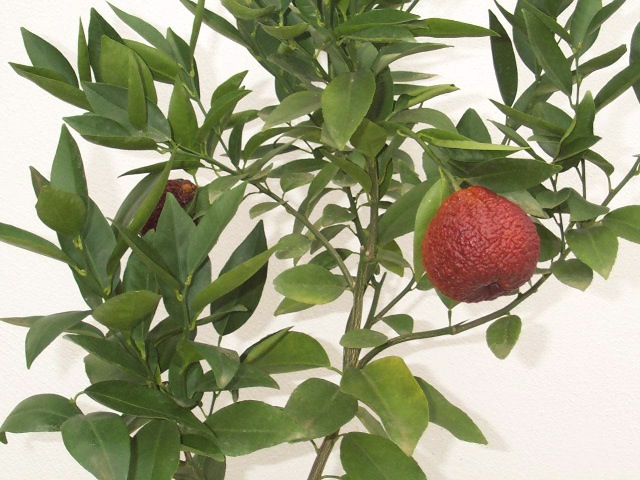 | | 2009 | DEVELOPED | 1990 | | | | | Cultivar | This accession was apparently developed and selected by ISA for use in the ornamental market. See Abstracts of the XLVI Italian Society of Agricultural Genetics Annual Congress 2002. This is a budwood introduction of the same genotype as RRUT 289. It should therefore be truer to type and not have juvenility issues. RRUT 289 should be considered for de-accessioning when (and if) RRUT 455 is released from quarantine and evaluated. (RR Krueger, 09/02/2010) | 1846910 | RRUT 455 |
| 394 | RRUT 444 | 'Sunki' | Citrus ×aurantium L. var. chrysocarpa (Hassk.) ined. | China | RIV | | | 2009 | DONATED | 1922 | | | | | Cultivar | This accession was obtained at the request of personnel from the laboratory of Prof Mikeal Roose of the Dept of Botany and Plant Science, University of California, Riverside. The existing accession of 'Sunki' at Riverside, PI 539678/RCRC 3143, showed some inconsistencies with progeny from a 'Sunki' cross. Preliminary results from Prof Roose's lab have confirmed that RRUT 444 is indeed different than PI 539678. This accession was received from the US Horticultural Research Laboratory from a tree propagated from a tree formerly at the Whitmore Foundation Farm (WFF). The USHRL accession at WFF is stated in the WFF Accession Book to be "cpb-1-174 = fortunella sp plant china 1922". Another section in the Accession Book refers to "cpb 10174". The admitedly incomplete list of CPB numbers on file at NCGRCD does not show a CPB 1-174; however, it does show a CPB 10174 which is indeed stated to be "C japonica 'seedless kumquat'". The archival records also equate CPB 10174 with RCRC 2377. RCRC 2377 is an inactive accession at Riverside as of 1986. However, archival records for RCRC 2377 state: "This is not a kumquat...resembles a small mandarin." (comment by WP Bitters, ca 1969). This suggests that at some point, this accession of 'Sunki' was mislabelled as a seedless kumquat. A personal communication from Dr KD Bowman of USHRL received 07/08/2009 states: "Sunki is a small fruited mandarin that I have used in many crosses. I don't think it would be mistaken for kumquat by anyone very familiar with citrus. The oldest Sunki tree at Whitmore, 9E-2-22, is what I have used for most of my crosses. Regarding the greenhouse source of Sunki sent to you, I haven't seen it and can't offer much comment on that. The plant you indicated as the field source of the greenhouse tree, 9W-2-16, no longer exists at that location. That 9W-2-16 tree was moved to another location and appears to be typical of our 9E-2-22 Sunki at that new location. I would put more weight on the characteristics of our Sunki in the field than I would on any historical records about CPB numbers." Thus it appears that this is a legitimate accession of 'Sunki' irregardless of any documentation errors. More information on 'Sunki' and a summary of its rootstock characteristics is available at PI 539678/RCRC 3143. (RR Krueger, 07/08/2009) | 1802000 | RRUT 444 |
| 395 | RRUT 394 | 'Valencia seedless' | Citrus ×aurantium L. var. sinensis L. | New South Wales, Australia | RIV | | | 2009 | DEVELOPED | 1920 | | | | | Cultivar | Reintroduction of RRUT 337. According to the donor (documentation received with budwood), the original tree at Concordia is 65 years old on trifoliate and was affected witth CEVd and other viroids. The budwood sent to NCGRCD was "taken from a mother tree growing under greenhouse conditions. The original tree was shoot-tip grafted, indexed and found free of citrus tristeza virus (CTV), exocortis (CEV), cachexia-xiloporosis, psorosis, citrus vareigated chlorosis (CVC) and citrus canker." According to Hodgson (1967), this selection differs from standard 'Valencia' "in that the fruit is more oblong or oval in form, less seedy (occasionally one or two seeds), and matures earlier (mate midseason). The tree is vigorous and upright with large leaves that tend to be bunched, giving it a distinctive appearance, and is strongly alternate bearing." According to the donor (documentation received with budwood), this selection has "Good fruit quality. Excellent color and juice. Seedless fruit." This selection of 'Valencia seedless' was imported since there is some question as to the trueness of the existing accession of 'Seedless Valencia' (CRC 2776/PI 539657). This statement is anectdotal, apparently dating from the 1960s. Since the Argentinian accession was received in 1940, if there was some mixup in Riverside, the imported accession should represent the original genotype/phenotype. This needs to be verified after quarantine release. (RR Krueger, 01/03/2009) | 1791355 | RRUT 394 |
| 396 | RRUT 391 | USDA Navel 2-C | Citrus ×aurantium L. var. sinensis L. | Argentina | RIV | | | 2008 | COLLECTED | 1970 | | | | | Cultivar | One of a group of three navels (RRUT 390, RRUT 391, RRUT 392) received from Greg McCollum, USHRL. His comments (extracted from email dated 08/22/2008): "These selections came from seed that Heinz Wutscher collected in Argentina. Mature trees are growing here on the property of Mr Orie Lee in St Cloud. I have done some preliminary evaluations of the fruit and they are all of very excellent quality." (RR Krueger, 05/25/2009) | 1801693 | RRUT 391 |
| 397 | RRUT 392 | USDA Navel 3-S | Citrus ×aurantium L. var. sinensis L. | Argentina | RIV | | | 2008 | COLLECTED | 1970 | | | | | Cultivar | One of a group of three navels (RRUT 390, RRUT 391, RRUT 392) received from Greg McCollum, USHRL. His comments (extracted from email dated 08/22/2008): "These selections came from seed that Heinz Wutscher collected in Argentina. Mature trees are growing here on the property of Mr Orie Lee in St Cloud. I have done some preliminary evaluations of the fruit and they are all of very excellent quality." (RR Krueger, 05/25/2009) | 1801694 | RRUT 392 |
| 398 | RCRC 4196 | 'Pehrson #3' | Citrus ×aurantium L. var. sinensis L. | California, United States | RIV | | | 2008 | DEVELOPED | 1980 | | | | | Cultivar | This is one of a group of 8 valencias clones selected by University of California Cooperative Extension Specialist Emeritus John Pehrson in the 1970's or 1980's. These were included in the Valencia Strain Trial established a the UC Lindcove Field Station. This accession and Pehrson #4 were selected as being the most promising. For more information on the history of this accession, please see notes taken in 2006 by John Bash and a personal communication from 2009 from John Pehrson to Tracy Kahn. (RR Krueger, 10/03/2009) | 1815274 | RCRC 4196 |
| 399 | RCRC 4197 | 'Pehrson #4' | Citrus ×aurantium L. var. sinensis L. | California, United States | RIV | | | 2008 | DEVELOPED | 1980 | | | | | Cultivar | This is one of a group of 8 valencias clones selected by University of California Cooperative Extension Specialist Emeritus John Pehrson in the 1970's or 1980's. These were included in the Valencia Strain Trial established a the UC Lindcove Field Station. This accession and Pehrson #3 were selected as being the most promising. For more information on the history of this accession, please see notes taken in 2006 by John Bash and a personal communication from 2009 from John Pehrson to Tracy Kahn. (RR Krueger, 10/03/2009) | 1815275 | RCRC 4197 |
| 400 | RCRC 4198 | 'China S-20' | Citrus ×aurantium L. var. chrysocarpa (Hassk.) ined. | Sichuan Sheng, China | RIV | | | 2008 | DONATED | 08/28/1995 | | | | | Cultivar | Collector rated "acceptable" tree vigor and fruit quality and "good" cold hardiness. Additional information on the Chinese satsumas is available in this summary of a conversation between Tracy Kahn and Billl Dozier. This accession has not been well characterized under California conditions. (RR Krueger, 06/12/2010) | 1815276 | RCRC 4198 |
| 401 | RCRC 4199 | 'China 6-18' | Citrus ×aurantium L. var. chrysocarpa (Hassk.) ined. | Sichuan Sheng, China | RIV | | | 2008 | DONATED | 10/16/1998 | | | | | Cultivar | Another one of the satsumas imported from China by Huang and Dozier. Additional information on the Chinese satsumas is available in this summary of a conversation between Tracy Kahn and Billl Dozier. This accession has not been well characterized under California conditions. (RR Krueger, 06/12/2010) | 1815277 | RCRC 4199 |
| 402 | RCRC 4200 | 'Everhard' | Citrus ×aurantium L. var. sinensis L. | Texas, United States | RIV | | | 2008 | DEVELOPED | 1940 | | | | | Cultivar | According to Sauls (1998), "The two most widely planted navel orange varieties in Texas are 'Everhard' and 'N33E'. 'Everhard' is similar to the 'Baianinha Piracicaba' of Brazil, having rather smaller fruit that are oval to round. The navel is very small and closed, commonly being inconspicuous or absent altogether. The fruit is thin skinned, of very good flavor, and it reaches maturity in late September [in South Texas]." Additional information from Sauls (2008) states that "Everhard is a smaller fruit characterized by a very small or no navel; it is a consistent producer." According to the Acorn Springs Farms website, "While the 'Everhard' is typically more compact than the average 'Washington', comparative testing by Texas AandM University proved that the Everhard had more consistent (fruit) bearing levels and higher resistance to post-harvest decay than several other navel varieties. The Everhard Navel is so reliable, in fact, that the commercial citrus industry south of New Orleans purchased thousands of them to replace other navel varieties destroyed in a hurricane." (RR Krueger, 10/19/2009) | 1815278 | RCRC 4200 |
| 403 | RCRC 4201 | 'California roja' | Citrus ×aurantium L. var. sinensis L. | Venezuela | RIV | | | 2008 | DONATED | 08/28/1984 | | | | | Cultivar | Selected as being of interest to the California citrus industry by members of the California Citrus Nursery Society during a tour of INRA-CIRAD, Corsica, in conjunction with the Congress of the International Society of Citrus Nursermen in 1997. According to Franck Curk, Curator of the French Citrus Germaplasm Collection, "In our collection the fruit is exactly the same than the Cara Cara. It is a pink salmon flesh navel orange as the Cara Cara orange is". (personal communication to Toni Siebert, ca 2008). Additional information from Franck (email of 10/20/2009) is that "Here in Corsica, Cara Cara navel and California Roja navel are not at the same location, so, some times we notice some differences in ripening time or coloration, but globally they really look like the same. California Roja has been introduced to Corsica from Venezuela in 1984 and Cara Cara has been introduced from Spain in 1991". Although at some point the SRA website provided California as the origin of this variety, it apparently actually was introduced from Venezuela and so the source of the name is unknown. In any case, it is apparently the same or very similar as 'Cara Cara'. It has not been well characterized in California since its release. (RR Krueger, 06/12/2010) | 1815279 | RCRC 4201 |
| 404 | RCRC 4202 | 'Orange a feuilles laciniees' | Citrus ×aurantium L. var. sinensis L. | Morocco | RIV | | | 2008 | DONATED | 04/17/1959 | | | | | Cultivar | This variety was selected by former UC Riverside Staff Research Associate Ottillia "Toots" Bier during a tour of the SRA, San Giuliano, by the California Citrus Nursery Society in conjunction with the Congress of the International Society of Citrus Nurserymen in 1997. It was chosed as a curiosity due to the leaf morphology, which is twisted and distorted. Although it was received in Corsica from Morocco, it is likely that is represents a older type of citrus as shown in the works of Ferrarii, Risso et Poteau, etc. These authors show many types of citrus that are characterized according to fruit or leaf morphology. I cannot find the word "laciniand#233;" in any French online dictionary. Perhaps its meaning is similar to "lacio" in Spanish, which would be consistent with its appearance. Readers are invited to comment on this to me via email. (RR Krueger, 06/12/2010) | 1815280 | RCRC 4202 |
| 405 | RRUT 374 | USDA 1-105-106 | Citrus ×aurantium L. var. chrysocarpa (Hassk.) ined. | Florida, United States | RIV | | | 2007 | DEVELOPED | | | | | | Cultivar | Stated to be a "juicing tangor" "'with deep orange color, produces extremely high quality juice" by donor. Reintroduction of RRUT 285 (did not establish) and 318 (perished in the Great Greenhouse Meltdown of 2007). (RRK, 09/2007) | 1737403 | RRUT 374 |
| 406 | RCRC 4193 | 'Pollock T4' | Citrus ×aurantium L. var. sinensis L. | Australia | | | Historic | 2006 | DONATED | 1991 | | | | | Cultivar | This is supposed to be a late navel originating in Australia. Since it was a proprietary introduction through CCPP, not much is known about its characteristics. Its relationship to Autmn Gold (RCRC 4037 is not known at this time. Permission was received by Tracy Kahn to plant in the Citrus Variety Collection for observation and demonstration. A slight amount of additional information and attractive images are available from the Citrus Variety Collection website. (RR Krueger, 06/15/2010) | 1841906 | RCRC 4193 |
| 407 | RCRC 4194 | 'Secret Garden' | Citrus ×aurantium L. var. sinensis L. | California, United States | | | Historic | 2006 | DONATED | 1992 | | | | | Cultivar | Since this was a proprietary introduction through CCPP, not much is known about its characteristics. Permission was received by Tracy Kahn to plant in the Citrus Variety Collection for observation. A slight amount of additional information and attractive images are available from the Citrus Variety Collection website. (RR Krueger, 10/15/2010) | 1841907 | RCRC 4194 |
| 408 | RCRC 4195 | 'Whitley' | Citrus ×aurantium L. var. sinensis L. | Australia | | | Historic | 2006 | DONATED | 1991 | | | | | Cultivar | This is supposed to be a late navel originating in Australia. Since it was a proprietary introduction through CCPP, not much is known about its characteristics. Permission was received by Tracy Kahn to plant in the Citrus Variety Collection for observation and demonstration. A slight amount of additional information and attractive images are available from the Citrus Variety Collection website. (RR Krueger, 06/15/2010) | 1841908 | RCRC 4195 |
| 409 | RCRC 4186 | 'BAY GOLD' | Citrus ×aurantium L. | North Island, New Zealand | RIV | | | 2006 | DEVELOPED | 1980 | | | | | Cultivar | "Our citrus breeding programme was established in the 1970s in Te Puke and was transferred to Kerikeri in the 1980s. The objectives of the programme are to produce easy-peel, seedless mandarins and scab-resistant lemons adapted to the New Zealand environment. We are using a range of conventional breeding methods to develop breeding lines and cultivars. We have recently released four cultivars for the home garden labelled the 'Bay' series ('Bay Zest', 'Bay Sunset', 'Bay Sweetie' and 'Bay Gold'). The Bay series is named after the major citrus growing regions of New Zealand (Bay of Islands, Bay of Plenty and Poverty Bay) and the cultivars are sure to be an attractive and flavoursome addition to the home garden." (Source: HortResearch Website. Note: Release date source: Nicotra, 2001. "Citrus are being bred for convenience factors such as an easy-peel skin, and adaptation to New Zealand's cool, maritime climate. 'Bay Gold', a Clementine mandarin x Seminole tangelo hybrid, is the first registered citrus hybrid to be bred in New Zealand. It is a juicy tangelo-like fruit that peels easily and is virtually seedless. It is also resistant to Alternaria, a serious rind blemish disease which affects the 'Seminole' tangelo." (source: Muggleston and Glucina, 1994) "Bay Gold has been released in NZ as a home garden variety. It is an attractive tree and fruit but there are some issues that make it unsuitable for commercial production in NZ." (A Currie, email of 03 Sept 2007) Note that 'Bay Gold' was sent to California with the restriction that only six propagations be made in order to observe fruit quality under California conditions. Therefore, it may not be distributed from the Repository and requests for propagative material should be sent to HortResearch. A limited amount of fruit quality data is available from California at the CCPP Website. (RRK, 09/2007) | 1736978 | RCRC 4186 |
| 410 | RCRC 4192 | 'Gillemberg' | Citrus ×aurantium L. var. sinensis L. | Transvaal, South Africa | RIV | | | 2006 | DEVELOPED | 1985 | | | | | Cultivar | 'Gillemberg' navel matures 4 - 6 weeks after 'Palmer' and hangs well on the tree. The fruit is medium-to-large in size (larger than 'Palmer'), round to oblong in shape, with a pebbly, sometimes coarse rind, and a Palmer-like tight navel end. Fruit quality and yield on the parent tree is excellent. The foliage is denser and the leaves more tapered than 'Palmer'. (Description condensed from Burdette, 1995, and Saunt, 2000.) In South Africa, 'Gillemberg' was multiplied starting in 1987 and was later shoot-tip-grafted and propagative material distributed through Outspan. Growers weren encouraged to plant 'Gillember' on a "semi-commercial scale" in the Cape areas (Burdette et al, 1995). According to Burdette et al (1995), rootstocks choices for 'Gillemberg' would probably be the same as for 'Parent Washington' and 'Palmer'. Saunt (2000) further notes that 'Gillemberg' "has outstanding flavour even when grown on rough lemon rootstock in the cooler citrus-producing areas in South Africa." Permission was obtained to plant 'Gillemberg' in the field collection (UC Riverside Citrus Varieties Collection) for observation and evaluation. It is not maintained as a budsource and cannot be distributed. (RRK, 10/2007) | 1740163 | RCRC 4192 |
| 411 | RRUT 366 | 'Agua Tibia' | Citrus ×aurantium L. var. sinensis L. | California, United States | RIV | | | 2005 | DONATED | 04/08/2005 | | | | | Cultivar | This variety was obtained due to its possible historical significance (see Source History). (RR Krueger, 11/30/2009) | 1826610 | RRUT 366 |
| 412 | RRUT 321 | RSD 1996003 | Citrus ×aurantium L. | China | | | Historic | 2004 | DONATED | | | | | | Wild material | This has the same name as RSD 1996003. However, RSD 1996003 is a citron and was so identified by the donor. This (RRUT 321) is supposed to be a sour orange. Therefore, it should be retained. If it ends up being a citron, it should be discarded at a later date. (RRK, 11/2004). Actually, this has the vegetative characteristics of a papeda. (RRK, 06/2006) This accession perished in the Great Greenhouse Meltdown of 2007. (RRK, 07/08/2007) | 1698336 | RRUT 321 |
| 413 | RRUT 319 | 'Duncan' | Citrus ×aurantium L. var. racemosa (Risso) ined. | California, United States | RIV | | | 2003 | DONATED | 07/23/1996 | | | | | Cultivar | Indexed/therapied at CCPP in order to produce a pathogen-tested source of 'Duncan'. This is presumably identical to the 'Duncan' accession in the CVC (CRC 3832/PI 539482). (RRK, 2006-06) | 1698334 | RRUT 319 |
| 414 | RCRC 4112 | 'FULWOOD' | Citrus ×aurantium L. var. sinensis L. | South Australia, Australia | RIV | | | 2003 | DEVELOPED | | | | | | Cultivar | According to Pat Barkley (email of 08-13-2001): "'Fulwood' navel is an early navel from the late Brian Fulwood's farm in Waikerie, South Australia. The original tree was on rough lemon. Because of its earliness a lot of nurseries and growers started to run with it before I had indexed it. I subsequently found it to be infected with citrus tatterleaf virus and as many trees had been propagated on citrange, the inevitable stunting and bud-union yellow ring developed. I have cleaned it up and we have some trees in the field to see if it is still early (which I doubt it will be)." (RRK, 08/2007) | 1734155 | RCRC 4112 |
| 415 | RRUT 263 | 'Ruby (4N)' | Citrus ×aurantium L. var. sinensis L. | California, United States | RIV | | | 2002 | DEVELOPED | 1930 | | | | | Breeding material | It is not known whether or not this differs from RRUT 31 since the bud source of RRUT 31 is not known. (RR Krueger, 11/2006) | 1830338 | RRUT 263 |
| 416 | RCRC 4147 | 'Willial' | Citrus ×aurantium L. | | RIV | | | 2002 | DEVELOPED | 1930 | | | | | Cultivar | | 1830319 | RCRC 4147 |
| 417 | RCRC 4150 | 'Warren Marsh' | Citrus ×aurantium L. var. racemosa (Risso) ined. | | RIV | | | 2002 | DEVELOPED | 1930 | | | | | Cultivar | | 1830321 | RCRC 4150 |
| 418 | RCRC 4145 | 'Marlow' | Citrus ×aurantium L. | | RIV | | | 2002 | DEVELOPED | 1930 | | | | | Cultivar | | 1830318 | RCRC 4145 |
| 419 | RRUT 241 | 'Paperrind (4N)' | Citrus ×aurantium L. var. sinensis L. | California, United States | RIV | | | 2002 | DEVELOPED | 1930 | | | | | Breeding material | | 1830326 | RRUT 241 |
| 420 | RCRC 4142 | 'Ruvel nuc #1' | Citrus ×aurantium L. var. sinensis L. | | RIV | | | 2002 | DEVELOPED | 1930 | | | | | Cultivar | It is not known at this time whether 'Ruvel' nucellars nos 1 and 2 differ from each other. Howver, the consensus was that they were nucellar selections or propagations and therefore redundant. Consequently, 'Ruvel nucellar #1' (RCRC 4142) was retained and 'Ruvel nucellar #2' (RRUT 236) was de-accessioned effective 11/2006. (RR Krueger, 11/2006) | 1830312 | RCRC 4142 |
| 421 | RRUT 249 | 'Royal (4N)' | Citrus ×aurantium L. var. racemosa (Risso) ined. | California, United States | RIV | | | 2002 | DEVELOPED | 1930 | | | | | Breeding material | | 1830330 | RRUT 249 |
| 422 | RRUT 252 | 'Hall (4N) #3' | Citrus ×aurantium L. var. racemosa (Risso) ined. | California, United States | RIV | | | 2002 | DEVELOPED | 1930 | | | | | Breeding material | It is not known whether 'Hall (4N)' nos 2 and 3 differ from each other or are simply different propagations from the same bud source. This accession was retained in order to maintain a budsource of a 4N 'Hall', whereas 'Hall 4N #2' (RRUT 251) was de-accessioned effective 11/2006. (RR Krueger, 11/2006) | 1830332 | RRUT 252 |
| 423 | RRUT 265 | 'Valencia #1b (4N)' | Citrus ×aurantium L. var. sinensis L. | Florida, United States | RIV | | | 2002 | DEVELOPED | 1970 | | | | | Breeding material | This is one of several putative tetraploids developed by Herb Barrett that were sent to Riverside at some point, presumably due to a lack of interest or resources to maintain them in Orlando. Not all of these apparent tetraploids are actually 4N, according to Tim Williams. Only those designed as 4N by TEW were incorporated into the NCGRCD holdings. A more exact determination should be made at some point. (RR Krueger, 02-05-2009) | 1830311 | RRUT 265 |
| 424 | RRUT 266 | Red Mexican #4 (4N) | Citrus ×aurantium L. var. racemosa (Risso) ined. | Florida, United States | RIV | | | 2002 | DEVELOPED | 1970 | | | | | Breeding material | This is one of several putative tetraploids developed by Herb Barrett that were sent to Riverside at some point, presumably due to a lack of interest or resources to maintain them in Orlando. Not all of these apparent tetraploids are actually 4N, according to Tim Williams. Only those designed as 4N by TEW were incorporated into the NCGRCD holdings. A more exact determination should be made at some point. (RR Krueger, 02-05-2009) | 1793548 | RRUT 266 |
| 425 | RRUT 269 | Temple #4 (4N) | Citrus ×aurantium L. var. chrysocarpa (Hassk.) ined. | Florida, United States | RIV | | | 2002 | DEVELOPED | 1970 | | | | | Breeding material | This is one of several putative tetraploids developed by Herb Barrett that were sent to Riverside at some point, presumably due to a lack of interest or resources to maintain them in Orlando. Not all of these apparent tetraploids are actually 4N, according to Tim Williams. Only those designed as 4N by TEW were incorporated into the NCGRCD holdings. A more exact determination should be made at some point. (RR Krueger, 02-05-2009) | 1793555 | RRUT 269 |
| 426 | RRUT 270 | Clementine #3 (4N) | Citrus ×aurantium L. | Florida, United States | RIV | | | 2002 | DEVELOPED | 1970 | | | | | Breeding material | This is one of several putative tetraploids developed by Herb Barrett that were sent to Riverside at some point, presumably due to a lack of interest or resources to maintain them in Orlando. Not all of these apparent tetraploids are actually 4N, according to Tim Williams. Only those designed as 4N by TEW were incorporated into the NCGRCD holdings. A more exact determination should be made at some point. (RR Krueger, 02-05-2009) | 1698322 | RRUT 270 |
| 427 | RRUT 385 | Hudson #1 (4N) | Citrus ×aurantium L. var. racemosa (Risso) ined. | Florida, United States | RIV | | | 2002 | DEVELOPED | 1970 | | | | | Breeding material | This is one of several putative tetraploids developed by Herb Barrett that were sent to Riverside at some point, presumably due to a lack of interest or resources to maintain them in Orlando. Not all of these apparent tetraploids are actually 4N, according to Tim Williams. Only those designed as 4N by TEW were incorporated into the NCGRCD holdings. A more exact determination should be made at some point. This particular accession is probably not actually a tetraploid. (RR Krueger, 02-05-2009) | 1793557 | RRUT 385 |
| 428 | RCRC 4141 | 'Rufert A' | Citrus ×aurantium L. var. sinensis L. | | RIV | | | 2002 | DEVELOPED | 1930 | | | | | Cultivar | It is not known at this time whether 'Rufert A' and 'Rufert C' differ from each other. See comments in The Citrus Industry, 1948, 1:839 implying that 'Rufert' was a type of seedling rather than a variety. The consensus was that only one example or accession of 'Rufert' needed to be maintained. Therefore, 'Rufert A' (RCRC 4141) was retained and 'Rufert C' was de-accessioned effective 11-2006. (RRK, 11-2006) | 1830315 | RCRC 4141 |
| 429 | RCRC 4143 | 'Allspice' | Citrus ×aurantium L. | | RIV | | | 2002 | DEVELOPED | 1930 | | | | | Cultivar | | 1830316 | RCRC 4143 |
| 430 | RCRC 4148 | 'Wincia' | Citrus ×aurantium L. var. chrysocarpa (Hassk.) ined. | | RIV | | | 2002 | DEVELOPED | 1930 | | | | | Cultivar | | 1830320 | RCRC 4148 |
| 431 | RRUT 234 | 'Seedy Marsh (4N)' | Citrus ×aurantium L. var. racemosa (Risso) ined. | California, United States | RIV | | | 2002 | DEVELOPED | 1930 | | | | | Breeding material | | 1829976 | RRUT 234 |
| 432 | RCRC 4228 | 'Bitters Newhall' | Citrus ×aurantium L. var. sinensis L. | California, United States | RIV | | | 2002 | DONATED | 06/01/2002 | | | | | Cultivar | | 1698295 | RCRC 4228 |
| 433 | RCRC 4237 | 'Amoa 8' | Citrus ×aurantium L. var. chrysocarpa (Hassk.) ined. | Sicilia, Italy | RIV | | | 2002 | DEVELOPED | 1990 | | | | | Cultivar | This accession was apparently developed and selected by ISA for use in the ornamental market. See Abstracts of the XLVI Italian Society of Agricultural Genetics Annual Congress 2002. Planted in field for observation, 06/2007. (RRK, 06/2007) A more recent budwood introduction of this genotype is RRUT 455. As a budwood introduction, RRUT 455 may be truer to type and not have juvenility issues. Therefore, RRUT 289 should be considered for de-accessioning when (and if) RRUT 455 is released from quarantine and evaluated. (RR Krueger, 09/02/2010) | 1729196 | RCRC 4237 |
| 434 | RCRC 4282 | 'Variegated Cara Cara' | Citrus ×aurantium L. var. sinensis L. | California, United States | RIV | | | 2001 | DONATED | 10/01/2001 | | | | | Cultivar | This is not 'Variegated Cara Cara' (RRUT 19), which has normally colored fruit flesh of low quality. This selection arose as a sport of 'Cara Cara' maintained in the NCGRCD screenhouse. This accession should be planted in the field for evaluation of (it is hoped) better quality fruit quality. (R.R. Krueger, 2006-06) Fruit of this accession are (somewhat erratically) variegated with pink flesh. They are of small size (typical of variegated accessions) and overall fruit quality does not appear to be high. These characteristics are similar to the other active accession of 'Variegated Cara Cara', RCRC 4207. (R.R. Krueger, 2010-06) Tracy Kahn decided that she prefers RRUT 194. Therefore, RCRC 4207 is inactivated and RRUT 194 becomes the 'Variegated Cara Cara' of record. (R.R. Krueger, 2020-09-04) | 1698289 | RCRC 4282 |
| 435 | RCRC 4209 | 'Olympic Gold' | Citrus ×aurantium L. var. sinensis L. | Victoria, Australia | RIV | | | 2001 | DONATED | 08/23/1996 | | | | | Cultivar | Not too much is known about this navel orange. It was originally imported through CCPP as a contract or proprietary cleanup. However, information from Toni Siebert in 2009 states the following: "This accession was considered proprietary until August 2008. In August 2008, Tracy Kahn contacted Ellen Brokaw who contacted the widow of Dan Sheehan who licensed Brokaw Nursery in 1996 to handle the Olympic Gold. Before getting a response to this inquiry Larry Rose then informed Tracy Kahn that there was no patent on the variety and we have permission to plant it. We do not have fruit quality information at this time." (RR Krueger, 11/06/2009) | 1824199 | RCRC 4209 |
| 436 | RCRC 4184 | 'Arrufatina' | Citrus ×aurantium L. | Castellon de Plana, Spain | RIV | | | 2001 | DEVELOPED | 1968 | | | | | Cultivar | According to Bono-Ubeda et al (p 28), trees of 'Arrufatina' tend to be thorny when young, but this disappears somewhat with age. The seedless fruit is of a good size and has acceptable quality. It is an early variety, maturing about three weeks earlier than 'Nules'. It is productive and should be planted in "early" zones. Harvesting should begin when the fruit starts to de-green, and if harvest is delayed then coloring is delayed and there is a tendency to puff. Additional information from Saunt (pp 54-55) indicates that fruit size is larger than 'Nules' and 'Oronules' but smaller than 'Marisol'. In addition to the puff mentioned above, granulation may also occur if harvest is delayed. When fully mature, the rind color is a very intense orange but appearance is slightly detracted from by the depressed stylar end. "While the sugar to acid reatio is higher than Marisol but lower than Oronules, the flavour [sic] of Arrufatina cannot compete with either of these two other early maturing selections, with the result that further plantings are likely to be on a limited scale in Spain." (Saunt, p 55) There is little information available on the potential perforamance of this selection in California. (RRK, 09/2007) | 1736111 | RCRC 4184 |
| 437 | RCRC 4185 | 'Hernandina' | Citrus ×aurantium L. | Valenciana, Comunidad, Spain | RIV | | | 2001 | DEVELOPED | 1966 | | | | | Cultivar | According to Bono-Ubeda et al (p 25), trees of 'Hernandina' are vigorous and have good development. The size, form, juice content, and fruit quality are similar to 'Fina', but full color development is reached two months later. Seedless. Productive but with a slight tendency to alternate-bear. Should be cultivated in zones of late harvest with small risk of frost since it is not commercially interesting to offer this variety before the middle of February. Delay of harvest is not advisable since this can cause a small loss in the amount of juice and of acid, resulting in a diminuation of the normally excellent quality. Additional information from Saunt (p 56) indicates that the delayed color development as compared to 'Fina' is particularly pronounced at the stylar end, which sometimes never completely colors. In contrast, internal maturity is reached in late November, only one or two weeks later than 'FIna'. Harvest normally startsin mid-January and can proceed until the end of February, at which time granulation develops and the tree is induced to alternate-bear. Saunt further states that 'Hernandina' is the most popular variety planted in Spain with about 8,000 ha producing about 100,000 tons. However, the market for 'Hernandina' is being challenged by extensive planting of 'Nour' in Morocco in recent years. There is little information available on the potential perforamance of this selection in California. (RRK, 09/2007) | 1736112 | RCRC 4185 |
| 438 | RCRC 4058 | 'RICALATE' | Citrus ×aurantium L. var. sinensis L. | Castellon de Plana, Spain | RIV | | | 2001 | DEVELOPED | 1975 | | | | | Cultivar | 'Ricalate' is said to be slightly smaller and later than 'Washington' and to hang well until late in the season. (RRK, 08/2006) I talked to Paco Llatser in Manzanillo, Mexico in August, 2011. He said that the most important aspect of this is that it hangs on the tree very well. They are interested in why this is and are researching it with people from a local Valencia institution (not IVIA). (RR Krueger, 08/26/2011) Linkies: Information on 'Ricalate' from the University of California Riverside Citrus Variety Collection. Information on 'Ricalate' from the University of California Riverside Citrus Clonal Protection Program. | 1705359 | RCRC 4058 |
| 439 | RCRC 4241 | 'Gardner' | Citrus ×aurantium L. var. sinensis L. | Florida, United States | RIV | | | 2001 | DONATED | 03/01/1999 | | | | | Cultivar | 'Gardner' is a mid-season orange with slightly higher TSS and better color than 'Hamlin'. It may be processed between 'Hamlin' and 'Valencia' and also used as a fresh fruit. (USDA release notice) See material on file for results of disease testing and other information. (RRK, 2006-06) | 1698283 | RCRC 4241 |
| 440 | RCRC 4242 | 'Midsweet' | Citrus ×aurantium L. var. sinensis L. | Florida, United States | RIV | | | 2001 | DEVELOPED | 03/01/1999 | | | | | Cultivar | 'Midsweet' is a mid-season sweet orange that is for processing. It produces higher TSS per box and has better color than 'Hamlin', and may also be used as fresh fruit. (from USDA release notice) See material on file for results of disease testing and other information. (RRK, 2006-06) | 1698282 | RCRC 4242 |
| 441 | RRUT 149 | 'Goutoucheng (4-1)' | Citrus ×aurantium L. | Sichuan Sheng, China | RIV | | | 2001 | DONATED | 03/19/1985 | | | | | Rootstock | This accession of 'Goutoucheng' appeared quite different than the other 3 in the ISSR study of 2001 (Krueger and Roose, Journal of ASHS, 128:827-837, 2003). It should be carefully observed in order to make sure that it is correctly identified (ie, not rootstock or switched with another of the group of accessions received from PRC at the same time). | 1698245 | RRUT 149 |
| 442 | RRUT 152 | 'Fuju (1-10-17)' | Citrus ×aurantium L. var. chrysocarpa (Hassk.) ined. | Sichuan Sheng, China | RIV | | | 2001 | DONATED | 03/19/1985 | | | | | Cultivar | This appeared identical to the seed introduction of 'Fuju' (RRUT 82) by ISSR in 2001 (Krueger and Roose, Journal of ASHS, 128:827-837, 2003). | 1698248 | RRUT 152 |
| 443 | RRUT 157 | un-named sweet orange (?) ex-Nepal | Citrus ×aurantium L. var. sinensis L. | Nepal | RIV | | | 2001 | DONATED | 03/17/1987 | | | | | Uncertain improvement status | This accession was rec'd as Citrus sp from Nepal via USDA-PGQO, but its background is not known. Tentative ID by J Bash and R Krueger, 1998. | 1698253 | RRUT 157 |
| 444 | RRUT 159 | un-named sweet orange (?) ex-Nepal | Citrus ×aurantium L. var. sinensis L. | Nepal | RIV | | | 2001 | DONATED | 03/17/1987 | | | | | Uncertain improvement status | This accession was rec'd as Citrus sp from Nepal via USDA-PGQO, but its background is not known. Tentative ID by J Bash and R Krueger, 1998. | 1698255 | RRUT 159 |
| 445 | RRUT 163 | un-named sweet orange (?) ex-Nepal | Citrus ×aurantium L. var. sinensis L. | Nepal | RIV | | | 2001 | DONATED | 03/17/1987 | | | | | Uncertain improvement status | This accession was rec'd as Citrus sp from Nepal via USDA-PGQO, but its background is not known. Tentative ID by J Bash and R Krueger, 1998. Note: Q number - from CCPP source - does not appear on PGQO printout; may be Q-26731 = donor's I-52 = donor's BE-1139). | 1698259 | RRUT 163 |
| 446 | RRUT 170 | 'Red Mexican' | Citrus ×aurantium L. var. racemosa (Risso) ined. | Florida, United States | RIV | | | 2001 | DONATED | 1953 | | | | | Cultivar | According to HK Wutscher (ca 1997), this does not come true-to-type from seed, producing white-fleshed fruit. Observed: fruit medium-sized for grapefruit, medium color, no blush, seedy, flesh color better than other tree at R12-T12. Photo no 9 of those taken at Rio Farms. For additional information and disease-testing results, see information on file. (RRK, 2006-06) | 1698266 | RRUT 170 |
| 447 | RRUT 180 | 'Sunstar' | Citrus ×aurantium L. var. sinensis L. | Florida, United States | RIV | | | 2001 | DONATED | 03/01/1999 | | | | | Cultivar | 'Sunstar' is a mid-season orange that is better colored than 'Hamlin'. It may be used as a fresh fruit or processed between 'Hamlin' and 'Valencia' (its primary use). (from USDA release notice) See material on file for results of disease testing and other information. (RRK, 2006-06) | 1698276 | RRUT 180 |
| 448 | RRUT 181 | 'US SEEDLESS PINEAPPLE' | Citrus ×aurantium L. var. sinensis L. | Florida, United States | RIV | | | 2001 | DEVELOPED | 05/11/1970 | | | | | Cultivar | The major advantage of this selection over conventional 'Pineapple' is said to be the fact that this may also be used as a fresh fruit. It is also said to be less prone to fruit drop than normal 'Pineappple'. (USDA-ARS-HRL notes) Evaluation of fruit and juice quality of this selection and others produced at the same time on four rootstocks at two locations in Florida can be found in McCollum and Bowman (2005). See material on file for results of disease testing and other information. (RR Krueger, 2006-06) This accession has been released (07/20/2009) by USHRL and will be available when quarantine processing is completed. More information is available in the Release Notice. (RR Krueger, 10/04/2009) | 1698277 | RRUT 181 |
| 449 | RRUT 182 | 'Succari' | Citrus ×aurantium L. var. sinensis L. | Florida, United States | RIV | | | 2001 | DONATED | 03/01/1999 | | | | | Cultivar | 'Succari' is also known as 'Succory' and 'Sukkari'. It is described in The Citrus Industry, vol 1, p 469: 'fruit small to medium-sized, somewhat oblate to globose; seedy. Rind medium-thick and surface relatively smooth. Good color at maturity. Flesh color pale and juice abundant, but almost devoid of acid. Sugar-acid ratio of 90 - 100:1 at maturity. Matures early (October - December). Of unknown origin, Succari has long been popular in Egypt and is of considerable commercial importance.' See material on file for results of disease testing and other information. (RRK, 2006-06) | 1698278 | RRUT 182 |
| 450 | RRUT 183 | 'Cooper' | Citrus ×aurantium L. var. sinensis L. | Florida, United States | RIV | | | 2001 | DONATED | 03/01/1999 | | | | | Cultivar | This variety was selected to be a better quality late-season navel for Florida. It matures at about the same time as other navels, but holds its quality about a month longer than other navels. Fruit size smaller than Florida navel DPI-56-11. (USDA-ARS-HRL notes) This will probably not be useful in California but may be good additions for Florida or other more tropical areas (according to J Chaparro). Unreleased variety for evaluation only. See material on file for results of disease testing and other information. (RRK, 2006-06) | 1698279 | RRUT 183 |
| 451 | RRUT 184 | 'Bahianinha Monte Parnazo' | Citrus ×aurantium L. var. sinensis L. | São Paulo, Brazil | RIV | | | 2001 | COLLECTED | 1977 | | | | | Cultivar | According to HK Wutscher, ca 1997, this selection is supposed to be similar to the parent type of Washington navel, and also like Bahia #48 (seeds of which were collected at the same time by WC Cooper). ''WC Cooper knows the characeristics of each but has not given me a copy." (CJ Hearn to JB Carpenter, 1977). See material on file for results of disease testing and other information. (RRK, 2006-06) | 1698280 | RRUT 184 |
| 452 | RRUT 188 | 'Swingle' | Citrus ×aurantium L. | Florida, United States | RIV | | | 2001 | DEVELOPED | 03/01/1999 | | | | | Cultivar | See material on file for results of disease testing and other information. (RRK, 2006-06) | 1698284 | RRUT 188 |
| 453 | RRUT 190 | 'TRESCA' | Citrus ×aurantium L. var. sinensis L. | Florida, United States | RIV | | | 2001 | DEVELOPED | 03/01/1999 | | | | | Cultivar | This variety should not be confused with 'Tresca' pummelo (PI 539386/RCRC 302). About the same season as 'Pineapple' but nearly seedless and better color. Also for fresh fruit. Said to have a long juvenility period, grow more upright than most other sweet oranges, and flushes vigorously if over fertilized. (USDA-ARS-HRL notes). See material on file for results of disease testing and other information. (RRK, 2006-06) | 1698286 | RRUT 190 |
| 454 | RRUT 119 | 'Corniculata (OPS)' | Citrus ×aurantium L. | | RIV | | | 2000 | DONATED | 03/2000 | | | | | Cultivar | This is one of several historical citrus types accessed at historic botanic gardens in Europe and generously donated. According to the donor, and in accordance with its name and older literature, this variety has horned fruits (ie, is "corniculated"). Since only one tree was established from the received seeds, it needs to be planted in the field and observed in order to verify this. (RR Krueger, 05/2004) | 1841621 | RRUT 119 |
| 455 | RRUT 36 | 'Collins-Hibbert' | Citrus ×aurantium L. var. sinensis L. | California, United States | RIV | | | 1999 | DONATED | 12/01/1999 | | | | | Cultivated material | October 25, 1999: received phone call from Chuck SImon, then Curator at the Davis repository. Chuck said that Ted deJong, dept of Pomology, UC Davis, had heard from a woman in Live Oak that a grove with a "heritage tree" of citrus "from the original Oroville tree" (ie, Bidwell's Bar tree) was going to be bulldozed. Ted said he thought NPGS might be interested in the tree. Correspondence with Ted said he did not get the woman's name but believed she was associated with the Collings(?) Ranch. He did not know the timeframe for the bulldozing. A followup phone call from "Toots" Bier yielded the following (email of 12/08/1999): "Had a message left last night by the unnamed lady. Her name is Kathleen Collins of Coleen Farms. It is an Arabian and Aberdeen horse ranch. They are planning to sell the place and want to preserve the trees in their present location. The 8 trees were planted prior to 1901 and are from the Bidwell's Bar tree. She says they are well documented because the original owner's families are still around. She sounds pleasant and intelligent and would welcome a visit. She describes herself as a 'weekender' but says her weekday time is flexible. The best time to actually reach her is Friday or Monday." I called Ms Collins directly on 12/12/1999. She indicated that the trees were planted prior to 1901 by Mr Hibbert. The property has always been in the Hibbert or Collins family. The trees were not damaged by the freezes of 1998 or 1991. They have never been treated with pesticides and are fertilized with "material" from the Angus herd. On a site visit in 12/1999, I collected pooled budwood from the 8 trees. The trees had no apparent graft unions and were probably either seedlings (most likely) or cuttings. Fruit quality was good. After all these years, an additional site visit would be interesting. (RR Krueger, 09/10/2010) | 1847306 | RRUT 36 |
| 456 | RCRC 4037 | 'AUTUMN GOLD' | Citrus ×aurantium L. var. sinensis L. | | RIV | | | 1998 | | | | | | | Cultivar | Received as budwood by CCPP 08/1989; contract clean-up for California Citrus Nursery Society, which retains exclusive propagation rights in U.S. Propagated for planting in CVC only; planted July, 1998. Originally selected by Jack Pollock, Mourquong, NSW, Australia, circa 1950s; apparent sport of Washington navel; AKA Pollock Late Navel. IPR: PVR (Australia): licensed in U.S. to CCNS | 1586930 | RCRC 4037 |
| 457 | RCRC 4038 | 'BARNFIELD' | Citrus ×aurantium L. var. sinensis L. | | RIV | | | 1998 | | | | | | | Cultivar | Received as budwood by CCPP, 01/1989; contract clean-up for L. Caratan, Delano, CA, which retains exclusive propagation rights in the U.S. Propagated for planting in CVC only; planted July, 1998. First selected by Wayne Barnfield, Ellerslie, NSW, Australia, circa 1985; apparent sport of Washington navel; said to have good size and carry well on tree without chemicals until May to June. IPR: PVR (Australia); licensed in U.S. to L. Caratan, Delano, CA. | 1586931 | RCRC 4038 |
| 458 | RCRC 4039 | 'CHISLETT' | Citrus ×aurantium L. var. sinensis L. | | RIV | | | 1998 | | | | | | | Cultivar | Received as budwood by CCPP, 05/1990; contract clean-up for Brokaw Nursery, Saticoy, CA, which retains exclusive propagation rights in the U.S. Propagated for planting in CVC only; planted July, 1998. First selected by N.A. Chislett, Kenley, Victoria, Australia, circa 1986; sport of Washington navel. IPR: PVR (Australia); #314; U.S. Patent no. 8212; N.A. Chislett, Kenley, Victoria, Australia. Licensed in U.S. to Brokaw Nursery, Saticoy, CA. | 1586932 | RCRC 4039 |
| 459 | RCRC 4040 | 'POWELL' | Citrus ×aurantium L. var. sinensis L. | | RIV | | | 1998 | | | | | | | Cultivar | Received as budwood by CCPP, 04/1990; contract clean-up for Michaelis Nursery, Porterville, CA, which retains exclusive propagation rights in the U.S. Propagated for planting in CVC only; planted July, 1998. First selected by Clive Neil Powell, Curlwaa, NSW, Australia, circa 1978; apparent sport of Washington navel. IPR: PVR (Australia); U.S. Patent no. 6733; Powell Late Navel Pty, Ltd, P.O. Box 1135, Mildura, Victoria, Australia. Licensed in U.S. to Michaelis Nursery, Porterville, CA. | 1586933 | RCRC 4040 |
| 460 | RCRC 4041 | 'SUMMER GOLD' | Citrus ×aurantium L. var. sinensis L. | | RIV | | | 1998 | | | | | | | Cultivar | Received as budwood by CCPP, 04/1990; contract clean-up for California Citrus Nursery Society, which retains exclusive propagation rights in the U.S. Propagated for planting in CVC only; planted July, 1998. originally selected by Dudley Marrows, Mourquong, NSW, Australia, circa 1950s; apparent sport of Washington navel; AKA Murrows Late. IPR: PVR (Australia) # 313; D. Marrows, Boeill Creek, NSW, Australia. Licensed in U.S. to CCNS | 1586934 | RCRC 4041 |
| 461 | RRUT 81 | 'Suanju nucellar' | Citrus ×aurantium L. var. chrysocarpa (Hassk.) ined. | China | RIV | | | 1998 | DONATED | 03/10/1998 | | | | | Cultivar | "t is grown in Guangdong and Guangxi as a rootstock for sweet oranges and mandarins in hilly areas." "Wild type used as rootstocks." (donor'snotes) (RR Krueger, 01/30/2010) | 1829355 | RRUT 81 |
| 462 | RSD 1998007 | 'Goutouchen (OPS)' | Citrus ×aurantium L. | China | | | Historic | 1998 | DONATED | 03/10/1998 | | | | | Rootstock | Of 109 seeds, 38 germinated. A nucellar seedling (RRUT 80) identified with ISSR markers (work performed by Prof Mikeal Roose, 2001); 3 zygotic seedlings were retained (RSD1998007SG008; RSD1998007SG014; RSD1998007SG031). (RR Krueger, 01/24/2010) | 1829321 | RSD 1998007 |
| 463 | RRUT 89 | 'Foerster "mutant" nucellar' | Citrus ×aurantium L. | California, United States | RIV | | | 1997 | DEVELOPED | 2001 | | | | | Cultivar | Nucellar selection of RSD 1997010. Of 50 seeds of RRSD 1997010 collected, 46 germinated and 1 was retained as RRUT 89. Appearance is similar to other sour oranges but ISSR markers were slightly different than 'Standard' sour orange (PI 539176). According to Heinz Wutscher, this genotype acts like a regular sour orange rootstock. (RR Krueger, 09/12/2010) | 1847426 | RRUT 89 |
| 464 | RRUT 90 | 'Mediterranean nucellar' | Citrus ×aurantium L. var. sinensis L. | California, United States | RIV | | | 1997 | DEVELOPED | 2001 | | | | | Cultivar | Nucellar selection made with ISSR markers of RSD 1997012. Of 30 seeds of RSD 1997012 collected, 27 germinated and 1 was retained as RRUT 90. Source of accession at Rio Farms unknown, so probably not much different than other Mediterranean-type bloods. Possibly may have better color development under warm weather conditions if addapted to Texas conditions. (RR Krueger, 09/14/2010) | 1847427 | RRUT 90 |
| 465 | RSD 1997002 | 'Zhu Luan (OPS)' | Citrus ×aurantium L. | Zhejiang Sheng, China | RIV | | | 1997 | DONATED | 03/19/1997 | | | | | Rootstock | Of 131 seeds, 49 germinated. A nucellar seedling (RRUT 75) was identified with ISSR markers (work performed by Prof Mikeal Roose, 2001); one zygotic seedling was retained (RSD1997002SG001). "A sour orange hybrid as a citrus rootstock of orange and mandarin in Zhejiang Province, Eastern China." (donor's notes) (RR Krueger, 01/24/2010) | 1829312 | RSD 1997002 |
| 466 | RCRC 4029 | 'ROJO BLANCO' | Citrus ×aurantium L. var. racemosa (Risso) ined. | | RIV | | | 1996 | | | | | | | Cultivar | Putatively bred at USDA Date and Citrus Station, Indio, and released to UCR when station closed. Source: Lindcove Field Station HY-8-14, Lindcove, California | 1580237 | RCRC 4029 |
| 467 | RRUT 54 | 'Karun Jamir nucellar' | Citrus ×aurantium L. | Karnataka, India | RIV | | | 1996 | DONATED | | | | | | Rootstock | ISSR markers appear identical to 'Standard' sour orange (I 53R9176/RCRC 0628). (RR Krueger, 01/18/2010) | 1829109 | RRUT 54 |
| 468 | RRUT 31 | 'Ruby 4N' | Citrus ×aurantium L. var. sinensis L. | California, United States | RIV | | | 1993 | DEVELOPED | 1960 | | | | | Breeding material | This accession was one of various tetraploids produced at UC Riverside. The provenance of this accession is somewhat suspect and when it has been verified that another propagation of the source has been made, this should probably be de-accessioned. (RR Krueger, 09/12/2010) | 1847419 | RRUT 31 |
| 469 | RRUT 32 | 'Temple 4N' | Citrus ×aurantium L. var. chrysocarpa (Hassk.) ined. | Florida, United States | RIV | | | 1993 | DEVELOPED | 1960 | | | | | Breeding material | This accession was one of various tetraploids received at UC Riverside from the USDA-ARS USHRL, Orlando, FL, in the 1970's in order to preserve them. The provenance of this accession is somewhat suspect and when it has been verified that another propagation of the source has been made, this should probably be de-accessioned. (RR Krueger, 09/12/2010) | 1847418 | RRUT 32 |
| 470 | RRUT 364 | 'RIO RED 4N' | Citrus ×aurantium L. var. racemosa (Risso) ined. | Transvaal, South Africa | RIV | | | 1990 | DONATED | 07/01/1990 | | | | | Cultivar | Seed of putative tetraploid. Budwood from seedling later budded onto rootstock. According to Tim Williams, it is not useful because it is not fertile. Retained for the time being for further observation. (RRK, 08/2006) | 1706294 | RRUT 364 |
| 471 | RRUT 367 | 'MINNEOLA' | Citrus ×aurantium L. | Florida, United States | RIV | | | 1989 | DEVELOPED | 1931 | | | | | Cultivar | 'Minneola' tangelo fruits are large, and oblate to obovate, usually with a fairly prominent neck. The flesh color is a deep reddish-orange, medium-thick, and moderately adherent. There are usually 10 - 12 segments. The flesh is orange-colored, tender, juicy, and aromatic. The flavor is rich and tart, and often described as "sprightly". The trees are vigorous and productive, but less cold-resistant than 'Olando'. When grown in solid blocks, 'Minneola' generally has few seeds. Inter-planting with pollinators such as 'Dancy', 'Clementine', or 'Kinnow' ('Orland' is cross-incompatible) increases productivity but also increases seediness. 'Minneola' has a tendency to alternate-bear and is susceptible to Alternari and scab when those diseases are present and climatic conditions are conducive to their development. 'Minneola' has proven adaptable to many different climatic and soil conditions. It is grown commercially in the desert areas of California and Arizona; the Mediterranean areas of Cyprus, Israel, and South Africa; and the semi-tropical climates of Florida, Argentina, and South Africa. For more information, see: The Citrus Industry, 1967, I: 528-529; Saunt, 2000, Citrus Varieties of the World, p. 78; Tucker et al, 4998, Florida Citrus Varieties, p.30; and http://wdis.ifas.ufl.edu/scripts/htmlgen.exe?bodyandDOCUMENT_CH072, from which this information was summarized. There are currently three selections of 'Minneola' in NCGRCD holdings (RRUT 347, RRUT 367, and PI 539709). They appear to differ little from one another, all maturing at the same time and having similar fruit. (RRK, 10/2006) | 1711286 | RRUT 367 |
| 472 | PI 433930 | 'Trifoliate + Satsuma' | Citrus ×insitorum Mabb. | Abkhazia, Georgia | RIV | | | 1979 | COLLECTED | PRE 02/1979 | From Sukhum Experiment Station (Gul'ripah). | | | | Breeding material | Not much is known about this genotype. This accession is stated to be a chimaera of P trifoliata and C unshiu, no specific cultivars or selections being noted. The tree has trifoliate leaves and fruit that is somewhat like satsuma. The seeds also look somewhat like satsuma seeds but are more elongate than trifoliate seeds usually are. A comment received from Dr Ed Stover (2014-01-16) states that "with trifoliate leaves and Satsuma-like fruit, it sounds like it really is a periclinal (hand-in-glove) chimera." Note that this genotype was previously erroneously identified as PI 539818. Observation data from 1989 - 1992 were originally taken with that designation. (RR Krueger, 2014-01-16) | 1328866 | PI 433930 |
| 473 | PI 539181 | Kikudaidai | Citrus hybr. | California, United States | RIV | | | 1962 | DONATED | 01/01/1962 | | | | | | Medium-large yellow fruit; rind rough, similar to rough lemon, medium thick; flesh yellow; hollow core; many seeds; very sour; very short inflorescence; leaves broad with large petiole wings. | 1434117 | PI 539181 |
| 474 | PI 539225 | 'GABBUCHINEE' | Citrus hybr. | California, United States | RIV | | | 1954 | DONATED | 01/01/1954 | | | | | Cultivar | Reported to be sport of bitter orange and sath gudi sweet orange and susceptible to many diseases. Fruit looks like common sour orange. | 1434161 | PI 539225 |
| 475 | PI 539179 | 'BERGAMOT' | Citrus ×limon (L.) Osbeck var. bergamia (Loisel.) ined. | California, United States | RIV | | | 1951 | DONATED | 01/01/1951 | | | | | Cultivar | Fruit fits Citrus Industry description (Vol 1, pp 494-496). | 1434115 | PI 539179 |
| 476 | PI 539833 | 'CITRADIA' | Citrus sp. | California, United States | RIV | | | 1924 | DONATED | 06/01/1924 | | | | | Cultivar | | 1434769 | PI 539833 |
| 477 | PI 539834 | 'CITRADIA' | Citrus sp. | California, United States | RIV | | | 1924 | DONATED | 06/01/1924 | | | | | Cultivar | | 1434770 | PI 539834 |
| 478 | PI 539835 | 'CITRADIA' | Citrus sp. | California, United States | RIV | | | 1924 | DONATED | 06/01/1924 | | | | | Cultivar | | 1434771 | PI 539835 |
| 479 | PI 29160 | 'Etonia' | Citrus hybr. | Florida, United States | RIV | | | 1910 | COLLECTED | | | | | | | Introduced into NPGS as RRUT 481. That record also has more information on this original PI record. (RR Krueger, 10/03/2010) | 1595021 | PI 29160 |
| 480 | RCRC 4256 | 'C-146' | Citrus ×insitorum Mabb. | | RIV | | | 2018 | | | | | | | Rootstock | This citrus rootstock has been used in various trials in California, for lemons in California, for grapefruit in Florida, and for sweet oranges in Florida, among others. (RR Krueger, 2020-08-30) | 1961302 | RCRC 4256 |