| 0 | PI 658369 | 'China S-8' | Citrus ×aurantium L. var. chrysocarpa (Hassk.) ined. | Hubei Sheng, China | RIV | | | 2007 | COLLECTED | 08/1995 | | | | | Cultivar | Rated by the collector as having "good" tree vigor and cold hardiness and "very good" fruit quality. Additional information on the Chinese satsumas is available in this summary of a conversation between Tracy Kahn and Billl Dozier. (RR Krueger, 08/2006) | 1724149 | PI 658369 |
| 1 | PI 658370 | 'China S-15' | Citrus ×aurantium L. var. chrysocarpa (Hassk.) ined. | Hubei Sheng, China | RIV | | | 2007 | COLLECTED | 08/1995 | | | | | Cultivar | Collector rated tree vigor and fruit quality as "good" and and cold hardiness as "very good". Additional information on the Chinese satsumas is available in this summary of a conversation between Tracy Kahn and Billl Dozier. (RR Krueger, 08/2007) | 1724150 | PI 658370 |
| 2 | PI 658371 | 'China S-17' | Citrus ×aurantium L. var. chrysocarpa (Hassk.) ined. | Sichuan Sheng, China | RIV | | | 2007 | COLLECTED | 08/1995 | | | | | Cultivar | Rated by the collector as having "acceptable" tree vigor, fruit quality, and cold hardiness. Additional information on the Chinese satsumas is available in this summary of a conversation between Tracy Kahn and Billl Dozier. (RR Krueger, 04/2007) | 1724151 | PI 658371 |
| 3 | PI 658372 | 'China 6-15' | Citrus ×aurantium L. var. chrysocarpa (Hassk.) ined. | China | RIV | | | 2007 | COLLECTED | 10/1998 | | | | | Cultivar | The second set of 5 satsumas from PR China via Auburn University was received in California with less information than the first set. However, the variety is said to be cold tolerant. Additional information on the Chinese satsumas is available in this summary of a conversation between Tracy Kahn and Billl Dozier. (RR Krueger, 12/2006) | 1724148 | PI 658372 |
| 4 | PI 658354 | 'China S-11' | Citrus ×aurantium L. var. chrysocarpa (Hassk.) ined. | Hubei Sheng, China | RIV | | | 2006 | COLLECTED | 08/1995 | | | | | Cultivar | Collector rated tree vigor and cold hardiness as "very good" and fruit quality as "good". Additional information on the Chinese satsumas is available in this summary of a conversation between Tracy Kahn and Billl Dozier. (RR Krueger, 08/2006) | 1715782 | PI 658354 |
| 5 | PI 658357 | 'Avana tardivo di Ciaculli' | Citrus ×aurantium L. var. chrysocarpa (Hassk.) ined. | Sicilia, Italy | RIV | | | 2006 | DEVELOPED | | | | | | Cultivar | The 'avana' group of mandarins are the Italian versions of the common Mediterranean/Willowleaf/Comun types. This selection has become the most popular in recent years (Saunt 2000). As indicated by its name, it is a late-maturing selection. Saunt (2000) states that it is up to 2 months later maturing than other 'Avana' selections. Information from Australia states that it is 6 - 8 weeks later than 'Imperial' (which has a maturity similar to 'Owari' satsuma). The fruit are sweet, low seeded, have reduced "bores" (central columns), are somewhat flat, and have a pale orange or yellow rind. This accession was selected for introduction to the US during a visit to Corsica during the 1997 ISCN conference. (RRK, 12/2006) | 1715785 | PI 658357 |
| 6 | PI 658358 | 'Avana apireno' | Citrus ×aurantium L. var. chrysocarpa (Hassk.) ined. | Sicilia, Italy | RIV | | | 2006 | DEVELOPED | | | | | | Cultivar | The 'avana' group of mandarins are the Italian versions of the common Mediterranean/Willowleaf/Comun types. This selection is fairly commonly grown in Sicily (particularly the area near Catana). As indicated by the name, this selection has few seeds. Information from Australia indicates that it is 3 - 5 weeks later than 'Imperial' mandarin (which matures similar to 'Owari' satsuma). It was selected for introduction to the US during a visit to Corsica during the 1997 ISCN conference. (RR Krueger, 12/2006) Regarding the origin of this accession, the INRA San Giuliano website, 'Avana apireno' originated in 1810 in Italy (most probably Sicily). However, Russo et al (1977), referencing Russo et al (1975), state: "The 'Avana Apireno' mandarin was discovered in a 'Avana' orchard in the Picanello area of Catania 1962. At that time 3 trees that produced fruit with few seeds were recognized. From that time, the clonal offspring of those trees tested for many years in different places of Southern Italy have confirmed this quality...The production and quality of the fruit are similar to that of the 'Avana' and the 'Avana Apireno'...A nucellar line produced from one of the 3 original trees in 1962 has confirmed the low seediness of the mother tree. However the nucellar line has fewer seed per fruit than the mother tree..." (RR Krueger, 03/21/2008) | 1715786 | PI 658358 |
| 7 | PI 658348 | 'China S-5' | Citrus ×aurantium L. var. chrysocarpa (Hassk.) ined. | Hunan Sheng, China | RIV | | | 2006 | COLLECTED | 08/1995 | | | | | Cultivar | This selection was rated by the collector as having "good" tree vigor and cold hardiness and "very good" fruit quality. Additional information on the Chinese satsumas is available in this summary of a conversation between Tracy Kahn and Billl Dozier. (RR Krueger, 12/2006) | 1715776 | PI 658348 |
| 8 | PI 658349 | 'China S-12' | Citrus ×aurantium L. var. chrysocarpa (Hassk.) ined. | Sichuan Sheng, China | RIV | | | 2006 | COLLECTED | 08/1995 | | | | | Cultivar | Collector rated tree vigor and fruit quality as "acceptable" and cold hardiness as "good". Additional information on the Chinese satsumas is available in this summary of a conversation between Tracy Kahn and Billl Dozier. (RR Krueger, 08/2006) | 1715777 | PI 658349 |
| 9 | PI 658350 | 'China S-18' | Citrus ×aurantium L. var. chrysocarpa (Hassk.) ined. | Hunan Sheng, China | RIV | | | 2006 | COLLECTED | 08/1995 | | | | | Cultivar | Collector rated tree vigor, fruit quality, and cold hardiness as "good". Additional information on the Chinese satsumas is available in this summary of a conversation between Tracy Kahn and Billl Dozier. (RR Krueger, 08/2006) | 1715778 | PI 658350 |
| 10 | PI 658353 | 'China S-1' | Citrus ×aurantium L. var. chrysocarpa (Hassk.) ined. | China | RIV | | | 2006 | COLLECTED | 10/1998 | | | | | Cultivar | The second set of 5 satsumas from PR China via Auburn University was received in California with less information than the first set. However, the variety is said to be cold tolerant. Additional information on the Chinese satsumas is available in this summary of a conversation between Tracy Kahn and Billl Dozier. (RR Krueger, 12/2006) | 1715781 | PI 658353 |
| 11 | PI 654898 | 'China S-3' | Citrus ×aurantium L. var. chrysocarpa (Hassk.) ined. | Sichuan Sheng, China | RIV | | | 2002 | COLLECTED | 08/1995 | | | | | Cultivar | Collector rated tree vigor as "good" and fruit quality and cold hardiness as "acceptable". Additional information on the Chinese satsumas is available in this summary of a conversation between Tracy Kahn and Billl Dozier. (RR Krueger, 08/2006) | 1705121 | PI 654898 |
| 12 | PI 654836 | 'Miho Wase' | Citrus ×aurantium L. var. chrysocarpa (Hassk.) ined. | Sizuoka, Japan | RIV | | | 2001 | DEVELOPED | 1940 | | | | | | | 1705342 | PI 654836 |
| 13 | PI 654878 | 'Aguzdera satsuma' | Citrus ×aurantium L. var. chrysocarpa (Hassk.) ined. | Georgia | RIV | | | 2001 | DEVELOPED | 1980 | | | | | Cultivar | Little information other than origin data is available for this variety. | 1705113 | PI 654878 |
| 14 | PI 654879 | 'Iveriya satsuma' | Citrus ×aurantium L. var. chrysocarpa (Hassk.) ined. | Georgia | RIV | | | 2001 | DEVELOPED | 1980 | | | | | Cultivar | Little information other than origin data is available for this variety. | 1705114 | PI 654879 |
| 15 | PI 654848 | 'China S-2' | Citrus ×aurantium L. var. chrysocarpa (Hassk.) ined. | Hunan Sheng, China | RIV | | | 2001 | COLLECTED | 08/1995 | | | | | Cultivar | Collector rated tree vigor, cold hardiness, and fruit quality as "acceptable". Additional information on the Chinese satsumas is available in this summary of a conversation between Tracy Kahn and Billl Dozier. (RR Krueger, 08/2006) | 1705361 | PI 654848 |
| 16 | PI 654849 | 'China S-9' | Citrus ×aurantium L. var. chrysocarpa (Hassk.) ined. | Hubei Sheng, China | RIV | | | 2001 | COLLECTED | 08/1995 | | | | | Cultivar | Collector rated tree vigor and cold hardiness as "very good" and fruit quality as "good". Preliminary information from a trial at Santa Paula, CA, conducted by Thomas Chao, suggested that 'China S-9' would be very early under California conditions, probably as early as the other early satsumas evaluated, 'Miyagawa' (PI 654862/RCRC 4074) and 'Xie Shan' (PI 654869/RCRC 4081). In addition, 'China S-9' at Lindcove Research and Extension Center in Tulare County, California, showed a smoother skin than most other satsumas, a desirable characteristic. Additional information on the Chinese satsumas is available in this summary of a conversation between Tracy Kahn and Billl Dozier. (RR Krueger, 08/2006) | 1705362 | PI 654849 |
| 17 | PI 654852 | 'ARMSTRONG' | Citrus ×aurantium L. var. chrysocarpa (Hassk.) ined. | Louisiana, United States | RIV | | | 2001 | DONATED | 09/1991 | | | | | Cultivar | | 1705365 | PI 654852 |
| 18 | PI 654854 | 'AOSHIMA' | Citrus ×aurantium L. var. chrysocarpa (Hassk.) ined. | Sizuoka, Japan | RIV | | | 2001 | DEVELOPED | 1950 | | | | | Cultivar | 'Aoshima' is a late maturing satsuma (mid-December to early January) that stores well. It has replaced 'Ishikawa' as the leading variety of of late maturing satsuma in Japan. 'Aoshima' is grown mainly in its native Shizuoka Prefecture on about 6000 ha. The trees are vigorous, densely foliated, precocious, and are reliable bearers. The fruit is larger than most other satsumas and has an attractive oblate shape. The rind is smooth and tightly adhering but easy to peel. Flavor is superior with both high sugar and high acid levels. (summarized from J Saunt, Citrus Varieties of the World, 2000) (RRK, 08/2006) | 1705367 | PI 654854 |
| 19 | PI 654859 | 'SHIROKOLISTVENNYI' | Citrus ×aurantium L. var. chrysocarpa (Hassk.) ined. | Russian Federation | RIV | | | 1999 | DEVELOPED | | | | | | Cultivar | | 1705348 | PI 654859 |
| 20 | PI 654860 | 'SILVERHILL' | Citrus ×aurantium L. var. chrysocarpa (Hassk.) ined. | Florida, United States | RIV | | | 1999 | DEVELOPED | 1908 | | | | | Cultivar | This accession is said to be nearly identical to 'Frost Owari' (PI 539689/RCRC 3178) (RRK, 08/2006) | 1705372 | PI 654860 |
| 21 | PI 654862 | 'MIYAGAWA' | Citrus ×aurantium L. var. chrysocarpa (Hassk.) ined. | Hukuoka, Japan | RIV | | | 1999 | DEVELOPED | 1923 | | | | | Cultivar | "Fruit large (for satsuma), moderately oblate, with thin and smooth rind. Seedless. Juice abundant, sugars and acid well-blended, and quality excellent. Matures very early and stores well for Wase Unshiu. Tree more vigorous than most old Wase clones and productive....It is currently the best known and much the most extensively grown of the Wase varieties." (The Citrus Industry, 1967, Vol 1, p 503). "Still Japan's most extensively grown variety on an estimated 12,000 ha....The tree lacks vigoour compared with other Wase varieties such as its daughter varieties 'Miho' and 'Okitsu'.... 'Miyagawa' matures slightly ealier than 'Miho' and three to four weeks ahead of 'Owari'. THe fruit is larger than 'Owari', with a smoother rind texture but it is thicker than other Wase varieties. The flavour is quite sharo because of the moderately high acid level coupled with sugard levels that are not particularly high....In trials in South Africa, 'Miyagawa' is regarded as a promising variety but it is less suitable for New Zealand exports compared with 'Miho'." (Saunt, Citrus Varieties of the World, 2000, p 48) "'Miyagawa' is an early maturing satsuma that has been grown in New Zealand for many years and was the basis of its satsuma industry. It is still a popular variety, but is considered by some to be too dificult to manage and is being superseded slowly by newer varieties. 'Miho' and 'Okitsu' are easier to manage (less flowers are formed and therefore less fruit thinning is required and they mature earlier or achieve higher sugar contents.)" (notes from the donor, circa 1995) In a trial in California conducted by Thomas Chao, UC Riverside, 'Miyagawa' (along with 'Xie Shan') developed brix earlier in the season. Projected harvest in the San Joaquin Valley was as early as mid-September. 'Miyagawa' had a sharp flavor due to moderately high acid coupled with moderate sugar levels. Internal color was better than the other selections tested. Additionally, it was seedless and peeled easily. (Information from Topics in Subtropics, 2005, 3(2):3-5) (RRK, 08/2006) | 1705374 | PI 654862 |
| 22 | PI 654869 | 'Xie Shan' | Citrus ×aurantium L. var. chrysocarpa (Hassk.) ined. | Zhejiang Sheng, China | RIV | | | 1999 | DONATED | 03/1992 | | | | | Cultivar | According to Fred Gmitter, University of Florida (personal communication ca 2004), 'Xie Shan' is "Extremely early ripening in comparison to other Chinese satsumas." In a California trial, Thomas Chao, UC RIverside, reported tha 'Xie Shan' developed high brix levels somwhat earlier than the other early cv tested ('Armstrong', 'Miyagawa', and 'Chinese S-9'). However, high acid levels kept the sugar/acid ratio within about the same range as the other cv. 'Xie Shan' and 'Miyagawa' were considered the earliest cv in this trial. Additionally, it is reported that 'Xie Shan' was completely seedless. easy peeling, and had a unique taste and flavor. Projected harvest in the San Joaquin Valley was mid-September. (Information from Topics in Subtropics, 2005, 3(2): 3-5). Thomas Chao, in the cited publication, states that 'Xie Shan' is a Chinese translation of a Japanese cv called 'Wakayama'. However, references to a cv 'Wakayama' are not at hand. Wakayama is a principal Japanese satsuma growing area. Additionally, Xie Shan is a geographic name in China. Caveat citriculturist. (RRK, 08/2006) | 1705378 | PI 654869 |
| 23 | PI 600666 | 'KUNO WASE' | Citrus ×aurantium L. var. chrysocarpa (Hassk.) ined. | South Africa | RIV | | | 1996 | DONATED | | | | | | Cultivar | | 1551908 | PI 600666 |
| 24 | PI 600668 | 'DART I (SOUTH)' | Citrus ×aurantium L. var. chrysocarpa (Hassk.) ined. | California, United States | RIV | | | 1993 | DONATED | 01/1991 | | | | | Cultivar | In the early 1990s, 6 budlines of 'Owari' satsumas (RCRC 4098, PI 600668/RCRC 4099, RCRC 4100, PI 600669/RCRC 4101, RCRC 4102, RCRC 4103) were collected from Tulare County, California in the hope of finding a superior-performing selection for San Joaquin Valley conditions. However, interest in these quickly waned and they are not currently maintained by CCPP as commercial bud sources. It is not known at this time how they are supposed to differ or be superior to the standard selection of 'Owari' ('Frost Owari', PI 539689/RCRC 3178). (RRK, 08/2007) | 1551910 | PI 600668 |
| 25 | PI 600669 | 'DUNGAN' | Citrus ×aurantium L. var. chrysocarpa (Hassk.) ined. | California, United States | RIV | | | 1993 | DONATED | 01/1991 | | | | | Cultivar | In the early 1990s, 6 budlines of 'Owari' satsumas (RCRC 4098, PI 600668/RCRC 4099, RCRC 4100, PI 600669/RCRC 4101, RCRC 4102, RCRC 4103) were collected from Tulare County, California in the hope of finding a superior-performing selection for San Joaquin Valley conditions. However, interest in these quickly waned and they are not currently maintained by CCPP as commercial bud sources. It is not known at this time how they are supposed to differ or be superior to the standard selection of 'Owari' ('Frost Owari', PI 539689/RCRC 3178). (RRK, 08/2007) | 1551911 | PI 600669 |
| 26 | PI 654887 | 'DART I (NORTH)' | Citrus ×aurantium L. var. chrysocarpa (Hassk.) ined. | California, United States | RIV | | | 1993 | DONATED | 01/1991 | | | | | Cultivar | In the early 1990s, 6 budlines of 'Owari' satsumas (RCRC 4098, PI 600668/RCRC 4099, RCRC 4100, PI 600669/RCRC 4101, RCRC 4102, RCRC 4103) were collected from Tulare County, California in the hope of finding a superior-performing selection for San Joaquin Valley conditions. However, interest in these quickly waned and they are not currently maintained by CCPP as commercial bud sources. It is not known at this time how they are supposed to differ or be superior to the standard selection of 'Owari' ('Frost Owari', PI 539689/RCRC 3178). (RRK, 08/2007) | 1640736 | PI 654887 |
| 27 | PI 654888 | 'ROAD 164' | Citrus ×aurantium L. var. chrysocarpa (Hassk.) ined. | California, United States | RIV | | | 1993 | DONATED | 01/1991 | | | | | Cultivar | In the early 1990s, 6 budlines of 'Owari' satsumas (RCRC 4098, PI 600668/RCRC 4099, RCRC 4100, PI 600669/RCRC 4101, RCRC 4102, RCRC 4103) were collected from Tulare County, California in the hope of finding a superior-performing selection for San Joaquin Valley conditions. However, interest in these quickly waned and they are not currently maintained by CCPP as commercial bud sources. It is not known at this time how they are supposed to differ or be superior to the standard selection of 'Owari' ('Frost Owari', PI 539689/RCRC 3178). (RRK, 08/2007) | 1560041 | PI 654888 |
| 28 | PI 654889 | 'Lange #3' | Citrus ×aurantium L. var. chrysocarpa (Hassk.) ined. | California, United States | RIV | | | 1993 | DONATED | 01/1991 | | | | | Cultivar | In the early 1990s, 6 budlines of 'Owari' satsumas (RCRC 4098, PI 600668/RCRC 4099, RCRC 4100, PI 600669/RCRC 4101, RCRC 4102, RCRC 4103) were collected from Tulare County, California in the hope of finding a superior-performing selection for San Joaquin Valley conditions. However, interest in these quickly waned and they are not currently maintained by CCPP as commercial bud sources. It is not known at this time how they are supposed to differ or be superior to the standard selection of 'Owari' ('Frost Owari', PI 539689/RCRC 3178). (RR Krueger, 08/2007) | 1640737 | PI 654889 |
| 29 | PI 654886 | 'MCEWEN' | Citrus ×aurantium L. var. chrysocarpa (Hassk.) ined. | California, United States | RIV | | | 1993 | DONATED | 01/1991 | | | | | Cultivar | In the early 1990s, 6 budlines of 'Owari' satsumas (RCRC 4098, PI 600668/RCRC 4099, RCRC 4100, PI 600669/RCRC 4101, RCRC 4102, RCRC 4103) were collected from Tulare County, California in the hope of finding a superior-performing selection for San Joaquin Valley conditions. However, interest in these quickly waned and they are not currently maintained by CCPP as commercial bud sources. It is not known at this time how they are supposed to differ or be superior to the standard selection of 'Owari' ('Frost Owari', PI 539689/RCRC 3178). (RRK, 08/2007) | 1640735 | PI 654886 |
| 30 | PI 539683 | 'DANCY (FROST NUCELLAR)' | Citrus ×aurantium L. var. chrysocarpa (Hassk.) ined. | California, United States | RIV | | | 1990 | DONATED | 03/01/1990 | | | | | Cultivar | | 1434619 | PI 539683 |
| 31 | PI 600646 | 'CLAUSELLINA' | Citrus ×aurantium L. var. chrysocarpa (Hassk.) ined. | Spain | RIV | | | 1990 | DONATED | 01/01/1990 | | | | | Cultivar | Bud mutation of Owari Satsuma, found in 1962 in Almazora (Castellon), Spain (per Francisco Llatser). | 1500161 | PI 600646 |
| 32 | PI 436688 | OKITSU | Citrus ×aurantium L. var. chrysocarpa (Hassk.) ined. | Japan | RIV | | | 1979 | COLLECTED | 11/30/1978 | Purchased at a garden center, Nagoya | | | | | A cultivar of the Japanese Mikan. Fruit flavor excellent. Hardiness good. | 1331624 | PI 436688 |
| 33 | PI 433259 | 'MUKAKU KISHIU' | Citrus ×aurantium L. var. chrysocarpa (Hassk.) ined. | Japan | RIV | | | 1979 | DONATED | 02/1979 | | | | | Cultivar | | 1328195 | PI 433259 |
| 34 | PI 358061 | 'DOBASHI BENI' | Citrus ×aurantium L. var. chrysocarpa (Hassk.) ined. | Japan | RIV | | | 1971 | DEVELOPED | | | | | | Cultivar | | 1267371 | PI 358061 |
| 35 | PI 539690 | 'NEPOLITANA' | Citrus ×aurantium L. var. chrysocarpa (Hassk.) ined. | California, United States | RIV | | | 1967 | DONATED | 01/01/1967 | | | | | Cultivar | Fruit appears identical to Frost Owari Satsuma at Lindcove, California. | 1434626 | PI 539690 |
| 36 | PI 539712 | Yatsushiro mikan | Citrus ×aurantium L. var. chrysocarpa (Hassk.) ined. | California, United States | RIV | | | 1963 | DONATED | 01/01/1963 | | | | | | In Japan: Fruit oblate, stem end flat, stylar end flattened, slightly depressed; no areole or navel; smooth rind, good orange color; rind 2-3 mm thick; large hollow core; flesh deep orange; average 3 seeds; polyembryonic; flesh juicy, tender, rich no rag; leaves small, elliptical, petiole short, slightly winged. Early, medium-small mandarin type; tried at Lindcove, California, appears to have no value there. See The Citrus Industry, Vol 1, p 505. | 1434648 | PI 539712 |
| 37 | PI 539347 | Monkey orange, Kokni ou Kodakithuli | Citrus ×aurantium L. var. chrysocarpa (Hassk.) ined. | California, United States | RIV | | | 1962 | DONATED | 01/01/1962 | | | | | | See The Citrus Industry, Vol 1, p 525. Small, moderately sour mandarin. | 1434283 | PI 539347 |
| 38 | PI 539492 | 'CLEOPATRA' | Citrus ×aurantium L. var. chrysocarpa (Hassk.) ined. | California, United States | RIV | | | 1961 | DONATED | 01/01/1961 | | | | | Cultivar | See The Citrus Industry, Vol 1, p 525. | 1434428 | PI 539492 |
| 39 | PI 539455 | 'KUNEMBO' | Citrus ×aurantium L. var. chrysocarpa (Hassk.) ined. | California, United States | RIV | | | 1960 | DONATED | 01/01/1960 | | | | | Cultivar | See The Citrus Industry, Vol 1, p 506. Large fruit, thick rind, flavor fair, lots of rag. | 1434391 | PI 539455 |
| 40 | PI 539675 | Jimikan | Citrus ×aurantium L. var. chrysocarpa (Hassk.) ined. | California, United States | RIV | | | 1960 | DONATED | 01/01/1960 | | | | | | From Japan. Looks like Sanbokan; large, rough, thick-rind; yellow fruit; flavor palatable. | 1434611 | PI 539675 |
| 41 | PI 539684 | Giri-mikan | Citrus ×aurantium L. var. chrysocarpa (Hassk.) ined. | California, United States | RIV | | | 1960 | DONATED | 01/01/1960 | | | | | | Medium-small, sour mandarin. | 1434620 | PI 539684 |
| 42 | PI 539679 | Tachibana orange | Citrus ×aurantium L. var. chrysocarpa (Hassk.) ined. | California, United States | RIV | | | 1958 | DONATED | 01/01/1958 | | | | | | Very small, moderately sour mandarin. | 1434615 | PI 539679 |
| 43 | PI 539241 | 'H-56' | Citrus ×aurantium L. var. chrysocarpa (Hassk.) ined. | California, United States | RIV | | | 1957 | DONATED | 07/01/1957 | | | | | Cultivar | Used in Baldwin Park QD (Quick Decline) rootstock trials. Looks promising as a rootstock. A small, round, orange tangor -- most fruit on ground already at this date. Sweet & juicy, flavor fair to good, but too small and seedy for eating fruit potential. (EM Nauer, 01/18/1989) | 1434177 | PI 539241 |
| 44 | PI 539454 | Korai tachibana | Citrus ×nippokoreana Tanaka | California, United States | RIV | | | 1957 | DONATED | 01/01/1957 | | | | | | Notes from T. Tankaka, Citrologia, p. 34, 1961: "Indigenous plants have...spiny erect trunk...very spiny branches, large leaves, fruit small...rind thick, many seeds, pulp acid." | 1434390 | PI 539454 |
| 45 | PI 539269 | Keraji | Citrus ×aurantium L. var. chrysocarpa (Hassk.) ined. | Ôsaka, Japan | RIV | | | 1956 | DONATED | 05/07/1956 | | | | | Cultivar | Notes from Tanaka (1961): "Open headed shrubby tree...nearly spineless...leaves medium...narrowly wingrd or nearly wingless...fruit [somewhat rectangular]...rind [rough]...[little acid and sweet]." Notes from W.P. Bitters's trip to Japan 1963: "Very small fruit, yellow to yellowish brown, rind 3 mm thick, hollow core, 3 seeds, juicy, rich, very little rag, tangelo taste, appears polyembryonic, too small for commercial use, try as rootstock." Small to medium sized mandarin, very puffy, sweet but very overripe now. (E.M. Nauer, 03/1987) A strange mandarin. Very light orange, almost just dark yellow. Puffy, moderately rough rind. Peels and sections well. Flesh light orange, very juicy and sweet, almost acidless. Seeds large, about 1 per section. Section membranes very tough to chew. (E.M. Nauer, 01/18/1989) Tanaka (1961) considers 'Kabuchi', 'Keraji', and 'Oto' to be "...three closely related cultigens...compris[ing] an isolated group ... characterized by yellow soft [skin] of very early maturity borne on twigs bearing distinctly winged broad [leaves]. Only the first is known in Japan mainland, as being cultivated in Kagoshima Pref. for a long time, while the last two are exclusively Okinawa Citrus." In addition to the previous description, Tanaka (1961) states that the seeds are polyembryonic and that "the aroma of the rind was very fragrant...[t]he pulp was extremely sweet, meaty, fragrant and almost without acidity, being very good quality." Yamamoto et al. (2004) collected fruit described as 'Keraji' from five locations and fruit labelled as 'Kabuchi' from seven locations. Three of the collections of 'Keraji' were found to be "'Keraji'-like" with smooth rind textures and few seeds, whereas the two other collections of 'Keraji' had fruit that were "'Kabuchi'-like" with rough rind textures and seedier fruit. Isozyme analysis showed the same pattern. Likewise, Tanaka (1961 pp. 92-96) described some differences in 'Keraji' fruit obtained from different geographic areas. Thus is appears that there is sometimes mis-identification of these two similar cultivars. At this time, the 'Kabuchi' accession is still in quarantine and it will be several years before it is released and its fruit evaluated and compared with the 'Keraji' accession. (R.R. Krueger, 2021-09-03) Information and pictures of 'Keraji' from the University of California Riverside Citrus Variety Collection. | 1434205 | PI 539269 |
| 46 | PI 539678 | 'Sunki' | Citrus ×aurantium L. var. chrysocarpa (Hassk.) ined. | California, United States | RIV | | | 1956 | DEVELOPED | 1983 | | | | | | "The sunki, suenkat or sunkat of South China, which is the sour mandarin C. reticulata, var. austera) of Swingle's classification...is a medium-small, upright tree with distinctive pale-green leaves. The fruit is medium-small, oblate and markedly depressed at both ends, and with basal furrows. The rind is very thin, loose, and light yellowish-orange, with a smooth, shiny surface and prominent oil glands. The rind is strong and spicy with a distinctive aroma. The flavor is acid, the fruit never becoming edible. Seeds are medium-large, plump, polyembryonic, and have pale-green cotyledons. "C. sunki is considered to be native to China and is said to be a widely employed rootstock in China and Taiwan." (Hodgson, 1967, pp 525-526) "Differs from the sweet mandarin orange in having smaller fruits with intensely acid pulp. The type of this variety is the sour mandarin called sand#252;n kat in Cantonese, propagated from seed in the Swatow region of Kwantung, where it is commonly used as a rootstock for grafting. G.W. Groff in 1918, in a manuscript report covering his work on citrus done in China under Swingle's supervision for the former Bureau of Plant Industry of the U.S. Department of Agriculture, described the sand#252;n kat as follows: "'Fruits slightly depressed-globose, 2.9-3.3 cm long, 3.3-3.6 cm diam., with smooth, loose peel about 4 mm thick, capucine yellow (Ridgway, pl. 3) when ripe; oil glands small, round, far apart, fragrant; segments 9, easily separated; segment walls thin, tender, white; core 6-8 mm diam., soft; pulp deep chrom yellow (Ridgway, pl. 3), composed of small, short, pulp-vesicles, clinging together but irregularly arranged and easily broken; juice reddish yellow, very sour; seeds about 9, rounded at one end, pointed at the other, showing white parallel lines from base to tip; leaves lanceolate-elliptical, blades 6.8 X 2.5 cm, rather acutely cuneate at the base and narrowed to a blunt apex, with about 10 pairs of lateral veins; petioles nearly wingless.' "This variety is widely grown about Swatow, China, where it is used as a rootstock upon which to graft the Ponkan or mi-tong-kan ("honey pot orange") and other famous varieties widely exported from Swatow. "Probably some of the other sour mandarins called kat by the Cantonese are forms of this variety. Some of the so-called kat varieties with large fruits, which as they ripen may become sweet enough to eat, are probably hybrids between the variety austera and the sweet mandarin, C. reticulata, or the sweet orange, C. sinensis." (Swingle, 1943, p 415; Swingle and Reece, 1967, pp 381-382) A small sour mandarin. (EM Nauer, 03/1987) Sunki is widely used as a rootstock in China but has not had extensive evaluation in other areas. It is tolerant of tristeza and xyloporosis but susceptible to exocortis. Sunki is reported to be susceptible to Phytophthora but has survived well in some trials. It is also said to be tolerant of blight-like diseases in Brazil. Trees propagated on Sunki are reported to be highly salt tolerant, moderately cold hardy, and only slightly susceptible to chlorosis on calcareous soils. Trees on Sunki have been reported to be smaller than standard in China and Texas but large in Florida and California. Fruit yield and quality are at least equivalent to trees on sour orange or Cleopatra mandarin. Sunki is polyembryonic but has a higher proportion of zygotic seedlings than many other rootstocks. (Summarized from Wutscher, 1979, p 251; Castle, 1987, pp 373-374; Castle et al, 1993, p 25) This is the "standard" accession of 'Sunki'. A recently received selection is RRUT 444. (RR Krueger, 07/09/2009) | 1434614 | PI 539678 |
| 47 | PI 109658 | 'Tim Kat' | Citrus ×aurantium L. var. chrysocarpa (Hassk.) ined. | Maryland, United States | | | Historic | 1935 | COLLECTED | 08/1919 | | | | | Cultivar | C oleocarpa Hort ex Tan. This species is the timkat of southern China and yuhikitsu of Japan. The fruit is small, yellowish-orange, and somewhat oblate. The base usually has a short radially furrowed neck and the apex is depressed. The rind is medium-thin, relatively tight but readily peelable, and strongly aromatic. Flesh color is deeper than that of the rind, the texture is crisp, and the flavor is rich but subacid. The seeds have light green cotyledons. This species is of Chinese origin and is said to have importance on the Chinese mainland, on Hong Kong Island, and on Taiwan. (Hodgson, 1967, p 525) Budded on Orogold sweet. This tree was pulled by mistake in 1950. Fortunately seedlings of it were growing in the nursery. Propagations have been made from several of these seedlings. Will be set out in 1951. (WP Bitters, 04/17/1951) A small fruited mandarin called C oleocarpa or timkat (in southern China) is described in [Hodgson, 1967, p 525]. This accession may or may not be the same cultivar. Probably not, in my opinion; but what do I know? Only what Dr Bitters tells me, and he won't tell me much. (EM Nauer, 1986) Small mandarin, heavy crop, medium orange rind color, peels & sections well, too tart. (EM Nauer, 03/1987) There are some gaps in the history of this accession. Apparently it originally came to the US as budwood in 1919 and remained in USDA control until at least 1935, when it was PI'ed. It arrived at Riverside in the mid-1930's (1938 being estimated from accessions with similar CRC numbers), but in what form is not specified (archival sources note "budwood?"). Apparently a tree was planted but pulled by accident in 1950. A budded tree was planted in 1951, apparently from a seedling budsource. From that point, the history is better documented. (RR Krueger, 2017-12-21) See also information from the UC Riverside Citrus Variety Collection. | 1801098 | PI 109658 |
| 48 | PI 539685 | 'TEMPLE' | Citrus ×aurantium L. var. chrysocarpa (Hassk.) ined. | California, United States | RIV | | | 1935 | DONATED | 01/01/1935 | | | | | Cultivar | Exocortis removed by shoot tip grafting. | 1434621 | PI 539685 |
| 49 | PI 539188 | 'WILLOWLEAF' | Citrus ×aurantium L. var. chrysocarpa (Hassk.) ined. | California, United States | RIV | | | 1933 | DONATED | 01/01/1933 | | | | | Cultivar | See The Citrus Industry, Vol 1, pp 507-509. | 1434124 | PI 539188 |
| 50 | PI 539457 | 'King' | Citrus ×aurantium L. var. chrysocarpa (Hassk.) ined. | California, United States | RIV | | | 1931 | DEVELOPED | 01/01/1931 | | | | | Cultivar | Very similar and may be identical to [PI 539456]. (EM Nauer, 01/20/1989) | 1434393 | PI 539457 |
| 51 | PI 539688 | 'KAWANO' | Citrus ×aurantium L. var. chrysocarpa (Hassk.) ined. | California, United States | RIV | | | 1928 | DONATED | 01/01/1928 | | | | | Cultivar | Seedling yellows removed by thermotherapy 1985. Kawano-wase is not among major Wase strains listed in Citrus Industry, Vol 1, pp 502-503. | 1434624 | PI 539688 |
| 52 | PI 539689 | 'OWARI (FROST #1)' | Citrus ×aurantium L. var. chrysocarpa (Hassk.) ined. | California, United States | RIV | | | 1916 | DONATED | 01/01/1916 | | | | | Cultivar | Origin: H.B. Frost seedling from Rubidoux Tract | 1434625 | PI 539689 |
| 53 | PI 539270 | 'KINOKUNI' | Citrus ×aurantium L. var. chrysocarpa (Hassk.) ined. | California, United States | RIV | | | 1915 | DONATED | 04/01/1915 | | | | | Cultivar | Small, oblate mandarin, imported from China, of excellent quality. Identified as Kinokuni mandarin by Dr. Tanaka here in 1928. Very small fruit, light orange rind color. | 1434206 | PI 539270 |
| 54 | PI 13005 | 'DANCY (WESHART)' | Citrus ×aurantium L. var. chrysocarpa (Hassk.) ined. | California, United States | RIV | | | 1914 | DEVELOPED | | | | | | Cultivar | Fruit appears identical to Dancy. | 1062135 | PI 13005 |
| 55 | PI 539456 | 'King' | Citrus ×aurantium L. var. chrysocarpa (Hassk.) ined. | | RIV | | | 1914 | | | | | | | Cultivar | Very similar and may be identical to [PI 539457]. (EM Nauer, 01/20/1989) | 1434392 | PI 539456 |
| 56 | RRUT 557 | 'US Ortanique-LS' | Citrus ×aurantium L. var. chrysocarpa (Hassk.) ined. | Florida, United States | RIV | | | 2022 | DEVELOPED | 1998 | | | | | Cultivar | This accession was received as part of the USDA MAC project to move budwood from Florida to California. Additional information on its characteristics is available from the release notice attached to this record. (R.R. Krueger, 2022-09-02) | 2139114 | RRUT 557 |
| 57 | RCRC 4240 | 'Early St Ann' | Citrus ×aurantium L. var. chrysocarpa (Hassk.) ined. | Louisiana, United States | RIV | | | 2013 | DEVELOPED | 1960 | | | | | Cultivar | According to Bourgeois et al (2001, 2002), 'Early St Ann' is an improved quality, early maturing satsuma that ripens in early September to mid October (in Louisiana). Fruis are said to be larger, higher quality, and the trees higher yielding than 'Early Armstrong' satsuma. More detailed information is available in Bourgeois et al (2001, 2002), link below. (RR Krueger, 08/22/2013) | 1912828 | RCRC 4240 |
| 58 | RCRC 4223 | 'Ueno' | Citrus ×aurantium L. var. chrysocarpa (Hassk.) ined. | Saga, Japan | RIV | | | 2011 | DEVELOPED | 1970 | | | | | Cultivar | According to Saunt (2000) (p 47), 'Ueno' is "[c]urrently the second most popular Goka Wase [very early] variety in Japan...Ueno trees are of similar habit but somewhat stronger than Miyagawa and have good, consistent production. Fruit size is medium and slightly more oblate than Miyagawa, with a smoother, thinner rind and deeper reddish-orange colour [sic]. Maturing 10 - 15 days earlier than Miyagawa, and of superior quality on account of being sweeter and of lower acidity, Ueno stores well on the trees, losing little flavour [sic] over the succeeding four weeks." According to Harty and Anderson (1995), 'Ueno' matures between early October and early November in Jaoan, which is indeed about 2 weeks earlier than 'Miyagawa'. In 1995, there were approximately 2000 ha in production in Japan (second in the very early group to 'Miyamoto'). According to Yang (1994), 'Ueno' has less albedo, higher sugar content, and earlier maturity than 'Miyagawa'. Park et al (2010) reported that 10 genes were up-regulated in 'Miyagawa' and 'Ueno' and related these findings to phenotypic differences . (RR Krueger, 07/05/2011) | 1880995 | RCRC 4223 |
| 59 | RCRC 4225 | 'LA Early' | Citrus ×aurantium L. var. chrysocarpa (Hassk.) ined. | Louisiana, United States | RIV | | | 2011 | DEVELOPED | 1960 | | | | | Cultivar | 'LA Early' produces medium to large fruit with higher yields and slightly larger size than Early Armstrong, another Louisianan satsuma. Taste, flavor, and appearance are described as "excellent" by the developers. It is stated to mature in early September to mi-October in southern Louisiana. This information was taken from the citations below, which have more detailed information and data. Note that the text in both documents is the same, so you can access it through the link. (RR Krueger, 07/08/2011) | 1881211 | RCRC 4225 |
| 60 | RCRC 4213 | 'China 6-21' | Citrus ×aurantium L. var. chrysocarpa (Hassk.) ined. | Sichuan Sheng, China | RIV | | | 2009 | DONATED | 10/16/1998 | | | | | Cultivar | Another one of the satsumas imported from China by Huang and Dozier. Additional information on the Chinese satsumas is available in this summary of a conversation between Tracy Kahn and Billl Dozier. This accession has not been well characterized under California conditions. (RR Krueger, 07/15/2010) | 1843600 | RCRC 4213 |
| 61 | RCRC 4214 | 'China 6-22' | Citrus ×aurantium L. var. chrysocarpa (Hassk.) ined. | Sichuan Sheng, China | RIV | | | 2009 | DONATED | 10/16/1998 | | | | | Cultivar | Additional information on the Chinese satsumas is available in this summary of a conversation between Tracy Kahn and Billl Dozier. This accession has not been well characterized under California conditions. (RR Krueger, 07/15/2010) | 1843601 | RCRC 4214 |
| 62 | RCRC 4216 | 'Miyamoto' | Citrus ×aurantium L. var. chrysocarpa (Hassk.) ined. | Wakayama, Japan | RIV | | | 2009 | DEVELOPED | 1960 | | | | | Cultivar | According to Saunt (2000): "Miyamoto arose as a limb mutation discovered in 1960 on a Miyagawa Wase tree on L Miyamoto's property, Shimotsu-cho, Wakayama Prefecture. "Although thought to be virus-free when first released, it was discovered that Miyamoto was carrying citrus mosaic virus, known in Japan as 'Toromikan' (tiger mandarin) which slowed down the rapid increase in plantings. Nevertheless, Miyamoto is currently the most popular Goko Wase [editor's note: very early satsuma group] variety with an estimated 2,500 ha in production. "Miyamoto, which matures 10 days and 15 to 20 days earlier than Okitsu and Miyagawa respectively, has other superior traits such as good colour, particularly the flesh, and a high Brix level. The fruit is medium in size and more spherical in shape than Okitsu or Miyagawa. Miyamoto is reported to be a hgih yielding variety and has a tendency to set a large crop." In China, the fruit is described as "Fruit obloid, yellowish orange, sizes uniformly in 5.5 cm X 6.8 cm, apex flattened, oil glands slightly conspicuous. Fruit marketing season commences in middle-late September. TSS above 8.0 %, acid content below 1.0 %. In the areas with higher accumulated temperature, it matures 15 days earlier than Miyagawa wase." (RR Krueger, 08/06/2010) | 1845319 | RCRC 4216 |
| 63 | RCRC 4217 | 'Nichinan ichigo' | Citrus ×aurantium L. var. chrysocarpa (Hassk.) ined. | Wakayama, Japan | RIV | | | 2009 | DONATED | 03/29/1994 | | | | | Cultivar | Not much information is apparently available about this genotype. It is apparently a very early (Goko wase) satsuma and would be expected to mature sometime in October in the northern hemisphere. (RR Krueger, 08/09/2010) I talked to Paco Llatser in Manzanillo, Mexico in August, 2011. He explained the story behind 'Nichinan ichigo' and 'Iwasaki'. Paco had gone to Japan to look for Satsumas to introduce in Spain. The Japanese had many, many Satsuma selections and Paco was overwhelmed. He settled on these two to introduce to Spain. 'Iwasaki' is very early (early to mid-September in Spain). It has good taste and fruit quality (size, color) and packs well. Unlike some other Satsumas, it is vigorous and grows well on 'Carrizo'. It is becoming the most widely planted Satsuma in Spain. 'Nichinan ichigo' is probably a littler earlier than 'Iwasaki'. It has good qualities and is also vigorous but has not been released in Spain. (RR Krueger, 08/26/2011) | 1845480 | RCRC 4217 |
| 64 | RCRC 4218 | 'Iwasaki' | Citrus ×aurantium L. var. chrysocarpa (Hassk.) ined. | Wakayama, Japan | RIV | | | 2009 | DONATED | 03/29/1994 | | | | | Cultivar | Not much information is apparently available about this genotype. It is apparently a very early (Goko wase) satsuma and would be expected to mature sometime in October in the northern hemisphere. (RR Krueger, 08/09/2010) I talked to Paco Llatser in Manzanillo, Mexico in August, 2011. He explained the story behind 'Iwasaki' and 'Nichinan ichigo'. Paco had gone to Japan to look for Satsumas to introduce in Spain. The Japanese had many, many Satsuma selections and Paco was overwhelmed. He settled on these two to introduce to Spain. 'Iwasaki' is very early (early to mid-September in Spain). It has good taste and fruit quality (size, color) and packs well. Unlike some other Satsumas, it is vigorous and grows well on 'Carrizo'. It is becoming the most widely planted Satsuma in Spain. 'Nichinan ichigo' is probably a littler earlier than 'Iwasaki'. It has good qualities and is also vigorous but has not been released in Spain. (RR Krueger, 08/26/2011) | 1845481 | RCRC 4218 |
| 65 | RRUT 470 | 'Clemelin' | Citrus ×aurantium L. var. chrysocarpa (Hassk.) ined. | Cuba | RIV | | | 2009 | DONATED | 03/01/1991 | | | | | Cultivar | This selection is supposed to be an indicator for cachexia (Perez et al, Proc Int Soc Citriculture, 2:786-787, 1992). However, L Navarro states that 'under our conditions it does no give better results than Parson's Special for cachexia indexing' (documentation accompanying previous introduction). Note that this introduction is the same genotype as RRUT 325. Since this introduction has been completely indexed, RRUT 325 was inactivated. (RR Krueger, 08/18/2010) | 1845970 | RRUT 470 |
| 66 | RRUT 455 | 'Amoa 8' | Citrus ×aurantium L. var. chrysocarpa (Hassk.) ined. | Sicilia, Italy | RIV | 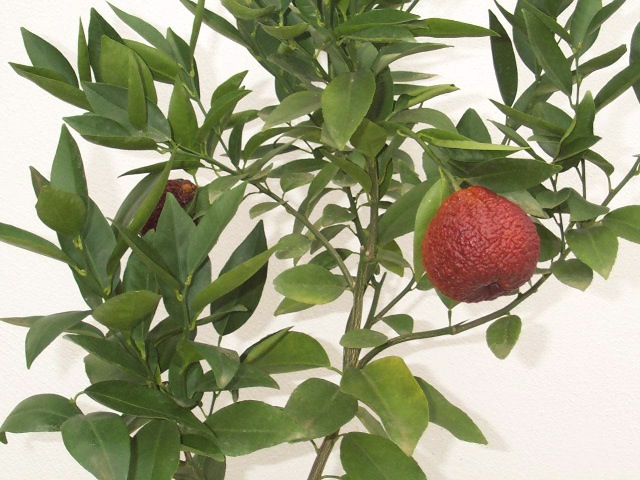 | | 2009 | DEVELOPED | 1990 | | | | | Cultivar | This accession was apparently developed and selected by ISA for use in the ornamental market. See Abstracts of the XLVI Italian Society of Agricultural Genetics Annual Congress 2002. This is a budwood introduction of the same genotype as RRUT 289. It should therefore be truer to type and not have juvenility issues. RRUT 289 should be considered for de-accessioning when (and if) RRUT 455 is released from quarantine and evaluated. (RR Krueger, 09/02/2010) | 1846910 | RRUT 455 |
| 67 | RRUT 444 | 'Sunki' | Citrus ×aurantium L. var. chrysocarpa (Hassk.) ined. | China | RIV | | | 2009 | DONATED | 1922 | | | | | Cultivar | This accession was obtained at the request of personnel from the laboratory of Prof Mikeal Roose of the Dept of Botany and Plant Science, University of California, Riverside. The existing accession of 'Sunki' at Riverside, PI 539678/RCRC 3143, showed some inconsistencies with progeny from a 'Sunki' cross. Preliminary results from Prof Roose's lab have confirmed that RRUT 444 is indeed different than PI 539678. This accession was received from the US Horticultural Research Laboratory from a tree propagated from a tree formerly at the Whitmore Foundation Farm (WFF). The USHRL accession at WFF is stated in the WFF Accession Book to be "cpb-1-174 = fortunella sp plant china 1922". Another section in the Accession Book refers to "cpb 10174". The admitedly incomplete list of CPB numbers on file at NCGRCD does not show a CPB 1-174; however, it does show a CPB 10174 which is indeed stated to be "C japonica 'seedless kumquat'". The archival records also equate CPB 10174 with RCRC 2377. RCRC 2377 is an inactive accession at Riverside as of 1986. However, archival records for RCRC 2377 state: "This is not a kumquat...resembles a small mandarin." (comment by WP Bitters, ca 1969). This suggests that at some point, this accession of 'Sunki' was mislabelled as a seedless kumquat. A personal communication from Dr KD Bowman of USHRL received 07/08/2009 states: "Sunki is a small fruited mandarin that I have used in many crosses. I don't think it would be mistaken for kumquat by anyone very familiar with citrus. The oldest Sunki tree at Whitmore, 9E-2-22, is what I have used for most of my crosses. Regarding the greenhouse source of Sunki sent to you, I haven't seen it and can't offer much comment on that. The plant you indicated as the field source of the greenhouse tree, 9W-2-16, no longer exists at that location. That 9W-2-16 tree was moved to another location and appears to be typical of our 9E-2-22 Sunki at that new location. I would put more weight on the characteristics of our Sunki in the field than I would on any historical records about CPB numbers." Thus it appears that this is a legitimate accession of 'Sunki' irregardless of any documentation errors. More information on 'Sunki' and a summary of its rootstock characteristics is available at PI 539678/RCRC 3143. (RR Krueger, 07/08/2009) | 1802000 | RRUT 444 |
| 68 | RCRC 4198 | 'China S-20' | Citrus ×aurantium L. var. chrysocarpa (Hassk.) ined. | Sichuan Sheng, China | RIV | | | 2008 | DONATED | 08/28/1995 | | | | | Cultivar | Collector rated "acceptable" tree vigor and fruit quality and "good" cold hardiness. Additional information on the Chinese satsumas is available in this summary of a conversation between Tracy Kahn and Billl Dozier. This accession has not been well characterized under California conditions. (RR Krueger, 06/12/2010) | 1815276 | RCRC 4198 |
| 69 | RCRC 4199 | 'China 6-18' | Citrus ×aurantium L. var. chrysocarpa (Hassk.) ined. | Sichuan Sheng, China | RIV | | | 2008 | DONATED | 10/16/1998 | | | | | Cultivar | Another one of the satsumas imported from China by Huang and Dozier. Additional information on the Chinese satsumas is available in this summary of a conversation between Tracy Kahn and Billl Dozier. This accession has not been well characterized under California conditions. (RR Krueger, 06/12/2010) | 1815277 | RCRC 4199 |
| 70 | RRUT 374 | USDA 1-105-106 | Citrus ×aurantium L. var. chrysocarpa (Hassk.) ined. | Florida, United States | RIV | | | 2007 | DEVELOPED | | | | | | Cultivar | Stated to be a "juicing tangor" "'with deep orange color, produces extremely high quality juice" by donor. Reintroduction of RRUT 285 (did not establish) and 318 (perished in the Great Greenhouse Meltdown of 2007). (RRK, 09/2007) | 1737403 | RRUT 374 |
| 71 | RRUT 269 | Temple #4 (4N) | Citrus ×aurantium L. var. chrysocarpa (Hassk.) ined. | Florida, United States | RIV | | | 2002 | DEVELOPED | 1970 | | | | | Breeding material | This is one of several putative tetraploids developed by Herb Barrett that were sent to Riverside at some point, presumably due to a lack of interest or resources to maintain them in Orlando. Not all of these apparent tetraploids are actually 4N, according to Tim Williams. Only those designed as 4N by TEW were incorporated into the NCGRCD holdings. A more exact determination should be made at some point. (RR Krueger, 02-05-2009) | 1793555 | RRUT 269 |
| 72 | RCRC 4148 | 'Wincia' | Citrus ×aurantium L. var. chrysocarpa (Hassk.) ined. | | RIV | | | 2002 | DEVELOPED | 1930 | | | | | Cultivar | | 1830320 | RCRC 4148 |
| 73 | RCRC 4237 | 'Amoa 8' | Citrus ×aurantium L. var. chrysocarpa (Hassk.) ined. | Sicilia, Italy | RIV | | | 2002 | DEVELOPED | 1990 | | | | | Cultivar | This accession was apparently developed and selected by ISA for use in the ornamental market. See Abstracts of the XLVI Italian Society of Agricultural Genetics Annual Congress 2002. Planted in field for observation, 06/2007. (RRK, 06/2007) A more recent budwood introduction of this genotype is RRUT 455. As a budwood introduction, RRUT 455 may be truer to type and not have juvenility issues. Therefore, RRUT 289 should be considered for de-accessioning when (and if) RRUT 455 is released from quarantine and evaluated. (RR Krueger, 09/02/2010) | 1729196 | RCRC 4237 |
| 74 | RRUT 152 | 'Fuju (1-10-17)' | Citrus ×aurantium L. var. chrysocarpa (Hassk.) ined. | Sichuan Sheng, China | RIV | | | 2001 | DONATED | 03/19/1985 | | | | | Cultivar | This appeared identical to the seed introduction of 'Fuju' (RRUT 82) by ISSR in 2001 (Krueger and Roose, Journal of ASHS, 128:827-837, 2003). | 1698248 | RRUT 152 |
| 75 | RRUT 81 | 'Suanju nucellar' | Citrus ×aurantium L. var. chrysocarpa (Hassk.) ined. | China | RIV | | | 1998 | DONATED | 03/10/1998 | | | | | Cultivar | "t is grown in Guangdong and Guangxi as a rootstock for sweet oranges and mandarins in hilly areas." "Wild type used as rootstocks." (donor'snotes) (RR Krueger, 01/30/2010) | 1829355 | RRUT 81 |
| 76 | RRUT 32 | 'Temple 4N' | Citrus ×aurantium L. var. chrysocarpa (Hassk.) ined. | Florida, United States | RIV | | | 1993 | DEVELOPED | 1960 | | | | | Breeding material | This accession was one of various tetraploids received at UC Riverside from the USDA-ARS USHRL, Orlando, FL, in the 1970's in order to preserve them. The provenance of this accession is somewhat suspect and when it has been verified that another propagation of the source has been made, this should probably be de-accessioned. (RR Krueger, 09/12/2010) | 1847418 | RRUT 32 |