| 0 | W6 57393 | NEWFS-306 | Laportea canadensis (L.) Wedd. | Massachusetts, United States | W6 | 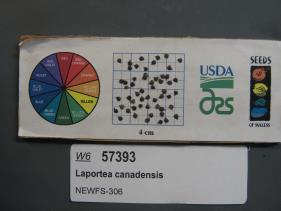 | | 2019 | | | | | | | Wild material | | 2098190 | W6 57393 |
| 1 | W6 61417 | CBG- 10852 | Verbesina alternifolia (L.) Britton ex Kearney | Illinois, United States | W6 |  | | 2023 | | | | | | | Wild material | | 2142299 | W6 61417 |
| 2 | W6 61418 | CBG- 10853 | Agastache scrophulariifolia (Willd.) Kuntze | Illinois, United States | W6 |  | | 2023 | | | | | | | Wild material | | 2142300 | W6 61418 |
| 3 | Ames 35887 | JDC/MR/2022/034/1014 | Morus rubra L. | Iowa, United States | NC7 |  | | 2022 | COLLECTED | 07/12/2022 | Waubonsie State Park located north, northwest of Hamburg, T68N R42W Sec. 29 and Sec. 32. | 40.67552500, -95.68690400 | 355 | Mid slope (ranging from 10-30 degrees) to base of slopes and along all drainages and valleys of deciduous woods. | Wild material | The native range for Red Mulberry is reported from the eastern margin of the Great Plains, extending north to southern Ontario, Canada, and distributed as far south as southern Florida (Little, 1971). Conservation assessments in North America indicate current (2026) and future concern for the species including Michigan (threatened); Massachusetts (endangered); Ontario Canada (endangered); with NatureServe's 2025 global G5 rank due to genetic swamping and habitat pressure. Red Mulberry seems to be extremely localized to moist, floodplain areas that are high-quality bottomland forests. This accession represents genetics collected from the northwestern edge of the species native range. Specimens sampled in nature displayed the following morphological characters: acuminate leaf tips, impressed veins, pubescent upper and lower leaves, flaky bark (often with tiny pin holes (insect emergence holes)), cordate leaf base, and umbrella-shaped growth habit. M. rubra specimens noted ranged in size from 1"-23" inches DBH with some of the tallest specimens reaching 70' in height. The largest specimen sampled (#172-13) measuring 23.25" DBH. Estimated hundreds, perhaps a thousand specimens of M. rubra noted within the park with very little representation of hybrids or Morus alba. Representation of M. rubra outside of park boundaries is near completely absent and the presence of hybrids and M. alba is extremely evident. Soluble solids content from fruits collected in the wild ranged from 19.0-32.9 degrees Brix. This range of Brix values is likely a result of genetic diversity and also variation in maturity of fruits. Fruits selected for Brix measurements were black in color. The specimen sampled with the highest Brix value was #172-9. All M. rubra specimens noted at time of sampling (12 July 2022) were exhibiting determinate growth compared to local hybrids and M. alba, which were still actively growing with newly emerging leaves. The first study (Adhikari et al. 2026) on the mitogenome of M. rubra utilized sample #172-13 (Ames 35887 Tree #13) reporting 359,221 base pairs (bp) long with 45.8% GC content, comprising 57 genes: 32 protein-coding, 21 transfer, and four ribosomal RNAs. | 2138220 | Ames 35887 |
| 4 | W6 59167 | CBG-10451 | Carex hyalinolepis Steud. | Illinois, United States | W6 | | | 2021 | | | | | | | Wild material | | 2120198 | W6 59167 |
| 5 | W6 59232 | CBG-10542 | Agastache nepetoides (L.) Kuntze | Illinois, United States | W6 | | | 2021 | | | | | | | Wild material | Plant numbers estimated. | 2120146 | W6 59232 |
| 6 | Ames 35601 | Ames 35601 | Blephilia hirsuta (Pursh) Benth. | Iowa, United States | NC7 |  | | 2020 | COLLECTED | 10/16/2020 | Trout Run Trail along the Upper Iowa River located on the western edge of Decorah, T98N R8W SW1/4 Sec. 16, Winneshiek County | 43.30129700, -91.79717100 | 265 | Low woods | Wild material | Leaves with a pleasant minty odor when crushed. Stems, peitoles, and leaves very pubescent. Plants in nature (northeast Iowa) peaked flower on 11 July 2020. | 2107897 | Ames 35601 |
| 7 | OPGC 7949 | NEWFS-307 | Eutrochium maculatum (L.) E. E. Lamont | Massachusetts, United States | OPGC |  | | 2019 | | | | | | | Wild material | | 2098191 | OPGC 7949 |
| 8 | W6 57384 | NEWFS-276 | Juncus effusus L. | Massachusetts, United States | W6 |  | | 2019 | | | | | | | Wild material | | 2098181 | W6 57384 |
| 9 | Ames 35232 | Ames 35232 | Ptelea trifoliata L. | Illinois, United States | NC7 |  | | 2019 | COLLECTED | 10/01/2019 | Rock Creek watershed located approximately 4.5 miles southwest of Athens, T17N R6W SE1/4 SW1/4 Sec. 8 | 39.93164600, -89.80193000 | 159 | Creek banks, floodplain, and fence rows (north and west facing slopes) | Wild material | | 2097768 | Ames 35232 |
| 10 | WLP 156 | NACPEC19-022 | Oxydendrum arboreum (L.) DC. | Kentucky, United States | NA | | | 2019 | COLLECTED | 09/09/2019 | Madison County; Berea College Forest: Around the corner from Upper Indian Fort Trail Junction, on top of the Davis Hollow "holler" | 37.56414400, -84.23341800 | 477 | Sandstone outcrop, incredibly thin, low pH <4. Very heavy foot traffic | Wild material | | 2110468 | WLP 156 |
| 11 | Ames 35216 | Potato Creek SP | Monarda sp. | Indiana, United States | NC7 |  | | 2019 | COLLECTED | 09/02/2019 | Potato Creek State Park located approximately 2.6 miles northeast of North Liberty, T36N R1E extreme eastern edge of NW 1/4 SW 1/4 Sec. 23. | 41.55439400, -86.38375900 | 222 | Degraded floodplain, along sides of elevated road bed. | Wild material | This taxa is currently undescribed and according to Campbell and Medley in The atlas of vascular plants in Kentucky (Accessed 06 September 2019) was provisionally named Monarda serotina by R.T. Simmers. Described as a broad-leaved form of M. fistulosa, generally intermediate between M. fistulosa and M. clinopodia, with probable hybrid origin. Typcial habitat is mesic woods and edges on lowlands. In contrast to M. fistulosa, this taxon has longer petioles (usually 2-3 cm versus 0.5-2.0 cm), lower leaf surfaces with scattered spreading hairs, and corollas are paler pink at tips to almost white with peak flowering occurring prior to M. fistulosa by approximately 1-2 weeks. Leaves are rather rugose, where upper leaf tissue between veins is visibly raised. This accession represents genetics from northern Indiana (Potato Creek State Park). Plants at the collection site in nature peaked flowering near 8 July 2019 where flower colors were more lavender in sun but pale in shade (Namestnik, S., personal communication, 15 July 2020). Peak fruiting occurs mid-August. Average height of plants sampled in nature estimated at 4.5' in height. | 2097752 | Ames 35216 |
| 12 | OPGC 6391 | CBG-7403 | Lobelia cardinalis L. | Washington, United States | OPGC |  | | 2017 | | | | | | | Wild material | | 1954824 | OPGC 6391 |
| 13 | OPGC 7774 | CBG-7496 | Senecio suaveolens (L.) Elliott | Wisconsin, United States | OPGC |  | | 2017 | | | | | | | Wild material | | 1954811 | OPGC 7774 |
| 14 | W6 53089 | CBG-7114 | Osmorhiza longistylis (Torr.) DC. | Illinois, United States | W6 |  | | 2017 | | | | | | | Wild material | | 1954840 | W6 53089 |
| 15 | Ames 34032 | Ames 34032 | Monarda didyma L. | West Virginia, United States | NC7 |  | | 2017 | COLLECTED | 08/17/2017 | Fernow Forest approximately 3.6 miles east, southeast of Parsons along Road 701 adjacent to Elklick Run Creek, Tucker County. | 39.04350000, -79.67683300 | 703 | Allegheny Plateau. Mixed mesophytic forest, riparian area. | Wild material | | 1954321 | Ames 34032 |
| 16 | Ames 34033 | Ames 34033 | Monarda didyma L. | West Virginia, United States | NC7 |  | | 2017 | COLLECTED | 09/02/2017 | Monongahela National Forest along Road 1678 following Sutton Run Creek aproximately 4.3 miles east of Green Bank, Pocahontas County. | 38.40400000, -79.75550000 | 1001 | Wet/mesic forested, riparian area. | Wild material | | 1954322 | Ames 34033 |
| 17 | W6 49534 | CBG-2475 | Carex stipata Muhl. ex Willd. | Illinois, United States | W6 |  | | 2015 | | | | | | | Wild material | | 1926011 | W6 49534 |
| 18 | Ames 2917 | JDC/GD/2013/001/445 | Gymnocladus dioicus (L.) K. Koch | Illinois, United States | NC7 |  | | 1984 | COLLECTED | 08/26/1982 | East bank of the Mazon River, SE 1/4 of SW 1/4 of Section 12, T33N R7E, Morris Quad, Grundy County. | 41.34600000, -88.37740000 | 159 | Mesic floodplain forest. | Wild material | Large tree. | 1022538 | Ames 2917 |