| 0 | PI 610977 | Acc:412 | Leymus triticoides (Buckley) Pilg. | Utah, United States | W6 | | | 1995 | COLLECTED | | Majors flat, San Pete County. | | | | Wild material | | 1484375 | PI 610977 |
| 1 | PI 537357 | A-11 | Leymus triticoides (Buckley) Pilg. | Nevada, United States | W6 | | | 1989 | COLLECTED | 1975 | 1.6km E of Valmy | | | | Wild material | | 1432293 | PI 537357 |
| 2 | PI 537358 | A-19 | Leymus triticoides (Buckley) Pilg. | Nevada, United States | W6 | | | 1989 | COLLECTED | 1975 | Hwy 140, 17.6km S of Orovada | | | | Wild material | | 1432294 | PI 537358 |
| 3 | PI 537360 | A-31 | Leymus triticoides (Buckley) Pilg. | Idaho, United States | W6 | | | 1989 | COLLECTED | 1975 | Hwy 78, 3.2km S of Melba | | | | Wild material | | 1432296 | PI 537360 |
| 4 | PI 516193 | T-414 | Leymus triticoides (Buckley) Pilg. | Nevada, United States | W6 | | | 1988 | COLLECTED | 07/22/1987 | Farmstead, 3.2km W of highways 95 and 140 junction, N of Winnemucca. | 41.40000000, -117.83333333 | | | Wild material | Plant stand solid. Seed set good. | 1411129 | PI 516193 |
| 5 | PI 516194 | T-417 | Leymus triticoides (Buckley) Pilg. | Oregon, United States | W6 | | | 1988 | COLLECTED | 07/22/1987 | Bridge, E of road, N of French Glen. | 42.88333333, -118.88333333 | | | Wild material | Seed set good. | 1411130 | PI 516194 |
| 6 | PI 516195 | T-484 | Leymus triticoides (Buckley) Pilg. | Nevada, United States | W6 | | | 1988 | COLLECTED | 07/22/1987 | Pasture along creek, 3400 W. Winnemucca Blvd., Winnemucca. | 40.95000000, -117.75000000 | | | Wild material | Plant stand solid. | 1411131 | PI 516195 |
| 7 | PI 490360 | 'Rio' | Leymus triticoides (Buckley) Pilg. | California, United States | W6 | | | 1984 | DONATED | 07/1984 | | | | | Wild material | Collected by C. Finch and E. Eaton. Used for stabilizing stream banks, waterways and levees. Plants vigorous, agressive, productive in Mediterranean climate area of California. | 1385296 | PI 490360 |
| 8 | PI 434040 | 'Shoshone' | Leymus triticoides (Buckley) Pilg. | Wyoming, United States | W6 | | | 1979 | COLLECTED | | Saline area along the Wind River, southern outskirts of Riverton | | | | Cultivar | Shoshone beardless wildrye is a strongly rhizomatous, perennial grass adapted to wet, saline soil conditions. The rhizomes are covered with a dark brown papery coating, with few root hairs between root nodes. Once established either by seeding or sprigging, Shoshone is capable of spreading into even stronger saline soils. The hard seed coat, in part, creates both a physical and physiological seed dormancy, requiring that the seed be planted only in the late fall or winter. Wet, cold conditions are necessary to trigger germination. Shoshone has a shorter stature of 60-100 cm and is leafier than the native beardless wild rye. The majority of the leaves are basal or low on the seed-bearing culm. Leaves are light green to a yellowish-green. The seed-head of Shoshone are more compact with much shorter lemma awns. The seed of Shoshone does not shatter when mature, allowing direct-cut combining of seed. Shoshone has approximately 400 seeds per gram. | 1328976 | PI 434040 |
| 9 | PI 578750 | P-2741 | Leymus triticoides (Buckley) Pilg. | Washington, United States | W6 | | | 1977 | DONATED | 1977 | | | | | Breeding material | | 1473721 | PI 578750 |
| 10 | PI 578749 | P 15594 | Leymus triticoides (Buckley) Pilg. | Montana, United States | W6 | | | 1970 | DONATED | 1970 | | | | | Cultivar | | 1473720 | PI 578749 |
| 11 | W6 62795 | DCA00-10 | Leymus triticoides (Buckley) Pilg. | California, United States | W6 |  | | 2025 | | | | | | | Wild material | | 2193092 | W6 62795 |
| 12 | W6 51905 | OR010-294 | Leymus triticoides (Buckley) Pilg. | Ohio, United States | W6 | | | 2017 | | | | | | | Wild material | | 1947038 | W6 51905 |
| 13 | W6 30225 | CA170-56 | Leymus triticoides (Buckley) Pilg. | California, United States | W6 |  | | 2007 | | | | | | | Wild material | | 1719008 | W6 30225 |
| 14 | PI 701909 | 'L-74X' | Leymus hybr. | Utah, United States | W6 | | | 2023 | DEVELOPED | | | | | | | Basin wildrye is somewhat indeterminate and shatters its seed. To avoid shattering losses, growers tend to harvest basin wildrye seed prior to maximal physiological maturity. To resolve the intersecting problems of floral indeterminacy and seed shattering, USDA-ARS released the L-74X basin wildrye X creeping wildrye germplasm on August 26, 2021. While L-74X has a narrow genetic base due to a biparental cross in its history, it can be used to introgress the non-shattering recessive sh6 allele of creeping wildrye (2n = 4x = 28) into 4x basin wildrye and closely related 4x Leymus species. L-74X originated with hybridization between 4x populations of basin wildrye and creeping wildrye, while eight generations of recombination and natural selection restored fertility to the interspecific hybrid. Intentional selection led to fixation of the sh6 allele. Averaged across two years, shattering genotypes (Sh6/sh6) averaged 19.4% greater (P < 0.05) seed yield per spike 23 days after pollination (DAP), but by 95 DAP non-shattering genotypes (sh6/sh6) averaged 167% greater (P < 0.05) seed yield per spike. Germination increased from 72.1% at 23 DAP to 86.4% at 95 DAP. The sh6 allele allows seed growers to delay seed harvest, concomitantly reducing shattering losses and improving physiological seed quality | 2141276 | PI 701909 |
| 15 | PI 547121 | T-56 | Leymus hybr. | Nevada, United States | W6 | | | 1990 | COLLECTED | 07/23/1986 | Secret Pass | | | | Wild material | | 1442057 | PI 547121 |
| 16 | PI 537362 | T-45 | Leymus hybr. | Nevada, United States | W6 | | | 1989 | COLLECTED | 07/22/1986 | North side of Eureka | | | | Wild material | | 1432298 | PI 537362 |
| 17 | PI 537363 | T-48 | Leymus hybr. | Nevada, United States | W6 | | | 1989 | COLLECTED | 07/22/1986 | N of Eureka | | | | Wild material | | 1432299 | PI 537363 |
| 18 | W6 62494 | DCA00-14 | Phyla nodiflora (L.) Greene | California, United States | W6 | 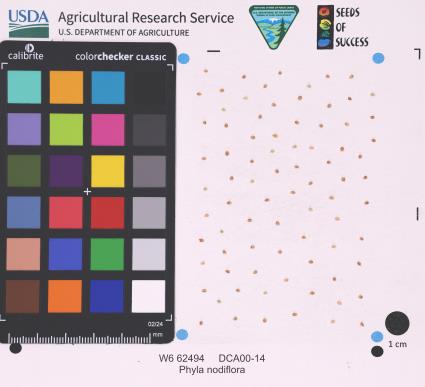 | | 2025 | | | | | | | Wild material | | 2192192 | W6 62494 |
| 19 | W6 62800 | DCA00-7 | Heliotropium curassavicum L. | California, United States | W6 |  | | 2025 | | | | | | | Wild material | | 2193097 | W6 62800 |
| 20 | W6 62801 | DCA00-9 | Carex barbarae Dewey | California, United States | W6 |  | | 2025 | | | | | | | Wild material | | 2193098 | W6 62801 |
| 21 | W6 61556 | CA340-45 | Achillea millefolium L. | California, United States | W6 |  | | 2024 | | | | | | | Wild material | More of this population is scattered along banks of Panther Creek | 2168005 | W6 61556 |
| 22 | W6 58432 | CA190B-142 | Trifolium barbigerum Torr. | California, United States | W6 | | | 2020 | | | | | | | Wild material | The stipules on lvs are large and variable in shape. The flowers are held in a bowl-shaped involucre of bracts with toothed edges.ûDensely hairy involucre, larger heads (as compared to TRMI4) | 2110326 | W6 58432 |
| 23 | W6 58436 | CA190B-147 | Trifolium polyodon Greene | California, United States | W6 | | | 2020 | | | | | | | Wild material | Trifolium polydon differs from Trifolium varigatum in field by the calyx lobes. The TRPO3 has calyx lobes with shoulders and the TRVA does not have shoulders. ûLight pink uni-colored flowers, lobed sepal lobes, flat involucre. | 2110330 | W6 58436 |
| 24 | W6 58454 | CA190B-169 | Juncus sp. | California, United States | W6 | | | 2020 | | | | | | | Wild material | Received as Juncus phaeocephalus var. phaeocephalus | 2110348 | W6 58454 |
| 25 | OPGC 8064 | OR010-396 | Calochortus macrocarpus Douglas | Oregon, United States | OPGC | | | 2020 | | | | | | | Wild material | Purple perianth, with 3 distinct petals and 3 narrow lance-like sepals. Yellow anthers along interior of petals. Nectary is bearded and triangular/sagittate in shape. Flowers usually come in pairs. | 2107493 | OPGC 8064 |
| 26 | W6 56445 | CA190B-138 | Nassella pulchra (Hitchc.) Barkworth | California, United States | W6 |  | | 2019 | | | | | | | Wild material | | 2091948 | W6 56445 |