| 0 | PI 665772 | Ya Li seedling China source | Pyrus ×bretschneideri Rehder | China | COR | | | 2012 | COLLECTED | 02/2011 | | | | | Clone | Seedling population grown from seed of 3 Ya Li fruit of Chinese origin purchased at Asian Market in Portland, Oregon. Seed germinated spring 2011. | 1901304 | PI 665772 |
| 1 | PI 654960 | Syan Li | Pyrus ×bretschneideri Rehder | Kazakhstan | COR | | | 1993 | DONATED | 03/23/1993 | | | | | Rootstock | Rootstock cultivar. Cultivar name indicates Asian origin. Characterized by excellent root system in nursery and high yield of seedlings. | 1098670 | PI 654960 |
| 2 | PI 688090 | 'Xuehuali' | Pyrus ×bretschneideri Rehder | Hebei Sheng, China | COR | | | 1989 | DONATED | 03/29/1989 | | | | | Cultivar | Xuehuali (Snowflake) - This is one of the most popular Chinese pear cultivars in China. It has been extensively grown in Shijiazhuang district , Hebei province. It was a chance seedling. Xuehuali matures in mid-late September. The fruits are are very large, generally weighing around 30 g, broad-ovate in shape with a long stem (5.5-6.3 cm long), greenish-yellow to golden yellow in color; the flesh is white, firm, crisp, juicy, very sweet, with a few grit cells around the core, best of eating quality. The fruit keeps very long, it can be stored in the common cellars to may. The tree grows moderately vigorous, bears early and crops heavily. This cultivar is a good pollinator for Ya Li. Its productivity is not as high as Ya Li, but many people prefer its large fruit and richer sweeter flavor. -- Wang Yu-Lin, 1996 | 1095333 | PI 688090 |
| 3 | PI 506362 | 'Ya Li' | Pyrus ×bretschneideri Rehder | China | COR |  | | 1987 | DEVELOPED | | | | | | Cultivar | Ya Li (English Translation = Duck Pear) (PI 506362).--Orig. unknown. Old cultivar from Northeast China. Fruit: large, 70 mm diam., 82 mm long, globular-pyriform, neck may be obscure; light green to yellow, clean, waxy, small lenticels, free of russet; white flesh is crisp, juicy, sweet, fragrant; stem curved, often fleshy and off-center; ripe mid-late September in Oregon; stores 24 weeks. Tree: large, upright, vigorous, very early bloom, requires early pollinator. Cold hardy yet low chilling requirement, about 350-500 hours. - Brooks and Olmo Register of Fruit and Nut Varieties. Ya Li is commonly cultivated in Shansi, Hopeh, Shantung, and Honan Provinces of Northeastern China. The tree is large, vigorous, spreading, dense, and productive. The bark is smooth with dark, greenish-brown under-color overlaid with thin, shedding, grayish-white cork tissue. Petioles of young leaves may have one or more needle-like stipules on ventral side near the base of the blade that slough off as the leaves age. Ya Li cultivar is self-incompatible and self-unfruitful in most years. It requires cross-pollination to yield fruits at commercial magnitude. Such cross-pollination can be accomplished with Twentieth Century, Kikusui, Chojuro, Bartlett, Shinseiki, or Tsu Li to yield good fruit-sets. | 1401298 | PI 506362 |
| 4 | PI 542023 | 'Tsu Li' | Pyrus ×bretschneideri Rehder | China | COR |  | | 1986 | DEVELOPED | | | | | | Cultivar | Tse Li (Ts Li) --Grown in Shantung Province, Northern China for thousands of years. Fruit: large, 75 mm diam., 89 mm long, ovate-pyriform with no distinct neck, irregular, lumpy; yellow with large prominent tan lenticels; crisp, juicy, sweet, trace of tartness, distinct aroma; ripe mid-late September in Oregon, 4 weeks after Nijisseiki; stores 25 weeks at 0 C. Tree: large, upright, very early bloom, requires early blooming pollinator such as Ya Li. Cold hardy yet low chilling requirement, about 350-500 hours. -- Brooks and Olmo Register of Fruit and Nut Varieties. Hu (1937) reported that Tsu Li is an old and famous variety in the Shantung Province of Northeastern China, and that production is restricted to the Chucheng, Laiyang, and Penglai districts. Kubo (1970) stated that Tsu Li was introduced into Japan from Laiyang in 1912 by Tetsuya Onta. -- W.H. Griggs and B.T. Awakiri. 1977. Asian Pear Varieties in California This clone was introduced as PI 224088 with the spelling 'Tzu Li' in March 1955 from Tokyo University, Hongo, Tokyo, Japan. Obtained by University of California at Davis in 1957. -- Griggs and Awakiri. 1977 | 1436959 | PI 542023 |
| 5 | PI 542022 | 'Hsiang Sui Li' | Pyrus ×bretschneideri Rehder | Liaoning Sheng, China | COR |  | | 1986 | DEVELOPED | | | | | | Cultivar | Very blight resistant | 1436958 | PI 542022 |
| 6 | PI 665784 | 'Shian-Sui-Li' | Pyrus ×bretschneideri Rehder | China | COR | 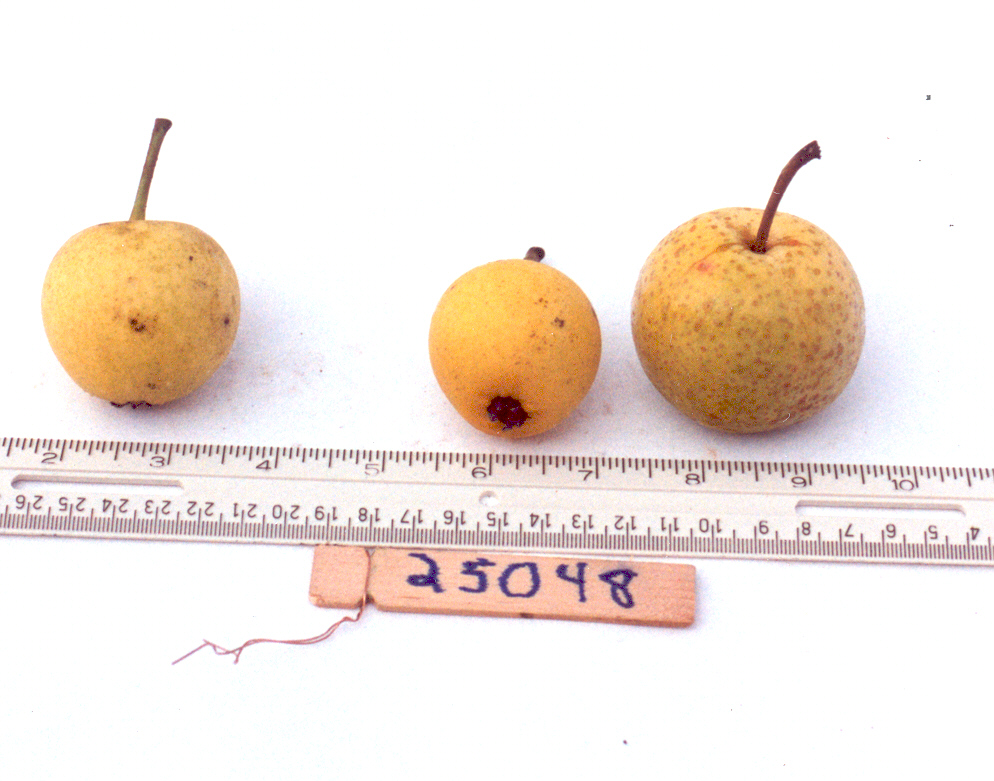 | | 1984 | COLLECTED | | | | | | Cultivar | | 1090860 | PI 665784 |
| 7 | PI 144035 | 'Laioyang 50' | Pyrus ×bretschneideri Rehder | Manitoba, Canada | COR |  | | 1984 | DEVELOPED | | | | | | Cultivar | | 1135787 | PI 144035 |
| 8 | PI 654922 | 'Tsu Li #2' | Pyrus ×bretschneideri Rehder | Liaoning Sheng, China | COR | | | 1984 | DONATED | 03/05/1984 | | | | | | | 1090026 | PI 654922 |
| 9 | PI 267863 | 'Pingo Li' | Pyrus ×bretschneideri Rehder | Jilin Sheng, China | COR |  | | 1981 | DEVELOPED | | | | | | Cultivar | | 1201589 | PI 267863 |
| 10 | PI 312509 | 'Tse Li' | Pyrus ×bretschneideri Rehder | Shandong Sheng, China | COR |  | | 1981 | DEVELOPED | | | | | | Cultivar | PI 312509 was received by the USDA Plant Industry Station, Beltsville, Maryland on Mary 17, 1968. Scions were presented by the Research Institute of Pomology, Skierniewice, Poland. Tse Li (Ts Li) (PI 312509).--Grown in Shantung Province, Northern China for thousands of years. Fruit: large, 75 mm diam., 89 mm long, ovate-pyriform with no distinct neck, irregular, lumpy; yellow with large prominent tan lenticels; crisp, juicy, sweet, trace of tartness, distinct aroma; ripe mid-late September in Oregon, 4 weeks after Nijisseiki; stores 25 weeks at 0 C. Tree: large, upright, very early bloom, requires early blooming pollinator such as Ya Li. Cold hardy yet low chilling requirement, about 350-500 hours. -- Brooks and Olmo Registe of Fruit and Nut Varieties. Hu (1937) reported that Tsu Li is an old and famous variety in the Shantung Province of Northeastern China, and that production is restricted to the Chucheng, Laiyang, and penglai districts. Kubo (1970) stated that Tsu Li was introduced into Japan from Laiyang in 1912 by Tetsuya Onta. -- W.H. Griggs and B.T. Awakiri. 1977. Asian Pear Varieties in California Description: This plant can be found in northern and northeastern China, eastern Siberia, Manchuria, Korea, Amurland, and Ussuri. It is an old and famous cultivar in Shantung Province of Northeastern China. In the United States, Tse Li receives much attention due to its tendency to be resistant to fire-blight. However, because of its slow growth rate the USDA discouraged its use. The tree is large, vigorous, dense, and moderately productive. The fruit varies in size and shape. It can be found as ovate-pyriform in longitudinal section and circular to angular in transverse section. The tree is self-incompatible and self-unfruitful in most years. It requires cross-pollination for commercial fruit-set, and Ya Li pollen appears to serve this purpose best. | 1233249 | PI 312509 |
| 11 | PI 541999 | 'Ping Ding Li' | Pyrus ×bretschneideri Rehder | China | COR |  | | 1981 | DEVELOPED | | | | | | Cultivar | | 1436935 | PI 541999 |
| 12 | PI 45845 | 'Yaguang Li' | Pyrus ×bretschneideri Rehder | Hebei Sheng, China | COR |  | | 1918 | DEVELOPED | | | | | | Cultivar | When judged by American tastes and standards, the Ya Kuang Li is unquestionably the finest variety of China. It resembles the better American or European pears in tenderness, juiciness, flavor, and quality more closely than any other pear in China. In quality, it is equaled by only one other Oriental pear -- the famous Peking Pai Li. It is equal in this respect to our better American varieties, and certainly as good if not better than our Bartlett. It is large, somewhat variable in shape, although usually somewhat quince-shaped. The color is an attractive cinnamon yellow. The calyx is always persistent. The skin is rather thick and slightly rough. The flesh is tender, melting, juicy, creamy white in color, and grit cells not noticeable in eating. excepting around the core. It is aromatic, sweet with slight acidity, sprightly, very agreeable. This variety is grown only in northern China. The fruit is found on the peking market from early October until the first of January, and is one of the three most popular varieties on that market. I regard this as the most promising Oriental variety ever introduced into this country. While the variety is good enough to introduce and grow just as it is, it may prove of even greater value for breeding purposes. This variety certainly contains considerable P. ussuriensis blood. It may have derived solely from that species, although it appears to be a hybrid between this and some other species. Judging from this, we should expect it to shoe a high degree of resistance to pear blight, and should prove valuable in breeding new blight resistant varieties. Inoculation experiments have shown that it blights in the young shoots but appears to be very resistant in the older wood. Judging from its parentage, it should also prove valuable in breeding hardy varieties for cold regions. The tree is a vigorous, rather spreading grower. -- F.C. Reimer. 1919. Report of a trip to the Orient to collect and study Oriental pears. | 1106052 | PI 45845 |
| 13 | PI 688184 | 'Dangshan Su Li' | Pyrus ussuriensis Maxim. & Rupr. | China | COR | 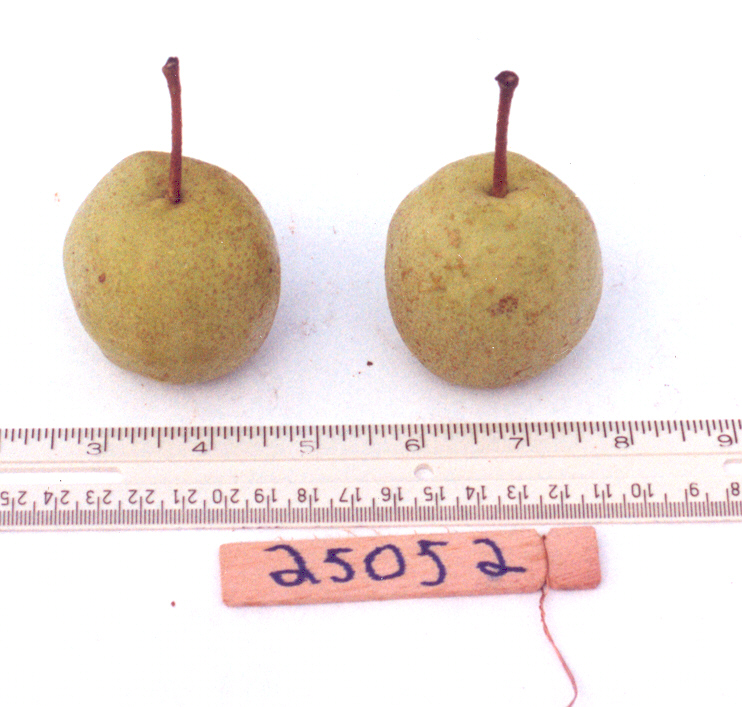 | | 1991 | DEVELOPED | | | | | | Cultivar | Su Li pear from Dang Shan. In China this pear is also called 'Su Li' -- Pu Fu Shen. Pomologist Ma Shu Shang from Northwestern University in Xion provides the description: Dang-shan Su Li (Pyrus bretschneideri) originated from the Dang Shan area of Anhui Province (Dang Mountain Crispy Pear). Trees bloom at the beginning of April...fruit is mature Sept 20. Size is 200-250 grams. Long storage until March-April in caves. Su Li is the most important variety in northwestern China. In 2002 there was 700,000 mu producing 400,000 tons in Shaanxi Province.' -- info from John Wells, Hood River Grower Shipper Association, 11/2003. | 1020475 | PI 688184 |
| 14 | PI 541990 | 'Huang Hsiang Sui Li' | Pyrus ussuriensis Maxim. & Rupr. | Shandong Sheng, China | COR |  | | 1981 | DEVELOPED | 1918 | | | | | Cultivar | Very blight resistant, fruit quality poor | 1436926 | PI 541990 |