| 0 | PI 617646 | 'Bradford' | Pyrus ×calleryana Decne. | Maryland, United States | COR |  | | 1996 | DEVELOPED | | | | | | Cultivar | Clone from IR-2, Prosser, Washington. Prosser obtained from USDA, Glenn Dale, Maryland in 1980. Attractive in early spring when it blooms, easily trained, good autumn foliage color, very adaptible to range of conds. This virus free accession replaces virus infected CPYR 2184. | 1522025 | PI 617646 |
| 1 | PI 617533 | 'Cleveland Select' | Pyrus ×calleryana Decne. | Ohio, United States | COR | | | 1990 | DEVELOPED | | | | | | Cultivar | Ornamental P. calleryana cultivar. Named for the city of Cleveland, Ohio, where it presumably originated. Probably derived from a street tree in Cleveland, Ohio. May be synonymous with Chanticleer. Tree is evenly branched with a conical crown shape and has very glossy summer foilage, and nice reddish fall color. Along with 'Aristocrat' it is considered one of the hardiest P. calleryana cultivars. | 1019688 | PI 617533 |
| 2 | PI 541104 | 'Redspire' | Pyrus ×calleryana Decne. | United States | COR | | | 1988 | DEVELOPED | | | | | | Cultivar | Redspire (PI 541104). -Ornamental Pyrus calleryana cultivar. Originated in South Brunswick Township, N.J., by William Flemer III, Princeton, N.J. Plant patent 3815; 16 Dec. 1975; assigned to Treesearch, Kingston, N.J. Open pollinated seedling of Bradford. Fruit: very small, not abundant, self-fruitful, eggshaped, very astringent. Tree: small pyramidal; hardy. Appearance less 'stiff' than Bradford. Colors sooner and is considered to be hardier than Bradford. Has survived winters in central Vermont. | 1436040 | PI 541104 |
| 3 | PI 541105 | 'Chanticleer' | Pyrus ×calleryana Decne. | Ohio, United States | COR | | | 1988 | DEVELOPED | | | | | | Cultivar | Trade-marked. Conical crown shape to 35 feet tall with 16 foot spread, foliage turns brilliant red in the fall. Selected from a tree planted in Cleveland, Ohio. Plant Patent No. 2489 issued March 23, 1965. -- Santamour and McArdle, Journal of Arboriculture, April 1983. Chanticleer was discovered as a cultivated seedling in an ornamental planting. It was asexually produced by grafting on Callery pear understock at Edward H. Scanlon's nursery in Olmstead Falls, Ohio and also at his growing grounds in Oregon. It is recognized by its compact and distinct conical head shape, with branches departing from the trunk at an angle of about 40 degrees and turning upward and shortening as the branching approaches the top. The 'Chanticleer' pear was found during the 1950s on streets in Cleveland, Ohio and noted for it's desirable characteristics. The pear was commercially introduced in 1965 by famous Scanlon Nursery and calling it the 'Chanticleer' Pear. It has been one of the most recommended trees by municipal arborists. | 1436041 | PI 541105 |
| 4 | PI 541106 | P. calleryana Crown Point 6-48 | Pyrus ×calleryana Decne. | Oregon, United States | COR | | | 1988 | DEVELOPED | | | | | | Breeding material | From Crown Point orchard test plots (?) | 1436042 | PI 541106 |
| 5 | PI 541107 | 'Grant St. Yellow' | Pyrus ×calleryana Decne. | Oregon, United States | COR | | | 1988 | DEVELOPED | | | | | | Cultivar | A population of P. calleryana seedlings was donated to the city of Corvallis by Mel Westwood during the 1970s. These trees were planted along streets and in parks around the city. This tree, growing along Grant Street, was observed several years later by Westwood to have good yellow fall color. -- J. Postman 2003 | 1436043 | PI 541107 |
| 6 | PI 541108 | 'Aristocrat' | Pyrus ×calleryana Decne. | Kentucky, United States | COR | | | 1988 | DEVELOPED | 1969 | | | | | Cultivar | Aristocrat Pear was discovered in 1969 as a seedling mutation. This cultivar will grow rapidly the first 7 to 8 years as a pyramidal tree. At maturity the tree becomes oval in shape and reach a height of 30-35 feet. The structure has a very strong central leader with firmly attached strong branching that resists windbreakage. Limbs swing upward for easy base clearance and may be pruned for extra clearance without harming the form or structure. When well established, Aristocrat tree is tolerant to wet or dry soils. Its hardiness has been tested into upper Michigan and New York, but it also grows well in California and Florida. -- HortScience, 1977. Selection in 1969 by William T. Straw, Carlisle Nursery, Independence, Kentucky; pyramidal to broad-pyramidal in outline, branches more horizontal and crotch angles wider, lustrous dark green leaves with a wavy edge and for that reason quite distinct from other P. calleryana selections; fall color is variable and ranges from yellow to red; trees not as good as 'Bradford', although advertised as having better fall color; flowers are more sparsely borne but still quite attractive; tends to maintain a central leader and shows great vigor for 6-year old trees may be 12 feet high, 10 feet wide with a 3 foot trunk diam.; 36 feet high and 16 feet wide after 15 years; thornless; shows about the same cold and heat tolerance as 'Bradford'; is more fireblight susceptible than 'Bradford'; fireblight in the Southeast during 1988 and 1989 was devastating on this cultivar, many growers refuse to plant it; in the North fireblight is not such a problem; flowers later than 'Bradford' and structurally has held together over time; on March 10, 1991 'Aristocrat' was still in bud while 'Bradford was in full flower; older specimens at Bernheim and Mt. Airy Arboreta and Arlington Memorial Gardens, Cincinnati attest to this; with time the central leader is lost and trees are 40-45 feet high by 20-25 feet wide; Cappiello reported 'Aristocrat' hardy at Orono, ME while 'Bradford' was killed. -- M. Dirr, Manual of Woody Landscape Plants, revised 1998. | 1436044 | PI 541108 |
| 7 | PI 541109 | 'Avery Park' | Pyrus ×calleryana Decne. | Oregon, United States | COR | | | 1988 | DEVELOPED | | | | | | Breeding material | A population of P. calleryana seedlings was donated to the city of Corvallis, Oregon, by Mel Westwood during the 1970s. These trees were planted along streets and in parks around the city. This tree, growing in Avery Park, was observed several years later by Westwood to have an upright growth habit, similar to a Lombardy Poplar. -- J. Postman 2003 | 1436045 | PI 541109 |
| 8 | PI 541089 | 'OPR 156' | Pyrus ×calleryana Decne. | Oregon, United States | COR |  | | 1988 | DEVELOPED | | | | | | Breeding material | Tree vigorous, medium to large fruit | 1436025 | PI 541089 |
| 9 | PI 541092 | 'OPR 187' | Pyrus ×calleryana Decne. | Oregon, United States | COR | | | 1988 | DEVELOPED | | | | | | Breeding material | OPR 187 is one of a series of P. calleryana rootsprouts collected from the Crown Point orchard, Medford, Oregon by M. Westwood and tested for rootstock use from 1968-1970. | 1436028 | PI 541092 |
| 10 | PI 541101 | 'OPR 211' | Pyrus ×calleryana Decne. | Oregon, United States | COR |  | | 1988 | DEVELOPED | | | | | | Breeding material | Weak anchorage, small fruit, pear decline(?) | 1436037 | PI 541101 |
| 11 | PI 541087 | Tashkent 1212 | Pyrus ×calleryana Decne. | Tashkent, Uzbekistan | COR |  | | 1987 | DONATED | 04/15/1987 | | | | | Cultivated material | | 1436023 | PI 541087 |
| 12 | PI 541085 | 'OPR 135' | Pyrus ×calleryana Decne. | Oregon, United States | COR | | | 1986 | DEVELOPED | | | | | | Breeding material | From Crown Point orchard belonging to Bob Norris, Medford, Oregon. Very good trees of Bartlett growing on calleryana type rootstock that tends to sprout readily from the roots (OPR 129 - 141). | 1436021 | PI 541085 |
| 13 | PI 541082 | P. calleryana - Crown Point 5-67 | Pyrus ×calleryana Decne. | Oregon, United States | COR |  | | 1986 | DEVELOPED | | | | | | Breeding material | | 1436018 | PI 541082 |
| 14 | PI 420995 | 'Whitehouse' | Pyrus ×calleryana Decne. | District of Columbia, United States | COR | | | 1984 | DEVELOPED | 1977 | | | | | Cultivar | Description: Whitehouse pear was selected in 1969 from a population of 2500 seedlings growing at or near the vicinity of the U.S. Plant Introduction Station in Glenn Dale, Maryland. The original tree developed as an open pollinated seedling presumably resulting from Bradford crossed with one of the many P. calleryana seedlings growing at the station. It was one of the 12 preliminary selections that grew on the property of Mr. Radford Rigoli, Bell Station Road, Maryland. Unfortunately, the year following its selection, the original tree was destroyed during a clearing of the field for cultivation. This cultivar is named in honor of Dr. William E. Whitehouse, Senior Horticulturist, USDA, Beltsville, Maryland. It develops strong central leader with slender, upward arching branches, producing a very narrow columnar tree form. The leaves are ovate-oblong with acute tips and undulate margins. It is glossy green through summer months, dark red-purple in the late autumn. The flowers are five petaled, off white, blossoming before leaf emergence in most years and about one week after Bradford. The fruits are small, round, russet, and sparsely set unless cross-pollinated with other clones Whitehouse trees have proven to be resistant to fire blight, Erwinia amylovora, through natural infection and by field inoculation tests. | 1317986 | PI 420995 |
| 15 | PI 617505 | P. calleryana PC-6 | Pyrus ×calleryana Decne. | Uncertain | COR |  | | 1984 | DEVELOPED | | | | | | Uncertain improvement status | | 1007974 | PI 617505 |
| 16 | PI 214185 | P. calleryana D6 | Pyrus ×calleryana Decne. | New South Wales, Australia | COR |  | | 1983 | DEVELOPED | | | | | | Breeding material | PI 214185. PYRUS CALLERYANA. From Australia. Budwood presented by the Department of Agriculture, Farrer Place, Sydney, New South Wales. Received Mar. 17, 1954. Selection D6. Found to be superior to other rootstocks in Australia by Whitaker. See Westwood rootstock citations. | 1176114 | PI 214185 |
| 17 | PI 541026 | P. calleryana | Pyrus ×calleryana Decne. | Missouri, United States | COR |  | | 1983 | DEVELOPED | | | | | | Breeding material | | 1435962 | PI 541026 |
| 18 | PI 541027 | P. calleryana Ozark | Pyrus ×calleryana Decne. | United States | COR |  | | 1983 | DEVELOPED | | | | | | Breeding material | From Ozark Orchards, one of the Bear Creek orchards west of main bldg on Hwy 99 in Medford. From seed or plants that Reimer collected in China. | 1435963 | PI 541027 |
| 19 | PI 541050 | P. calleryana | Pyrus ×calleryana Decne. | Oregon, United States | COR |  | | 1983 | DEVELOPED | | | | | | Breeding material | No galls, no aphids | 1435986 | PI 541050 |
| 20 | PI 541052 | P. calleryana | Pyrus ×calleryana Decne. | Tennessee, United States | COR |  | | 1983 | DEVELOPED | | | | | | Breeding material | | 1435988 | PI 541052 |
| 21 | PI 541053 | OSU-2 | Pyrus ×calleryana Decne. | Oregon, United States | COR |  | | 1983 | DEVELOPED | | | | | | Breeding material | Blight resistant. Original seedlot collected by Reimer in 1917 | 1435989 | PI 541053 |
| 22 | PI 541054 | OSU-3 | Pyrus ×calleryana Decne. | Oregon, United States | COR |  | | 1983 | DEVELOPED | | | | | | Breeding material | Blight resistant. Original seedlot collected by Reimer in 1917 | 1435990 | PI 541054 |
| 23 | PI 541055 | OSU-5 | Pyrus ×calleryana Decne. | Oregon, United States | COR |  | | 1983 | DEVELOPED | | | | | | Breeding material | Blight resistant. Original seedlot collected by Reimer in 1917 | 1435991 | PI 541055 |
| 24 | PI 541056 | OSU-6 | Pyrus ×calleryana Decne. | Oregon, United States | COR |  | | 1983 | DEVELOPED | | | | | | Breeding material | Blight resistant. Original seedlot collected by Reimer in 1917 | 1435992 | PI 541056 |
| 25 | PI 541057 | OSU-7 | Pyrus ×calleryana Decne. | Oregon, United States | COR |  | | 1983 | DEVELOPED | | | | | | Breeding material | Blight resistant. Original seedlot collected by Reimer in 1917 | 1435993 | PI 541057 |
| 26 | PI 541058 | OSU-8 | Pyrus ×calleryana Decne. | Oregon, United States | COR |  | | 1983 | DEVELOPED | | | | | | Breeding material | Blight resistant. Original seedlot collected by Reimer in 1917 | 1435994 | PI 541058 |
| 27 | PI 541059 | OSU-9 | Pyrus ×calleryana Decne. | Oregon, United States | COR |  | | 1983 | DEVELOPED | | | | | | Breeding material | Blight resistant. Original seedlot collected by Reimer in 1917 | 1435995 | PI 541059 |
| 28 | PI 541062 | P. calleryana | Pyrus ×calleryana Decne. | Tennessee, United States | COR |  | | 1983 | DEVELOPED | | | | | | Breeding material | | 1435998 | PI 541062 |
| 29 | PI 541063 | P. calleryana | Pyrus ×calleryana Decne. | Tennessee, United States | COR | 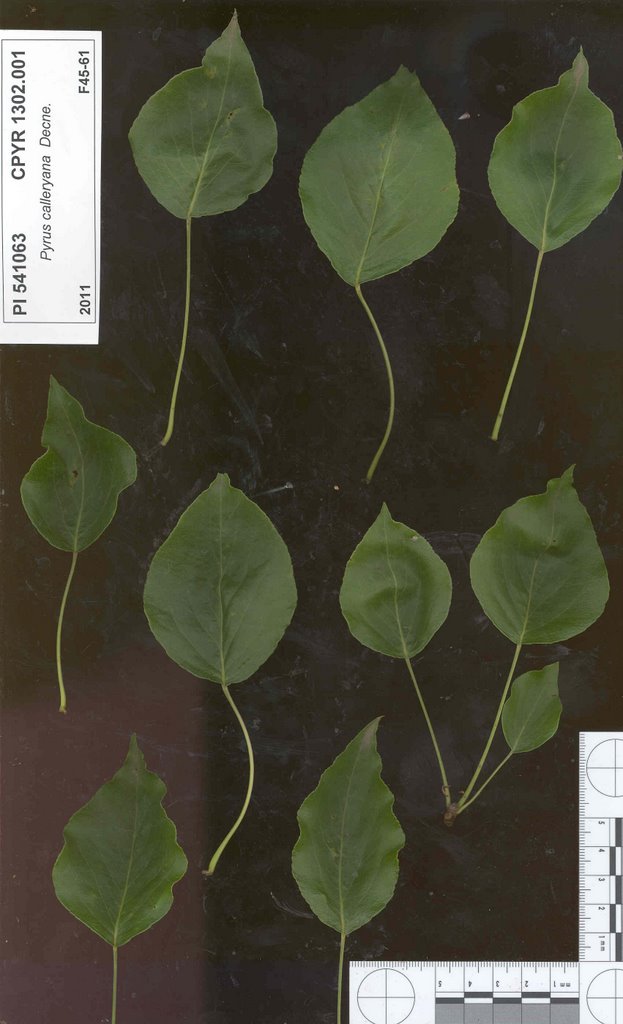 | | 1983 | DEVELOPED | | | | | | Breeding material | | 1435999 | PI 541063 |
| 30 | PI 541064 | P. calleryana | Pyrus ×calleryana Decne. | Missouri, United States | COR |  | | 1983 | DEVELOPED | | | | | | Breeding material | | 1436000 | PI 541064 |
| 31 | PI 541065 | P. calleryana | Pyrus ×calleryana Decne. | Missouri, United States | COR |  | | 1983 | DEVELOPED | | | | | | Breeding material | | 1436001 | PI 541065 |
| 32 | PI 541066 | 'OPR 125' | Pyrus ×calleryana Decne. | Oregon, United States | COR | | | 1983 | DEVELOPED | | | | | | Breeding material | Selected from rootstock test plots established by F. Reimer. OPR 125 is a P. calleryana rootstock propagated from beneath a productive Seckel tree in the orchard of Larry and Elmer Hull in north Medford, Oregon probably in the 1960s. | 1436002 | PI 541066 |
| 33 | PI 541067 | P. calleryana from Westwood | Pyrus ×calleryana Decne. | Oregon, United States | COR |  | | 1983 | DEVELOPED | | | | | | Breeding material | | 1436003 | PI 541067 |
| 34 | PI 541071 | P. calleryana | Pyrus ×calleryana Decne. | Oregon, United States | COR |  | | 1983 | DEVELOPED | | | | | | Breeding material | | 1436007 | PI 541071 |
| 35 | PI 541075 | 'Autumn Blaze' | Pyrus ×calleryana Decne. | Oregon, United States | COR |  | | 1983 | DEVELOPED | 1980 | | | | | Cultivar | Description: This ornamental pear was selected by M. Westwood in 1969 from several hundred seedlings of P. calleryana growing at the rootstock research nursery at the OSU Lewis-Brown Horticulture Farm, Corvallis. The seedling was from P. calleryana stock introduced to the Medford, Oregon area by F. C. Reimer. Reimer, in cooperation with F. N. Meyer, made two seed collections of this species from native trees in China. The first collection was made in 1917 and the second in 1919 at a different location. Unfortunately, Reimer did not maintain these collections separately, so the absolute origin is unknown. Autumn Blaze is famous for its striking fall leaf coloration. It colors early and is a very brilliant purple red. The tree develops an upright pyramidal shape if trained to a dominant central leader. If the leader is headed back at planting, then the tree develops as a broad pyramid. Its fruit is nearly round, russet-green to maize yellow when ripe. The flesh is cream in color, very acid, with a heavy layer of stone cells exterior to the core area. It is also considered one of the hardiest varieties of this species. For example, the buds are hardy to minus 34 degrees while other cultivars are hardy only to minus28. | 1436011 | PI 541075 |
| 36 | PI 541076 | 'OPR 195' | Pyrus ×calleryana Decne. | Oregon, United States | COR | | | 1983 | DEVELOPED | | | | | | Breeding material | | 1436012 | PI 541076 |
| 37 | PI 541077 | P. calleryana | Pyrus ×calleryana Decne. | Missouri, United States | COR |  | | 1983 | DEVELOPED | | | | | | Breeding material | | 1436013 | PI 541077 |
| 38 | PI 541078 | P. calleryana | Pyrus ×calleryana Decne. | Oregon, United States | COR |  | | 1983 | DEVELOPED | | | | | | Breeding material | | 1436014 | PI 541078 |
| 39 | PI 541079 | 'OPR 132' | Pyrus ×calleryana Decne. | Oregon, United States | COR | | | 1983 | DEVELOPED | | | | | | Breeding material | From Crown Point orchard belonging to Bob Norris, Medford, Oregon. Very good trees of Bartlett growing on calleryana type rootstock that tends to sprout readily from the roots (OPR 129 - 141). | 1436015 | PI 541079 |
| 40 | PI 541113 | P. call. f. graciliflora O.P. | Pyrus ×calleryana Decne. | Illinois, United States | COR |  | | 1983 | DEVELOPED | | | | | | Cultivated material | | 1436049 | PI 541113 |
| 41 | PI 541959 | P. calleryana MA182-53 | Pyrus ×calleryana Decne. | Illinois, United States | COR |  | | 1983 | DEVELOPED | | | | | | Cultivated material | Received as P. decaisne | 1436895 | PI 541959 |
| 42 | PI 617513 | P. calleryana PC-5 (non-typical) | Pyrus ×calleryana Decne. | Missouri, United States | COR |  | | 1983 | DEVELOPED | | | | | | Breeding material | Atypical, selected in Montana for non-thorniness and cold- hardiness | 1012231 | PI 617513 |
| 43 | PI 617514 | P. calleryana PC-7 (hybrid) | Pyrus ×calleryana Decne. | Missouri, United States | COR |  | | 1983 | DEVELOPED | | | | | | Breeding material | | 1012235 | PI 617514 |
| 44 | PI 617515 | P. calleryana PC-7 (hybrid) | Pyrus ×calleryana Decne. | Missouri, United States | COR |  | | 1983 | DEVELOPED | | | | | | Breeding material | | 1012248 | PI 617515 |
| 45 | PI 617518 | P. calleryana Glenn Dale? | Pyrus ×calleryana Decne. | Oregon, United States | COR |  | | 1983 | DEVELOPED | | | | | | Breeding material | Long-chilling seed (selected for cold-hardiness), shows no evidence of winter damage | 1013048 | PI 617518 |
| 46 | PI 541021 | Howell 47-35 | Pyrus ×calleryana Decne. | Oregon, United States | COR |  | | 1983 | DEVELOPED | | | | | | Breeding material | | 1435957 | PI 541021 |
| 47 | PI 541017 | P. calleryana No. 11 | Pyrus ×calleryana Decne. | Oregon, United States | COR |  | | 1981 | DEVELOPED | | | | | | Breeding material | | 1435953 | PI 541017 |
| 48 | PI 541018 | P. calleryana | Pyrus ×calleryana Decne. | Uncertain | COR |  | | 1981 | DEVELOPED | | | | | | Uncertain improvement status | | 1435954 | PI 541018 |
| 49 | PI 541019 | P. calleryana | Pyrus ×calleryana Decne. | Uncertain | COR |  | | 1981 | DEVELOPED | | | | | | Uncertain improvement status | | 1435955 | PI 541019 |
| 50 | PI 313928 | P. calleryana var. Graciliflora | Pyrus ×calleryana Decne. | Uncertain | COR |  | | 1981 | COLLECTED | 03/31/1966 | | | | | Wild material | Received as Pyrus calleryana var. Graciliflora from the Union of Soviet Socialist Republics. Scions were presented to the USDA Plant Industry Station in Beltsville, Maryland by the All-Union Institute of Plant Industry, Leningrad on 31 March, 1966. -- USDA Plant Inventory No. 174 | 1234432 | PI 313928 |
| 51 | PI 420809 | P. calleryana | Pyrus ×calleryana Decne. | Asia | COR |  | | 1981 | COLLECTED | 1974 | | | | | Wild material | Cuttings presented May 1974 by the director, N.I. Vavilov Institute of Plant Inustry, Leningrad. Numbered March 7, 1978. | 1317819 | PI 420809 |
| 52 | PI 541013 | 'Capital' | Pyrus ×calleryana Decne. | District of Columbia, United States | COR |  | | 1981 | DEVELOPED | 1981 | | | | | Cultivar | This ornamental pear was introduced in 1981 by W.L. Ackerman. It is named for the nation's capital. The tree is thornless, with a narrow columnar form, making it more suitable than Bradford for some urban plantings. Introduction from the U.S. National Arboretum (Washington D.C.) that is more upright than 'Whitehouse' and can be substituted for Lombardy Poplar; its leaves turn coppery in fall; see HortScience 16:799-800 (1981); early reports indicated it was a good selection; leaves are a lustrous dark green, show moderate to good fireblight resistance, grew 32 feet high by 8 feet wide after 15 years, possibly a good choice for narrow restricted growing areas; evaluations in 1988 and 1989 reported tremendous fireblight susceptibility, in fact, so great that nurserymen are removing it from the fields in southern nurseries; when at its best, a respectable columnar form, particularly in foliage; pretty ragged in winter. -- M. Dirr, Manual of Woody Landscape Plants, revised 1998. | 1435949 | PI 541013 |
| 53 | PI 541009 | P. calleryana | Pyrus ×calleryana Decne. | Oregon, United States | COR |  | | 1981 | DEVELOPED | | | | | | Breeding material | Blight resistant | 1435945 | PI 541009 |
| 54 | PI 541010 | P. calleryana | Pyrus ×calleryana Decne. | Missouri, United States | COR |  | | 1981 | DEVELOPED | | | | | | Breeding material | | 1435946 | PI 541010 |
| 55 | PI 541011 | P. calleryana | Pyrus ×calleryana Decne. | Oregon, United States | COR |  | | 1981 | DEVELOPED | | | | | | Breeding material | | 1435947 | PI 541011 |
| 56 | PI 541012 | 'OPR 157' | Pyrus ×calleryana Decne. | Oregon, United States | COR | | | 1981 | DEVELOPED | | | | | | Breeding material | OPR 157 is an unknown P. calleeryana seedling from the Crown Point orchard near Medford, OR collected in 1968 by M. Westwood. | 1435948 | PI 541012 |
| 57 | PI 617603 | Bartlett - Southern | Pyrus communis L. | Louisiana, United States | COR | | | 1994 | DEVELOPED | 1969 | | | | | Cultivar | Bartlett sport found in Abbeville, Louisiana about 1969. Very productive and disease resistant there and in other sites. Clearly low chill but not fully evaluated in south Texas to determine how low. It does grow fairly well directly on calleryana but seems more vigorous with a comice interstem. | 1507868 | PI 617603 |
| 58 | PI 541448 | 'Warren' | Pyrus communis L. | Mississippi, United States | COR |  | | 1985 | DEVELOPED | 1976 | | | | | Cultivar | Warren (PI 541448).-Originated at Hattiesburg, Mississippi, by T.O. Warren as chance seedling. Introduced in 1976. Fruit: medium to large; shape variable; skin dull brown, sometimes with red blush, smooth; flesh whitish, buttery, smooth, moderately firm; flavor said to be comparable to Magness or Comice; ripens about with Magness; stores much better than Bartlett. Tree: vigorous; pyramidal, with flat crotch angles; cold hardy; tolerant of high summer temperatures; resistant, but not immune, to fire blight; disease free foliage. - Brooks and Olmo Register of Fruit and Nut Varieties Due to much interest in the Warren pear I thought it best to give POMONA readers the history and other pertinent information about this fruit. I found this pear about nine years ago growing in the back yard of a friend. It hasn't been determined if it is a named variety or a seedling though I tried hard to identify it. No other dessert pear will take our heat 60 miles from the Gulf, and not have blight with the good taste it has. Magness, Ayres, and Comice pears have the dessert taste I am speaking of. Magness grows here, Ayers does also, but Comice is limited to cool nights of West Coast regions. This pear is on extensive tests by many NAFEX members all over the U.S.A. Also most major federal and state horticultural stations have it on tests today. The Warren pear is a somewhat drab brown color where sun does not reach it much, but can have a pretty red blush on the side exposed to the sun. It has a unique shape, a long neck, dew drop shape on maybe half the crop of medium to small size. Oddly enough larger specimens have two other shapes. One somewhat like Bartlett with a shoulder, and the other bell shaped like Magness. The long tapering neck of the smaller pears reminds one of the many times larger Devoe pear. This genetic trait makes it more difficult to identify the tree-three distinct shapes and sizes. Most pears don't do this. Some may have bigger or smaller fruit but of the same general shape. Taste: very sweet and juicy; several drops of juice fall after each bite. The seed core is very small and you eat over 98% of the pear. It has a pleasant aroma, too. Blight: very resistant to blight. It sometimes appears only near the top of a few limbs, though tests show many varieties alongside of the same age that do blight. Bearing: I don't have all the data to evaluate it properly but know it bears heavily some years, not like the Magness that is noted for shy bearing. Have patience. In some locations it fruits out the second year, but in my region it takes six, seven, or eight years to first hold fruit. This pear is very compatible on Pyrus calleryana rootstock and should do well on any good standard root base. I would not use quince as a base for it, as quince is in another genus. Growth is fast and rank on Pyrus calleryana in a pretty, pyramidal, Christmas tree shape with thick limbs and healthy medium size, dark green leaves. I rate it superb in flavor, even better than Comice, known as one of the best. This is unofficial, but tests I have run have proven that the Warren pear may well be self-fertile. I am almost sure this pear has Pyrus communis blood in its genetic background, from which most of our high dessert types come from. I am not too concerned whether we ever classify it. I'm just well pleased to have such a pear. It is the fastest, most healthy grower on Pyrus calleryana I have grafted in over 50 years. -- T.O. Warren, 1986, Pomona. | 1436384 | PI 541448 |
| 59 | PI 541729 | P. calleryana x P. fauriei | Pyrus hybr. | Oregon, United States | COR | | | 1983 | DEVELOPED | | | | | | Breeding material | | 1436665 | PI 541729 |
| 60 | PI 541730 | P. calleryana x P. fauriei | Pyrus hybr. | Oregon, United States | COR | | | 1983 | DEVELOPED | | | | | | Breeding material | | 1436666 | PI 541730 |
| 61 | PI 541731 | P. dimorphophylla x P. calleryana | Pyrus hybr. | Oregon, United States | COR | | | 1983 | DEVELOPED | | | | | | Breeding material | Rootstock | 1436667 | PI 541731 |
| 62 | PI 541732 | P. dimorphophylla x P. calleryana | Pyrus hybr. | Oregon, United States | COR | | | 1983 | DEVELOPED | | | | | | Breeding material | | 1436668 | PI 541732 |
| 63 | PI 541733 | P. dimorphophylla x P. calleryana | Pyrus hybr. | Oregon, United States | COR | | | 1983 | DEVELOPED | | | | | | Breeding material | Rootstock | 1436669 | PI 541733 |
| 64 | PI 541768 | P. pashia x P. calleryana | Pyrus hybr. | Victoria, Australia | COR | | | 1983 | DEVELOPED | | | | | | Breeding material | | 1436704 | PI 541768 |
| 65 | PI 541770 | P. betulifolia x P. calleryana | Pyrus hybr. | Oregon, United States | COR | | | 1983 | DEVELOPED | | | | | | Breeding material | Possibly a good rootstock clone | 1436706 | PI 541770 |
| 66 | PI 541771 | P. betulifolia-2 x P. calleryana-2 | Pyrus hybr. | Oregon, United States | COR | | | 1983 | DEVELOPED | | | | | | Breeding material | Possibly a very good rootstock clone | 1436707 | PI 541771 |
| 67 | PI 541773 | P. pashia x P. calleryana | Pyrus hybr. | Victoria, Australia | COR | 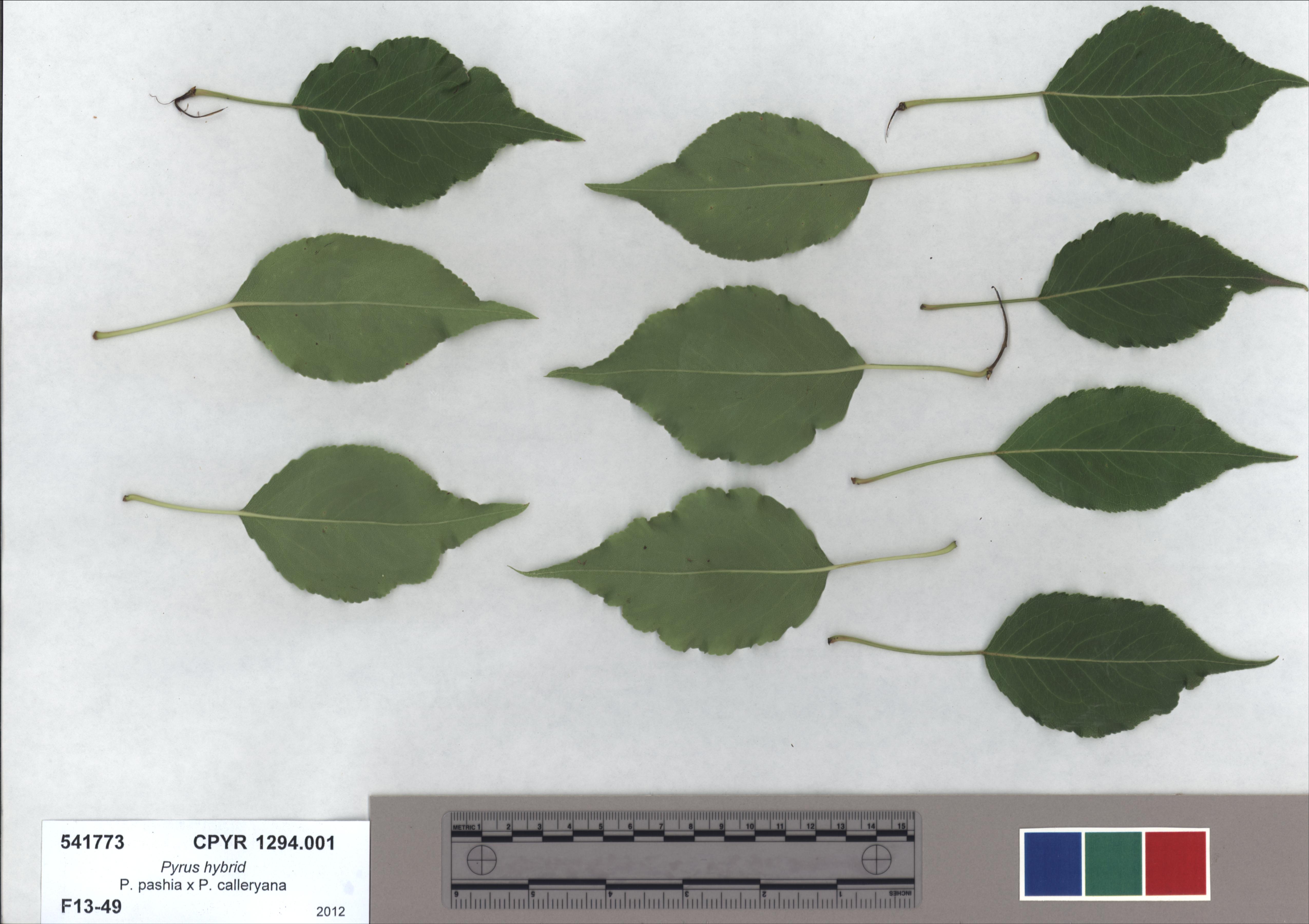 | | 1983 | DEVELOPED | | | | | | Breeding material | | 1436709 | PI 541773 |
| 68 | PI 541776 | P. ussuriensis x P. calleryana | Pyrus hybr. | Oregon, United States | COR |  | | 1983 | DEVELOPED | | | | | | Breeding material | | 1436712 | PI 541776 |
| 69 | PI 541783 | P. betulifolia x P. calleryana-5 | Pyrus hybr. | Oregon, United States | COR | | | 1983 | DEVELOPED | | | | | | Breeding material | Possibly a very good rootstock clone, blight resistant | 1436719 | PI 541783 |
| 70 | PI 541792 | P. calleryana hybrid | Pyrus hybr. | Missouri, United States | COR |  | | 1983 | DEVELOPED | | | | | | Breeding material | | 1436728 | PI 541792 |
| 71 | PI 541794 | P. calleryana hybrid | Pyrus hybr. | Missouri, United States | COR | | | 1983 | DEVELOPED | | | | | | Breeding material | | 1436730 | PI 541794 |
| 72 | PI 541797 | P. pashia x P. calleryana | Pyrus hybr. | Victoria, Australia | COR |  | | 1983 | DEVELOPED | | | | | | Breeding material | | 1436733 | PI 541797 |
| 73 | PI 541799 | P. ussuriensis x P. calleryana | Pyrus hybr. | Oregon, United States | COR | | | 1983 | DEVELOPED | | | | | | Breeding material | | 1436735 | PI 541799 |
| 74 | PI 617516 | AA #107432 | Pyrus fauriei C. K. Schneid. | Japan | COR |  | | 1983 | COLLECTED | | | | | | Cultivated material | Pyrus fauriei FAURIE'S PEAR. Morton Arboretum 159-31 gr. Grafts received on 01 Mar 1931 from The Morton Arboretum, source no. 1915-23 in Pyrus collection. Original source was Arnold Arboretum (10743) and was received as Pyrus calleryana var. fauriei. Seed was collected by Ernest H. Wilson, Arnold Arboretum of Harvard University, in Japan. --information from Morton Arboretum curator Kunso Kim, 5/10/2011. | 1012658 | PI 617516 |
| 75 | PI 617526 | P. betulifolia 2 x P. calleryana 2 | Pyrus hybr. | Oregon, United States | COR | | | 1983 | DEVELOPED | | | | | | Breeding material | Possibly a good rootstock clone | 1014214 | PI 617526 |
| 76 | PI 541634 | P. fauriei No. 5 | Pyrus fauriei C. K. Schneid. | Korea, South | COR |  | | 1981 | COLLECTED | | | | | | Wild material | Description: This species of pear is a native of southern and central Korea. In 1917 F. C. Reimer made a thorough study of its distribution and characteristics in that country. Reimer noted this species as the northern or alpine form of P. calleryana. It is very similar to that species in nearly every respect except in tree and leaf size, which are very much smaller. In fact, the trees of P. fauriei are usually more shrubs or bushes and sometimes grow in thickets. In all respects the fruits of both species are similar. The varieties of this species are quite variable. Some of the seedlings show a high degree of resistance to blight while others show marked susceptibility. P. fauriei appears to be of little value as a stock except possibly as a dwarfing form to take the place of the quince commonly used for this purpose. | 1436570 | PI 541634 |
| 77 | PI 318871 | Inunashi | Pyrus dimorphophylla Makino | Japan | COR |  | | 1981 | DEVELOPED | | | | | | Cultivar | Received as Pyrus calleryana 'Inunashi' as scions from the Horticultural Research Station, Ministry of Agriculture and Forestry, Hiratsuka, Kanagawa, Japan. Received by the USDA Plant Industry Station in Beltsville, Maryland on 7 March, 1967. -- USDA Plant Inventory No. 175. | 1237219 | PI 318871 |
| 78 | NA 86885 | RJL2021PA-004 | Ilex verticillata (L.) A. Gray | Pennsylvania, United States | NA | | | 2021 | COLLECTED | 11/16/2021 | Plants growing in woodlands along a small unnamed creek corridor dumping into the Middle Branch White Clay Creek in Goddard Park, West Grove Pennsylvania, off of Wickerton Road, Chester County. | 39.81063861, -75.82750806 | 124 | Plants are growing in a range of habitats from mesic woodlands to saturated streamside settings of deciduous woodlands that drain toward the Middle Branch White Clay Creek. Plants grow in high understory shade with dappled to indirect sunlight. The only female (fruiting) plants were found in areas along the creek where soils are moist to saturated. Numerous male specimens were found in the areas described above. Soils: Soils found in the areas where this collection was made are comprised primarily of Baile silt loam (Ba), Hatboro silt loam (Ha), and Glenelg silt loam, 8 to 15 percent slopes (GgC). Baile silt loam consists of very deep, poorly drained, moderately low to moderately high saturated hydraulic conductivity, soils on upland depressions and footslopes that were formed in local alluvium over residuum from acid crystalline rocks, chiefly mica schist and granitized schist and gneiss; slope ranges from 0 to 8 percent. Hatboro silt loam consists of very deep and poorly drained soils formed in deposited alluvium derived from metamorphic and crystalline rock. They are on flood plains. Slopes range from 0 to 3 percent. Glenelg silt loam, 8 to 15 percent slopes consists of very deep, well drained soils formed in residuum weathered from micaceous schist on uplands of the Blue Ridge and the Northern Piedmont. This soil is undifferentiated, mostly poorly drained sandy bottomland soils intermingled with decomposing organic litter and eroded silts and clays due to erosion. Slope: 0 to 15% Aspect: Variable. | Wild material | | 2123125 | NA 86885 |
| 79 | WLP 1731 | RJL2021PA-001 | Viburnum acerifolium L. | Pennsylvania, United States | NA | | | 2021 | COLLECTED | 11/05/2021 | Plants growing in woodlands above a small unnamed creek that dumps into the Middle Branch White Clay Creek in Goddard Park, West Grove Pennsylvania, off of Wickerton Road, Chester County. | 39.80462083, -75.82888750 | 103 | Plants growing in a mesic, well-drained habitat of deciduous woodlands, for the most part, above the riparian zone that drains toward a small unnamed creek that feeds into the Middle Branch White Clay Creek. Plants are growing in high understory shade with very little direct sun during most of the day. The remnant woodlands exist mostly along the steep slopes, wetlands and seeps of seasonal and year-round creeks flowing into the Middle Branch White Clay Creek. The woodlands are bordered by numerous housing developments and land converted to meadows; hence there is significant first order edge that is heavily impacted by invasive plant intrusion. Soils: Soils are classified as Glenelg silt loam, 8 to 15% slopes (GgC); this series consists of very deep, well drained soils formed in residuum weathered from micaceous schist on uplands of the Blue Ridge and the Northern Piedmont. Saturated hydraulic conductivity is moderately high in the subsoil and moderately high to high in the substratum. This upper horizon of this soil is undifferentiated, mostly poorly drained sandy bottomland soils intermingled with decomposing organic litter and eroded silts and clays due to erosion. Slope: 8 to 15% Aspect: West. | Wild material | | 2123080 | WLP 1731 |
| 80 | WLP 1732 | RJL2021PA-002 | Viburnum prunifolium L. | Pennsylvania, United States | NA | | | 2021 | COLLECTED | 11/05/2021 | Plants growing in woodlands along a small unnamed creek corridor dumping into the Middle Branch White Clay Creek in Goddard Park, West Grove Pennsylvania, off of Wickerton Road, Chester County. | 39.80462083, -75.82888750 | 102 | Plants are growing in a range of habitats from drier upland woods to moist creekside settings of deciduous woodlands that drain toward the Middle Branch White Clay Creek. Plants grow in part shade to high understory shade with dappled to indirect direct sunlight. Plants achieve their largest size and fruiting potential in part sun of the riparian zone of the creek where woodland canopy is thinner. Soils: Soils found in the areas where this collection was made are comprised primarily of flood plain Hatboro silt loam (Ha) and well-drained, upland Glenelg silt loam, 8 to 15 percent slopes (GgC). Hatboro silt loam consists of very deep and poorly drained soils formed in deposited alluvium derived from metamorphic and crystalline rock. They are on flood plains. Slopes range from 0 to 3 percent. Glenelg silt loam, 8 to 15 percent slopes consists of very deep, well drained soils formed in residuum weathered from micaceous schist on uplands of the Blue Ridge and the Northern Piedmont. This soil is undifferentiated, mostly poorly drained sandy bottomland soils intermingled with decomposing organic litter and eroded silts and clays due to erosion. Slope: 0 to 15% Aspect: Variable. | Wild material | | 2123098 | WLP 1732 |
| 81 | WLP 1733 | RJL2021PA-003 | Viburnum dentatum L. | Pennsylvania, United States | NA | | | 2021 | COLLECTED | 11/05/2021 | Plants growing in woodlands along a small unnamed creek corridor dumping into the Middle Branch White Clay Creek in Goddard Park, West Grove Pennsylvania, off of Wickerton Road, Chester County. | 39.80522167, -75.82928139 | 107 | Plants are growing in a range of habitats from mesic woodland to moist creekside settings of deciduous woodlands that drain toward the Middle Branch White Clay Creek. Plants grow in high understory shade with dappled to indirect sunlight. Soils: Soils found in the areas where this collection was made are comprised primarily of flood plain Hatboro silt loam (Ha) and well-drained, upland Glenelg silt loam, 8 to 15 percent slopes (GgC). Hatboro silt loam consists of very deep and poorly drained soils formed in deposited alluvium derived from metamorphic and crystalline rock. They are on flood plains. Slopes range from 0 to 3 percent. Glenelg silt loam, 8 to 15 percent slopes consists of very deep, well drained soils formed in residuum weathered from micaceous schist on uplands of the Blue Ridge and the Northern Piedmont. This soil is undifferentiated, mostly poorly drained sandy bottomland soils intermingled with decomposing organic litter and eroded silts and clays due to erosion. Slope: 0 to 15% Aspect: Variable. | Wild material | | 2123124 | WLP 1733 |
| 82 | WLP 1747 | RJL2021PA-005 | Rosa palustris Marshall | Pennsylvania, United States | NA | | | 2021 | COLLECTED | 11/20/2021 | Plants growing in wetland seeps surrounded by mown hayfields just west of the Middle Branch White Clay Creek in Goddard Park, West Grove Pennsylvania, off of Wickerton Road, Chester County. | 39.80090528, -75.82383250 | 100 | Habitat Notes: Plants are growing in permanently saturated to moist soils in wetland habitats. Plants appear to be obligate wetland plants and are found only in permanent to nearly permanent wet habitats observed. Generally, the shrubs are found in part shade to full sun. Soils: Soils found in the areas where this collection was made are comprised primarily of Hatboro silt loam (Ha). Hatboro silt loam consists of very deep and poorly drained soils formed in deposited alluvium derived from metamorphic and crystalline rock. They are on flood plains. Slopes range from 0 to 3 percent. Slope: 0 to 3% Aspect: Variable. | Wild material | | 2123715 | WLP 1747 |
| 83 | NA 88164 | NCBG-427 | Pinus virginiana Mill. | Maryland, United States | NA |  | | 2019 | | | | | | | Wild material | | 2098446 | NA 88164 |