| 0 | PI 665760 | ALB-2011-024 | Pyrus communis L. subsp. pyraster (L.) Ehrh. | Albania | COR | | | 2011 | COLLECTED | 09/15/2011 | Seed from single wild tree by side of road in village of Dardhe. 'Dardhe' means 'pear' | 40.51661000, 20.82468000 | 1320 | | Wild material | | 1891853 | PI 665760 |
| 1 | PI 665770 | ALB-2011-89a | Pyrus spinosa Forssk. | Tepelene, Albania | COR | | | 2011 | COLLECTED | 09/22/2011 | Near village of Mezhgoram, east of Tepelene. | 40.29152000, 20.07928000 | 184 | Fruit collected from 2 trees (bagged separately as A and B) ~ .5 km apart. Tree A seems to be slightly pyraster-like. | Wild material | | 1891945 | PI 665770 |
| 2 | PI 617681 | 'Fox 11' | Pyrus communis L. subsp. pyraster (L.) Ehrh. | Emilia-Romagna, Italy | COR | | | 1999 | DEVELOPED | 1998 | | | | | Cultivar | Pyrus communis rootstock developed in Bologna, Italy, by Professor Marangoni. Medium-high vigour and good anchorage. Suitable for alkaline soils. | 1584971 | PI 617681 |
| 3 | PI 657914 | P. communis var. pyraster | Pyrus communis L. subsp. pyraster (L.) Ehrh. | Baranya, Hungary | COR | | | 1998 | COLLECTED | 10/03/1998 | Tenkes mountains, northwest of Mariagyud village. | 46.25000000, 18.31667000 | 300 | South facing slope | Wild material | | 1574232 | PI 657914 |
| 4 | PI 293833 | P. communis - Yedentsi Forest | Pyrus communis L. subsp. pyraster (L.) Ehrh. | Moldova | COR | | | 1988 | COLLECTED | | | | | | Breeding material | Original seedlot collected by Creech and Scott in Yedentsi Forest, 200 km north of Kishinev, Moldavia. Tree old, in the wild. | 1222579 | PI 293833 |
| 5 | PI 293834 | P. communis - Crimea | Pyrus communis L. subsp. pyraster (L.) Ehrh. | Krym, Ukraine | COR |  | | 1988 | COLLECTED | | | | | | Breeding material | Original seedlot collected by Creech and Scott at Barlakosh, Crimea. Collector Number 1380. Dry, barren, open meadow. Elevation 900 meters. Tree vigorous, in wild; fruits small. | 1222580 | PI 293834 |
| 6 | PI 293837 | P. communis - Crimea | Pyrus communis L. subsp. pyraster (L.) Ehrh. | Krym, Ukraine | COR | | | 1988 | COLLECTED | | | | | | Breeding material | Original seedlot collected by Creech and Scott in the Big Chuchel Mountains. Collector Number 1392. Southeast slope, elevation 1150 meters. Tree small, in wild; foliage good. | 1222583 | PI 293837 |
| 7 | PI 293838 | P. communis ssp. pyraster - Crimea | Pyrus communis L. subsp. pyraster (L.) Ehrh. | Krym, Ukraine | COR | 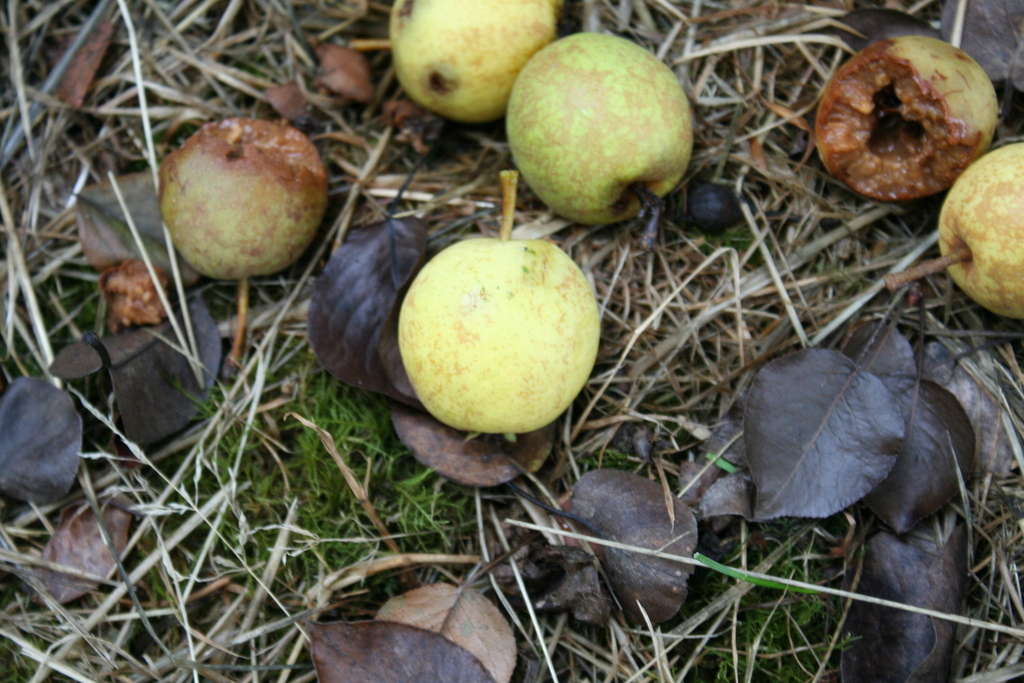 | | 1988 | COLLECTED | | | | | | Breeding material | Original seedlot collected by Creech and Scott in the Big Chuchel Mountains, Crimea. Collectors Number 1393. Open, dry slope, elevation 1050 meters, annual rainfall about 400 mm. Tree small, in wild; head round, dense. | 1222584 | PI 293838 |
| 8 | PI 293842 | P. pyraster - Yeldentsi Forest | Pyrus communis L. subsp. pyraster (L.) Ehrh. | Moldova | COR | | | 1988 | COLLECTED | 1963 | | | | | Breeding material | Original seedlot collected by Creech and Scott in the Yeldentsi Forest, Moldavia. Collectors Number 1423. Dry, windy site at 300 meters elevation. Tree in wild, typical. | 1222587 | PI 293842 |
| 9 | PI 541490 | Olez Brown | Pyrus communis L. subsp. pyraster (L.) Ehrh. | Turkey | COR |  | | 1988 | COLLECTED | | | | | | Breeding material | Original seed collected by Hayati Olez, Bahce Kulturleri Istasyonu, Arifiye, Adapazari, Turkey. In a letter to Mel Westwood dated 19 June, 1963, Olez describes two seedlots sent to Westwood previously. Westwood refers to these two seedlots as 'Olez Red' and 'Olez Brown' due to the color of the seed coats. Olez describes the source of the brown seeds as follows: 'The other type of seeds which were from Sakarya Province are called as wild pear and I am not sure what species they belong to. Wild pear seedlings are used a pear rootstocks here. These are also quite winter hardy and we did not have any pear decline problem on this rootstock.' -- Transcribed by J. Postman, August 2005. Westwood notes indicate that both red and brown seed appear to be wild P. communis or P. pyraster, not P. elaeagrifolia. | 1436426 | PI 541490 |
| 10 | PI 506379 | R-10 | Pyrus communis L. subsp. pyraster (L.) Ehrh. | Romania | COR | 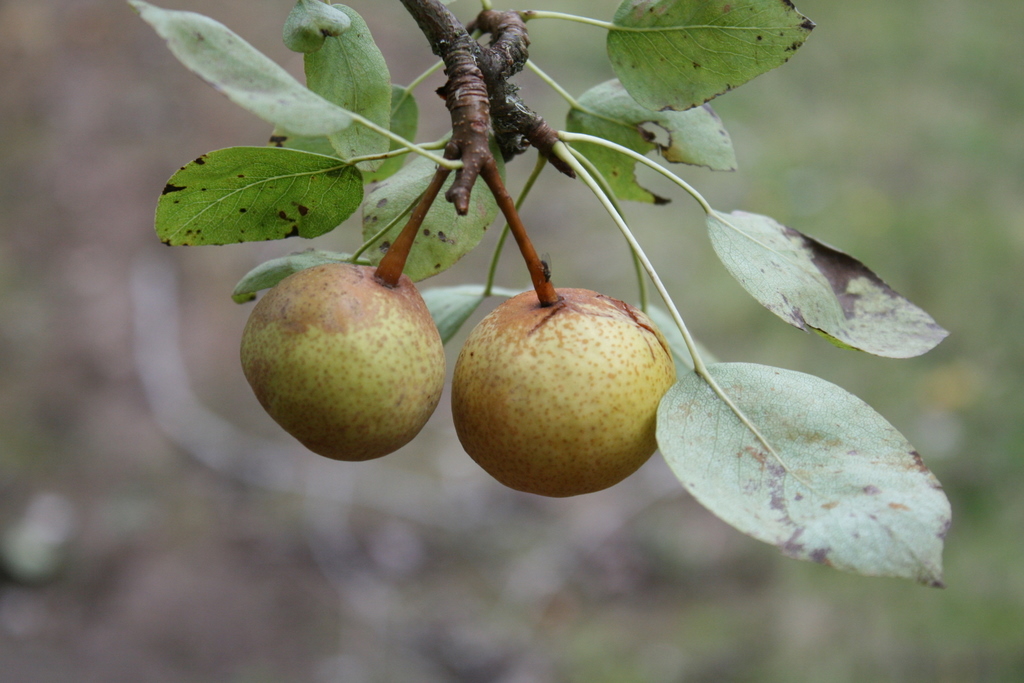 | | 1987 | DEVELOPED | | | | | | Uncertain improvement status | Collector number R-10. Collected on 29 August, 1978 by Tom van der Zwet in Romania, near Valisoara (Jud.Cluj). Fruits small, green | 1401315 | PI 506379 |
| 11 | PI 506380 | R-11 | Pyrus communis L. subsp. pyraster (L.) Ehrh. | Romania | COR |  | | 1987 | COLLECTED | | Valisoraras | | | | Cultivated material | Fruits small, green | 1401316 | PI 506380 |
| 12 | PI 502173 | P. communis ssp. pyraster - Poland | Pyrus communis L. subsp. pyraster (L.) Ehrh. | Poland | COR | | | 1986 | COLLECTED | | Zawoda Kowalicha | 50.00000000, 22.00000000 | | | Wild material | Resistant to local diseases and other pests | 1397109 | PI 502173 |
| 13 | PI 483365 | 'Gelbmostler' | Pyrus communis L. subsp. pyraster (L.) Ehrh. | Switzerland | COR |  | | 1984 | DEVELOPED | | | | | | Cultivar | Gelbmostler is an old perry pear, known since the 18th century in Austria and northern Switzerland. The fruit is medium to large, globular; greenish-yellow changing to light yellow, often slightly blushed, speckled with russet dots. Its flesh is yellowish-white, coarse-grained, juicy, astringent, and over-ripens quickly. Arose probably in area around Lake Constance, which has shorelines in southern Germany, Switzerland and Austria, where it is still grown. Recorded in 1854 by German pomologist Lucas. Its name means 'yellow möst pear, that is, for makinginto perry. Fruit: small/medium (43-64mm high x 51-67mm wide). Shape: short-round-conical tending to flat-round. Colour: yellow/light gold, sometimes slt. pink flush; some russet mainly around eye, stalk. bold fine russet lenticels. Eye: open; sepals linked, reflexed. Basin: shallow, slt. ribbed/beaded. Stalk: short/med. length; med. thick; inserted erect. may be curved. Cavity: slt. Flesh: sharp, astringent, yet plenty of sweetness. -- Morgan, 2015, The Book of Pears. Google Translated from - http://www.arche-noah.at/etomite/assets/downloads/Bibliothek/Obstsortenblaetter/Mostbirne/Gelbmostler.pdf ORIGIN: The Gelbmostler is in northern Switzerland at home. Around the turn of the century the species was widespread around the lake. In Austria, it was introduced in 1885 and since then prevalent (Amstetten and Scheibbser District). The fruit shown are from an orchard stock in Zeillern, Misc Amstetten. SYNONYMS: Galmostler (Switzerland), Welsche mountain pear (Vorarlberg, German Lake Constance), Helleger Mostbirne (Vorarlberg) FRUIT DESCRIPTION: The fruit is medium to fairly large and round to slightly dull top-shaped;2 fruits weigh 130 g CUP: Rough, green-yellow, later pale yellow, sometimes slightly reddened light, rust spots on distributed whole fruit CHALICE: Strong russeting around the calyx, sepals formed completely, like a horn. STEM: Russeting around the stem, stem medium length, slightly curved. PULP: The flesh is yellowish white, coarse-grained, very very juicy, but very herb and will soon be doughy. CORE BODY: Hohlachsig, medium ever, a few black-brown nuclei containing TREE FEATURES: The tree is very vigorous and healthy, fairly big and tall as possible. The Branches are slender and straight, densely covered with short fruit wood. Summer shoots light brown, with many white spots. Strong and protruding eyes. LEAF: Medium in size, roundish, 52:74 mm in size SUITABLE TREE SHAPE: Standard tree SOIL AND CLIMATE CLAIM: No special requirements Flowering: medium early POLLEN: Poor pollinator IDENTIFYING SPECIFIC: On the long, light-related branches, the fruit densely covered with short wooden are easily recognizable. GOOD FEATURES: The healthy, vigorous growth, early onset of middle income and the extremely rich portability of the tree. BAD FEATURES: The short shelf life of the fruit. Irregular income. MATURITY: Mid to late September DURABILITY: Does not last long, must be processed quickly, is no transport pear RESULTS AND FITNESS: The variety is almost a year. The Gelbmostler are many very clear and must, the pressed varietal wine, is something too tart. For mixing with sweeter cider from However, it is eminently suitable varieties. Sugar content: 10-11% by weight, acid: 6-7 wt ?, tannin: 0.8-0.9 wt ? DISEASE SUSCEPTIBILITY: Very resistant LITERATURE: Loschnig, Josef (1913): The cider pears. Petzold, Herbert (1989): pears, 3 Edition, Melsungen Schleicher, William (1888): Description of the Weierhof tentatively planted Most pear varieties, unpublished. Manuscript | 1378301 | PI 483365 |
| 14 | PI 483370 | 'Erabasma' | Pyrus communis L. subsp. pyraster (L.) Ehrh. | Poland | COR |  | | 1984 | DEVELOPED | | | | | | Cultivar | | 1378306 | PI 483370 |
| 15 | PI 483371 | 'Grusha ot Nagovskiego' | Pyrus communis L. subsp. pyraster (L.) Ehrh. | Novgorod, Russian Federation | COR |  | | 1984 | DEVELOPED | | | | | | Cultivar | [A Grush pear] figures in a very important case of Freud's, one of his five 'famous' cases and the one in which he discovered and theorized about the Primal Scene. .. The patient in this case was named Sergei Pankejeff, a Russian aristocrat whose family owned two estates before the war and revolution... Late in the analysis, Pankejeff--called the Wolf Man--reported that he had had a childhood anxiety about a butterfly with swallow-tail wings and yellow stripes. Eventually, he and Freud recognized that this butterfly signified (among other things) the Grusha pear, which he told Freud grew on his estate. 'He had suddenly thought of ... a particular sort of pear with a most delicious taste--a big pear with yellow stripes on its skin. The word for 'pear' in his language was 'grusha', and that had also been the name of the nursery-maid.' It is the nursery maid who figures large in the analysis, but the pear is critical for establishing her name. -- Victoria Pedrick (Georgetown University), October 04, 2002, email correspondence. | 1378307 | PI 483371 |
| 16 | PI 483374 | 'Krolewka' | Pyrus communis L. subsp. pyraster (L.) Ehrh. | Poland | COR |  | | 1984 | DEVELOPED | | | | | | Cultivar | | 1378310 | PI 483374 |
| 17 | PI 483382 | 'Ananaska ceska' | Pyrus communis L. subsp. pyraster (L.) Ehrh. | Czech Republic | COR |  | | 1984 | DEVELOPED | | | | | | Cultivar | Budwood collected October 21, 1976 by T. van der Zwet at the Fruit Experiment Station in Holovousy, Czechoslovakia. | 1378318 | PI 483382 |
| 18 | PI 483383 | P-14 | Pyrus communis L. subsp. pyraster (L.) Ehrh. | Poland | COR | | | 1984 | COLLECTED | 09/12/1978 | near Zamosc lat/lon entered 8/2005 from National Geographic atlas | 50.70000000, 22.90000000 | 0 | | Cultivated material | Collector number P-14. Collected by Tom van der Zwet on 12 September, 1978 near Zawada Kowalicha in eastern Poland (near Zamosc). Seedling tree. Fruits green, medium sized. Resistant to fungal diseases and insects. Cultivated. Collected as budwood. -- USDA Plant Inventory No. 192. | 1378319 | PI 483383 |
| 19 | PI 483384 | P-17 | Pyrus communis L. subsp. pyraster (L.) Ehrh. | Poland | COR |  | | 1984 | COLLECTED | 09/12/1978 | near Zamosc lat/lon entered 8/2005 from National Geographic atlas | 50.70000000, 22.90000000 | 0 | | Cultivated material | Collector number P-17. Collected by Tom van der Zwet on 12 September, 1978 near Zawada Kowalicha in eastern Poland (near Zamosc). Seedling tree. No fruit. Appeared quite resistant to fungi and insects. Cultivated. Collected as budwood. -- USDA Plant Inventory No. 192 | 1378320 | PI 483384 |
| 20 | PI 483385 | P-18 | Pyrus communis L. subsp. pyraster (L.) Ehrh. | Poland | COR | | | 1984 | COLLECTED | 09/12/1978 | near Zamosc lat/lon entered 8/2005 from National Geographic atlas | 50.70000000, 22.90000000 | 0 | | Cultivated material | Collector number P-18. Collected by Tom van der Zwet on 12 September, 1978 near Zawada Kowalicha in eastern Poland (near Zamosc). Seedling tree. Cultivated. Collected as budwood. -- USDA Plant Inventory No. 192 | 1378321 | PI 483385 |
| 21 | PI 483386 | P-26 | Pyrus communis L. subsp. pyraster (L.) Ehrh. | Poland | COR |  | | 1984 | COLLECTED | 09/12/1978 | near Baligrod | 49.30000000, 22.40000000 | 0 | | Cultivated material | 'P-26' - Collected 14 September, 1978 near Baligrod, Poland by Tom van der Zwet. Seedling tree. Fruits medium sized, pyriform, with large grit cells. Appears very resistant to fungal diseases. Cultivated. Collected as budwood. | 1378322 | PI 483386 |
| 22 | PI 483390 | 'Kiselac' | Pyrus communis L. subsp. pyraster (L.) Ehrh. | Serbia | COR |  | | 1984 | DEVELOPED | | | | | | Cultivar | Fruits yellow, pyriform, 150g, ripens early September. Resistant to diseases and insects. | 1378326 | PI 483390 |
| 23 | PI 483391 | 'Batjarka' | Pyrus communis L. subsp. pyraster (L.) Ehrh. | Former Serbia and Montenegro | COR |  | | 1984 | DEVELOPED | | | | | | Cultivar | Tree about 100 years old. Fruit yellow, large, ripens mid-September. | 1378327 | PI 483391 |
| 24 | PI 483396 | 'Smederevka' | Pyrus communis L. subsp. pyraster (L.) Ehrh. | Former Serbia and Montenegro | COR |  | | 1984 | DEVELOPED | | | | | | Cultivar | Leaves very green with some blister mite. Fruit size like Clapp, ripens in September. | 1378332 | PI 483396 |
| 25 | PI 483399 | 'Mednik' | Pyrus communis L. subsp. pyraster (L.) Ehrh. | Serbia | COR |  | | 1984 | DEVELOPED | | | | | | Cultivar | Leaves dark green. Fruit pyriform of 'Bartlett' size, known as honey pear. Very resistant to diseases and insects. | 1378335 | PI 483399 |
| 26 | PI 483400 | 'Projnjaca' | Pyrus communis L. subsp. pyraster (L.) Ehrh. | Bulgaria | COR |  | | 1984 | DEVELOPED | | | | | | Cultivar | Tree about 40 years old. Fruit of 'Bartlett' size, ripens late August. Very resistant to leaf spot. | 1378336 | PI 483400 |
| 27 | PI 483401 | 'Crna Poloska' | Pyrus communis L. subsp. pyraster (L.) Ehrh. | Former Serbia and Montenegro | COR |  | | 1984 | DEVELOPED | | | | | | Cultivar | | 1378337 | PI 483401 |
| 28 | PI 132094 | Persian Common Pear | Pyrus communis L. subsp. pyraster (L.) Ehrh. | Iran | COR |  | | 1983 | COLLECTED | 03/27/1939 | NE Iran | 36.76000000, 53.97000000 | | | Cultivated material | PI 132094 - Scions presented by Alfred Rehder, Arnold Arboretum, Jamaica Plain, Massachusetts to USDA Plant Introduction Station on 27 March, 1939. A form of the common pear having fruits the size and shape of a cherry, originating in the northeastern part of Iran (Persia). Description is from previous introduction see PI 33172 -- USDA Plant Inventory No. 138. PI 33172 - One of a large group of 'seed' accessions presented by the Director of the Museum of Natural History, Paris, France received on 20 March, 1912 at the USDA Bureau of Plant Industry, Office of Foreign Seed and Plant Introduction. -- USDA Plant Inventory No. 30. | 1134048 | PI 132094 |
| 29 | PI 349026 | P. pyraster Izvor 1969 | Pyrus communis L. subsp. pyraster (L.) Ehrh. | North Macedonia | COR |  | | 1983 | COLLECTED | | near Izvor | 41.55472000, 21.69722000 | 341 | | Breeding material | Original seed collected by T. Dimitrovski of the University of Skopje, in 1969 near Izvor, Macedonia. | 1260474 | PI 349026 |
| 30 | PI 349027 | P. pyraster Leva Reka 1969 | Pyrus communis L. subsp. pyraster (L.) Ehrh. | North Macedonia | COR |  | | 1983 | COLLECTED | | near Leva Reka | 41.15861000, 21.06111000 | 1323 | | Breeding material | Original seed collected by T. Dimitrovski of the University of Skopje, in 1969 near Leva Reka, Macedonia. | 1260475 | PI 349027 |
| 31 | PI 349028 | P. pyraster Mavrovo 1969 | Pyrus communis L. subsp. pyraster (L.) Ehrh. | North Macedonia | COR | | | 1983 | COLLECTED | 1969 | near Mavrovo | 41.65694000, 20.73444000 | 1427 | | Breeding material | Original seed collected by T. Dimitrovski of the University of Skopje, in 1969 near Mavrovo, Macedonia. | 1260476 | PI 349028 |
| 32 | PI 369881 | Stip No. 1 | Pyrus communis L. subsp. pyraster (L.) Ehrh. | North Macedonia | COR | | | 1983 | COLLECTED | | Eight km from Stip, Macedonia. | 41.73333000, 22.18333000 | 368 | | Breeding material | Seed collected in 1971 by T. Dimitrovski, University of Skopje, about 8 kilometers from Stip, Macedonia. | 1277129 | PI 369881 |
| 33 | PI 377614 | Mavrovo No. 7 | Pyrus communis L. subsp. pyraster (L.) Ehrh. | North Macedonia | COR |  | | 1983 | COLLECTED | 12/07/1972 | Mavrovo, Mavrovi Anovi, Macedonia. | 44.00000000, 20.00000000 | | | Wild material | | 1282893 | PI 377614 |
| 34 | PI 541382 | Olez 4 | Pyrus communis L. subsp. pyraster (L.) Ehrh. | Turkey | COR | | | 1983 | COLLECTED | 11/26/1963 | Derbent, Izmit - western Turkey | 40.73000000, 30.15000000 | 0 | | Wild material | 'Olez 4' - Seed collected in the wild in Turkey by Hayati lez in November, 1963 and sent to Mel Westwood in Oregon. Collected at Derbent, Izmit. Low elevation, trees abundant. Fruit turbinate, small, stem short and medium thickness, cavity shallow and smooth; leaves ovate, rounded at base, serrate margins, acuminate tips; branches thorny. -- letter from lez to Westwood, 18 November, 1963. | 1436318 | PI 541382 |
| 35 | PI 541391 | Olez 5 | Pyrus communis L. subsp. pyraster (L.) Ehrh. | Turkey | COR |  | | 1983 | COLLECTED | | | 40.73000000, 30.15000000 | 0 | | Breeding material | 'Olez 5' - Seed collected in the wild in Turkey by Hayati lez in November, 1963 and sent to Mel Westwood in Oregon. Collected at Derbent, Izmit. Low elevation, trees abundant. Fruit globular-acute-pyriform, small; stem long and medium thickness, cavity shallow, russeted; leaves oval, acute-rounded at base, crenate margins, acute tips. -- letter from lez to Westwood, 18 November, 1963. | 1436327 | PI 541391 |
| 36 | PI 541392 | Olez 4 | Pyrus communis L. subsp. pyraster (L.) Ehrh. | Turkey | COR | | | 1983 | COLLECTED | | Derbent, Izmit in western Turkey | 40.73000000, 30.15000000 | 0 | | Breeding material | 'Olez 4' - Seed collected in the wild in Turkey by Hayati lez in November, 1963 and sent to Mel Westwood in Oregon. Collected at Derbent, Izmit. Low elevation, trees abundant. Fruit turbinate, small, stem short and medium thickness, cavity shallow and smooth; leaves ovate, rounded at base, serrate margins, acuminate tips; branches thorny. -- letter from lez to Westwood, 18 November, 1963. | 1436328 | PI 541392 |
| 37 | PI 541393 | Olez 5 | Pyrus communis L. subsp. pyraster (L.) Ehrh. | Oregon, United States | COR | 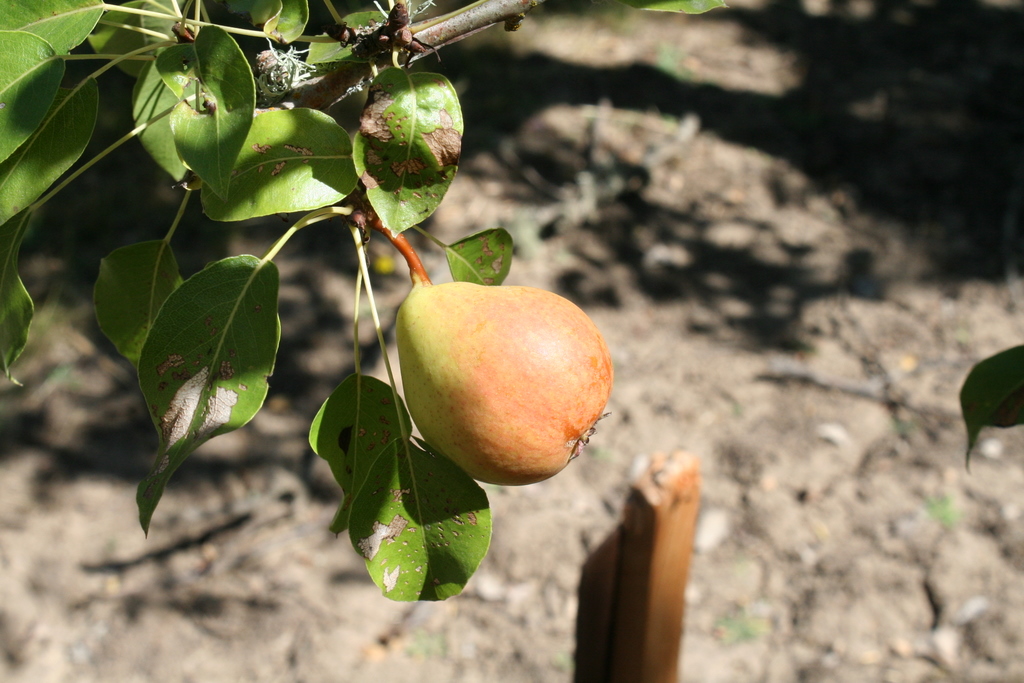 | | 1983 | DEVELOPED | | | | | | Breeding material | 'Olez 5' - Seed collected in the wild in Turkey by Hayati lez in November, 1963 and sent to Mel Westwood in Oregon. Collected at Derbent, Izmit. Low elevation, trees abundant. Fruit globular-acute-pyriform, small; stem long and medium thickness, cavity shallow, russeted; leaves oval, acute-rounded at base, crenate margins, acute tips. -- letter from lez to Westwood, 18 November, 1963. Crowngall resistant seedling, selected by M.N. Westwood | 1436329 | PI 541393 |
| 38 | PI 541395 | Olez 3 | Pyrus communis L. subsp. pyraster (L.) Ehrh. | Turkey | COR | | | 1983 | COLLECTED | | Derbent, Izmit | 40.73000000, 30.15000000 | 0 | | Breeding material | 'Olez 3' - Seed collected in Turkey by Hayati lez in November, 1963 and sent to Mel Westwood in Oregon. Collected at Derbent, Izmit. Low elevation, trees abundant. Fruit small, globular, symmetrical. Stem short and thick. Cavity shallow, smooth. Leaves orbicular in shape, rounded at base, with crenate margins and acuminate tips. Branches thorny. -- letter from lez to Westwood, 18 November, 1963. | 1436331 | PI 541395 |
| 39 | PI 541429 | P-61 blight resistant rootstock | Pyrus communis L. subsp. pyraster (L.) Ehrh. | Oregon, United States | COR |  | | 1983 | DEVELOPED | | | | | | Breeding material | Fire blight resistant rootstock. The Southern Oregon Experiment Station made a concerted attempt to find fire blight resistant root and framework stocks from 1923 and 1931. Over 10,000 French P. communis seedlings were grown and repeatedly inoculated with the blight organism, and after 5-6 years only ten trees survived. These seedlings were capable of transmitting blight resistance to a high percentage of their progeny, particularly when cross pollinated with other blight resistant pears. The best of the resistant seedlings were W-1, W-2, P-18, P-30, P-61, P-70 and P-87 (F. Reimer. 1950. Oregon Agricultural Experiment Station Bulletin 485). - H. Hartman, 1957 | 1436365 | PI 541429 |
| 40 | PI 541430 | OPR 1 | Pyrus communis L. subsp. pyraster (L.) Ehrh. | Oregon, United States | COR | | | 1983 | DEVELOPED | | | | | | Breeding material | | 1436366 | PI 541430 |
| 41 | PI 541435 | Olez 5 | Pyrus communis L. subsp. pyraster (L.) Ehrh. | Turkey | COR |  | | 1983 | COLLECTED | | | 40.73000000, 30.15000000 | 0 | | Wild material | 'Olez 5' - Seed collected in the wild in Turkey by Hayati lez in November, 1963 and sent to Mel Westwood in Oregon. Collected at Derbent, Izmit. Low elevation, trees abundant. Fruit globular-acute-pyriform, small; stem long and medium thickness, cavity shallow, russeted; leaves oval, acute-rounded at base, crenate margins, acute tips. -- letter from lez to Westwood, 18 November, 1963. | 1436371 | PI 541435 |
| 42 | PI 541436 | Olez 4 | Pyrus communis L. subsp. pyraster (L.) Ehrh. | Turkey | COR | | | 1983 | COLLECTED | | Derbent, Izmit in western Turkey | 40.73000000, 30.15000000 | 0 | | Wild material | 'Olez 4' - Seed collected in the wild in Turkey by Hayati lez in November, 1963 and sent to Mel Westwood in Oregon. Collected at Derbent, Izmit. Low elevation, trees abundant. Fruit turbinate, small, stem short and medium thickness, cavity shallow and smooth; leaves ovate, rounded at base, serrate margins, acuminate tips; branches thorny. -- letter from lez to Westwood, 18 November, 1963. | 1436372 | PI 541436 |
| 43 | PI 541568 | P. communis ssp. pyraster | Pyrus communis L. subsp. pyraster (L.) Ehrh. | Hungary | COR | | | 1983 | COLLECTED | | | | | | Wild material | Original seedlot collected by A. Rehder | 1436504 | PI 541568 |
| 44 | PI 617521 | Olez 3 | Pyrus communis L. subsp. pyraster (L.) Ehrh. | Turkey | COR | | | 1983 | COLLECTED | | Derbent, Izmit - western Turkey | 40.73000000, 30.15000000 | 0 | | Breeding material | 'Olez 3' - Seed collected in Turkey by Hayati lez in November, 1963 and sent to Mel Westwood in Oregon. Collected at Derbent, Izmit. Low elevation, trees abundant. Fruit small, globular, symmetrical. Stem short and thick. Cavity shallow, smooth. Leaves orbicular in shape, rounded at base, with crenate margins and acuminate tips. Branches thorny. -- letter from lez to Westwood, 18 November, 1963. Fruit larger than wild type, may be hybrid with domestic variety. | 1013991 | PI 617521 |
| 45 | PI 377611 | Gorna Bosava-Kavadarci No. 1 | Pyrus communis L. subsp. pyraster (L.) Ehrh. | North Macedonia | COR |  | | 1982 | COLLECTED | 1972 | In the Gorna Bosava-Kavadarci area. | 41.35000000, 22.06667000 | 0 | | Breeding material | Seed collected in 1972 by T. Dimitrovski, University of Skopje, near Gorna Bosava-Kavadarci, Macedonia. | 1282891 | PI 377611 |
| 46 | PI 541323 | P. communis ssp. pyraster - Turkey | Pyrus communis L. subsp. pyraster (L.) Ehrh. | Oregon, United States | COR | | | 1982 | DEVELOPED | | | | | | Breeding material | Original seedlot collected by H. Olez | 1436259 | PI 541323 |
| 47 | PI 541567 | IRP 92-1 | Pyrus communis L. subsp. pyraster (L.) Ehrh. | Uncertain | COR |  | | 1981 | DEVELOPED | | | | | | Uncertain improvement status | P. pyraster No. 9 was sent by M. Westwood in Corvallis, Oregon to P. Fridlund in Prosser, Washington for virus testing and therapy. NCGR received scions from Fridlund. | 1436503 | PI 541567 |
| 48 | PI 541291 | Olez 5 | Pyrus communis L. subsp. pyraster (L.) Ehrh. | Turkey | COR |  | | 1981 | COLLECTED | | Derbent, Izmit in western Turkey | 40.73000000, 30.15000000 | 0 | | Breeding material | 'Olez 5' - Seed collected in the wild in Turkey by Hayati lez in November, 1963 and sent to Mel Westwood in Oregon. Collected at Derbent, Izmit. Low elevation, trees abundant. Fruit globular-acute-pyriform, small; stem long and medium thickness, cavity shallow, russeted; leaves oval, acute-rounded at base, crenate margins, acute tips. -- letter from lez to Westwood, 18 November, 1963. Fire blight resistant seedling selection in work done by Westwood. | 1436227 | PI 541291 |
| 49 | PI 541292 | Olez 1 | Pyrus communis L. subsp. pyraster (L.) Ehrh. | Turkey | COR |  | | 1981 | COLLECTED | | | | | | Breeding material | 'Olez 1' - Seed sent to Mel Westwood from northwest Turkey by Hayati Olez in November, 1963. 'A mixture of wild pear seeds which we use for seedling propagation. These were collected by farmers and sold to us. Wild trees are abundant and quite old. Elevation is low, about 50 m.' -- letter from Olez to Westwood, 18 November, 1963. | 1436228 | PI 541292 |
| 50 | PI 541298 | P-87 | Pyrus communis L. subsp. pyraster (L.) Ehrh. | Oregon, United States | COR |  | | 1981 | DEVELOPED | 1926 | | | | | Breeding material | Fire blight resistant rootstock. The Southern Oregon Experiment Station made a concerted attempt to find fire blight resistant root and framework stocks from 1923 and 1931. Over 10,000 French P. communis seedlings were grown and repeatedly inoculated with the blight organism, and after 5-6 years only ten trees survived. These seedlings were capable of transmitting blight resistance to a high percentage of their progeny, particularly when cross pollinated with other blight resistant pears. The best of the resistant seedlings were W-1, W-2, P-18, P-30, P-61, P-70 and P-87 (F. Reimer. 1950. Oregon Agricultural Experiment Station Bulletin 485). - H. Hartman, 1957 | 1436234 | PI 541298 |
| 51 | PI 437051 | 'Jubilee' | Pyrus communis L. subsp. pyraster (L.) Ehrh. | Saskatchewan, Canada | COR |  | | 1979 | DONATED | 12/1979 | | | | | Cultivar | PI 437051 - Budwood received at USDA Quarantine Station from Carrot Valley Nursery, Saskatoon, Saskatchewan, Canada in December 1979. -- USDA/ARS Plant Inventory No. 188 Part 1. | 1331987 | PI 437051 |
| 52 | WLP 1727 | PCC19-RO-13 | Rosa gallica L. | Tulcea, Romania | NA | | | 2019 | COLLECTED | 09/26/2019 | Carjelari; Just south of Carjelari; in historic Dobrogea [Dobruja] region. | 44.95148000, 28.33915000 | 196 | In ruderal community, sprawling between crop field and gravel road in silty loam soil. | | 10-15 individuals here. [This species has been cultivated for so long, with its wild origins widely regarded as murky, that this should not be automatically assumed to represent naturally-occurring material. Also, since the plant spreads clonally, it is unlear whether this was a single clone, or if the individuals were widely separated and genetically distinct. -SBL] | 2109161 | WLP 1727 |
| 53 | WLP 889 | PCC19-RO-01 | Carpinus orientalis Mill. | Iași, Romania | NA | | | 2019 | COLLECTED | 09/23/2019 | Roscani; ; Roscani Forest [Padurea Roscani]; in historic Moldavia region. | 47.43375000, 27.41406000 | 141 | Mixed woodland in silty hills. | | 20 trees visible from collection site, population likely much larger. | 2109159 | WLP 889 |
| 54 | NA 86027 | PCC19-RO-02 | Quercus dalechampii Ten. | Iași, Romania | NA | | | 2019 | COLLECTED | 09/23/2019 | Roscani; ; Roscani Forest [Padurea Roscani]; in historic Moldavia region. | 47.43369000, 27.41383000 | 152 | Mixed woodland in silty hills. | Wild material | Collected from two trees, one fruiting on the roadside. At least 15 trees visible. | 2109115 | NA 86027 |