| 0 | PI 665746 | JPN-2009-145 | Pyrus ussuriensis Maxim. & Rupr. | Iwate, Japan | COR | | | 2009 | COLLECTED | 09/22/2009 | Hayasaka Kogen (high plateau) near Morioka | 39.84314000, 141.51410000 | 936 | Open field along road, several scattered Pyrus trees present | Wild material | Fruits collected 9/22/2009 near Hayasaka Kogen (high plateau) in Morioka region of Iwate Province. Several scattered pear trees were present in open fields along road. Fruit was collected primarily from one large, broad, spreading tree. A few fruit was collected from two other trees, but the that fruit was smaller had few to no seeds. Fruit round to very slightly pyriform, about 2 cm diameter; large russet dots on skin; many stone cells; calyx mostly persistent; 5 locules. From September to 25, 2009, U.S. scientists K. Hummer and J. Postman from the USDA Agricultural Research Service and Japanese scientists H. Iketani and H. Imanishi from the Japanese Ministry of Forestry and Fisheries/National Institute of Agrobiological Sciences, and Akita Agricultural University collaborated on an expedition to collect temperate fruit genera in Hokkaido and northern Honshu, Japan. An agreement between Japan and the USDA specified the terms of exchange, and materials collected were shared between scientists of both countries. | 1824056 | PI 665746 |
| 1 | PI 665748 | JPN-2009-149 | Pyrus ussuriensis Maxim. & Rupr. | Iwate, Japan | COR | | | 2009 | COLLECTED | 09/22/2009 | Karumatsuzawa (upper stream) near Morioka | 39.81135000, 141.41896000 | 728 | Dark humid, temperate forest; | Wild material | Fruits collected 9/22/2009 from single tree near Karumatsuzawa in Morioka region of Iwate Province. Dark humid, temperate forest; pear tree on edge of woods growing with Aesculus, Ulmus daviana, Viburnum, Acer palmatum, Perasites; Frank Reimer collected Pyrus near here a century ago, but this site is much higher elevation than Reimer visited in 1917-18, and this is a unique population that was not sampled by Reimer. Tree to about 15 m. Fruit green and mature; most fruit had fallen and sample was collected from the ground. From September 7 to 25, 2009, U.S. scientists K. Hummer and J. Postman from the USDA Agricultural Research Service and Japanese scientists H. Iketani and H. Imanishi from the Japanese Ministry of Forestry and Fisheries/National Institute of Agrobiological Sciences, and Akita Agricultural University collaborated on an expedition to collect temperate fruit genera in Hokkaido and northern Honshu, Japan. An agreement between Japan and the USDA specified the terms of exchange, and materials collected were shared between scientists of both countries. | 1824058 | PI 665748 |
| 2 | PI 637995 | 'Primorski Sour OP' | Pyrus ussuriensis Maxim. & Rupr. | Habarovskij kraj, Russian Federation | COR | | | 2001 | COLLECTED | | From roadside stand, pears grown in town Maly Klyuch Road side stand Latitude 44 27.993, Longitude 132 41.253 | 44.53306000, 132.06667000 | 115 | | Cultivated material | | 1631154 | PI 637995 |
| 3 | PI 688147 | 'HVSC 53' | Pyrus ussuriensis Maxim. & Rupr. | Habarovskij kraj, Russian Federation | COR |  | | 2001 | COLLECTED | 2001 | Pear1= Camp 15 | 47.42083000, 134.56417000 | 70 | | Uncertain improvement status | | 1635349 | PI 688147 |
| 4 | PI 637988 | 'Liu Yue Xian' | Pyrus ussuriensis Maxim. & Rupr. | China | COR | | | 1995 | DONATED | 05/04/1995 | | | | | Cultivar | Released from quarantine in Beltsville. Plants received in this group with 'T' numbers are heat-treated sub clones of the original introductions. | 1507884 | PI 637988 |
| 5 | PI 654958 | Uzhi Li | Pyrus ussuriensis Maxim. & Rupr. | Kazakhstan | COR | | | 1993 | DONATED | 03/23/1993 | | | | | Rootstock | Rootstock cultivar. Cultivar name indicates Asian origin. Characterized by excellent root system in nursery and high yield of seedlings. | 1098665 | PI 654958 |
| 6 | PI 654917 | 'Chinfon Li' | Pyrus ussuriensis Maxim. & Rupr. | China | COR |  | | 1991 | DEVELOPED | | | | | | Cultivar | | 1020486 | PI 654917 |
| 7 | PI 688184 | 'Dangshan Su Li' | Pyrus ussuriensis Maxim. & Rupr. | China | COR | 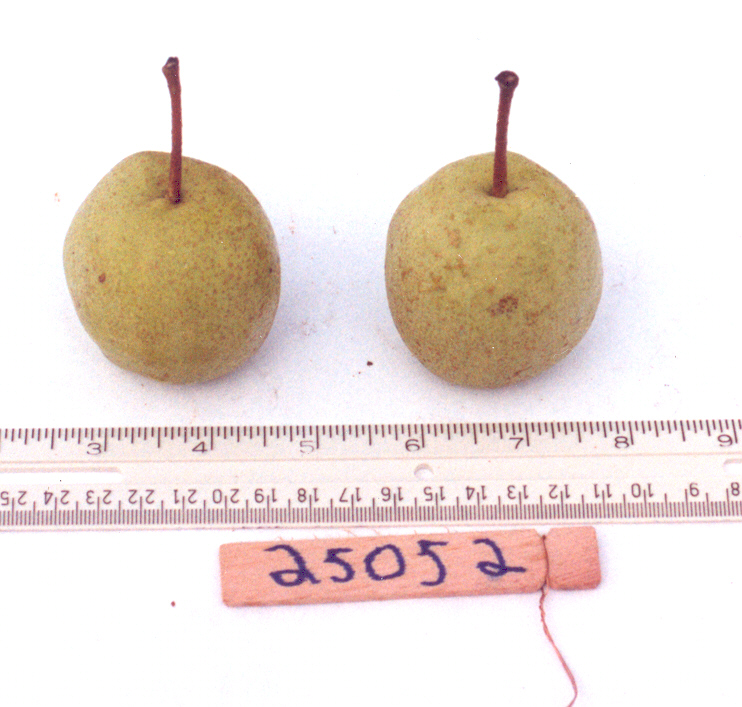 | | 1991 | DEVELOPED | | | | | | Cultivar | Su Li pear from Dang Shan. In China this pear is also called 'Su Li' -- Pu Fu Shen. Pomologist Ma Shu Shang from Northwestern University in Xion provides the description: Dang-shan Su Li (Pyrus bretschneideri) originated from the Dang Shan area of Anhui Province (Dang Mountain Crispy Pear). Trees bloom at the beginning of April...fruit is mature Sept 20. Size is 200-250 grams. Long storage until March-April in caves. Su Li is the most important variety in northwestern China. In 2002 there was 700,000 mu producing 400,000 tons in Shaanxi Province.' -- info from John Wells, Hood River Grower Shipper Association, 11/2003. | 1020475 | PI 688184 |
| 8 | PI 478004 | T 6095 | Pyrus ussuriensis Maxim. & Rupr. | Manitoba, Canada | COR | | | 1991 | COLLECTED | | | | | | Cultivated material | Collected in September, 1954, by J.D. McDermand from cultivated tree at the research station in Mordon Manitoba. He noted this to be a 'potential multiple use plant: shelterbelt, wildlife habitat, ornamental. Cold and drought tolerant.' | 1372940 | PI 478004 |
| 9 | PI 617537 | 'Chien Li' | Pyrus ussuriensis Maxim. & Rupr. | China | COR |  | | 1990 | DEVELOPED | | | | | | Cultivar | | 1019756 | PI 617537 |
| 10 | PI 541965 | 'Nan Guo Li' | Pyrus ussuriensis Maxim. & Rupr. | Liaoning Sheng, China | COR | 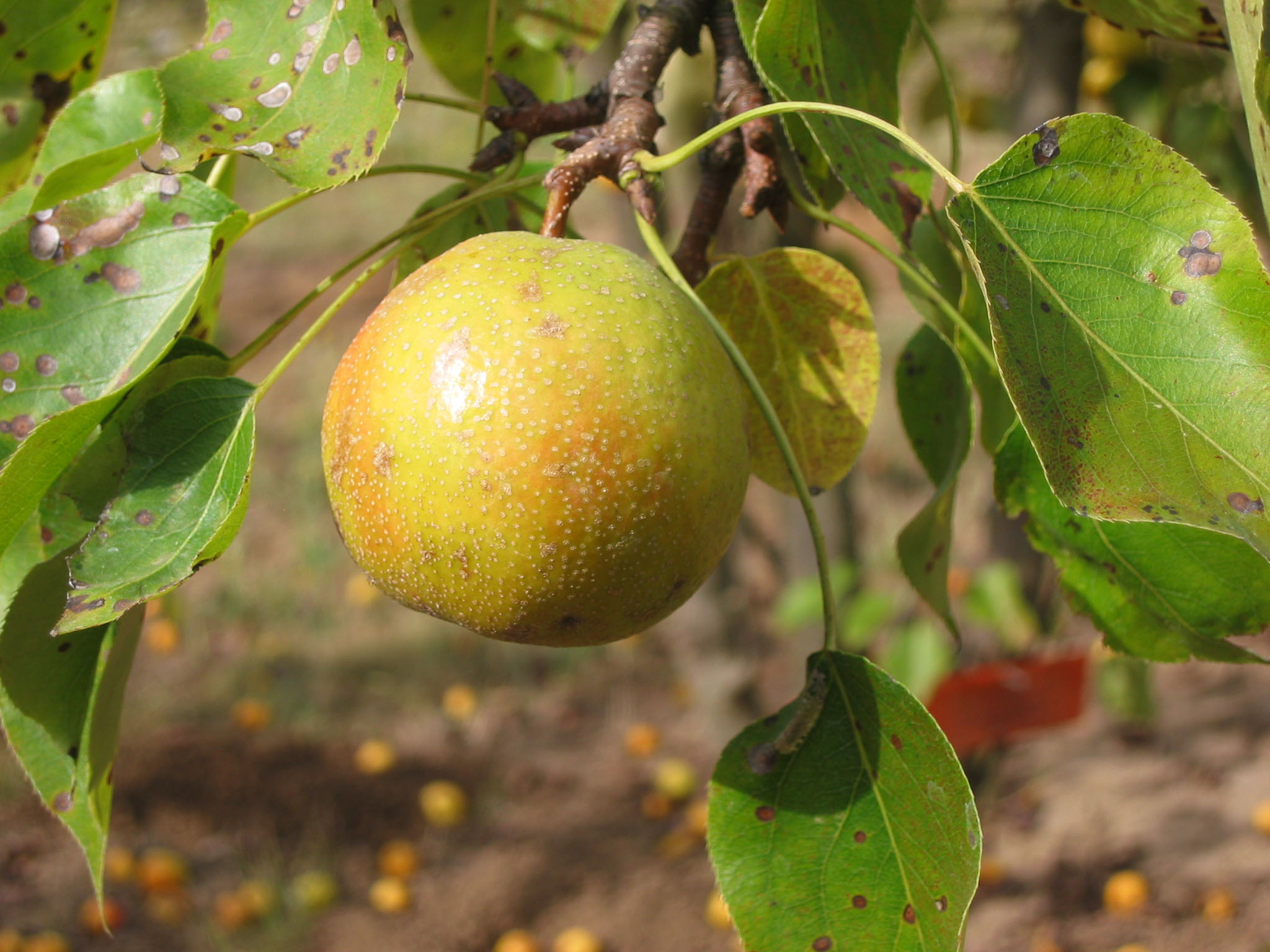 | | 1989 | DEVELOPED | | | | | | Cultivar | | 1436901 | PI 541965 |
| 11 | PI 541813 | Shi Hua Li seedling | Pyrus ussuriensis Maxim. & Rupr. | Oregon, United States | COR |  | | 1988 | DEVELOPED | | | | | | Breeding material | | 1436749 | PI 541813 |
| 12 | PI 506363 | 'Sotoorihime' | Pyrus ussuriensis Maxim. & Rupr. | Japan | COR |  | | 1987 | DEVELOPED | | | | | | Cultivar | This is an old Japanese cultivar, grown in the Tohoku area (Northern part of Japan) | 1401299 | PI 506363 |
| 13 | PI 542021 | P. ussuriensis 174 - Korea | Pyrus ussuriensis Maxim. & Rupr. | Korea, South | COR |  | | 1984 | COLLECTED | | | 36.00000000, 128.00000000 | | | Wild material | | 1436957 | PI 542021 |
| 14 | PI 44151 | 'Suan Li' | Pyrus ussuriensis Maxim. & Rupr. | Jilin Sheng, China | COR | 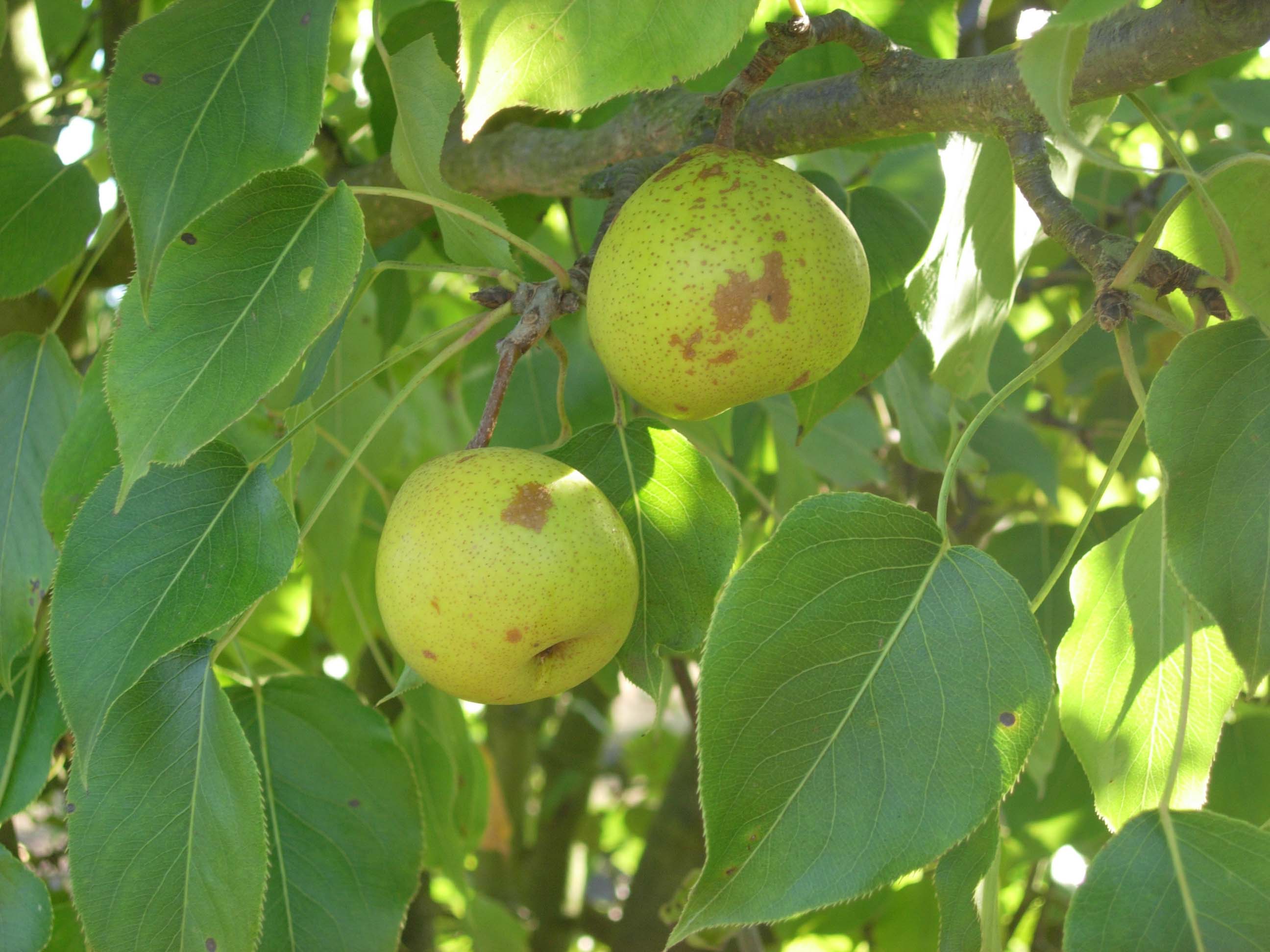 | | 1984 | DEVELOPED | | | | | | Cultivar | Originally collected by F.N. Meyer Also collected by F.C. Reimer in 1917. He called it the 'small' Suan Li as opposed to 'Ta Suan Li' (see CPYR 1148) which translates to 'Big Sour Pear': In a small valley in the mountains west of Peking, I found a variety locally known as 'Suan Li' meaning sour pear. This is an interesting variety and in some respects comes very close to the Ping Li (see CPYR 454). It differs chiefly from that variety in the longer stem of the fruit, color not quite so attractive, and perhaps hardly equal to it in quality. The leaves also are slightly longer. Aside from this, the description for Ping Li fits this variety very well. It should be tested as a variety for home use, local market, and should be extensively used in breeding work. I obtained scionwood of this and succeeded in getting a few of the scions to live. Inoculation experiments proved that this variety, while not immune in the tender shoots, is highly resistant to pear blight. It is a variety of P. ussuriensis. -- F.C. Reimer. 1919. Report of a trip to the Orient to collect and study Oriental pears. | 1105836 | PI 44151 |
| 15 | PI 665778 | 'Chiao-Ma' | Pyrus ussuriensis Maxim. & Rupr. | Liaoning Sheng, China | COR | | | 1984 | DONATED | 03/05/1984 | | | | | Cultivar | | 1090007 | PI 665778 |
| 16 | PI 688074 | 'Guan-Hong-Shieo' | Pyrus ussuriensis Maxim. & Rupr. | Liaoning Sheng, China | COR | | | 1984 | DONATED | 03/05/1984 | | | | | Cultivar | | 1090009 | PI 688074 |
| 17 | PI 305300 | P. ussuriensis - China (from Vavilov) | Pyrus ussuriensis Maxim. & Rupr. | China | COR |  | | 1983 | COLLECTED | | | | | | Breeding material | Typical wild type of P. ussuriensis. Original seedlot received from the Vavilov Institute | 1228977 | PI 305300 |
| 18 | PI 542011 | K-30 | Pyrus ussuriensis Maxim. & Rupr. | Korea, South | COR |  | | 1983 | COLLECTED | 09/07/1981 | Mountians near Chengong | 36.00000000, 128.00000000 | 350 | | Wild material | P. ussuriensis hybrid. Collector number K-30 (Korea 30). Seed collected in the wild by M.N. Westwood on 7 September, 1981 in Korea. Tree growing on mountains near Cheongju on coarse granite soil, ph 4-5, steep slope, 350 m elevation. Lowest temperature about -20 C. Medium tree to 10 m, setose serrate leaves, large size. Fruit green skin, persistent calyx, 2.5 to 3.0 cm diam., 5 carpels. Probably pollinated from tree K-31 (CPYR 5). Original seed sample 91 seeds. -- J. Postman 2006, from M.N. Westwood collection notebook. | 1436947 | PI 542011 |
| 19 | PI 542014 | P. ussuriensis No. 4 - Korea | Pyrus ussuriensis Maxim. & Rupr. | Korea, South | COR |  | | 1983 | COLLECTED | PRE 1980 | | | | | Breeding material | Description: This species' habitat includes northern and northeastern China and eastern Siberia. The regions which they are commonly found are: Manchuria, Korea, Amurland, and Ussuri. From these locations it is thought that this species may be one of the hardiest of all the pears. In the United States, P. ussuriensis has received a great deal of attention because its stock appears to be resistant to blight. Data collected by Reimer of Oregon has indicated that this species is highly resistant to fire blight. Hence, Reimer thought it might be a valuable stock. The USDA, however, after conducting a thorough trial discouraged its use. The tree proved to be a slow grower, susceptible to leaf-blight (cannot hold its leaves during growing and budding season) and posed a problem in budding because the tough bark do not 'slip' easily. This species has been used as a parent when breeding for cold hardiness and blight resistance. | 1436950 | PI 542014 |
| 20 | PI 542015 | P. ussuriensis MA 1919-23 | Pyrus ussuriensis Maxim. & Rupr. | Illinois, United States | COR |  | | 1983 | DEVELOPED | | | | | | Breeding material | Original seedlot collected by E.H. Wilson | 1436951 | PI 542015 |
| 21 | PI 542016 | P. ussuriensis CJW | Pyrus ussuriensis Maxim. & Rupr. | Oregon, United States | COR | 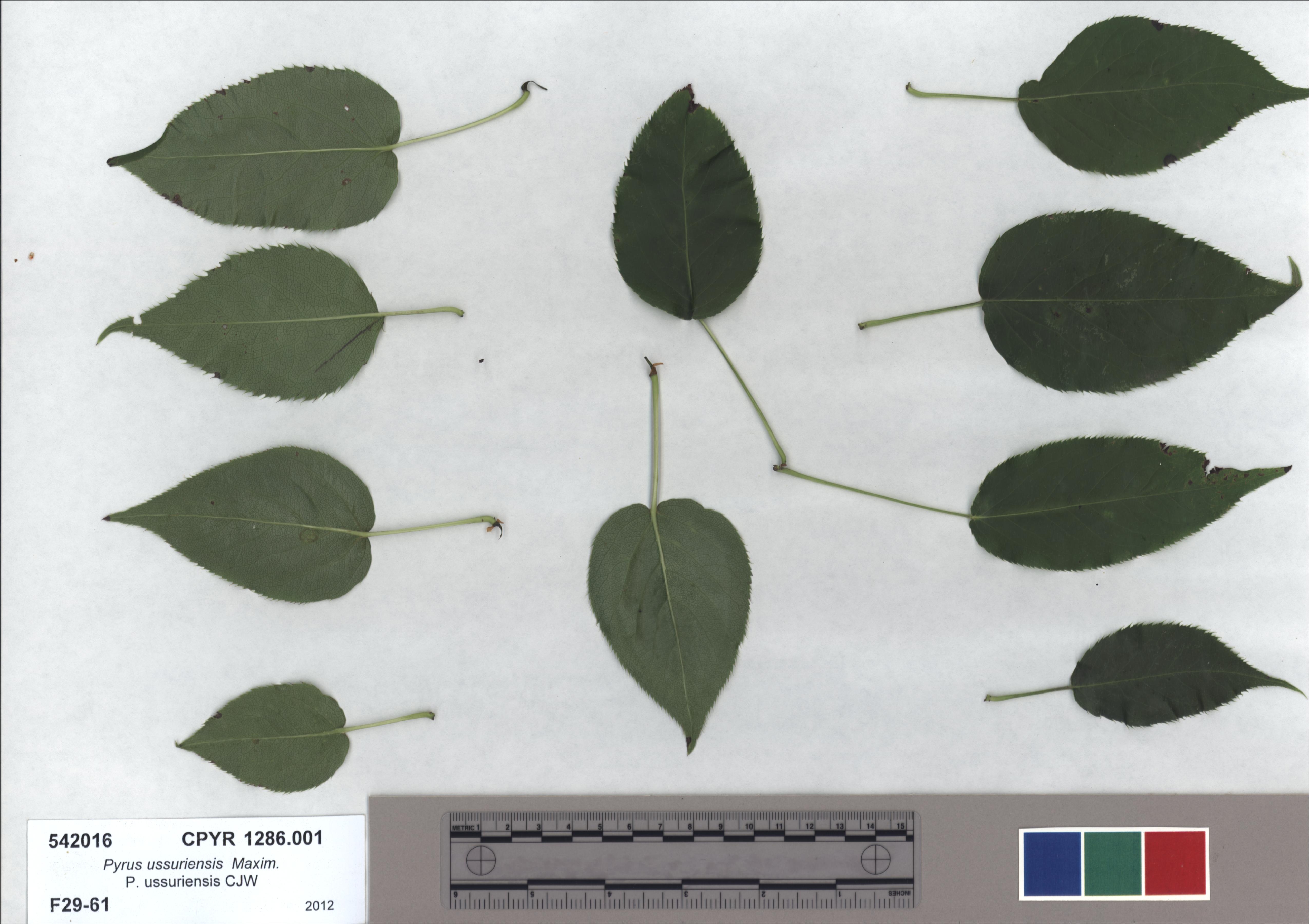 | | 1983 | DEVELOPED | | | | | | Breeding material | | 1436952 | PI 542016 |
| 22 | PI 542017 | 2497-22 | Pyrus ussuriensis Maxim. & Rupr. | China | COR | | | 1983 | COLLECTED | | | | | | Breeding material | Original seedlot collected by E.H. Wilson | 1436953 | PI 542017 |
| 23 | PI 542018 | P. ussuriensis W-6 | Pyrus ussuriensis Maxim. & Rupr. | Oregon, United States | COR | | | 1983 | DEVELOPED | | | | | | Breeding material | | 1436954 | PI 542018 |
| 24 | PI 542019 | 'Harbin' | Pyrus ussuriensis Maxim. & Rupr. | China | COR |  | | 1983 | COLLECTED | 01/01/1924 | Harbin | | | | Cultivated material | Harbin (PI 542019). - A cold-hardy, fire blight resistant pear line used as a rootstock or windbreak. Originated in Brookings, South Dakota by Neils E. Hansen, South Dakota Agriculture Experiment Station. Introduced in 1926. Pyrus ussuriensis; original seed gathered in 1924 about 50 miles east of Harbin, North china by Professor Hansen. The Harbin pear is usually propagated from seed, so the name is given to the seedlings. Fruit: quality poor. Tree: hardy; used in South Dakota as a rootstock; some seedlings show fire blight resistance; good windbreak tree since the foliage and branching are dense. - Brooks and Olmo Register of Fruit and Nut Varieties | 1436955 | PI 542019 |
| 25 | PI 541909 | 'Chin Li' | Pyrus ussuriensis Maxim. & Rupr. | China | COR |  | | 1983 | DEVELOPED | | | | | | Cultivar | | 1436845 | PI 541909 |
| 26 | PI 542010 | 'Pa Li' | Pyrus ussuriensis Maxim. & Rupr. | China | COR |  | | 1983 | DEVELOPED | | | | | | Cultivar | Fruit quality good | 1436946 | PI 542010 |
| 27 | PI 542009 | P. ussuriensis - China | Pyrus ussuriensis Maxim. & Rupr. | China | COR |  | | 1983 | COLLECTED | | | | | | Breeding material | | 1436945 | PI 542009 |
| 28 | PI 542006 | 'Mien Suan Li' | Pyrus ussuriensis Maxim. & Rupr. | China | COR | | | 1983 | DEVELOPED | | | | | | Cultivar | Blight resistant | 1436942 | PI 542006 |
| 29 | PI 542007 | 'Tzu Ma Li' | Pyrus ussuriensis Maxim. & Rupr. | China | COR |  | | 1983 | DEVELOPED | | | | | | Cultivar | | 1436943 | PI 542007 |
| 30 | PI 542003 | P. ussuriensis No. 6 - Korea | Pyrus ussuriensis Maxim. & Rupr. | Oregon, United States | COR |  | | 1981 | DEVELOPED | | | | | | Breeding material | | 1436939 | PI 542003 |
| 31 | PI 307544 | 'Chui Chi Li' | Pyrus ussuriensis Maxim. & Rupr. | China | COR |  | | 1981 | DEVELOPED | | | | | | Cultivar | 'Chui Chi Li' with various alternate English spellings such as 'Qiu Zi Li' is a generic common name for the species Pyrus ussuriensis. | 1229892 | PI 307544 |
| 32 | PI 312150 | No. 2088/62 | Pyrus ussuriensis Maxim. & Rupr. | Kazakhstan | COR |  | | 1981 | COLLECTED | 03/02/1966 | Alma-ata | | | | Wild material | No. 2088/62. Alma-ata, USSR. | 1233106 | PI 312150 |
| 33 | PI 312151 | No. 2319/62 | Pyrus ussuriensis Maxim. & Rupr. | Uzbekistan | COR |  | | 1981 | COLLECTED | 03/02/1966 | Maxim-Taschkent | | | | Wild material | PI 312151. No. 2319/62. Maxim-Taschkcnt, U.S.S.R. | 1233107 | PI 312151 |
| 34 | PI 312152 | No. 2421/62 | Pyrus ussuriensis Maxim. & Rupr. | Tajikistan | COR |  | | 1981 | COLLECTED | 03/02/1966 | Stalinbad | | | | Wild material | PI 312152. No. 2421/62. Maxim Dueschambe (Staiinbad) U.S.S.R. | 1233108 | PI 312152 |
| 35 | PI 313938 | P. ussuriensis var. ovoidea | Pyrus ussuriensis Maxim. & Rupr. | Russian Federation | COR | | | 1981 | COLLECTED | 03/31/1966 | | | | | Wild material | Received as Pyrus ussuriensis var. ovoidea from the Union of Soviet Socialist Republics. Scions were presented to the USDA Plant Industry Station in Beltsville, Maryland by the All-Union Institute of Plant Industry, Leningrad on 31 March, 1966. -- USDA Plant Inventory No. 174 | 1234437 | PI 313938 |
| 36 | PI 541955 | 'Tau Ma Li' | Pyrus ussuriensis Maxim. & Rupr. | China | COR | | | 1981 | DEVELOPED | | | | | | Cultivar | | 1436891 | PI 541955 |
| 37 | PI 541985 | 'Ba Li Hsiang' | Pyrus ussuriensis Maxim. & Rupr. | Liaoning Sheng, China | COR |  | | 1981 | DEVELOPED | | | | | | Cultivar | Blight resistant rootstock. Yellow-white fleshed pear. Early to mid-September ripening in China. Chinese name Ba li hsiang li meaning Eight li fragrant pear implying that it can be detected by its odor at a distance of about 8 li, about 2 1/2 miles. December 9, 1916. (from notes on photo by Frank Meyer taken in 1916 in Arnold Arboretum photo collection). | 1436921 | PI 541985 |
| 38 | PI 541988 | 'Guar Li Seedling No. 2' | Pyrus ussuriensis Maxim. & Rupr. | Oregon, United States | COR |  | | 1981 | DEVELOPED | | | | | | Breeding material | The name 'Guar Li' means 'Water Pear', alluding to the soft, very juicy character of the flesh. The fruit is small to medium in size, oblate, yellowish with a red cheek. The calyx is persistent, and the stem of medium length in some specimens, and long in others. The flesh is soft, juicy, and of fair quality in some strains and good in others. The leaves, at least of the strains which I studied, show the typical form and margins of P. ussuriensis. Unfortunately, I did not obtain scionwood of this variety. We have a large number of seedlings of it, and these are very vigorous growers, and show a very marked degree of resistance to the pear blight. This is a very promising variety for breeding purposes and also as a stock for other pears. On my next trip to China, I shall obtain scionwood of this variety. -- F.C. Reimer. 1919. Report of a trip to the Orient to collect and study Oriental pears. | 1436924 | PI 541988 |
| 39 | PI 541990 | 'Huang Hsiang Sui Li' | Pyrus ussuriensis Maxim. & Rupr. | Shandong Sheng, China | COR |  | | 1981 | DEVELOPED | 1918 | | | | | Cultivar | Very blight resistant, fruit quality poor | 1436926 | PI 541990 |
| 40 | PI 541993 | 'Hong Li' | Pyrus ussuriensis Maxim. & Rupr. | China | COR |  | | 1981 | DEVELOPED | 1918 | | | | | Cultivar | Collected by F.C. Reimer in China in 1917. The name Hung Li means Red Pear. This term, of course, is very indefinite when applied to Chinese varieties of pears. In fact, there are a score of Chinese pears which are known by this name. The writer obtained scionwood of a least three varieties or strains all known as Hung Li. Any pear which possesses a red cheek may pass under the name Hung Li. The term, therefore, is so infefinite that one does not know what variety or type is being obtained unless one actually sees the trees and the fruit on the tree. The most common type of Hung Li produces fruit of medium size, roundish in shape, with a yellow background and a red cheek on the sunny side, and a shiny skin. The calyx is deciduous. The flesh is hard, possesses a sub-acid flavor, and is not of very high quality. It is a remarkable keeper, and the fruit under favorable conditions will shrivel and dry up and seldom rot. The tree is a vigorous grower. The botany of this variety, in fact almost the entire group has been a puzzle. A careful study leads me to the conclusion that this is a hybrid group with P. ussuriensis as one of the parents. One very interesting and apparently very valuable variety was obtained near Malanyu under the name Hung Li. I did not see the fruit on this tree as it had all been picked and shipped when I visited the orchard. The leaves show the typical margins of P. ussuriensis, although the shape of the leaf is somewhat different. The young trees in the nursery are very vigorous growers. This variety has proved a perfect marvel in its ability to resist pear blight. Repeated inoculations on various dates and the virulent cultures have failed entirely in most instances. In some cases these were successful in the very tender and very vigorous growing tips and would blight down for a distance of two or three inches and then stop. No other cultivated variety so far tested in our entire collection has proved as resistant as this one. A splendid stand was also obtained in grafting this variety. Every effort is now being made to force this variety into early bearing, and we shall study with great interest the character of the fruit. -- F.C. Reimer. 1919. Report of trip to the Orient to collect and study Oriental pears. | 1436929 | PI 541993 |
| 41 | PI 541994 | 'Lo Suan Li' | Pyrus ussuriensis Maxim. & Rupr. | China | COR |  | | 1981 | DEVELOPED | | | | | | Cultivar | Blight resistant, fruit quality poor | 1436930 | PI 541994 |
| 42 | PI 541998 | 'Pai Li' | Pyrus ussuriensis Maxim. & Rupr. | Hebei Sheng, China | COR |  | | 1981 | DEVELOPED | | | | | | Cultivar | Description: Pai Li originated from Honan, China. The fruits are large, pyriform, and greenish yellow. The flesh is granular, juicy, with a fair quality. The trees are vigorous. In Chico, California, Pai Li season begins early in August. -- Pu Fu Shen. 1989. Pai Li is probably the most popular pear among the Chinese in north China, and is it is also very highly regarded by all foreigners. The sweet flavor of this variety especially appeals to the Chinese, and it must also be added that most Chinese do not care for the tart and sub-acid fruits which we regard so highly in this country... The Pai Li is medium in size, usually 1.5 to 2 inches, although occasionally 2.5 inches in diameter. It is roundish or slightly oblate in shape. The color is a light lemon yellow, with many small inconspicuous cinnamon dots; and the skin is smooth, shiny and quite thin. The calyx is deciduous in about 80% of the fruits and persistent or partly so, in the remainder. At picking time, the flesh is firm, but becomes mellow, tender and is juicy whent ready to eat. No grit cells are noticeable except around the core as in the European pears. The flavor is sweet and very agreeable. In quality, it compares very well with the better European pears. It is an excellent keeper and can be obtained on the Peking market from October to the first of March. In north China this is often known as the 'Peking Pear' as it is very papular at Peking and many other markets obtain their supply there. It is also extensively grown in the neighborhood of that city. This should prove a valuable pear for home use in local markets in America. It should also prove of value in breeding work, as it is of excellent quality and a splendid keeper, and possibly also in breeding blight resistant varieties as it appears to be a hybrid with P. ussuriensis as one of its parents. -- F.C. Reimer. 1919. Report of a trip to the Orient to collect and study Oriental pears. 'Pai Li' scions were collected by F.C. Reimer and received at the USDA Office of Foreign Seed and Plant Introduction on 16 February, 1918 and assigned PI 45848. Chenganssz, near Peking | 1436934 | PI 541998 |
| 43 | PI 542000 | 'Ta Mo Pan' | Pyrus ussuriensis Maxim. & Rupr. | China | COR | | | 1981 | DEVELOPED | | | | | | Cultivar | Fruit quality poor | 1436936 | PI 542000 |
| 44 | PI 542001 | 'Ta Suan Li' | Pyrus ussuriensis Maxim. & Rupr. | Liaoning Sheng, China | COR |  | | 1981 | DEVELOPED | | | | | | Cultivar | The Ta Suan Li (big sour pear) is more extensively grown in the mountain districts north of Peking than any other variety. The fruit is medium to large in size, slightly flattened, and greenish yellow in color. the calyx is always persistent, and the stem is rather long. The flesh is hard, contains large grit cells, especially around the core, and has an extremely tart flavor. It is distinctly a pear of poor quality. It is a late pear and an excellent keeper, often remaining in good condition until sprieng under favorable conditions. The tree is a remarkable vigorous grower, and of spreading habit. The leaves are extremely large and the margins possess unusually large and long bristles. This variety certainly belongs to Pyrus ussuriensis When inoculated it blights readily in the very young trees, but shows a good degree of resistance in the older harder wood. This variety cannot be recommended for its fruit which is too poor in quality either for home use or market. Since it belongs to P. ussuriensis, it may prove of value in hybridization work, especially in breeding work in cold regions. -- F.C. Reimer. 1919. Report of a trip to the Orient to collect and study Oriental pears. | 1436937 | PI 542001 |
| 45 | PI 542002 | 'Da Tou Huang [Ta Tau Huang]' | Pyrus ussuriensis Maxim. & Rupr. | Liaoning Sheng, China | COR |  | | 1981 | DEVELOPED | | | | | | Cultivar | Fruit quality poor, very blight resistant ripens in mid to late August | 1436938 | PI 542002 |
| 46 | PI 657927 | 'David' | Pyrus hybr. | Saskatchewan, Canada | COR | | | 2007 | DEVELOPED | 1960 | | | | | Cultivar | Originated at University of Saskatchewan in Saskatoon, Canada, by C.F. Patterson. Selected in 1958 and introduced in 1960. Pedigree: Pyrus ussuriensis x Bartlett. Tested as Sask. PR-3. Fruit: up to 2.75 in. long and 2.25 in. diameter under nonirrigated field conditions at Saskatoon; skin thin, flesh quality good, holds firmness without breaking down quickly; good for cooking and processing. Ripe in September. Tree is fire blight resistant and extremely cold hardy, to below -50 F. | 1725674 | PI 657927 |
| 47 | PI 665741 | 86-077 C | Pyrus pyrifolia (Burm. f.) Nakai | Kyonggi, Korea, South | COR |  | | 2006 | COLLECTED | 10/19/1984 | Ongjin-Gun, Paekryoung Island, east of Chunghwa-Dong along road north to Yonhwa-Ri. Behind farmhouse, in sun. | 37.93333000, 124.66667000 | | | Wild material | 1984 Expedition to Korea - NW
Collected as P. ussuriensis, but examination of fruit photos provided by Anthony Aiello in August 2018 suggest that this is a wild type P. pyrifolia. | 1726872 | PI 665741 |
| 48 | PI 641283 | 'Philip' | Pyrus communis L. | Saskatchewan, Canada | COR | | | 2002 | DEVELOPED | 1960 | | | | | Cultivar | Philip (CPYR 2738).-Originated in Saskatoon, Saskatchewan, Canada, by C.F. Patterson, University of Saskatchewan. Introduced in 1960 for home gardens. Pyrus ussuriensis x Aspa; selected in 1958; tested as Sask. PR-4. Fruit: 2.75 inches long and 2.5 inches in diameter under non-irrigated field conditions at Saskatoon; skin tender; very fair quality; ripens during the last 2 weeks of September. Tree: hardy. | 1636901 | PI 641283 |
| 49 | PI 617627 | 'Andrew' | Pyrus hybr. | Saskatchewan, Canada | COR |  | | 1996 | DEVELOPED | 1960 | | | | | Cultivar | Andrew (PI 617627).-Originated in Saskatoon, Saskatchewan, Canada, by C.F. Patterson, University of Saskatchewan. Introduced in 1960 for home gardens. Pyrus ussuriensis Maxim. x Bartlett; selected in 1958; tested as Sask. PR 1. Fruit: 2 inches long by 2 inches in dam. under non-irrigated field conditions at Saskatoon; skin thin; flesh quality fair to good, but breaks down quickly; ripens in early September. Tree: hardy. -- Brooks and Olmo Register of Fruit and Nut Varieties. | 1516496 | PI 617627 |
| 50 | PI 617629 | 'John' | Pyrus hybr. | Saskatchewan, Canada | COR | | | 1996 | DEVELOPED | 1960 | | | | | Cultivar | John (PI 617629).-Originated in Saskatoon, Saskatchewan, Canada, by C.F. Patterson, University of Saskatchewan, Introduced in 1960 for home gardens. Pyrus ussuriensis x Aspa; selected in 1958; tested as Sask. PR-15. Fruit: up to 3 inches long and 2 1/2 inches in diam. under non-irrigated field conditions at Saskatoon; skin thin, yellowing well before flesh becomes soft; quality good; ripens in late September. Tree: hardy. - Brooks and Olmo Register of Fruit and Nut Varieties | 1516498 | PI 617629 |
| 51 | PI 617631 | 'Peter' | Pyrus hybr. | Saskatchewan, Canada | COR |  | | 1996 | DEVELOPED | | | | | | Cultivar | Peter (PI 617631).-Originated in Saskatoon, Saskatchewan, Canada, by C.F. Patterson, University of Saskatchewan. Introduced in 1960 for home gardens. Pyrus ussuriensis x Aspa; selected in 1958; tested as Sask. PR-6. Fruit: 2 1 / 8 inches long and 2 inches in diam. under non-irrigated field conditions at Saskatoon; skin moderately thin; quality very fair; ripens the last 2 weeks in September. Tree: hardy. - Brooks and Olmo Register of Fruit and Nut Varieties | 1516501 | PI 617631 |
| 52 | PI 617633 | 'Simon' | Pyrus hybr. | Saskatchewan, Canada | COR |  | | 1996 | DEVELOPED | 1960 | | | | | Cultivar | Orig. in Saskatoon, Saskatchewan, canada, by C.F. Patterson, Univ. of Saskatchewan. Introd. in 1960 for home gardens. Pyrus ussuriensis x Aspa; selected in 1958; tested as Sask. PR 9. Fruit: 2 1/2 inches long and 1 7/8 inches in diam. under non-irrigated field conditions at Saskatoon; skin moderately thin; quality fair; ripe during the last 2 weeks of September. Tree: hardy. - Brooks and Olmo Register of Fruit and Nut Varieties | 1516503 | PI 617633 |
| 53 | PI 617635 | 'Thomas' | Pyrus hybr. | Saskatchewan, Canada | COR |  | | 1996 | DEVELOPED | 1960 | | | | | Cultivar | Thomas (PI 617635).-Originated in Saskatoon, Saskatchewan, Canada, by C.F. Patterson, University of Saskatchewan. Introduced in 1960 for home gardens, Pyrus ussuriensis Maxim. x Bartlett; selected in 1959; tested as Sask. PR-17. Fruit: 2.25 inches long and 2.25 inches in diam. under nonirrigated field conditions at Saskatoon; flesh very firm, quality fair; keeps well in cold storage; ripens during late September to early October. Tree: hardy. -- Brooks and Olmo Register of Fruit and Nut Varieties. | 1516505 | PI 617635 |
| 54 | PI 312503 | 'Michurin Beurre Zimnaya' | Pyrus hybr. | Russian Federation | COR |  | | 1990 | DEVELOPED | 1912 | | | | | Cultivar | In 1903, several blossoms of a six-year-old Ussurian pear sapling that had bloomed for the first time werefertilized with pollen taken in the orchard of an amateur gardener... from a pear he had erroneously called Beurre Diel. Its correctname was Beurre Royal, as became evident subsequently. Five seedlings resulted and two were discarded. A seedling with very thick shoots that produced beautiful fruitwith good flavour and kept in storage until January was named 'Tolstobezhka' in 1912. Another seedling with largefruit thickly speckled with red patches on a gree background, of good flavourand autumn ripening was named ' Rakovka' in 1912. The final seedling was named 'Michurin Beurre Zimnaya' and combined good qualities of both the tree and the fruit. "This new variety of real winter pear will undoubtedly be evaluated as first-grade, very good for orchards in the central and partly also in the northern zones of the U.S.S.R.. This high evaluation of this variety is not in the least an exaggeration, if only for the reason that in our parts there has not been up till now a single hardy variety of pear, the fruit of which could keep fresh during the winter. Moreover, of enormous importance is the exceptional hardiness of the tree. During my twenty-two years of observation, not a single branch, not a single twig, was damaged by frost. The tree suffered no particular damage even in the winter of 1926/26 when the temperature went down to minus 36 C, and its stem suffered no damage whatever from sunburn..." -- from I.V. Michurin Selected Works. 1950. | 1233245 | PI 312503 |
| 55 | PI 665739 | 'Summercrisp' | Pyrus hybr. | Minnesota, United States | COR |  | | 1990 | DEVELOPED | 1987 | | | | | Cultivar | Summercrisp (CPYR 2823). An early season pear with good resistance to fire blight; among the hardiest tested at University of Minnesota. Originally received by University of Minnesota Fruit Breeding Farm, Excelsior, in 1933 from John Gaspard, Caledonia, Minn. Released in 1987 by J.J. Luby, D.S. Bedford, E.E. Hoover, S.T. Munson, W.H. Gray, D.K. Wildung, and C. Stushnoff. Parentage unknown; ancestry includes P. ussuriensis and P. communis. Tested as Gaspard #5 and N33201. Not patented. Fruit: pyriform; 60 to 80 mm. diam., 80 to 100 mm, long; skin green with red blush and prominent red lenticels. Flesh crisp, juicy, mild flavor. Stores for 6 weeks under refrigeration; develops internal browning when allowed to ripen before storage. Not suitable for canning. Tree: medium size; conical shape; blooms with Patten and Parker; requires cross-pollination. -- Brooks and Olmo Register of Fruit and Nut Varieties. Cold hardy; successfully fruited in Anchorage, Alaska. -- Paul Lariviere, 2006 | 1019670 | PI 665739 |
| 56 | PI 541804 | 'Gourmet' | Pyrus hybr. | South Dakota, United States | COR |  | | 1987 | DEVELOPED | 1988 | | | | | Cultivar | Gourmet (PI 541804).-A high-quality, cold-hardy dessert pear, resistant to fire blight. Originated at South Dakota State University, Brookings, by R.M. Peterson and J.R. Waples; South Dakota F15 x Ewart; cross made in 1954. Released in 1988. Background includes Pyrus ussuriensis and P. pyrifolia, as well as P. communis. Tested as South Dakota 69-S-1 and South Dakota 55-8-22. Fruit: medium size, 56 to 74 mm in diam., 60 to 76 mm long; turbinate, uneven surface; cavity almost non-existent skin thick, green-yellow with numerous russet dots. Flesh firm, yellow, coarse, crisp, and juicy. Texture like an Asian pear; flavor like a European pear. Ripe third week of September at Brookings; can be stored through December. Tree: winter hardy, upright; medium vigor; moderately productive. -- Brooks and Olmo Register of Fruit and Nut Varieties | 1436740 | PI 541804 |
| 57 | PI 541776 | P. ussuriensis x P. calleryana | Pyrus hybr. | Oregon, United States | COR |  | | 1983 | DEVELOPED | | | | | | Breeding material | | 1436712 | PI 541776 |
| 58 | PI 541789 | OPR 141 | Pyrus hybr. | Oregon, United States | COR |  | | 1983 | DEVELOPED | | | | | | Breeding material | | 1436725 | PI 541789 |
| 59 | PI 541799 | P. ussuriensis x P. calleryana | Pyrus hybr. | Oregon, United States | COR | | | 1983 | DEVELOPED | | | | | | Breeding material | | 1436735 | PI 541799 |
| 60 | PI 541908 | 'Okolo' | Pyrus pyrifolia (Burm. f.) Nakai | South Dakota, United States | COR | 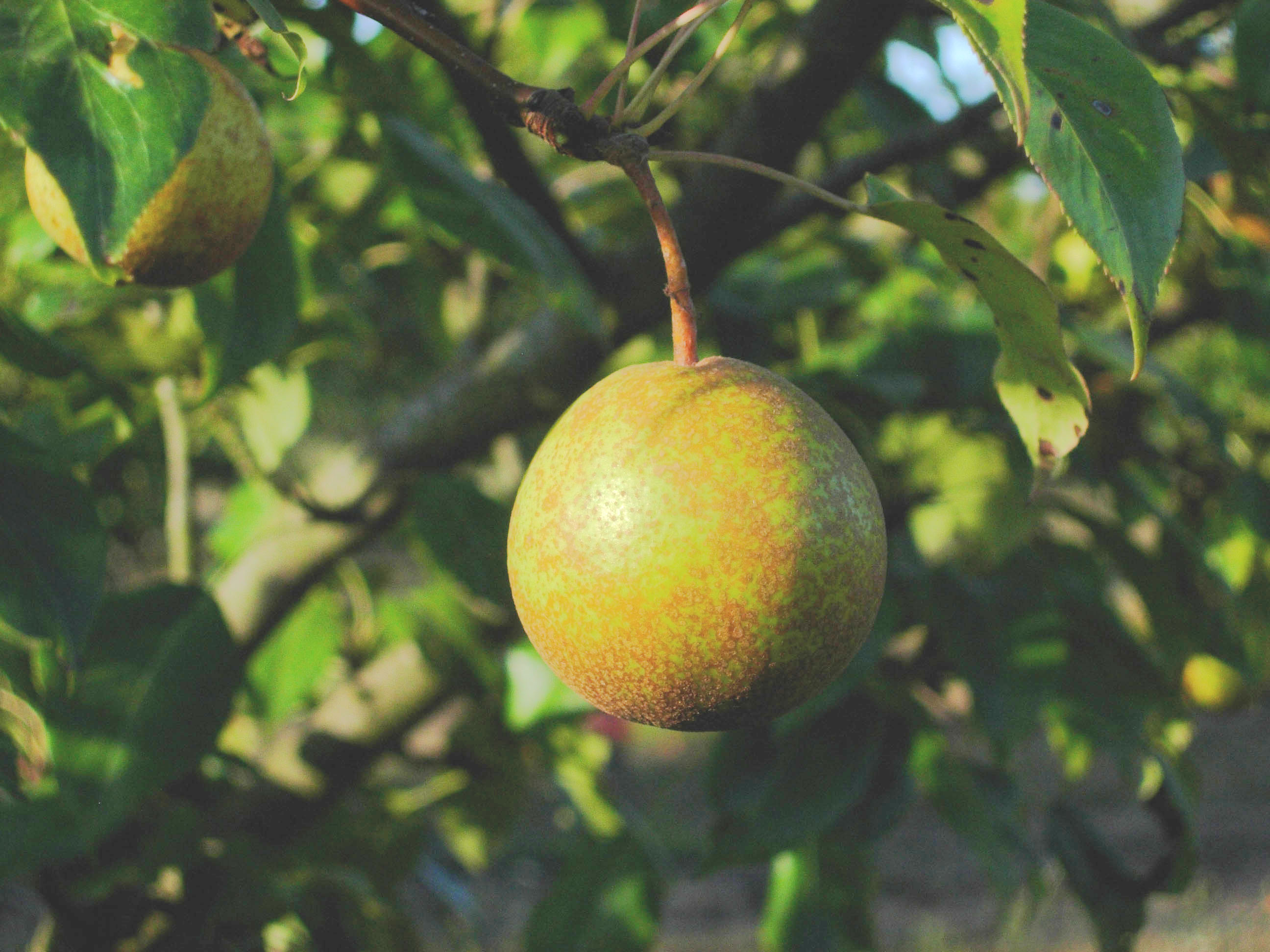 | | 1983 | DEVELOPED | 1940 | | | | | Cultivar | Okolo (PI 541908).-Originated in Brookings, South Dakota, by N.E. Hansen, South Dakota Agriculture Experiment Station. Introduced in 1940. Open-pollinated seedling of Pyrus ussuriensis. Fruit: diam. about 2 1/4 inches; pyriform; skin light yellow with minute russet dots; stem long and stout; flesh white, firm, juicy, with delicious flavor. Tree: bears well. - Brooks and Olmo Register of Fruit and Nut Varieties | 1436844 | PI 541908 |
| 61 | PI 143979 | 'Olia' | Pyrus hybr. | Habarovskij kraj, Russian Federation | COR | | | 1983 | DEVELOPED | 1940 | | | | | Cultivar | Olia (PI 143979).-Originated in Habarovsk, Maritime Province, Russia, by A.V. Lukasheff. Introduced into Manitoba, Canada, in 1940. Pyrus ussuriensis x Finland Early Yellow; cross made in 1910; sister seedling of Tioma. Fruit: somewhat smaller than Tioma but sweeter and more aromatic than that variety; quality too low for commercial value; as in Tioma, chief value lies in being a parent for development of large fruit and a hardy tree. Tree: very similar to Tioma; hardy. - Brooks and Olmo Register of Fruit and Nut Varieties | 1135783 | PI 143979 |
| 62 | PI 541726 | 'Pontotoc' | Pyrus hybr. | Mississippi, United States | COR |  | | 1983 | DEVELOPED | 1926 | | | | | Cultivar | Pontotoc (PI 541726).-Originated in Pontotoc, Miss., by J.C.C. Price, Mississippi Agr. Exp. Station., State College, Miss. Introduced in 1926. Parentage unknown; discovered in 1922. Fruit: size medium, round; flesh tender, fair for canning. Tree rest period short; field resistance to fire blight very good, low chilling requirement. - Brooks and Olmo Register of Fruit and Nut Varieties | 1436662 | PI 541726 |
| 63 | PI 541727 | 'Sodak' | Pyrus hybr. | South Dakota, United States | COR | 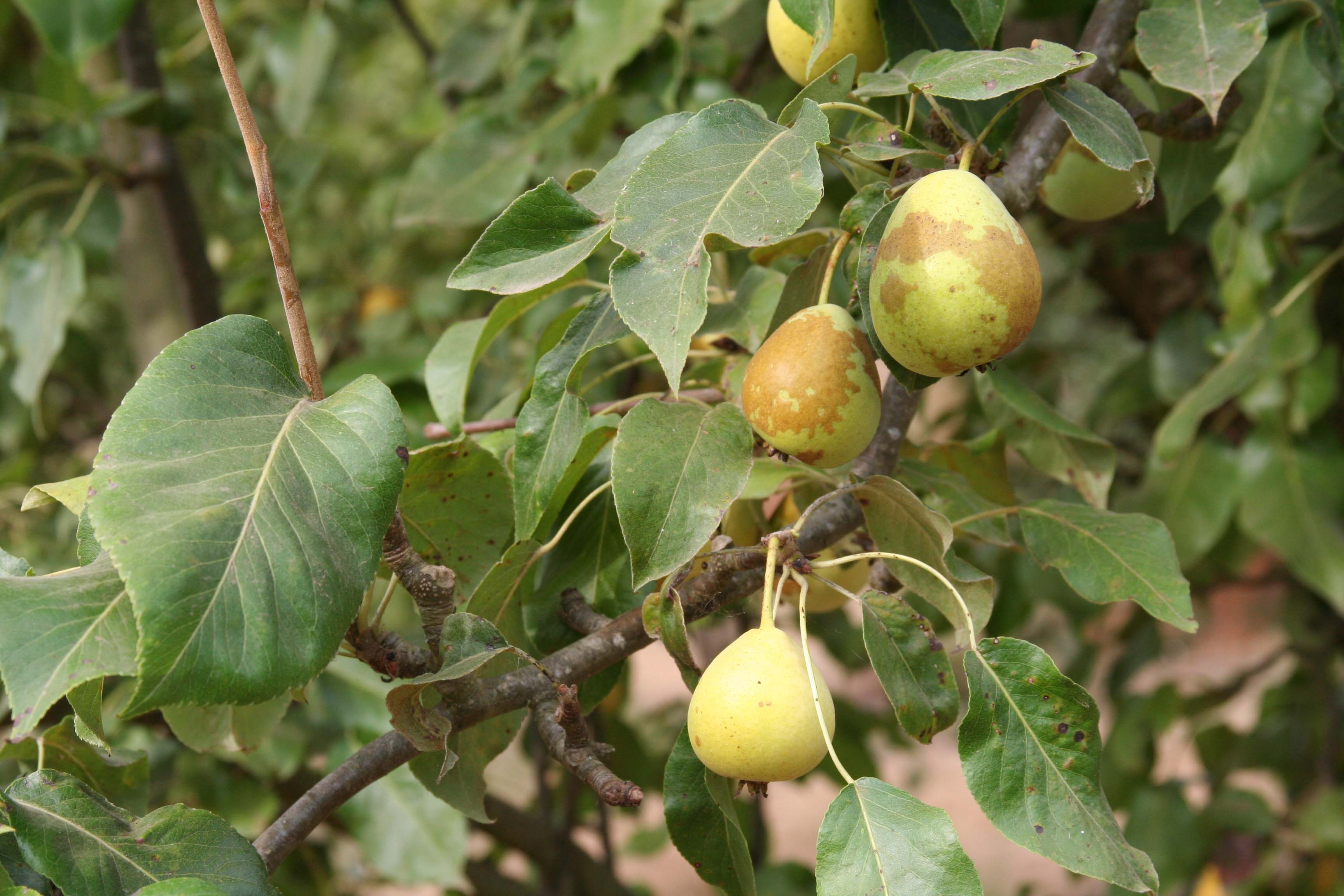 | | 1983 | DEVELOPED | 1945 | | | | | Cultivar | Sodak (PI 541727).-Originated in Brookings, SOUTH DAKOTA, by N.E. Hansen, South Dakota Agriculture Experiment Station. Introduced in 1945. Pyrus ussuriensis Maxim. x Marguerite Marillat. Fruit: 2 x 2-1 / 2 inches; oblong-obovate-pyriform; flesh white, very juicy, melting, buttery. Tree: vigorous; probably obsolete. - Brooks and Olmo Register of Fruit and Nut Varieties | 1436663 | PI 541727 |
| 64 | PI 132103 | 'Shu Li' | Pyrus pyrifolia (Burm. f.) Nakai | China | COR |  | | 1981 | DEVELOPED | | | | | | Cultivar | PI 132103 - P. ussuriensis 'Shu-li' . Scions presented to the USDA Bureau of Plant Industry by Alfred Rehder, Arnold Arboretum, Jamaica Plain, Massachusetts. March 27, 1939. | 1134049 | PI 132103 |
| 65 | PI 312509 | 'Tse Li' | Pyrus ×bretschneideri Rehder | Shandong Sheng, China | COR |  | | 1981 | DEVELOPED | | | | | | Cultivar | PI 312509 was received by the USDA Plant Industry Station, Beltsville, Maryland on Mary 17, 1968. Scions were presented by the Research Institute of Pomology, Skierniewice, Poland. Tse Li (Ts Li) (PI 312509).--Grown in Shantung Province, Northern China for thousands of years. Fruit: large, 75 mm diam., 89 mm long, ovate-pyriform with no distinct neck, irregular, lumpy; yellow with large prominent tan lenticels; crisp, juicy, sweet, trace of tartness, distinct aroma; ripe mid-late September in Oregon, 4 weeks after Nijisseiki; stores 25 weeks at 0 C. Tree: large, upright, very early bloom, requires early blooming pollinator such as Ya Li. Cold hardy yet low chilling requirement, about 350-500 hours. -- Brooks and Olmo Registe of Fruit and Nut Varieties. Hu (1937) reported that Tsu Li is an old and famous variety in the Shantung Province of Northeastern China, and that production is restricted to the Chucheng, Laiyang, and penglai districts. Kubo (1970) stated that Tsu Li was introduced into Japan from Laiyang in 1912 by Tetsuya Onta. -- W.H. Griggs and B.T. Awakiri. 1977. Asian Pear Varieties in California Description: This plant can be found in northern and northeastern China, eastern Siberia, Manchuria, Korea, Amurland, and Ussuri. It is an old and famous cultivar in Shantung Province of Northeastern China. In the United States, Tse Li receives much attention due to its tendency to be resistant to fire-blight. However, because of its slow growth rate the USDA discouraged its use. The tree is large, vigorous, dense, and moderately productive. The fruit varies in size and shape. It can be found as ovate-pyriform in longitudinal section and circular to angular in transverse section. The tree is self-incompatible and self-unfruitful in most years. It requires cross-pollination for commercial fruit-set, and Ya Li pollen appears to serve this purpose best. | 1233249 | PI 312509 |
| 66 | PI 420808 | Chinese Pear | Pyrus pyrifolia (Burm. f.) Nakai | Thailand | COR |  | | 1981 | COLLECTED | 08/1973 | Collected in Meo village near Chiang Mai. | 18.78333000, 98.98333000 | 0 | | Breeding material | Collected by Robert Knight as a low-chill Pyrus ussuriensis in the Meo village near Chiangmai, Thailand in August 1973. Budwood presented to the USDA Plant Introduction Station by the Subtropical Horticultural Research Unit, Miami, Florida. PI number assigned March 7, 1978. Collected as Pyrus ussuieriensis, reidentified as P. serotina (= P. pyrifolia). | 1317818 | PI 420808 |
| 67 | PI 541999 | 'Ping Ding Li' | Pyrus ×bretschneideri Rehder | China | COR |  | | 1981 | DEVELOPED | | | | | | Cultivar | | 1436935 | PI 541999 |
| 68 | PI 542037 | P. x phaeocarpa | Pyrus ×phaeocarpa Rehder | Oregon, United States | COR |  | | 1981 | DEVELOPED | | | | | | Breeding material | Rehder's Pyrus phaeocarpa includes the group of pears commonly known as Tang Li in North China (see CPYR 1184), and is most closely related to Pyrus betulaefolia. The tree is of medium size. Foliage elliptical-ovate or oblong-ovate, long gradually tapering point, and base usually broadly wedge-shaped, with open, large, blunt serrate teeth. Inflorescence and umbelled-raceme, 5 - 7 flowered; sepals triangular lanceolate; petals oval, white, stamens about 20; styles 3 or 4, rarely 2. Fruit pyriform 2 to 3 cm. long and 1.5 - 2 broad, brown, 3-4 celled. Variety globosa has roundish fruit with leaves ovate with a round base. Distribution: This is an extremely variable type. It is native to northeastern China. I found it in the foot hills and mountains to the west and north of Peking. Mr. F.N. Meyer had found it in the mountains in Poshan in central Shantung Province. The trees are comparatively rare and usually occur as isolated specimens. This type has given rise to a small number of cultivated varieties, and to a good many seedlings which are grown in a limited way in the orchards of North China. All of these varieties and cultivates seedlings pass under the general name 'Tang Li'. Only one of these, the Tang Li grown at Malanyu and in the Panshan district is really worthy of a varietal name. It is medium to large in size, russet in color, with hard flesh, and of poor quality. Botany: After a careful study in the field in north China, and of the seedlings grown from it at this Experimental Station, I am of the opinion that this is not a distinct or well-defined species, but that it is simply a group of hybrids between other species. The following facts support this view: It is var more variable in form of tree, character of branches, character, form and margin of leaf, size, form, and character of furit, and number of seed cells, than any distinct species of Pyrus that I have studied. This group includes forms which in general can be classed as intermediate between P. betulaefolia and P. ussuriensis... The best evidence of hybridity, however, is revealed in the seedlings of this type. A considerable number of seedlings have been grown from three distinct and typical strains in this group... In each lot part of them resemble the seedlings of P. ussuriensis, part those of P. betulaefolia, and part are intermediate between these two species. -- F.C. Reimer. 1919. Report of a trip to the Orient to collect and study Oriental Pears. This clone came from the Southern Oregon Experiment Station, and is probably a seedling from Reimer's collection in China. | 1436973 | PI 542037 |
| 69 | PI 45845 | 'Yaguang Li' | Pyrus ×bretschneideri Rehder | Hebei Sheng, China | COR |  | | 1918 | DEVELOPED | | | | | | Cultivar | When judged by American tastes and standards, the Ya Kuang Li is unquestionably the finest variety of China. It resembles the better American or European pears in tenderness, juiciness, flavor, and quality more closely than any other pear in China. In quality, it is equaled by only one other Oriental pear -- the famous Peking Pai Li. It is equal in this respect to our better American varieties, and certainly as good if not better than our Bartlett. It is large, somewhat variable in shape, although usually somewhat quince-shaped. The color is an attractive cinnamon yellow. The calyx is always persistent. The skin is rather thick and slightly rough. The flesh is tender, melting, juicy, creamy white in color, and grit cells not noticeable in eating. excepting around the core. It is aromatic, sweet with slight acidity, sprightly, very agreeable. This variety is grown only in northern China. The fruit is found on the peking market from early October until the first of January, and is one of the three most popular varieties on that market. I regard this as the most promising Oriental variety ever introduced into this country. While the variety is good enough to introduce and grow just as it is, it may prove of even greater value for breeding purposes. This variety certainly contains considerable P. ussuriensis blood. It may have derived solely from that species, although it appears to be a hybrid between this and some other species. Judging from this, we should expect it to shoe a high degree of resistance to pear blight, and should prove valuable in breeding new blight resistant varieties. Inoculation experiments have shown that it blights in the young shoots but appears to be very resistant in the older wood. Judging from its parentage, it should also prove valuable in breeding hardy varieties for cold regions. The tree is a vigorous, rather spreading grower. -- F.C. Reimer. 1919. Report of a trip to the Orient to collect and study Oriental pears. | 1106052 | PI 45845 |
| 70 | PI 40019 | Kansu Pear | Pyrus sp. | China | COR |  | | 1915 | COLLECTED | 3/2/1915 12:00:00 AM | Near Tchenyatau (near Titao). (Other names for Ti-tao: Taoyang, Lin-t'ao and Didao.) | 35.37780000, 103.85640000 | | | Breeding material | Original seedlot collected by Frank N. Meyer. Received March 2, 1915. Quoted notes by Mr. Meyer in USDA Plant Inventory No. 42. 'Pyrus ussuriensis Maxim. No. 2157a. Near Tshenyatau (near Titao), Kansu, China. December 1, 1914. A species of wild pear, growing to be a large tree,with a wide-spreading,dense head of branches. Bark of dark color and in the main trunk even blackish and deeply furrowed in old specimens. Young branches often ferociously spiny and especially so in suckers. Leaves small and with much shorter peduncles than in Pyrus chinensis. Fruits globose, flattened. Calyx persistent, peduncle generally short; much variation exists as regards size, but the fruits of this species of pear are generally small; the flesh is also acri and often quite hard, though some of the larger ones are edible after having been frozen. This pear is not found in the warm valleys, but it thrives best at altitudes of about 8,000 ft. in company with such hardy trees and shrubs as Picea obovata, Populus tremula, Malus baccata, Hippophae rhamnoides, Syringa amurensis, Rhamnus dahurica, Sorbaria sorbifolia, and others. This pear has apparently given rise to some locally cultivated forms bearing small, sour fruits, which are juicy, however, and melting, and not hard and gritty, like the poorer strains of P. chinensis. Of undoubted value as a stock for pears in cold sections and as a factor in breeding experiments in trying to extend successful pear culture farthernorthward.' | 1104822 | PI 40019 |