| 0 | PI 710524 | MARSB-091 | Phytolacca americana L. | New York, United States | S9 | 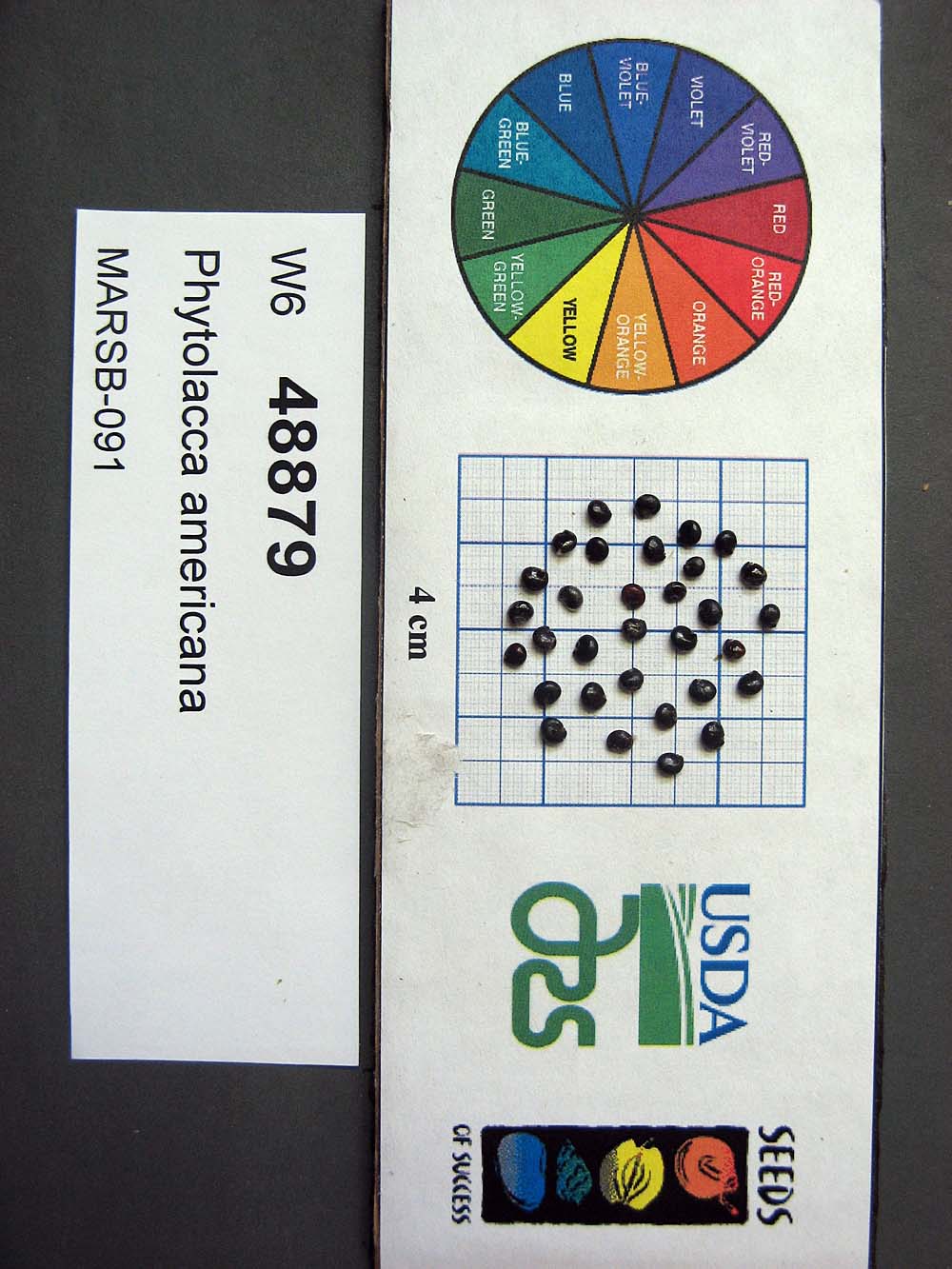 | | 2015 | | | | | | | Wild material | | 1922926 | PI 710524 |
| 1 | PI 693827 | R10-15-058 | Dactylis glomerata L. subsp. lobata (Drejer) H. Lindb. | Stavropol, Russian Federation | W6 | | | 2011 | COLLECTED | 07/20/2010 | NE facing slope at foot of Mashuk Mountain near Pyatigorsk | 44.06300000, 43.09500000 | 592 | Temperate deciduous forest understory. Limestone parent material, small statured <0.4m in height, fine, light green, soft, lax, basal leaves (diploid?): seed collected from >100 plants | Wild material | | 1883153 | PI 693827 |
| 2 | W6 62493 | DCA00-13 | Acmispon americanus (Nutt.) Rydb. var. americanus | California, United States | W6 |  | | 2025 | | | | | | | Wild material | | 2192191 | W6 62493 |
| 3 | W6 62494 | DCA00-14 | Phyla nodiflora (L.) Greene | California, United States | W6 | 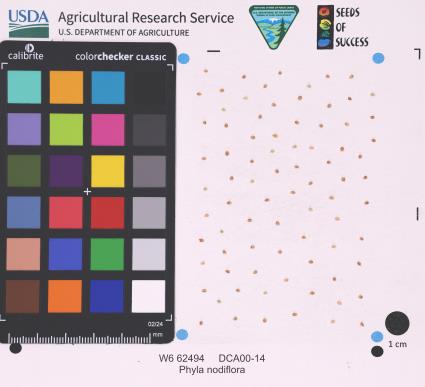 | | 2025 | | | | | | | Wild material | | 2192192 | W6 62494 |
| 4 | W6 62495 | DCA00-15 | Oenothera elata Kunth | California, United States | W6 |  | | 2025 | | | | | | | Wild material | | 2192193 | W6 62495 |
| 5 | W6 62496 | DCA00-16 | Grindelia camporum Greene | California, United States | W6 |  | | 2025 | | | | | | | Wild material | | 2192194 | W6 62496 |
| 6 | W6 62648 | CA180A-13 | Helenium puberulum DC. | California, United States | W6 |  | | 2025 | | | | | | | Wild material | Ray flowers tiny to nonexistent; head yellow to brownish red. Borders recreational trail. Noticed that head count increased significantly between week of first ID and time of collection ~3 weeks.). Fruit falls off head and can be easily lost; collect heads by clipping stem. Quick turnaround between flower and fruit production. 1seed/fruit, average 692 seeds/head, estimated 86% viability. | 2192866 | W6 62648 |
| 7 | W6 62685 | CA340-60 | Danthonia californica Bol. | California, United States | W6 |  | | 2025 | | | | | | | Wild material | Very densely populated in the meadows. More easily distinguishable in the summer than in the spring. | 2192903 | W6 62685 |
| 8 | W6 62687 | CA340-62 | Deschampsia cespitosa (L.) P. Beauv. | California, United States | W6 |  | | 2025 | | | | | | | Wild material | 2 larger pockets in the previously wet areas of the meadows, with a few individuals scattered outside of those pockets. 1 pocket in the northern meadow and one in the eastern meadow. Looks similar to other species when vegetative, but easily distinguishable when in flower.Yielded a triple collection. | 2192905 | W6 62687 |
| 9 | W6 62716 | CA360A-15 | Cercis occidentalis Torr. ex A. Gray | California, United States | W6 |  | | 2025 | | | | | | | Wild material | Received as Cercis orbiculata. Varying sizes with seed pods at variable levels of development, some still red and rubbery and others on the verge of late ripeness. Sometimes crowded in with Toxicodendron diversilobum, mostly in creek washes. Deceptive in dispersemet, where one is located in a wash there are are oftentimes several others behind it being obscured by oaks. | 2192934 | W6 62716 |
| 10 | W6 62719 | CA360A-18 | Madia elegans D. Don | California, United States | W6 |  | | 2025 | | | | | | | Wild material | In a field immediately to left of entering Reading Island Trail; matted in its grasses and lots of dry Vitchia. Larger plants in anthesis, seeds collected from smaller plants. Some variation in seed progress of development; also some variation in seed type produced. Mostly large black ligulate seeds, however a very few seem to only have central achenes, and one had tiny almost guitar shaped seeds. Confirmed it was the same plant and species as others. We will be using the black ligulate seeds as our target for this collection. Collection is (of now 07/24/2024/) only from smaller plants that have already gone to seed. | 2192937 | W6 62719 |
| 11 | W6 62722 | CA360A-20 | Eriophyllum lanatum (Pursh) J. Forbes | California, United States | W6 |  | | 2025 | | | | | | | Wild material | Average of 92.8-108 fruits per capitulum, viability low 34-41%. (Viability infructescense calculation over single seed per fruit.) | 2192940 | W6 62722 |
| 12 | W6 62795 | DCA00-10 | Leymus triticoides (Buckley) Pilg. | California, United States | W6 |  | | 2025 | | | | | | | Wild material | | 2193092 | W6 62795 |
| 13 | W6 62796 | DCA00-11 | Diplacus aurantiacus (Curtis) Jeps. | California, United States | W6 |  | | 2025 | | | | | | | Wild material | | 2193093 | W6 62796 |
| 14 | W6 62801 | DCA00-9 | Carex barbarae Dewey | California, United States | W6 |  | | 2025 | | | | | | | Wild material | | 2193098 | W6 62801 |
| 15 | W6 61558 | CA340-47 | Achillea millefolium L. | California, United States | W6 |  | | 2024 | | | | | | | Wild material | | 2168007 | W6 61558 |
| 16 | W6 61574 | CA360-204 | Elymus glaucus Buckley | California, United States | W6 |  | | 2024 | | | | | | | Wild material | | 2168023 | W6 61574 |
| 17 | Ames 36154 | JDC/MM/2023/051/1083 | Monarda maxmedleyi J. J. N. Campb. & Floden | Kentucky, United States | NC7 |  | | 2023 | COLLECTED | 08/08/2023 | Located just east of highway 213 (Morris Creek Road) near Powell and Montgomery County line. Population in both counties. | 37.90554800, -83.86808700 | 359 | Dry, steep hillside (roadside). Localized to south-facing slopes. | Wild material | Plants measuring 12-18" in height. Peak flowering at collection site occurred near 24th of May (2023). Some specimens extremely vigorous forming dense clonal patches covering a 5' x 5' area. Majority of specimens with mostly white flowers. | 2158359 | Ames 36154 |
| 18 | W6 61025 | CA360-196 | Cyperus eragrostis Lam. | California, United States | W6 |  | | 2023 | | | | | | | Wild material | grows in tussocks, seedheads axillary | 2142664 | W6 61025 |
| 19 | W6 61029 | CA360-200 | Schoenoplectus californicus (C. A. Mey.) Soják | California, United States | W6 |  | | 2023 | | | | | | | Wild material | Seed head shape and stem shape near base and tip. | 2142668 | W6 61029 |
| 20 | WLP 2670 | RJL2022PA-016 | Acer negundo L. | Pennsylvania, United States | NA | | | 2022 | COLLECTED | 10/21/2022 | Plants growing in woodlands above a small unnamed creek that dumps into the Middle Branch White Clay Creek in Goddard Park, West Grove Pennsylvania, off of Wickerton Road, Chester County. Plants are found regularly but scattered in the understory of the woodlands. | 39.80426000, -75.82609300 | 105 | Plants growing in a mesic, well-drained habitat of deciduous woodlands along streams and above the riparian zone that drains toward a small unnamed creek that feeds into the Middle Branch White Clay Creek. Plants generally grow in part shade to full sun, but perform best and fruit more heavily in full sun where there is abundant access to moisture. The remnant woodlands exist mostly along the steep slopes, wetlands and seeps of seasonal and year-round creeks flowing into the Middle Branch White Clay Creek. The woodlands are bordered by numerous housing developments and land converted to meadows; hence there is significant first order edge that is heavily impacted by invasive plant intrusion. Despite this fact, Acer negundo is highly competitive and competes well.
Soils: The underlying geology of this area is the Glenarm Wissahickon Formation of lower Paleozoic origin and lithologically similar to oligoclase-mica schist of the Wissahickon Formation (PZw), but also includes lenticular amphibolite bodies having ocean-floor basalt chemistry.
Source: USGS Pennsylvania Geologic Map Data (https://mrdata.usgs.gov/geology/state/sgmc-unit.php?unit=PAPZgw%3B0)
The primary soil type in the area of this collection is classified as Glenelg silt loam, 3 to 8 percent slopes. This series consists of very deep, well drained soils formed in residuum weathered from micaceous schist on uplands of the Blue Ridge and the Northern Piedmont. Saturated hydraulic conductivity is moderately high in the subsoil and moderately high to high in the substratum. This upper horizon of this soil is undifferentiated, mostly poorly drained sandy bottomland soils intermingled with decomposing organic litter and eroded silts and clays due to erosion.
Source: NRCS Web Soil Survey (https://websoilsurvey.sc.egov.usda.gov/App/WebSoilSurvey.aspx) | Wild material | | 2139661 | WLP 2670 |
| 21 | NA 88292 | CA360-192 | Cercis occidentalis Torr. ex A. Gray | California, United States | NA | | | 2022 | | | | | | | Wild material | Green heart shaped leaves, dried seed pods, opposite branching | 2138500 | NA 88292 |
| 22 | W6 60456 | CA180-249 | Thysanocarpus curvipes Hook. | California, United States | W6 |  | | 2022 | | | | | | | Wild material | Small white to purple flowers born on a raceme; styles <.7mm. Leaves lanceolate, bases lobed, clasping. Stems fuzzy. Winged fruit pedicels in a continuous 1.5-12mm arc. Fruit, <6mm, entire, crenate or perforated. | 2138394 | W6 60456 |
| 23 | W6 60459 | CA180-241 | Alnus rhombifolia Nutt. | California, United States | W6 |  | | 2022 | | | | | | | Wild material | Deciduous tree not forming thickets. Bark is pale gray. Leaves are alternate, rhombic to elliptic with serrate margins, acute tip, not rolled under. Monoecieous. Males long & slender. females 1.5cm cones. | 2138397 | W6 60459 |
| 24 | NA 86885 | RJL2021PA-004 | Ilex verticillata (L.) A. Gray | Pennsylvania, United States | NA | | | 2021 | COLLECTED | 11/16/2021 | Plants growing in woodlands along a small unnamed creek corridor dumping into the Middle Branch White Clay Creek in Goddard Park, West Grove Pennsylvania, off of Wickerton Road, Chester County. | 39.81063861, -75.82750806 | 124 | Plants are growing in a range of habitats from mesic woodlands to saturated streamside settings of deciduous woodlands that drain toward the Middle Branch White Clay Creek. Plants grow in high understory shade with dappled to indirect sunlight. The only female (fruiting) plants were found in areas along the creek where soils are moist to saturated. Numerous male specimens were found in the areas described above. Soils: Soils found in the areas where this collection was made are comprised primarily of Baile silt loam (Ba), Hatboro silt loam (Ha), and Glenelg silt loam, 8 to 15 percent slopes (GgC). Baile silt loam consists of very deep, poorly drained, moderately low to moderately high saturated hydraulic conductivity, soils on upland depressions and footslopes that were formed in local alluvium over residuum from acid crystalline rocks, chiefly mica schist and granitized schist and gneiss; slope ranges from 0 to 8 percent. Hatboro silt loam consists of very deep and poorly drained soils formed in deposited alluvium derived from metamorphic and crystalline rock. They are on flood plains. Slopes range from 0 to 3 percent. Glenelg silt loam, 8 to 15 percent slopes consists of very deep, well drained soils formed in residuum weathered from micaceous schist on uplands of the Blue Ridge and the Northern Piedmont. This soil is undifferentiated, mostly poorly drained sandy bottomland soils intermingled with decomposing organic litter and eroded silts and clays due to erosion. Slope: 0 to 15% Aspect: Variable. | Wild material | | 2123125 | NA 86885 |
| 25 | WLP 1731 | RJL2021PA-001 | Viburnum acerifolium L. | Pennsylvania, United States | NA | | | 2021 | COLLECTED | 11/05/2021 | Plants growing in woodlands above a small unnamed creek that dumps into the Middle Branch White Clay Creek in Goddard Park, West Grove Pennsylvania, off of Wickerton Road, Chester County. | 39.80462083, -75.82888750 | 103 | Plants growing in a mesic, well-drained habitat of deciduous woodlands, for the most part, above the riparian zone that drains toward a small unnamed creek that feeds into the Middle Branch White Clay Creek. Plants are growing in high understory shade with very little direct sun during most of the day. The remnant woodlands exist mostly along the steep slopes, wetlands and seeps of seasonal and year-round creeks flowing into the Middle Branch White Clay Creek. The woodlands are bordered by numerous housing developments and land converted to meadows; hence there is significant first order edge that is heavily impacted by invasive plant intrusion. Soils: Soils are classified as Glenelg silt loam, 8 to 15% slopes (GgC); this series consists of very deep, well drained soils formed in residuum weathered from micaceous schist on uplands of the Blue Ridge and the Northern Piedmont. Saturated hydraulic conductivity is moderately high in the subsoil and moderately high to high in the substratum. This upper horizon of this soil is undifferentiated, mostly poorly drained sandy bottomland soils intermingled with decomposing organic litter and eroded silts and clays due to erosion. Slope: 8 to 15% Aspect: West. | Wild material | | 2123080 | WLP 1731 |
| 26 | WLP 1732 | RJL2021PA-002 | Viburnum prunifolium L. | Pennsylvania, United States | NA | | | 2021 | COLLECTED | 11/05/2021 | Plants growing in woodlands along a small unnamed creek corridor dumping into the Middle Branch White Clay Creek in Goddard Park, West Grove Pennsylvania, off of Wickerton Road, Chester County. | 39.80462083, -75.82888750 | 102 | Plants are growing in a range of habitats from drier upland woods to moist creekside settings of deciduous woodlands that drain toward the Middle Branch White Clay Creek. Plants grow in part shade to high understory shade with dappled to indirect direct sunlight. Plants achieve their largest size and fruiting potential in part sun of the riparian zone of the creek where woodland canopy is thinner. Soils: Soils found in the areas where this collection was made are comprised primarily of flood plain Hatboro silt loam (Ha) and well-drained, upland Glenelg silt loam, 8 to 15 percent slopes (GgC). Hatboro silt loam consists of very deep and poorly drained soils formed in deposited alluvium derived from metamorphic and crystalline rock. They are on flood plains. Slopes range from 0 to 3 percent. Glenelg silt loam, 8 to 15 percent slopes consists of very deep, well drained soils formed in residuum weathered from micaceous schist on uplands of the Blue Ridge and the Northern Piedmont. This soil is undifferentiated, mostly poorly drained sandy bottomland soils intermingled with decomposing organic litter and eroded silts and clays due to erosion. Slope: 0 to 15% Aspect: Variable. | Wild material | | 2123098 | WLP 1732 |
| 27 | WLP 1733 | RJL2021PA-003 | Viburnum dentatum L. | Pennsylvania, United States | NA | | | 2021 | COLLECTED | 11/05/2021 | Plants growing in woodlands along a small unnamed creek corridor dumping into the Middle Branch White Clay Creek in Goddard Park, West Grove Pennsylvania, off of Wickerton Road, Chester County. | 39.80522167, -75.82928139 | 107 | Plants are growing in a range of habitats from mesic woodland to moist creekside settings of deciduous woodlands that drain toward the Middle Branch White Clay Creek. Plants grow in high understory shade with dappled to indirect sunlight. Soils: Soils found in the areas where this collection was made are comprised primarily of flood plain Hatboro silt loam (Ha) and well-drained, upland Glenelg silt loam, 8 to 15 percent slopes (GgC). Hatboro silt loam consists of very deep and poorly drained soils formed in deposited alluvium derived from metamorphic and crystalline rock. They are on flood plains. Slopes range from 0 to 3 percent. Glenelg silt loam, 8 to 15 percent slopes consists of very deep, well drained soils formed in residuum weathered from micaceous schist on uplands of the Blue Ridge and the Northern Piedmont. This soil is undifferentiated, mostly poorly drained sandy bottomland soils intermingled with decomposing organic litter and eroded silts and clays due to erosion. Slope: 0 to 15% Aspect: Variable. | Wild material | | 2123124 | WLP 1733 |
| 28 | OPGC 8368 | CA180-215 | Calochortus albus (Benth.) Douglas ex Benth. | California, United States | OPGC | | | 2021 | | | | | | | Wild material | White nodding flower can be pale pink. Nectary crescent shaped with yellow or white glandular hairs. Bracts lanceolate. Ovate sepals are paired with elliptic petals. Winged capsule turns from green to tan when dark seed are ripe. Green strappy leaves are basal from bulb as well as along flower stem. | 2120357 | OPGC 8368 |
| 29 | OPGC 8370 | CA180-220 | Clarkia purpurea (Curtis) A. Nelson & J. F. Macbr. subsp. quadrivulnera (Douglas ex Lindl.) F. H. Lewis & M. E. Lewis | California, United States | OPGC | | | 2021 | | | | | | | Wild material | Petals purple to wine red often with a contrasting purple spot in center or edge but highly variable. | 2120361 | OPGC 8370 |
| 30 | OPGC 8377 | CA180-235 | Oenothera elata Kunth subsp. hirsutissima (A. Gray ex S. Watson) W. Dietr. | California, United States | OPGC | | | 2021 | | | | | | | Wild material | Bright yellow flowers fade to peach. 4 sepals are reflexed. 8 stamens are shorter than single stigma. Stigma tip is four-lobed, about 4cm long. Four yellow petals are smooth, not crepey. Stem has hairs; red to green. | 2120371 | OPGC 8377 |
| 31 | W6 59319 | CA190B-173 | Pseudognaphalium beneolens (Davidson) Anderb. | California, United States | W6 | | | 2021 | | | | | | | Wild material | Late fruit phenology. Most seeds already dropped. | 2120374 | W6 59319 |
| 32 | W6 59321 | CA190B-176 | Eriogonum gracile Benth. var. gracile | California, United States | W6 | | | 2021 | | | | | | | Wild material | Flower color changes from cream-white to reddish brown as fruit matures.
| 2120541 | W6 59321 |
| 33 | W6 58054 | CA360-179 | Artemisia douglasiana Besser | California, United States | W6 | | | 2020 | | | | | | | Wild material | Very small, yellow flowers; leaves slightly lobed towards base of plant, darker green on the surface, pale underneath. | 2107458 | W6 58054 |
| 34 | WLP 2522 | Oakmulgee Ranger District | Hydrangea quercifolia W. Bartram | Alabama, United States | NA |  | | 2019 | COLLECTED | 11/29/2018 | Talladega National Forest, Oakmulgee Ranger District, Bibb County. Approximately 14 miles west of Centreville, along FR738. | 32.95619300, -87.43060000 | | Shady roadside, wooded slopes. | Wild material | Measurements of sampled specimens taken in nature: Height 40 to 89 in.; width 24 to 192 in. Measurements for each specimen sampled may be provided upon request. | 2106232 | WLP 2522 |
| 35 | W6 55316 | CA360-146 | Grindelia camporum Greene | California, United States | W6 |  | | 2018 | | | | | | | Wild material | | 1967868 | W6 55316 |
| 36 | NA 88424 | CA180-151 | Rosa californica Cham. & Schltdl. | California, United States | NA |  | | 2018 | | | | | | | Wild material | Rosa californica | 1966291 | NA 88424 |
| 37 | Ames 34239 | CA180-115 | Helenium puberulum DC. | California, United States | NC7 | | | 2017 | | | | | | | Wild material | | 1947173 | Ames 34239 |
| 38 | W6 49983 | CA180-99 | Cyperus eragrostis Lam. | California, United States | W6 |  | | 2015 | | | | | | | Wild material | | 1927007 | W6 49983 |
| 39 | WLP 218 | JDC/TC/2014/089/591A | Tsuga canadensis (L.) Carrière | Alabama, United States | NA | | | 2014 | COLLECTED | 09/23/2014 | Alabama: Franklin County; William B. Bankhead National Forest, north-facing banks of Bear Creek watershed. | 34.33924600, -87.54771500 | 285 | Growing in association with Quercus alba, Cornus florida, Pueraria montana var. lobata, Magnolia macrophylla, Platanus occidentalis, Liquidambar styraciflua, and Fagus grandifolia. | Wild material | Excellent cone production. Optimum timing for harvest. Species infrequent to locally abundant across a 12 mile linear stretch of the southeast corner of Franklin County to north-central Winston County. | 1922361 | WLP 218 |
| 40 | W6 41343 | CA930B-003 | Nassella pulchra (Hitchc.) Barkworth | California, United States | W6 |  | | 2011 | | | | | | | Wild material | | 1868938 | W6 41343 |
| 41 | W6 30056 | CA340-03-1 | Eriocoma lemmonii (Vasey) Romasch. | California, United States | W6 | 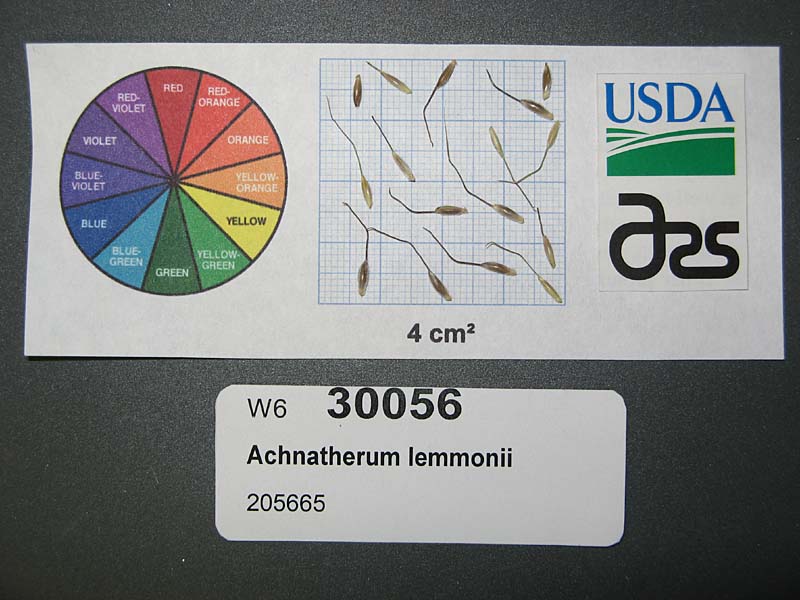 | | 2007 | | | | | | | Wild material | | 1718939 | W6 30056 |
| 42 | DLEG 35 | DLEG 35 | Cercis occidentalis Torr. ex A. Gray | California, United States | | | Historic | 2000 | COLLECTED | 08/17/2000 | Tehama Co. California Hwy 36, 18.5 miles by road (W bound) from Trinity Co. line, E. of Platina (E. of Redbluff). Ca. 1500 ft. elevation. | | | | Wild material | Collection site: Plants along road in woodland with Digger pine, Quercus agrifolia, Q. lobata, Arctostaphylos sp., Vitis sp. Collector: W. Feldman. Common name: Western redbud, California redbud. | 1663591 | DLEG 35 |
| 43 | NA 64942 | WD175 | Acer ceriferum Rehder | Hubei Sheng, China | NA | | | 1994 | COLLECTED | 10/01/1994 | | 32.40750000, 110.99833000 | | In moist woodland valley on rocky ledge w/ Lindera glauca, Actinidia chinensis, Acer henryi, Cornus controversa, Pueraria lobata & Quercus serrata. Growing at base of east facing cliff. | Wild material | | 1951983 | NA 64942 |
| 44 | NA 64951 | WD184 | Cephalotaxus sinensis (Rehder & E. H. Wilson) H. L. Li | Hubei Sheng, China | NA | | | 1994 | COLLECTED | 10/01/1994 | Associated Taxa – Lindera glauca:Actinidia chinensis:Acer henryi:Cornus controversa:Pueraria montana var. lobata:Quercus serrata | 32.40750000, 110.99833000 | 1200 | In moist woodland on rocky ledge w/ Lindera glauca, Actinidia chinensis, Acer henryi, Cornus controversa, Pueraria lobata & Quercus serrata. Growing on rocky ravine slopes. | Wild material | | 1951138 | NA 64951 |