| 0 | Ames 19367 | Ames 19367 | Quercus ×schochiana Dieck | Missouri, United States | NC7 |  | | 1992 | COLLECTED | | Missouri: southeastern corner of state. | 37.14982600, -90.76904300 | | | Wild material | Accession was separated during a grow out at NCRPIS from a seed lot of Ames 4723, which was originally received by the Missouri Dept. of Conservation as Quercus phellos. This hybrid is assumed to be a hybrid between Quercus phellos and Quercus palustris based on morphological characters being intermediate of both species. | 1082829 | Ames 19367 |
| 1 | PI 666670 | V. cory. x V. darrowii HL-2006-038 | Vaccinium hybr. | Florida, United States | COR | | | 2006 | COLLECTED | 05/26/2006 | Among residential roads on eastern shore of Lake Marion, southeast of Haines City, Polk county. | 28.08082000, -81.51570000 | 30 | In flatwoods on sand. Under longleaf pine, Vitis vines throughout, Vaccinium myrtilloides and Quercus myrtifolia. | Wild material | Eastern edge of Lake Wales Ridge region. Housing developments encroaching into natural areas. | 1702641 | PI 666670 |
| 2 | PI 657089 | KAZ 96 07-03 | Malus hybr. | Kazakhstan | GEN | 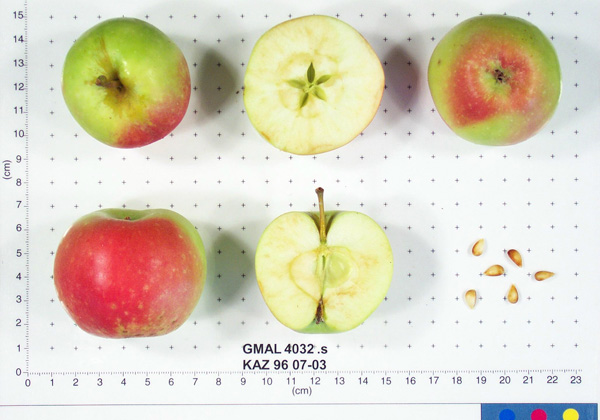 | | 1996 | COLLECTED | 09/08/1996 | 15km east of Topelevka-Djungarsky Range. 3 km southeast of Topelevka Forestry Camp. Collections made in radius around camp. Incline 10%, northwest. | 45.40722222, 80.43944444 | 1460 | Fertile. Dominant tree sp: Malus sierversii; Assoc.-Betula, Crataegus, Acer, Quercus, Tilia, Populus, Betula. Dom. Shrub Sp: Berberis, Lonicera: Assoc.-Cotoneaster, Rubus, Berberis, Ribes. Dom. herb.:Fragaria,Grasses,Humulus:Assoc.-Dianthus | Uncertain improvement status | Sampled 80 fruits from 1 tree. Flesh flavor is subacid. Fruit size is larger than 50mm. Free of disease and insects. Nice apple, 50 year old tree. Scion collected also. ---Malus sieversii hybrid. Domestic introgression intentified using 20K Illumina Infinium apple SNP array--Gold_Reinette is a likely grandparent | 1693368 | PI 657089 |
| 3 | PI 657093 | KAZ 96 07-10 | Malus hybr. | Kazakhstan | GEN | 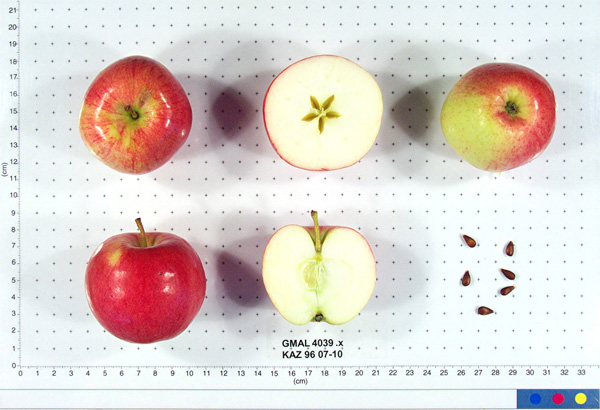 | | 1996 | COLLECTED | 09/09/1996 | 15km east of Topelevka-Djungarsky Range. 3 km southeast of Topelevka Forestry Camp. Collections made in radius around camp. Aspect flat. | 85.41527778, 80.40277778 | 1250 | Fertile. Dominant tree sp: Malus sierversii; Assoc.-Betula, Crataegus, Acer, Quercus, Tilia, Populus, Betula. Dom. Shrub Sp: Berberis, Lonicera: Assoc.-Cotoneaster, Rubus, Berberis, Ribes. Dom. herb.:Fragaria,Grasses,Humulus:Assoc.-Dianthus | Uncertain improvement status | Sampled 60 fruits from 1 tree. Flesh flavor is aromatic. Over color is 70% red. Fruit size is larger than 50mm. Free of disease and insects. Best apple so far, great. ---Malus sieversii hybrid. Domestic introgression intentified using 20K Illumina Infinium apple SNP array--Gold_Reinette is a grandparent | 1693493 | PI 657093 |
| 4 | PI 682768 | KAZ 96 07-03 | Malus hybr. | Kazakhstan | GEN | | | 1996 | COLLECTED | 09/08/1996 | 15km east of Topelevka-Djungarsky Range. 3 km southeast of Topelevka Forestry Camp. Collections made in radius around camp. Incline 10%, northwest. | 45.40722222, 80.43944444 | 1460 | Fertile. Dominant tree sp: Malus sierversii; Assoc.-Betula, Crataegus, Acer, Quercus, Tilia, Populus, Betula. Dom. Shrub Sp: Berberis, Lonicera: Assoc.-Cotoneaster, Rubus, Berberis, Ribes. Dom. herb.:Fragaria,Grasses,Humulus:Assoc.-Dianthus | Uncertain improvement status | Sampled 80 fruits from 1 tree. Flesh flavor is subacid. Fruit size is larger than 50mm. Free of disease and insects. Nice apple, 50 year old tree. Scion collected also. ---Malus sieversii hybrid. Domestic introgression intentified using 20K Illumina Infinium apple SNP array--Gold_Reinette likely a grandparent | 1693381 | PI 682768 |
| 5 | PI 682770 | KAZ 96 07-03 | Malus hybr. | Kazakhstan | GEN | 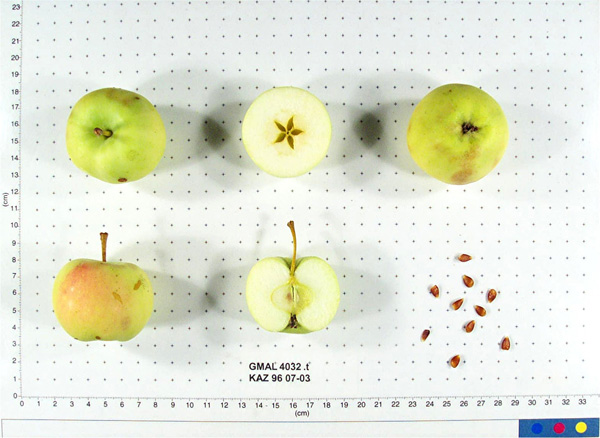 | | 1996 | COLLECTED | 09/08/1996 | 15km east of Topelevka-Djungarsky Range. 3 km southeast of Topelevka Forestry Camp. Collections made in radius around camp. Incline 10%, northwest. | 45.40722222, 80.43944444 | 1460 | Fertile. Dominant tree sp: Malus sierversii; Assoc.-Betula, Crataegus, Acer, Quercus, Tilia, Populus, Betula. Dom. Shrub Sp: Berberis, Lonicera: Assoc.-Cotoneaster, Rubus, Berberis, Ribes. Dom. herb.:Fragaria,Grasses,Humulus:Assoc.-Dianthus | Uncertain improvement status | Sampled 80 fruits from 1 tree. Flesh flavor is subacid. Fruit size is larger than 50mm. Free of disease and insects. Nice apple, 50 year old tree. Scion collected also. ---Malus sieversii hybrid. Domestic introgression intentified using 20K Illumina Infinium apple SNP array--Gold_Reinette likely a grandparent | 1693367 | PI 682770 |
| 6 | PI 682772 | KAZ 96 07-07 | Malus hybr. | Kazakhstan | | 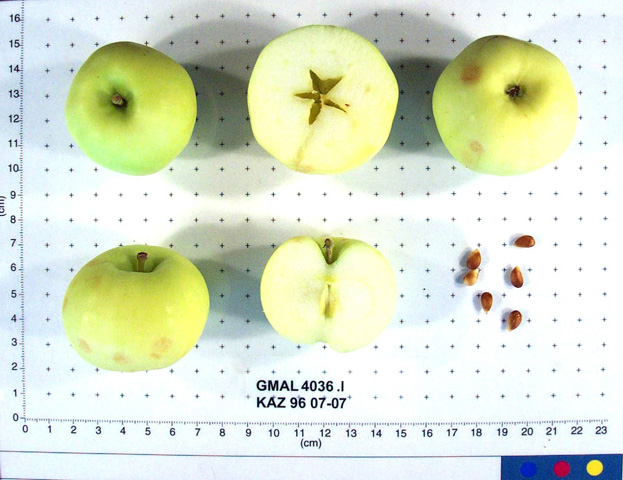 | Historic | 1996 | COLLECTED | 09/09/1996 | 15km east of Topelevka-Djungarsky Range. 3 km southeast of Topelevka Forestry Camp. Collections made in radius around camp. Collected near GMAL 4256. | 45.40472222, 80.40694444 | 1220 | Fertile. Dominant tree sp: Malus sierversii; Assoc.-Betula, Crataegus, Acer, Quercus, Tilia, Populus, Betula. Dom. Shrub Sp: Berberis, Lonicera: Assoc.-Cotoneaster, Rubus, Berberis, Ribes. Dom. herb.:Fragaria,Grasses,Humulus:Assoc.-Dianthus | Uncertain improvement status | Sampled 7 fruits form 1 tree. Flesh flavor is sweet. Fruit size is larger than 50mm. Free of disease and insects. Has water core. Strange hazelnutbananna flavor. Scion collected also. ---Malus sieversii hybrid. Domestic introgression intentified using 20K Illumina Infinium apple SNP array-- | 1693415 | PI 682772 |
| 7 | PI 682779 | KAZ 96 07-10 | Malus hybr. | Kazakhstan | GEN | 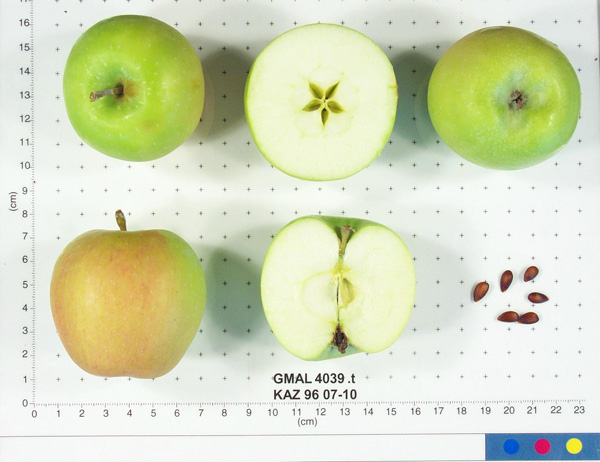 | | 1996 | COLLECTED | 09/09/1996 | 15km east of Topelevka-Djungarsky Range. 3 km southeast of Topelevka Forestry Camp. Collections made in radius around camp. Aspect flat. | 85.41527778, 80.40277778 | 1250 | Fertile. Dominant tree sp: Malus sierversii; Assoc.-Betula, Crataegus, Acer, Quercus, Tilia, Populus, Betula. Dom. Shrub Sp: Berberis, Lonicera: Assoc.-Cotoneaster, Rubus, Berberis, Ribes. Dom. herb.:Fragaria,Grasses,Humulus:Assoc.-Dianthus | Uncertain improvement status | Sampled 60 fruits from 1 tree. Flesh flavor is aromatic. Over color is 70% red. Fruit size is larger than 50mm. Free of disease and insects. Best apple so far, great. ---Malus sieversii hybrid. Domestic introgression intentified using 20K Illumina Infinium apple SNP array--Gold_Reinette is a grandparent | 1693477 | PI 682779 |
| 8 | PI 682781 | KAZ 96 07-10 | Malus hybr. | Kazakhstan | GEN | 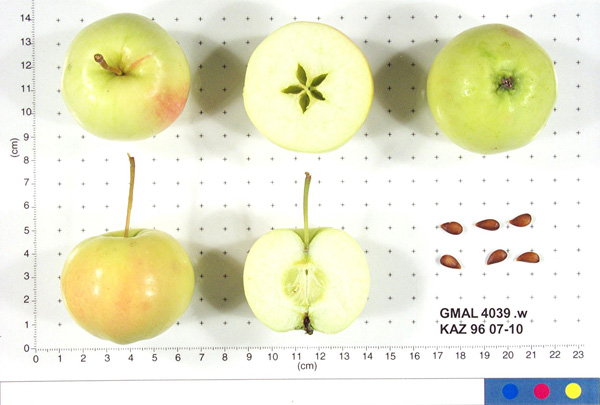 | | 1996 | COLLECTED | 09/09/1996 | 15km east of Topelevka-Djungarsky Range. 3 km southeast of Topelevka Forestry Camp. Collections made in radius around camp. Aspect flat. | 85.41527778, 80.40277778 | 1250 | Fertile. Dominant tree sp: Malus sierversii; Assoc.-Betula, Crataegus, Acer, Quercus, Tilia, Populus, Betula. Dom. Shrub Sp: Berberis, Lonicera: Assoc.-Cotoneaster, Rubus, Berberis, Ribes. Dom. herb.:Fragaria,Grasses,Humulus:Assoc.-Dianthus | Uncertain improvement status | Sampled 60 fruits from 1 tree. Flesh flavor is aromatic. Over color is 70% red. Fruit size is larger than 50mm. Free of disease and insects. Best apple so far, great. ---Malus sieversii hybrid. Domestic introgression intentified using 20K Illumina Infinium apple SNP array--Gold_Reinette is a grandparent | 1693492 | PI 682781 |
| 9 | NA 88590 | 2024RM-003 | Ilex verticillata (L.) A. Gray | Florida, United States | NA | | | 2024 | COLLECTED | 11/21/2024 | Along the west/north side of the Yellow River about 0.33 kilometers (as the crow flies) upstream from the channel that leads the Fisher Old Mill Road Boat Ramp. This site was accessed by boat. | 30.62868600, -86.80748000 | 4 | Plants are found growing primarily in permanently saturated to submersed conditions along the edge of the Yellow River in part shade. The riverine habitat is comprised of a wide array of deciduous and evergreen trees, shrubs, and perennial plant species. Most of the plants along the river are adapted to acidic conditions and, while the aquatic habitat is generally fresh water, there is occasionally tidal or hurricane-caused saltwater intrusions. Slope: 0 percent. Aspect: East-southeast. The underlying geology of this area is characterized as Alluvium from undifferentiated Quaternary Sediments. Much of Florida's surface is covered by a varying thickness of undifferentiated sediments consisting of siliciclastics, organics and freshwater carbonates. Where these sediments exceed 20 feet (6.1 meters) thick, they were mapped as discrete units. To subdivide the undifferentiated sediments, those sediments occurring in flood plains were mapped as alluvial and flood plain deposits (Qal). Sediments showing surficial expression of beach ridges and dunes were mapped separately (Qbd) as were the sediments composing Trail Ridge (Qtr). Terrace sands were not mapped (refer to Healy [1975] for a discussion of the terraces in Florida). The subdivisions of the Undifferentiated Quaternary Sediments (Qu) are not lithostratigraphic units but are utilized to facilitate a better understanding of the State's geology. The siliciclastics are light gray, tan, brown to black, unconsolidated to poorly consolidated, clean to clayey, silty, unfossiliferous, variably organic-bearing sands to blue green to olive green, poorly to moderately consolidated, sandy, silty clays. Gravel is occasionally present in the panhandle. Organics occur as plant debris, roots, disseminated organic matrix and beds of peat. Freshwater carbonates, often referred to as marls in the literature, are scattered over much of the State. In southern Florida, freshwater carbonates are nearly ubiquitous in the Everglades. These sediments are buff colored to tan, unconsolidated to poorly consolidated, fossiliferous carbonate muds. Sand, silt and clay may be present in limited quantities. These carbonates often contain organics. The dominant fossils in the freshwater carbonates are mollusks. (Source: USGS Florida Geologic Map Data). The soils of this are characterized as Bibb-Kinston Series association. The Bibb Series consists of very deep, poorly drained, moderately permeable soils on flood plains of streams in the Southern Coastal Plain (133A) Major Land Resource Area. They formed in stratified loamy and sandy alluvium that are commonly and frequently flooded and water runs off the surface very slowly. Slopes range from 0 to 2 percent. Reaction ranges from extremely acid to strongly acid throughout. Content of mica flakes ranges from none to common. Content of rounded gravel typically ranges from 0 to 10 percent throughout, but may range to 50 percent in thin strata below a depth of 1 meter. Buried soil horizons, present in many pedons have the same range in color and texture as the surface horizon which has iron and organic matter concentrations in shades of brown and yellow ranging from none to common. Texture is sand, loamy sand, loamy fine sand, fine sandy loam, sandy loam, loam or silt loam. The Kinston Series consists of very deep, poorly drained, moderately permeable soils found on flood plains. They were formed in alluvial depositions. Slopes range from 0 to 2 percent. Soil reaction ranges from strongly acid to very strongly acid. Typical texture across the pedons is loamy, gravelly loam, sandy loam, and clay loam with dark concretions often present. (Source: California Soil Resource Lab/NRCS Official Soil Series Descriptions). | Wild material | | 2169927 | NA 88590 |