| 0 | PI 672652 | R. armeniacus DVS3 | Rubus armeniacus Focke | California, United States | COR | | | 2011 | COLLECTED | 12/11/2008 | from the west end of the UC Davis campus, Yolo County, California | 38.54332000, -121.76675000 | | Large bush growing next to feral Boysenberry in abandoned community garden. | Cultivar | DVS3: R. armeniacus Collected December 11, 2008 from the west end of the UC Davis campus, Yolo County, California Molecularly confirmed to be the R. armeniacus genotype that is widespread across the West Coast US. Lat: 38.54332, Long: -121.76675, Elev: 16 m Notes on habitat: Large bush growing next to feral Boysenberry in abandoned community garden. No images | 1881225 | PI 672652 |
| 1 | PI 638309 | 'R. gliacus variegated' | Rubus armeniacus Focke | Oregon, United States | COR |  | | 2004 | DONATED | 07/26/2004 | | | | | Cultivar | Variegated Blackberry - Rubus armeniacus 'Variegatus'. Chimeral chlorophyll mutation expressed as white leaf margins. Dancing Oaks Nursery obtained clone from Philip Curtis Farms, Oregon City, Oregon. Originally received as a R. ursinus but was re-identified to R. armeniacus.
reidentified to R. armeniacus Originally received as R. ursinus
| 1662011 | PI 638309 |
| 2 | PI 638228 | R. armeniacus | Rubus armeniacus Focke | Oregon, United States | COR |  | | 2003 | COLLECTED | 05/02/2003 | | | | | Wild material | | 1646447 | PI 638228 |
| 3 | PI 638230 | R. armeniacus | Rubus armeniacus Focke | Oregon, United States | COR |  | | 2003 | COLLECTED | 05/02/2003 | | | | | Wild material | | 1646449 | PI 638230 |
| 4 | PI 672603 | R. armeniacus from Armenia 02-010 | Rubus armeniacus Focke | Armenia | COR | | | 2002 | COLLECTED | 09/01/2002 | From open market in Kapan, Syunik Marz provence. Collected from around Kapan. | 39.20861000, 46.40361000 | 810 | Purchased in open market; collected in wild around Kapan - possibly a mix of species. Blackberry that grows like a shrub. | Wild material | | 1642345 | PI 672603 |
| 5 | PI 618543 | R. armeniacus 2 PAI 1A | Rubus armeniacus Focke | Chile | COR | | | 1992 | COLLECTED | 02/1992 | | | | | Breeding material | Collection information is forthcoming | 1014787 | PI 618543 |
| 6 | PI 618545 | R. armeniacus 2 PAI 1C | Rubus armeniacus Focke | Chile | COR | | | 1992 | COLLECTED | 02/1992 | | | | | Breeding material | Collection information is forthcoming | 1014803 | PI 618545 |
| 7 | PI 618546 | R. armeniacus 2 BIO 1A | Rubus armeniacus Focke | Chile | COR | | | 1992 | COLLECTED | 02/1992 | | | | | Breeding material | Collection information is forthcoming | 1014809 | PI 618546 |
| 8 | PI 618547 | R. armeniacus 2 GOR 1A | Rubus armeniacus Focke | Chile | COR | | | 1992 | COLLECTED | 02/1992 | | | | | Breeding material | Collection information is forthcoming | 1014824 | PI 618547 |
| 9 | PI 553841 | R. armeniacus H-5 | Rubus armeniacus Focke | Hawaii, United States | COR | | | 1983 | COLLECTED | 08/08/1983 | Volcano Experiment Station, Big Island | 19.46453000, -155.24863000 | 1160 | Volcano Experiment Station, Big Island | Wild material | Fruit here is small, with few drupelets, not vigorous | 1448813 | PI 553841 |
| 10 | PI 553842 | R. armeniacus H-9 | Rubus armeniacus Focke | Hawaii, United States | COR | | | 1983 | COLLECTED | 08/08/1983 | Along the road to the Mauna Loa Trail, Big Island | 19.47308000, -155.35745000 | 1680 | Along the road to the Mauna Loa Trail, Big Island | Wild material | Fruits here are small with few drupelets | 1448814 | PI 553842 |
| 11 | PI 553843 | R. armeniacus H-32 | Rubus armeniacus Focke | Hawaii, United States | COR | | | 1983 | COLLECTED | 08/10/1983 | Kapapala Ranch, Mauna Loa slope along a jeep road, Big Is. | 19.37448000, -155.44775000 | 2135 | Kapapala Ranch, Mauna Loa slope along a jeep road, Big island. | Wild material | Fruit here is small with few drupelets | 1448815 | PI 553843 |
| 12 | PI 553840 | R. armenacus | Rubus armeniacus Focke | Oregon, United States | COR |  | | 1983 | COLLECTED | 07/15/1983 | Between disturbed subdivision area and forest, Corvallis | 44.08333000, -123.08333000 | 45 | Between disturbed subdivision area and forest, Corvallis | Wild material | Otto Jahn collection
| 1448812 | PI 553840 |
| 13 | PI 618579 | R. armeniacus Russia | Rubus armeniacus Focke | Russian Federation | COR | | | 1981 | COLLECTED | | | | | | Breeding material | Original seedlot collected by J.W. Hull in the North Caucasus | 1508020 | PI 618579 |
| 14 | PI 679744 | R. ursinus MLK Corvallis | Rubus ursinus Cham. & Schltdl. | Oregon, United States | COR | | | 2015 | COLLECTED | 06/20/2015 | back trail of MLK Park off Walnut Ave., Corvallis, Oregon | 44.59138889, -123.31111111 | 15 | edge of trail understory of walnut tree | Wild material | Plant with 75% ripe black fruit, some immature unripe red. Trailing habit. Intermixed with Rubus armeniacus that was in full bloom. Fruit about 1 cm long x 0.5 cm. Black drupelets. | 1926847 | PI 679744 |
| 15 | PI 672647 | R. hybrid CSP6A | Rubus hybr. | California, United States | COR |  | | 2011 | COLLECTED | 05/08/2011 | Caswell Memorial State Park, San Joaquin County, CA | 37.69462000, -121.18248000 | 14 | Single cane 1.5 m long, semi-erect, next to similar canes, grass, and catchweed bedstraw. | Cultivar | CSP6A: R. ursinus x armeniacus Collected May 8, 2008 in Caswell Memorial State Park, San Joaquin County, CA Distinct genotype from CSP2A. Lat: 37.69462, Long: -121.18248, Elev: 14 m Notes on habitat: Single cane 1.5 m long, semi-erect, next to similar canes, grass, and catchweed bedstraw. Associated image files: 1202, 1532 | 1881220 | PI 672647 |
| 16 | PI 654994 | 'Onyx' | Rubus hybr. | Oregon, United States | COR | | | 2008 | DONATED | 04/29/2008 | | | | | Cultivar | http://hortsci.ashspublications.org/content/46/4/657.full
‘Onyx’ is a new trailing blackberry (Rubus subg. Rubus Watson) cultivar from the U.S. Department of Agriculture–Agricultural Research Service (USDA-ARS) breeding program in Corvallis, OR, released in cooperation with the Oregon Agricultural Experiment Station. ‘Onyx’ is a vigorous, somewhat erect, thorny, trailing blackberry that produces moderate yields of uniform, firm, and sweet high quality fruit with excellent flavor that are suited for the local and wholesale fresh market. ‘Onyx’ is being released primarily as a result of its outstanding fresh fruit quality in the late season.
‘Onyx’, tested as ORUS 1523-4, was selected in Corvallis, OR, in 1997 from a cross made in 1995 of OSC 1466 and ORUS 1117-11. OSC 1466 was selected in 1966 and has always been noted for its productivity and outstanding fruit quality, especially flavor, but its fruit are small. ORUS 1117-11 is a thornless selection with high yields of late-ripening fruit with excellent quality. ‘Onyx’ is being released
primarily as a result of its outstanding fresh fruit quality in the late season.
https://patents.google.com/patent/USPP22358P2/en
Description and specifications of a new and distinct blackberry cultivar which originated from seed produced by a hand pollinated cross of OSC 1466 (non-patented)×ORUS 1117-11 (non-patented) is provided. This new trailing blackberry cultivar can be distinguished by its high yields, large fruit size, excellent fresh fruit quality, mid-late season fruit ripening, and healthy plants.
BACKGROUND OF THE INVENTION
The present invention relates to the discovery of a new and distinct cultivar of blackberry hybrid plant botanically know as a Rubus subgenus Rubus hybrid and herein referred to as ‘ONYX’, as herein described and illustrated.
The new and distinct cultivar of blackberry originated from a hand pollinated cross of OSC 1466 (non-patented)×ORUS 1117-11 (non-patented).
Plants and fruit of this new cultivar differ phenotypically from its parents. The new cultivar is later ripening and larger in fruit size than the female parent OSC 1466 (non-patented) and has firmer, more uniformly shaped fruit than the male parent ORUS 1117-11 (non-patented). The new cultivar also has thorny canes, unlike the ORUS 1117-11 (non-patented) parent. The new cultivar has higher yields of firmer fruit than either of the parent blackberries. Although blackberries (Rubus subgenus Rubus) are highly heterogeneous and outcrossing, and most clones contain genes from more than one species, the new cultivar and its progenitor lines phenotypically exhibit characters predominately of the trailing western United States species, Rubus ursinus Cham et. Schltdl. (western trailing blackberry). Rubus idaeus L., (red raspberry), R. armeniacus Focke (Himalaya blackberry). R. baileyanus Britton, and R. argutus Link Porter (highbush blackberry) can all be found in the pedigree of this new cultivar.
The seeds resulting from this controlled hybridization were germinated in a greenhouse in the winter of 1995 and planted in a field in Corvallis, Oreg. in the spring. The seedlings fruited during the summer of 1997 and one, designated ORUS 1523-4, was selected for its mid-late season ripening, large fruit size, excellent fruit quality, and excellent plant health.
During 1997, the original plant selection was propagated asexually from dormant, hardwood cane cuttings from the above noted location. An observational plot of 3 plants was established at the above noted location and at Aurora, Oreg. in the spring of 1998. Subsequently, larger replicated plantings were established Aurora, Oreg. with asexually multiplied plants.
The new cultivar has been asexually multiplied annually since 1997 by the use of cane cuttings. The new cultivar was established in vitro from a cane cutting and microcuttings have been taken and rooted from this sort of culture. During all asexual multiplication, the characteristics of the original plant have been maintained and no aberrant phenotypes have appeared.
Test plantings over a wide geographic area have shown this new cultivar to be adapted to differing soil and climatic conditions although it is best adapted to Mediterranean type climates where trailing blackberries are typically grown.
Plants of the new cultivar are vigorous and prolific and establish well after planting. Primocanes and floricanes have typical trailing blackberry growth habit. The plants are thorny with size and density of thorns being less than ‘Marion’ (non-patented) at the base, comparable at midpoint, and more thorny at the terminus. The primocanes emerge and grow vertically for 30-60 cm before arching to the ground and growing along the ground. Primocanes are typically lifted and tied onto a trellis system and after going through the dormant period break bud, flower and fruit as floricanes. Plants show no particular susceptibility to anthracnose [Elsinoe veneta (Burkh.) Jenkins], septoria (Septoria rubi Westend), cane blight (Leptosphaeria coniothyrium ([Fuckel] Sacc.) spur blight (Didymella applanata [Niessl] Sacc.), and purple blotch (Septocyta ruborum [Lib.] Petr.) nor have they tested positive for Raspberry bushy dwarf virus. The bloom period of the new cultivar averages 4-5 days later than the ‘Marion’ (non-patented) and 8-11 days later than ‘Black Diamond’ (non-patented).
Fruit of the new cultivar begin ripening 19 days later than ‘Siskiyou’ (non-patented) and 9 days later than ‘Marion’ (non-patented). The average harvest date of 5% ripe fruit is 9 July, of 50% ripe fruit is 16 July, and 1 August for 95% ripe fruit in the Willamette Valley of Oregon and the midpoint of harvest is 7 days later than for ‘Marion’ (non-patented). Fruit yields of the new cultivar are usually around 14, 309 kg/hectare (6.39 tons/acre) and are comparable to those for ‘Marion’ (non-patented). Yields are consistent from year to year.
The fruit is conical, with very uniformly sized, shaped and arranged drupelets giving the fruit a very uniform, attractive shape. The fruit are bright glossy black. The fruit is medium large (6.1 g) and typically 1 g larger than ‘Marion’ (non-patented) and 0.5 g smaller than ‘Siskiyou’ (non-patented). The new cultivar maintains a uniform fruit size throughout the harvest season. The new cultivar exhibits excellent fruit fertility with full drupelet set in contrast to ‘Siskiyou’ (non-patented), which can have poorly set fruit tips; it also has much better drupelet set than ‘Marion’ (non-patented). The fruit is firm at maturity, rating much higher than ‘Marion’ (non-patented) and comparable to ‘Metolius’ (non-patented) and ‘Siskiyou’ (non-patented).
The fresh fruit rates very good in flavor, being comparable to ‘Obsidian’ (non-patented), ‘Metolius’ (non-patented), and ‘Kotata’ (non-patented) but slightly lower than ‘Marion’ (non-patented) or ‘Siskiyou’ (non-patented). The flavor is sweet with a nice acidic balance with aroma typical of western blackberries. The fruit texture is comparable to ‘Marion’ (non-patented), ‘Metolius’ (non-patented), ‘Obsidian’ (non-patented), and ‘Siskiyou’ (non-patented) and the seeds are much less noticeable than in ‘Chester Thornless’ (non-patented) and ‘Ouachita’ (U.S. Plant Pat. No. 17,162). The soluble solids concentration averages 13.7% on shiny black fruit, similar to ‘Marion’ (non-patented) (13.3%) and lower than ‘Navaho’ (U.S. Plant Pat. No. 6,679), (15.6%). Dry seed weight averages 3.28 mg/seed, and seeds are smaller than those of ‘Marion’ (non-patented) and ‘Black Diamond’ (non-patented) (each 3.95 mg seed).
Fruit clusters are medium-long (similar to ‘Marion’ (non-patented)), cymose, and are mostly borne on the periphery of the plant canopy, providing easy access to harvest. Flower fertility is high and clusters are well filled.
The new cultivar has been named the ONYX cultivar.
| 1777901 | PI 654994 |
| 17 | PI 653409 | R. leucodermis Oregon | Rubus leucodermis Douglas ex Torr. & A. Gray | Oregon, United States | COR | | | 2008 | COLLECTED | 07/2007 | Lane County. BLM land in Winberry Creek area near Lowell. 1850' elevation. R1E T19S Sec13 | 43.91580000, -122.63950000 | 565 | Growing in vicinity: Rubus parviflorus, Rubus laciniatus, Rubus armeniacus, Rhamnus purshiana, Lotus corniculatus. | Wild material | Michael Russell collected from Oregon.
| 1750545 | PI 653409 |
| 18 | PI 638315 | R. ursinus GP 13s-7 | Rubus ursinus Cham. & Schltdl. | Oregon, United States | COR |  | | 2004 | DEVELOPED | 1998 | | | | | Breeding material | In 1993 and 1994 we collected a great deal of Rubus ursinus from the Pacific Northwest as seed as well as vegetative cuttings. We grew these populations out in a common garden and used a number of parents in crosses. While we began with several thousand seedlings we have culled that down to about a dozen. These were either chosen as superior clones, representatives of superior populations, or in an attempt to keep the selection of R. ursinus germplasm broad.Tested as having a ploidy of 12x by flow cytometry by Meng (1998). Collected as seed. When population grown out appeared to not be pure R. ursinus based on vegetative morphology and what appear to be hermaphroditic flowers. Best guess would be that it was a hybrid between R. ursinus and R. armeniacus (R. procerus.). Extremely vigorous and disease resistant compared to typical R. ursinus but poor drupelet set. Subsequent hybridizations with R. ursinus derivatives and R. armeniacus have produced seed but no plants. | 1664005 | PI 638315 |
| 19 | PI 553254 | 'Marion' | Rubus hybr. | Oregon, United States | COR | _thumbnail.jpg "Click for 2 image(s) for this accession.") | | 1992 | DEVELOPED | 1956 | | | | | Cultivar | Orig. in Corvallis, Ore., by George F. Waldo, U.S. Dept. of Agriculture and Oregon Agr. Expt. Sta. Introd. in 1956. Chehalem x Olallie; cross made in 1945; selected in 1948; tested as US-Oregon 928. Fruit: medium to large; round in cross diameter, somewhat longer than wide; individual drupelet and seed size medium; skin bright black, not as bright as Chehalem or Evergreen, but more attractive than Boysen; flesh medium firm; quality high with excellent flavor, generally superior to Boysen or Evergreen; excellent for local markets, canning, freezing, pies, ice cream flavoring, jams, jellies; harvest season more favorable than Evergreen, ripening in Boysen season and before Evergreen in Oregon; resembles Himalaya or Chehalem. Bush: trailing; vigorous grower; generally only a few long canes, up to 20 ft long; spines large and numerous; fruiting later-als long and strong with many fruits; very productive, more so than Boysen, higher yields for a longer period than Boysen; adapted to western Oregon and western Washington. Named after Marion County, in which it was tested extensively.BandO
Cultivar release by George Waldo cross made in 1945, selected in 1948, tested as USOR 928; introduced in 1956
Cultivar Synonym= Tested as ORUS 928
NAMED FOR= Marion County, Oregon, where it was tested extensively | 1448226 | PI 553254 |
| 20 | PI 553946 | R. armeniacus Hawaii | Rubus sp. | Hawaii, United States | COR | | | 1985 | COLLECTED | 02/22/1985 | Wailua, Island of Kauai. Sandy-volcanic soil | 22.00000000, -159.50000000 | 1100 | Wailua, Island of Kauai. Sandy-volcanic soil | Wild material | Fruit fully ripe 2-22-85, many fruit deformed shape | 1448918 | PI 553946 |
| 21 | PI 710521 | CA360-166 | Eleocharis palustris (L.) Roem. & Schult. | California, United States | S9 |  | | 2019 | | | | | | | Wild material | | 2091971 | PI 710521 |
| 22 | PI 637961 | F. virginiana subsp. platypetala Benton | Fragaria ×ananassa Duchesne ex Rozier nothosubsp. cuneifolia (Nutt. ex Howell) Staudt | Oregon, United States | COR | | | 2004 | COLLECTED | 05/20/2004 | From a meadow behind city lot 2775 N.W. 29th Street Corvallis, Oregon, Benton County | 44.58625000, -123.28447000 | 95 | Open field, northwest facing slope with canary grass, Rubus armeniacus and Crataegus sp. | Wild material | | 1656324 | PI 637961 |
| 23 | W6 62488 | DCA00-18 | Baccharis pilularis DC. | California, United States | W6 |  | | 2025 | | | | | | | Wild material | | 2192186 | W6 62488 |
| 24 | W6 62489 | DCA00-19 | Diplacus aurantiacus (Curtis) Jeps. | California, United States | W6 |  | | 2025 | | | | | | | Wild material | | 2192187 | W6 62489 |
| 25 | W6 62597 | TYT-3 | Achillea millefolium L. | California, United States | W6 |  | | 2025 | | | | | | | Wild material | Yarrow hidden amongst grasses and ferns. | 2192295 | W6 62597 |
| 26 | W6 62648 | CA180A-13 | Helenium puberulum DC. | California, United States | W6 |  | | 2025 | | | | | | | Wild material | Ray flowers tiny to nonexistent; head yellow to brownish red. Borders recreational trail. Noticed that head count increased significantly between week of first ID and time of collection ~3 weeks.). Fruit falls off head and can be easily lost; collect heads by clipping stem. Quick turnaround between flower and fruit production. 1seed/fruit, average 692 seeds/head, estimated 86% viability. | 2192866 | W6 62648 |
| 27 | W6 62672 | CA330-228 | Fragaria vesca L. | California, United States | W6 | 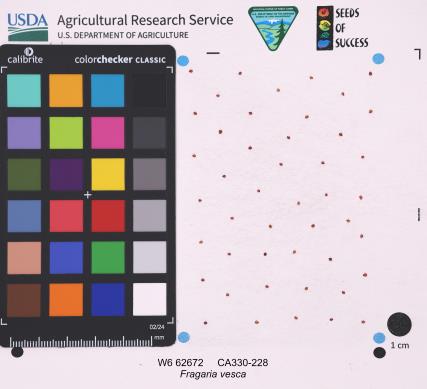 | | 2025 | | | | | | | Wild material | | 2192890 | W6 62672 |
| 28 | W6 62710 | CA360-240 | Verbena lasiostachys Link | California, United States | W6 |  | | 2025 | | | | | | | Wild material | | 2192928 | W6 62710 |
| 29 | W6 62724 RE | CA360A-22 | Asclepias fascicularis Decne. | California, United States | W6 |  | | 2025 | | | | | | | Wild material | RECOLLECTION. Surrounding berm of Paynes Creek Crossing, some in central portion of evaporated water drainage/ephemeral poolage. Roughly 1/4 still vegetative without any sign of infloresence or floral meristems. Some slight variation in developed follicle size. Beloved by praying mantises. | 2192942 | W6 62724 RE |
| 30 | W6 62727 | CA360A-7 | Deschampsia danthonioides (Trin.) Munro | California, United States | W6 |  | | 2025 | | | | | | | Wild material | Ephemeral wetland; Verbascum blattata, Rumex crispus, Taenitherium caput-medusae | 2192945 | W6 62727 |
| 31 | Ames 36284 | Oak Creek Canyon | Alnus oblongifolia Torr. | Arizona, United States | NC7 |  | | 2024 | COLLECTED | 10/18/2024 | Oak Creek Canyon, approximately five miles north-northeast of Sedona in the Coconino National Forest, T18N R6E Sec. 8 and Sec. 21 and also T19N R6E Sec. 22 and Sec. 27. | 35.01694800, -111.73755900 | 1538 | Creek beds in canyon bottom. | Wild material | Plants sampled in nature had dark green, glossy leaves. Young bark is smooth and light grey, becoming dark and scaly with age. Approximately 50 feet in height. | 2169812 | Ames 36284 |
| 32 | W6 61510 | CA180-280 | Erythranthe guttata (DC.) G. L. Nesom | California, United States | W6 |  | | 2024 | | | | | | | | | 2167609 | W6 61510 |
| 33 | W6 61583 | CA360-218 | Rosa californica Cham. & Schltdl. | California, United States | W6 |  | | 2024 | | | | | | | Wild material | | 2168031 | W6 61583 |
| 34 | W6 61948 | OR090B-337 | Juncus ensifolius Wikstr. | Oregon, United States | W6 |  | | 2024 | | | | | | | Wild material | NA | 2168353 | W6 61948 |
| 35 | W6 61949 | OR090B-338 | Juncus effusus L. | Oregon, United States | W6 |  | | 2024 | | | | | | | Wild material | NA | 2168354 | W6 61949 |
| 36 | W6 61950 | OR090B-339 | Juncus patens E. Mey. | Oregon, United States | W6 |  | | 2024 | | | | | | | Wild material | NA | 2168355 | W6 61950 |
| 37 | W6 60985 | CA330-218 | Bromus carinatus Hook. & Arn. | California, United States | W6 | 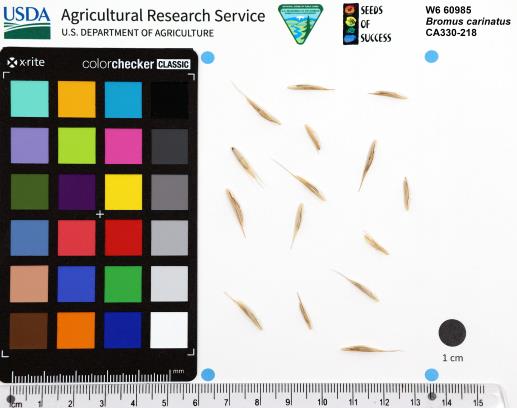 | | 2023 | | | | | | | Wild material | Tall grass, panicle inflorescence, lemma in herringbone arrangement, lemmas opposite arrangement, green broad leaves | 2142624 | W6 60985 |
| 38 | W6 61025 | CA360-196 | Cyperus eragrostis Lam. | California, United States | W6 |  | | 2023 | | | | | | | Wild material | grows in tussocks, seedheads axillary | 2142664 | W6 61025 |
| 39 | W6 61027 | CA360-198 | Elymus glaucus Buckley | California, United States | W6 |  | | 2023 | | | | | | | Wild material | Seeds Grow in Pairs, Spiraling up the head | 2142666 | W6 61027 |
| 40 | Ames 35907 | Oak Creek Canyon | Fraxinus velutina Torr. | Arizona, United States | NC7 | 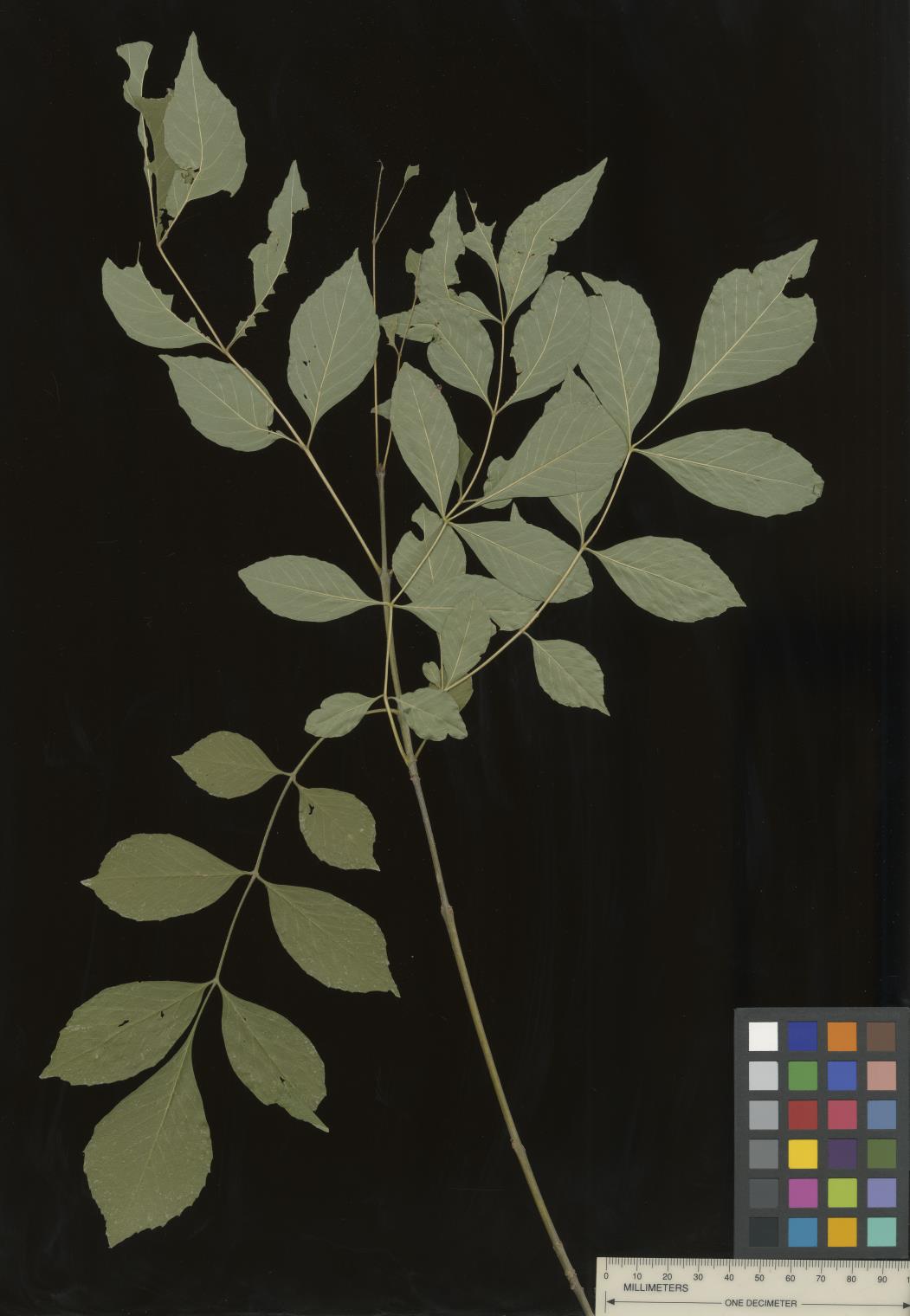 | | 2022 | COLLECTED | 09/02/2022 | Oak Creek Canyon, approximately five miles north-northeast of Sedona in the Coconino National Forest. T18N R6E NE 1/4 NW 1/4 Sec. 21 . | 34.93600300, -111.74436900 | 1464 | Floodplain and riverbanks, growing in gravely soil. | Wild material | Most of the velvet ash in this population are small trees (10-25 feet in height and approximately 5 inches DBH). Variation was noted for leaflet pubescence but with the petioles of all trees in the population being pubescent. | 2139669 | Ames 35907 |
| 41 | OPGC 8604 | OR080-80 | Lysichiton americanus Hultén & H. St. John | Oregon, United States | OPGC |  | | 2022 | | | | | | | Wild material | Large, glabrous leaves with a large raceme of flowers and one large, yellow bract. | 2138327 | OPGC 8604 |
| 42 | OPGC 8649 | CA360-191 | Hastingsia alba (Durand) S. Watson | California, United States | OPGC | 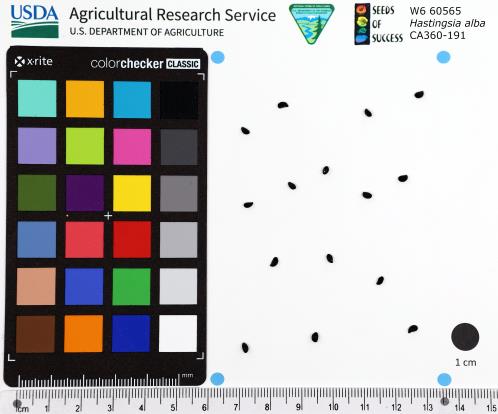 | | 2022 | | | | | | | Wild material | dense inflorescence, white flowers | 2138503 | OPGC 8649 |
| 43 | W6 59563 | OR080-69 | Lupinus rivularis Douglas ex Lindl. | Oregon, United States | W6 | | | 2021 | | | | | | | Wild material | Large, 1-5ft, erect forb w/ a deep tap root. In Oregon, its habit can be like an evergreen subshrub. The flowers are purple-blue to white in coloration. | 2120729 | W6 59563 |
| 44 | W6 57638 | OR080-59 | Chamaenerion angustifolium (L.) Scop. subsp. angustifolium | Oregon, United States | W6 | | | 2020 | | | | | | | Wild material | SOS 92nd Shipment | 2104936 | W6 57638 |
| 45 | W6 57644 | OR080-67 | Lupinus polyphyllus Lindl. var. polyphyllus | Oregon, United States | W6 | | | 2020 | | | | | | | Wild material | | 2104942 | W6 57644 |
| 46 | W6 57661 | CA180-208 | Prunella vulgaris L. | California, United States | W6 | | | 2020 | | | | | | | Wild material | SOS 92nd Shipment | 2104959 | W6 57661 |
| 47 | NA 87973 | OR080-36 | Amelanchier alnifolia (Nutt.) Nutt. ex M. Roem. | Oregon, United States | NA |  | | 2018 | COLLECTED | 07/22/2016 | Collected off the roadside of Hwy 22, approx. 10 miles south of the junction of hwy 22 and hwy 130. | 45.08000000, -123.63111000 | 109 | Valley bottom roadside with a mix of conifer trees as dominant species (most likely planted), deciduous trees, as well as shrubby understory. Additional shrub and grass species including invasives such as Rubus armeniacus. Slight slopes, 0-5 degrees. Basalt derived clay soil. | Wild material | | 1957619 | NA 87973 |
| 48 | W6 52040 | CA180-117 | Hoita macrostachya (DC.) Rydb. | California, United States | W6 | | | 2017 | | | | | | | Wild material | | 1947175 | W6 52040 |
| 49 | W6 51920 | OR130-109 | Camassia leichtlinii (Baker) S. Watson | Washington, United States | W6 | | | 2017 | | | | | | | Wild material | | 1947053 | W6 51920 |
| 50 | W6 51793 | OR110-838 | Alnus rhombifolia Nutt. | Oregon, United States | W6 | | | 2017 | | | | | | | Wild material | | 1943640 | W6 51793 |
| 51 | W6 43505 | CA360-118 | Elymus elymoides (Raf.) Swezey | California, United States | W6 |  | | 2012 | | | | | | | Wild material | | 1898579 | W6 43505 |