| 0 | PI 704849 sos | R. flagellaris MARSB-128 | Rubus flagellaris Willd. | New Jersey, United States | COR |  | | 2019 | | | | | | | Wild material | | 2097493 | PI 704849 sos |
| 1 | PI 702720 | MARSB-360 | Schizachyrium scoparium (Michx.) Nash | New Jersey, United States | S9 |  | | 2019 | | | | | | | Wild material | | 2097597 | PI 702720 |
| 2 | PI 612569 | F. virginiana subsp. grayana NC 95-21-1 | Fragaria virginiana Mill. subsp. grayana (Vilm. ex J. Gay) Staudt | Mississippi, United States | COR |  | Out of Season | 1995 | COLLECTED | 07/12/1995 | Mississippi, Pontotoc county. Trace State Park (just outside Tupelo) | 33.85528000, -88.53917000 | 0 | Along roadside in grassy areas. Found in shade under trees. Scattered and morphologically diverse popl. | Wild material | Update on 1995 F. virginiana Collections in the Southeastern USA James R. Ballington and Jerry A. Payne South Carolina was extremely frustrating, by the middle of the week we had only verified the existence of one location for Fragaria virginiana inthe Coastal Plain. Three accessions were located in the Edgefield District of Sumter National Forest and four in Greenwood State Park. Fragaria virginiana from the one verified Coastal Plain location is currently growing in a garden near Lexington, SC. Twelve accessions of Vaccinium spp., four of Gaylussacia frondosa, and one of Rubus argutus were also collected.In southeastern Louisiana and in Mississippi, Fragaria virginiana was not abundant either, and no accessions were found south of Starkville, MS. Specific previous sites were visited near Hattisburg and Laurel, MS, but F. virginiana was no longer present. A total 33 accessions of F. viriniana were collected from east central and northeastern Mississippi. Occurring in small outcroppings of prairie in these regions. Characterized by a very thin layer of 'usually' sticky black soil over decaying limestone, and a scattered to dense overstory of Juniperus virginiana. Within such prairies, F. virginiana was often found growing directly under J. virginiana where little other vegetation occurred. In addition to F. virginiana, 14 accessions of Vaccinium spp. and two accessions Rubus flagellaris were also collected. The collecting trips raised serious questions concerning the statusof Fragaria virginiana in the southeastern US. Is it really as rare as it appears to be in areas such as the coastal plain of South Carolina, southern Mississippi and southeastern Louisiana? People in almost every area told us how abundant wild strawberries were on their property or generally in their region, but these almost always turned out to be either Duchesnea indica, or Potentilla canadensis. The abundance of these two species was about what we had hoped for F. virginiana. | 1507734 | PI 612569 |
| 3 | PI 616689 | F. virginiana subsp. virginiana NC 95-4-1 | Fragaria virginiana Mill. subsp. virginiana | South Carolina, United States | COR | | Out of Season | 1995 | COLLECTED | 06/12/1995 | South Carolina, Williamsburg county, Creel Farm, Henry community. South from Hemingway on SC 41 to county road 121 , left on 121 for 4.5 miles to SC 512 in Henry. Just across SC 512 on 121, to Creel farm. | 34.32111000, -79.28556000 | 0 | Woodland, currently w/ a heavy canopy of mostly deciduous trees. V. tenellum, R. trivialis and R. flagellans occasionally in the woods and along the field edge. | Wild material | South Carolina was extremely frustrating, by the middle of the week we had only verified the existence of one location for Fragaria virginiana in the Coastal Plain, so we moved over into the southern piedmont. Three accessions were located in the Edgefield District of Sumter National Forest and four in Greenwood State Park. The one verified Coastal Plain location is in a garden near Lexington, SC. Twelve accessions of Vaccinium spp., four of Gaylussacia frondosa, and one of Rubus argutus were also collected. Southeastern Louisiana and Mississippi were more successful, but not abundant in these areas either. No accessions were found south of Starkville, MS. Specific previous sites were visited near Hattisburg and Laurel, MS, but F. virginiana was no longer present. A total 33 accessions of F. virginiana were collected from east central and northeastern MS, occurring in small outcroppings of prairie; characterized by a very thin layer of 'usually' sticky black soil over decaying limestone with scattered to dense overstory of Juniperus virginiana. Fragaria virginiana was often found growing directly under J. virginiana where little other vegetation occurred. Dr. Sidney McDaniel of Mississippi State University refers to these areas as 'cedar prairie woodlands'. In addition to F. virginiana, 14 accessions of Vaccinium spp. and two accessions Rubus flagellaris were also collected. These trips raise serious questions concerning the status of Fragaria virginiana in the southeastern US. Is it really as rare as it appears to be? In Greenwood State Park in South Carolina, the species was pioneering on bare ground two years after clearcutting. In Mississippi it was not found in such areas, although one herbarium specimen came from the edged of wildlife food plot. People in almost every area told us how abundant wild strawberries were on their property or in their region, but these almost always turned out to be either Duchesnea indica, or Potentilla canadensis. | 1507705 | PI 616689 |
| 4 | PI 616691 | F. virginiana subsp. virginiana NC 95-11-1 | Fragaria virginiana Mill. subsp. virginiana | South Carolina, United States | COR |  | Out of Season | 1995 | COLLECTED | 06/16/1995 | South Carolina, Abbeville county, Sumter National Forest. FS Road 520 at White Creek Bridge. | 34.08972000, -82.41028000 | 0 | Modest colony of F. virginiana in shade in shallow ditch by road side (above creek). Good moisture and moisture holding capacity. Sig. comp. from grasses & lugumes + Lonicera hallii & tree sdlg. | Wild material | South Carolina was extremely frustrating, by the middle of the week we had only verified the existence of one location for Fragaria virginiana in the Coastal Plain, so we moved over into the southern piedmont. Three accessions were located in the Edgefield District of Sumter National Forest and four in Greenwood State Park. The one verified Coastal Plain location is in a garden near Lexington, SC. Twelve accessions of Vaccinium spp., four of Gaylussacia frondosa, and one of Rubus argutus were also collected. Southeastern Louisiana and Mississippi were more successful, but not abundant in these areas either. No accessions were found south of Starkville, MS. Specific previous sites were visited near Hattisburg and Laurel, MS, but F. virginiana was no longer present. A total 33 accessions of F. virginiana were collected from east central and northeastern MS, occurring in small outcroppings of prairie; characterized by a very thin layer of 'usually' sticky black soil over decaying limestone with scattered to dense overstory of Juniperus virginiana. Fragaria virginiana was often found growing directly under J. virginiana where little other vegetation occurred. Dr. Sidney McDaniel of Mississippi State University refers to these areas as 'cedar prairie woodlands'. In addition to F. virginiana, 14 accessions of Vaccinium spp. and two accessions Rubus flagellaris were also collected. These trips raise serious questions concerning the status of Fragaria virginiana in the southeastern US. Is it really as rare as it appears to be? In Greenwood State Park in South Carolina, the species was pioneering on bare ground two years after clearcutting. In Mississippi it was not found in such areas, although one herbarium specimen came from the edged of wildlife food plot. People in almost every area told us how abundant wild strawberries were on their property or in their region, but these almost always turned out to be either Duchesnea indica, or Potentilla canadensis. | 1507708 | PI 616691 |
| 5 | PI 616695 | F. virginiana subsp. virginiana NC 95-12-4 | Fragaria virginiana Mill. subsp. virginiana | South Carolina, United States | COR |  | Out of Season | 1995 | COLLECTED | 06/17/1995 | South Carolina, Greenwood county, Greenwood State Park. Along road 207 that fronts the Park boundary. | 34.18944000, -82.96528000 | 0 | Upland - very disturbed area, apparently clearcut 2 yrs ago. Some areas of bare soil. Clearcut cornered with established 30 year old pines. | Wild material | South Carolina was extremely frustrating, by the middle of the week we had only verified the existence of one location for Fragaria virginiana in the Coastal Plain, so we moved over into the southern piedmont. Three accessions were located in the Edgefield District of Sumter National Forest and four in Greenwood State Park. The one verified Coastal Plain location is in a garden near Lexington, SC. Twelve accessions of Vaccinium spp., four of Gaylussacia frondosa, and one of Rubus argutus were also collected. Southeastern Louisiana and Mississippi were more successful, but not abundant in these areas either. No accessions were found south of Starkville, MS. Specific previous sites were visited near Hattisburg and Laurel, MS, but F. virginiana was no longer present. A total 33 accessions of F. virginiana were collected from east central and northeastern MS, occurring in small outcroppings of prairie; characterized by a very thin layer of 'usually' sticky black soil over decaying limestone with scattered to dense overstory of Juniperus virginiana. Fragaria virginiana was often found growing directly under J. virginiana where little other vegetation occurred. Dr. Sidney McDaniel of Mississippi State University refers to these areas as 'cedar prairie woodlands'. In addition to F. virginiana, 14 accessions of Vaccinium spp. and two accessions Rubus flagellaris were also collected. These trips raise serious questions concerning the status of Fragaria virginiana in the southeastern US. Is it really as rare as it appears to be? In Greenwood State Park in South Carolina, the species was pioneering on bare ground two years after clearcutting. In Mississippi it was not found in such areas, although one herbarium specimen came from the edged of wildlife food plot. People in almost every area told us how abundant wild strawberries were on their property or in their region, but these almost always turned out to be either Duchesnea indica, or Potentilla canadensis. | 1507712 | PI 616695 |
| 6 | PI 616700 | F. virginiana NC 95-16-6 | Fragaria virginiana Mill. subsp. grayana (Vilm. ex J. Gay) Staudt | Mississippi, United States | COR |  | Out of Season | 1995 | COLLECTED | 07/10/1995 | Mississippi, Oktibbeha county. From Starkville, E on Hwy 82/182 2.2 mi to sec rd 16. L on sec rd 16 4.6 mi to Rock Hill Rd. Righton Rock Hill Rd for 1.6 mi. | 33.54611000, -88.71472000 | 0 | On right: almost excl in shade of Juniperus virgiana, shallow soil over exposed chalk - shade appeared critical for survival. On left: more or less open, competing w/ grasses & R. trivialis. | Wild material | South Carolina was extremely frustrating, by the middle of the week we had only verified the existence of one location for Fragaria virginiana in the Coastal Plain, so we moved over into the southern piedmont. Three accessions were located in the Edgefield District of Sumter National Forest and four in Greenwood State Park. The one verified Coastal Plain location is in a garden near Lexington, SC. Twelve accessions of Vaccinium spp., four of Gaylussacia frondosa, and one of Rubus argutus were also collected. Southeastern Louisiana and Mississippi were more successful, but not abundant in these areas either. No accessions were found south of Starkville, MS. Specific previous sites were visited near Hattisburg and Laurel, MS, but F. virginiana was no longer present. A total 33 accessions of F. virginiana were collected from east central and northeastern MS, occurring in small outcroppings of prairie; characterized by a very thin layer of 'usually' sticky black soil over decaying limestone with scattered to dense overstory of Juniperus virginiana. Fragaria virginiana was often found growing directly under J. virginiana where little other vegetation occurred. Dr. Sidney McDaniel of Mississippi State University refers to these areas as 'cedar prairie woodlands'. In addition to F. virginiana, 14 accessions of Vaccinium spp. and two accessions Rubus flagellaris were also collected. These trips raise serious questions concerning the status of Fragaria virginiana in the southeastern US. Is it really as rare as it appears to be? In Greenwood State Park in South Carolina, the species was pioneering on bare ground two years after clearcutting. In Mississippi it was not found in such areas, although one herbarium specimen came from the edged of wildlife food plot. People in almost every area told us how abundant wild strawberries were on their property or in their region, but these almost always turned out to be either Duchesnea indica, or Potentilla canadensis. | 1507717 | PI 616700 |
| 7 | PI 616701 | F. virginiana NC 95-17-1 | Fragaria virginiana Mill. subsp. grayana (Vilm. ex J. Gay) Staudt | Mississippi, United States | COR | | Out of Season | 1995 | COLLECTED | 07/10/1995 | Mississippi, Oktibbeha county. E on Hwy 82 to Old Mayhew Road. Right on Old Mayhew 0.8 mi to unpaved road heading uphill to left. Left on unpaved rd 0.5 mi to nat'l gas pipeling right of way. | 33.45778000, -88.77056000 | 0 | A significant popl of F. virginiana occurred under J. virginiana trees in an extended cedar glade on slopes above a meadow. | Wild material | South Carolina was extremely frustrating, by the middle of the week we had only verified the existence of one location for Fragaria virginiana in the Coastal Plain, so we moved over into the southern piedmont. Three accessions were located in the Edgefield District of Sumter National Forest and four in Greenwood State Park. The one verified Coastal Plain location is in a garden near Lexington, SC. Twelve accessions of Vaccinium spp., four of Gaylussacia frondosa, and one of Rubus argutus were also collected. Southeastern Louisiana and Mississippi were more successful, but not abundant in these areas either. No accessions were found south of Starkville, MS. Specific previous sites were visited near Hattisburg and Laurel, MS, but F. virginiana was no longer present. A total 33 accessions of F. virginiana were collected from east central and northeastern MS, occurring in small outcroppings of prairie; characterized by a very thin layer of 'usually' sticky black soil over decaying limestone with scattered to dense overstory of Juniperus virginiana. Fragaria virginiana was often found growing directly under J. virginiana where little other vegetation occurred. Dr. Sidney McDaniel of Mississippi State University refers to these areas as 'cedar prairie woodlands'. In addition to F. virginiana, 14 accessions of Vaccinium spp. and two accessions Rubus flagellaris were also collected. These trips raise serious questions concerning the status of Fragaria virginiana in the southeastern US. Is it really as rare as it appears to be? In Greenwood State Park in South Carolina, the species was pioneering on bare ground two years after clearcutting. In Mississippi it was not found in such areas, although one herbarium specimen came from the edged of wildlife food plot. People in almost every area told us how abundant wild strawberries were on their property or in their region, but these almost always turned out to be either Duchesnea indica, or Potentilla canadensis. | 1507718 | PI 616701 |
| 8 | PI 616702 | F. virginiana NC 95-17-2 | Fragaria virginiana Mill. subsp. grayana (Vilm. ex J. Gay) Staudt | Mississippi, United States | COR | | Out of Season | 1995 | COLLECTED | 07/10/1995 | Mississippi, Oktibbeha county. E on Hwy 82 to Old Mayhew Road. Right on Old Mayhew 0.8 mi to unpaved road heading uphill to left. Left on unpaved rd 0.5 mi to nat'l gas pipeling right of way. | 33.45778000, -88.77056000 | 0 | A significant popl of F. virginiana occurred under J. virginiana trees in an extended cedar glade on slopes above a meadow. | Wild material | South Carolina was extremely frustrating, by the middle of the week we had only verified the existence of one location for Fragaria virginiana in the Coastal Plain, so we moved over into the southern piedmont. Three accessions were located in the Edgefield District of Sumter National Forest and four in Greenwood State Park. The one verified Coastal Plain location is in a garden near Lexington, SC. Twelve accessions of Vaccinium spp., four of Gaylussacia frondosa, and one of Rubus argutus were also collected. Southeastern Louisiana and Mississippi were more successful, but not abundant in these areas either. No accessions were found south of Starkville, MS. Specific previous sites were visited near Hattisburg and Laurel, MS, but F. virginiana was no longer present. A total 33 accessions of F. virginiana were collected from east central and northeastern MS, occurring in small outcroppings of prairie; characterized by a very thin layer of 'usually' sticky black soil over decaying limestone with scattered to dense overstory of Juniperus virginiana. Fragaria virginiana was often found growing directly under J. virginiana where little other vegetation occurred. Dr. Sidney McDaniel of Mississippi State University refers to these areas as 'cedar prairie woodlands'. In addition to F. virginiana, 14 accessions of Vaccinium spp. and two accessions Rubus flagellaris were also collected. These trips raise serious questions concerning the status of Fragaria virginiana in the southeastern US. Is it really as rare as it appears to be? In Greenwood State Park in South Carolina, the species was pioneering on bare ground two years after clearcutting. In Mississippi it was not found in such areas, although one herbarium specimen came from the edged of wildlife food plot. People in almost every area told us how abundant wild strawberries were on their property or in their region, but these almost always turned out to be either Duchesnea indica, or Potentilla canadensis. | 1507719 | PI 616702 |
| 9 | PI 616703 | F. virginiana NC 95-17-3 | Fragaria virginiana Mill. subsp. grayana (Vilm. ex J. Gay) Staudt | Mississippi, United States | COR | | Out of Season | 1995 | COLLECTED | 07/10/1995 | Mississippi, Oktibbeha county. E on Hwy 82 to Old Mayhew Road. Right on Old Mayhew 0.8 mi to unpaved road heading uphill to left. Left on unpaved rd 0.5 mi to nat'l gas pipeling right of way. | 33.45778000, -88.77056000 | 0 | A significant popl of F. virginiana occurred under J. virginiana trees in an extended cedar glade on slopes above a meadow. | Wild material | South Carolina was extremely frustrating, by the middle of the week we had only verified the existence of one location for Fragaria virginiana in the Coastal Plain, so we moved over into the southern piedmont. Three accessions were located in the Edgefield District of Sumter National Forest and four in Greenwood State Park. The one verified Coastal Plain location is in a garden near Lexington, SC. Twelve accessions of Vaccinium spp., four of Gaylussacia frondosa, and one of Rubus argutus were also collected. Southeastern Louisiana and Mississippi were more successful, but not abundant in these areas either. No accessions were found south of Starkville, MS. Specific previous sites were visited near Hattisburg and Laurel, MS, but F. virginiana was no longer present. A total 33 accessions of F. virginiana were collected from east central and northeastern MS, occurring in small outcroppings of prairie; characterized by a very thin layer of 'usually' sticky black soil over decaying limestone with scattered to dense overstory of Juniperus virginiana. Fragaria virginiana was often found growing directly under J. virginiana where little other vegetation occurred. Dr. Sidney McDaniel of Mississippi State University refers to these areas as 'cedar prairie woodlands'. In addition to F. virginiana, 14 accessions of Vaccinium spp. and two accessions Rubus flagellaris were also collected. These trips raise serious questions concerning the status of Fragaria virginiana in the southeastern US. Is it really as rare as it appears to be? In Greenwood State Park in South Carolina, the species was pioneering on bare ground two years after clearcutting. In Mississippi it was not found in such areas, although one herbarium specimen came from the edged of wildlife food plot. People in almost every area told us how abundant wild strawberries were on their property or in their region, but these almost always turned out to be either Duchesnea indica, or Potentilla canadensis. | 1507720 | PI 616703 |
| 10 | PI 616706 | F. virginiana subsp. grayana NC 95-17-6 | Fragaria virginiana Mill. subsp. grayana (Vilm. ex J. Gay) Staudt | Mississippi, United States | COR | | Out of Season | 1995 | COLLECTED | 07/10/1995 | Mississippi, Oktibbeha county. E on Hwy 82 to Old Mayhew Road. Right on Old Mayhew 0.8 mi to unpaved road heading uphill to left. Left on unpaved rd 0.5 mi to nat'l gas pipeling right of way. | 33.45778000, -88.77056000 | 0 | A significant popl of F. virginiana occurred under J. virginiana trees in an extended cedar glade on slopes above a meadow. | Wild material | South Carolina was extremely frustrating, by the middle of the week we had only verified the existence of one location for Fragaria virginiana in the Coastal Plain, so we moved over into the southern piedmont. Three accessions were located in the Edgefield District of Sumter National Forest and four in Greenwood State Park. The one verified Coastal Plain location is in a garden near Lexington, SC. Twelve accessions of Vaccinium spp., four of Gaylussacia frondosa, and one of Rubus argutus were also collected. Southeastern Louisiana and Mississippi were more successful, but not abundant in these areas either. No accessions were found south of Starkville, MS. Specific previous sites were visited near Hattisburg and Laurel, MS, but F. virginiana was no longer present. A total 33 accessions of F. virginiana were collected from east central and northeastern MS, occurring in small outcroppings of prairie; characterized by a very thin layer of 'usually' sticky black soil over decaying limestone with scattered to dense overstory of Juniperus virginiana. Fragaria virginiana was often found growing directly under J. virginiana where little other vegetation occurred. Dr. Sidney McDaniel of Mississippi State University refers to these areas as 'cedar prairie woodlands'. In addition to F. virginiana, 14 accessions of Vaccinium spp. and two accessions Rubus flagellaris were also collected. These trips raise serious questions concerning the status of Fragaria virginiana in the southeastern US. Is it really as rare as it appears to be? In Greenwood State Park in South Carolina, the species was pioneering on bare ground two years after clearcutting. In Mississippi it was not found in such areas, although one herbarium specimen came from the edged of wildlife food plot. People in almost every area told us how abundant wild strawberries were on their property or in their region, but these almost always turned out to be either Duchesnea indica, or Potentilla canadensis. | 1507723 | PI 616706 |
| 11 | PI 616707 | F. virginiana NC 95-18-1 | Fragaria virginiana Mill. subsp. grayana (Vilm. ex J. Gay) Staudt | Mississippi, United States | COR | | Out of Season | 1995 | COLLECTED | 07/11/1995 | Mississippi, Monroe county. Hwy 45 north to Hwy 278. E on Hwy 278to Central Grove Rd. Right on Peacely Ferry Rd. 1.1 mi. | 33.45750000, -88.77056000 | 0 | Cedar glade on both roadsides, with F. virginiana scattered on the site under J. virginiana, always under heavy shade. | Wild material | South Carolina was extremely frustrating, by the middle of the week we had only verified the existence of one location for Fragaria virginiana in the Coastal Plain, so we moved over into the southern piedmont. Three accessions were located in the Edgefield District of Sumter National Forest and four in Greenwood State Park. The one verified Coastal Plain location is in a garden near Lexington, SC. Twelve accessions of Vaccinium spp., four of Gaylussacia frondosa, and one of Rubus argutus were also collected. Southeastern Louisiana and Mississippi were more successful, but not abundant in these areas either. No accessions were found south of Starkville, MS. Specific previous sites were visited near Hattisburg and Laurel, MS, but F. virginiana was no longer present. A total 33 accessions of F. virginiana were collected from east central and northeastern MS, occurring in small outcroppings of prairie; characterized by a very thin layer of 'usually' sticky black soil over decaying limestone with scattered to dense overstory of Juniperus virginiana. Fragaria virginiana was often found growing directly under J. virginiana where little other vegetation occurred. Dr. Sidney McDaniel of Mississippi State University refers to these areas as 'cedar prairie woodlands'. In addition to F. virginiana, 14 accessions of Vaccinium spp. and two accessions Rubus flagellaris were also collected. These trips raise serious questions concerning the status of Fragaria virginiana in the southeastern US. Is it really as rare as it appears to be? In Greenwood State Park in South Carolina, the species was pioneering on bare ground two years after clearcutting. In Mississippi it was not found in such areas, although one herbarium specimen came from the edged of wildlife food plot. People in almost every area told us how abundant wild strawberries were on their property or in their region, but these almost always turned out to be either Duchesnea indica, or Potentilla canadensis. | 1507724 | PI 616707 |
| 12 | PI 616708 | F. virginiana NC 95-18-2 | Fragaria virginiana Mill. subsp. grayana (Vilm. ex J. Gay) Staudt | Mississippi, United States | COR | | Out of Season | 1995 | COLLECTED | 07/11/1995 | Mississippi, Monroe county. Hwy 45 north to Hwy 278. E on Hwy 278to Central Grove Rd. Right on Peacely Ferry Rd. 1.1 mi. | 33.45750000, -88.77056000 | 0 | Cedar glade on both roadsides, with F. virginiana scattered on the site under J. virginiana, always under heavy shade. | Wild material | South Carolina was extremely frustrating, by the middle of the week we had only verified the existence of one location for Fragaria virginiana in the Coastal Plain, so we moved over into the southern piedmont. Three accessions were located in the Edgefield District of Sumter National Forest and four in Greenwood State Park. The one verified Coastal Plain location is in a garden near Lexington, SC. Twelve accessions of Vaccinium spp., four of Gaylussacia frondosa, and one of Rubus argutus were also collected. Southeastern Louisiana and Mississippi were more successful, but not abundant in these areas either. No accessions were found south of Starkville, MS. Specific previous sites were visited near Hattisburg and Laurel, MS, but F. virginiana was no longer present. A total 33 accessions of F. virginiana were collected from east central and northeastern MS, occurring in small outcroppings of prairie; characterized by a very thin layer of 'usually' sticky black soil over decaying limestone with scattered to dense overstory of Juniperus virginiana. Fragaria virginiana was often found growing directly under J. virginiana where little other vegetation occurred. Dr. Sidney McDaniel of Mississippi State University refers to these areas as 'cedar prairie woodlands'. In addition to F. virginiana, 14 accessions of Vaccinium spp. and two accessions Rubus flagellaris were also collected. These trips raise serious questions concerning the status of Fragaria virginiana in the southeastern US. Is it really as rare as it appears to be? In Greenwood State Park in South Carolina, the species was pioneering on bare ground two years after clearcutting. In Mississippi it was not found in such areas, although one herbarium specimen came from the edged of wildlife food plot. People in almost every area told us how abundant wild strawberries were on their property or in their region, but these almost always turned out to be either Duchesnea indica, or Potentilla canadensis. | 1507725 | PI 616708 |
| 13 | PI 616710 | F. virginiana subsp. grayana NC 95-18-6 | Fragaria virginiana Mill. subsp. grayana (Vilm. ex J. Gay) Staudt | Mississippi, United States | COR |  | Out of Season | 1995 | COLLECTED | 07/11/1995 | Mississippi, Monroe county. Hwy 45 north to Hwy 278. E on Hwy 278to Central Grove Rd. Right on Peacely Ferry Rd. 1.1 mi. | 33.45750000, -88.77056000 | 0 | Cedar glade on both roadsides, with F. virginiana scattered on the site under J. virginiana, always under heavy shade. | Wild material | South Carolina was extremely frustrating, by the middle of the week we had only verified the existence of one location for Fragaria virginiana in the Coastal Plain, so we moved over into the southern piedmont. Three accessions were located in the Edgefield District of Sumter National Forest and four in Greenwood State Park. The one verified Coastal Plain location is in a garden near Lexington, SC. Twelve accessions of Vaccinium spp., four of Gaylussacia frondosa, and one of Rubus argutus were also collected. Southeastern Louisiana and Mississippi were more successful, but not abundant in these areas either. No accessions were found south of Starkville, MS. Specific previous sites were visited near Hattisburg and Laurel, MS, but F. virginiana was no longer present. A total 33 accessions of F. virginiana were collected from east central and northeastern MS, occurring in small outcroppings of prairie; characterized by a very thin layer of 'usually' sticky black soil over decaying limestone with scattered to dense overstory of Juniperus virginiana. Fragaria virginiana was often found growing directly under J. virginiana where little other vegetation occurred. Dr. Sidney McDaniel of Mississippi State University refers to these areas as 'cedar prairie woodlands'. In addition to F. virginiana, 14 accessions of Vaccinium spp. and two accessions Rubus flagellaris were also collected. These trips raise serious questions concerning the status of Fragaria virginiana in the southeastern US. Is it really as rare as it appears to be? In Greenwood State Park in South Carolina, the species was pioneering on bare ground two years after clearcutting. In Mississippi it was not found in such areas, although one herbarium specimen came from the edged of wildlife food plot. People in almost every area told us how abundant wild strawberries were on their property or in their region, but these almost always turned out to be either Duchesnea indica, or Potentilla canadensis. | 1507727 | PI 616710 |
| 14 | PI 616712 | F. virginiana NC 95-19-3 | Fragaria virginiana Mill. subsp. grayana (Vilm. ex J. Gay) Staudt | Mississippi, United States | COR | | Out of Season | 1995 | COLLECTED | 07/11/1995 | Mississippi, Monroe county. Hwy 278 1.8 mi from Lake Monroe Rd to Wrenwood Rd. L on Wrenwood (an unpaved rd to Presbyterian Church Camp). Site 0.75 mi off road to the right, behind caretakers home. | 34.00750000, -88.57139000 | 0 | Cedar glade with occasional F. virginiana, mostly in heavy shade, but with several colonies extending out into open areas. | Wild material | South Carolina was extremely frustrating, by the middle of the week we had only verified the existence of one location for Fragaria virginiana in the Coastal Plain, so we moved over into the southern piedmont. Three accessions were located in the Edgefield District of Sumter National Forest and four in Greenwood State Park. The one verified Coastal Plain location is in a garden near Lexington, SC. Twelve accessions of Vaccinium spp., four of Gaylussacia frondosa, and one of Rubus argutus were also collected. Southeastern Louisiana and Mississippi were more successful, but not abundant in these areas either. No accessions were found south of Starkville, MS. Specific previous sites were visited near Hattisburg and Laurel, MS, but F. virginiana was no longer present. A total 33 accessions of F. virginiana were collected from east central and northeastern MS, occurring in small outcroppings of prairie; characterized by a very thin layer of 'usually' sticky black soil over decaying limestone with scattered to dense overstory of Juniperus virginiana. Fragaria virginiana was often found growing directly under J. virginiana where little other vegetation occurred. Dr. Sidney McDaniel of Mississippi State University refers to these areas as 'cedar prairie woodlands'. In addition to F. virginiana, 14 accessions of Vaccinium spp. and two accessions Rubus flagellaris were also collected. These trips raise serious questions concerning the status of Fragaria virginiana in the southeastern US. Is it really as rare as it appears to be? In Greenwood State Park in South Carolina, the species was pioneering on bare ground two years after clearcutting. In Mississippi it was not found in such areas, although one herbarium specimen came from the edged of wildlife food plot. People in almost every area told us how abundant wild strawberries were on their property or in their region, but these almost always turned out to be either Duchesnea indica, or Potentilla canadensis. | 1507730 | PI 616712 |
| 15 | PI 616713 | F. virginiana NC 95-19-4 | Fragaria virginiana Mill. subsp. grayana (Vilm. ex J. Gay) Staudt | Mississippi, United States | COR | | Out of Season | 1995 | COLLECTED | 07/11/1995 | Mississippi, Monroe county. Hwy 278 1.8 mi from Lake Monroe Rd to Wrenwood Rd. L on Wrenwood (an unpaved rd to Presbyterian Church Camp). Site 0.75 mi off road to the right, behind caretakers home. | 34.00750000, -88.57139000 | 0 | Cedar glade with occasional F. virginiana, mostly in heavy shade, but with several colonies extending out into open areas. | Wild material | South Carolina was extremely frustrating, by the middle of the week we had only verified the existence of one location for Fragaria virginiana in the Coastal Plain, so we moved over into the southern piedmont. Three accessions were located in the Edgefield District of Sumter National Forest and four in Greenwood State Park. The one verified Coastal Plain location is in a garden near Lexington, SC. Twelve accessions of Vaccinium spp., four of Gaylussacia frondosa, and one of Rubus argutus were also collected. Southeastern Louisiana and Mississippi were more successful, but not abundant in these areas either. No accessions were found south of Starkville, MS. Specific previous sites were visited near Hattisburg and Laurel, MS, but F. virginiana was no longer present. A total 33 accessions of F. virginiana were collected from east central and northeastern MS, occurring in small outcroppings of prairie; characterized by a very thin layer of 'usually' sticky black soil over decaying limestone with scattered to dense overstory of Juniperus virginiana. Fragaria virginiana was often found growing directly under J. virginiana where little other vegetation occurred. Dr. Sidney McDaniel of Mississippi State University refers to these areas as 'cedar prairie woodlands'. In addition to F. virginiana, 14 accessions of Vaccinium spp. and two accessions Rubus flagellaris were also collected. These trips raise serious questions concerning the status of Fragaria virginiana in the southeastern US. Is it really as rare as it appears to be? In Greenwood State Park in South Carolina, the species was pioneering on bare ground two years after clearcutting. In Mississippi it was not found in such areas, although one herbarium specimen came from the edged of wildlife food plot. People in almost every area told us how abundant wild strawberries were on their property or in their region, but these almost always turned out to be either Duchesnea indica, or Potentilla canadensis. | 1507731 | PI 616713 |
| 16 | PI 616716 | F. virginiana NC 95-21-2 | Fragaria virginiana Mill. subsp. grayana (Vilm. ex J. Gay) Staudt | Mississippi, United States | COR | | Out of Season | 1995 | COLLECTED | 07/12/1995 | Mississippi, Pontotoc county. Trace State Park (just outside Tupelo) | 33.85528000, -88.53917000 | 0 | Along roadside in grassy areas. Found in shade under trees. Scattered and morphologically diverse popl. | Wild material | South Carolina was extremely frustrating, by the middle of the week we had only verified the existence of one location for Fragaria virginiana in the Coastal Plain, so we moved over into the southern piedmont. Three accessions were located in the Edgefield District of Sumter National Forest and four in Greenwood State Park. The one verified Coastal Plain location is in a garden near Lexington, SC. Twelve accessions of Vaccinium spp., four of Gaylussacia frondosa, and one of Rubus argutus were also collected. Southeastern Louisiana and Mississippi were more successful, but not abundant in these areas either. No accessions were found south of Starkville, MS. Specific previous sites were visited near Hattisburg and Laurel, MS, but F. virginiana was no longer present. A total 33 accessions of F. virginiana were collected from east central and northeastern MS, occurring in small outcroppings of prairie; characterized by a very thin layer of 'usually' sticky black soil over decaying limestone with scattered to dense overstory of Juniperus virginiana. Fragaria virginiana was often found growing directly under J. virginiana where little other vegetation occurred. Dr. Sidney McDaniel of Mississippi State University refers to these areas as 'cedar prairie woodlands'. In addition to F. virginiana, 14 accessions of Vaccinium spp. and two accessions Rubus flagellaris were also collected. These trips raise serious questions concerning the status of Fragaria virginiana in the southeastern US. Is it really as rare as it appears to be? In Greenwood State Park in South Carolina, the species was pioneering on bare ground two years after clearcutting. In Mississippi it was not found in such areas, although one herbarium specimen came from the edged of wildlife food plot. People in almost every area told us how abundant wild strawberries were on their property or in their region, but these almost always turned out to be either Duchesnea indica, or Potentilla canadensis. | 1507735 | PI 616716 |
| 17 | PI 616717 | F. virginiana NC 95-21-3 | Fragaria virginiana Mill. subsp. grayana (Vilm. ex J. Gay) Staudt | Mississippi, United States | COR |  | Out of Season | 1995 | COLLECTED | 07/12/1995 | Mississippi, Pontotoc county. Trace State Park (just outside Tupelo) | 33.85528000, -88.53917000 | 0 | Along roadside in grassy areas. Found in shade under trees. Scattered and morphologically diverse popl. | Wild material | South Carolina was extremely frustrating, by the middle of the week we had only verified the existence of one location for Fragaria virginiana in the Coastal Plain, so we moved over into the southern piedmont. Three accessions were located in the Edgefield District of Sumter National Forest and four in Greenwood State Park. The one verified Coastal Plain location is in a garden near Lexington, SC. Twelve accessions of Vaccinium spp., four of Gaylussacia frondosa, and one of Rubus argutus were also collected. Southeastern Louisiana and Mississippi were more successful, but not abundant in these areas either. No accessions were found south of Starkville, MS. Specific previous sites were visited near Hattisburg and Laurel, MS, but F. virginiana was no longer present. A total 33 accessions of F. virginiana were collected from east central and northeastern MS, occurring in small outcroppings of prairie; characterized by a very thin layer of 'usually' sticky black soil over decaying limestone with scattered to dense overstory of Juniperus virginiana. Fragaria virginiana was often found growing directly under J. virginiana where little other vegetation occurred. Dr. Sidney McDaniel of Mississippi State University refers to these areas as 'cedar prairie woodlands'. In addition to F. virginiana, 14 accessions of Vaccinium spp. and two accessions Rubus flagellaris were also collected. These trips raise serious questions concerning the status of Fragaria virginiana in the southeastern US. Is it really as rare as it appears to be? In Greenwood State Park in South Carolina, the species was pioneering on bare ground two years after clearcutting. In Mississippi it was not found in such areas, although one herbarium specimen came from the edged of wildlife food plot. People in almost every area told us how abundant wild strawberries were on their property or in their region, but these almost always turned out to be either Duchesnea indica, or Potentilla canadensis. | 1507736 | PI 616717 |
| 18 | PI 616718 | F. virginiana NC 95-21-4A | Fragaria virginiana Mill. subsp. grayana (Vilm. ex J. Gay) Staudt | Mississippi, United States | COR |  | Out of Season | 1995 | COLLECTED | 07/12/1995 | Mississippi, Pontotoc county. Trace State Park (just outside Tupelo) | 33.85528000, -88.53917000 | 0 | Along roadside in grassy areas. Found in shade under trees. Scattered and morphologically diverse popl. | Wild material | South Carolina was extremely frustrating, by the middle of the week we had only verified the existence of one location for Fragaria virginiana in the Coastal Plain, so we moved over into the southern piedmont. Three accessions were located in the Edgefield District of Sumter National Forest and four in Greenwood State Park. The one verified Coastal Plain location is in a garden near Lexington, SC. Twelve accessions of Vaccinium spp., four of Gaylussacia frondosa, and one of Rubus argutus were also collected. Southeastern Louisiana and Mississippi were more successful, but not abundant in these areas either. No accessions were found south of Starkville, MS. Specific previous sites were visited near Hattisburg and Laurel, MS, but F. virginiana was no longer present. A total 33 accessions of F. virginiana were collected from east central and northeastern MS, occurring in small outcroppings of prairie; characterized by a very thin layer of 'usually' sticky black soil over decaying limestone with scattered to dense overstory of Juniperus virginiana. Fragaria virginiana was often found growing directly under J. virginiana where little other vegetation occurred. Dr. Sidney McDaniel of Mississippi State University refers to these areas as 'cedar prairie woodlands'. In addition to F. virginiana, 14 accessions of Vaccinium spp. and two accessions Rubus flagellaris were also collected. These trips raise serious questions concerning the status of Fragaria virginiana in the southeastern US. Is it really as rare as it appears to be? In Greenwood State Park in South Carolina, the species was pioneering on bare ground two years after clearcutting. In Mississippi it was not found in such areas, although one herbarium specimen came from the edged of wildlife food plot. People in almost every area told us how abundant wild strawberries were on their property or in their region, but these almost always turned out to be either Duchesnea indica, or Potentilla canadensis. | 1507737 | PI 616718 |
| 19 | PI 616720 | F. virginiana subsp. grayana NC 95-21-5 | Fragaria virginiana Mill. subsp. grayana (Vilm. ex J. Gay) Staudt | Mississippi, United States | COR |  | Out of Season | 1995 | COLLECTED | 07/12/1995 | Mississippi, Pontotoc county. Trace State Park (just outside Tupelo) | 33.85528000, -88.53917000 | 0 | Along roadside in grassy areas. Found in shade under trees. Scattered and morphologically diverse popl. | Wild material | South Carolina was extremely frustrating, by the middle of the week we had only verified the existence of one location for Fragaria virginiana in the Coastal Plain, so we moved over into the southern piedmont. Three accessions were located in the Edgefield District of Sumter National Forest and four in Greenwood State Park. The one verified Coastal Plain location is in a garden near Lexington, SC. Twelve accessions of Vaccinium spp., four of Gaylussacia frondosa, and one of Rubus argutus were also collected. Southeastern Louisiana and Mississippi were more successful, but not abundant in these areas either. No accessions were found south of Starkville, MS. Specific previous sites were visited near Hattisburg and Laurel, MS, but F. virginiana was no longer present. A total 33 accessions of F. virginiana were collected from east central and northeastern MS, occurring in small outcroppings of prairie; characterized by a very thin layer of 'usually' sticky black soil over decaying limestone with scattered to dense overstory of Juniperus virginiana. Fragaria virginiana was often found growing directly under J. virginiana where little other vegetation occurred. Dr. Sidney McDaniel of Mississippi State University refers to these areas as 'cedar prairie woodlands'. In addition to F. virginiana, 14 accessions of Vaccinium spp. and two accessions Rubus flagellaris were also collected. These trips raise serious questions concerning the status of Fragaria virginiana in the southeastern US. Is it really as rare as it appears to be? In Greenwood State Park in South Carolina, the species was pioneering on bare ground two years after clearcutting. In Mississippi it was not found in such areas, although one herbarium specimen came from the edged of wildlife food plot. People in almost every area told us how abundant wild strawberries were on their property or in their region, but these almost always turned out to be either Duchesnea indica, or Potentilla canadensis. | 1507739 | PI 616720 |
| 20 | PI 616721 | F. virginiana subsp. grayana NC 95-21-6 | Fragaria virginiana Mill. subsp. grayana (Vilm. ex J. Gay) Staudt | Mississippi, United States | COR | | Out of Season | 1995 | COLLECTED | 07/12/1995 | Mississippi, Pontotoc county. Trace State Park (just outside Tupelo) | 33.85528000, -88.53917000 | 0 | Along roadside in grassy areas. Found in shade under trees. Scattered and morphologically diverse popl. | Wild material | South Carolina was extremely frustrating, by the middle of the week we had only verified the existence of one location for Fragaria virginiana in the Coastal Plain, so we moved over into the southern piedmont. Three accessions were located in the Edgefield District of Sumter National Forest and four in Greenwood State Park. The one verified Coastal Plain location is in a garden near Lexington, SC. Twelve accessions of Vaccinium spp., four of Gaylussacia frondosa, and one of Rubus argutus were also collected. Southeastern Louisiana and Mississippi were more successful, but not abundant in these areas either. No accessions were found south of Starkville, MS. Specific previous sites were visited near Hattisburg and Laurel, MS, but F. virginiana was no longer present. A total 33 accessions of F. virginiana were collected from east central and northeastern MS, occurring in small outcroppings of prairie; characterized by a very thin layer of 'usually' sticky black soil over decaying limestone with scattered to dense overstory of Juniperus virginiana. Fragaria virginiana was often found growing directly under J. virginiana where little other vegetation occurred. Dr. Sidney McDaniel of Mississippi State University refers to these areas as 'cedar prairie woodlands'. In addition to F. virginiana, 14 accessions of Vaccinium spp. and two accessions Rubus flagellaris were also collected. These trips raise serious questions concerning the status of Fragaria virginiana in the southeastern US. Is it really as rare as it appears to be? In Greenwood State Park in South Carolina, the species was pioneering on bare ground two years after clearcutting. In Mississippi it was not found in such areas, although one herbarium specimen came from the edged of wildlife food plot. People in almost every area told us how abundant wild strawberries were on their property or in their region, but these almost always turned out to be either Duchesnea indica, or Potentilla canadensis. | 1507740 | PI 616721 |
| 21 | PI 616723 | NC 95-22-4 | Fragaria virginiana Mill. subsp. grayana (Vilm. ex J. Gay) Staudt | Mississippi, United States | COR |  | Out of Season | 1995 | COLLECTED | 07/13/1995 | Mississippi, Tishomingo county, Tishomingo State Park. | 34.26028000, -88.88583000 | 0 | Upper piedmont vegetation on ridges and in deep shady ravines; closely resembling the Applachians where rock outcrops occur. V. arboreum, V. elliotii fairly abundant. Scattering of Rubus spp | Wild material | South Carolina was extremely frustrating, by the middle of the week we had only verified the existence of one location for Fragaria virginiana in the Coastal Plain, so we moved over into the southern piedmont. Three accessions were located in the Edgefield District of Sumter National Forest and four in Greenwood State Park. The one verified Coastal Plain location is in a garden near Lexington, SC. Twelve accessions of Vaccinium spp., four of Gaylussacia frondosa, and one of Rubus argutus were also collected. Southeastern Louisiana and Mississippi were more successful, but not abundant in these areas either. No accessions were found south of Starkville, MS. Specific previous sites were visited near Hattisburg and Laurel, MS, but F. virginiana was no longer present. A total 33 accessions of F. virginiana were collected from east central and northeastern MS, occurring in small outcroppings of prairie; characterized by a very thin layer of 'usually' sticky black soil over decaying limestone with scattered to dense overstory of Juniperus virginiana. Fragaria virginiana was often found growing directly under J. virginiana where little other vegetation occurred. Dr. Sidney McDaniel of Mississippi State University refers to these areas as 'cedar prairie woodlands'. In addition to F. virginiana, 14 accessions of Vaccinium spp. and two accessions Rubus flagellaris were also collected. These trips raise serious questions concerning the status of Fragaria virginiana in the southeastern US. Is it really as rare as it appears to be? In Greenwood State Park in South Carolina, the species was pioneering on bare ground two years after clearcutting. In Mississippi it was not found in such areas, although one herbarium specimen came from the edged of wildlife food plot. People in almost every area told us how abundant wild strawberries were on their property or in their region, but these almost always turned out to be either Duchesnea indica, or Potentilla canadensis. | 1507742 | PI 616723 |
| 22 | PI 616724 | F. virginiana NC 95-22-5 | Fragaria virginiana Mill. subsp. grayana (Vilm. ex J. Gay) Staudt | Mississippi, United States | COR |  | Out of Season | 1995 | COLLECTED | 07/13/1995 | Mississippi, Tishomingo county, Tishomingo State Park. | 34.26028000, -88.88583000 | 0 | Upper piedmont vegetation on ridges and in deep shady ravines; closely resembling the Applachians where rock outcrops occur. V. arboreum, V. elliotii fairly abundant. Scattering of Rubus spp | Wild material | South Carolina was extremely frustrating, by the middle of the week we had only verified the existence of one location for Fragaria virginiana in the Coastal Plain, so we moved over into the southern piedmont. Three accessions were located in the Edgefield District of Sumter National Forest and four in Greenwood State Park. The one verified Coastal Plain location is in a garden near Lexington, SC. Twelve accessions of Vaccinium spp., four of Gaylussacia frondosa, and one of Rubus argutus were also collected. Southeastern Louisiana and Mississippi were more successful, but not abundant in these areas either. No accessions were found south of Starkville, MS. Specific previous sites were visited near Hattisburg and Laurel, MS, but F. virginiana was no longer present. A total 33 accessions of F. virginiana were collected from east central and northeastern MS, occurring in small outcroppings of prairie; characterized by a very thin layer of 'usually' sticky black soil over decaying limestone with scattered to dense overstory of Juniperus virginiana. Fragaria virginiana was often found growing directly under J. virginiana where little other vegetation occurred. Dr. Sidney McDaniel of Mississippi State University refers to these areas as 'cedar prairie woodlands'. In addition to F. virginiana, 14 accessions of Vaccinium spp. and two accessions Rubus flagellaris were also collected. These trips raise serious questions concerning the status of Fragaria virginiana in the southeastern US. Is it really as rare as it appears to be? In Greenwood State Park in South Carolina, the species was pioneering on bare ground two years after clearcutting. In Mississippi it was not found in such areas, although one herbarium specimen came from the edged of wildlife food plot. People in almost every area told us how abundant wild strawberries were on their property or in their region, but these almost always turned out to be either Duchesnea indica, or Potentilla canadensis. | 1507743 | PI 616724 |
| 23 | PI 616725 | F. virginiana NC 95-16-1 | Fragaria virginiana Mill. subsp. grayana (Vilm. ex J. Gay) Staudt | Mississippi, United States | COR |  | Out of Season | 1995 | COLLECTED | 07/10/1995 | Mississippi, Oktibbeha county. From Starkville, E on Hwy 82/182 2.2 mi to sec rd 16. L on sec rd 16 4.6 mi to Rock Hill Rd. Righton Rock Hill Rd for 1.6 mi. | 33.54611000, -88.71472000 | 0 | On right: almost excl in shade of Juniperus virgiana, shallow soil over exposed chalk - shade appeared critical for survival. On left: more or less open, competing w/ grasses & R. trivialis. | Wild material | South Carolina was extremely frustrating, by the middle of the week we had only verified the existence of one location for Fragaria virginiana in the Coastal Plain, so we moved over into the southern piedmont. Three accessions were located in the Edgefield District of Sumter National Forest and four in Greenwood State Park. The one verified Coastal Plain location is in a garden near Lexington, SC. Twelve accessions of Vaccinium spp., four of Gaylussacia frondosa, and one of Rubus argutus were also collected. Southeastern Louisiana and Mississippi were more successful, but not abundant in these areas either. No accessions were found south of Starkville, MS. Specific previous sites were visited near Hattisburg and Laurel, MS, but F. virginiana was no longer present. A total 33 accessions of F. virginiana were collected from east central and northeastern MS, occurring in small outcroppings of prairie; characterized by a very thin layer of 'usually' sticky black soil over decaying limestone with scattered to dense overstory of Juniperus virginiana. Fragaria virginiana was often found growing directly under J. virginiana where little other vegetation occurred. Dr. Sidney McDaniel of Mississippi State University refers to these areas as 'cedar prairie woodlands'. In addition to F. virginiana, 14 accessions of Vaccinium spp. and two accessions Rubus flagellaris were also collected. These trips raise serious questions concerning the status of Fragaria virginiana in the southeastern US. Is it really as rare as it appears to be? In Greenwood State Park in South Carolina, the species was pioneering on bare ground two years after clearcutting. In Mississippi it was not found in such areas, although one herbarium specimen came from the edged of wildlife food plot. People in almost every area told us how abundant wild strawberries were on their property or in their region, but these almost always turned out to be either Duchesnea indica, or Potentilla canadensis. | 1507744 | PI 616725 |
| 24 | PI 616726 | F. virginiana NC 95-18-4 | Fragaria virginiana Mill. subsp. grayana (Vilm. ex J. Gay) Staudt | Mississippi, United States | COR |  | Out of Season | 1995 | COLLECTED | 07/11/1995 | Mississippi, Monroe county. Hwy 45 north to Hwy 278. E on Hwy 278to Central Grove Rd. Right on Peacely Ferry Rd. 1.1 mi. | 33.45750000, -88.77056000 | 0 | Cedar glade on both roadsides, with F. virginiana scattered on the site under J. virginiana, always under heavy shade. | Wild material | South Carolina was extremely frustrating, by the middle of the week we had only verified the existence of one location for Fragaria virginiana in the Coastal Plain, so we moved over into the southern piedmont. Three accessions were located in the Edgefield District of Sumter National Forest and four in Greenwood State Park. The one verified Coastal Plain location is in a garden near Lexington, SC. Twelve accessions of Vaccinium spp., four of Gaylussacia frondosa, and one of Rubus argutus were also collected. Southeastern Louisiana and Mississippi were more successful, but not abundant in these areas either. No accessions were found south of Starkville, MS. Specific previous sites were visited near Hattisburg and Laurel, MS, but F. virginiana was no longer present. A total 33 accessions of F. virginiana were collected from east central and northeastern MS, occurring in small outcroppings of prairie; characterized by a very thin layer of 'usually' sticky black soil over decaying limestone with scattered to dense overstory of Juniperus virginiana. Fragaria virginiana was often found growing directly under J. virginiana where little other vegetation occurred. Dr. Sidney McDaniel of Mississippi State University refers to these areas as 'cedar prairie woodlands'. In addition to F. virginiana, 14 accessions of Vaccinium spp. and two accessions Rubus flagellaris were also collected. These trips raise serious questions concerning the status of Fragaria virginiana in the southeastern US. Is it really as rare as it appears to be? In Greenwood State Park in South Carolina, the species was pioneering on bare ground two years after clearcutting. In Mississippi it was not found in such areas, although one herbarium specimen came from the edged of wildlife food plot. People in almost every area told us how abundant wild strawberries were on their property or in their region, but these almost always turned out to be either Duchesnea indica, or Potentilla canadensis. | 1507745 | PI 616726 |
| 25 | PI 619335 | R-W 37 | Pycnanthemum pilosum Nutt. | Illinois, United States | COR | | | 1992 | COLLECTED | 1991 | Growing in brushy vine patch along railroad right-of-way 2.3 miles NNE of center of Grayville, Grayville Quad, Edwards Co. T3S R14W NE1/4 of NE1/4 of Sec 9. Area dominated by Lonicera japonica, Campsis radicans & Rubus flagellaris. | 38.28333333, -87.98333333 | 125 | | Uncertain improvement status | | 1002603 | PI 619335 |
| 26 | W6 62515 | FWS0300-105 | Helianthus occidentalis Riddell | Michigan, United States | W6 |  | | 2025 | | | | | | | Wild material | Northeast subpopulation not producing viable seeds, but the rest of the subpopulations are | 2192213 | W6 62515 |
| 27 | W6 62524 | FWS0300-120 | Liatris aspera Michx. | Michigan, United States | W6 |  | | 2025 | | | | | | | Wild material | | 2192222 | W6 62524 |
| 28 | W6 62527 | FWS0300-130 | Solidago hispida Muhl. ex Willd. | Michigan, United States | W6 |  | | 2025 | | | | | | | Wild material | Received as: Solidago hispida | 2192225 | W6 62527 |
| 29 | W6 62529 | FWS0300-132 | Symphyotrichum oolentangiense (Riddell) G. L. Nesom | Michigan, United States | W6 |  | | 2025 | | | | | | | Wild material | | 2192227 | W6 62529 |
| 30 | W6 62530 | FWS0300-133 | Crocanthemum canadense (L.) Britton | Michigan, United States | W6 |  | | 2025 | | | | | | | Wild material | Helianthemum bicknellii also present, but easily distinguishable | 2192228 | W6 62530 |
| 31 | W6 62538 | FWS0300-153 | Monarda punctata L. | Michigan, United States | W6 |  | | 2025 | | | | | | | Wild material | | 2192236 | W6 62538 |
| 32 | W6 62539 | FWS0300-154 | Liatris cylindracea Michx. | Michigan, United States | W6 |  | | 2025 | | | | | | | Wild material | The vegetative part of the population is likely dormant, though it is not possible to discern dormant individuals. Consequently, the above population size may be an underestimate. | 2192237 | W6 62539 |
| 33 | W6 62546 | FWS0300-97 | Schizachyrium scoparium (Michx.) Nash | Michigan, United States | W6 |  | | 2025 | | | | | | | Wild material | There is Solidago vossii in the area. | 2192244 | W6 62546 |
| 34 | W6 62547 | FWS0300-98 | Andropogon gerardi Vitman | Michigan, United States | W6 |  | | 2025 | | | | | | | Wild material | There is Solidago vossii in the area. | 2192245 | W6 62547 |
| 35 | OPGC 8810 | CBG- 10773 | Penstemon pallidus Small | Illinois, United States | OPGC | | | 2023 | | | | | | | Wild material | | 2142241 | OPGC 8810 |
| 36 | NA 88421 | CBG-10737 | Prunus americana Marshall | | NA |  | | 2021 | | | | | | | Wild material | Spatially discreet collection for a clonal species. Counts made approximately every 6 feet. Fruits collected from the plant and the ground. | 2137989 | NA 88421 |
| 37 | W6 60356 | CBG-10736 | Houstonia longifolia Gaertn. | | W6 |  | | 2021 | | | | | | | Wild material | | 2137988 | W6 60356 |
| 38 | OPGC 8284 | CBG-9989 | Rhexia virginica L. | Illinois, United States | OPGC | | | 2021 | | | | | | | Wild material | | 2120039 | OPGC 8284 |
| 39 | OPGC 8293 | CBG-10194 | Doellingeria umbellata (Mill.) Nees | Illinois, United States | OPGC | | | 2021 | | | | | | | Wild material | | 2120060 | OPGC 8293 |
| 40 | OPGC 8352 | CBG-10600 | Scutellaria lateriflora L. | Illinois, United States | OPGC | | | 2021 | | | | | | | Wild material | Received as Scutellaria lateriflora var. lateriflora. | 2120185 | OPGC 8352 |
| 41 | Ames 34162 | MARSB-711 | Spiraea tomentosa L. | New York, United States | NC7 |  | | 2018 | COLLECTED | 12/23/2017 | Private property located approximately 0.25 miles southwest of Hunter Road and Parksville Road intersection, Sullivan County | 41.91374700, -74.66922300 | 701 | Wet meadow, mountianous (dessicated plateau), slope 5-10 degrees. | Wild material | Plants 3' in hieght with bright pink flowers in late July-August | 1957728 | Ames 34162 |
| 42 | W6 53064 | CBG-6889 | Hudsonia tomentosa Nutt. | Wisconsin, United States | W6 |  | | 2017 | | | | | | | Wild material | | 1954815 | W6 53064 |
| 43 | W6 53107 | CBG-7601 | Rhynchospora capitellata (Michx.) Vahl | Illinois, United States | W6 |  | | 2017 | | | | | | | Wild material | | 1954858 | W6 53107 |
| 44 | W6 53114 | CBG-7095 | Scrophularia lanceolata Pursh | Wisconsin, United States | W6 |  | | 2017 | | | | | | | Wild material | | 1954865 | W6 53114 |
| 45 | Ames 34150 | MARSB-710 | Spiraea alba Du Roi | New York, United States | NC7 |  | | 2017 | COLLECTED | 11/17/2017 | Private property located approximately 0.25 miles southwest of Hunter Road and Parksville Road intersection, Sullivan County | 41.91374700, -74.66922300 | 610 | Wet meadow, mountianous (dessicated plateau), slope 5-10 degrees. | Wild material | Flower color, pale pink. | 1954951 | Ames 34150 |
| 46 | Ames 34281 | CBG-2812 | Monarda fistulosa L. | Illinois, United States | NC7 |  | | 2015 | COLLECTED | 09/07/2013 | IDNR RR prairie between Litchfield and Gillespie along IL Route 16, Macoupin County | 39.16025000, -89.76463900 | 202 | Mesic prairie. | Wild material | | 1926147 | Ames 34281 |
| 47 | W6 48833 | MARSB-55 | Carex swanii (Fernald) Mack. | New Jersey, United States | W6 | 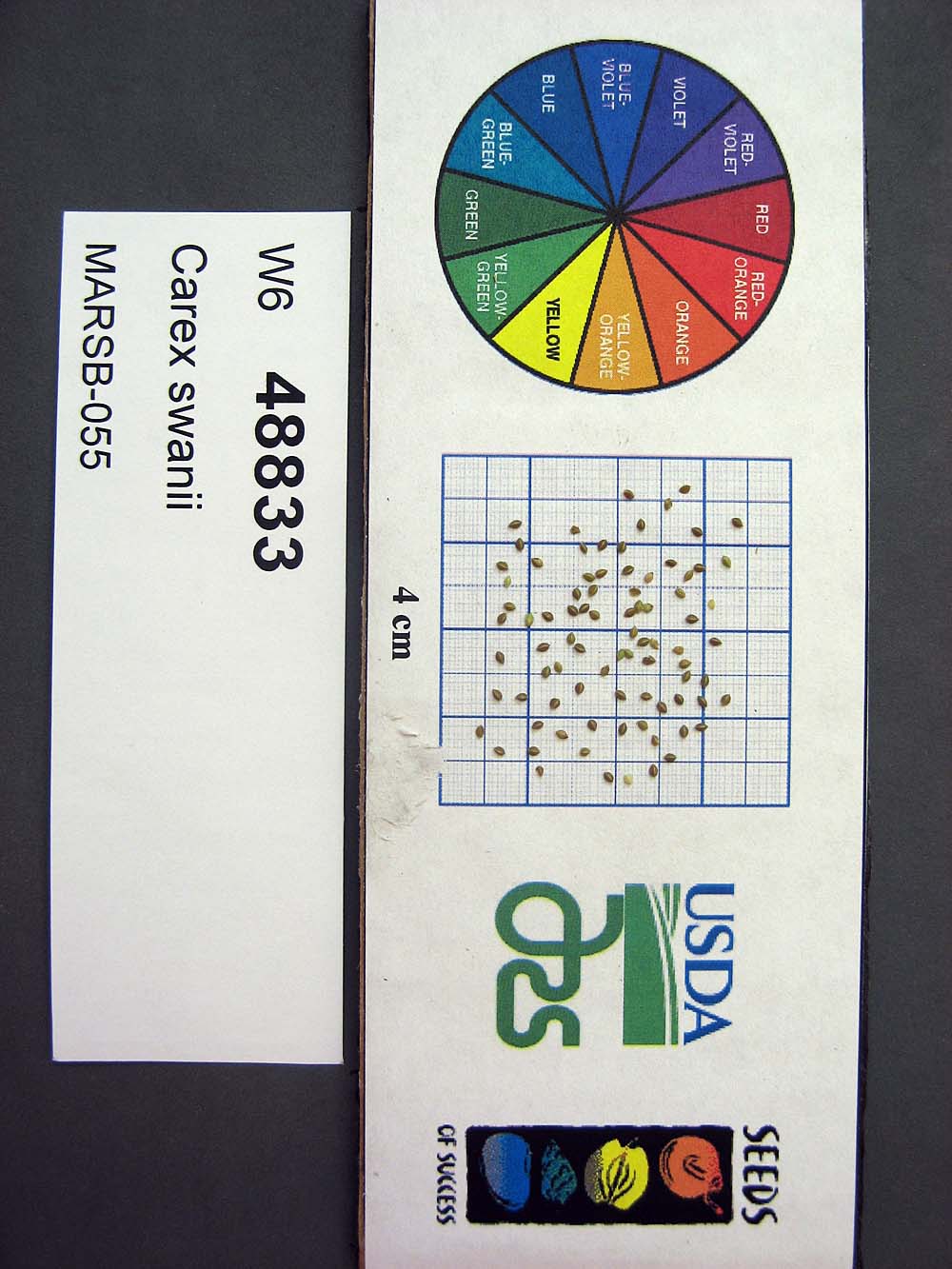 | | 2015 | | | | | | | Wild material | | 1922909 | W6 48833 |
| 48 | W6 48845 | MARSB-58 | Danthonia spicata (L.) P. Beauv. ex Roem. & Schult. | New York, United States | W6 |  | | 2015 | | | | | | | Wild material | | 1922913 | W6 48845 |
| 49 | W6 48848 | MARSB-057 | Avenella flexuosa (L.) Parl. | New York, United States | W6 | 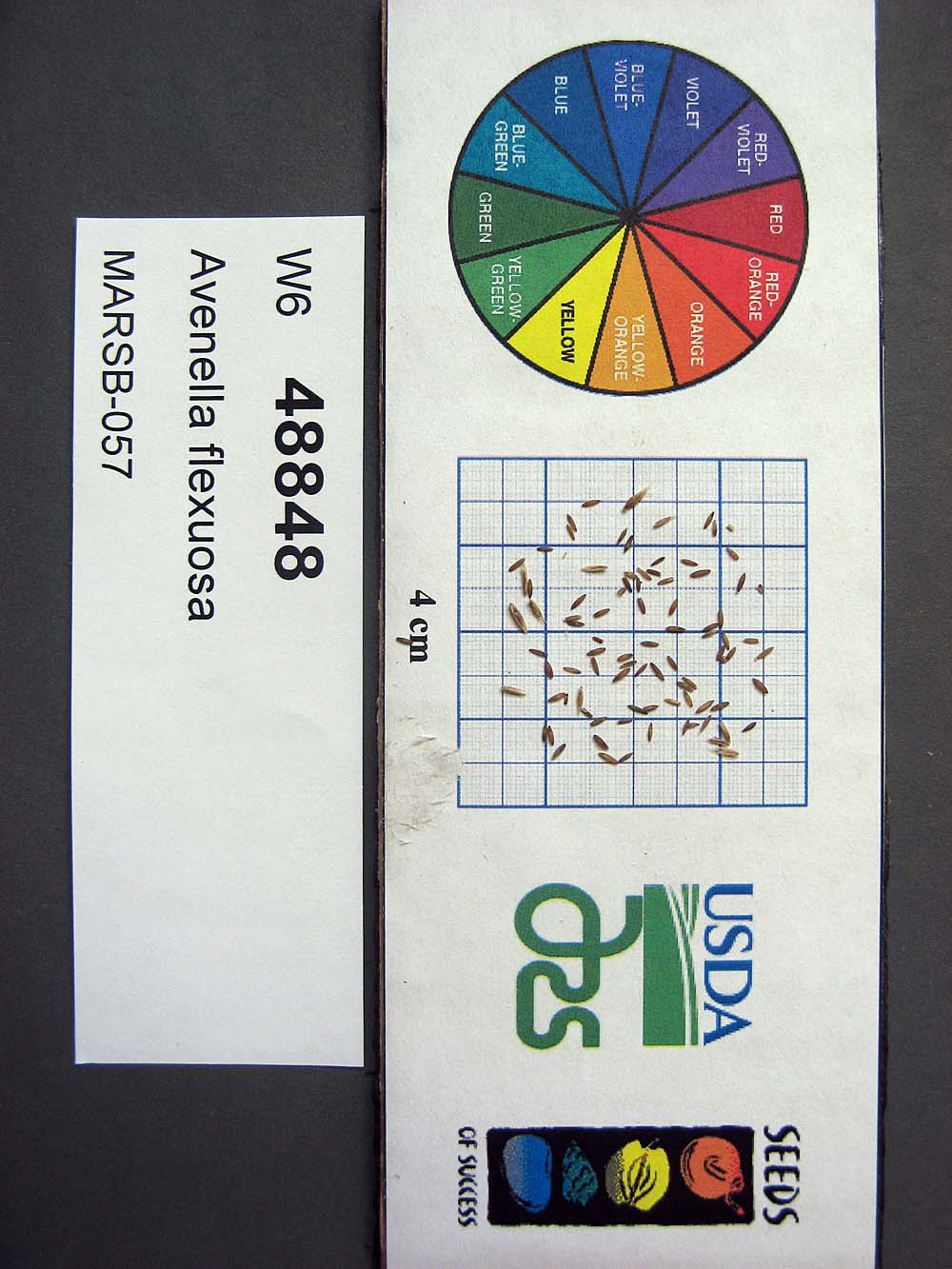 | | 2015 | | | | | | | Wild material | | 1922914 | W6 48848 |