| 0 | PI 708614 | MD_2025_1 | Rubus idaeus L. subsp. strigosus (Michx.) Focke | British Columbia, Canada | COR |  | | 2025 | COLLECTED | 08/26/2025 | | 50.96900600, -118.12712800 | 1685 | | Wild material | Collected August 26, 2025. West flank of Mt. MacKenzie, Revelstoke, British Columbia. Growing along trail access and path for gondola. Steep, west-facing slope with thin, rocky soil. Plants ~1m in height, dense glandular prickles along stems, petioles, peduncles and abaxial surface of sepals. Canes with strong anthocyanin pigmentation and waxy coating giving a purplish appearance. Plants are scattered and uncommon in the area. Foliage dark green and mostly healthy, with thick tomentum on the abaxial surface, some with scattered rust pustules. Dominant shrubby vegetation in the area Vaccinium sp., primarily V. membranaceum as well as Rhododendron albiflorum. Surrounding mixed conifer woods dominated by Tsuga mertensiana, Abies sp., and Picea sp.
| 2192747 | PI 708614 |
| 1 | PI 700905 | 'Caroline' | Rubus idaeus L. subsp. idaeus | | COR | | | 2022 | | | | | | | Cultivar | Material from Amanda Lake | 2138713 | PI 700905 |
| 2 | PI 700908 | 'Glen Clova' | Rubus idaeus L. subsp. idaeus | | COR | | | 2022 | | | | | | | Cultivar | Material from Amanda Lake | 2138716 | PI 700908 |
| 3 | PI 699386 | Nootka OP | Rubus idaeus L. | Canada | COR | | | 2019 | DONATED | 10/2019 | | | | | | Received from Bob Martin Lab. Seeds were stored in a drawer. No information on origin. RBDV resistance written on envelope. Envelope printed with CANADA. | 2123420 | PI 699386 |
| 4 | PI 689394 | ORUS 1025-10 | Rubus idaeus L. | Oregon, United States | COR | | | 2018 | DEVELOPED | | | | | | Breeding material | OSC 1582 x ORUS 564R-24. Floricane fruiting red raspberry. High quality but dark fruit. Machine harvests very nicely. Excellent yield. Most important reason to keep: excellent root rot resistance. | 1970164 | PI 689394 |
| 5 | PI 689395 | ORUS 1167-2 | Rubus idaeus L. | Oregon, United States | COR | | | 2018 | DEVELOPED | | | | | | Breeding material | ORUS 799-1 x Autumn Bliss. Primocane fruiting red raspberry. Most valuable trait: Very early PF crop. Bright attractive fruit. Susceptible to RBDV seems to tolerate root rot. | 1970166 | PI 689395 |
| 6 | PI 688307 | R. idaeus subsp. strigosus MD-18-21 Maine | Rubus idaeus L. subsp. strigosus (Michx.) Focke | Maine, United States | COR | | | 2018 | COLLECTED | 08/15/2018 | | | | | Wild material | Michael Dossett collection from Maine | 1965251 | PI 688307 |
| 7 | PI 688308 | R. idaeus subsp. strigosus MD-18-22 Maine | Rubus idaeus L. subsp. strigosus (Michx.) Focke | Maine, United States | COR | | | 2018 | COLLECTED | 08/15/2018 | | | | | Wild material | Michael Dossett collection from Maine | 1965252 | PI 688308 |
| 8 | PI 679807 | R. idaeus ssp. strigosus Quebec-16-01 | Rubus idaeus L. subsp. strigosus (Michx.) Focke | Québec, Canada | COR |  | | 2016 | COLLECTED | 08/14/2016 | Lac Saint-Pierre, Villeroy, Rest area off Route 20 | 46.38840000, -71.84350000 | 100 | Edge of mixed woods (primarily birch and red maple) near entrance to rest area (westbound). Some fruit collected approximately 0.5 km further east and south of Route 20 along Chemin Canyon. | Wild material | Quebec expedition 2016 | 1942690 | PI 679807 |
| 9 | PI 679805 | R. idaeus ssp. strigosus Placid Lake | Rubus idaeus L. subsp. strigosus (Michx.) Focke | Colorado, United States | COR | | | 2016 | COLLECTED | 06/18/2016 | on edge of Placid Lake under Ponderosa pine | 40.38739450, -105.55886110 | 2387 | dry understory shade | Wild material | | 1940875 | PI 679805 |
| 10 | PI 679728 | Red raspberry D9-11 educational | Rubus idaeus L. subsp. idaeus | Oregon, United States | COR | | | 2014 | DONATED | 09/11/2014 | | | | | Cultivated material | open pollinated red raspberry seed for educational purposes | 1920712 | PI 679728 |
| 11 | PI 672718 | R. idaeus subsp. idaeus Albania 2013-017 | Rubus idaeus L. subsp. idaeus | Albania | COR | | | 2014 | COLLECTED | 2013 | | | | | Wild material | 2.0 g of seed received from the Plant Germplasm Inspection Station in Beltsville, MD | 1914847 | PI 672718 |
| 12 | PI 672711 | R. idaeus subsp. strigosus MD-018 | Rubus idaeus L. subsp. strigosus (Michx.) Focke | Idaho, United States | COR | | | 2013 | COLLECTED | 09/01/2011 | | | | | Wild material | Plants grown from this seedlot appear to mostly be somewhat sensitive to Phytophthora root rot in greenhouse screens. | 1914009 | PI 672711 |
| 13 | PI 672691 | R. idaeus subsp. strigosus BC 93-16-43 | Rubus idaeus L. subsp. strigosus (Michx.) Focke | British Columbia, Canada | COR | | | 2012 | COLLECTED | 09/27/2012 | | | | | Genetic material | BC 93-16-43 (Kanata-B x Tulameen) is a cross between Tulameen and a wild Rubus strigosus seedling from just outside of Ottawa, Ontario. It is somewhat thorny and has a distinctive waxy pubescence on the canes. The fruit are small, soft, and medium red in color with excellent flavor. BC 93-16-43 has excellent resistance to root rot (on par with `Latham? in our greenhouse inoculations) has resistance to all biotypes of Amphorophora agathonica that have been identified to date, and also has resistance to raspberry bushy dwarf virus. | 1905234 | PI 672691 |
| 14 | PI 672669 | R. idaeus ALB-2011-052 | Rubus idaeus L. subsp. idaeus | Albania | COR | | | 2011 | COLLECTED | 09/17/2011 | | 42.39168000, 19.71082000 | 1468 | | Wild material | | 1891865 | PI 672669 |
| 15 | PI 672670 | R. idaeus ALB-2011-053 | Rubus idaeus L. subsp. idaeus | Albania | COR | | | 2011 | COLLECTED | 09/17/2011 | | 42.38757000, 19.73672000 | 1671 | | Wild material | | 1891866 | PI 672670 |
| 16 | PI 672672 | R. strigosus Fairbanks DBPH 10 | Rubus idaeus L. subsp. strigosus (Michx.) Focke | Alaska, United States | COR | | | 2011 | COLLECTED | 07/25/2011 | | 64.94310000, -147.95930000 | 675 | | Wild material | | 1892057 | PI 672672 |
| 17 | PI 672673 | R. strigosus Fairbanks DBPH 15 | Rubus idaeus L. subsp. strigosus (Michx.) Focke | Alaska, United States | COR |  | | 2011 | COLLECTED | 07/26/2011 | | 64.63550000, 147.12420000 | | | Wild material | | 1892058 | PI 672673 |
| 18 | PI 667656 | 'Vintage' | Rubus idaeus L. subsp. idaeus | Oregon, United States | COR | | | 2011 | DEVELOPED | 2010 | | | | | Genetic material | The U.S. Department of Agriculture-Agricultural Research Service, the Oregon Agricultural Experiment Station and the Washington Agricultural Research Center announce the release of an outstanding flavored, primocane fruiting red raspberry for the fresh market. VINTAGE, tested as ORUS 2786-5, was selected in Corvallis, Oregon in 2003 from a population grown from open pollinated seed of `Isabel' red raspberry. 'Isabel' is a patented cultivar (PP9,340) developed by Sweetbriar Development, Inc. (Watsonville, CA) that has proprietary selections as parents. VINTAGE is being released primarily due to its outstanding fresh fruit quality, especially flavor and bright color, in a primocane fruiting red raspberry that is suited for the fresh market.
VINTAGE has been evaluated most extensively in trials at Oregon State University's North Willamette Research and Extension Center (Aurora, Ore.; OSU-NWREC) and in USDA-ARS plots in Corvallis, Ore. VINTAGE plants are similarly vigorous to 'Heritage' but the canes tend to be not as stiffly erect or as tall. The canes have prickles that are denser basipetally and tend to be slightly less prickly than `Heritage'. The canes have shown no serious cane diseases.
VINTAGE ripens ahead of `Heritage' but later than `Autumn Bliss', `Chinook', and 'Rafzaqu' ('HimboTop' (R) ). The average harvest date of 5% ripe fruit is around 23-25 August, of 50% ripe fruit is 9-18 September, and of 95% ripe fruit is 7-8 October in the Willamette Valley of Oregon. VINTAGE has yields that are comparable to `Heritage', being slightly less in one trial and slightly greater in another. VINTAGE has consistently produced yields around 1.2-1.9 kg/plant.
VINTAGE fruit are similar in shape to `Heritage' but they are slightly less conical and more rounded. The fruit is attractive, with uniformly sized, shaped, and arranged drupelets. While the fruit are rated as very good for drupelet coherence, they may not hold together as tightly as `Heritage' but they have a comparable firmness. The fruit separate more easily from the plant than those of 'Heritage'. The fruit are medium size (3.2-3.4g) and 20-35% larger than `Heritage'. One of the most outstanding characteristics of VINTAGE is its bright red, attractive color, much brighter and less dark than the fruit of `Heritage'. VINTAGE fresh fruit are very sweet and rate as excellent for flavor, much better than those of `Heritage'.
VINTAGE fruit have a combination of excellent sweetness (soluble solids 12.4-12.8%), moderate pH (3.41-3.45) and a moderate titratable acidity (11.5-11.9) helping to give the fruit a sweet flavor but the lower titratable acidity may prevent it from being a good processing berry. In general the soluble solids and pH are higher than those of `Heritage' and the titratable acidity almost half of those for `Heritage' fruit. The fruit texture when the fruit are eaten is more pleasant, less dry and seedy, than those of `Heritage'.
VINTAGE is introduced as a very sweet, outstanding flavored, bright red, and large primocane fruiting red raspberry with excellent overall quality for the fresh market and yields comparable to current industry standards. VINTAGE should be adapted wherever other primocane fruiting raspberries can be successfully grown. | 1860779 | PI 667656 |
| 19 | PI 672675 | R. strigosus Fairbanks DBPH 18 | Rubus idaeus L. subsp. strigosus (Michx.) Focke | Alaska, United States | COR |  | | 2011 | COLLECTED | 07/26/2011 | | 64.61480000, -147.10600000 | 285 | | Wild material | | 1892060 | PI 672675 |
| 20 | PI 687147 sos | R. idaeus subsp. strigosus LLPMC-1-29 | Rubus idaeus L. subsp. strigosus (Michx.) Focke | New Mexico, United States | COR |  | | 2011 | COLLECTED | 01/01/2011 | | | | | Wild material | | 1856119 | PI 687147 sos |
| 21 | PI 660951 | R. strigosus Alaska KH-07-19-01sd | Rubus idaeus L. subsp. strigosus (Michx.) Focke | Alaska, United States | COR | | | 2010 | COLLECTED | 07/19/2010 | Bonaza Research Station | 64.70950000, -148.32666000 | 233 | | Wild material | Kim Hummer collection from Alaska.
| 1846767 | PI 660951 |
| 22 | PI 660952 | R. strigosus Alaska KH-07-19-02sd | Rubus idaeus L. subsp. strigosus (Michx.) Focke | Alaska, United States | COR | | | 2010 | COLLECTED | 07/19/2010 | Bathing Beauty Pond, North Pole, AK. | 64.71383000, -147.19187000 | 162 | | Wild material | Kim Hummer collection from Alaska.
| 1846768 | PI 660952 |
| 23 | PI 660954 | R. strigosus Alaska KH-07-21-02sd | Rubus idaeus L. subsp. strigosus (Michx.) Focke | Alaska, United States | COR | | | 2010 | COLLECTED | 07/24/2010 | Fairbanks North Star County, off Spinach Creek Road, northwest of the University of Alaska Fairbanks | 64.93931000, -148.06968000 | 288 | | Wild material | Kim Hummer collection from Alaska.
| 1846770 | PI 660954 |
| 24 | PI 672608 | 'Chemainus' | Rubus idaeus L. subsp. idaeus | British Columbia, Canada | COR | | | 2009 | DONATED | 02/27/2009 | | | | | Cultivar | Name of town which comes from a native shaman and prophet "Tsa-meeun-is" (Broken Chest or Bitten Breast).
| 1796890 | PI 672608 |
| 25 | PI 672609 | 'Saanich' | Rubus idaeus L. subsp. idaeus | British Columbia, Canada | COR | | | 2009 | DONATED | 02/27/2009 | | | | | Cultivar | Translates as 'place of fertile soils'.
| 1796891 | PI 672609 |
| 26 | PI 672610 | 'Rudyberry' | Rubus idaeus L. subsp. idaeus | British Columbia, Canada | COR | | | 2009 | DONATED | 02/27/2009 | | | | | Cultivar | | 1796892 | PI 672610 |
| 27 | PI 672611 | 'Nanoose' | Rubus idaeus L. subsp. idaeus | British Columbia, Canada | COR | | | 2009 | DONATED | 02/27/2009 | | | | | Cultivar | | 1796893 | PI 672611 |
| 28 | PI 657882 | Spinefree Willamette | Rubus idaeus L. subsp. idaeus | Victoria, Australia | COR | | | 2008 | DEVELOPED | 1990 | | | | | Cultivar | Spinelessness is dominate from the gene Sfw. Clone of normal red raspberry 'Willamette' sent to Australia. Graeme McGregor observed and propagated the thronless mutant. Clones were sent from Australia to Scotland where Derek Jennings named and studied the plant.
Spinelessness in a mutant of the red raspberry cultivar 'Willamette'.
NAMED FOR= spinlessness | 1789098 | PI 657882 |
| 29 | PI 653406 | R. strigosus Washington | Rubus idaeus L. subsp. strigosus (Michx.) Focke | Washington, United States | COR | | | 2008 | COLLECTED | 09/02/2007 | Salmon Meadows campground and vicinity. Okanogan National Forest, Okanogan County. Just past the campground toward Lone Frank Pass along FR-38/FR-3820. | 48.65860000, -119.84200000 | 1355 | Roadside/forest edge in area of mixed Spruce/Fir forest. | Wild material | Michael Dossett collected from Washington.
| 1750542 | PI 653406 |
| 30 | PI 652987 | R. idaeus HDF-2007-101 | Rubus idaeus L. subsp. idaeus | Nebraska, United States | COR |  | | 2007 | COLLECTED | 07/10/2007 | Dawes County East Ash Canyon, Pine Ridge Trail | 42.61686000, -103.19389000 | 0 | Mixed deciduous/conifer canyon, very open, heavily grazed by cattle; soil: dry sandy silt | Wild material | Michael Dossett, Chad Finn collected from Nebraska. unknown to occur until this sample was collected
| 1733172 | PI 652987 |
| 31 | PI 653312 | R. strigosus Custer St Park HDF-2007-102 | Rubus idaeus L. subsp. strigosus (Michx.) Focke | South Dakota, United States | COR |  | | 2007 | COLLECTED | 07/10/2007 | Custer State Park | 43.82540000, -103.36510000 | 1430 | Stream borders, riparian and conifer woods. Plants common in a variety of habitats with moisture | Wild material | Michael Dossett, Chad Finn collected from South Dakota.
| 1733173 | PI 653312 |
| 32 | PI 653313 | R. strigosus Spearfish HDF-2007-106 | Rubus idaeus L. subsp. strigosus (Michx.) Focke | South Dakota, United States | COR |  | | 2007 | COLLECTED | 07/11/2007 | Lawrience County, Spearfish - Burno Gulch Road | 44.44862000, -103.80866000 | 1383 | Riparian to coniferous but mostly in moist riparian zone along roadside | Wild material | Michael Dossett, Chad Finn collected from South Dakota.
| 1733174 | PI 653313 |
| 33 | PI 653320 | R. strigosus Waubay HDF-2007-120 | Rubus idaeus L. subsp. strigosus (Michx.) Focke | South Dakota, United States | COR | | | 2007 | COLLECTED | 07/13/2007 | Day County, Waubay Nat. Wildlife Refuge near Waubay | 45.43180000, -97.31210000 | 605 | variety of habitats from open prairie restoration to riparian understory, common and widely scattered | Wild material | Michael Dossett, Chad Finn collected from South Dakota.
| 1733184 | PI 653320 |
| 34 | PI 653322 | R. strigosus Belgrade MN HDF-2007-124 | Rubus idaeus L. subsp. strigosus (Michx.) Focke | Minnesota, United States | COR |  | | 2007 | COLLECTED | 07/14/2007 | Kamdiyohi County Belgrade 7135 240th Ave NE 56312 | 45.34890000, -94.94700000 | 406 | mixed moist deciduous forest, growing along road as well as driveway | Wild material | Michael Dossett, Chad Finn collected from Minnesota.
| 1733187 | PI 653322 |
| 35 | PI 652962 | ORUS 1142-1 | Rubus idaeus L. subsp. idaeus | Oregon, United States | COR | | | 2006 | DEVELOPED | 1990 | | | | | Cultivar | Very high quality red raspberry that may be released as cultivar. Moderate to high yields of very uniformly shaped and sized firm bright red berries. Excellent for fresh market.
| 1722587 | PI 652962 |
| 36 | PI 653108 | 'Josephine' | Rubus idaeus L. subsp. idaeus | Maryland, United States | COR |  | | 2006 | DEVELOPED | 1993 | | | | | Cultivar | A large-fruited primocane raspberry. Origin: University of Maryland by H.J. Swartz; Amity x Scotish Crop Research Institute 18E6; cross made in 1989; selected 1993 at Rutgers Fruit Research Station, Cream Ridge, New Jursey; tested as JEF-f1 as part of University of Maryland, Rutgers, Wisconsin River Falls, and Virginia Polytechnical Institute Bramble Breeding Program; USPPAF. Fruit: very large, firm; round; reasonable flavor; ripens on primocanes 10 days later than Caroline. Plant: very productive; vigorous; abundant numbers of promocanes. Resistant to late rust and to several leaf hopper species. - Hugh Daubeny, HortScience 2002
| 1699240 | PI 653108 |
| 37 | PI 643959 | 'Taylor' | Rubus idaeus L. subsp. idaeus | Massachusetts, United States | COR |  | | 2006 | DONATED | 03/06/2006 | | | | | Cultivar | Canes glabrous, slightly glaucous, slightly branched; prickles many, straight, short, stiff, color at base and tip purple, base slightly raised, elongated, conspicuous; leaves ternate and quinate, moderately plicate, flat, terminal leaflets oval; apex medium in length, acute; serrations dull, coarse, moderately deep, irregular; basal leaflets sessile or nearly so, pronounced over lapping; length/width ratio less than 2.Outstanding characteristics: Many short purple prickles; terminal leaflets on ternate leaves often lobed; pronounced overlapping of basal leaflets.Canes pubescent, non glaucous, not branched; prickles many, short, supple, color at base and tip purple, base round, conspicuous; leaves predominantly quinate; strongly plicate, U to saucer folded, terminal leaflets on quinate leaves obovate; on ternate leaves ovate and lobed; apex medium in length, acute; serrations dull, coarse, shallow, irregular; basal leaflets sessile, slight to no over lapping; length/width ratio less than 2.Outstanding characteristics: Pubescent canes, many short, supple, purple prickles; strongly picate leaves with U to saucer fold; little to no overlapping of basal leaflets; terminal leaflets on ternate leaves lobed; serrations dull, coarse.Roberts, O.C. and A. S. Colby. 1957. Red and purple raspberries: their idendification from plant primocanes. University of Massachusetts Agri. Expt. Sta. Bul. 523. 27 pp.
| 1699239 | PI 643959 |
| 38 | PI 653103 | 'Anne' | Rubus idaeus L. subsp. idaeus | Maryland, United States | COR |  | | 2006 | DEVELOPED | | | | | | Cultivar | The following is a detailed description of the new cultivar, including fruit production, together with the cultivar's morphological characteristics. The characteristics of the cultivar are compared to the standard used in the area: `Hertiage`. This description is based on information provided by cooperating scientists from plants grown in fields at Queenstown, Md., Cream Ridge, N.J., Blackstone, Va. and River Falls, Wis., Rock Hall, Pa., and from plants grown in the greenhouse at College Park. JEF-b1 produces a moderate number of root- and crown-suckers. During the growing season, canes are light green colored, usually unbranched, semi-erect and moderately vigorous. Thorns are sparse, green, thin and usually less than 2 mm in length (see FIG. 3). Leaves have a R.H.S. (Royal Horticultural Society of London) Colour Chart number of 22A, are trifoliolate, and pentafoliolate on vigorous primocanes. Leaf serration is more complex than other eastern american raspberries, and is similar to `Glen Gerry`, a parent. `Glen Gerry` does not produce fall fruit and is thornless. Tips or serrations of JEF-b1 leaves form more acute angles than those on leaves of `Heritage` and other fall bearing cultivars. JEF-b1 leaf color is dark green. Fruit is borne on the top of the primocane in the fall season or from lateral buds at the base of winter canes. Fruit trusses are cymose clusters. Flowers are perfect and indistinguishable from other raspberry cultivars. Fruit are light yellow in color, having R.H.S. Color Chart number 143A, firm, large, and very symmetrical. Druplets are held together tightly, and druplets will often tear before they separate from their neighbors. Fruit is round-conic, has an even collar, and readily separates from its torus as do other raspberries. The cavity width is slightly smaller than in other cultivars. Fruit has a mild-sweet flavor with a banana-aromatic flavor developing in cooler climates. The plant is field resistant to many common pests and diseases in the eastern United States, e.g. mildew, anthracnose, leaf rust, and verticillium wilt. The plants' reaction to Phytophthora fragarae root rot is probably moderately resistant. Fruit is only moderately resistant to rot. Fruit Production JEF-b1 has been tested in a replicated trial in Cream Ridge, N.J., and in Rock Hall, Pa. The following data were collected in the summer/fall of 1994 and 1995. Early yield refers to fruit picked before Sep. 1, 1994.
Cultivar release by Harry Swartz, Joseph Fiola, Herbert Stiles, and Brian Smith
| 1699233 | PI 653103 |
| 39 | PI 653104 | 'Jaclyn' | Rubus idaeus L. subsp. idaeus | Massachusetts, United States | COR |  | | 2006 | DONATED | 03/06/2006 | | | | | Cultivar | | 1699234 | PI 653104 |
| 40 | PI 653105 | 'Lauren' | Rubus idaeus L. subsp. idaeus | Massachusetts, United States | COR |  | | 2006 | DONATED | 03/06/2006 | | | | | Cultivar | | 1699235 | PI 653105 |
| 41 | PI 653106 | 'Polana' | Rubus idaeus L. subsp. idaeus | Massachusetts, United States | COR |  | | 2006 | DONATED | 03/06/2006 | | | | | Cultivar | Polana is a cold tolerant northern red raspberry. Plants have shorter canes than most, and fill in rows quickly. Fruits are medium to large in size and full of the juiciest raspberry flavor. Polana's strong points are: Early, fall bearing, high yields because buds produce 2 fruiting laterals each and good fruit quality.
Cultivar release from Brzezna, Poland
| 1699236 | PI 653106 |
| 42 | PI 653107 | 'Prelude' | Rubus idaeus L. subsp. idaeus | Massachusetts, United States | COR |  | | 2006 | DONATED | 03/06/2006 | | | | | Cultivar | 'Prelude' matures seven days earlier than standard early-season cultivars, in late June and early July,' said Maloney. It originated from a cross of NY 817 [Hilton x NY600 (Durham x September)] x 'Hilton', and was previously tested as NY 1009. Winter hardy in Zone 5, the plants of 'Prelude' are vigorous and sucker freely. 'Prelude' fruit average 2.2 grams per berry, are positioned openly with good placement, and are very easy to harvest. 'Prelude' also bears fruit on primocanes in the fall. The total average fall production is slightly less than 'Heritage' and the average fruit size is slightly higher. In test plots conducted at the Geneva Experiment Station, Kevin Maloney, who manages the program at Geneva, reports that plant vigor and fruit production of 'Prelude' has not declined when summer cropping annually.
Cultivar release by Courtney Weber
| 1699237 | PI 653107 |
| 43 | PI 641308 | R. idaeus Shelly | Rubus idaeus L. subsp. idaeus | New Jersey, United States | COR |  | | 2005 | DONATED | 04/11/2005 | | | | | Cultivar | Open pollinated seed from Shelly L1
| 1676549 | PI 641308 |
| 44 | PI 653101 | 'Caroline' | Rubus idaeus L. subsp. idaeus | Indiana, United States | COR |  | | 2005 | DONATED | 03/10/2005 | | | | | Cultivar | Fall (primocane) bearing red raspberry with large, very sweet, firm fruit. Ripens before Heritage and is more resistant to root rots. Vigorous growth habit. Indiana Berry and Plant catalog.
| 1672292 | PI 653101 |
| 45 | PI 643957 | R. idaeus GE-2004-044 | Rubus idaeus L. subsp. idaeus | Georgia | COR | | | 2004 | COLLECTED | 09/26/2004 | Tush-Pshav-Kevsureti (Mtskheta-Mtianeti) province, Arguni River Valley. | 42.61708000, 45.11109000 | 1398 | | Wild material | | 1665944 | PI 643957 |
| 46 | PI 638319 | 'Perron's Red' | Rubus idaeus L. subsp. idaeus | Canada | COR |  | | 2004 | DEVELOPED | 1987 | | | | | Cultivar | Origin in Quebec, Canada, by W.H. Perron and Company. Selected in 1977, introduced in 1987. Fruit: large; conic; medium red, slightly more glossy than Heritage; less firm than Heritage; produced on primocanes; season similar to Heritage in British Columbia. Plant: vigorous; numerous canes, fairly erect, glabrous, light green with some red overlay, purple spines. Susceptable to the North American aphid vector raspberry mosaic virus complex.
W.H. Perron 1987 release.
| 1664009 | PI 638319 |
| 47 | PI 638282 | 'Encore' | Rubus idaeus L. subsp. idaeus | New York, United States | COR |  | | 2004 | DEVELOPED | | | | | | Cultivar | Encore matures late, peaking in production late in the season, and extends the red raspberry harvest into August,' said Maloney. 'Encore' originated from a cross of 'Canby' x 'Cherokee', and was previously tested as NY7. 'Encore' has excellent winter hardiness in Zone 5, has very good root suckering and vigor, and produces above average commercial fruit yields. Fruit average 2.9 grams per berry, are attractive, with firm texture, and have a good balanced flavor.Linda McCandless, Cornell University, New York State Agricultural Experiment Station
| 1659735 | PI 638282 |
| 48 | PI 638250 | R. strigosus Arizona OJ-2003-10 | Rubus idaeus L. subsp. strigosus (Michx.) Focke | Arizona, United States | COR | | | 2003 | COLLECTED | 09/15/2003 | Cochise county, Chiricahua Mountain, along crest trail, Long Park to Chiricahua Peak. | 31.86861000, -109.28500000 | 2835 | | Wild material | Jim Oliphant and Jodi Jackson collection.
| 1649776 | PI 638250 |
| 49 | PI 638242 | R. strigosus North Dakota DC2001-6 | Rubus idaeus L. subsp. strigosus (Michx.) Focke | North Dakota, United States | COR |  | | 2003 | COLLECTED | 10/09/2001 | One-tenth mile north of county road 2 along west side of River Road opposite some farm buildings. | 48.96778000, -101.94972000 | 495 | Upper flood plain of Souris River with Crataegus sp. and Humulus lupulus. | Wild material | Douglas Cook collection from North Dakota.
| 1648405 | PI 638242 |
| 50 | PI 638227 | 'Chinook' | Rubus idaeus L. subsp. idaeus | Oregon, United States | COR |  | | 2003 | DEVELOPED | | | | | | Cultivar | CHINOOK ripens its primocane crop 7-12 days before 'Heritage' the most widely grown primocane-fruiting cultivar in the world. CHINOOK has had very high yields (20356 kg/ha); similar to 'Heritage' (20352 kg/ha). The fruit are more round than conic, extremely firm, and dry, with an attractive red color similar to 'Heritage'; The fruit are much larger than 'Heritage' (3.1-3.7 g vs 2.3-2.5 g). The fruit pick easily from the plant when ripe, however, commercial growers must train pickers carefully on the appropriate stage for picking as red, but underripe, fruit can be difficult to pick. Fruit flavor has been rated as similar to or slightly better than 'Heritage' and is similar to 'Summit'. CHINOOK can be shipped long distances, much better than 'Autumn Bliss', in part because of its fruit firmness and skin toughness. CHINOOK has been successfully air-freighted from the Pacific Northwest to the East Coast of the U.S. by commercial producers. While CHINOOK will mostly be grown for its fresh crop, it processes well as an individually quick frozen (IQF) product. CHINOOK plants are vigorous but shorter (1.55 m, ~38 nodes) than Heritage (1.64 m, ~43 nodes). The canes are slightly smaller in diameter than 'Heritage' and they are not as sturdy. The combination of heavy fruit load and less sturdy canes produces a plant that must be supported. CHINOOK produces more canes than does 'Heritage'. While CHINOOK has on average 5 node shorter canes than 'Heritage', the average number of fruiting nodes is only 1.4 less than 'Heritage' (16.4 vs 17.8). The spines on CHINOOK canes are infrequent with 2-3 purple spines per internode compared to 8-10 for 'Heritage'. CHINOOK is expected to be susceptible to the common strain of raspberry bushy dwarf virus (RBDV), however, CHINOOK has shown no particular susceptibility to fungal diseases. Very little botrytis fruit rot (Botrytis cinerea) has been seen on CHINOOK, although it ripens in the Pacific Northwest at a time when there is very little rain suggesting avoidance rather than resistance. When it has been planted in commercial fields infected with root rot, presumably Phytophthora fragariae var. rubi, it has not shown symptoms of the disease. CHINOOK is introduced as an early-ripening, primocane-fruiting berry for the fresh market where its production of early season, high quality, very firm fruit and high yields will make it a preferred berry for fresh market sales. CHINOOK nuclear stock has tested negative for tomato ringspot, raspberry bushy dwarf, and tobacco streak viruses by ELISA and has indexed negative on grafting to R. occidentalis. CHINOOK is not patented. However, when this germplasm contributes to the development of a new cultivar, hybrid, or germplasm, it is requested that appropriate recognition be given to the source. Further information or a list of nurseries propagating CHINOOK is available on written request to Chad Finn; USDA-ARS, Northwest Center for Small Fruit Research; Horticultural Crops Research Laboratory; 3420 NW Orchard Ave.; Corvallis, Oregon 97330. The USDA-ARS does not sell plants. In addition, genetic material of this release has been deposited in the National Plant Germplasm System, where it will be available for research purposes, including development and commercialization of new cultivars.
| 1646445 | PI 638227 |
| 51 | PI 638211 | R. idaeus ARM-02-199 | Rubus idaeus L. subsp. idaeus | Armenia | COR |  | | 2002 | COLLECTED | 09/14/2002 | Purchased from roadside vendor near Alaverdi in Lori Marz province. | 40.98333000, 44.65000000 | 0 | | Wild material | | 1642353 | PI 638211 |
| 52 | PI 643948 | R. idaeus ARM-02-101 | Rubus idaeus L. subsp. idaeus | Armenia | COR | | | 2002 | COLLECTED | 09/06/2002 | Khosrov Preserve, Ararat Marz provence. | 40.60611000, 44.54333000 | 2201 | Roadside on edge of forest with Betula litwinovii. | Wild material | | 1642346 | PI 643948 |
| 53 | PI 643949 | R. idaeus Armenia | Rubus idaeus L. subsp. idaeus | Armenia | COR | | | 2002 | COLLECTED | 09/07/2002 | Dilijan National Park, Tavush Marz provence. | 40.66194000, 45.00583000 | 1650 | Moist forest with Quercus macranthera. | Wild material | | 1642347 | PI 643949 |
| 54 | PI 643950 | R. idaeus Armenia | Rubus idaeus L. subsp. idaeus | Armenia | COR | | | 2002 | COLLECTED | 09/07/2002 | North of Sevan Pass in the province of Tavush Marz. | 40.67917000, 44.88083000 | 1940 | At edge of Pinus sylvestris grove, in wet ravine below. | Wild material | | 1642348 | PI 643950 |
| 55 | PI 643951 | R. idaeus ARM-02-164 | Rubus idaeus L. subsp. idaeus | Armenia | COR | | | 2002 | COLLECTED | 09/12/2002 | Vanadzor Valley, Lori Marz province. | 40.75194000, 44.47111000 | 1794 | On forest edge along a moist seep with Quercus macranthera and Carpinus betulus. | Wild material | | 1642350 | PI 643951 |
| 56 | PI 643952 | R. idaeus ARM-02-182 | Rubus idaeus L. subsp. idaeus | Armenia | COR | | | 2002 | COLLECTED | 09/13/2002 | Along Pushkin Mountain Road in Lori Marz province. | 40.90528000, 44.43028000 | 1922 | Growing in Scattered clusters in rocky terrain. | Wild material | | 1642351 | PI 643952 |
| 57 | PI 638222 | R. strigosus Colorado OCJ-39 | Rubus idaeus L. subsp. strigosus (Michx.) Focke | Colorado, United States | COR |  | | 2002 | COLLECTED | 09/16/2002 | South off US-50 on S-149, then south 1.5 miles on County Road 31. Willow creek, Gunnison River Watershed. | 38.45250000, -107.05861000 | 2478 | Aspect: NE Associated vegetation: Populus deltoides and Rosa | Wild material | | 1642364 | PI 638222 |
| 58 | PI 638205 | 'Cowichan' | Rubus idaeus L. subsp. idaeus | British Columbia, Canada | COR |  | | 2002 | DONATED | 03/28/2002 | | | | | Cultivar | Fruit: Large, proght, glossy medium red, excellent quality with good flavor, most similar to Tulameen by firmer, easy to harvest. Plant: moderately productive, vigorous, upright, sturdy floricanes with medium length, upright, stiff laterals with well spaced fruit, abundant red to purple primocanes, short spines on lower part of cane are not objectionable. Susceptible to cane Botrytis and to spur blight, may have some resistance to root rot, to date has not become naturally infected with raspberry bushy dwarf vius, resistant to common strain of North American aphid vector of the raspberry mosaic virus complex. HortScience 37(2):265COWICHAN (2001) - raspberry. Derived from a Halkomelem First Nation's word meaning 'warm country' or 'warmed by the sun'. The name originated because of a large rock formation, on the side of Mt. Tzuhalem, supposedly resembling a frog basking in the sun.The 'Cowichan' cultivar produces larger, firm fruit of good quality. Plants may have resistance to raspberry bushy dwarf virus and to Phytophthora-incited root rot. It is too soon, after its release, to predict level of acceptance.
Hugh Daubney and Chaim Kempler cultivar release Cross made in 1987, selected in 1990, introduced in 2001
English Translation= Halkomelem First Nation's word : "warmed by the sun"
NAMED FOR= Mt. Tzuhalem rock formation like a frog basking in the sun | 1636907 | PI 638205 |
| 59 | PI 638206 | 'Malahat' | Rubus idaeus L. subsp. idaeus | British Columbia, Canada | COR |  | | 2002 | DEVELOPED | 1996 | | | | | Cultivar | Malahat-A high-yielding, early-ripening, fresh-market raspberry. Orig. in Vancouver B.C., Catiada, by H.A. Daubeny and C. Kempler, Agriculture and Agri-Food Canada, Pacific Agr. Res. Cen-tre. Meeker x BCISCRI 7853/116 (selection has complex parentage including Nootka, Rubus occidentalis, R. phoenicolasius); cross made by HAD in 1985; selected in 1987; tested as BC 85-5-24; introd . in 1996. Propagated underaroyalty agreement by Sieglin Ent., Abbotsford, B.C. Fruit: large; firm; conic; glossy medium red; easy to harvest, flavor not as sweet as Chilliwack but considered good; good shelf life; intermediate reaction to Botrytis post harvest rot; ripens earlier than any other high-quality Pacific Northwest variety. Plant: high yield; vigorous, fairly upright habit; adequate primocane numbers; winter hardiness appears similar to Meeker and less than Chilliwack. Relatively susceptible to spur blight; susceptible to cane spot; resistant to cane Botrytis; relatively susceptible to Phytophthora root rot in green-house screening test; susceptible to natural infection by raspberry bushy dwarf virus; resistant to the common strain of the North American aphid vector of the raspberry mosaic virus complex.MALAHAT (1996) - raspberry - There is some debate on the origin of this Saanich First Nation's name. Some say it means "infested with caterpillars" (let us hope not!) and others say it means "place where one gets bait.The 'Malahat' cultivar ripens fruit particularly early and thus lengthens the harvest season for fresh market raspberries. It is also suitable for processing and is gaining in popularity. Fruit is large and the plants productive.
Hugh Daubeny cultivar release cross made by HAD in 1985; selected in 1987; tested as BC 85 introduced in 1996
English Translation= Saanich First Nation's name "Place where one gets bait"
| 1636908 | PI 638206 |
| 60 | PI 638209 | R. idaeus ARM-01-464 | Rubus idaeus L. subsp. idaeus | Armenia | COR | | | 2001 | COLLECTED | 08/20/2001 | | 40.66833000, 44.88611000 | 660 | very steep hillside above a canyon on the way to Dilijan Reserve | Wild material | | 1640897 | PI 638209 |
| 61 | PI 638186 | ORUS 1838 | Rubus idaeus L. subsp. idaeus | Oregon, United States | COR |  | | 2001 | DONATED | 03/08/2001 | | | | | Cultivar | Francis J. Lawrence cross
| 1612432 | PI 638186 |
| 62 | PI 638187 | ORUS 1780-B | Rubus idaeus L. subsp. idaeus | Oregon, United States | COR |  | | 2001 | DONATED | 03/08/2001 | | | | | Cultivar | France J. Lawrence cross and selection
| 1612433 | PI 638187 |
| 63 | PI 638188 | ORUS 1994 | Rubus idaeus L. subsp. idaeus | Oregon, United States | COR |  | | 2001 | DONATED | 03/08/2001 | | | | | Cultivar | Francis J. Lawrence cross
| 1612434 | PI 638188 |
| 64 | PI 658553 | 'Podgorina' | Rubus idaeus L. subsp. idaeus | Serbia | COR | | | 2000 | DEVELOPED | 1980 | | | | | Cultivar | | 1607818 | PI 658553 |
| 65 | PI 618309 | 'Dinkum' | Rubus idaeus L. subsp. idaeus | Victoria, Australia | COR |  | | 2000 | DEVELOPED | 1985 | | | | | Cultivar | Dinkum. Originated in Toolangi, Australia, by G. McGregor, Institute for Horticultural Development, Melbourne, Victoria. Autumn Bliss x Glen Moy; cross made in 1983 by D.L. Jennings, Scottish Crop Research Institute; selected by G. McGregor in 1985; tested as A-83-31-G5; introduced in 1992. Propagated under an agreement with the Australian Rubus Growers Association. Fruit: medium size; firm with medium size drupelets; medium dark red and slightly more glossy than Autumn Bliss; excellent flavor; easy to harvest; main production on primocanes; over-wintered floricanes produce early summer fruit on lower portions; some reistance to postharvest Botrytis rot; ripens as much as 19 days earlier than Heritage and at the same time or 3 days earlier than Autumn Bliss; fresh market use. Plant: yield similar to Autumn Bliss but usually has more condensed ripening season and higher yield at each harvest; upright primocanes with relatively short fruiting laterals. Susceptible to root rot and to infection by pollen transmission of raspberry bushy dwarf virus.
| 1599285 | PI 618309 |
| 66 | PI 618310 | 'Balder' | Rubus idaeus L. subsp. idaeus | Akershus, Norway | COR |  | | 2000 | DEVELOPED | 1980 | | | | | Cultivar | Balder. Originated in Aas-NLH, Norway, by G. Redalen, Agricultural University of Norway. Norna x Malling Jewel; cross made in 1975; selected in 1980; tested as H4-10-07; introduce in 1988. Fruit: medium size; dark, dull red color; relatively soft; medium sweet; high acidity, separates readily from the receptacle; early, relatively concentrated season; processing use. Plant: productive; primocanes numerous, erect, and vigorous, with dark-purple spines largely restricted to the basal portions, slightly waxy and glabrous; floricanes erect and vigorous, light brownish gray; large leaves may hide fruit, making hand harvest difficult; very winter hardy; susceptible to cane spot.
| 1599286 | PI 618310 |
| 67 | PI 618311 | 'Kitsilano' | Rubus idaeus L. subsp. idaeus | British Columbia, Canada | COR |  | | 2000 | DEVELOPED | | | | | | Cultivar | KITSILANO (1998) - raspberry - Derived from the name of Squamish First Nation settler who came from a village on the Squamish River and settled in Stanley Park circa 1860. Fruit of the 'Kitsilano' cultivar ripens particularly late in the season and provides an effective overlap with some of the early ripening primocane (fall) cultivars. The fruit is a bright red. It is not particularly large in size and this appears to be a deterrent to its acceptance.
Cultivar release by Hugh Daubeny
NAMED FOR= the name of Squamish First Nation settler | 1599287 | PI 618311 |
| 68 | PI 618314 | 'Glen Rosa' | Rubus idaeus L. subsp. idaeus | Scotland, United Kingdom | COR |  | | 2000 | DEVELOPED | 1994 | | | | | Cultivar | Glen Rosa. A raspberry with easily harvested fruit, well adapted to the cool growing conditions of Scotland. Originated in Invergowrie, Scotland, by R.J. McNicol and D.L. Jennings, Scottish Crop Research Institute. Sibling of Glen Ample; complex parentage includes Glen Prosen and Meeker; cross made in 1978; tested as SCRI 7815Al2; introduced in 1994. Worldwide marketing rights held by NSA Plants, East Mailing, Kent, U.K. Fruit: medium size; bright medium-red color; firm with good collar adhesion; easily removed from receptacle; adapted to machine harvest; midseason ripening; fairly good flavor; for processing, less well adapted to fresh market. Plant: production moderate; spine-free, relatively upright canes with medium vigor. Gene H gives resistance to spur blight and cane Botrytis; gene Al0 gives resistance to the four known strains of the European aphid vector of the raspberry mosaic virus complex; gene Bu gives resistance to raspberry bushy dwarf virus.
| 1599290 | PI 618314 |
| 69 | PI 618316 | 'Maroseyka' | Rubus idaeus L. subsp. idaeus | Washington, United States | COR |  | | 2000 | DONATED | 04/04/2000 | | | | | Cultivar | | 1599292 | PI 618316 |
| 70 | PI 653100 | 'Autumn Britten' | Rubus idaeus L. subsp. idaeus | Washington, United States | COR |  | | 2000 | DONATED | 04/04/2000 | | | | | Cultivar | Autumn Britten.-An early ripening, primocane-fruiting raspberry released for eastern Canada. Orig. in East Malling, Kent, U.K., by V.H. Knight, E. Keep, and J.H. Parker, Hort. Res. Intl. Sibling of Au-tumn Bliss, with complex derivation in-volving several red raspberry varieties and Rubus arcticus, R. strigosus, and R. occidentalis; tested as EM 3676 / 6; introd. in 1995. Plant variety rights held by Ontario Berry Growers Assn. and Hort. Res. Intl. Fruit: large; medium to dark red; firm; at times more uniform than Autumn Bliss; usually ripens a few days after Autumn Bliss; can be difficult to harvest in British Columbia but not in Ontario. Plant: yields similar to or slightly higher than Autumn Bliss; canes not as erect as Autumn Bliss; some spines. Susceptible to infection by pollen transmission of raspberry bushy dwarf virus; gene A10 gives resistance to the four known strains of the European aphid vector of the raspberry mosaic virus complex.Autumn Britten originates in Great Britain. It ripens before Caroline and Heritage, bearing fruit from late summer through the fall. It has a very large, very firm and coherent berry that is flavorful. Autumn Britten has shown to be winter hardy in trials at Nourse Farms. Plants are moderately vigorous
cultivar introduced by V.H. Knight, E. Keep, and J.H. Parker in 1995 from East Mallin Experiment Station, Kent
WHY NAMED= fall fruiting raspberry from Great Britain
| 1603276 | PI 653100 |
| 71 | PI 618284 | 'Cherokee' | Rubus idaeus L. subsp. idaeus | Virginia, United States | COR | | | 2000 | DEVELOPED | 1977 | | | | | Cultivar | Orig. in Blacksburg, Va., by G.D. Oberle, Virginia Agr. Ext. Serv., Vir-ginia Polytechnical Inst. and State Univ. Introd. in 1972. Hilton x VPI 5 (Taylor x St. Regis); cross made in 1958; selected in 1972; tested as VPI 13. Fruit: large; round conic to medium conic; medium to bright red; firm; seeds prominent; fruit well exposed; season extends from late June to mid July on floricanes and mid September to frost on primocanes. Plant: productive; good vigor; tolerant to fluctuating winter temperatures. Tolerant to root rot. Susceptible to the common strain of the North American aphid vector of the raspberry mosaic virus complex.
| 1603235 | PI 618284 |
| 72 | PI 618332 | R. strigosus Lake Altoona WI | Rubus idaeus L. subsp. strigosus (Michx.) Focke | Wisconsin, United States | COR | | | 1999 | COLLECTED | 08/1999 | Along North Beach Road, Park Road and Lake Road adjacent to Lake Altoona in Altoona, Wisconsin. | 44.81028000, -91.42361000 | 0 | | Wild material | | 1585886 | PI 618332 |
| 73 | PI 618392 | 'Coho' | Rubus idaeus L. subsp. idaeus | Oregon, United States | COR |  | | 1999 | DEVELOPED | 05/19/1999 | | | | | Cultivar | 'Coho' is a new floricane fruiting red raspberry (Rubus idaeus L.) from the U.S. Dept. of Agriculture-Agricultural Research Service (USDA-ARS) breeding program in Corvallis, Ore., released in cooperation with the Oregon State Agricultural Experiment Station, the Washington State Univ. Agricultural Research Center, and the Idaho Agricultural Experiment Station. 'Coho' is high yielding and late-ripening, and produces large, bright red, very firm fruit that separate easily from the receptacle. The cultivar is best suited for fresh markets, although it has been reported to be excellent when individually quick frozen (IQF; commercial processor, personal communication). The 'Coho' ripening season is later than 'Tulameen' and slightly earlier than 'Kitsilano' and it produces larger fruit than the latter.'Coho' is named after the salmon (Oncorhynchus kisutch Walbaum) that is renowned for its brilliant red body coloration and late spawning runs.The fruit are bright red; not nearly as dark as 'Willamette' nor as light-colored as 'Chilcotin'. Fruit flavor was rated excellent. Fruit are similar to 'Tulameen' in firmness and were rated the firmest of all compared cultivars. The combination of firmness, flavor, and bright red, nondarkening color suggests that 'Coho' should be excellent for the fresh market. 'Coho' has not been tested for suitability to mechanical harvesting, but in subjective evaluations based on ease of separation, it seems similar to 'Chilliwack', which is considered to be easily mechanically harvested.
'Coho' is named after the salmon renowned for its brilliant red body coloration and late spawning runs.
| 1579750 | PI 618392 |
| 74 | PI 643942 | 'Lloyd George' | Rubus idaeus L. subsp. idaeus | Scotland, United Kingdom | COR |  | | 1999 | DONATED | 04/22/1999 | | | | | Cultivar | Orig.- as a chance seedling in a wood in Dorsetshire, England. Parentage probably the native Rubus idaeus; introd. J.J. Kettle, Corfe Castle, Dorset; introd. into North America in 1923. Fruit: medium size, soft, dark, excellent flavor. Plant: moderately productive and vigorous. Resistant to the common strain of the North American aphid vector of the rasp-berry mosaic virus complex. Has been used extensively in North American breeding programs as a source of aphid resistance, conferred by gene Agi, and in both North American and European programs as a source of fruit quality, particularly flavor.Canes prbescent, non glaucous, slightly branched; prickles many, short, stiff, color at base and tip purple, base round, much raised, conspicuous; leaves ternate and quinate, strongly plicate, flat with some leaves reflex folded, terminal leaflet oval; apex medium in length, acute; serrations dull, shallow; basal leaflets stalked, slightly overlapping; length/ width ratio leass than 2.Outstanding characteristics: Pubescent canes, many purple prickles, with conspicuous bases; plicate leaves.Roberts, O.C. and A. S. Colby. 1957. Red and purple raspberries: their idendification from plant primocanes. University of Massachusetts Agri. Expt. Sta. Bul. 523. 27 pp.
Named for prime minister of England
| 1583780 | PI 643942 |
| 75 | PI 618385 | 'K81-6 (Raspberry)' | Rubus idaeus L. subsp. idaeus | Indiana, United States | COR |  | | 1999 | DONATED | 02/25/1999 | | | | | Cultivar | Late season berry introduced in Kentville, Nova Scotia, Canada. Hardy to minus 34 degrees F, vigorous and tall plants have excellent taste. A very large firm berry.Winter hardy for the upper mid-west and the east coast.Very large fruit, well constructed small drupelets, attractive and good flavorPlant has an upright and vigorous growth habitHigh yieldingSummer bearingMid-late season. This produced the largest summer berry with great flavor. The plant is vigorous and quite upright but requires trellising with its large fruit load. - Nourse Catalog 2006Late season. Berries are very large, medium firm with a good flavour and are produced on vigorous plants. It has good winter-hardiness. Grower experience with K81-6 has been mixed. Some growers have removed their plantings because of difficulties with fire blight. Leaf curl virus has also been a problem for some. Pick-your-own customers have favoured this selection because of its fruit size and quality.
Selection number was released by Agriculture and Agri-Food C Canada, Kentville Experiment Station, Nova Scotia selection number from their station
NAMED FOR= Kentville Experriment Station selection number | 1574257 | PI 618385 |
| 76 | PI 654990 | 'Titan' | Rubus idaeus L. | Indiana, United States | COR |  | | 1999 | DONATED | 02/25/1999 | | | | | Cultivar | 'Titan' was tested as N.Y. 883. It was selected from progeny of a cross between 'Hilton' ('Newburgh' x 'September') and N.Y. 598 ('Newburgh' x 'St. Walfried'). This cross was made in 1963, and the selection was made in 1966. 'Titan' has undergone field testing for many years at Geneva and on various commercial farms in the Northeast. Although it was an advanced selection, 'Titan' also was included in replicated yield trials conducted by P. Crandall, Vancouver, Wash.Titan produces a very large mild flavor and long conical fruit. It's bright red color and large size makes it an attractive fruit for redi-pick or you-pick sales. It is winter hardy to 15 degrees F. Although Titan can be very productive, it has shown succeptability to root rot and should be grown on beds or light soils. The exceptionally large fruit has also been reported to be soft under some growing conditions.'Titan' does not appear to be resistant to important diseases. Like most other cultivars, it is susceptible to tobacco streak virus, raspberry bushy dwarf virus, and tomato ringspot virus. Likewise, there is little evidence of resistance to raspberry mosaic virus or raspberry leaf curl virus, although these 2 viruses are of secondary importance in New York. 'Titan' appears to be as susceptible to cane disease and preharvest and postharvest fruit rots as the other cultivars grown in the Northeast.'Titan' is not well-suited to mechanical harvest as is practiced in the Northwest, because its fruit clasps the torus quite firmly. This characteristic does not impede hand harvesting.
J. C. Sanford, D. K. Ourecky, and J. E. Reich cultivar
| 1574256 | PI 654990 |
| 77 | PI 672599 | 'Golden Harvest' | Rubus idaeus L. subsp. idaeus | Indiana, United States | COR |  | | 1999 | DONATED | 02/25/1999 | | | | | Cultivar | Golden Harvest. (U.S. Patent applied, all rights reserved.) Golden Harvest originated in New York state and was tested in Michigan for almost ten years. From a private program, this is a fairly firm berry, about the size, season, and sweetness of Heritage.
yellow mutant of red raspberry
| 1574259 | PI 672599 |
| 78 | PI 608861 | R. strigosus Sled Dog KH98-13 | Rubus idaeus L. subsp. strigosus (Michx.) Focke | Alaska, United States | COR | | | 1998 | COLLECTED | 08/10/1998 | Sled Dog RV Park, Badger Loop Road, on the banks of the Chena River, about 4 miles east of Fairbanks, Alaska. | 64.83167000, -147.53306000 | 30 | Along river bank. Associated with grasses, ladyfern and Fragaria virginiana. Soil was dark brown, very sandy-loam, very little organic matter. | Wild material | | 1562778 | PI 608861 |
| 79 | PI 618377 | R. strigosus Oregon | Rubus idaeus L. subsp. strigosus (Michx.) Focke | Oregon, United States | COR | | | 1998 | COLLECTED | 08/15/1998 | Strawberry Wilderness in Malheur Nation Forest; T14S R34E Sec. 30; Strawberry Lake Campground at end of Forest Road 6001. From Prairie City take Highway 60 (Strawberry Road) south, which becomes Forest Road 6001. | 44.30000000, -119.68333000 | 1828 | Small clumps in full sunshinie near creek. Less abundant than Fragaria and Vaccinium | Wild material | | 1562488 | PI 618377 |
| 80 | PI 608859 | R. idaeus KH98-06 | Rubus idaeus L. subsp. idaeus | Alaska, United States | COR | | | 1998 | COLLECTED | 08/07/1998 | Along river's edge for about 0.5 mile, sampling many plants, Little Susitna River Park, Alaska. | 61.43778000, -150.16806000 | 10 | Very moist boggy location by river edge next to open woods. Associated with devil's club,red currant, watermellonberry, cranberry-bush (Viburnum edulum). | Wild material | | 1562202 | PI 608859 |
| 81 | PI 657878 | 'Kiwigold' | Rubus idaeus L. subsp. idaeus | | COR |  | | 1998 | DEVELOPED | 1988 | | | | | Cultivar | Orig. in Murrinsville, New Zealand, by C.E.H. and M.A. Thomas. Sport of Heritage discovered in 1984; introd. in 1988. U.S. plant patent pending; assigned to Nourse Farms, South Deerfield, Mass. Fruit: medium; conic; yellow; firm; excellent quality; produced on primocanes; ripening time similar to Heritage. Plan primocanes vigorous, numerous, erect, sturdy; more spines than Heritage; no red pigmentation.
introduced in 1988.
BACKGROUND OF THE INVENTION The present invention relates to a new and distinct asexually--reproduced variety of fall-bearing yellow raspberry, Rubus idaeus, known as `Kiwigold` which is exceptional for its cohesive, well-formed fruit of yellow color when ripe. ORIGIN This new cultivar was discovered by Chris Thomas, on his farm on Horrell Road, Morrinsville, New Zealand. The original plant was a sport found within a commercial planting of `Heritage` in March 1985 and was a naturally occurring whole plant mutation. The `Heritage` crop was planted in August 1983 with dormant rooted canes taken from a nearby commercial planting. No other yellow fruiting plants had been seen in this field which was removed in 1987. PROPAGATION The original cane was marked and dug out when dormant to be planted in the home garden for observation. The next summer (1986) it produced many suckers and some of these fruited and appeared true to type of the original. Subsequently, suckers and the mother cane were planted in another area of the garden, isolated from `Heritage` for multiplication. In July 1988, enough planting material was available to plant out a cropping row and subsequently the area planted has been expanded to the present 2 acres. Plants are also being established for testing in the USA (Massachusetts) area, Scotland and England. | 1556085 | PI 657878 |
| 82 | PI 691944 | Strawberry necrotic shock virus in Willamette | Rubus idaeus L. subsp. idaeus | Oregon, United States | COR | | | 1997 | DONATED | 10/17/1997 | | | | | Cultivar | Strawberry necrotic shock virus in Willamette | 2097841 | PI 691944 |
| 83 | PI 691934 | Tomato ringspot virus in raspberry | Rubus idaeus L. subsp. idaeus | Oregon, United States | COR | | | 1997 | DONATED | 10/16/1997 | | | | | Cultivar | Tomato ringspot virus in raspberry | 2097831 | PI 691934 |
| 84 | PI 691936 | Hop latent mosaic virus in Latham | Rubus idaeus L. subsp. idaeus | Oregon, United States | COR | | | 1997 | DONATED | 10/17/1997 | | | | | Cultivar | Hop latent mosaic virus in Latham | 2097833 | PI 691936 |
| 85 | PI 691938 | Rubus Yellow Net Virus in Baumforth Seedling A | Rubus idaeus L. subsp. idaeus | Oregon, United States | COR | | | 1997 | DONATED | 10/16/1997 | | | | | Cultivar | Rubus Yellow Net Virus in Baumforth Seedling A | 2097836 | PI 691938 |
| 86 | PI 608838 | R. idaeus 96090 | Rubus idaeus L. subsp. idaeus | Heilongjiang Sheng, China | COR | | | 1996 | COLLECTED | 08/08/1996 | Yabuli village (= apple for the wild Malus baccata) (=Yabloko) | 44.93333000, 128.00000000 | 325 | | Cultivated material | Verified in the field by Maxine Thompson
| 1536612 | PI 608838 |
| 87 | PI 604643 | R. idaeus Washington | Rubus idaeus L. subsp. idaeus | Washington, United States | COR | | | 1996 | COLLECTED | 09/27/1996 | Cub Lake, Chelan county, Washington, United States | 48.20000000, -120.41667000 | 1615 | Growing on south facing slope of large granitic boulders. Plants in habitat: gooseberry, Epildoium, thimbleberry, Douglas fir. This raspberry competes very well in this boulder field. | Wild material | Seeds collected from at least 25 plants in a population of several hundred plants. Plants up to 76 cm tall, berries nearly 1 cm long (smaller than observed in 1995) probably due to drier conditions in 1996 an early frost and snow storm about 9/15/1996. | 1536597 | PI 604643 |
| 88 | PI 606521 | R. idaeus KHCW 96-23-01 | Rubus idaeus L. subsp. idaeus | Alaska, United States | COR | | | 1996 | COLLECTED | 08/04/1996 | Plants were collected while walking down a nature trail to the lake. Kenai National Wildlife Refuge, Skihill Road. | 60.46361000, -151.07500000 | 62 | Dense shrub along trail. | Wild material | USDA Plant Exploration Expedition, 1996. Associated plants:Betula nana, Ledum palustris ssp. groenlandicum Andromeda polifolia, Geacaulon lividum, Empetrum nigrum Vaccinium vitis-idaea. | 1536584 | PI 606521 |
| 89 | PI 606524 | R. idaeus var. strigosus KHCW 96-24-01 | Rubus idaeus L. subsp. strigosus (Michx.) Focke | Alaska, United States | COR | | | 1996 | COLLECTED | 08/04/1996 | Pull-off to west of Kalifonski Beach Road, overlooking Cook Inlet. | 60.50028000, -151.28083000 | 3 | Open edge of parking log, facing west. | Wild material | USDA Plant Exploration Expedition, 1996 | 1536587 | PI 606524 |
| 90 | PI 606525 | R. idaeus KHCW 96-24-01 | Rubus idaeus L. subsp. idaeus | Alaska, United States | COR |  | | 1996 | COLLECTED | 08/04/1996 | Pull-off to west of Kalifonski Beach Road, overlooking Cook Inlet. | 60.50028000, -151.28083000 | 3 | Open edge of parking log, facing west. | Wild material | USDA Plant Exploration Expedition, 1996 | 1536588 | PI 606525 |
| 91 | PI 606534 | R. idaeus KHCW 96-30-01 | Rubus idaeus L. subsp. idaeus | Alaska, United States | COR |  | | 1996 | COLLECTED | 08/06/1996 | Cottonwood Creek, Wasilla | 61.58167000, -149.39194000 | 100 | Woody marsh next to Cottonwood Creek, dark organic soil. | Wild material | USDA Plant Exploration Expedition, 1996 | 1536596 | PI 606534 |
| 92 | PI 618440 | Qualicum | Rubus idaeus L. subsp. idaeus | British Columbia, Canada | COR |  | | 1996 | DEVELOPED | 1995 | | | | | Cultivar | A high-yielding, midseason raspberry producing large, firm fruit with a good shelf life. Orig. in Vancouver, British Columbia, Canada, by H.A. Daubeny, Agr. and Agri-Food Canada, Pacific Agr. Res. Centre. Glen Moy x Chilliwack; cross made in 1983; selected in 1986; tested as BC 83-16-50; introd in 1995. Propagated under a royalty agreement by Sieglin Ent., Abbotsford, British Columbia. Fruit: large; conic; medium red, slightly less glossy than Chilliwack; easily removed from the receptacle; can be machine-harvested; relatively high soluble solids; pleasant fresh flavor; some resistance to pre- and postharvest fruit rots; fresh market and processing, including individual quick freeze. Plant: vigorous, upright habit; primocanes fairly numerous, light rosy-red color with dark purple spines mostly at base; floricanes light brown with gray overlay and basal cracking; long, strongly attached laterals tend to droop; fruit spaced well apart along laterals; winter hardiness appears adequate in the Pacific Northwest. Some resistance to spur blight; resistant to powdery mildew; susceptible to cane Botrytis and cane spot; susceptible to Phytophthora-incited root rot in greenhouse screening test; susceptible to infection by pollen transmission of raspberry bushy dwarf virus; resistant to the common strain of the North American aphid vector of the raspberry mosaic virus complex.QUALICUM (1993) - raspberry - Derived from a Nanaimo First Nations Tribe term for "place of the dog (chum) salmon.The 'Qualicum' cultivar produces particularly firm, large fruit that is well suited to transport. It is high yielding and is gaining wider acceptance. One fresh market grower in the Lower Mainland even prefers it over 'Tulameen'.
Hugh Daubeny cultivar release cross made in 1983; selected in 1986; tested as BC 83-16-50; released in 1995
English Translation= Nanaimo First Nations word "place of the dog (chum) salmon."
WHY NAMED= firm large fruit well suited to transport
| 1522040 | PI 618440 |
| 93 | PI 618437 | 'San Diego' | Rubus idaeus L. subsp. idaeus | California, United States | COR | 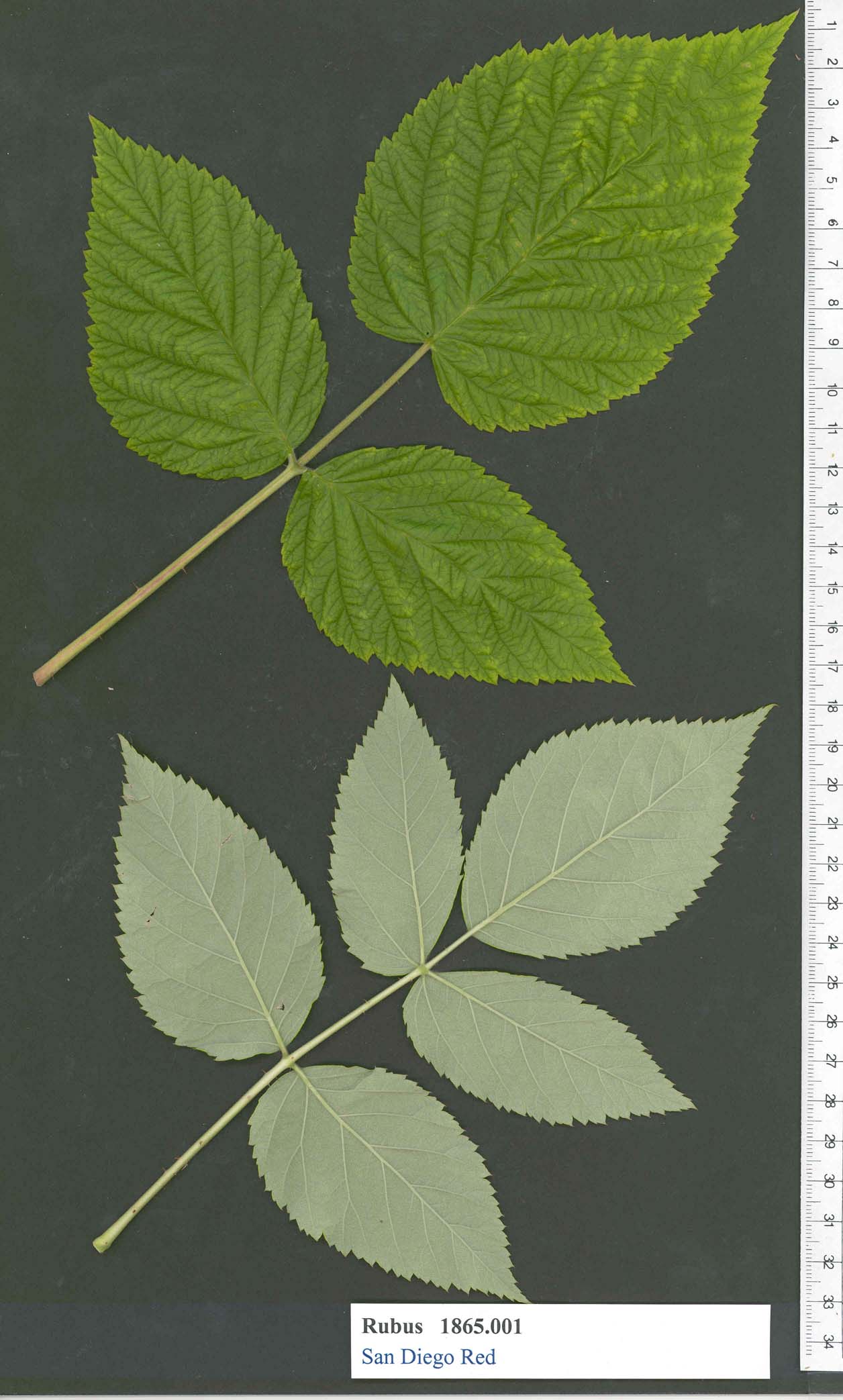 | | 1996 | DONATED | 03/15/1996 | | | | | Cultivar | | 1522036 | PI 618437 |
| 94 | PI 618438 | 'Sonoma' | Rubus idaeus L. subsp. idaeus | California, United States | COR | | | 1996 | DONATED | 03/15/1996 | | | | | Cultivar | Orig. in Glen Ellen, Calif., by E.E. Roach, Log Cabin Nursery. (Ranere x Latham) x (Cuthbert x Latham); selected in 1947; introd. in 1951. Fruit: large. Plant: primocane fruiting; able to withstand and bear fruit in hot summer and low humidity; produces to mid-December.
bred by E.E. Roach, Log Cabin Nursery selected in 1947; introduced in 1951
NAMED FOR= Sonoma, California | 1522037 | PI 618438 |
| 95 | PI 618441 | 'Tulameen' | Rubus idaeus L. subsp. idaeus | British Columbia, Canada | COR |  | | 1996 | DEVELOPED | | | | | | Cultivar | Orig. in Vancouver, British Columbia, by H.A. Daubeny and A. Ander-son, Agr. Canada Res. Sta. Nootka x Glen Prosen; cross made in 1980; selected in 1983; tested as BC 80-28-53; introd. in 1989. Fruit: very large; long-conic; medium red, glossy; firm; drupelets numerous; separates readily from receptacle and can be machine-harvested; starts to ripen with Meeker but has a longer season that over-laps early primocane-fruiting cultivars; relatively susceptible to preharvest botrytis rot, some resistance to postharvest rot; good flavor; fresh-market and processing uses, including individual quick freeze. Plant: very high yield; vigorous; fairly up-right habit; primocanes reasonably numer-ous, nonpubescent, green with an irregu-larly distributed purple overlay concentrated at the base; sharp, purple spines largely restricted to basal portions; floricanes sturdy, fairly upright, grayish-yellow with general basal cracking; fruiting laterals strongly attached, relatively long, with fruit well spaced; long pedicels aid in giving excellent exposure for hand-harvesting; moderately winter hardy in the Pacific Northwest. Susceptible to spur blight, moderately susceptible to cane Botrytis and cane spot; moderately suscep-tible to root rot; slow to become infected by pollen transmission of raspberry bushy dwarf virus; resistant to the common strain of the North American aphid vector of the raspberry mosaic virus complex and to powdery mildew.
named for the Tulameen Indians Native North American name (possibly a mountain range ?)
Cultivar Synonym= BC 80-28-53
| 1522039 | PI 618441 |
| 96 | PI 618464 | 'Plainsman' | Rubus idaeus L. subsp. strigosus (Michx.) Focke | Wyoming, United States | COR | | | 1994 | DEVELOPED | | | | | | Cultivar | Notice to nurserymen relative to the naming and release for propagation of a new red raspberry, 'Plainsman' (dated February 17, 1993) : The Agricultural Research Service hereby releases to nurserymen for propagation PLAINSMAN, a new cold-hardy, productive red raspberry. PLAINSMAN, tested as selection 72-1, originated from a cross of September x Cheyenne seedling 62-17 (Rubus idaeus strigosus). Cheyenne 62-17 is a 3rd generation seedling from plants collected in the wild in Shell Canyon near Greybull, Wyoming, in 1952 and selected for the new-wood, early, summer-fruiting character. Crosses resulting in the two varieties were made in 1964 and the seedlings were grown at Cheyenne, Wyoming, in 1965. It was grown, selected and tested by Gene S. Howard, a retired Agricultural Research Service horticulturist. Fruit of PLAINSMAN is conic in shape and up to 28 mm in diameter. Color for this variety is medium to deep red and the flesh is medium in firmness. Yield is medium to high. Flavor is as flavorful as standard raspberries. Fruit is borne on new-wood of the current season's growth and ripens in southeastern Wyoming by the first week of August. First ripe fruit averages 3 to 4 weeks earlier than August Red. The plants are everbearing in nature and the fruiting season lasts for about 6 weeks or until heavy frosts occurs. Plants of PLAINSMAN have excellent vigor and produce numerous canes. Plants are somewhat larger and more vigorous than either PATHFINDER or TRAILBLAZER. Plants will make solid beds unless cultivated and kept in rows. Above ground canes are frozen back or killed to near ground level over winter. They may be mowed with a rotary mower and raked off before the new growth begins in spring thus eliminating hand pruning and reservoirs for diseases. Botanical characters more nearly resemble the taxonomic descriptions for R. idaeus strigosus than R. idaeus although characters of both are present. PLAINSMAN is recommended for trial plantings in Colorado, Wyoming, Montana, South Dakota, Idaho, North Dakota, Minnesota, Wisconsin, and Utah. Foliar diseases were not reported from cooperators in the areas recommended for trial. The plant material has not been tested for virus, but the plants have retained good production, growth, and suckering for over 20 years, suggesting it has virus tolerance. Plant material has been sent to the National Clonal Germplasm Repository for virus evaluation. A limited number of plants for propagation will be available to researchers and nurserymen. Written requests should be sent to Gerald E. Schuman, High Plains Grasslands Research Station, 8408 Hildreth Road, Cheyenne, WY 82009
named for the Great Plains of the U. S. for the settlers of the Plains
| 1507981 | PI 618464 |
| 97 | PI 658551 | R. idaeus subsp. idaeus N88-13-230 | Rubus idaeus L. subsp. idaeus | Nord-Trøndelag, Norway | COR | | | 1994 | DEVELOPED | 1988 | | | | | | | 1104207 | PI 658551 |
| 98 | PI 618383 | R. idaeus Oulu 500 | Rubus idaeus L. subsp. idaeus | Troms, Norway | COR | | | 1994 | COLLECTED | 09/14/1993 | Storfjord, Paras | 69.08333000, 20.10000000 | 0 | | Wild material | | 1568834 | PI 618383 |
| 99 | PI 604623 | R. idaeus Amber open pollinated | Rubus idaeus L. subsp. idaeus | Oregon, United States | COR | | | 1993 | DEVELOPED | | | | | | Cultivar | Fruit from plant large, amber, sweet. Reference CRUB 777. | 1015911 | PI 604623 |
| 100 | PI 618489 | R. strigosus Nelchina-1 | Rubus idaeus L. subsp. strigosus (Michx.) Focke | Alaska, United States | COR | | | 1993 | COLLECTED | 08/19/1993 | Glenn Hwy mile 137.6 in campground at Little Nelchina State Recreation Area. Moist mixed forest area along river. | 61.95000000, -146.83333000 | 700 | Glenn Hwy mile 137.6 in campground at Little Nelchina State Recreation Area. Moist mixed forest area along river. | Wild material | | 1015869 | PI 618489 |
| 101 | PI 608823 | R. idaeus G-13180 | Rubus idaeus L. subsp. idaeus | Ohio, United States | COR | | | 1993 | COLLECTED | | East of Mentor, Ohio on Johnnycake Ridge in Mr. Washburn's garden. Lat/lon accurate to Mentor. | 41.65000000, -81.33333333 | | | Cultivated material | Reference G-13180. Open-pollinated seed collected from 1964 to 1966. Main feature is much growth in first year; everbearing; very dark fruit. Pale bark, many prickles. Not a partial fall crop, a bit late for central Maine. Variable, but has a strong tendency for autumn fruiting. | 1015884 | PI 608823 |
| 102 | PI 608825 | R. idaeus G-14646 | Rubus idaeus L. subsp. idaeus | New York, United States | COR | | | 1993 | COLLECTED | | | | | | Cultivar | Reference G-14646. Grows very tall, especially in semi-shade. | 1015898 | PI 608825 |
| 103 | PI 608826 | R. idaeus subsp. idaeus G-16889 | Rubus idaeus L. subsp. idaeus | England, United Kingdom | COR | | | 1993 | COLLECTED | | | | | | Cultivar | Reference G-16889. Only tetraploid variety of red raspberry available. Slow growing, lacks vigor. Fruits are coarse with very large druplets. No value except as polyploid for breeding. | 1015901 | PI 608826 |
| 104 | PI 618504 | R. strigosus British Columbia | Rubus idaeus L. subsp. strigosus (Michx.) Focke | British Columbia, Canada | COR | | | 1992 | COLLECTED | 1992 | Near Stewart, BC at Black Water Lake | 55.90000000, -129.98333000 | 2900 | Near Stewart, BC at Black Waterlake | Wild material | | 1015510 | PI 618504 |
| 105 | PI 618541 | R. idaeus 2 SIM 1D | Rubus idaeus L. subsp. idaeus | Chile | COR | | | 1992 | COLLECTED | 02/1992 | | | | | Breeding material | Yellow fruit | 1014739 | PI 618541 |
| 106 | PI 618542 | R. idaeus 2 SIM 1C | Rubus idaeus L. subsp. idaeus | Chile | COR | | | 1992 | COLLECTED | 02/1992 | | | | | Breeding material | Red fruit | 1014742 | PI 618542 |
| 107 | PI 618456 | 'Centennial' | Rubus idaeus L. subsp. idaeus | Washington, United States | COR |  | | 1992 | DEVELOPED | 1990 | | | | | Cultivar | 'Centennial' was selected by B.H.B. in 1978 at Puyallup, Wash., from the 1974 cross made by H.A.D of 'Meeker' x 'Skeena'. It has been tested throughout the Pacific Northwest as WSU 738. 'Meeker' was released from the Washington State Univ. breeding program in 1967 (Brooks and Olmo, 1972) and is one of the leading commercial cultivars in the Pacific Northwest. 'Skeena' was released from the Agriculture Canada breeding program in British Columbia (B.C.) in 1978 (Daubeny, 1978) and is also commercially important in the Pacific Northwest. 'Skeena' was also the male parent of two other 1974 crosses that resulted in the release of 'Chilliwack' and 'Comox' from the Agriculture Canada, B.C., program in 1987 (Daubeny, 1987).The fruit has a pleasant, mild flavor.''Centennial' appears to be well-adapted in southern portions of the Pacific Northwest (south of about 48'N). It has not been reliably cold hardy at Abbotsford, B.C., and is not recommended where 'Meeker' may be damaged by cold. The fruit should meet the requirements of both fresh-market and processing uses; however, it is not suited to machine-harvesting.Although it has not been rigorously tested outside the Pacific Northwest, 'Centennial' has yielded well and produced large fruit at Raleigh, N.C. It also is being grown com-mercially around Watsonville, Calif. These indications suggest that 'Centennial' may be adapted to areas south of the location it was developed and tested.Centennial' is susceptible to Amphorophora agathonica Hottes, the aphid vector of the raspberry mosaic virus complex. However, in the Pacific Northwest, A. agathonica is most prevalent in British Colum-bia and northern Washington (Martin, 31988), where 'Centennial' would not be recommended because of potential winter damage. At Puyallup, where there is a high frequency of RBDV, 'Centennial' has tested positive for the virus using the ELISA technique.Appears to be well-adapted to the southern portions of the Pacific Northwest. Suitable for fresh market and processing
Pat Moore, Tom Sjulin, Bruce Barritt, and Hugh Daubeny cv.
Cultivar Synonym= Tested as WSU 738
NAMED FOR= Commemorating the Washington State Univ. centennial, 1989-90 | 1014199 | PI 618456 |
| 108 | PI 606445 | R. idaeus Denmark | Rubus idaeus L. subsp. idaeus | Denmark | COR | | | 1991 | COLLECTED | 07/23/1991 | Danish National Park, Jutland, along roadside in a woodland | 56.00000000, 10.00000000 | 100 | Danish National Park, Jutland, along roadside in a woodland | Wild material | Population sample. Plants vigorous | 1013569 | PI 606445 |
| 109 | PI 618455 | ORUS 980-4 Yellow | Rubus idaeus L. subsp. idaeus | Oregon, United States | COR |  | | 1991 | DEVELOPED | | | | | | Breeding material | Fruit yellow to apricot colored, late season in Oregon. Primocane fruiting, very few spines
Cross made by George Waldo in Corvallis, Oregon Cross made in 1983
NAMED FOR= USDA Oregon State Selection | 1013455 | PI 618455 |
| 110 | PI 618583 | 'Century' | Rubus idaeus L. subsp. idaeus | Uncertain | COR |  | | 1991 | DEVELOPED | | | | | | Cultivar | | 1013390 | PI 618583 |
| 111 | PI 618454 | 'Honey Queen' | Rubus idaeus L. subsp. idaeus | Alberta, Canada | COR |  | | 1991 | DEVELOPED | 1966 | | | | | Cultivar | Reported to be a superior variety of yellow raspberry. Vigorous and high-yielding this reportedly superiour variety was developed by fruit breeder and authority Rober Erskine of Alberta, Canada. Honey queen is a seedling of Honey King pollinated with the old Canadian red raspberry variety Herbert. Ordinary sized fruit. Very winter hardy and shorter canes than Amber.
named for yellow fruit
WHY NAMED= Yellow-fruited cultivar
NAMED FOR= In honor of its parent Honey King | 1013380 | PI 618454 |
| 112 | PI 553640 | 'Wawi' | Rubus idaeus L. subsp. idaeus | France | COR |  | | 1991 | DEVELOPED | 1990 | | | | | Cultivar | A fresh market raspberry adapted to France.Fruit: medium to small size, firm, good flavor, attractive.Plant: high yield. tolerant to Phytophthora root rot in the field.Daubeny, 1996.
Cultivar Synonym= F.646
| 1448612 | PI 553640 |
| 113 | PI 553638 | 'Newberry' | Rubus idaeus L. subsp. idaeus | Washington, United States | COR |  | | 1991 | DEVELOPED | 1951 | | | | | Cultivar | F. A. NEWBERRY, Port Angeles, WashingtonIn the month of July in the year of 1941, we took a number of plants from our place when the Government took over for a housing project; namely, Boysenberries, Loganberries, St. Regis Everbearing Raspberries, and Cuthbert Raspberries.We were not too careful digging them as we were in a hurry and took them over to this place, dug a big round hole and chucked them in, all mixed up, and trampled the dirt down around them.That summer was very dry and hot. We did not have an opportunity to water them at all.Late the following spring we dug them out. We had a few Cuthbert Raspberry canes, a few St. Regis Everbearing canes, only one Boysenberry and three Loganberry canes. They showed but little life and all the Loganberry plants presumably died; but about 5 or 7 weeks later a plant came up about 5 or 6 inches from one of the stalks of Loganberries.The foliage of this plant appeared to be much different than any plant I had ever seen, so I went down and asked our County Agent, at that time the late C. D. Yeager, to come up and look at it. I said to him, "Mr. ' Yeager, what kind of a plant is that." He looked it over very carefully then said, "Mr. Newberry, I don't know but I believe you have a Sport but we cannot tell if it is worth anything till it has fruit On it. It may not amount to anything." So when the fruit was ripe, he came out again and our present County Agent Melvin Mickel was with him, and Mr. Yeager said I had a wonderful flavored berry and he advised me to take care of it but that in time it may revert back to one particular kind of the four varieties named.I waited about two years and it still kept its flavor and general appearance, and up until this time, to the best of my knowledge, has shown no indication of disease and in the year of 1946, I started proceedings for a plant patent from the U. S. Patent Office which patent is still pending.These canes reach a height or length of between 9 and 11 feet. They do not do well if they are cut back like a raspberry plant, and they are very much inclined to droop as their canes attain length, so, therefore, I trellis them on wire 42 inches high. I recommend that the plants stand 11 feet between each hill and not less than 6 feet between the rows. I have tried several different kinds of fertilizer and I find that chicken fertilizer or litter of straw is best.The berries have a tendency to cling far more than any raspberry I have ever seen, although they pick like a raspberry. The general public verifies the fact that they have a decided tart or tang in comparison with any raspberry they have ever tasted. They claim they make wonderful jelly, jam, preserves, and are excellent for pies , and stand up both as in flavor and appearance when frozen, and according to the response of the public in all categories they will soon be one of the most popular berries on the market.This year from 172 full grown plants and 244 plants set out last spring we had a total picking of approximately 3400 lbs. This year the first berry was ripe on the 1st of July and we are still picking about 3 boxes every 4 days.First amount worth mentioning on July 9, 1949, 8 crates, to a high of 14 crates and to a low of 1 1/2 crates on August 18, 1949, with a total picking between these dates of 34 pickings and gradually tapering off to the present date of November 29, 1949.At the present time the Western Washington Experiment Station has the plants, also the Oregon Station at Corvallis, Oregon.Mr. Melvin Michel, Clallam County Agent, is familiar with these plants and berries and would gladly answer any questions.
named for F. A. Newberry, plant breeder
WHY NAMED= Special flavor, with an uncommon tang for raspberry
NAMED FOR= F.A. Newberry, discoverer | 1448610 | PI 553638 |
| 114 | PI 553625 | Eluzia x Fantasia seed | Rubus idaeus L. subsp. idaeus | Russian Federation | COR | | | 1991 | COLLECTED | 08/10/1990 | | | | | Breeding material | | 1448597 | PI 553625 |
| 115 | PI 553627 | Lesovenko seed OP | Rubus idaeus L. subsp. idaeus | Russian Federation | COR | | | 1991 | COLLECTED | 08/10/1990 | | | | | Breeding material | | 1448599 | PI 553627 |
| 116 | PI 553629 | Fantasia x Kalakolchick seed | Rubus idaeus L. subsp. idaeus | Russian Federation | COR | | | 1991 | COLLECTED | 08/10/1990 | | | | | Breeding material | | 1448601 | PI 553629 |
| 117 | PI 553631 | Eluzia x Kalakolchik seed | Rubus idaeus L. subsp. idaeus | Russian Federation | COR | | | 1991 | COLLECTED | 08/10/1990 | | | | | Breeding material | | 1448603 | PI 553631 |
| 118 | PI 553633 | Eluzia x 549 seed | Rubus idaeus L. subsp. idaeus | Russian Federation | COR | | | 1991 | COLLECTED | 08/10/1990 | | | | | Breeding material | | 1448605 | PI 553633 |
| 119 | PI 553634 | R. idaeus LI #1 | Rubus idaeus L. subsp. idaeus | Russian Federation | COR | | | 1991 | COLLECTED | 08/10/1990 | Primorsky Region (Vladivostok) | | | | Wild material | | 1448606 | PI 553634 |
| 120 | PI 553635 | R. idaeus LI #2 | Rubus idaeus L. subsp. idaeus | Russian Federation | COR | | | 1991 | COLLECTED | 08/10/1990 | Primorsky Region (Vladivostok) | | | | Wild material | | 1448607 | PI 553635 |
| 121 | PI 553636 | R. idaeus LI #3 | Rubus idaeus L. subsp. idaeus | Russian Federation | COR | | | 1991 | COLLECTED | 08/10/1990 | Primorsky Region (Vladivostok) | | | | Wild material | | 1448608 | PI 553636 |
| 122 | PI 553570 | R. idaeus Scotland 2 | Rubus idaeus L. subsp. idaeus | Scotland, United Kingdom | COR | | | 1991 | COLLECTED | 08/1990 | Strathmore-Blairgowrie vicinity | 56.66667000, -3.41667000 | 150 | Strathmore-Blairgowrie vicinity | Wild material | Sampled from a 500m section; habitat for raspberries in this area is roadsides, drainage ditches, woods and fields | 1448542 | PI 553570 |
| 123 | PI 553571 | R. idaeus Scotland 3 | Rubus idaeus L. subsp. idaeus | Scotland, United Kingdom | COR | | | 1991 | COLLECTED | 08/1990 | Strathmore-Blairgowrie vicinity | 56.66667000, -3.41667000 | 50 | Strathmore-Blairgowrie vicinity | Wild material | Sampled from a 500m section; habitat for raspberries in this area is roadsides, drainage ditches, woods and fields | 1448543 | PI 553571 |
| 124 | PI 553572 | R. idaeus Scotland 4 | Rubus idaeus L. subsp. idaeus | Scotland, United Kingdom | COR | | | 1991 | COLLECTED | 08/1990 | Glen Isla | 56.65000000, -3.21667000 | 170 | Glen Isla | Wild material | Collected from a 500m section; habitat for raspberries in this area is roadsides, drainage ditches, woods and fields | 1448544 | PI 553572 |
| 125 | PI 553573 | R. idaeus Scotland 6 | Rubus idaeus L. subsp. idaeus | Scotland, United Kingdom | COR | | | 1991 | COLLECTED | 08/1990 | Glen Isla, Knockshannock | 56.71667000, -3.25000000 | 220 | Glen Isla, Knockshannock | Wild material | Seed bulked from approx. 30 plants, many plants sterile, possibly male | 1448545 | PI 553573 |
| 126 | PI 553574 | R. idaeus Scotland 7 | Rubus idaeus L. subsp. idaeus | Scotland, United Kingdom | COR | | | 1991 | COLLECTED | 08/1990 | Glen Isla, East Mill | 56.73333000, -3.26667000 | 250 | Glen Isla, East Mill | Wild material | Seed bulked from approx. 50 plants on roadside. This area is roadsides, drainage ditches, woods and fields | 1448546 | PI 553574 |
| 127 | PI 553575 | R. idaeus Scotland 8 | Rubus idaeus L. subsp. idaeus | Scotland, United Kingdom | COR | | | 1991 | COLLECTED | 08/1990 | Glen Isla, Kirkton of Glenisla | 56.75000000, -3.33333000 | 250 | Glen Isla, Kirkton of Glenisla | Wild material | Seed bulked from approx. 90 plants. Pasture and forest in vicinity. Many crumbly fruits | 1448547 | PI 553575 |
| 128 | PI 553576 | R. idaeus Scotland 11 | Rubus idaeus L. subsp. idaeus | Scotland, United Kingdom | COR | | | 1991 | COLLECTED | 08/1990 | Sidlaws, Glamis | 56.56667000, -3.00000000 | 200 | Sidlaws, Glamis | Wild material | Seed bulked from approx. 100 plants, most very spiny. Some fruit are large (2cm), most are hairy. Area appears grazed | 1448548 | PI 553576 |
| 129 | PI 553577 | R. idaeus Scotland 13 | Rubus idaeus L. subsp. idaeus | Scotland, United Kingdom | COR | | | 1991 | COLLECTED | 08/1990 | Strathmore-Kirriemuir vicinity | 56.66667000, -3.00000000 | 100 | Strathmore-Kirriemuir vicinity | Wild material | Surrounding area extensively planted to raspberries. Plants are short, growing on a stone wall. 5% or so are spineless | 1448549 | PI 553577 |
| 130 | PI 553578 | R. idaeus Scotland 19 | Rubus idaeus L. subsp. idaeus | Scotland, United Kingdom | COR | | | 1991 | COLLECTED | 08/1990 | Glen Prusen, Pearsie | 56.71667000, -3.05000000 | 200 | Glen Prusen, Pearsie | Wild material | Fruit bulked from approx. 60 plants which varied for fruit and cane pigment (yellow vs. red) | 1448550 | PI 553578 |
| 131 | PI 553579 | R. idaeus Scotland 20 | Rubus idaeus L. subsp. idaeus | Scotland, United Kingdom | COR | | | 1991 | COLLECTED | 08/1990 | Strathmore-Kirriemuir vicinity, Woodside Farm | 56.68333000, -3.01667000 | 160 | Strathmore-Kirriemuir vicinity, Woodside Farm | Wild material | Seed bulked from approx. 60 plants on roadside, surrounded by larch woodland and cereal fields | 1448551 | PI 553579 |
| 132 | PI 553580 | R. idaeus Scotland 21 | Rubus idaeus L. subsp. idaeus | Scotland, United Kingdom | COR | | | 1991 | COLLECTED | 08/1990 | Strathmore-Kirriemuir vicinity, Westmuir | 56.65000000, -3.03333000 | 110 | Strathmore-Kirriemuir vicinity, Westmuir | Wild material | Seed bulked from approx. 40 plants. Plants only sparsely spined. Surrounded by a strip of woodland and cereal fields | 1448552 | PI 553580 |
| 133 | PI 553581 | R. idaeus Scotland 22 | Rubus idaeus L. subsp. idaeus | Scotland, United Kingdom | COR | | | 1991 | COLLECTED | 08/1990 | Strathmore-Kirriemuir vicinity, Forestmuir | 56.68333000, -2.95000000 | 110 | Strathmore-Kirriemuir vicinity, Forestmuir | Wild material | Seed bulked from approx. 60 plants in hedgerow. Sandy soil. Surrounding fields are pasture, hay and cereals | 1448553 | PI 553581 |
| 134 | PI 553582 | R. idaeus Scotland 23 | Rubus idaeus L. subsp. idaeus | Scotland, United Kingdom | COR | | | 1991 | COLLECTED | 08/1990 | Strathmore-Kirriemuir vicinity | 56.70000000, -2.96667000 | 130 | Strathmore-Kirriemuir vicinity | Wild material | Seed bulked from approx. 60 plants on roadside ditches, next to a small woodland, surrounded by cereal and hay fields | 1448554 | PI 553582 |
| 135 | PI 553583 | R. idaeus Scotland 25 | Rubus idaeus L. subsp. idaeus | Scotland, United Kingdom | COR | | | 1991 | COLLECTED | 08/1990 | Strathmore-Kirriemuir vicinity | 56.48333000, -3.15000000 | 160 | Strathmore-Kirriemuir vicinity | Wild material | Seed bulked from approx. 60 plants growing along roadside ditches | 1448555 | PI 553583 |
| 136 | PI 553584 | R. idaeus Scotland 27 | Rubus idaeus L. subsp. idaeus | Scotland, United Kingdom | COR |  | | 1991 | COLLECTED | 08/1990 | Sidlaws, South Latch | 56.48333000, -3.20000000 | 200 | Sidlaws, South Latch | Wild material | Seed bulked from approx. 40 plants alond roadside. Most had short stiff spines | 1448556 | PI 553584 |
| 137 | PI 553585 | R. idaeus Scotland 28 | Rubus idaeus L. subsp. idaeus | Scotland, United Kingdom | COR | | | 1991 | COLLECTED | 08/1990 | Sidlaws, Mill Farm | 56.46667000, -3.30000000 | 150 | Sidlaws, Mill Farm | Wild material | Population includes some yellow-fruited plants. This area is roadsides, drainage ditches, woods and fields | 1448557 | PI 553585 |
| 138 | PI 553586 | R. idaeus Scotland 29 | Rubus idaeus L. subsp. idaeus | Scotland, United Kingdom | COR | | | 1991 | COLLECTED | 08/1990 | Sidlaws | 56.41667000, -3.33333000 | 180 | Sidlaws | Wild material | Seed bulked from approx. 60 plants on roadside, some yellow- fruited | 1448558 | PI 553586 |
| 139 | PI 553587 | R. idaeus Scotland 30 | Rubus idaeus L. subsp. idaeus | Scotland, United Kingdom | COR | | | 1991 | COLLECTED | 08/1990 | Perth, Glen Carse | 56.40000000, -3.31667000 | 40 | Perth, Glen Carse | Wild material | Seed bulked from approx. 80 plants covering a north- facing hillside | 1448559 | PI 553587 |
| 140 | PI 553588 | R. idaeus Scotland 31 | Rubus idaeus L. subsp. idaeus | Scotland, United Kingdom | COR | | | 1991 | COLLECTED | 08/1990 | Sidlaws, Muirloch Farm | 56.50000000, -3.11667000 | 170 | Sidlaws, Muirloch Farm | Wild material | Seed bulked from approx. 40 plants on roadside. This area is roadsides, drainage ditches, woods and fields | 1448560 | PI 553588 |
| 141 | PI 553589 | R. idaeus Scotland 33 | Rubus idaeus L. subsp. idaeus | Scotland, United Kingdom | COR | | | 1991 | COLLECTED | 08/1990 | Strathmore-Blairgowrie vicinity, wet, sedge-filled low area | 56.58333000, -3.38333000 | 70 | Strathmore-Blairgowrie vicinity, wet, sedge-filled low area | Wild material | Seed bulked from approx. 30 plants, some very spiny, some with large fruit. Some spineless seedlings | 1448561 | PI 553589 |
| 142 | PI 553590 | R. idaeus Scotland 35 | Rubus idaeus L. subsp. idaeus | Scotland, United Kingdom | COR | | | 1991 | COLLECTED | 08/1990 | Strathmore-Blairgowrie vicinity, Try Farm | 56.60000000, -3.40000000 | 40 | Strathmore-Blairgowrie vicinity, Try Farm | Wild material | Seed collected from approx. 100 plants, some yellow-fruited. This area is roadsides, drainage ditches, woods and fields | 1448562 | PI 553590 |
| 143 | PI 553591 | R. idaeus Scotland 36 | Rubus idaeus L. subsp. idaeus | Scotland, United Kingdom | COR | | | 1991 | COLLECTED | 08/1990 | Strathmore-Blairgowrie vicinity, Rattray | 56.61667000, -3.33333000 | 190 | Strathmore-Blairgowrie vicinity, Rattray | Wild material | Seed collected from approx. 50 plants growing on a stone dike | 1448563 | PI 553591 |
| 144 | PI 553592 | R. idaeus Scotland 37 | Rubus idaeus L. subsp. idaeus | Scotland, United Kingdom | COR | | | 1991 | COLLECTED | 08/1990 | Strathmore-Forfar vicinity, Auchter Forfar | 56.65000000, -2.83333000 | 90 | Strathmore-Forfar vicinity, Auchter Forfar | Wild material | Seed collected from approx. 30 plants. Area surrounded by cereal, potato and hay fields | 1448564 | PI 553592 |
| 145 | PI 553593 | R. idaeus Scotland 38 | Rubus idaeus L. subsp. idaeus | Scotland, United Kingdom | COR | | | 1991 | COLLECTED | 08/1990 | Strathmore-Forfar vicinity, Balgavies Loch | 56.65000000, -2.76667000 | 80 | Strathmore-Forfar vicinity, Balgavies Loch | Wild material | Seed collected from approx. 50 spring clones, one w/amber fruit. Most very spiny, a few with spines only at cane base | 1448565 | PI 553593 |
| 146 | PI 553594 | R. idaeus Scotland 39 | Rubus idaeus L. subsp. idaeus | Scotland, United Kingdom | COR | | | 1991 | COLLECTED | 08/1990 | Strathmore-Forfar vicinity, North Mains of Turin | 56.66667000, -2.76667000 | 130 | Strathmore-Forfar vicinity, North Mains of Turin | Wild material | Seed collected from approx. 70 plants including 6 yellow- fruited. Most plants very spiny | 1448566 | PI 553594 |
| 147 | PI 553595 | R. idaeus Scotland 40 | Rubus idaeus L. subsp. idaeus | Scotland, United Kingdom | COR | | | 1991 | COLLECTED | 08/1990 | Strathmore-Forfar vicinity, Stannochy | 56.71667000, -2.68333000 | 50 | Strathmore-Forfar vicinity, Stannochy | Wild material | Seed collected from approx. 40 plants including 3 yellow- fruited | 1448567 | PI 553595 |
| 148 | PI 553596 | R. idaeus Scotland 41 | Rubus idaeus L. subsp. idaeus | Scotland, United Kingdom | COR | | | 1991 | COLLECTED | 08/1990 | Strathmore-Forfar vicinity, Canmore | 56.61667000, -2.90000000 | 110 | Strathmore-Forfar vicinity, Canmore | Wild material | Seed collected from approx. 50 plants including 3 yellow- fruited. Some plants had virus symptoms | 1448568 | PI 553596 |
| 149 | PI 553597 | R. idaeus Scotland 43 | Rubus idaeus L. subsp. idaeus | Scotland, United Kingdom | COR | | | 1991 | COLLECTED | 08/1990 | Strathmore-Montrose vicinity | 56.73333000, -2.48333000 | 30 | Strathmore-Montrose vicinity | Wild material | Seed collected from approx. 25 plants with sparse spines, large fruit (>1cm) and some virus symptoms | 1448569 | PI 553597 |
| 150 | PI 553598 | R. idaeus Scotland 45 | Rubus idaeus L. subsp. idaeus | Scotland, United Kingdom | COR | | | 1991 | COLLECTED | 08/1990 | Strathbraan/Upper Tay, Dunkeld | 56.53333000, -3.56667000 | 80 | Strathbraan/Upper Tay, Dunkeld | Wild material | Seed collected from approx. 20 spring clones along a road- side above River Tay | 1448570 | PI 553598 |
| 151 | PI 553599 | R. idaeus Scotland 49 | Rubus idaeus L. subsp. idaeus | Scotland, United Kingdom | COR | | | 1991 | COLLECTED | 08/1990 | Invergowrie/Longforgan area, Kingoodie | 56.45000000, -3.06667000 | 10 | Invergowrie/Longforgan area, Kingoodie | Wild material | Seed collected from approx. 30 plants, many with virus symptoms | 1448571 | PI 553599 |
| 152 | PI 553600 | R. idaeus Scotland 51 | Rubus idaeus L. subsp. idaeus | Scotland, United Kingdom | COR | | | 1991 | COLLECTED | 08/1990 | Invergowrie/Longforgan area | 56.45000000, -3.11667000 | 10 | Invergowrie/Longforgan area | Wild material | Seed collected from approx. 25 plants (yellow-fruited) along roadside drainage ditch. Several plants with large fruit | 1448572 | PI 553600 |
| 153 | PI 553601 | R. idaeus Scotland 52 | Rubus idaeus L. subsp. idaeus | Scotland, United Kingdom | COR | | | 1991 | COLLECTED | 08/1990 | Sidlaws, Glen of Rait | 56.43333000, -3.28333000 | 150 | Sidlaws, Glen of Rait | Wild material | Seed collected from approx. 50 plants. This area is roadsides, drainage ditches, woods and fields | 1448573 | PI 553601 |
| 154 | PI 553602 | R. idaeus Scotland 54 | Rubus idaeus L. subsp. idaeus | Scotland, United Kingdom | COR | | | 1991 | COLLECTED | 08/1990 | Invergowrie/Longforgan area, Ballindean | 56.46667000, -3.21667000 | 130 | Invergowrie/Longforgan area, Ballindean | Wild material | Seed collected from approx. 30 plants, some spined only at base of cane, plant with yellow fruit | 1448574 | PI 553602 |
| 155 | PI 553603 | R. idaeus Scotland 56 | Rubus idaeus L. subsp. idaeus | Scotland, United Kingdom | COR | | | 1991 | COLLECTED | 08/1990 | Invergowrie/Longforgan area, Star Inn Farm | 56.46667000, -3.08333000 | 30 | Invergowrie/Longforgan area, Star Inn Farm | Wild material | Seed collected from approx. 20 plants on roadside, adjacent to field of cultivar Glen Cova | 1448575 | PI 553603 |
| 156 | PI 553604 | R. idaeus Scotland 57 | Rubus idaeus L. subsp. idaeus | Scotland, United Kingdom | COR | | | 1991 | COLLECTED | 08/1990 | Invergowrie/Longforgan area | 56.48333000, -3.05000000 | 140 | Invergowrie/Longforgan area | Wild material | Seed collected from approx. 40 yellow-fruited plants. This area is roadsides, drainage ditches, woods and fields | 1448576 | PI 553604 |
| 157 | PI 553605 | R. idaeus Scotland 58 | Rubus idaeus L. subsp. idaeus | Scotland, United Kingdom | COR | | | 1991 | COLLECTED | 08/1990 | Sma' Glen | 56.43333000, -3.76667000 | 200 | Sma' Glen | Wild material | Seed collected from approx. 30 plants, most very spiny. This area is roadsides, drainage ditches, woods and fields | 1448577 | PI 553605 |
| 158 | PI 553606 | R. idaeus Scotland 59 | Rubus idaeus L. subsp. idaeus | Scotland, United Kingdom | COR | | | 1991 | COLLECTED | 08/1990 | Sma' Glen, Newton Bridge | 56.45000000, -3.80000000 | 230 | Sma' Glen, Newton Bridge | Wild material | Seeds collected from approx. 7 plants. Raspberries rare in this area | 1448578 | PI 553606 |
| 159 | PI 553607 | R. idaeus Scotland 60 | Rubus idaeus L. subsp. idaeus | Scotland, United Kingdom | COR | | | 1991 | COLLECTED | 08/1990 | Sma' Glen | 56.43333000, -3.78333000 | 220 | Sma' Glen | Wild material | Seed collected from 6 plants, very shiny fruit. This area is roadsides, drainage ditches, woods and fields | 1448579 | PI 553607 |
| 160 | PI 553608 | R. idaeus Scotland 62 | Rubus idaeus L. subsp. idaeus | Scotland, United Kingdom | COR | | | 1991 | COLLECTED | 08/1990 | Strathbraan, Little Trochy | 56.55000000, -3.65000000 | 150 | Strathbraan, Little Trochy | Wild material | Seed collected from approx. 30 plants. This area is roadsides, drainage ditches, woods and fields | 1448580 | PI 553608 |
| 161 | PI 553609 | R. idaeus Scotland 64 | Rubus idaeus L. subsp. idaeus | Scotland, United Kingdom | COR | | | 1991 | COLLECTED | 08/1990 | Strathbraan, Drumour Lodge | 56.55000000, -3.66667000 | 180 | Strathbraan, Drumour Lodge | Wild material | Seed collected from approx. 20 plants on hillside along the road | 1448581 | PI 553609 |
| 162 | PI 553610 | R. idaeus Scotland 65 | Rubus idaeus L. subsp. idaeus | Scotland, United Kingdom | COR | | | 1991 | COLLECTED | 08/1990 | Upper Tay, Inver | 56.56667000, -3.60000000 | 50 | Upper Tay, Inver | Wild material | Seed collected from approx. 30 plants on roadside. Rasp- berries very common and productive at this site | 1448582 | PI 553610 |
| 163 | PI 553611 | R. idaeus Scotland 66 | Rubus idaeus L. subsp. idaeus | Scotland, United Kingdom | COR | | | 1991 | COLLECTED | 08/1990 | Grampian, Lieth Hall | 57.36667000, -2.80000000 | 180 | Grampian, Lieth Hall | Wild material | Seed collected from approx. 30 plants in open woods. Some plants very productive with large fruit | 1448583 | PI 553611 |
| 164 | PI 553612 | R. idaeus Scotland 68 | Rubus idaeus L. subsp. idaeus | Scotland, United Kingdom | COR | | | 1991 | COLLECTED | 08/1990 | Glen Cova, vicinity of the Clova Hotel | 56.85000000, -3.11667000 | 220 | Glen Cova, vicinity of the Clova Hotel | Wild material | Seed collected from approx. 20 very spiny, short plants. This area is roadsides, drainage ditches, woods and fields | 1448584 | PI 553612 |
| 165 | PI 553613 | R. idaeus Scotland 69 | Rubus idaeus L. subsp. idaeus | Scotland, United Kingdom | COR | | | 1991 | COLLECTED | 08/1990 | Glen Cova, Glen Dell trailhead | 56.88333000, -3.16667000 | 250 | Glen Cova, Glen Dell trailhead | Wild material | Seed collected from approx. 50 plants including one amber- fruited one | 1448585 | PI 553613 |
| 166 | PI 553614 | R. idaeus Scotland 4-70 | Rubus idaeus L. subsp. idaeus | Scotland, United Kingdom | COR | | | 1991 | COLLECTED | 08/1990 | Glen Isla | | 170 | | Wild material | Sampled from a 500m section; habitat for raspberries in this area is roadsides, drainage ditches, woods and fields | 1448586 | PI 553614 |
| 167 | PI 553615 | R. idaeus Scotland 71 | Rubus idaeus L. subsp. idaeus | Scotland, United Kingdom | COR | | | 1991 | COLLECTED | 08/1990 | Glen Isla, Little Forter | 56.76667000, -3.33333000 | 290 | Glen Isla, Little Forter | Wild material | Seed bulked from approx. 85 red and 25 yellow-fruited plants. Much crumbly fruit. Raspberries growing in wet meadows | 1448587 | PI 553615 |
| 168 | PI 553616 | R. idaeus Scotland 73 | Rubus idaeus L. subsp. idaeus | Scotland, United Kingdom | COR | | | 1991 | COLLECTED | 08/1990 | Glen Esk | 56.85000000, -2.65000000 | 70 | Glen Esk | Wild material | Seed collected from approx. 50 plants along roadside in open woods | 1448588 | PI 553616 |
| 169 | PI 553617 | R. idaeus Scotland 74 | Rubus idaeus L. subsp. idaeus | Scotland, United Kingdom | COR | | | 1991 | COLLECTED | 08/1990 | Glen Esk, Auchmull | 56.88333000, -2.68333000 | 140 | Glen Esk, Auchmull | Wild material | Seed collected from approx. 20 plants in a roadside pasture | 1448589 | PI 553617 |
| 170 | PI 553618 | R. idaeus Scotland 75 | Rubus idaeus L. subsp. idaeus | Scotland, United Kingdom | COR | | | 1991 | COLLECTED | 08/1990 | Glen Esk, Craigoshina | 56.91667000, -2.73333000 | 130 | Glen Esk, Craigoshina | Wild material | Seed collected from 6 plants. This area is roadsides, drainage ditches, woods and fields | 1448590 | PI 553618 |
| 171 | PI 553619 | R. idaeus Scotland 77 | Rubus idaeus L. subsp. idaeus | Scotland, United Kingdom | COR | | | 1991 | COLLECTED | 08/1990 | Glen Esk, Invermark Lodge - Loch Lee | 56.96667000, -2.91667000 | 260 | Glen Esk, Invermark Lodge - Loch Lee | Wild material | Seed collected from approx. 30 plants growing in wet sedge meadow. Large, well-formed fruit | 1448591 | PI 553619 |
| 172 | PI 553620 | R. idaeus Scotland 78 | Rubus idaeus L. subsp. idaeus | Scotland, United Kingdom | COR | | | 1991 | COLLECTED | 08/1990 | Glen Esk, Tarfside | 56.93333000, -2.70000000 | 200 | Glen Esk, Tarfside | Wild material | Seed from approx. 10 plants with poor drupelet set. This area is roadsides, drainage ditches, woods and fields | 1448592 | PI 553620 |
| 173 | PI 553621 | R. idaeus Scotland 82 | Rubus idaeus L. subsp. idaeus | Scotland, United Kingdom | COR | | | 1991 | COLLECTED | 08/1990 | Glen Cova, Cullow | 56.73333000, -3.00000000 | 220 | Glen Cova, Cullow | Wild material | Seed collected from approx. 60 plants. This area is roadsides, drainage ditches, woods and fields | 1448593 | PI 553621 |
| 174 | PI 553622 | R. idaeus Scotland 83 | Rubus idaeus L. subsp. idaeus | Scotland, United Kingdom | COR | | | 1991 | COLLECTED | 08/1990 | Grampian, Glenmore Forest | 57.20000000, -3.71667000 | 340 | Grampian, Glenmore Forest | Wild material | Seed collected from approx. 30 plants in pine woods, sandy soil | 1448594 | PI 553622 |
| 175 | PI 553569 | 'Yellow Antwerp' | Rubus idaeus L. subsp. idaeus | Belgium | COR |  | | 1990 | DEVELOPED | | | | | | Cultivar | Received virus-indexed as Yellow Antwerp 1 (VIRUS INFECTED)
named for Antwerp plain in North Belgium
| 1448541 | PI 553569 |
| 176 | PI 553566 | R. idaeus Kazakhstan | Rubus idaeus L. subsp. idaeus | Kazakhstan | COR | | | 1990 | COLLECTED | 07/14/1990 | Zailinsky Range, stream valley of tributary to Issyk River | | | | Wild material | Plants to 0.7m, mostly growing on rocky, exposed slopes above stream. Fruits very soft with excellent flavor | 1448538 | PI 553566 |
| 177 | PI 553567 | R. idaeus Kazakhstan | Rubus idaeus L. subsp. idaeus | Kazakhstan | COR | | | 1990 | COLLECTED | 07/16/1990 | Nature preserve in Zailinsky Ala Tau, near stream | | | | Wild material | Plants to 0.8m. Fruits just ripe at collection, soft but excellent flavor. Densely vegetated area | 1448539 | PI 553567 |
| 178 | PI 236950 | R. strigosus British Columbia | Rubus idaeus L. subsp. strigosus (Michx.) Focke | British Columbia, Canada | COR | | | 1990 | COLLECTED | 1956 | Sandy soil along bank of Kuskanook Creek, 2mi N. of Naskup | | 1400 | | Wild material | Plant with bushy habit, fruits large, juicy | 1186075 | PI 236950 |
| 179 | PI 553349 | ORUS 1658 ORUSM 78 | Rubus idaeus L. subsp. idaeus | Oregon, United States | COR |  | | 1990 | DEVELOPED | | | | | | Breeding material | Cross made by George Waldo in Corvallis, Oregon Cross made in 1967
NAMED FOR= USDA Oregon State Selection number | 1448321 | PI 553349 |
| 180 | PI 553350 | ORUS 1835 ORUSM 38 | Rubus idaeus L. subsp. idaeus | Oregon, United States | COR |  | | 1990 | DEVELOPED | | | | | | Breeding material | Cross made by George Waldo in Corvallis, Oregon cross made in 1973
| 1448322 | PI 553350 |
| 181 | PI 553565 | 'Algonquin' | Rubus idaeus L. subsp. idaeus | British Columbia, Canada | COR |  | | 1990 | DEVELOPED | 1984 | | | | | Cultivar | Algonquin. -Orig. in Vancouver, British Columbia, Canada, by H.A. Daubeny, Agr. Canada Res. Sta. and T.M. Sjulin, Washington State Univ., Puyallup, and released as germplasm BC 72-1-7; Haida x Canby; cross made in 1972; selected in 1975; introd. in 1989 by Hugh Daubeny and A. Dale, Hort. Res. Inst. Ontario, Simcoe. Fruit: medium size; bright, nondarkening red; may separate with difficulty from receptacle in some environments; medium firmness; some resistance to postharvest rot caused by Rhizopus spp. Plant: productive, upright; compact habit with medium length laterals, short internodes; primocanes numerous; glabrous, nonwaxy; relatively few spines; floricanes have basal cracking; winter hardy in the Pacific Northwest, Ontario, Nova Scotia, and Denmark; shows low chilling requirement in New Zealand. Homozygous for gene Ag1 for resistance to the common strain of the North American aphid vector of the raspberry mosaic virus complex; slow to become infected by pollen transmission of raspberry bushy dwarf virus; moderately susceptible to cane Botrytis; some resistance to spur blight and to root rot.ALGONQUIN (1989) - raspberry - Refers to a group of community of First Nations People in western Ontario and adjacent Quebec, centering on the Ottawa River and its tributaries. Algonquin Park, the oldest provincial park in Ontario, is located 210 km north of Ontario. The name is appropriate as the cultivar performs particularly well in Ontario and is winter hardy.A unique feature of the 'Algonquin' cultivar is its homozygosity for resistance to the common strain of Amphorophora agathonica, the North American aphid vector of the raspberry mosaic virus complex. Since resistance is based on a single gene pair, the use of 'Algonquin' in breeding programmes gives non-segregating progenies.
Hugh Daubeny and Tom M. Sjulin cultivar release cross made in 1972, selected in 1975, released as BC 72-1-7 in 1984, cultivar named in 1989.
Cultivar Synonym= Tested as BC-72-1-7
WHY NAMED= Not adapted to BC but was adapted to Ontario
NAMED FOR= Algonquin Native People of Ontario | 1448537 | PI 553565 |
| 182 | PI 554039 | R. strigosus Minnesota | Rubus idaeus L. subsp. strigosus (Michx.) Focke | Minnesota, United States | COR |  | | 1990 | COLLECTED | | Paradise Bay on Lake Superior 15km NE of Grand Marais | 47.83333000, -90.25000000 | | Paradise Bay on Lake Superior 15km NE of Grand Marais | Wild material | | 1449011 | PI 554039 |
| 183 | PI 554040 | R. strigosus Minnesota | Rubus idaeus L. subsp. strigosus (Michx.) Focke | Minnesota, United States | COR | | | 1990 | COLLECTED | 1989 | Chippewa Nat'l Forest, along North Country Trail | 46.50000000, -94.50000000 | | Chippewa Nat'l Forest, along North Country Trail | Wild material | Collected in new growth of aspen (aprrox. 10 yrs old) in sandy, strong soil | 1449012 | PI 554040 |
| 184 | PI 553564 | 'Latham' | Rubus idaeus L. subsp. idaeus | Minnesota, United States | COR |  | | 1990 | DEVELOPED | 1920 | | | | | Cultivar | Orig. in Excelsior, Minn., by Univ. of Minnesota Fruit Breeding Farm. King x Louden; cross made in 1908; selected in 1914; tested as Minn. 4; introd. in 1920. Fruit: small to medium size; round; bright attractive red; somewhat soft and tends to crumble, medium juicy, medium sweet, sprightly; season medium to late, ripening over a long period; good for canning and freezing. Plant: vigorous, productive; very winter hardy. Susceptible to the North American aphid vector of the rasp-berry mosaic virus complex; susceptible to powdery mildew.Standard for springbearing red raspberries, widely grown
Cultivar Synonym= Tested as Minn. #4
| 1448536 | PI 553564 |
| 185 | PI 553556 | 'Comet' | Rubus idaeus L. subsp. idaeus | Ontario, Canada | COR |  | | 1989 | DEVELOPED | 1955 | | | | | Cultivar | Orig. in Ottawa, Ontario, Canada, by Canada Dept. Agr., Res. Sta. Ottawa x Madawaska; selected in 1943; tested as Ottawa 383; introd. in 1954. Fruit: large; red; conic; moderately firm, quality fair; matures 2 to 3 days before Latham. Plant: medium spines; tall, stout; hardy; productive.Canes stocky, glabrous, strongly glaucous, not branched; prickles many, straight, short, stiff, color at base tinged to red, color at tip red, base much raised, elongated, conspicuous; leaves ternate, terminal leaflet very large, broad, cordate, often trilobed, smooth to slightly plicate, flat; apex long acuminate; serrations dull, coarse, moderately deep; basal leaflets sessile, slightly overlapping; length/width ratio less than 2.Outstanding characteristics: Stocky canes; very large, broad, flat, cordate leaves/ many reddish prickles.Roberts, O.C. and A. S. Colby. 1957. Red and purple raspberries: their idendification from plant primocanes. University of Massachusetts Agri. Expt. Sta. Bul. 523. 27 pp.
Cultivar Synonym= Tested as Ottawa 383
| 1448528 | PI 553556 |
| 186 | PI 553557 | 'Cooper I' | Rubus idaeus L. subsp. idaeus | Uncertain | COR |  | | 1989 | DEVELOPED | | | | | | Cultivar | | 1448529 | PI 553557 |
| 187 | PI 553558 | 'Cooper II' | Rubus idaeus L. subsp. idaeus | Uncertain | COR |  | | 1989 | DEVELOPED | | | | | | Cultivar | | 1448530 | PI 553558 |
| 188 | PI 553559 | 'Gateneau' | Rubus idaeus L. subsp. idaeus | Ontario, Canada | COR | | | 1989 | DEVELOPED | 1943 | | | | | Cultivar | Orig. in Ottawa, Ontario, Canada, by Canada Dept. Agr., Res. Sta. Lloyd George x Newman; selected in 1931; tested as Ottawa 276; introd. in 1943. Fruit: large; conic; dark red; moderately firm, quality fair; ripens very early. Plant: canes medium spiny; medium short; winter hardy; very productive. Very susceptible to anthracnose.Canes glabrous, slightly glaucous, not branched; prickles few, short, straight, stiff, color at base and tip purple, base slighly raised, round, conspicuous; leaves ternate and quinate, slightly plicate, flat to reverse saucer folded, terminal leaflet broad oval; apex medium in length, acute to acuminate, reflexed; serrations dull, moderately coarse, shallow, even; basal leaflets sessile, slightly overlapping; length/width ratio less than 2.Outstanding characteristics: Terminal leaflets broad oval, flat to reverse saucer folded; even serrations; short prickles. Roberts, O.C. and A. S. Colby. 1957. Red and purple raspberries: their idendification from plant primocanes. University of Massachusetts Agri. Expt. Sta. Bul. 523. 27 pp.
Cultivar Synonym= Tested as Ottawa 276
| 1448531 | PI 553559 |
| 189 | PI 553552 | R. strigosus LH 27-1 Idaho | Rubus idaeus L. subsp. strigosus (Michx.) Focke | Idaho, United States | COR | | | 1989 | COLLECTED | 08/1989 | Bitterroot N.F., Deep Creek, on rocky slope along roadside | 45.83333000, -115.25000000 | 1585 | Bitterroot N.F., Deep Creek, on rocky slope along roadside | Wild material | Seed and herbarium samples collected | 1448524 | PI 553552 |
| 190 | PI 553967 | R. strigosus Montana | Rubus idaeus L. subsp. strigosus (Michx.) Focke | Montana, United States | COR | | | 1989 | COLLECTED | 08/1989 | Half Moon Campground in the Crazy Mountains, Gallatin N.F. | 45.50000000, -110.00000000 | 1965 | Half Moon Campground in the Crazy Mountains, Gallatin N.F. | Wild material | Fruit and herbarium samples from plants on nearby south- facing rocky hillside | 1448939 | PI 553967 |
| 191 | PI 553547 | R. strigosus LH 5-2 South Dakota | Rubus idaeus L. subsp. strigosus (Michx.) Focke | South Dakota, United States | COR | | | 1989 | COLLECTED | 1989 | Black Hills Nat'l Forest, Whitetail Gulch, grazed meadow | 43.75000000, -103.50000000 | 1555 | Black Hills Nat'l Forest, Whitetail Gulch, grazed meadow | Wild material | Some plants with shiny, well-formed moderately large fruit, on an open roadside slope, fairly moist | 1448519 | PI 553547 |
| 192 | PI 553548 | R. strigosus LH 3-1 Palmer Creek SD | Rubus idaeus L. subsp. strigosus (Michx.) Focke | South Dakota, United States | COR | | | 1989 | COLLECTED | 1989 | Palmer Creek, North of Custer State Park entrance | 43.75000000, -103.50000000 | 1760 | Palmer Creek, North of Custer State Park entrance | Wild material | Fruit and herbarium samples collected | 1448520 | PI 553548 |
| 193 | PI 553550 | R. strigosus LH 23-1 Montana | Rubus idaeus L. subsp. strigosus (Michx.) Focke | Montana, United States | COR | | | 1989 | COLLECTED | 1989 | Smelter Mountain, volcanic rock, very dry site | 45.50000000, -111.83333000 | 1995 | Smelter Mountain, volcanic rock, very dry site | Wild material | Population fruit sample | 1448522 | PI 553550 |
| 194 | PI 554038 | R. strigosus Montana | Rubus idaeus L. subsp. strigosus (Michx.) Focke | Montana, United States | COR | | | 1989 | COLLECTED | 1989 | Along Jack Creek in the Madison Range, Beaverhead N.F. | 45.50000000, -111.83333000 | 1675 | Along Jack Creek in the Madison Range, Beaverhead N.F. | Wild material | From several plants growing on slag heap from small hillside mine on north-facing 45 degree slope | 1449010 | PI 554038 |
| 195 | PI 553543 | 'Bababerry' | Rubus idaeus L. subsp. idaeus | California, United States | COR |  | | 1989 | DEVELOPED | 1981 | | | | | Cultivar | Can withstand and flourish in hot dry climates like Calif.'s. Canes extremely vigorous, fruit with a rich, tangy flavor The canes carry somewhat soft prickles randomly on all sides of the canes at a rate of approximately 45 per inch of stem. The prickles achieve a maximum length of approximately one sixteenth inch. Emergent prickles are visible upon close inspection on the newest growth. The prickles, except in the newest 4 to 8 inches of new growth, are brown, their color being between Corinthian Purple and Neutral Red (Plate XXXVIII, Ridgway); when they have achieved their brown color the prickles are brown from their bases to their tips and contrast sharply with the bright green canes they are a part of. The emergent prickles on new growth carry the same bright green color as the new growth and gradually change to the brown color as they grow. The primocanes and new growth on floricanes are bright green, varying from Viridine Yellow to Cosse Green (Plate V, Ridgway). When exposed to hot direct sun, some of the bright green canes will change color on the side exposed to the direct sun, changing on that side to a color very similar to that of the prickles (between Corinthian Purple and Neutral Red, Plate XXXVIII, Ridgway). Many of the primocanes which are protected from the direct sun and some which are exposed to the direct sun will maintain their bright green color all over throughout the growing season except where the mature primocanes develop a brown bark the first foot or so above their bases. New growth on the floricanes also is bright green which varies from Viridine Yellow to Cosse Green (See Plate V, Ridgway). Like the primocanes, the bright green color may continue through the growing season on the new growth or may change to the brown color on the side exposed to heavy direct sun as with the primocanes. It produces two crops of berries, one in the spring and one in the fall. The berries are large, firm, of good quality, sweet and of excellent flavor. The leaves are sharply serrated, heavily veined and considerably corrugated. In comparisons with 'Indian Summer', an existing variety of everbearing red raspberry, the corrugations of the older leaves of the new variety as contrasted with the flatter older leaves of Indian Summer is a distinguishing characteristic when the plants are not in berries.
| 1448515 | PI 553543 |
| 196 | PI 553544 | 'Redwing' | Rubus idaeus L. subsp. idaeus | Minnesota, United States | COR |  | | 1989 | DEVELOPED | 1987 | | | | | Cultivar | Orig. in St. Paul, Minn., by J. Luby, E. Hoover, D. Bedford, S. Munson, W. Gray, D. Wilding, and C. Stushnoff, Dept. of Hort. Sci. and Landscape Archi-tecture, Univ. of Minnesota. Heritage x Fall Red; cross made in 1969; selected in 1972; tested as MN 629; introd. in 1987. Fruit: size and color similar to Heritage in Minnesota, but color lighter and brighter in British Columbia; firmness slightly less than Heri-tage; flavor similar or slightly inferior to Heritage; produced on primocanes in Au-gust; ripens 10 to 14 days earlier than Heri-tage in Minnesota; season similar to Heri-tage in British Columbia Plant: yields usu-ally lower than Heritage; primocanes vig-orous; moderate numbers; stout; green with light red overlay; moderately dense; light red to pink canes; short, purple spines. Susceptible to the North American aphid vector of the raspberry mosaic virus com-plex; susceptible to cane spot.
Tested as MN 629
| 1448516 | PI 553544 |
| 197 | PI 553546 | Ruby(tm)/'Watson' | Rubus idaeus L. subsp. idaeus | New York, United States | COR |  | | 1989 | DEVELOPED | 1988 | | | | | Cultivar | Cultivar name "Watson", distributed under commercial trademark name "Ruby". Fruit largest of any fallbearing cultivars in North America. Produced on primocanes at same time as Heritage in Minnesota. Fruit is conic, bright medium red. Flavor similar to Heritage. Ease of separation from receptacle can vary due to uneven ripening. Susceptible to pre- and postharvest fruit rot. This plant has yields similar to Heritage, vigorous; numerous primocanes with light purple prickles distributed uniformly and sparsely. Susceptible to root rot and crown gall, but has stood up to field conditions well in our trials. Susceptible to mosaic virus; reported as resistant to yellow rust and in California.
'Ruby' is a trademarked name for the cultivar 'Watson'
Cultivar Synonym= Watson. Tested as NY 114
NAMED FOR= John P. Watson, retired fruit breeder at Geneva | 1448518 | PI 553546 |
| 198 | PI 553539 | 'Ralitsa' | Rubus idaeus L. subsp. idaeus | Bulgaria | COR |  | | 1989 | DEVELOPED | | | | | | Cultivar | | 1448511 | PI 553539 |
| 199 | PI 553533 | ORUS 1836 ORUSM 162 | Rubus idaeus L. subsp. idaeus | Oregon, United States | COR |  | | 1989 | DEVELOPED | | | | | | Breeding material | USDA/OSU small fruit certified stock
Cross made by George Waldo in Corvallis, Oregon cross made in 1973
| 1448505 | PI 553533 |
| 200 | PI 553534 | 'Lewis' | Rubus idaeus L. subsp. idaeus | Oregon, United States | COR | | | 1989 | DEVELOPED | | | | | | Cultivar | USDA/OSU small fruit certified stock. LEWIS has had superior performance in New Zealand in research trials and grower's production fields. In NZ, LEWIS had very good yields of medium-large, medium-red, very firm and shiny berries that seperate from the plant easily. The plants produce a moderate number of canes with medium vigor and thickness and few spines. The main defeciencies of LEWIS in NZ are its susceptibility to rust (Phragmidium rubi-idaei Karsten), root rot (Phytophthora cactorum Shroeter) and budmoth (Heterocrossa rubophago Dugdale). Lewis is considered outstanding for the fresh market and is recommended for some Northern and most Central and Southern districts of NZ.LEWIS has performed well in Oregon and Washington; fruit yields are similar to 'Meeker,' but with larger and firmer fruit. pH is similar to 'Meeker' and 'Willamete'; greater soluble solids and intermediate titratable acidity and anthocyanin levels. Fruits ripen 2-5 days later than 'Meeker.' Fruits can be mechanically harvested.LEWIS has tested positive to raspberry bushy dwarf virus after several years in the field, however, it appears no more susceptible than 'Meeker.' In OR and WA, LEWIS has shown no other particular disease problems. While not extremely sensitive to Phytophthora root rot, on heavy or wet soils, LEWIS will show symptoms of the disease.LEWIS has been an excellent parent in New Zealand and Pacific Northwest breeding programs and readily transmits large fruit size.LEWIS is introduced as a berry for the fresh market, pick-your-own operations and for processing. Its large, attractive glossy fruit have made it a preferred berry for fresh market sales.LEWIS nuclear stock has tested negative for tomato ringspot, raspberry bushy dwarf, and tobacco streak viruses by ELISA and has indexed negative on grafting to R. occidentalis.
'Lewis' is named for Meriwether Lewis who explored the United States in 1800s; and for Henry Lewis who was an explorer/surveyor in New Zealand,. Breeders were: C. Finn, F. Lawrence, P. Moore, G. Lanford, B. Yorgey, Strik
| 1448506 | PI 553534 |
| 201 | PI 553535 | ORUS 932-2 | Rubus idaeus L. subsp. idaeus | Oregon, United States | COR |  | | 1989 | DEVELOPED | | | | | | Breeding material | USDA/OSU small fruit certified stock
Cross made by George Waldo in Corvallis, Oregon Cross made in 1984
NAMED FOR= USDA Oregon State University selection | 1448507 | PI 553535 |
| 202 | PI 553536 | ORUS 716-4 | Rubus idaeus L. subsp. idaeus | Oregon, United States | COR | | | 1989 | DEVELOPED | | | | | | Breeding material | USDA/OSU small fruit certified stock
Oregon State and USDA selection number Cross made in 1981
| 1448508 | PI 553536 |
| 203 | PI 553537 | 'Chilcotin' | Rubus idaeus L. subsp. idaeus | British Columbia, Canada | COR |  | | 1989 | DEVELOPED | 1977 | | | | | Cultivar | Orig. in Vancouver, British Columbia, Canada, by H.A. Daubeny, Agr. Canada Res. Sta. Sumner x Newburgh; cross made in 1963; selected in 1965; introd. in 1977. Fruit: medium size; conic, glossy, non-darkening red; medium firm; early to midseason ripening with long harvest season; ease of separation from receptable can vary; fresh market. Plant: productive; moderate vigor; canes moderately spiny; numerous primocanes; pubescent; moder-ately winter hardy in the Pacific Northwest. Susceptible to the North American aphid vector of the raspberry mosaic virus com-plex; resistant to the common strain of the raspberry bushy dwarf virus; resistant to cane Botrytis; only moderately susceptible to spur blight.CHILCOTIN (1978) - raspberry - Obviously refers to the Chilcotin Tribe and Country in the Cariboo. Specifically refers to the Chicotin River which flows east into the Fraser. The name can be translated as 'orchre river people'. Ochre here refers not to the color but to the mineralized substance (usually red or yellow) much prized by the First Nations People for use as a base for paint or dye.The 'Chilcotin' raspberry is appropriately named since its color is bright, non-darkening red. The cultivar is credited with re-vitalizing the fresh market in BC. It is no longer grown extensivley in BC where it has been replaced by cultivars like 'Tulameen' and 'Malahat'. It still is important in New Zealand where it has a relatively small but significant share of the market. It has been an important parent in at least one breeding programme, that of Driscoll Associates in California.
cultivar release by Hugh Daubeny cross made in 1963; selected in 1965; introduced in 1977
English Translation= "orchre river people".
WHY NAMED= Ochre here refers to the mineralis for yellow or red dye
NAMED FOR= appropriate since fruit color is bright, non-darkening red | 1448509 | PI 553537 |
| 204 | PI 553524 | 'Korbfuller' | Rubus idaeus L. subsp. idaeus | Germany | COR |  | | 1989 | DEVELOPED | | | | | | Cultivar | translation: basket-filler
English Translation= Basket Filler
| 1448496 | PI 553524 |
| 205 | PI 553532 | R. strigosus Fairbanks AK | Rubus idaeus L. subsp. strigosus (Michx.) Focke | Alaska, United States | COR | | | 1989 | COLLECTED | 08/1988 | Hummocks in wet forest area, Eielsen Air Force Base 22 miles South of Fairbanks | 64.83333000, -147.83333000 | 150 | Hummocks in wet forest area near Fairbanks | Wild material | Low temperature last winter was approx. -35 | 1448504 | PI 553532 |
| 206 | PI 553529 | Oregon 1030 | Rubus idaeus L. subsp. idaeus | Oregon, United States | COR | | | 1989 | DEVELOPED | 1950 | | | | | Breeding material | Uncertain whether this clone is true Oregon 1030 | 1448501 | PI 553529 |
| 207 | PI 553525 | 'Preussen' | Rubus idaeus L. subsp. idaeus | Germany | COR |  | | 1988 | DEVELOPED | 1919 | | | | | Cultivar | Not successful as a cultivar, produces few canes
German
| 1448497 | PI 553525 |
| 208 | PI 553526 | 'Zeva II' | Rubus idaeus L. subsp. idaeus | Switzerland | COR |  | | 1988 | DEVELOPED | 1960 | | | | | Cultivar | | 1448498 | PI 553526 |
| 209 | PI 553527 | 'Schoenemann' | Rubus idaeus L. subsp. idaeus | Germany | COR |  | | 1988 | DEVELOPED | | | | | | Cultivar | Late ripening | 1448499 | PI 553527 |
| 210 | PI 553518 | R. strigosus Wyoming | Rubus idaeus L. subsp. strigosus (Michx.) Focke | Oregon, United States | COR |  | | 1988 | DEVELOPED | 1968 | | | | | Breeding material | | 1448490 | PI 553518 |
| 211 | PI 553520 | R. strigosus Wyoming | Rubus idaeus L. subsp. strigosus (Michx.) Focke | Oregon, United States | COR | | | 1988 | DEVELOPED | | | | | | Breeding material | | 1448492 | PI 553520 |
| 212 | PI 553521 | R. strigosus Wyoming | Rubus idaeus L. subsp. strigosus (Michx.) Focke | Oregon, United States | COR | | | 1988 | DEVELOPED | 1969 | | | | | Breeding material | | 1448493 | PI 553521 |
| 213 | PI 553522 | R. strigosus Wyoming | Rubus idaeus L. subsp. strigosus (Michx.) Focke | Oregon, United States | COR | | | 1988 | DEVELOPED | 1969 | | | | | Breeding material | | 1448494 | PI 553522 |
| 214 | PI 553508 | 'Chief' | Rubus idaeus L. subsp. idaeus | Minnesota, United States | COR |  | | 1988 | DEVELOPED | 1930 | | | | | Cultivar | Hardy, a heavy cropper, excellent quality, good shipper and disease resistant Canes glabrous, slightly glaucous, erect, somewhat branched; prickles many, medium length, supple, color at base green, color at tip tinged, base slightly raised, elongated inconspicuous; leaves ternate and quinate, terminal leaflets on quinate leaves broad oval, plicate, flat; apex medium length, acute to acuminate; serrations moderately sharp, moderately coarse, shallow; basal leaflets sessile, decidedly overlapping; length /width ration less than 2.Outstanding characteristice: broad, oval, flat leaves; numerous supple prickles; decidedly overlapping of basal leaflets.Roberts, O.C. and A. S. Colby. 1957. Red and purple raspberries: their idendification from plant primocanes. University of Massachusetts Agri. Expt. Sta. Bul. 523. 27 pp.
the best
| 1448480 | PI 553508 |
| 215 | PI 553512 | 'Gradina' | Rubus idaeus L. subsp. idaeus | Former Serbia and Montenegro | COR |  | | 1988 | DEVELOPED | 1973 | | | | | Cultivar | Origin; It derived from a cross of Malling Exploit x Rubin made by Dr P.D. *Misic, V.Z. Bugar6i~, BSc. Agric. and Dr M.B. Tesic~. It was released and introduced into production in 1973. Plant characteristicsA summer-fruiting type. Vigour: very vigorousCanes: It produces numerous light--coloured canes. Primocanes are strong and slightly bent in the middle, bearing abundant secondary buds (73.8%).Spines: fairly pronouncedFruiting laterals: Fruiting canes produce on average 19 fruiting branches which are relatively long (45 cm) but do not break under the weight of the crop.Fertility: self-fertileCropping: high-yieldingRegional adaptability: It is suited to growing in all major raspberry-growing areas in Yugoslavia.Susceptibility: it is susceptible to spur blight caused by Didymella applanata (Niessl) Sacc. Small colonies of Aphis idaeus v. d. Goot and Amphorophora rubi ssp. idaei Borner, the aphid vectors of the economically most important raspberry viruses in our country occur sporadically. It is tolerant of these viruses. It is highly resistant to cane and fruit botrytis caused by Botrytis ciiierea Pers. Bud burst: mid-early Flowering time: mid-lateFruitRipening season: mid-early to mid-lateRipening period: Fruits ripen almost simultaneously, so that it has a shorter ripening period (about three weeks).Size: largeMass: about 4 gDrupelets: about 120 Colour: redShape: truncate-conical Taste: well-balanced Firmness: firm Transportability: satisfactory Sugar content: 6.1% Acid content: 1.7% Harvesting: The fruits are easily picked.UsageFresh: very suitableFreezing: very suitableProcessing: suitableGeneral commentsAccording to the performance it has shown in major raspberry-producing areas, it belongs to the group of eco-nomically most important raspberry cultivars in Yugoslavia. The right to propagate it has been sold to France.NCGR Corvallis
P.D. Misic cultivar release Introduced in 1973
| 1448484 | PI 553512 |
| 216 | PI 553513 | 'Krupna Dvorodna' | Rubus idaeus L. subsp. idaeus | Former Serbia and Montenegro | COR |  | | 1988 | DEVELOPED | 1975 | | | | | Cultivar | Origin; It derived from a cross of Malling Exploit x Rubin. The breeders are Dr P. D. Migid, V. Z. *Bugar6id, BSc. Agric. and Dr M. B. Tegi6. It was named and released in 1973. Plant characteristicsAn autumn fruiting red raspberry (wi-th two crops in one season).Vigour: moderately vigorousCanes: It produces few light-coloured canes. Young canes are strong and erect. It does not produce secondary buds on primocanes.Spines: Spines are large and sparse.Fruiting laterals: It produces on average 13 fruiting laterals of moderate length (36 cm) which do not break under the weight of the crop.Cropping: moderateRegional adaptability: It occurs sporadically in the varietal raspberry range in Serbia and in the collections of some research institutions worldwide. The regions in Yugoslavia with milder climate are favourable for its growing.Susceptibility: It is rather susceptible to winter frosts. Bud burst: early Flowering time: very earlyFruitRipening season:First: very early, 3-4 days before Malling ExploitSecond: during September and Octo-berRipening period: Fruits ripen almost simultaneously and it therefore has a shorter ripening period compared with other cultivars.Size: very large Mass: 4.5 g Drupelets: about 160Colour: redShape: truncate-conical Taste: well-balancedFirmness: firmTransportability: satisfactory Sugar content: 6.4%Acid content: 1.7%Harvesting suitability: The fruits are easily picked. Usage Fresh: very suitable Freezing: suitable Processing: It can be processed.General commentsIt is suitable for growing in home gardens due to its very early ripening, very large and good quality fruits and is of interest to fruit breeders to be used in the process of hybridization for devel-oping new cultivars. The canes are prone to frost damage under more severe climatic conditions.NCGR Corvallis
named for town ?
| 1448485 | PI 553513 |
| 217 | PI 553516 | 'Pocahontas' | Rubus idaeus L. subsp. idaeus | Virginia, United States | COR |  | | 1988 | DEVELOPED | 1972 | | | | | Cultivar | Orig. in Blacksburg, Va., by G.D. Oberle, Virginia Agr. Ext. Serv., Vir-ginia Polytechnical Inst. and State Univ. Hilton x VPI 5 (Taylor x St. Regis). Cross made in 1958, selected in 1964, tested as VPI 14; introd. in 1972. Fruit: red; large; medium conic to long conic; medium red with dusky overcast, attractive; firm, small drupelets, texture fine, flavor aromatic; ripens 25 June to 15 July, somewhat hidden. Plant: larger than average; upright; very vigorous; winter hardiness above average, tolerant to fluctuating winter temperatures; very productive. Tolerant to anthracnose, cane blight, and leaf spot.
named for the Indian Princess
Cultivar Synonym= Tested as VPI 14
NAMED FOR= Pocahontas | 1448488 | PI 553516 |
| 218 | PI 553517 | 'Southland' | Rubus idaeus L. subsp. idaeus | North Carolina, United States | COR | | | 1988 | DEVELOPED | 1968 | | | | | Cultivar | Orig. in Raleigh, N.C., by C.F. Williams, Agr. Expt. Sta. and Crops Res. Div., U.S. Dept. of Agriculture. N.C. 237 x Md. S420-5, a complex hybrid involving several raspberry species; cross made in 1950; selected in 1953; introd. in 1968. Fruit: medium size; symmetric and conic; light red, does not darken on maturity; firm; does not crumble; flavor slightly acid with good dessert quality, but color may be too light for frozen pack; ripens early, 2 to 3 days after Sunrise, also has substantial primocane fruit in early or mid-August. Plant: moderate vigor; multiplies freely, thrives with high soil fertility and good drainage; under these conditions, plants need to be maintained in thin narrow rows or grown in the hill system; winter hardy. Highly resistant to leaf spot, powdery mil-dew, and cane spot.Recommended for home garden and commercial use in the upper and mid-South regions
named for the southern states of the U.S.
WHY NAMED= Vigorous and productive in southern Arkansas
| 1448489 | PI 553517 |
| 219 | PI 553502 | 'Summit' | Rubus idaeus L. subsp. idaeus | Oregon, United States | COR |  | | 1988 | DEVELOPED | 1989 | | | | | Cultivar | Orig. in Corvallis, Ore., by F.J. Lawrence, U.S. Dept. of Agriculture-Agr. Res. Serv. and Oregon State Univ. and Washington State Univ. ORUS 1838 (Fallred x ORUS 1347) x ORUS 1842 (NY 600 x OR 1347) (ORUS 1347 is a very late primocane fruiting selection with firm, attractive fruit with a pedigree involving Newburgh, Washington, and Willamette.); selected in 1976; tested as ORUS 2033; introd. in 1989. Fruit: small to medium; medium red; firm; round; produced on primocanes in August; ripens 10 to 14 days earlier than Heritage in the Pacific Northwest; reasonably easy separation from receptacle; good fresh-market and processing qualities. Plant: high yield; primocanes vigorous, nonpubescent, waxy; a few scattered purple spines; fruiting laterals strong and medium long. Resistant to root rot; susceptible to infection by pollen transmission of raspberry bushy dwarf virus and to the North American aphid vector of the raspberry mosaic virus complex.Canes pubescent, non glaucous, not branched; prickles many, short, supple, color at base and tip purple, base round, conspicuous; leaves predominantly quinate; strongly plicate, U to saucer folded, terminal leaflets on quinate leaves obovate; on ternate leaves ovate and lobed; apex medium in length, acute; serrations dull, coarse, shallow, irregular; basal leaflets sessile, slight to no over lapping; length/width ratio less than 2.Outstanding characteristics: Pubescent canes, many short, supple, purple prickles; strongly picate leaves with U to saucer fold; little to no overlapping of basal leaflets; terminal leaflets on ternate leaves lobed; serrations dull, coarse.Roberts, O.C. and A. S. Colby. 1957. Red and purple raspberries: their idendification from plant primocanes. University of Massachusetts Agri. Expt. Sta. Bul. 523. 27 pp.
Francis J. Lawrence cultivar release named for the town of Summit, Oregon
Cultivar Synonym= Tested as ORUS 2033
WHY NAMED= Outstanding disease resistance
NAMED FOR= for Summit, Oregon, a small town | 1448474 | PI 553502 |
| 220 | PI 553503 | 'Chilliwack' | Rubus idaeus L. subsp. idaeus | British Columbia, Canada | COR |  | | 1988 | DEVELOPED | 1987 | | | | | Cultivar | Orig. in Vancouver, British Columbia, Canada, by H.A. Daubeny, Agr. Canada Res. Sta. BC 64-10-198 (Sumner x Carnival) x Skeena, cross made in 1974; se-lected in 1978; tested as BC 74-10-81, introd. in 1987. Fruit: large; conic; medium red, glossy;. firm; drupelets numerous; high soluble solids; excellent fresh eating quality; suitable for processing; separates readily from receptacle and, thus, is well-suited to machine harvesting; ripens several days later than Skeena and Willamette; some resistance to pre- and postharvest rots. Plant: moderate yield; upright growth habit with long, strong fruiting laterals; primocanes numerous, erect, glabrous, and nonwaxy; purple spines largely restricted to basal portions; floricanes erect, reddish to yellow brown with basal cracking. Susceptible to cane Botrytis, cane spot and crown gall; some resistance to spur blight, root rot; slow to become infected by pollen transmission of raspberry bushy dwarf virus; resistant to the common strain of the North American aphic cector of the raspberry mosaic virus complex. Winter hardy in the Pacific Northwest.CHILLIWACK (1986) -raspberry - Refers to a local First Nation's band and to various geographic features. The Tolkomelen word has the sense of 'quieter waters at the head' or 'travel by way of a backwater or slough'. The name was considered particularly appropriate since 'Chilliwack' produces firm fruit that travels well.The 'Chilliwack' cultivar has had great success in the Santiago area of Chile and in the state of Victoria in southeastern Australia. In Chile it fruits in November and December and is air freighted to cities in the Northern Hemisphere. Fresh quality is excellent. Plants show some tolerance to Phytophthora-incited root rots. It has been an importantparent in breeding programmes.
Hugh Daubeny cultivar release cross made in 1974, selected in 1978, Introduced in 1987 tested as BC 74-10-81
Cultivar Synonym= Tested as BC 74-10-81
English Translation= Tolkomelen word for "quieter waters at the head"
WHY NAMED= "travel by way of a backwater or slough"
NAMED FOR= Fruit traveling well | 1448475 | PI 553503 |
| 221 | PI 554029 | R. strigosus Colorado | Rubus idaeus L. subsp. strigosus (Michx.) Focke | Colorado, United States | COR | | | 1987 | COLLECTED | 08/13/1987 | Pitkin county, upslope from Weller Lake 15 m | 39.11667000, -106.71667000 | 2910 | Pitkin county, upslope from Weller Lake 15 m | Wild material | Small fruit, collected from several adjacent plants | 1449001 | PI 554029 |
| 222 | PI 554030 | R. strigosus Colorado | Rubus idaeus L. subsp. strigosus (Michx.) Focke | Colorado, United States | COR | | | 1987 | COLLECTED | 08/13/1987 | Pitkin County, about 30 m upslope of Weller Lake | 39.11667000, -106.71667000 | 2930 | Pitkin County, about 30 m upslope of Weller Lake | Wild material | Good plant 45-60cm tall, many spherical, bright red fruit | 1449002 | PI 554030 |
| 223 | PI 554031 | R. strigosus Colorado | Rubus idaeus L. subsp. strigosus (Michx.) Focke | Colorado, United States | COR | | | 1987 | COLLECTED | 08/13/1987 | Pitkin County, 39 m upslope of Weller Lake | 39.11667000, -106.71667000 | 2929 | Pitkin County, 39 m upslope of Weller Lake | Wild material | Very productive plant about 30cm tall | 1449003 | PI 554031 |
| 224 | PI 554032 | R. strigosus Colorado | Rubus idaeus L. subsp. strigosus (Michx.) Focke | Colorado, United States | COR | | | 1987 | COLLECTED | 08/13/1987 | Pitkin county, 30m upslope of Weller Lake | 39.11667000, -106.71667000 | 2930 | Pitkin county, 30m upslope of Weller Lake | Wild material | Healthy plants, no stress on fruiting canes, over 60cm tall | 1449004 | PI 554032 |
| 225 | PI 554033 | R. strigosus Colorado | Rubus idaeus L. subsp. strigosus (Michx.) Focke | Colorado, United States | COR | | | 1987 | COLLECTED | 08/13/1987 | Pitkin County, upslope of Weller Lake | 39.11667000, -106.71667000 | 2930 | Pitkin County, upslope of Weller Lake | Wild material | Very good plant with much ripe fruit | 1449005 | PI 554033 |
| 226 | PI 554034 | R. strigosus Colorado | Rubus idaeus L. subsp. strigosus (Michx.) Focke | Colorado, United States | COR | | | 1987 | COLLECTED | 08/13/1987 | Pitkin County, upslope from Weller Lake | 39.11667000, -106.71667000 | 2930 | Pitkin County, upslope from Weller Lake | Wild material | Randomly collected from plants scattered all over the slope | 1449006 | PI 554034 |
| 227 | PI 554035 | R. strigosus Colorado | Rubus idaeus L. subsp. strigosus (Michx.) Focke | Colorado, United States | COR | | | 1987 | COLLECTED | 08/09/1987 | Pitkin County, on bank of Roaring Fork River | 39.13333000, -106.76667000 | 2530 | Pitkin County, on bank of Roaring Fork River | Wild material | Collection from one clump 3x5m | 1449007 | PI 554035 |
| 228 | PI 554036 | R. strigosus Colorado | Rubus idaeus L. subsp. strigosus (Michx.) Focke | Colorado, United States | COR | | | 1987 | COLLECTED | 08/12/1987 | Pitkin County, about 1/2 mile from Conundrum Creek trailhead | 39.10000000, -106.86667000 | 2957 | Pitkin County, about 1/2 mile from Conundrum Creek trailhead | Wild material | Shrub growing in full sun, about 1m tall | 1449008 | PI 554036 |
| 229 | PI 553325 | 'Autumn Bliss' | Rubus idaeus L. subsp. idaeus | England, United Kingdom | COR |  | | 1987 | DEVELOPED | 1983 | | | | | Cultivar | Autumn Bliss.-Orig. in East Malling, En-gland, by E Keep, J.H. Parker, and V.H. Knight, Hort. Res. Intl. (East Malling Res. Sta.). Complex parentage involving Rubus strigosus, R. arcticus, R. occidentalis, and the red raspberry varieties Malling Landmark, Malling Promise, Lloyd George, Pyne's Royal, Burnetholm, and Norfolk Giant; cross made in 1974; selected in 1976; tested as EM 3676 / 78; introd. in 1984. Plant vari-ety rights held by Plant Breeding Intl. Cam-bridge and Hort. Res. Intl. Fruit: large; oval -conic; slightly dark red; pleasant, rather mild flavor; produced on primocanes; earlier ripening than either Heritage or Zeva Herbsternte, overlapping with late floricane fruiting types; fairly easy separa-tion from receptacle. Plant: productive; primocanes moderately numerous, gla-brous, fairly erect, green with pink tinge; numerous light purple spines. Susceptible to infection by pollen transmission of rasp-berry bushy dwarf virus; has the gene A10 for resistance to all races of the European aphid vector of raspberry mosaic virus. Cane diseases and winter hardiness are not considered since primocanes are usually removed after fruiting.
E. Keep, J. H. Parker, and V. H. Knight named for primocane fruiting
Cultivar Synonym= Tested as EM 3676/78, 'Malling' Autumn Bliss
WHY NAMED= Fall-bearing fruiting habit
| 1448297 | PI 553325 |
| 230 | PI 554022 | R. strigosus North Carolina | Rubus idaeus L. subsp. strigosus (Michx.) Focke | North Carolina, United States | COR |  | | 1987 | COLLECTED | | | 35.33333000, -83.33333000 | 2100 | Waterrock Knob off the Blue Ridge Highway | Breeding material | Canes over 6 feet tall, arching | 1448994 | PI 554022 |
| 231 | PI 370224 | R. idaeus Yugoslavia | Rubus idaeus L. subsp. idaeus | Serbia | COR | | | 1986 | COLLECTED | 1971 | Mala Krusa | 44.00000000, 20.00000000 | 1600 | Mala Krusa | Wild material | | 1277261 | PI 370224 |
| 232 | PI 370225 | R. idaeus Yugoslavia | Rubus idaeus L. subsp. idaeus | Former Serbia and Montenegro | COR | | | 1986 | COLLECTED | 1971 | Stogov Kamen | 44.00000000, 20.00000000 | 1690 | Stogov Kamen | Wild material | | 1277262 | PI 370225 |
| 233 | PI 370227 | R. idaeus Yugoslavia | Rubus idaeus L. subsp. idaeus | North Macedonia | COR | | | 1986 | COLLECTED | 1971 | Perun | 44.00000000, 20.00000000 | 1680 | Perun | Wild material | | 1277264 | PI 370227 |
| 234 | PI 370228 | R. idaeus Yugoslavia | Rubus idaeus L. subsp. idaeus | Former Serbia and Montenegro | COR | | | 1986 | COLLECTED | 1971 | Gjorgov Kamen | 44.00000000, 20.00000000 | 1610 | Gjorgov Kamen | Wild material | | 1277265 | PI 370228 |
| 235 | PI 370229 | R. idaeus Yugoslavia | Rubus idaeus L. subsp. idaeus | Serbia | COR | | | 1986 | COLLECTED | 1971 | Caparska Korija | 44.00000000, 20.00000000 | 1650 | Caparska Korija | Wild material | | 1277266 | PI 370229 |
| 236 | PI 370231 | R. idaeus Yugoslavia | Rubus idaeus L. subsp. idaeus | North Macedonia | COR | | | 1986 | COLLECTED | 1971 | Konopiste | 44.00000000, 20.00000000 | 780 | Konopiste | Wild material | | 1277268 | PI 370231 |
| 237 | PI 553500 | R. idaeus Scotland | Rubus idaeus L. subsp. idaeus | Scotland, United Kingdom | COR | | | 1986 | COLLECTED | | Skye | | | | Wild material | No additional information provided upon receipt | 1448472 | PI 553500 |
| 238 | PI 553952 | R. strigosus Matanuska Glacier AK | Rubus idaeus L. subsp. strigosus (Michx.) Focke | Alaska, United States | COR | | | 1986 | COLLECTED | 08/25/1986 | Palmer, Matanuska Glacier State Recreational Area | 62.16667000, -147.50000000 | 480 | Palmer, Matanuska Glacier State Recreational Area | Wild material | Typical, primocane to 1.7m, few green fruit. Ripe fruit is aromatic with an excellent flavor | 1448924 | PI 553952 |
| 239 | PI 553496 | R. strigosus Chena River Alaska | Rubus idaeus L. subsp. strigosus (Michx.) Focke | Alaska, United States | COR | | | 1986 | COLLECTED | 08/25/1986 | Chena River State Recreational Area, Mile 39 Campground Area on N. Fork Chena River | 64.83333000, -146.50000000 | 220 | About level area, mixed forest and disturbed area. Deep organic area, glacial soil | Wild material | Typical, to 1.5m, few fruit remaining | 1448468 | PI 553496 |
| 240 | PI 554023 | R. strigosus North Carolina | Rubus idaeus L. subsp. strigosus (Michx.) Focke | North Carolina, United States | COR | | | 1986 | COLLECTED | 08/05/1986 | Peak of Mt. Mitchell, Yancey County | 35.75000000, -82.25000000 | 2100 | Peak of Mt. Mitchell, Yancey County | Wild material | Variable for fruit size and degree of bloom, population samp | 1448995 | PI 554023 |
| 241 | PI 554024 | R. strigosus North Carolina | Rubus idaeus L. subsp. strigosus (Michx.) Focke | North Carolina, United States | COR | | | 1986 | COLLECTED | 08/05/1986 | Cranberry Ridge Overlook on the Blue Ridge Parkway | 35.50000000, -83.33333000 | 1825 | Cranberry Ridge Overlook on the Blue Ridge Parkway | Wild material | Variable, with primary fruit approaching commercial size | 1448996 | PI 554024 |
| 242 | PI 554025 | R. strigosus North Carolina | Rubus idaeus L. subsp. strigosus (Michx.) Focke | North Carolina, United States | COR | | | 1986 | COLLECTED | 08/05/1986 | Clingman's Dome Road, Swain County. Roadsides | 35.50000000, -83.41667000 | 1825 | Clingman's Dome Road, Swain County. Roadsides | Wild material | Generally quite good fruit size | 1448997 | PI 554025 |
| 243 | PI 554026 | R. strigosus North Carolina | Rubus idaeus L. subsp. strigosus (Michx.) Focke | North Carolina, United States | COR | | | 1986 | COLLECTED | 08/05/1986 | Along trail to Andrew's Bald, Swain County | 35.50000000, -83.41667000 | 2000 | Along trail to Andrew's Bald, Swain County | Wild material | Small sample | 1448998 | PI 554026 |
| 244 | PI 553494 | 'Malling Jewel' | Rubus idaeus L. subsp. idaeus | England, United Kingdom | COR |  | | 1986 | DEVELOPED | 1950 | | | | | Cultivar | Orig. in East Malling, England, by N.H. Grubb, East Malling Res. Sta.; Preussen x Malling 23/50 (Pyne's Royal selfed x Lloyd George selfed); selected in 1932; tested as Malling 33 / 54 and as Seedling J; introd. in 1950. Fruit: medium size; soft, dull, light red; easy to remove from receptacle; processing use. Plant: moderately productive, compact habit with moderate vigor; upright canes. Susceptible to all known strains of the European aphid vector of the raspberry mosaic virus complex but appears to have some tolerance to the complex itself.
named at East Malling Research Station
NAMED FOR= East Malling Research Station | 1448466 | PI 553494 |
| 245 | PI 553495 | 'Amber' | Rubus idaeus L. subsp. idaeus | New York, United States | COR | | | 1986 | DEVELOPED | 1950 | | | | | Cultivar | Canes glabrous, slightly glaucous yellowish green, not branched, prickles many, short, stiff, color at base green, color at tip tinged, base slightly raised, elongated, conspicuous, leaves predominantly quinate, large, smooth to slightly plicate, strongly reflex folded, terminal leaflet long oval, apex medium length, acute, reflexed and twisted, serrations dull, coarse, shallow, basal leaflets mostly sessile withoccasional short petiolule bases decidedly overlapping, length/width ratio less than 2. Outstanding characteristics: large strongly reflexed leaves, yellowish green canes, short prickles, decided overlapping of basal leaflets. Roberts and Colby. 1957.
Named by George L. Slate cross made in 1936, introduced in 1950
WHY NAMED= Yellow color of the fruit
| 1448467 | PI 553495 |
| 246 | PI 553489 | R. idaeus Finland 529 | Rubus idaeus L. subsp. idaeus | Finland | COR | | | 1985 | COLLECTED | 08/14/1985 | Biological Research Station, near Konnevesi | 63.00000000, 28.00000000 | 100 | Biological Research Station, near Konnevesi | Wild material | Typical of species, 2m tall, some variation in thornyness | 1448461 | PI 553489 |
| 247 | PI 553491 | R. idaeus Norway 555 | Rubus idaeus L. subsp. idaeus | Norway | COR |  | | 1985 | COLLECTED | 08/18/1985 | Storfjord, at edge of roadway above bay | 65.00000000, 20.00000000 | 5 | Storfjord, at edge of roadway above bay | Wild material | Typical of species, about 1.5 M tall, few fruit | 1448463 | PI 553491 |
| 248 | PI 553492 | R. idaeus Norway 51 | Rubus idaeus L. subsp. idaeus | Norway | COR | | | 1985 | COLLECTED | 07/27/1985 | Bergen, in open deciduous forest | 62.40000000, 24.20000000 | 40 | Bergen, in open deciduous forest | Wild material | Plants variable for thorniness, fruit color | 1448464 | PI 553492 |
| 249 | PI 554021 | R. strigosus Naples ID | Rubus idaeus L. subsp. strigosus (Michx.) Focke | Idaho, United States | COR |  | | 1985 | COLLECTED | 07/02/1984 | East of Naples off US 95 on Trail Creek Road (USFS 404), 2.2 miles. Boundary County | 48.55295000, -116.36045000 | 710 | Logged area (not clearcut or burned), steep slope, mostly facing west. Wet, with some springs. Coniferous forest. | Wild material | Upright growth to 2 M, thorny plant, flowering 7-2-84 | 1448993 | PI 554021 |
| 250 | PI 553487 | 'Amity' | Rubus idaeus L. subsp. idaeus | Oregon, United States | COR | _thumbnail.jpg "Click for 2 image(s) for this accession.") | | 1985 | DEVELOPED | 1984 | | | | | Cultivar | Amity.-Orig. in Corvallis, Ore., by F.J. Lawrence, released jointly by the U.S. Dept. of Agriculture-Agr. Res. Serv., Oregon Agr. Expt. Sta., and Washington Agr. Res. Center. Selected in 1976. ORUS 1839 (Fallred ORUS 1347) x ORUS 1835 (PI 338908 x Heritage) (PI 338908 is East Malling selection 791/45 derived from Malling Landmark and Rubus occidentalis); tested as ORUS 2036; introd. in 1984. Fruit: medium size, uniform shape; very firm; fairly dark red; ease of separation from receptacle varies and can be rather difficult under cooler weather conditions; good fresh-market and processing qualities; fruit produced on primocanes in August; ripens up to 7 days earlier than Heritage in the Pacific Northwest. Plant: moderate yield, slightly less than Heritage over the entire season; primocanes vigorous, glabrous, nonwax green with purple overlay; scattered pale purple spines that are objectionable; fruiting laterals medium to short length. Some resistance to root rot; susceptible to infection by pollen transmission of raspberry bushy dwarf virus and to the common strain of the North American aphid vector of the raspberry mosaic virus complex.
Francis J. Lawrence cultivar release named for the town of Amity, Oregon Amity means "friendship"
Cultivar Synonym= Tested as ORUS 2036
NAMED FOR= Town of Amity, Oregon | 1448459 | PI 553487 |
| 251 | PI 553488 | 'Rossana' | Rubus idaeus L. subsp. idaeus | Italy | COR |  | | 1985 | DEVELOPED | | | | | | Cultivar | Orig. at Univ. of Torino, Italy, by R. Paglietti. Open-pollinated Malling Promise; tested as MP 45. Fruit: medium size, larger than Heritage; bright red; conic; good flavor; not as firm as Heritage; ripens 1 week later than Heritage in Italy and 3 to 4 weeks later than Heritage in Minnesota; local and distant fresh markets. Plant: primocane fruiting; productive; fruit spaced well apart along laterals and well -exposed; over wintered canes not winter hardy in Minnesota; hardy to USDA zone 4. Some resistance to rot.
Pasquale Rosati cultivar
| 1448460 | PI 553488 |
| 252 | PI 553385 | 'Reveille' | Rubus idaeus L. subsp. idaeus | Maryland, United States | COR |  | | 1985 | DEVELOPED | 1966 | | | | | Cultivar | Orig. in College Park, Md., by I.C. Haut, Maryland Agr. Expt. Sta. [VPI 1 (Indian Summer x Sunrise)] x September; introd. in 1966. Fruit: large; bright red; good quality but too soft for commercial use; for home or roadside sales; ripens early. Plant: excellent resistance to fluctuating winter temperatures.Rec'd from #SWAR1 11-8-93 as tetraploid, not virus tested.
I.C. Haut cultivar release introduced in 1966
NAMED FOR= early ripening | 1448357 | PI 553385 |
| 253 | PI 553486 | R. idaeus Canada | Rubus idaeus L. subsp. idaeus | Alberta, Canada | COR | | | 1984 | DONATED | 11/07/1984 | | | | | Cultivated material | Devonian Botanic Garden collection
| 1448458 | PI 553486 |
| 254 | PI 554020 | R. strigosus Idaho | Rubus idaeus L. subsp. strigosus (Michx.) Focke | Idaho, United States | COR |  | | 1984 | COLLECTED | 07/01/1984 | One mile south of Canadian border on US 95, 1.6 miles east on USFS 2517. Above the Moyie River. | 48.97849000, -116.15652000 | 905 | Area logged (clearcut) perhaps 10 years previously, some regrowth trees to 10 m. Site with gradual west slope. Apears to be good soil. | Wild material | Upright thorny plant 1.5 M tall, flowering ending 7-1-84 | 1448992 | PI 554020 |
| 255 | PI 553482 | R. strigosus Washington | Rubus idaeus L. subsp. strigosus (Michx.) Focke | Washington, United States | COR |  | | 1984 | COLLECTED | 09/01/1971 | from the State of Washington | | | | Uncertain improvement status | No additional information provided | 1448454 | PI 553482 |
| 256 | PI 265749 | R. strigosus Minnesota | Rubus idaeus L. subsp. strigosus (Michx.) Focke | Minnesota, United States | COR | | | 1984 | COLLECTED | 05/31/1960 | St. Paul, Minn. | 44.90000000, -93.08333000 | | St. Paul, Minn. | Wild material | | 1200645 | PI 265749 |
| 257 | PI 265750 | R. strigosus | Rubus idaeus L. subsp. strigosus (Michx.) Focke | Minnesota, United States | COR | | | 1984 | COLLECTED | 05/31/1960 | Nadelia, Minn. | 44.08333000, -94.41667000 | | Nadelia, Minn. | Wild material | | 1200646 | PI 265750 |
| 258 | PI 265752 | R. strigosus | Rubus idaeus L. subsp. strigosus (Michx.) Focke | Minnesota, United States | COR | | | 1984 | COLLECTED | 05/31/1960 | Luck, Wisc. | 45.58333000, -92.50000000 | | Luck, Wisc. | Wild material | | 1200648 | PI 265752 |
| 259 | PI 265753 | R. strigosus | Rubus idaeus L. subsp. strigosus (Michx.) Focke | Wisconsin, United States | COR | | | 1984 | COLLECTED | 05/31/1960 | Rice Lake, Wis. | 45.00000000, -91.00000000 | | Rice Lake, Wis. | Wild material | | 1200649 | PI 265753 |
| 260 | PI 265754 | R. strigosus | Rubus idaeus L. subsp. strigosus (Michx.) Focke | Minnesota, United States | COR | | | 1984 | COLLECTED | 05/13/1960 | Peirz, Minn. | 46.00000000, -94.00000000 | | Peirz, Minn. | Wild material | | 1200650 | PI 265754 |
| 261 | PI 265755 | R. strigosus | Rubus idaeus L. subsp. strigosus (Michx.) Focke | Minnesota, United States | COR | | | 1984 | COLLECTED | 05/13/1960 | Pierz, Minn. | 46.00000000, -94.00000000 | | Pierz, Minn. | Wild material | | 1200651 | PI 265755 |
| 262 | PI 265756 | R. strigosus | Rubus idaeus L. subsp. strigosus (Michx.) Focke | Minnesota, United States | COR | | | 1984 | COLLECTED | 05/31/1960 | Page, Minn. | 46.00000000, -94.00000000 | | Page, Minn. | Wild material | | 1200652 | PI 265756 |
| 263 | PI 265757 | R. strigosus | Rubus idaeus L. subsp. strigosus (Michx.) Focke | Minnesota, United States | COR | | | 1984 | COLLECTED | 05/31/1960 | Foreston, Minn. | 45.66667000, -93.75000000 | | Foreston, Minn. | Wild material | | 1200653 | PI 265757 |
| 264 | PI 265760 | R. idaeus subsp. strigosus | Rubus idaeus L. subsp. strigosus (Michx.) Focke | Minnesota, United States | COR | | | 1984 | COLLECTED | 02/13/1984 | Bluffton, Minn. | 46.00000000, -94.00000000 | | Bluffton, Minn. | Wild material | | 1200656 | PI 265760 |
| 265 | PI 265761 | R. strigosus | Rubus idaeus L. subsp. strigosus (Michx.) Focke | Minnesota, United States | COR | | | 1984 | COLLECTED | 05/31/1983 | New York Hills, Minn. | 46.58333000, -95.25000000 | | New York Hills, Minn. | Wild material | | 1200657 | PI 265761 |
| 266 | PI 265762 | R. strigosus | Rubus idaeus L. subsp. strigosus (Michx.) Focke | Minnesota, United States | COR | | | 1984 | COLLECTED | 05/31/1960 | McGregor, Minn. | 46.61667000, -93.28333000 | | McGregor, Minn. | Wild material | | 1200658 | PI 265762 |
| 267 | PI 265763 | R. strigosus | Rubus idaeus L. subsp. strigosus (Michx.) Focke | Minnesota, United States | COR | | | 1984 | COLLECTED | 05/31/1960 | Aitkin, Minn. | 46.53333000, -93.71667000 | | Aitkin, Minn. | Wild material | | 1200659 | PI 265763 |
| 268 | PI 265764 | R. strigosus Pine River Minnesota | Rubus idaeus L. subsp. strigosus (Michx.) Focke | Minnesota, United States | COR | | | 1984 | COLLECTED | 05/31/1960 | Pine River, Minn. | 46.71667000, -94.40000000 | | Pine River, Minn. | Wild material | | 1200660 | PI 265764 |
| 269 | PI 265765 | R. strigosus | Rubus idaeus L. subsp. strigosus (Michx.) Focke | Minnesota, United States | COR | | | 1984 | COLLECTED | 1960 | Pine River, Minn. | 46.71667000, -94.40000000 | | Pine River, Minn. | Wild material | | 1200661 | PI 265765 |
| 270 | PI 265766 | R. strigosus | Rubus idaeus L. subsp. strigosus (Michx.) Focke | Minnesota, United States | COR | | | 1984 | COLLECTED | 1960 | Kelliher, Minn. | 47.91667000, -94.50000000 | | Kelliher, Minn. | Wild material | | 1200662 | PI 265766 |
| 271 | PI 265767 | R. strigosus | Rubus idaeus L. subsp. strigosus (Michx.) Focke | Minnesota, United States | COR | | | 1984 | COLLECTED | 1960 | Clementson, Minn. | 46.00000000, -94.00000000 | | Clementson, Minn. | Wild material | | 1200663 | PI 265767 |
| 272 | PI 265768 | R. strigosus | Rubus idaeus L. subsp. strigosus (Michx.) Focke | Minnesota, United States | COR | | | 1984 | COLLECTED | 1960 | Cotton, Minn. | 46.00000000, -94.00000000 | | Cotton, Minn. | Wild material | | 1200664 | PI 265768 |
| 273 | PI 554018 | R. strigosus Missouri | Rubus idaeus L. subsp. strigosus (Michx.) Focke | Missouri, United States | COR | | | 1984 | COLLECTED | 06/16/1959 | Willow Springs, Missouri | 37.00000000, -92.00000000 | | Willow Springs, Missouri | Wild material | | 1448990 | PI 554018 |
| 274 | PI 554019 | R. strigosus Minnesota | Rubus idaeus L. subsp. strigosus (Michx.) Focke | Minnesota, United States | COR | | | 1984 | COLLECTED | | Minneapolis | 44.96667000, -93.33333000 | | Minneapolis | Wild material | | 1448991 | PI 554019 |
| 275 | PI 553478 | 'Festival' | Rubus idaeus L. subsp. idaeus | Ontario, Canada | COR |  | | 1984 | DEVELOPED | 1971 | | | | | Cultivar | Free of Rubus stunt, good for jam and freezing. Recommended for home gardens and pick-your-owns
Cultivar Synonym= Tested as 48-26-02
| 1448450 | PI 553478 |
| 276 | PI 553479 | 'Killarney' | Rubus idaeus L. subsp. idaeus | Manitoba, Canada | COR |  | | 1984 | DEVELOPED | 1961 | | | | | Cultivar | Orig. in Morden, Manitoba, Canada, by C.R. Ure, Canada Dept. Agr., Res. Sta. Chief x Indian Summer; selected in 1949; tested as Morden 532; introd. in 1961. Fruit: red; somewhat larger than Latham; bright, medium red; very attractive; flavor sweet, sprightly, pleasant; good for dessert and as frozen or canned product. Plant: moderately tall; sturdy; canes thick; very winter hardy; very productive.
Cultivar Synonym= Tested as Morden 532
| 1448451 | PI 553479 |
| 277 | PI 553480 | 'Nova' | Rubus idaeus L. subsp. idaeus | Nova Scotia, Canada | COR |  | | 1984 | DEVELOPED | 1981 | | | | | Cultivar | Free of Rubus stunt virus. Fruit large-sized, bright red, firm with good flavor and cohesion Fruit: medium size, firm, good quality, somewhat acid,bright red, attractive, ripens midseason, Plant: very winter hardy, primocanes sturdy, upright, only a few spines,produces long laterals with fruit exposed to outside of row, productive. Brooks and Olmo Register of Fruit and Nut Varieties, 3rd Ed. ASHS Press. 1997.*****************************************Plant TypeSturdy, upright primocanes with few thorns. Fruit produced on long laterals.FruitFruit is medium size, bright red, firm and slightly acid to the taste. Average fruit size is almost identical to 'Festival' around 3.2 grams/berry. Yield 9-11 t/ha in trials at Kentville.MaturityFruit ripens in mid season.HardinessNova canes have been tested in and survived 10 winters in Nova Scotia, Prince Edward Island and Quebec. It is at least equal to 'Festival' for hardiness.Disease ResistanceThere has been no evidence of susceptibility to common cane diseases.AAFC Research Station, Kentville, Nova Scotia, Canada
selected by D. L. Craig at Kentville in 1981.
| 1448452 | PI 553480 |
| 278 | PI 553445 | 'Puyallup' | Rubus idaeus L. subsp. idaeus | Washington, United States | COR |  | | 1984 | DEVELOPED | 1953 | | | | | Cultivar | Orig. in Puyallup, Wash., by C.D. Schwartze and A.S. Myhre, Washington State Univ. Washington x Taylor; selected in 1943; introd. in 1953. Fruit: mild, sweet flavor, medium red; medium firm; midseason ripening; fresh and processing use. Plant: productive on well-drained soil; winter hardy in the Pacific Northwest; canes vigorous, medium to large, straight, fruiting laterals medium long and strong. Susceptible to powdery mildew, root rot, and to the North American aphid vector of the raspberry mosaic virus complex.Canes pubescent, slightly glaucous, vigorous, not branched; prickles many, straight, exceptionally short, stiff, color at base and tip purple, base slightly raised, elongated, conspicuous; leaves predominantly quinate, slightly plicate, flat to V folded, drooping, ovate; apex medium in length, acute; serrations moderately sharp, fine, shallow, even; basal leaflets stalked, no overlapping; length/width ratio less than 2.Outstanding characteristics: Pubescent canes; many very short purple prickles; drooping leaflets; even serrations; basal leaflets stalked.Roberts, O.C. and A. S. Colby. 1957. Red and purple raspberries: their idendification from plant primocanes. University of Massachusetts Agri. Expt. Sta. Bul. 523. 27 pp.
named for Puyallup, Washington
NAMED FOR= Puyallup, WA, where it was developed | 1448417 | PI 553445 |
| 279 | PI 553465 | 'Creston' | Rubus idaeus L. subsp. idaeus | British Columbia, Canada | COR |  | | 1984 | DEVELOPED | 1950 | | | | | Cultivar | Originator and place of origin uncertain but probably was a selection from the Agricultural Canada breeding program located in Ottawa. Tested as 151 in the Creston area of British Columbia; introduced in 1950. Fruit: small to medium size; medium red; conic; firm, fair flavor. Plant: moderately vigorous with strong and relatively smooth, upright canes. Resistant to the common strain of North American aphid vector of the raspberry mosaic virus complex; susceptible to infection by pollen transmission of raspberry bushy dwarf virus.
Cultivar Synonym= Tested as 151
NAMED FOR= Creston, BC, where it was locally known | 1448437 | PI 553465 |
| 280 | PI 553467 | 'Norna' | Rubus idaeus L. subsp. idaeus | Norway | COR |  | | 1984 | DEVELOPED | 1961 | | | | | Cultivar | Orig. at the Njos Res. Sta., Norway. Preussen x Lloyd George; cross made in 1944; introd. in 1964. Fruit: large; round; dark red with medium gloss; medium firm; well exposed and easy to harvest; large drupelets; suited for preserving; flavor mild, not sweet; early to medium-early ripening. Plant: moderate number of canes; erect; very vigorous; easy to manage; canes dull, not waxy, some pubescence; moderate number of spines; winter hardy. Susceptible to cane Botrytis.
introduced by the Njos Research Station, Norway
| 1448439 | PI 553467 |
| 281 | PI 553468 | 'Rubin Bulgarski' | Rubus idaeus L. subsp. idaeus | Bulgaria | COR |  | | 1984 | DEVELOPED | 1954 | | | | | Cultivar | sometimes referred to as 'Bulgarian Rubin'
Cultivar Synonym= Bulgarian Rubin, Rubin
| 1448440 | PI 553468 |
| 282 | PI 553470 | 'Tahoma' | Rubus idaeus L. subsp. idaeus | Washington, United States | COR |  | | 1984 | DEVELOPED | 1938 | | | | | Cultivar | Orig. in Puyallup, Wash., by C.D. Schwartze, Washington State Univ. Latham x Lloyd George; selected in 1935; introd. in 1938. Fruit: medium size, conic to thimble-shape; bright medium red, attractive; drupelets medium to small, usually coherent; medium firm, flavor good but sour. Plant: winter hardy in Pacific Northwest; canes moderate in height, slender, and straight; laterals short to medium length; becomes dormant early. Resistant to western yellow rust and to root rot.
| 1448442 | PI 553470 |
| 283 | PI 553471 | 'Veten' | Rubus idaeus L. subsp. idaeus | Norway | COR |  | | 1984 | DEVELOPED | 1961 | | | | | Cultivar | Orig. in Njos, Norway, State Expt. Sta. Asker x Lloyd George; introd. in 1961. Fruit: large; conic; dark red, medium bright to dull; large drupelets, soft but not crumbly; early to mid-season ripening; acidic flavor; processing use. Plant: productive; medium number of erect canes with moderate growth; canes dull, not waxy, light green with a little red in autumn and red-brown in winter; cane tips not pubescent; spines few, except on young canes; easy to manage; moderately winter hardy. Susceptible to cane Botrytis.
introduced by Njos, Norway Research Station (originally received as Veten) introduced in 1961
| 1448443 | PI 553471 |
| 284 | PI 553472 | Zeva Remontant | Rubus idaeus L. subsp. idaeus | Switzerland | COR |  | | 1984 | DEVELOPED | 1963 | | | | | Cultivar | Produces an early Autumn crop, primocane fruiting
translation: everbearing from Zeva introduced from Wadenswil, Switzerland
Cultivar Synonym= Zeva Herbsternte, Zeva Remontant, Zeva
| 1448444 | PI 553472 |
| 285 | PI 553474 | ORUS 1699 | Rubus idaeus L. subsp. idaeus | Oregon, United States | COR |  | | 1984 | DEVELOPED | | | | | | Breeding material | Cross made by George Waldo in Corvallis, Oregon Cross made in 1970
| 1448446 | PI 553474 |
| 286 | PI 553475 | ORUS 1401 | Rubus idaeus L. subsp. idaeus | Oregon, United States | COR |  | | 1984 | DEVELOPED | | | | | | Breeding material | Cross made by George Waldo in Corvallis, Oregon Cross made in 1962
| 1448447 | PI 553475 |
| 287 | PI 553457 | 'Goldenwest' | Rubus idaeus L. subsp. idaeus | Washington, United States | COR |  | | 1983 | DEVELOPED | 1953 | | | | | Cultivar | Orig. in Puyallup, Wash., by C.D. Schwartze and Myhre, Western Wash. Expt. Sta. Cuthbert x Lloyd George; selected in 1935; introduced in 1953. Fruit: thimble shaped; attractive yellow becoming pink when overripe; drupelets medium small, coherent, separating readily from the conic receptacle; medium firm, flavor good; resembles Washington, except in color; ripens late. Plant: vigorous; very productive; canes tall, nearly straight, bark light green becoming gray-brown when dormant; spines green, moderate in size and number; leaves large, rugose, medium green, fairly flat; fruiting laterals long; winter hardy. Resistant to the common strain of North American aphid vector of the rasp-berry mosaic virus complex; resistant to western yellow rust and powdery mildew.Canes pubescent, yellowish green, non glaucous, not branched; prickles many, medium in length, straight, supple, color at base green, color at tip dark purple, base slightly raised, inconspicuous; leaves mostly ternate, slightly plicate,drooping, glossy, flat, terminal leaflet ovate; apex long, acuminate; serrations sharp, fine, shallow; basal leaflets stalked, slightly over lapping; length/width ratio less than 2.Outstanding characteristics: Glossy leaves; yellowish green canes; stalked basal leaflets; tip of prickles dark purple.Roberts, O.C. and A. S. Colby. 1957. Red and purple raspberries: their idendification from plant primocanes. University of Massachusetts Agri. Expt. Sta. Bul. 523. 27 pp.
Charles D. Schwartze and Arthur Myhre cultivar release; introduced in 1953
WHY NAMED= Yellow-fruited
| 1448429 | PI 553457 |
| 288 | PI 553462 | 'Rideau' | Rubus idaeus L. subsp. idaeus | Ontario, Canada | COR |  | | 1983 | DEVELOPED | 1943 | | | | | Cultivar | Orig. in Ottawa, Ontario, Canada, by Canada Dept. Agr., Res. Sta. Lloyd George x Newman; selected in 1931; tested as Ottawa 262; introd. in 1943. Fruit: small; red; conic; bright and attractive color; firm, good quality; good shipper; good for processing. Plant: medium short; winter hardy; productive. Susceptible to powdery mildew. Resistant to the cornmon strain of the North American aphid vector of the raspberry mosaic virus complex.
Cultivar Synonym= Tested as Ottawa
| 1448434 | PI 553462 |
| 289 | PI 553454 | 'Malling Joy' | Rubus idaeus L. subsp. idaeus | England, United Kingdom | COR |  | | 1983 | DEVELOPED | 1980 | | | | | Cultivar | Very late ripening selection from black raspberry
= Malling Joy
NAMED FOR= East Malling Research Station | 1448426 | PI 553454 |
| 290 | PI 553453 | R. strigosus Patterson Creek Idaho | Rubus idaeus L. subsp. strigosus (Michx.) Focke | Idaho, United States | COR | | | 1983 | COLLECTED | 08/13/1983 | Along Patterson Creek, Shoshone County, Idaho | 44.08333000, -113.10000000 | 352 | Along side of the Creek | Wild material | Plants 3 ft tall, berries range from yellow to dark red | 1448425 | PI 553453 |
| 291 | PI 553446 | 'Marcy' | Rubus idaeus L. subsp. idaeus | New York, United States | COR |  | | 1983 | DEVELOPED | 1936 | | | | | Cultivar | Orig. in Geneva, N.Y., by R. Wellington, New York State Agr. Expt. Sta. Lloyd George x Newman; seedling first fruited in 1928; introd. in 1936. Fruit: red; extremely large; soft, flavor mild; early ripening; quality good but too dark when fully ripe. Plant: vigorous; not winter hardy. Very susceptible to infection by pollen transmission of raspberry bushy dwarf virus.Canes pubescent, non glaucous, not branched; prickles many, straight, short, supple, color at base and tip purple, base slightly raised, elongated, conspicuous; leaves ternate, strongly plicate, flat, terminal leaflets broad oval; apex medium in length, acuminate; serrations dull, course, moderately deep; basal leaflets sessile, decidedly overlapping; lenght / width ratio less than 2.Outstanding characteristics: Pubescent canes; purple prickles; broad oval leaves; decided overlapping of basal leaflets.Roberts, O.C. and A. S. Colby. 1957. Red and purple raspberries: their idendification from plant primocanes. University of Massachusetts Agri. Expt. Sta. Bul. 523. 27 pp.
R. Wellington cultivar release introduced in 1936
NAMED FOR= Mt. Marcy, tallest mountain in New York State. | 1448418 | PI 553446 |
| 292 | PI 553447 | 'Hilton' | Rubus idaeus L. subsp. idaeus | New York, United States | COR |  | | 1983 | DEVELOPED | 1965 | | | | | Cultivar | Orig. in Geneva, N.Y., by George L. Slate, New York State Agr. Expt. Sta. Newburgh x St. Walfried; cross made in 1945; selected in 1948; tested as N.Y. 183; introd. in 1965. Fruit: large; long conic; red; medium firm, thick, quality fair, cavity small; resembles Lloyd George; clings to plant until fully ripe; ripens midseason. Plant: very productive; vigorous; winter hardy.
cultivar release by George L. Slate introduced in 1965
Cultivar Synonym= Tested as NY 183
| 1448419 | PI 553447 |
| 293 | PI 553449 | 'Trent' | Rubus idaeus L. subsp. idaeus | Ontario, Canada | COR |  | | 1983 | DEVELOPED | 1943 | | | | | Cultivar | Orig. in Ottawa, Ontario, Canada, by Canada Dept. Agr., Res. Sta. Newman x Lloyd George; selected in 1931; tested as Ottawa 264; introd. in 1943. Fruit: small; medium dark red; firm, tends to crumble, fair quality; early ripening. Plant: produc-tive; canes short; strong; winter hardy. Susceptible to powdery mildew.
selected in 1931 tested as Ottawa 264 introduced in 1943
Cultivar Synonym= Tested as Ottawa 264
| 1448421 | PI 553449 |
| 294 | PI 553450 | 'Milton' | Rubus idaeus L. subsp. idaeus | New York, United States | COR | | | 1983 | DEVELOPED | 1927 | | | | | Cultivar | Orig. in Geneva, N.Y., by G.L. Slate, New York State Agr. Expt. Sta. Lloyd George x Newburgh; cross made in 1927; introd. in 1942. Fruit: medium size; bright red; firm, good flavor, ripens late. Plant: vigorous; tall; productive; winter hardy.Canes pubescent, nonglaucous, vigorous, drooping, slightly branched; prickles many, straight, short, stiff, color at base and tip dark purple, base slightly raised, elongated, distinctly conspicuous; leaves quinate and ternate, slightly plicate, flat to slightly folded, terminal leaflets oval to ovate; apex medium in length, acuminate; serrations sharp, moderately coarse, moderately deep; basal leaflets on quinate leaves stalked, slightly overlapping; length / width ratio less than 2.Outstanding characteristics: Pubescent, vigorous, drooping canes; dark purple prickles with conspicuous bases; leaves with sharp serrations.Roberts, O.C. and A. S. Colby. 1957. Red and purple raspberries: their idendification from plant primocanes. University of Massachusetts Agri. Expt. Sta. Bul. 523. 27 pp.
George L. Slate cultivar release cross made in 1927; introduced in 1942.
| 1448422 | PI 553450 |
| 295 | PI 553451 | 'Sumner' | Rubus idaeus L. subsp. idaeus | Washington, United States | COR | _thumbnail.jpg "Click for 3 image(s) for this accession.") | | 1983 | DEVELOPED | 1956 | | | | | Cultivar | Orig. in Puyallup, Wash., by C.D. Schwartze and Arthur S. Myhre, Washington State Univ. Washington x Tahoma; selected in 1938; introd. in 1956. Fruit: medium size; medium red; firm; sweet flavor; midseason ripening; fresh and processing use. Plant: productive; numerous canes of medium height and upright habit; winter hardy in Pacific Northwest. Resistant to powdery mildew and to western yellow rust; susceptible to the North American aphid vector of the raspberry mosaic virus complex.Canes pubescent, non glaucous, not branched; prickles many, short, supple, color at base and tip purple, base round, conspicuous; leaves predominantly quinate; strongly plicate, U to saucer folded, terminal leaflets on quinate leaves obovate; on ternate leaves ovate and lobed; apex medium in length, acute; serrations dull, coarse, shallow, irregular; basal leaflets sessile, slight to no over lapping; length/width ratio less than 2.Outstanding characteristics: Pubescent canes, many short, supple, purple prickles; strongly picate leaves with U to saucer fold; little to no overlapping of basal leaflets; terminal leaflets on ternate leaves lobed; serrations dull, coarse.Roberts, O.C. and A. S. Colby. 1957. Red and purple raspberries: their idendification from plant primocanes. University of Massachusetts Agri. Expt. Sta. Bul. 523. 27 pp.
Charles D. Schwartze and Arthur S. Myhre cultivar release selected in 1938; introduced in 1956
| 1448423 | PI 553451 |
| 296 | PI 553452 | 'Prestige' | Rubus idaeus L. subsp. idaeus | New Hampshire, United States | COR |  | | 1983 | DEVELOPED | 1979 | | | | | Cultivar | Prestige. - Orig. in Durham. New Hampshire. by A. F. Yeager (deceased), and E. M. Meader (retired) in cooperation with N. H. Agr. Expt. Sta. Introd. in 1979. Second generation sdlgs. Of Taylor x Rubus pungens oldhami Tested as NH TXP15 and observed since 1964. Berry: medium size, bright red. tart, pleasant flavor, ripens early: large druplets easily separated from distinctive yellow or orange torus when fully ripe. Plant: hardy. vigorous, productive, suckers sparingly, propagated by regeneration from roots left in ground when dug or transplanted. adapted to northern areas.
A. F. Yeager and E. M. Meader cultivar release
Cultivar Synonym= Tested as NH TXP-15
| 1448424 | PI 553452 |
| 297 | PI 553439 | 'Thames' | Rubus idaeus L. subsp. idaeus | Ontario, Canada | COR |  | | 1983 | DEVELOPED | 1952 | | | | | Cultivar | Orig. in Ottawa, Ontario, Canada, by Canada Dept. Agr., Res. Sta. Lloyd George x Newman; selected in 1931; tested as Ottawa 271; introd. in 1952. Fruit: bright red; holds color well after picking; good for freezing; matures very late. Plant: canes tall, strong, branched; unproductive
introduced by the Agriculture Canada Research Station Ottawa, Ontario
Cultivar Synonym= Tested as Ottawa 271
| 1448411 | PI 553439 |
| 298 | PI 553440 | 'Delmes' | Rubus idaeus L. subsp. idaeus | Ontario, Canada | COR |  | | 1983 | DEVELOPED | | | | | | Cultivar | | 1448412 | PI 553440 |
| 299 | PI 553443 | ORUS 1308 | Rubus idaeus L. subsp. idaeus | Oregon, United States | COR |  | | 1983 | DEVELOPED | | | | | | Breeding material | Oregon State and USDA selection number
| 1448415 | PI 553443 |
| 300 | PI 553481 | 'Carnival' | Rubus idaeus L. subsp. idaeus | Ontario, Canada | COR |  | | 1983 | DEVELOPED | 1955 | | | | | Cultivar | Free of Rubus stunt, productive, susceptible to mildew
Cultivar Synonym= Tested as Ottawa 382
| 1448453 | PI 553481 |
| 301 | PI 553922 | R. hybrid 5003/88 | Rubus idaeus L. subsp. idaeus | England, United Kingdom | COR | | | 1983 | COLLECTED | 09/1982 | | | | | Breeding material | See login notes for detailed pedigree. | 1448894 | PI 553922 |
| 302 | PI 553430 | 'Rose de Cote d'Or' | Rubus idaeus L. subsp. idaeus | France | COR |  | | 1983 | DEVELOPED | | | | | | Cultivar | descriptive name
| 1448402 | PI 553430 |
| 303 | PI 553433 | 'Malling Admiral' | Rubus idaeus L. subsp. idaeus | England, United Kingdom | COR |  | | 1983 | DEVELOPED | 1971 | | | | | Cultivar | NAMED FOR= East Malling Research Station | 1448405 | PI 553433 |
| 304 | PI 553411 | 'Pursley' | Rubus idaeus L. subsp. idaeus | Oregon, United States | COR | | | 1983 | DEVELOPED | | | | | | Cultivar | Primocane-fruiting
Mr. Pursley, on whose farm this cultivar was discovered
| 1448383 | PI 553411 |
| 305 | PI 553412 | ORUS 892 | Rubus idaeus L. subsp. idaeus | Oregon, United States | COR |  | | 1983 | DEVELOPED | | | | | | Breeding material | Cross made by George Waldo in Corvallis, Oregon Cross made in 1948
| 1448384 | PI 553412 |
| 306 | PI 553414 | MD-320-N | Rubus idaeus L. subsp. idaeus | Maryland, United States | COR |  | | 1983 | DEVELOPED | | | | | | Breeding material | | 1448386 | PI 553414 |
| 307 | PI 553415 | 'Malling Exploit' | Rubus idaeus L. subsp. idaeus | England, United Kingdom | COR |  | | 1983 | DEVELOPED | 1950 | | | | | Cultivar | Orig. in East Malling, England, by N.H. Grubb, East Malling Res. Sta. Newburgh x Malling 30/8 (Lloyd George x Pyne's Royal ) selected in 1937; introd. in 1950. Fruit: large; firm, red; picks easily; ripens early; resembles Malling Promise. Plant: productive; adapted to heavy, poorly drained soil. Virus tolerance fair.
NAMED FOR= East Malling Research Station | 1448387 | PI 553415 |
| 308 | PI 553416 | ORUS 1028 | Rubus idaeus L. subsp. idaeus | Oregon, United States | COR |  | | 1983 | DEVELOPED | | | | | | Breeding material | Cross made by George Waldo in Corvallis, Oregon Cross made in 1950 Oregon State and USDA selection number
NAMED FOR= USDA-Oregon Selection number | 1448388 | PI 553416 |
| 309 | PI 553417 | ORUS 1153 | Rubus idaeus L. subsp. idaeus | Oregon, United States | COR |  | | 1983 | DEVELOPED | | | | | | Breeding material | Cross made by George Waldo in Corvallis, Oregon Cross made in 1956
| 1448389 | PI 553417 |
| 310 | PI 553418 | ORUS 1094 | Rubus idaeus L. subsp. idaeus | Oregon, United States | COR |  | | 1983 | DEVELOPED | | | | | | Breeding material | Cross made by George Waldo in Corvallis, Oregon Cross made in 1954
| 1448390 | PI 553418 |
| 311 | PI 553419 | ORUS 1156 | Rubus idaeus L. subsp. idaeus | Oregon, United States | COR |  | | 1983 | DEVELOPED | | | | | | Breeding material | Cross made by George Waldo in Corvallis, Oregon Cross made in 1956
| 1448391 | PI 553419 |
| 312 | PI 553422 | ORUS 1314 | Rubus idaeus L. subsp. idaeus | Oregon, United States | COR |  | | 1983 | DEVELOPED | | | | | | Breeding material | Cross made by George Waldo in Corvallis, Oregon Cross made in 1961
| 1448394 | PI 553422 |
| 313 | PI 553423 | ORUS 1341 | Rubus idaeus L. subsp. idaeus | Oregon, United States | COR |  | | 1983 | DEVELOPED | 1961 | | | | | Breeding material | Cross made by George Waldo in Corvallis, Oregon Cross made in 1961
| 1448395 | PI 553423 |
| 314 | PI 553425 | 'Dormanred' | Rubus idaeus L. subsp. idaeus | Mississippi, United States | COR |  | | 1983 | DEVELOPED | 1972 | | | | | Cultivar | Orig. in State College, Miss., by J.P. Overcash, Mississippi Agr. Ext. Serv., Mississippi State Univ. Rubus parvifolius x Dorsett. Cross made in 1949, selected in 1951, tested as Miss. 158; introd. in 1972. Fruit: large; flattened globe; glossy medium red; juicy, medium firm, flavor mild acid; good for freezing; ripens mid-June. Plant: large; canes vigorous, productive; tolerant to high summer temperatures; adapted to Mississippi and adjacent states.
Clarence Dorman, Head of the Mississippi Agricultural Experiment Station 1938-1947
Cultivar Synonym= Tested as Miss. 158
| 1448397 | PI 553425 |
| 315 | PI 553428 | 'Zeva Herbsternte' | Rubus idaeus L. subsp. idaeus | Switzerland | COR |  - Copy_thumbnail.jpg "Click for 1 image(s) for this accession.") | | 1983 | DEVELOPED | 1963 | | | | | Cultivar | Primocane fruiting, late maturing, "autumn cropper"
introduced in 1963
Cultivar Synonym= Zeva 3, Zeva Remontant, Zeva, Zefa
| 1448400 | PI 553428 |
| 316 | PI 553429 | ORUS 1402 | Rubus idaeus L. subsp. idaeus | Oregon, United States | COR |  | | 1983 | DEVELOPED | | | | | | Breeding material | Cross made by George Waldo in Corvallis, Oregon Cross made in 1962
| 1448401 | PI 553429 |
| 317 | PI 553390 | 'Miranda' | Rubus idaeus L. subsp. idaeus | Sweden | COR |  | | 1983 | DEVELOPED | | | | | | Cultivar | | 1448362 | PI 553390 |
| 318 | PI 553409 | 'Heija' | Rubus idaeus L. subsp. idaeus | Finland | COR | | | 1982 | DEVELOPED | 1975 | | | | | Cultivar | Since 1939, the Institute of Horticulture of Agricultural Research Centre has been engaged in breeding a hybrid between the raspberry (Rubus idaeus L.) and the nectarberry (Rubus arcticus L.). The aim has been to develop a plant possessing the flavour of the nectarberry, but as easy to cultivate as the raspberry. The F1-generation lacks practical importance, being almost sterile. F2 and F3 generations, obtained by free pollination, provided a number of plants whose yields, fruit size and flavour proved to be very promising. These were selected for further breeding and named nectar raspberries. The nectarberry flavour was strongest in an individual of the F3 generation, which received the name 'Merva'. Unfortunately, its yield was so poor that it could not be commercially introduced for general cultivation. However, a cross between 'Merva' and the raspberry variety 'Malling Promise' provided promising selections, one of which was put on sale in 1975, under the variety name of 'Heija'. Both vegetatively and from the point of view of cultivation, its properties are very similar to those of the raspberry, whereas the qualitative composition of its aroma greatly resemples that of the nectarberry. - H. Hiirsalmi, J. S k
bred by H. Hiirsalmi in finland
| 1448381 | PI 553409 |
| 319 | PI 553410 | 'Phoenix' | Rubus idaeus L. subsp. idaeus | England, United Kingdom | COR |  | | 1982 | DEVELOPED | 1896 | | | | | Cultivar | Introduced in 1896 by the J. T. Lovett Company, Little Silver, New Jersey. Said to be a seedling given to the Lovett Company by a bankrupt nurseryman a few years previously. It is of the type of Miller and as grown at this Station is inferior in size and quality to standard sorts. Plants vigorous, usually hardy, moderately productive; canes slender; fruit variable in size ranging from below medium to large, dark red, firm; drupelets medium in size, inclined to crumble; fair in flavor and quality; midseason.SFNY
East Malling Research Station introduced into the US by J. T. Lovett Company, Little Silver, New Jersey
| 1448382 | PI 553410 |
| 320 | PI 553392 | Joy OP | Rubus idaeus L. subsp. idaeus | England, United Kingdom | COR | | | 1982 | DEVELOPED | | | | | | Breeding material | | 1448364 | PI 553392 |
| 321 | PI 553393 | Leo OP | Rubus idaeus L. subsp. idaeus | England, United Kingdom | COR | | | 1982 | DEVELOPED | | | | | | Breeding material | Open Pollinated
| 1448365 | PI 553393 |
| 322 | PI 553394 | Glen Clova OP | Rubus idaeus L. subsp. idaeus | England, United Kingdom | COR | | | 1982 | DEVELOPED | | | | | | Breeding material | Orig. in Dundee, Scotland, by D.L. Jennings, Scottish Hort. Res. Inst. Seedling of complex origin; year of crosses 1960; selected in 1963; tested as M9; introd. in 1969. Fruit: medium size; short conic; medium red, slightly downy; firm, good quality; for canning, freezing, and jam; rip-ens mid-July in Scotland. Plant: productive, erect; vigorous; hardy. Susceptible to pow-dery mildew; tolerant to cane spot.
| 1448366 | PI 553394 |
| 323 | PI 553395 | Malling Delight OP | Rubus idaeus L. subsp. idaeus | England, United Kingdom | COR | | | 1982 | DEVELOPED | 1973 | | | | | Breeding material | Open Pollinated
| 1448367 | PI 553395 |
| 324 | PI 553396 | Malling Promise OP | Rubus idaeus L. subsp. idaeus | England, United Kingdom | COR | | | 1982 | DEVELOPED | | | | | | Breeding material | | 1448368 | PI 553396 |
| 325 | PI 553397 | R. idaeus 3655/15 | Rubus idaeus L. subsp. idaeus | England, United Kingdom | COR | | | 1982 | DEVELOPED | | | | | | Breeding material | Elizabeth Keep collection
| 1448369 | PI 553397 |
| 326 | PI 553398 | R. idaeus 3655/47 | Rubus idaeus L. subsp. idaeus | England, United Kingdom | COR |  | | 1982 | DEVELOPED | | | | | | Breeding material | (This accession was part of the PL,SD 'breakout' - 1992) | 1448370 | PI 553398 |
| 327 | PI 553905 | R. hybrid 3650/6 | Rubus idaeus L. subsp. idaeus | England, United Kingdom | COR | | | 1982 | DEVELOPED | | | | | | Breeding material | Complex hybrid - see login notes for detailed pedigree. | 1448877 | PI 553905 |
| 328 | PI 553906 | R. hybrid 3909/1 | Rubus idaeus L. subsp. idaeus | England, United Kingdom | COR | | | 1982 | DEVELOPED | | | | | | Breeding material | Complex hybrid - see login notes for detailed pedigree. | 1448878 | PI 553906 |
| 329 | PI 553907 | R. hybrid 5005/54 | Rubus idaeus L. subsp. idaeus | England, United Kingdom | COR | | | 1982 | DEVELOPED | | | | | | Breeding material | Complex hybrid - see login notes for detailed pedigree. | 1448879 | PI 553907 |
| 330 | PI 553908 | R. hybrid 4997/55 | Rubus idaeus L. subsp. idaeus | England, United Kingdom | COR | | | 1982 | DEVELOPED | | | | | | Breeding material | Complex hybrid - see login notes for detailed pedigree. | 1448880 | PI 553908 |
| 331 | PI 553909 | R. hybrid 4997/17 | Rubus idaeus L. subsp. idaeus | England, United Kingdom | COR |  | | 1982 | DEVELOPED | | | | | | Breeding material | Complex hybrid - see login notes for detailed pedigree. | 1448881 | PI 553909 |
| 332 | PI 554017 | R. strigosus Idaho | Rubus idaeus L. subsp. strigosus (Michx.) Focke | Idaho, United States | COR |  | | 1982 | COLLECTED | 08/1982 | Near Big Hole National Battle Field, ID/MT border | 45.61667000, -113.45000000 | 200 | Near Big Hole National Battle Field, ID/MT border | Wild material | (This accession was part of the PL,SD 'breakout' - 1992) | 1448989 | PI 554017 |
| 333 | PI 553400 | R. idaeus Scotland WR-3 | Rubus idaeus L. subsp. idaeus | Scotland, United Kingdom | COR | | | 1982 | COLLECTED | 1982 | Glen Clova at Kilburn, Western side | 59.00000000, -4.00000000 | 250 | Glen Clova at Kilburn, Western side | Wild material | Derick Jennings collection in Scotland
| 1448372 | PI 553400 |
| 334 | PI 553401 | R. idaeus Scotland WR-4 | Rubus idaeus L. subsp. idaeus | Scotland, United Kingdom | COR |  | | 1982 | COLLECTED | 1982 | Glen Clova at Glenarm | 59.00000000, -4.00000000 | 245 | Glen Clova at Glenarm | Wild material | (This accession was part of the PL,SD 'breakout' - 1992) | 1448373 | PI 553401 |
| 335 | PI 553402 | R. idaeus Scotland WR-6 | Rubus idaeus L. subsp. idaeus | Scotland, United Kingdom | COR | | | 1982 | COLLECTED | 1982 | North end, Glen Esk | 59.00000000, -4.00000000 | 240 | North end, Glen Esk | Wild material | Derick Jennings collection in Scotland
| 1448374 | PI 553402 |
| 336 | PI 553403 | R. idaeus Scotland WR-1 | Rubus idaeus L. subsp. idaeus | Scotland, United Kingdom | COR | | | 1982 | COLLECTED | 1982 | Glenn Doll north of Kerrienun | 59.00000000, -4.00000000 | 240 | Glenn Doll north of Kerrienun | Wild material | Derick Jennings collection in Scotland
| 1448375 | PI 553403 |
| 337 | PI 553405 | R. idaeus Scotland WR-10 | Rubus idaeus L. subsp. idaeus | Scotland, United Kingdom | COR |  | | 1982 | COLLECTED | | Kerrienun | 59.00000000, -4.00000000 | 240 | Kerrienun | Wild material | (This accession was part of the PL,SD 'breakout' - 1992) | 1448377 | PI 553405 |
| 338 | PI 553406 | R. idaeus Scotland WR-11 | Rubus idaeus L. subsp. idaeus | Scotland, United Kingdom | COR | | | 1982 | COLLECTED | | South Esk, Glen Doll | 59.00000000, -4.00000000 | 240 | South Esk, Glen Doll | Wild material | Derick Jennings collection in Scotland
| 1448378 | PI 553406 |
| 339 | PI 553407 | R. idaeus Scotland WR-12 | Rubus idaeus L. subsp. idaeus | Scotland, United Kingdom | COR | | | 1982 | COLLECTED | | Glen Cova at LaRottal | 59.00000000, -4.00000000 | 160 | Glen Cova at LaRottal | Wild material | Derick Jennings collection in Scotland
| 1448379 | PI 553407 |
| 340 | PI 554014 | R. strigosus Alaska T7506 | Rubus idaeus L. subsp. strigosus (Michx.) Focke | Alaska, United States | COR |  | | 1982 | COLLECTED | | | 36.00000000, -94.08333000 | 400 | | Wild material | Glandular hairs, scattered bristles, glabrous underside leaf | 1448986 | PI 554014 |
| 341 | PI 553404 | R. idaeus Scotland WR-5 | Rubus idaeus L. subsp. idaeus | Scotland, United Kingdom | COR |  | | 1982 | COLLECTED | 1982 | Glen Esk at Gorndehy | 59.00000000, -4.00000000 | 240 | Glen Esk at Gorndehy | Wild material | (This accession was part of the PL,SD 'breakout' - 1992) | 1448376 | PI 553404 |
| 342 | PI 553387 | M-46-71 (Serbia) | Rubus idaeus L. subsp. idaeus | Serbia | COR | | | 1981 | DEVELOPED | 1940 | | | | | Breeding material | Petar D. Misic collection From Francis Lawrence
| 1448359 | PI 553387 |
| 343 | PI 553388 | M-52-71 (Serbia) | Rubus idaeus L. subsp. idaeus | Serbia | COR |  | | 1981 | DEVELOPED | 1940 | | | | | Breeding material | Petar D. Misic collection From Francis Lawrence
| 1448360 | PI 553388 |
| 344 | PI 553408 | R. strigosus Anaconda ID | Rubus idaeus L. subsp. strigosus (Michx.) Focke | Idaho, United States | COR |  | | 1981 | COLLECTED | 08/30/1981 | Anaconda | 46.11667000, -113.00000000 | 1800 | Anaconda | Wild material | | 1448380 | PI 553408 |
| 345 | PI 553863 | R. idaeus aculeatissimus 86648 | Rubus idaeus L. subsp. strigosus (Michx.) Focke | Wyoming, United States | COR |  | | 1981 | COLLECTED | | | 43.00000000, -107.00000000 | | | Wild material | (This accession was part of the PL,SD 'breakout' - 1992) | 1448835 | PI 553863 |
| 346 | PI 274260 | 'Boyne' | Rubus idaeus L. subsp. idaeus | Manitoba, Canada | COR |  | | 1981 | DEVELOPED | 1960 | | | | | Cultivar | Excellent for processing, adapted to Southern Manitoba
cultivar release by C. R. Ure Inroduced in 1960
Cultivar Synonym= Tested as Morden M-534
| 1205878 | PI 274260 |
| 347 | PI 553356 | 'Canby' | Rubus idaeus L. subsp. idaeus | Oregon, United States | COR |  | | 1981 | DEVELOPED | 1953 | | | | | Cultivar | Keeps very well fresh, erect, thornless Developed in Oregon, introduced in 1953. Fruit: Large, good flavored, firm, juicy, bright red with fine quality. Good for freezing, canning, cooking, and fresh eating. The canes are vigorous and productive. Heavy bearer. Canby is virus resistance and has aphid immunity from AG1 gene from Lloyd George. Sensitive to Root Rot . Not adapted to heavy soils. Grows best with cooler summers. Winter hardy in zones 4-8.Canes pubescent, dull, not branched; prickles many at base of cane, few to none center of cane, few top third of cane, exceedingly short, stiff, color at base and tip purple base slightly raised, round, conspicuous; leaves ternate and quinate, slightly plicate, flat to saucer folded, terminal leaflet on quinate leaves oval; apex medium length, acute; serrations moderately dull, moderately coarse, moderately shallow; basal leaflets sessile, decidedly overlapping with occasional reflexed bases; length/width ratio less than 2.Outstanding characteristics: absence of prickles in center of cane; exceedlingly short prickles; saucer fold on some leaves; decided overlapping of basal leaflets with occasional reflexed bases. Roberts, O.C. and A. S. Colby. 1957. Red and purple raspberries: their idendification from plant primocanes. University of Massachusetts Agri. Expt. Sta. Bul. 523. 27 pp.
Cultivar released by George Waldo
Cultivar Synonym= Thornless Red Raspberry (in Europe), also Wonder Thornless
WHY NAMED= named for the town of Canby, Oregon
NAMED FOR= Canby, Oregon | 1448328 | PI 553356 |
| 348 | PI 553359 | 'Haida' | Rubus idaeus L. subsp. idaeus | British Columbia, Canada | COR |  | | 1981 | DEVELOPED | 1973 | | | | | Cultivar | Orig. in Agassiz, British Columbia, Canada, by H. A. Daubeny, Canada Dept. Agr., Res. Sta. Malling Promise x Creston; cross made in 1959, selected in 1962, tested as BC 201; introd. in 1973. Fruit: medium size; blunt conic; glossy medium red, some-times separates with difficulty from recep-tacle; midseason ripening; fresh market use. Plant: productive; upright, compact habit with short to medium length later-als; numerous sturdy canes; primocanes rosy red; floricanes brown; very few spines; winter hardy. Resistant to the common strain of the North American aphid vector of the raspberry mosaic complex; resistant to both the common strain and a resistance -breaking strain of raspberry bushy dwarf virus; some resistance to spur blight and to root rot; moderately susceptible to cane Botrytis.HAIDA (1973) - raspberry - The Haida live along the coastal bays and inlets of the Queen Charlotte Islands. The Tribe is renown for its carved Totem Poles and great war canoes. Contemporay Haida are famous for their art work.The 'Haida' cultivar is particularly winter hardy and because of this is grown in Wisconsin and Minnesota.
Hugh Daubeny cultivar release cross made in 1959, selected in 1962 Tested as BC 201; introduced in 1973
Cultivar Synonym= Tested as BC 201
NAMED FOR= Indian Tribe near Vancouver, BC | 1448331 | PI 553359 |
| 349 | PI 553362 | 'Willamette' | Rubus idaeus L. subsp. idaeus | Oregon, United States | COR |  | | 1981 | DEVELOPED | 1943 | | | | | Cultivar | Orig. in Corvallis, Ore., by G.F. Waldo, U.S. Dept. of Agriculture. Newburgh x Lloyd George; selected in 1936; introd. in 1943. Fruit: medium size; dark red; nearly round; moderately firm, slightly acid, quality good for all forms of processing; early ripening. Plant: moder-ately productive; moderately vigorous canes; strong laterals; spiny; abundant primocanes; moderately winter hearty in the Pacific Northwest. Susceptible to the North American aphid vector of the raspberry mosaic virus complex; susceptible to root rot and to spur blight; resistant to the common strain of raspberry bushy dwarf virus; resistant to cane Botrytis and cane spot.Canes pubescent, non glaucous, not branched; prickles many, short, supple, color at base and tip purple, base round, conspicuous; leaves predominantly quinate; strongly plicate, U to saucer folded, terminal leaflets on quinate leaves obovate; on ternate leaves ovate and lobed; apex medium in length, acute; serrations dull, coarse, shallow, irregular; basal leaflets sessile, slight to no over lapping; length/width ratio less than 2.Outstanding characteristics: Pubescent canes, many short, supple, purple prickles; strongly picate leaves with U to saucer fold; little to no overlapping of basal leaflets; terminal leaflets on ternate leaves lobed; serrations dull, coarse.Canes pubescent, non gluaucous, not branched; prickles many, straight, short, stiff, color at base and tip purple, base slightly raised, around, conspicuous; leaves predominantly quinate, slightly plicate, flat, terminal leaflets broad ovate; apex long, acuminate, reflexed; serrations dull, moderately coarse, moderately deep; basal leaflets stalked, not overlapping; length/width ratio less than 2.Outstanding characteristics: Pubescent canes; many short prickles; broad ovate, flat terminal leaflets; long, acuminate, reflexed apex; basal leaflets stalked with no overlapping.Roberts, O.C. and A. S. Colby. 1957. Red and purple raspberries: their idendification from plant primocanes. University of Massachusetts Agri. Expt. Sta. Bul. 523. 27 pp.
named for the Willamette valley and river in Oregon
NAMED FOR= Willamette River, Oregon | 1448334 | PI 553362 |
| 350 | PI 553363 | 'Cuthbert' | Rubus idaeus L. subsp. idaeus | New York, United States | COR |  | | 1981 | DEVELOPED | 1865 | | | | | Cultivar | Cuthbert. (Queen of the Market, Quimby Favorite) - is now the most commonly grown red raspberry in America [in 1925], chiefly so because it adapts itself better to the varied climates and soils of raspberry regions than any other red variety. Cuthbert seems to grow best on sandy land, but thrives on a wide range of soils, and is as hardy to cold and endures heat as well as any other red raspberry. The plants are usually healthy and productive, but are more seriously affected by leaf curl than almost any other sort, and are quite susceptible to the dreaded mosaic. The faults are that the plants are not as productive as those of a good commercial sort ought to be and the crop ripens too late for many northern markets. The berries are of handsome red color, medium firm of flesh, and of very good quality when not overripe. As the berries pass maturity, however, the quality deteriorates and heavy bloom detracts from the attractiveness of the fruits. Cuthbert was found as a chance seedling by Thomas Cuthbert in his garden at Riverdale, now a part of New York City, about 1865. It was thought the variety might be a seedling of Hudson River Antwerp since it came up near a bed of that sort. The variety was not disseminated until about 1880, but since that time it has been widely grown. The berry was grown in different localities under various names but for the last quarter-century it has been known only as Cuthbert. The American Pomological Society added the variety to its list of recommended fruits in 1881. Plants tall, vigorous, upright-spreading, hardy, not very productive, very susceptible to leaf curl, contract mosaic slowly, moderately injured; propagated from suckers; canes numerous, somewhat stocky, light green becoming yellowish brown, with a very thin, whitish bloom, with eglandular tips; prickles very small, slender, numerous, green or slightly tinged red at the tips; leaflets usually 5, medium in size, pale green, very light colored beneath on the bearing canes, often curved, long-oval, dull rugose, with serrate margins; petiole slender, glabrous, slightly glaucous. Flowers medium in season; pedicels eglandular, pubescent; calyx prickly. Fruit late, season long; medium to large, uniform, retains size well through the season, conical, dull, dark red, with heavy bloom; torus roughish, pointed; drupelets small, very uniform, with strong coherence; cavity-scars conspicuous; flesh juicy, of but medium firmness, sweet, rich, aromatic; very good in quality. -- U.P. Hedrick. 1925. The Small Fruits of New York. A remarkably strong, hardy variety; stands the northern winter and southern summers equal to any. Berries very large. Measuring three inches around, conical, rich crimson, very handsome, and so firm they can be shipped hundreds of miles by rail in good condition; flavor is sweet, rich and luscious. The leading market variety for main crop.
Cultivar released by Thomas Cuthbert
Cultivar Synonym= Conover, Queen of the Market, Quinby
NAMED FOR= Named for Thomas Cuthbert, discoverer. | 1448335 | PI 553363 |
| 351 | PI 553364 | 'Liberty' | Rubus idaeus L. subsp. idaeus | Iowa, United States | COR |  | | 1981 | DEVELOPED | 1976 | | | | | Cultivar | Large fruit, about the size of Newburgh's. Very good for freezing, excellent fresh and for jam, cobblers and pies
cultivar release by E. L. Denison introduced in 1976
Cultivar Synonym= Tested as Iowa 32-6227
WHY NAMED= In honor of the US bicentennial
| 1448336 | PI 553364 |
| 352 | PI 553365 | 'Pathfinder' | Rubus idaeus L. subsp. idaeus | Wyoming, United States | COR | | | 1981 | DEVELOPED | 1976 | | | | | Cultivar | Early summer and fall crops, very cold hardy
finding paths to the west
| 1448337 | PI 553365 |
| 353 | PI 553366 | 'Ranere' | Rubus idaeus L. subsp. idaeus | New Jersey, United States | COR |  | | 1981 | DEVELOPED | 1920 | | | | | Cultivar | Crops in spring and summer. Fruit is similar to Chief in appearance, quality and flavor
Cultivar Synonym= 'St. Regis'
This cultivar, when crossed with 'Lloyd George' gave progenies with the earliest and the highest proportions of primocane-fruting segregates. | 1448338 | PI 553366 |
| 354 | PI 553368 | 'Viking' | Rubus idaeus L. subsp. idaeus | Ontario, Canada | COR |  | | 1981 | DEVELOPED | 1924 | | | | | Cultivar | Orig. in Vineland, Ontario, Canada, by Ontario Dept. Agr., Hort. Res. Inst. Cuthbert x Marlboro; cross made in 1914; selected in 1918; introd. in 1924. Fruit: medium to small; bright red; fairly soft; ripens rnidseason. Plant: moderately productive; canes relatively smooth; strong; very tall; winter hardy Susceptible to powdery mildew; very susceptible to both orange and late yellow rust.Canes glabrous, decidedly glaucous, not branched; prickles very few, staright, very short, stiff, color at base and tip tinged, base slightly raised, inconspicuous; leaves ternate and quinate, smooth to slightly plicate, flat, terminal leaflets broad, cordate; apex medium in length, acute; serrations dull, moderately coarse, moderately deep; basal leaflets sessile, slightly overlapping; length/width ratio less than 2.Outstanding characteristics: Pubescent canes; many purple prickles; decidedly plicate leaves with tendency to V fold; stalked lasal leaflets; length/width ratio 2 or nearly so.Canes pubescent, non glaucous, not branched; prickles many, short, supple, color at base and tip purple, base round, conspicuous; leaves predominantly quinate; strongly plicate, U to saucer folded, terminal leaflets on quinate leaves obovate; on ternate leaves ovate and lobed; apex medium in length, acute; serrations dull, coarse, shallow, irregular; basal leaflets sessile, slight to no over lapping; length/width ratio less than 2.Outstanding characteristics: Pubescent canes, many short, supple, purple prickles; strongly picate leaves with U to saucer fold; little to no overlapping of basal leaflets; terminal leaflets on ternate leaves lobed; serrations dull, coarse.Roberts, O.C. and A. S. Colby. 1957. Red and purple raspberries: their idendification from plant primocanes. University of Massachusetts Agri. Expt. Sta. Bul. 523. 27 pp.
starts with 'V' for Vineland Experiment Station
NAMED FOR= 'V' names to commemorate Vineland Station | 1448340 | PI 553368 |
| 355 | PI 553369 | 'Newburgh' | Rubus idaeus L. subsp. idaeus | New York, United States | COR |  | | 1981 | DEVELOPED | 1929 | | | | | Cultivar | Orig. in Geneva, N.Y., by R. Wellington, New York State Agr. Expt. Sta. Newman x Herbert; cross made in 1922; introd. in 1929. Fruit: bright red, attractive; medium size; fairly firm; fair quality and flavor; keeping and shipping quality good; does not process well; early to midseason ripening. Plant: productive; winter hardy. Resistant to root rot; susceptible to the North American aphid vector of the raspberry mosaic virus complex; moderately susceptible to powdery mildew.Canes glabrous, non glaucous, yellowish green, much branched; prickles many, medium in length, straight, stiff, color at base and tip purple, base much raised, conspicuous; leaves predominantly quinate, strongly plicate, V folded, terminal leaflets oval; apex medium in length, acuminate; serrations sharp, fine, medium depth; basal leaflets sessile, slightly overlapping; length/width ratio 2 or nearly so. Outstanding characteristics: Canes yellowish green and much branched; leaves strongly plicate and V folded; serrations sharp and fine; length/width ratio of basal leaflets 2 or nearly so.Roberts, O.C. and A. S. Colby. 1957. Red and purple raspberries: their idendification from plant primocanes. University of Massachusetts Agri. Expt. Sta. Bul. 523. 27 pp.
named after Newburgh, New York
| 1448341 | PI 553369 |
| 356 | PI 553370 | 'Scepter' | Rubus idaeus L. subsp. idaeus | Maryland, United States | COR | _thumbnail.jpg "Click for 2 image(s) for this accession.") | | 1981 | DEVELOPED | 1966 | | | | | Cultivar | Orig. in College Park, Md., by I.C. Haut, Maryland Agr. Expt. Sta. September x Durham; introd. in 1966. Fruit: large; medium red; moderately soft; resembles September; ripens 10 days earlier than September. Plant: very vigorous; highly tolerant to fluctuating winter temperature injury; primocane fruiting.
cultivar release by I. C. Haut Introduced in 1966
NAMED FOR= named for the jewel of the royal scepter | 1448342 | PI 553370 |
| 357 | PI 553371 | 'Citadel' | Rubus idaeus L. subsp. idaeus | Maryland, United States | COR |  | | 1981 | DEVELOPED | 1966 | | | | | Cultivar | Fruit very large, picks with difficulty, resist to leaf spot
I.C. Haut cultivar release introduced in 1966
| 1448343 | PI 553371 |
| 358 | PI 553372 | 'Nootka' | Rubus idaeus L. subsp. idaeus | British Columbia, Canada | COR |  | | 1981 | DEVELOPED | 1977 | | | | | Cultivar | Orig. in Vancouver, British Columbia, Canada, by H.A. Daubeny, Agr. Canada Res. Sta. Carnival x Willamette; cross made in 1964; selected in 1966; tested as BC 64-6-142; introd. in 1978. Fruit: round to conic, firm, medium to dark red; separates readily from receptacle, resistant to pre- and postharvest rot, long harvest season; drupelets numerous and medium; well adapted to machine harvest. Plant: productive; vigorous; canes fairly upright; relatively long laterals; winter hardy in the Pacific Northwest. Susceptible to spur blight; moderately susceptible to cane Botrytis; some resistance to root rot; resistant to the common strain of the North American aphid vector of the raspberry mosaic virus complex.NOOTKA (1978) - raspberry - Refers to Nootka Sound on the West Coast of Vancouver Island. The most likely explanation of the word nootka is that the first Europeans to go there heard the First Nations People say noo-ka-eh, the imperative of the local very meaning "go around".The 'Nootka' cultivar was not successful when it was first released, mainly because it was not that different than 'Willamette' the standard cultivar of the time. However, there is renewed interest in the cultivar because it seems to be resistant to the potentially devastating pollen borne raspberry bushy dwarf virus and, as well, has a particularly high level of soluble solids and is well-suited to machine harvest. It has been an important parent in breeding programmes.
Hugh A. Daubney cultivar release cross made in 1964; selected in 1966; tested as BC 64-6-142; introduced in 1977
Cultivar Synonym= Tested as BC 64-6-142
English Translation= the imperative of the local people meaning "go around".
WHY NAMED= First Nations People say noo-ka-eh to the first Europeans
NAMED FOR= Nootka Sound on the West Coast of Vancouver Island | 1448344 | PI 553372 |
| 359 | PI 553373 | 'Fallred' | Rubus idaeus L. subsp. idaeus | New Hampshire, United States | COR |  | | 1981 | DEVELOPED | 1964 | | | | | Cultivar | Crops continuously on primocanes until frost, vigorous
named for primocane fall fruiting habit
Cultivar Synonym= Tested as NH 56-2
| 1448345 | PI 553373 |
| 360 | PI 553374 | 'Skeena' | Rubus idaeus L. subsp. idaeus | British Columbia, Canada | COR | _thumbnail.jpg "Click for 3 image(s) for this accession.") | | 1981 | DEVELOPED | 1977 | | | | | Cultivar | Orig. in Vancouver, British Co-lumbia, Canada, by H.A. Daubeny, Agr. Canada Res. Sta. Creston x SCRI 6010/52 (derived from Burnetholm and Malling jewel); cross made in 1965; selected in 1967; tested as BC 65-2-16; introd. in 1977. Fruit: medium size; firm; medium red; conic; easy separation from receptacle; adapted to fresh market and frozen retail packs. Plant: productive; strong; upright; nonpubescent canes with few spines; strongly attached fruiting laterals; good primocane production; winter hardy in the Pacific Northwest. Resistant to the common strain of the North American aphid vector of the raspberry mosaic virus complex; some resistance to spur blight; susceptible to root rot and to infection by pollen transmission of raspberry bushy dwarf virus. Brooks and Olmo. Register of New Fruit and Nut Varieties.SKEENA (1978) - raspberry - Refers to the Skeena River. The name is derived from two Tsimshian First Nation words meaning, "water out of the clouds".The 'Skeena' cultivar continues to be one of the major cultivars in New Zealand. Its firm fruit and ease of harvest are well recognized. It is no longer grown to any extent in BC but has been an important parent in breeding programmes.
Hugh A. Daubeny cultivar release cross made in 1965; selected in 1967 tested as BC 65-2-16; introd. in 1977
Cultivar Synonym= Tested as BC 65-2-16
English Translation= Tsimshian First Nation word meaning :water out of the clouds
NAMED FOR= Skeena River | 1448346 | PI 553374 |
| 361 | PI 553376 | 'Madawaska' | Rubus idaeus L. subsp. idaeus | Ontario, Canada | COR |  | | 1981 | DEVELOPED | 1943 | | | | | Cultivar | Orig. in Ottawa, Ontario, Canada, by Canada Dept. Agr., Res. Sta. Lloyd George x Newman; selected in 1931; tested as Ottawa 272; introd. in 1943. Fruit: medium large; medium dark red; moderately firm, some tendency to crumble, quality fair; ripens early; fair quality only and tends to be acid. Plant: canes medium spiny; medium short; winter hardy; pro-ductive.Canes glabrous, moderately glaucous, not branched; prickles medium or less in number, straight, short, stiff, color at base and tip purple, base slightly raised, conspicuous; leaves ternate and quinate slightly plicate, flat, roundish cordate; apex medium in length, acute, reflexed; serrtions dull, moderately coarse, shallow, even; basal leaflets sessile, slightly overlapping with bases slightly reflexed; length/width ratio less than 2.Outstanding characteristics: Purple conspicuous prickles; roundish leaves with refexed tips, dull, even serrations.Roberts, O.C. and A. S. Colby. 1957. Red and purple raspberries: their idendification from plant primocanes. University of Massachusetts Agri. Expt. Sta. Bul. 523. 27 pp.
originated at Canada Dept. Agr., Res. Sta. Ottawa, Ontario selected in 1931; tested as Ottawa 272; introduced in 1943
Cultivar Synonym= Tested as Ottawa 272
NAMED FOR= Madawaska Indians | 1448348 | PI 553376 |
| 362 | PI 553377 | 'September' | Rubus idaeus L. subsp. idaeus | New York, United States | COR |  - Copy_thumbnail.jpg "Click for 2 image(s) for this accession.") | | 1981 | DEVELOPED | 1947 | | | | | Cultivar | Orig. in Geneva, N.Y., by G.L. Slate, New York State Agr. Expt. Sta. Marcy x Ranere; cross made in 1934; selected for second test in 1939; tested as N.Y. 17438; introd. in 1947. Fruit: medium size; bright red, attractive; firm; does not crumble; quality of the floricane fruit is only fair, but the primocane fruit is considered good quality; floricane fruit is as early as that of Indian Summer and June and about 5 days earlier than Newburgh; fall fruit matures 2 to 4 weeks before that of Indian Summer; tends to cling to the receptacle. Plant: vigorous; winter hardy; productive.Canes glabrous, moderately glaucous, slightly branched; prickles many, straight, short, stiff, color at base green, color at tip red, base slightly raised, elongated, conspicuous; leaves predominantly ternate, smooth to slightly picate, essentially flat with tendency to saucer fold, terminal leaflet cordate; apex exceptionallylong, acuminate, slightly reflexed; serrations dull, coarse, moderately deep; basal leaflets sessile, no overlapping; length/width ratio 2 or nearly so.Outstanding characteristics: Smooth, cordate leaves; long, acuminate, slightly reflexed apex; dull, coarse serrations; length/width ratio of leaflets 2 or nearly so.Roberts, O.C. and A. S. Colby. 1957. Red and purple raspberries: their idendification from plant primocanes. University of Massachusetts Agri. Expt. Sta. Bul. 523. 27 pp.
George Slate cultivar release cross made in 1934; selected for second test in 1939; tested as N.Y. 17438; introduced in 1947
Cultivar Synonym= Tested as NY 17438
WHY NAMED= named for ripening time of fruit
NAMED FOR= Fall cropping habit | 1448349 | PI 553377 |
| 363 | PI 553378 | 'Indian Summer' | Rubus idaeus L. subsp. idaeus | New York, United States | COR |  | | 1981 | DEVELOPED | 1936 | | | | | Cultivar | Orig. in Geneva, N.Y., by Richard Wellington, New York State Agr. Expt. Sta. N.Y. 1950 (Empire x Herbert) x Lloyd George; cross made in 1925; introd. in 1936. Fruit: red; aromatic; crumbles frequently; useful for jam; primocane fruiting variety. Plant: very productive; vigorous; resistant to the common strain of the North American aphid vector of the raspberry mosaic virus complex. Crumbles, frequently used for jam, home gardens Canes glabrous, moderately glaucous, slightly branched; prickles many, short, straight, stiff, color at base and tip purple, base slightly raised, elongated, conspicuous; leaves mostly ternate, noticeably thin, smooth to slightly plicate, flat to refex folded, ternate terminal leaflets often lobed, quinate terminal leaflets oval; apex long acuminate; serations sharp, fine, moderately deep, irregular; basal leaflets sessile, slighly overlapping with occasional reflex base of basal leaflets.Roberts, O.C. and A. S. Colby. 1957. Red and purple raspberries: their idendification from plant primocanes. University of Massachusetts Agri. Expt. Sta. Bul. 523. 27 pp.
Cultivar introduced by Richard Wellington cross made in 1925; introduced in 1936.
NAMED FOR= named for ripening time of primocane fruit | 1448350 | PI 553378 |
| 364 | PI 553380 | 'Washington' | Rubus idaeus L. subsp. idaeus | Washington, United States | COR |  | | 1981 | DEVELOPED | 1938 | | | | | Cultivar | Orig. in Puyallup, Wash., by C.D. Schwartze, Washington State Univ. Cuthbert x Lloyd George; selected in 1935; introd. in 1938. Fruit: medium size; bright medium red; sweet flavor, fresh and processing use; midseason ripening. Plant: moderately productive; moderately vigorous; strong laterals. Apparently resistant to the common strain of the North Ameri-can aphid vector of the raspberry mosaic virus complex; susceptible to western yellow rust and to root rot.Canes pubescent, non glaucous, not branched; prickles many, straight, short, stiff, color at base and tip purple, base slightly raised, elongated, conspicuous; leaves ternate and quinate, decidedly plicate, slightly folded with tendency to V fold, termanil leaflets long, oval; apex long, acuminate; serrations dull, moderately coarse, moderately deep; basal leaflets serrations dull, moderately coarse, moderately deep; basal leaflets stalked, slightly to no overlapping; length/width ratio 2 or nearly so.Outstanding characteristics: Pubescent canes; many perple prickles; decidedly plicate leaves wit tendency to V fold; stalked basal leaflets; length/width ratio 2 or nearly so.Canes pubescent, non glaucous, not branched; prickles many, short, supple, color at base and tip purple, base round, conspicuous; leaves predominantly quinate; strongly plicate, U to saucer folded, terminal leaflets on quinate leaves obovate; on ternate leaves ovate and lobed; apex medium in length, acute; serrations dull, coarse, shallow, irregular; basal leaflets sessile, slight to no over lapping; length/width ratio less than 2.Outstanding characteristics: Pubescent canes, many short, supple, purple prickles; strongly picate leaves with U to saucer fold; little to no overlapping of basal leaflets; terminal leaflets on ternate leaves lobed; serrations dull, coarse.Roberts, O.C. and A. S. Colby. 1957. Red and purple raspberries: their idendification from plant primocanes. University of Massachusetts Agri. Expt. Sta. Bul. 523. 27 pp.
named for the state of Washington
NAMED FOR= State of Washington, where it was developed | 1448352 | PI 553380 |
| 365 | PI 553381 | 'Baumforth Sd.A' | Rubus idaeus L. subsp. idaeus | England, United Kingdom | COR |  | | 1981 | DEVELOPED | 1880 | | | | | Cultivar | Good for jams, good disease resistance, very spiny
named for John Baumforth heritage cultivar
| 1448353 | PI 553381 |
| 366 | PI 553382 | 'Heritage' | Rubus idaeus L. subsp. idaeus | New York, United States | COR |  _thumbnail.jpg "Click for 2 image(s) for this accession.") | | 1981 | DEVELOPED | 1969 | | | | | Cultivar | Orig. in Geneva, N.Y., by George L. Slate, New York State Agr. Expt. Sta. (Milton x Cuthbert) x Durham; cross made in 1958, selected in 1960; tested as N.Y. 696; introd. in 1969. Fruit: medium size; conic; red, attractive; firm, fair quality; relatively late ripening primocane crop. Plant: tall, 5 to 7 ft; very vigorous, winter hardy; suckers prolifically; primocanes erect, sturdy; leaves distinctive oblong shape; more long laterals are produced in Maryland than farther north where the growth is more compact. Susceptible to the North American aphid vector of the raspberry mosaic virus complex.
released by George L. Slate cross made in 1958, selected in 1960, tested as NY 696, introduced in 1969
Cultivar Synonym= Tested as NY 696
| 1448354 | PI 553382 |
| 367 | PI 553383 | 'Sentry' | Rubus idaeus L. subsp. idaeus | Maryland, United States | COR |  | | 1981 | DEVELOPED | 1966 | | | | | Cultivar | Orig. in College Park, Md., by I. C. Haut, Maryland Agr. Expt. Sta. Sunrise x Taylor; introd. in 1966. Fruit: medium red; firm, high quality; resembles Taylor; ripens early to midseason. Plant: some resistance to injury from fluctuating winter temperatures under mid-Atlantic conditions.
I. C. Haut cultivar release introduced in 1966.
| 1448355 | PI 553383 |
| 368 | PI 554011 | R. strigosus 70131 Puyallup op | Rubus idaeus L. subsp. strigosus (Michx.) Focke | Washington, United States | COR |  | | 1981 | DEVELOPED | | | | | | Breeding material | 5-lflets, partly pinnate, glandular hairs, dark purplish bristles R. idaeus subsp. melanolasius type collected from open pollinated material at the Puyallup Farm 5 row 15 plants 1, 2, and 3. | 1448983 | PI 554011 |
| 369 | PI 554012 | R. strigosus Washington | Rubus idaeus L. subsp. strigosus (Michx.) Focke | Washington, United States | COR |  | | 1981 | DEVELOPED | | | | | | Breeding material | 3 to 5 lflets, white underside, light glandular hairs | 1448984 | PI 554012 |
| 370 | PI 657886 | 'Wyoming' | Rubus ×neglectus Peck | Alberta, Canada | COR | | | 2009 | DONATED | 05/18/2009 | | | | | Cultivar | Non-suckering; Cold Hardy; Long arching branches; Ripens mid-late August; Good fruit flavor.
| 1801681 | PI 657886 |
| 371 | PI 654994 | 'Onyx' | Rubus hybr. | Oregon, United States | COR | | | 2008 | DONATED | 04/29/2008 | | | | | Cultivar | http://hortsci.ashspublications.org/content/46/4/657.full
‘Onyx’ is a new trailing blackberry (Rubus subg. Rubus Watson) cultivar from the U.S. Department of Agriculture–Agricultural Research Service (USDA-ARS) breeding program in Corvallis, OR, released in cooperation with the Oregon Agricultural Experiment Station. ‘Onyx’ is a vigorous, somewhat erect, thorny, trailing blackberry that produces moderate yields of uniform, firm, and sweet high quality fruit with excellent flavor that are suited for the local and wholesale fresh market. ‘Onyx’ is being released primarily as a result of its outstanding fresh fruit quality in the late season.
‘Onyx’, tested as ORUS 1523-4, was selected in Corvallis, OR, in 1997 from a cross made in 1995 of OSC 1466 and ORUS 1117-11. OSC 1466 was selected in 1966 and has always been noted for its productivity and outstanding fruit quality, especially flavor, but its fruit are small. ORUS 1117-11 is a thornless selection with high yields of late-ripening fruit with excellent quality. ‘Onyx’ is being released
primarily as a result of its outstanding fresh fruit quality in the late season.
https://patents.google.com/patent/USPP22358P2/en
Description and specifications of a new and distinct blackberry cultivar which originated from seed produced by a hand pollinated cross of OSC 1466 (non-patented)×ORUS 1117-11 (non-patented) is provided. This new trailing blackberry cultivar can be distinguished by its high yields, large fruit size, excellent fresh fruit quality, mid-late season fruit ripening, and healthy plants.
BACKGROUND OF THE INVENTION
The present invention relates to the discovery of a new and distinct cultivar of blackberry hybrid plant botanically know as a Rubus subgenus Rubus hybrid and herein referred to as ‘ONYX’, as herein described and illustrated.
The new and distinct cultivar of blackberry originated from a hand pollinated cross of OSC 1466 (non-patented)×ORUS 1117-11 (non-patented).
Plants and fruit of this new cultivar differ phenotypically from its parents. The new cultivar is later ripening and larger in fruit size than the female parent OSC 1466 (non-patented) and has firmer, more uniformly shaped fruit than the male parent ORUS 1117-11 (non-patented). The new cultivar also has thorny canes, unlike the ORUS 1117-11 (non-patented) parent. The new cultivar has higher yields of firmer fruit than either of the parent blackberries. Although blackberries (Rubus subgenus Rubus) are highly heterogeneous and outcrossing, and most clones contain genes from more than one species, the new cultivar and its progenitor lines phenotypically exhibit characters predominately of the trailing western United States species, Rubus ursinus Cham et. Schltdl. (western trailing blackberry). Rubus idaeus L., (red raspberry), R. armeniacus Focke (Himalaya blackberry). R. baileyanus Britton, and R. argutus Link Porter (highbush blackberry) can all be found in the pedigree of this new cultivar.
The seeds resulting from this controlled hybridization were germinated in a greenhouse in the winter of 1995 and planted in a field in Corvallis, Oreg. in the spring. The seedlings fruited during the summer of 1997 and one, designated ORUS 1523-4, was selected for its mid-late season ripening, large fruit size, excellent fruit quality, and excellent plant health.
During 1997, the original plant selection was propagated asexually from dormant, hardwood cane cuttings from the above noted location. An observational plot of 3 plants was established at the above noted location and at Aurora, Oreg. in the spring of 1998. Subsequently, larger replicated plantings were established Aurora, Oreg. with asexually multiplied plants.
The new cultivar has been asexually multiplied annually since 1997 by the use of cane cuttings. The new cultivar was established in vitro from a cane cutting and microcuttings have been taken and rooted from this sort of culture. During all asexual multiplication, the characteristics of the original plant have been maintained and no aberrant phenotypes have appeared.
Test plantings over a wide geographic area have shown this new cultivar to be adapted to differing soil and climatic conditions although it is best adapted to Mediterranean type climates where trailing blackberries are typically grown.
Plants of the new cultivar are vigorous and prolific and establish well after planting. Primocanes and floricanes have typical trailing blackberry growth habit. The plants are thorny with size and density of thorns being less than ‘Marion’ (non-patented) at the base, comparable at midpoint, and more thorny at the terminus. The primocanes emerge and grow vertically for 30-60 cm before arching to the ground and growing along the ground. Primocanes are typically lifted and tied onto a trellis system and after going through the dormant period break bud, flower and fruit as floricanes. Plants show no particular susceptibility to anthracnose [Elsinoe veneta (Burkh.) Jenkins], septoria (Septoria rubi Westend), cane blight (Leptosphaeria coniothyrium ([Fuckel] Sacc.) spur blight (Didymella applanata [Niessl] Sacc.), and purple blotch (Septocyta ruborum [Lib.] Petr.) nor have they tested positive for Raspberry bushy dwarf virus. The bloom period of the new cultivar averages 4-5 days later than the ‘Marion’ (non-patented) and 8-11 days later than ‘Black Diamond’ (non-patented).
Fruit of the new cultivar begin ripening 19 days later than ‘Siskiyou’ (non-patented) and 9 days later than ‘Marion’ (non-patented). The average harvest date of 5% ripe fruit is 9 July, of 50% ripe fruit is 16 July, and 1 August for 95% ripe fruit in the Willamette Valley of Oregon and the midpoint of harvest is 7 days later than for ‘Marion’ (non-patented). Fruit yields of the new cultivar are usually around 14, 309 kg/hectare (6.39 tons/acre) and are comparable to those for ‘Marion’ (non-patented). Yields are consistent from year to year.
The fruit is conical, with very uniformly sized, shaped and arranged drupelets giving the fruit a very uniform, attractive shape. The fruit are bright glossy black. The fruit is medium large (6.1 g) and typically 1 g larger than ‘Marion’ (non-patented) and 0.5 g smaller than ‘Siskiyou’ (non-patented). The new cultivar maintains a uniform fruit size throughout the harvest season. The new cultivar exhibits excellent fruit fertility with full drupelet set in contrast to ‘Siskiyou’ (non-patented), which can have poorly set fruit tips; it also has much better drupelet set than ‘Marion’ (non-patented). The fruit is firm at maturity, rating much higher than ‘Marion’ (non-patented) and comparable to ‘Metolius’ (non-patented) and ‘Siskiyou’ (non-patented).
The fresh fruit rates very good in flavor, being comparable to ‘Obsidian’ (non-patented), ‘Metolius’ (non-patented), and ‘Kotata’ (non-patented) but slightly lower than ‘Marion’ (non-patented) or ‘Siskiyou’ (non-patented). The flavor is sweet with a nice acidic balance with aroma typical of western blackberries. The fruit texture is comparable to ‘Marion’ (non-patented), ‘Metolius’ (non-patented), ‘Obsidian’ (non-patented), and ‘Siskiyou’ (non-patented) and the seeds are much less noticeable than in ‘Chester Thornless’ (non-patented) and ‘Ouachita’ (U.S. Plant Pat. No. 17,162). The soluble solids concentration averages 13.7% on shiny black fruit, similar to ‘Marion’ (non-patented) (13.3%) and lower than ‘Navaho’ (U.S. Plant Pat. No. 6,679), (15.6%). Dry seed weight averages 3.28 mg/seed, and seeds are smaller than those of ‘Marion’ (non-patented) and ‘Black Diamond’ (non-patented) (each 3.95 mg seed).
Fruit clusters are medium-long (similar to ‘Marion’ (non-patented)), cymose, and are mostly borne on the periphery of the plant canopy, providing easy access to harvest. Flower fertility is high and clusters are well filled.
The new cultivar has been named the ONYX cultivar.
| 1777901 | PI 654994 |
| 372 | PI 638292 | R. sachalinensis | Rubus sachalinensis H. Lév. | Hokkaidô, Japan | COR |  | | 2004 | COLLECTED | 07/15/2004 | North of Otoineppu-mura on forest trail off of route 275. | 44.81610000, 142.26299000 | 171 | Edge of road, open light exposure. Associated species: bamboo, Betula platyphylla, big leaf(Petasites giganteus), Hackweed, Rhus and white clover. | Wild material | Hokkaido Forestry Research Institute and Greenery Research and Information Center is a state run facility by the Prefecture of Hokkaido. Native woody plants of Hokkaido are studied at this center. Dr. Takao Sato is a senior research scientist at this center and has written a book on 'Trees and Shrubs of Hokkaido' . Dr. Sato guided us through the collections at the HFRI. This accession was collected from cultivated plants of originally wild collected species growing in the experimental gardens. This accession was collected under the auspices of a bilateral agreement between the National Institute of Agrobiological Sciences, Ministry of Agriculture Fisheries and Foods, Japan, and the U. S. Department of Agriculture, Agricultural Reseach Service, USA, prepared in May 2004. | 1661990 | PI 638292 |
| 373 | PI 638207 | R. spp. ARM-01-183 | Rubus sp. | Armenia | COR | | | 2001 | COLLECTED | 08/10/2001 | near Bjuzakan Village | 40.06833000, 44.08500000 | 445 | | Wild material | Seeds grown out by Michael Dossett in 2020 and are blackberry, not Rubus idaeus as originally labeled. | 1640895 | PI 638207 |
| 374 | PI 638208 | R. spp. ARM-01-224 | Rubus sp. | Armenia | COR | | | 2001 | COLLECTED | 08/14/2001 | | 39.76944000, 45.32944000 | 0 | | Wild material | Seeds grown out by Michael Dossett in 2020 and are blackberry, not Rubus idaeus as originally labeled. | 1640896 | PI 638208 |
| 375 | PI 618490 | R. idaeus KAZ 93-29-01 | Rubus sp. | Kazakhstan | COR | | | 1993 | COLLECTED | 09/1993 | Lepsinsk, black river forestry camp | 45.51139000, 80.71472000 | 1300 | 10% east facing slope | Uncertain improvement status | George White collection from Kazakhstan
| 1015923 | PI 618490 |
| 376 | PI 666808 | DBPH 8 | Vaccinium uliginosum L. | Alaska, United States | COR |  | | 2011 | COLLECTED | 07/25/2011 | | 64.94310000, 147.95930000 | 675 | | Wild material | We returned eastbound on Murphy Dome Road, turning north on Moose Mountain Road, and following it north to a gate across the road leading to a downhill ski area. We walked into the site. Except for roads and ski trails, the site was generally covered with a moderate to dense canopy of Alnus, Betula, Picea, and Salix. Vaccinium uliginosum was scattered across the summit of the ski area. The plants were nearly prostrate, seldom rising more than 10-15 cm. The crop was light and berry size small, with berries mostly being borne singly. We collected one fruit and herbarium sample (DBPH 8). Empetrum nigrum, Rubus idaeus, and Vaccinium vitis-idaea subsp. minus were scattered alongside and under the canopy along the road leading uphill to the ski area. We collected an Empetrum nigrum (DBPH 9) sample along about 1 km of road. We also collected fruit and herbarium samples from Rubus idaeus (DBPH 10) from a small colony at the head of one of the ski trails. Vaccinium vitis idaea subsp. minus was abundant throughout the site and carpeted the ski runs in some areas. Berries were abundant and of average size, but none were ripe enough to harvest for seed. This is an excellent site for Vaccinium vitis idaea subsp. minus. We returned to the Georgeson Botanic Gardens and placed the fruit and herbarium samples inside a walk-in cooler for storage during the one-week trip. During the day, the samples had been stored inside an ice chest with a block of ice. | 1892067 | PI 666808 |
| 377 | PI 666703 | JPN-2009-105 | Vaccinium praestans Lamb. | Hokkaidô, Japan | COR | | | 2009 | COLLECTED | 09/15/2009 | Okishima Bog | 43.92965000, 142.97719000 | 829 | Trail-side associate with Juncus, Sasa bamboo, Acer palmatum, Dryopteris, Lycopodium and Rubus idaeus under Picea overstory. | Wild material | From September 7 to 25, 2009, U.S. scientists K. Hummer and J. Postman from the USDA Agricultural Research Service and Japanese scientists H. Iketani and H. Imanishi from the Japanese Ministry of Forestry and Fisheries/National Institute of Agrobiological Sciences, and Akita Agricultural University collaborated on an expedition to collect temperate fruit genera in Hokkaido and northern Honshu, Japan. An agreement between Japan and the USDA specified the terms of exchange, and materials collected were shared between scientists of both countries. | 1824114 | PI 666703 |
| 378 | PI 637963 | F. iinumae HD-2004-15 | Fragaria iinumae Makino | Hokkaidô, Japan | COR |  | | 2004 | COLLECTED | 07/10/2004 | Nakayama Pass on Rt 230 1 hour SE of Sapporo on Jozankei Kokudo parkway. In drainage ditch near road pull off. | 42.85671000, 141.09576000 | 823 | Open exposure to sun. associated vegetation: Carex, Salix, red and white clover, Aremesia, Rubus idaeus in understory for Betula platyphylla var. japonica. | Wild material | This accession was collected under the auspices of a bilateral agreement between the National Institute of Agrobiological Sciences, Ministry of Agriculture Fisheries and Foods, Japan, and the U. S. Department of Agriculture, Agricultural Reseach Service, USA, prepared in May 2004. Fruits ranged in ripeness from green to fully ripe. Fruit size had very large range from 2 to 3 cm in length.Fruit shape conical. Achenes were inset in many fruit. | 1661597 | PI 637963 |
| 379 | PI 637965 | F. iinumae HD-2004-25 | Fragaria iinumae Makino | Hokkaidô, Japan | COR |  | | 2004 | COLLECTED | 07/13/2004 | North Forest Research Laboratory (Tokuda 250 Nayoro) 2.5 km NE of main building complex, growing on edge of road in research forest. | 44.39814000, 142.20561000 | 520 | Associated species: Plantain, Rhus, Polygonum, Artemesia, Bamboo and Rubus idaeus var. aculeatissimus. | Wild material | This accession was collected under the auspices of a bilateral agreement between the National Institute of Agrobiological Sciences, Ministry of Agriculture Fisheries and Foods, Japan, and the U. S. Department of Agriculture, Agricultural Reseach Service, USA, prepared in May 2004. Collected by the sign of the road down to the marshy section. The fruit of these plants were mostly past. Old dried fruits were present on the plant or on the ground underneath the plant and were collected. The site was fragmented; small patches of Fragaria were found up to a distance of 10 meters. In some cases single plants were present on both sides of the road. | 1661599 | PI 637965 |
| 380 | PI 637981 | F. nipponica HD-2004-83 | Fragaria nipponica Makino | Hokkaidô, Japan | COR | | | 2004 | COLLECTED | 07/21/2004 | Akkeshi-wan peninsula, along side of road pull off. | 42.96858000, 144.72676000 | 50 | In open sun. Associated species: Rubus idaeus, Potentilla, grass, bigleaf. Poison ivy was also present. | Wild material | This accession was collected under the auspices of a bilateral agreement between the National Institute of Agrobiological Sciences, Ministry of Agriculture Fisheries and Foods, Japan, and the U. S. Department of Agriculture, Agricultural Reseach Service, USA, prepared in May 2004. | 1661616 | PI 637981 |
| 381 | PI 617893 | R. triste KH98-05 | Ribes triste Pall. | Alaska, United States | COR | | | 1998 | COLLECTED | 08/07/1998 | Along river's edge for about 0.5 mile, sampling many plants, Little Susitna River Park, about 40 miles southeast of Wasilla, Alaska. East of Ayrshire and Mackenzie Roads. | 61.43777778, -150.16805556 | 10 | Collected along river's edge. Associated plant Rubus idaeus, devil's club, watermellonberry, cranberry-bush (Viburnum edulum). | Wild material | | 1562196 | PI 617893 |
| 382 | W6 62368 | AK930-1192 | Elymus trachycaulus (Link) Gould subsp. trachycaulus | Alaska, United States | W6 | | | 2025 | | | | | | | Wild material | NA | 2172722 | W6 62368 |
| 383 | Ames 36263 | Chippewa National Forest (Itasca) | Viburnum opulus L. var. americanum Aiton | Minnesota, United States | NC7 |  | | 2024 | COLLECTED | 09/15/2024 | Chippewa National Forest between Alder and Suomi including Bowstring River, Turtle River, and Potato Creek watersheds. | 47.56968000, -93.68815400 | 407 | Roadside edges with most samples near open water (creek/rivers). | Wild material | Formerly known as Viburnum trilobum, American highbush cranberry (V. opulus var. americanum) is a North American native shrub that is utilized as an important ornamental and conservation plant that is also harvested as a minor fruit crop (jams/jellies). In nature, this variety is generally found in moist habitats typically along stream banks and swamps where ample moisture is readily available. The native range of V. opulus var. americana is concentrated in the northeastern United States and into Canada (Little, E. L. Jr. 1977). Attractive ornamental characteristics includes showy lacecap flowers in spring and bright red fruits and foliage in the fall. Fruits are tart with a hint of sweetness. The European highbush cranberry (V. opulus var. opulus) is nearly identical to American highbush cranberry other than small glands (<1 mm) on the petiole making the exact determination very challenging resulting in common misidentifications. A major difference between the American and European highbush cranberries is that the European variety produces unpalatable fruit. Recent research has shown that American and European highbush cranberries are genetically distinct and that plants of hybrid origin are uncommon (Tork et. al 2025). Genetics of this accession represents a very broad collection area stretching nearly 7.0 miles near Alder in central Itasca County of north central Minnesota. In August of 2022, a total of 23 leaf samples from this same area were sampled (OB001-OB012 and OB0015-OB025) and all samples were genetically confirmed as American highbush cranberry, V. opulus var. americanum (Tork et. al 2025). | 2168987 | Ames 36263 |
| 384 | Ames 36248 | Robert's Creek | Salix bebbiana Sarg. | Iowa, United States | NC7 |  | | 2024 | COLLECTED | 05/15/2024 | Robert’s Creek Preserve just north of Forest Road approximately 4.2 miles north, northeast of Elkader, T94N R5W near center of Sec. 36. | 42.91366500, -91.37990600 | 260 | Mixed hardwood forest. Very steep, moist, north-facing slope. | Wild material | Bebb's willow, Salix bebbiana, is a tight, clump forming, multi-stemmed shrub that can reach up to 25' in height that forms a rather distinct, mounded growth habit. Native to North America, the native range covers mostly Canada, but extending south into the northeastern US and also the Rocky Mountains range stretching as far south as New Mexico and Arizona (Little, E. L. Jr. 1977). In Iowa, this species seems to only be known from northeastern Iowa. Salix bebbiana can be found in a variety of habitats from pond margins/swamps to even moderately well-drained open fields. The female capsules are long (5-9 mm) with a very slender beak held on the longest stalk of any N. American Salix. This accession represents genetics from northeastern Iowa at the southern edge of its range in northeastern N. America. Specimens sampled were estimated at 30' in height. Some of the oldest, largest specimens sampled measuring approximately 8" DBH were showing signs of decline. Immature leaves are reddish or yellow green and rather rugose. | 2167645 | Ames 36248 |
| 385 | Ames 36018 | AS/SL/2023/003/213 | Salix lucida Muhl. | Wisconsin, United States | NC7 |  | | 2023 | COLLECTED | 02/25/2023 | Located just west of Kempster approximately 4.65 miles along County Road J (floodplains of Sucker Creek and West Branch Eau Claire River), T33N R10E Sec. 32, 33, and 34 (extreme southern edges) | 45.29205000, -89.27304100 | 479 | Wetland | Wild material | Salix lucida (shining willow) is referenced as a tall shrub or small tree with multiple trunks with the potential to reach 6 meters in height. Shining willow frequents wetland habitats such as swampy lakes, wet meadows and along rivers. Noted for it's extremely shiny, long (e.g. 7-14 cm) leaves with very elongated, acumiate leaf tips and conspicuous, enlarged glands clustered at the end of the petiole. First year branches are very glabrous and bright yellow to bright orange in color. Flowering tends to occur later in spring in comparison to other shrubby willows e.g. Salix discolor, Salix humilis, Salix petiolaris, and Salix eriocephala. Shining willow can often be confused with Salix serissima, but the presence of glands at the base of the petiole, the colorful first year stems (most noticeable in winter) of Salix lucida can be used to separate them. The native distribution of Salix lucida is concentrated in the northeastern U.S. with scattered disjuncts as far west as North Dakota and as far south as the northern tier of counties in Illinois, Indiana, and Ohio (Little, E. L. Jr. 1977). This accession represents genetics from northeastern Wisconsin. Specimens sampled in nature measuring approximately 6' in height with bright orange-yellowish stem colors on most recent year's growth. | 2141551 | Ames 36018 |
| 386 | Ames 36019 | AS/SD/2023/004/214 | Salix discolor Muhl. | Wisconsin, United States | NC7 |  | | 2023 | COLLECTED | 02/25/2023 | Located along County Road J west of Kempster and County Road T/County Road H west of Summit Lake. | 45.29210300, -89.27334900 | 478 | Wetland | Wild material | The native range of Salix discolor is concentrated in the northeastern United States and also throughout southern Canada (Little, E. L. Jr. 1977). Generally adapted/tolerant to wet soils this species is often found in meadows, fens, swamps, and streambanks. Attractive ornamental characteristics includes early spring, showy flowers and yellow foliage in the fall. Salix discolor provides a critical source of pollen at the beginning of the growing season for a plethora of pollinators and also serves as a larval host to many insect species. Salix discolor are commonly used in the cut flower industry for both their showy catkins and colorful, dormant winter stems. This accession represents genetics from central Wisconsin. Plants in nature measuring approximately 8-10' in height occassionally up to 25' with brown to red-brown stem colors on most recent year's growth. Some genotypes with dense pubescence on stems while others are glabrous. | 2141552 | Ames 36019 |
| 387 | Ames 36021 | AS/SP/2023/006/216 | Salix petiolaris Sm. | Wisconsin, United States | NC7 |  | | 2023 | COLLECTED | 02/25/2023 | Located just west of Kempster approximately 5.25 miles along County Road J (floodplain between Sucker Creek and West Branch Eau Claire River), T33N R10E Sec. 32 and 33 (extreme southern edges). | 45.29239600, -89.27583700 | 478 | Wetland | Wild material | Slender-leaved willow, Salix petiolaris, is a somewhat dense suckering shrub that can reach up to 10' in height with slender stems that branch minimally, but typically maintains a height of 5-8'. Native to North America, the native range covers mostly the northeastern US stretching from Maine to western North Dakota and Canada south to central Iowa (Little, E. L. Jr. 1977). Salix petiolaris typically dominates wetland areas including sedge meadows, marshes, riverbanks, and lake shores. Despite favoring wet habitats, it can also be found in dry, upland areas, especially those with high-water tables. However, longevity is generally limited in upland habitats. S. petiolaris, similar to other willow species, responds well to fire, coppicing, or heavy browsing (highly favored by deer) by sprouting new stems close to the crown. In cultivation, plants after five years will encompass a 5' x 5' area due to stems that arch from the main base of the plant. Coppicing of plants to ground level is highly recommended either annually or once every 3-5 years to maintain vigorous growth and plant health. This species requires substantial to full sun exposure and is an excellent choice for streambank stabilizations and windbreaks to reduce soil erosion and drifting snow, respectively. This accession represents genetics from central Wisconsin. Plants noted in nature measuring up to 6' in height. Very densely suckering clumps occassionally reaching up to 10' in diameter. Stem colors on most recent year's growth varied from orange-yellow, red (predominate), to yellow. Petioles are minutely hairy. | 2141554 | Ames 36021 |
| 388 | OPGC 8168 | NEWFS-410 | Euthamia graminifolia (L.) Nutt. | Maine, United States | OPGC | | | 2021 | | | | | | | Wild material | Leaf blades with few or inconspicuous resin glands, usually 3-12mm wide, plants varying from glabrous to conspicuously pubescent on stem/abaxial leaf surfaces, axillary fasicles if present, usually poorly developed and sparse. | 2115650 | OPGC 8168 |
| 389 | Ames 35589 | Ekalaka Hills #3 | Agastache foeniculum (Pursh) Kuntze | Montana, United States | NC7 | | | 2020 | | | | | | | Wild material | Agastache foeniculum in Montana has been minimally reported and is currently under review by the Montana Natural Heritage Program (20 October 2020). A total of eighteen herbarium specimens from Montana have been deposited (Consortium of Pacific Northwest Herbaria, accessed 20 October 2020) with twelve being collected since the year 2000. The species is rather restricted to the extreme eastern border and especially the southeastern corner of Montana with majority (12 herbarium specimens) being collected in Carter County. Genetics of this accession would represent the northwestern edge of the species native range. In nature, plants measured approximately 24-45 inches tall and were still green at time of collection (19 September 2020). | 2107752 | Ames 35589 |
| 390 | W6 53465 | NM030-63 | Elymus arizonicus (Scribn. & J. G. Sm.) Gould | New Mexico, United States | W6 | | | 2018 | | | | | | | Wild material | | 1958200 | W6 53465 |
| 391 | W6 53466 | NM030-64 | Chamaenerion angustifolium (L.) Scop. subsp. angustifolium | New Mexico, United States | W6 | | | 2018 | | | | | | | Wild material | | 1958201 | W6 53466 |
| 392 | W6 51623 | CBG-4797 | Juncus interior Wiegand | Illinois, United States | W6 | | | 2016 | | | | | | | Wild material | | 1942753 | W6 51623 |
| 393 | W6 51644 | CBG-5428 | Chamaenerion angustifolium (L.) Scop. subsp. angustifolium | Colorado, United States | W6 | | | 2016 | | | | | | | Wild material | | 1942774 | W6 51644 |
| 394 | Ames 33736 | JDC/BA/2016/028/743 | Betula alleghaniensis Britton | Iowa, United States | NC7 |  | | 2016 | COLLECTED | 09/02/2016 | Fallen Rock State Preserve approximately 1.9 miles southwest of Steamboat Rock, T88N R19W NW ¼ Sec. 32. | 42.39459000, -93.09423600 | 310 | High-quality, native, mesic deciduous woods on loose, loamy sandstone amongst very large boulders. North-facing with variable 10-50 degree slopes. Majority of specimens located at base of bluff or near water’s edge (Iowa River). | Wild material | The native range of Betula alleghaniensis is concentrated in the northeastern U.S. with disjunct populations in Iowa (Little, 1971). This accession represents a collection of Betula alleghaniensis germplasm from the extreme western edge of the species native range. The next closest occurrence is in Mitchell County, Iowa (60 miles). As of 2025, two trees at Fallen Rock State Preserve currently represent the state of Iowa's 1st and 2nd largest yellow birch specimens measuring 22.76" DBH; 70.83' height; 40' average crow spread (151.83 points) and 17.18" DBH; 65.33' height; 33.75' average crow spread (127.76 points), respectively (Rouw, M., personal communication, 13 May 2018). | 1942689 | Ames 33736 |
| 395 | Ames 32963 | JDC/BA/2015/049/706 | Betula alleghaniensis Britton | Iowa, United States | NC7 | | | 2015 | COLLECTED | 09/14/2015 | Bixby State Preserve, T91N R5W extreme southern edge of Sec. 23 basically restricted to W 1/2 of Sec. 23. | 42.67470300, -91.39917300 | 308 | North-facing algific talus slope (45-60 degrees) adjacent to Bear Creek. Moist deciduous woods. Growing in association with Diervilla lonicera, Hamamelis virginiana, Corylus sp., Viburnum opulus var. americanum, Cornus rugosa (few), Cornus alternifolia, Fraxinus nigra, Quercus rubra, Viburnum lentago, Ribes sp., Rubus idaeus subsp. strigosus, Rhamnus alnifolia (few), Rosa sp., Taxus canadensis, Prunus virginiana, Impatiens sp., Dirca palustris, and Pinus strobus (few). | Wild material | | 1927433 | Ames 32963 |
| 396 | Ames 34773 | AK930-483 | Potentilla norvegica L. | Alaska, United States | NC7 |  | | 2015 | COLLECTED | 09/11/2012 | Elliot Highway just south of Highway 2 and 11 intersection (Mile marker 78.5, pulloff). | 65.44436000, -148.78236000 | 268 | Disturbed margin of road at edge of mixed broadleaf/white spruce forest | Wild material | | 1923870 | Ames 34773 |
| 397 | W6 48958 | AK930-486 | Calamagrostis canadensis (Michx.) P. Beauv. | Alaska, United States | W6 |  | | 2015 | | | | | | | Wild material | | 1923873 | W6 48958 |
| 398 | W6 48959 | AK930-487 | Koenigia alpina (All.) T. M. Schust. & Reveal | Alaska, United States | W6 |  | | 2015 | | | | | | | Wild material | | 1923874 | W6 48959 |
| 399 | W6 48972 | AK930-502 | Barbarea orthoceras Ledeb. | Alaska, United States | W6 |  | | 2015 | | | | | | | Wild material | | 1923886 | W6 48972 |
| 400 | Ames 33731 | MARSB-070 | Rhus typhina L. | Pennsylvania, United States | NC7 |  | | 2015 | COLLECTED | 08/22/2013 | Tioga State Forest near Arnot, Tioga County | 41.63745000, -77.21233000 | 1280 | | Wild material | | 1922876 | Ames 33731 |
| 401 | Ames 31516 | JDC/CR/2012/014/407 | Cornus rugosa Lam. | Iowa, United States | NC7 |  | | 2012 | COLLECTED | 07/13/2012 | Bluffton Fir State Preserve, SW 1/4 of Section 10, T99N, R9W, Bluffton Quad, near Bluffton, Winneshiek County. | 43.41080200, -91.93845200 | 343 | Mixed hardwood forest. Very steep, northwest-facing slope. | Wild material | | 1903743 | Ames 31516 |
| 402 | Ames 32627 | AK930-269 | Potentilla norvegica L. | Alaska, United States | NC7 |  | | 2012 | COLLECTED | 09/09/2010 | West end of Circle Hot Springs Air Strip. | 65.48548000, -144.62135000 | 271 | Parking area margins. Silty loam soil (2.5Y 3/6). | Wild material | | 1900616 | Ames 32627 |
| 403 | WLP 2206 | AK930-128 | Amelanchier alnifolia (Nutt.) Nutt. ex M. Roem. | Alaska, United States | NA |  | | 2012 | COLLECTED | 08/10/2010 | Off the Seward Highway, Windy Trailhead, mile marker 106. Chugach State Park. | 61.24780000, -149.32671000 | 9 | vegetated rocky mountainside Soil type: sand, loam, rocks - 2.5/1 2.5Y. South facing slope, 10 degrees. | Wild material | | 1900462 | WLP 2206 |
| 404 | Ames 32631 | AK930-288 | Potentilla pensylvanica L. | Alaska, United States | NC7 |  | | 2012 | COLLECTED | 09/11/2010 | Bluffs east of Birch Creek crossing, Steese Highway. | 65.71155000, -144.31697000 | 239 | Silt, sand, and pebbles soil (2.5Y 4/4). | Wild material | | 1901064 | Ames 32631 |
| 405 | Ames 30062 | JDC/CR/2009/011/161 | Cornus rugosa Lam. | Wisconsin, United States | NC7 |  | | 2009 | COLLECTED | 08/03/2009 | Along Highway 133, Lower Wisconsin Riverway State Wildlife Area, SE 1/4 of NW 1/4 of Section 14, T7N, R4W, Wauzeka East Quad, Woodman, Grant County. | 43.08527778, -90.81638889 | 201 | Wisconsin River watershed. | Wild material | | 1812365 | Ames 30062 |
| 406 | DMOR 61 | M. australis J70 | Morus australis Poir. | Hokkaidô, Japan | DAV |  | | 2004 | COLLECTED | 07/19/2004 | Lake Abashiri, at trail head to lake and walking down the trails. | 43.99083333, 144.20361111 | 28 | Associated species: Corylus, Quercus Alnus, Rubus idaeus var. aculeatissimus (R. sachalinensis). | Wild material | | 1662103 | DMOR 61 |