| 0 | PI 591338 | 9051639 | Salix exigua Nutt. | Ontario, Canada | NC7 |  | | 1995 | COLLECTED | | Duffins Creek, Ajax, Southern Ontario. | | | Delta and flood plain. | Clone | Female clone with robust growth and profuse root suckering ability. Shrub up to 3-4 meters in height, growing in colonies with many stems, spreading by underground stolons. Branchlets slender, reddish-brown, at first silky-hairy, soon becoming smooth. Bark of older stems brown to grayish. Leaves alternate simple and deciduous, 5-12cm long, 5-15mm wide. Protential use for shoreline and streambank stabilization riprian zones. Useful in soil bioengineering projects as long as sufficient moisture is available. | 1495279 | PI 591338 |
| 1 | PI 591339 | 9051650 | Salix exigua Nutt. | Ontario, Canada | NC7 |  | | 1995 | COLLECTED | | Baseline Road, Ajax, Southern Ontario. | | | Along Duffins Creek, flood plain. | Clone | Female clone with robust growth and profuse root suckering ability. Shrub up to 3-4 meters in height, growing in colonies with many stems, spreading by underground stolons. Branchlets slender, reddish-brown, at first silky-hairy, soon becoming smooth. Bark of older stems brown to grayish. Leaves alternate simple and deciduous, 5-12cm long, 5-15mm wide. Potential use for shoreline and streambank stabilization riprian zones. Useful in soil bioengineering projects as long as sufficient moisture is available. | 1495302 | PI 591339 |
| 2 | PI 591340 | 9051652 | Salix exigua Nutt. | Ontario, Canada | NC7 |  | | 1995 | COLLECTED | | Regional Road 4, Whitby. | | | Lynde Creek, flood plain. | Clone | Male clone with robust growth and profuse root suckering ability. Shrub up to 3-4 meters in height, growing in colonies with many stems, spreading by underground stolons. Branchlets slender, reddish-brown, at first silky-hairy, soon becoming smooth. Bark of older stems brown to grayish. Leaves alternate simple and deciduous, 5-12cm long, 5-15mm wide. Potential use shoreline and streambank stabilization riprian zones. Useful in soil bioengineering projects as long as sufficient moisture is available. | 1495303 | PI 591340 |
| 3 | PI 591341 | 'Greenbank' | Salix exigua Nutt. | Ontario, Canada | NC7 |  | | 1995 | COLLECTED | | Hwy 7, Green River. | | | Wide flood plain with wet meadows. | Clone | Male clone with robust growth and profuse root suckering ability. Shrub up to 3-4 meters in height, growing in colonies with many stems, spreading by underground stolons. Branchlets slender, reddish-brown, at first silky-hairy, soon becoming smooth. Bark of older stems brown to grayish. Leaves alternate simple and deciduous, 5-12cm long, 5-15mm wide. Potential use for shoreline and streambank stabilization riprian zones. Useful in soil bioengineering projects as long as moisture is available. | 1495304 | PI 591341 |
| 4 | PI 573103 | 'Silvar' | Salix exigua Nutt. | Washington, United States | NC7 | | | 1993 | COLLECTED | 1980 | Sandbar in Tucannon River near confluence with Snake River, near Starbuck, Columbia County. | 46.55296500, -118.17667800 | 171 | Moist sands and gravel with inclusions of sandy loam. | Cultivar | Deciduous native shrub that forms thickets. Produces numberous stems and abundant leaves. Mature plant height 7m. Canopy width 5.6m. Leaves 10.3cm long x 0.7cm wide. Staminate and pistillate catkins appear after the first leaves. Tolerant to cold and heat in eastern Washington. No disease or toxicity problems to animals have been noted. Vegetatively propagated variety recommended for conservation plants for riparian zone vegetation, erosion control, water quality and wildlife habitat enhancement. | 1468074 | PI 573103 |
| 5 | PI 508553 | 'Multnomah' | Salix exigua Nutt. subsp. exigua var. columbiana Dorn | Oregon, United States | NC7 | | | 1987 | COLLECTED | 1980 | Along I-84, Exit 18, on the east bank of the Sandy River near Portland. | 45.54611400, -122.38340000 | 7 | | Wild material | A plant evaluation was executed at the Natural Resources Conservation Service Plant Materials Center, Corvallis, OR testing 24 sources of Columbia River willow. 'Multnomah' was selected for overall superiority in growth rate and form. A medium to large shrub that grows to a height of 10 to 20 feet depending on the site. Multi-stemmed and compact with upright slender branches, this species is known for its spreading or suckering habit. Young twigs are brown or green and smooth to slightly hairy. The bark of older limbs becomes grayish-brown and scaly with age. 'Multnomah' is a male clone flowering in May or early June. They are upright and flower after leaf formation in spring. Primary use for streambank stabilization along low velocity flow rivers. Area of adaptation is restricted to areas west of the Cascade Mountains in Oregon and Washington below 1,500 feet elevations. Originally collected in 1980 from plants growing along the banks of the Sandy River in Multnomah County near Portland. Released by USDA-NRCS in 1988 in cooperation with the Oregon Agricultural Experiment Station and Washington Agricultural Research Center. | 1403489 | PI 508553 |
| 6 | Ames 26203 | 9050135 | Salix exigua Nutt. | Kansas, United States | NC7 |  | | 2001 | COLLECTED | 03/24/1994 | Brown County. | 39.80000000, -95.58333333 | 259 | Wabash soil, 0-1% slope. Expected seasonal precipitation: 34 inches. | Wild material | | 1613055 | Ames 26203 |
| 7 | Ames 36292 | Faith-Moccasin WMA | Salix petiolaris Sm. | Minnesota, United States | NC7 |  | | 2024 | COLLECTED | 09/07/2024 | Faith Wildlife Management Area and Moccassin State Wildlife Management Area east of Twin Valley approximately 8.25 miles. | 47.26010700, -96.09171700 | 351 | Wetland, shrub-carr complex. | Wild material | Slender-leaved willow, Salix petiolaris, is a somewhat dense suckering shrub that can reach up to 10' in height with slender stems that branch minimally, but typically maintains a height of 5-8'. Native to North America, the native range covers mostly the northeastern US stretching from Maine to western North Dakota and Canada south to central Iowa (Little, E. L. Jr. 1977). Salix petiolaris typically dominates wetland areas including sedge meadows, marshes, riverbanks, and lake shores. Despite favoring wet habitats, it can also be found in dry, upland areas, especially those with high-water tables. However, longevity is generally limited in upland habitats. S. petiolaris, similar to other willow species, responds well to fire, coppicing, or heavy browsing (highly favored by deer) by sprouting new stems close to the crown. In cultivation, plants after five years will encompass a 5' x 5' area due to stems that arch from the main base of the plant. Coppicing of plants to ground level is highly recommended either annually or once every 3-5 years to maintain vigorous growth and plant health. This species requires substantial to full sun exposure and is an excellent choice for streambank stabilizations and windbreaks to reduce soil erosion and drifting snow, respectively. This accession represents genetics from northwestern Minnesota. Plants sampled in nature averaging 6-8' in height. Clump-type growth habit with minimal branching, but dense suckering (e.g. 50+ ramets per genet - typically encompassing 5' x 5' area). Dormant, winter stem are rather uniform/consistent orange-brown/mahogany colors. | 2169827 | Ames 36292 |
| 8 | Ames 35995 | Kauten Fen | Salix discolor Muhl. | Iowa, United States | NC7 |  | | 2023 | COLLECTED | 02/06/2023 | Kauten Fen, T92N R8W NE 1/4 of SW 1/4 of NE 1/4 Sec.16. | 42.78400000, -91.79050000 | 345 | Closely followed gradient of drainage creek, approximately 10 yards to the west of the small drainage creek. 1 to 4 percent slope. Clyde-Floyd complex (clay loam); poorly drained soils. Water table at approximately 12 inches. | Wild material | The native range of Salix discolor is concentrated in the northeastern United States and also throughout southern Canada (Little, E. L. Jr. 1977). Generally adapted/tolerant to wet soils this species is often found in meadows, fens, swamps, and streambanks. Attractive ornamental characteristics includes early spring, showy flowers and yellow foliage in the fall. Salix discolor provides a critical source of pollen at the beginning of the growing season for a plethora of pollinators and also serves as a larval host to many insect species. Salix discolor are commonly used in the cut flower industry for both their showy catkins and colorful, dormant winter stems. This germplasm was collected as dormant cuttings from a northeastern Iowa site, Kauten Fen, which is a site boasting with Salix diversity. One could likely find just about any hybrid combination possible and observe a wide-diversity of morphology across hybrids and within species. Acquisition specifically targeted characters that were most characterstic of Salix discolor. Field observations of this accession grown in cultivation has shown this accession to be extremely vigorous. Established specimens coppiced at grown level generates very thick shoots reaching 7-8' in height in a single growing season. | 2141279 | Ames 35995 |
| 9 | Ames 35803 | Turtlehead Fen | Salix eriocephala Michx. | Iowa, United States | NC7 |  | | 2022 | COLLECTED | 04/21/2022 | Turtlehead Fen (Chichaqua Bottoms Greenbelt) located 1.75 miles southeast of Farrar just north of highway 65, T81N R21W SW ¼ NW ¼ Sec. 31. | 41.78612100, -93.34726000 | 290 | Extremely high-quality remnant fen. Extremely wet, spongy soils with surface water visible at time of collection. | Wild material | Plants in nature averaging 20' in height. Bright red buds on nearly all genotypes with stem colors ranging from yellow/bronze, brownish-green, brown and green at time of sampling (21 April 2022). Some specimens are rather open, wide spreading and some are rather upright. Salix eriocephala at this site is one of the more dominant species of willow. | 2137909 | Ames 35803 |
| 10 | Ames 32215 | JDC/SE/2013/058/502 | Salix eriocephala Michx. | Iowa, United States | NC7 |  | | 2014 | COLLECTED | 12/17/2013 | Kauten Fen, T92N R8W NE 1/4 of SW 1/4 of NE 1/4 Sec.16. | 42.78400000, -91.79050000 | 345 | Closely followed gradient of drainage creek, approximately 10 yards to the west of the small drainage creek. 1 to 4 percent slope. Clyde-Floyd complex (clay loam); poorly drained soils. Water table at approximately 12 inches. | Wild material | Plants in nature averaging 13' in height. Most specimens with red or greenish buds on nearly all genotypes with stem colors ranging from yellow/bronze, brownish-green, brown, and green at time of sampling (6 February 2023). Some specimens are rather open, wide spreading and some are rather upright. Fruiting capsules are glabrous. | 1917819 | Ames 32215 |
| 11 | Ames 32216 | Kauten Fen | Salix petiolaris Sm. | Iowa, United States | NC7 |  | | 2014 | COLLECTED | 12/17/2013 | Kauten Fen, T92N R8W NE 1/4 of SW 1/4 of NE 1/4 Sec.16. | 42.78400000, -91.79050000 | 345 | Closely followed gradient of drainage creek, approximately 10 yards to the west of the small drainage creek. 1 to 4 percent slope. Clyde-Floyd complex (clay loam); poorly drained soils. Water table at approximately 12 inches. | Wild material | Slender-leaved willow, Salix petiolaris, is a somewhat dense suckering shrub that can reach up to 10' in height with slender stems that branch minimally, but typically maintains a height of 5-8'. Native to North America, the native range covers mostly the northeastern US stretching from Maine to western North Dakota and Canada south to central Iowa (Little, E. L. Jr. 1977). Salix petiolaris typically dominates wetland areas including sedge meadows, marshes, riverbanks, and lake shores. Despite favoring wet habitats, it can also be found in dry, upland areas, especially those with high-water tables. However, longevity is generally limited in upland habitats. S. petiolaris, similar to other willow species, responds well to fire, coppicing, or heavy browsing (highly favored by deer) by sprouting new stems close to the crown. In cultivation, plants after five years will encompass a 5' x 5' area due to stems that arch from the main base of the plant. Coppicing of plants to ground level is highly recommended either annually or once every 3-5 years to maintain vigorous growth and plant health. This species requires substantial to full sun exposure and is an excellent choice for streambank stabilizations and windbreaks to reduce soil erosion and drifting snow, respectively. This accession represents genetics collected from northeastern Iowa. Plants sampled in nature were noted as multi-stemmed, minimally branched specimens with attractive, stems variable in color from bright red to orange, to orange-red, to yellow-orange, but mostly red. Majority of plants noted were less than 4.5' in height. Fruiting capsules are minutely hairy to hairy. Petioles are minutely hairy. | 1917820 | Ames 32216 |
| 12 | PI 710734 | JDC/DP/2020/021/942 | Dalea purpurea Vent. | Iowa, United States | NC7 |  | | 2020 | COLLECTED | 09/17/2020 | Located approximately 0.75 miles east of Blairsburg, T89N, R24W NE 1/4 of Sec. 36, Hamilton County | 42.48218800, -93.63088000 | 376 | Roadside, remnant prairie. Canisteo and Nicollette clay loam soils (1-3 percent slopes) with depth to water table about 0-42 inches, slightly acidic and somewhat poorly drained. Very diverse flora present. | Wild material | | 2107727 | PI 710734 |
| 13 | PI 664880 | 5 | Prunella vulgaris L. | Iowa, United States | NC7 | | | 2006 | COLLECTED | 09/27/2006 | Department of Natural Resources public area, approximately 0.75 mile northwest of Des Moines River bridge, west of Luther, SW 1/4 of NW 1/4 of SE 1/4 of Section 29, T83N, R26W, Marcy Township, Boone County. | 41.96944444, -93.90333333 | 329 | Far west side of Des Moines River floodplain spring. Full sun. Edge of wet spring. | Wild material | Plants 16 inches tall. | 1712925 | PI 664880 |
| 14 | W6 62585 RE | NM930-606 | Sporobolus airoides (Torr.) Torr. | New Mexico, United States | W6 |  | | 2025 | | | | | | | Wild material | RECOLLECTION of NM930-584. Tufted perennial grass growing in hard and dense clumps with wide, open, loose inflorescences. Average height of 3 feet. | 2192283 | W6 62585 RE |
| 15 | W6 62594 | NM930-627 | Ratibida columnifera (Nutt.) Wooton & Standl. | New Mexico, United States | W6 |  | | 2025 | | | | | | | Wild material | R. columnifera is a perennial forb; stems 15-110 cm; leaf blades 2-15 cm long and 0.8-6 cm wide, 1-2 pinnatifid, faces hirsute, gland-dotted; heads 1-15; peduncles mostly 5- 50 cm long; phyllaries 5-14, out linear, inner lanceolate-ovate; ray florets 4-12, corollas yellow, purplish yellow, or maroon, ligules 7-35 mm long; disc columnar, 10-50 mm long; disc florets 200-400; pappus tan, of 1-2 toothlike projection; achenes oblong, abaxial margins glabrous, adaxial margins glabrous or ciliate. | 2192292 | W6 62594 |
| 16 | W6 62648 | CA180A-13 | Helenium puberulum DC. | California, United States | W6 |  | | 2025 | | | | | | | Wild material | Ray flowers tiny to nonexistent; head yellow to brownish red. Borders recreational trail. Noticed that head count increased significantly between week of first ID and time of collection ~3 weeks.). Fruit falls off head and can be easily lost; collect heads by clipping stem. Quick turnaround between flower and fruit production. 1seed/fruit, average 692 seeds/head, estimated 86% viability. | 2192866 | W6 62648 |
| 17 | W6 62705 | CA360-235 | Dichanthelium acuminatum (Sw.) Gould & C. A. Clark subsp. fasciculatum (Torr.) Freckmann & Lelong | California, United States | W6 |  | | 2025 | | | | | | | Wild material | Plants growing directly adjacent to or in creek drainage. | 2192923 | W6 62705 |
| 18 | W6 62955 | DWY00-6 | Atriplex gardneri (Moq.) D. Dietr. | Wyoming, United States | W6 |  | | 2025 | | | | | | | Wild material | | 2196131 | W6 62955 |
| 19 | W6 61549 | CA340-38 | Lupinus microcarpus Sims var. densiflorus (Benth.) Jeps. | California, United States | W6 |  | | 2024 | | | | | | | Wild material | Mostly on BLM but does run over onto Yolo County land so watch out while collecting We got to this population too late for 2023 for an operational collection so collecting in 2024 should be a priority so they can be combined, (Received as Lupinus densiflorus var. densiflorus) | 2167998 | W6 61549 |
| 20 | W6 61562 | CA340-52 | Asclepias fascicularis Decne. | California, United States | W6 |  | | 2024 | | | | | | | Wild material | | 2168011 | W6 61562 |
| 21 | W6 61787 | MT050-81 | Asclepias speciosa Torr. | Montana, United States | W6 |  | | 2024 | | | | | | | Wild material | Flower color is a light pink Leaves board and somewhat hairy Stem is filled with a thick milky substance | 2168234 | W6 61787 |
| 22 | Ames 36181 | Turtlehead Fen | Eutrochium maculatum (L.) E. E. Lamont | Iowa, United States | NC7 | | | 2023 | COLLECTED | 09/29/2023 | Turtlehead Fen (Chichaqua Bottoms Greenbelt) located 1.75 miles southeast of Farrar just north of highway 65, T81N R21W SW ¼ NW ¼ Sec. 31. | 41.78610000, -93.34730000 | 290 | Remnant fen with extremely wet, spongy soils and surface water visible at time of collection. | Wild material | Plants in nature ranged in height from three to eight feet. Variation was also noted for phenology with some plants mostly dispersed and some just ripening at the time of collection. | 2159013 | Ames 36181 |
| 23 | OPGC 8769 | NM930-523 | Asclepias speciosa Torr. | New Mexico, United States | OPGC | | | 2023 | | | | | | | Wild material | Plants are 1+ meter tall, showy pink/purple flower clusters (distinct star shape), oblong opposite leaves, seeds in large pods with soft spines, seeds attached to fuzzy white hairs to assist with dispersal. Pods split open when mature. Growing along Rio Chama below dam, high flow control. | 2142148 | OPGC 8769 |
| 24 | W6 61050 | CA930-1010 | Bouteloua barbata Lag. var. barbata | California, United States | W6 |  | | 2023 | | | | | | | Wild material | | 2142689 | W6 61050 |
| 25 | Ames 35912 | River Ranch | Fraxinus velutina Torr. | New Mexico, United States | NC7 |  | | 2022 | COLLECTED | 09/06/2022 | River Ranch Wildlife Management Area, approximately 24 miles southeast of Silver City (along Highway 61, 6.17 miles from intersection with Highway 180). T20S R10W W1/4 Sec. 7 and 18. | 32.57915200, -107.92347100 | 1525 | Banks of Mimbres River and previously grazed floodplain. | Wild material | This population includes the New Mexico state champion velvet ash (95 feet tall, 224 inches circumference and 77 feet average crown spread as of 2006). Variation was noted for leaf pubescence. | 2139674 | Ames 35912 |
| 26 | W6 59632 | NV030-1525 | Ericameria nauseosa (Pall. ex Pursh) G. L. Nesom & G. I. Baird subsp. consimilis (Greene) G. L. Nesom & G. I. Baird var. oreophila (A. Nelson) G. L. Nesom & G. I. Baird | Nevada, United States | W6 | | | 2021 | | | | | | | Wild material | | 2120962 | W6 59632 |
| 27 | OPGC 7547 | JDC/AT/2020/020/941 | Asclepias tuberosa L. | Iowa, United States | OPGC | | | 2020 | COLLECTED | 09/17/2020 | Located approximately 0.75 miles east of Blairsburg, T89N, R24W NE 1/4 of Sec. 36, Hamilton County | 42.48218800, -93.63088000 | 376 | Roadside, remnant prairie. Canisteo and Nicollette clay loam soils (1-3 percent slopes) with depth to water table about 0-42 inches, slightly acidic and somewhat poorly drained. Very diverse flora present. | Wild material | | 2107726 | OPGC 7547 |
| 28 | W6 58173 | UT060-99 | Sporobolus airoides (Torr.) Torr. | Utah, United States | W6 | | | 2020 | | | | | | | Wild material | Pyramidal open panicle. | 2107556 | W6 58173 |
| 29 | NA 88418 | NV030-701 | Populus fremontii S. Watson | Nevada, United States | NA | | | 2020 | | | | | | | Wild material | Tree growing to approximately 90 feet tall. | 2106485 | NA 88418 |
| 30 | NA 88419 | NV030-702 | Populus fremontii S. Watson | Nevada, United States | NA | | | 2020 | | | | | | | Wild material | Tree growing to approximately 90 feet tall. | 2106486 | NA 88419 |
| 31 | OPGC 7556 | JDC/PM/2020/006/927 | Phlox maculata L. | Iowa, United States | OPGC |  | | 2020 | COLLECTED | 07/18/2020 | Located approximately 3.0 miles southwest of Roland and just 330 yards west of 150h Street and 580th Avenue intersection, T85N R23W NE1/4 NE1/4 Sec. 32, Story County | 42.13724800, -93.54455800 | 305 | Roadside restoration. Locallized in wetter soils/drainage. | Wild material | Phlox maculata is rather rare in central Iowa, more common to northeastern parts of the state. This accession sampled in nature had purple-pink flowers on plants measuring circa 2-2.5’ in height with glabrous stems. Panicles measuring approximately 4-5” in length and 2” wide. Peak flowering and fruiting occurred 25 June and 18 July, respectively in central Iowa (2020). | 2106130 | OPGC 7556 |
| 32 | W6 56634 | CBG-8952 | Schoenoplectus acutus (Muhl. ex Bigelow) Á. Löve & D. Löve | South Dakota, United States | W6 |  | | 2019 | | | | | | | Wild material | | 2092733 | W6 56634 |
| 33 | W6 56637 | CBG-8956 | Glycyrrhiza lepidota Pursh | Nebraska, United States | W6 |  | | 2019 | | | | | | | Wild material | | 2092736 | W6 56637 |
| 34 | W6 56640 | CBG-9060 | Sagittaria cuneata E. Sheld. | South Dakota, United States | W6 |  | | 2019 | | | | | | | Wild material | | 2092739 | W6 56640 |
| 35 | GPRU 170 | NV030-1334 | Prunus virginiana L. | California, United States | GEN |  | | 2018 | COLLECTED | 09/25/2017 | From US-395N from Reno, turn L onto CA-70W to Chilcoot. Turn R onto CA-284N towards Frenchman Lake, and continue 7 miles until Cornus patch. | 39.87549000, -120.18370000 | 1623 | | Wild material | | 1970658 | GPRU 170 |
| 36 | OPGC 7350 | NV030-1336 | Solidago spectabilis (D. C. Eaton) A. Gray | Nevada, United States | OPGC |  | | 2018 | | | | | | | Wild material | | 1970660 | OPGC 7350 |
| 37 | W6 55785 | CA930A-735 | Atriplex canescens (Pursh) Nutt. var. canescens | California, United States | W6 |  | | 2018 | | | | | | | Wild material | Atriplex canescens var. canescens | 1970496 | W6 55785 |
| 38 | W6 55797 | CA930A-747 | Ericameria paniculata (A. Gray) Rydb. | California, United States | W6 |  | | 2018 | | | | | | | Wild material | Ericameria paniculata | 1970508 | W6 55797 |
| 39 | W6 55883 | CP4-2 | Descurainia pinnata (Walter) Britton | Utah, United States | W6 |  | | 2018 | | | | | | | Wild material | Descurainia pinnata | 1970594 | W6 55883 |
| 40 | W6 55946 | NV030-1333 | Cornus sericea L. subsp. occidentalis (Torr. & A. Gray) Fosberg | California, United States | W6 |  | | 2018 | | | | | | | Wild material | Cornus sericea subsp. occidentalis | 1970657 | W6 55946 |
| 41 | W6 55333 | CP2-151 | Achillea millefolium L. | Utah, United States | W6 |  | | 2018 | | | | | | | Wild material | Achillea millefolium | 1967885 | W6 55333 |
| 42 | NA 88037 | NM930-317 | Fallugia paradoxa (D. Don) Endl. ex Torr. | New Mexico, United States | NA |  | | 2018 | | | | | | | Wild material | | 1966050 | NA 88037 |
| 43 | NA 88038 | NM930-318 | Fallugia paradoxa (D. Don) Endl. ex Torr. | New Mexico, United States | NA |  | | 2018 | | | | | | | Wild material | | 1966051 | NA 88038 |
| 44 | NA 88039 | NM930-325 | Fallugia paradoxa (D. Don) Endl. ex Torr. | New Mexico, United States | NA |  | | 2018 | | | | | | | Wild material | | 1966058 | NA 88039 |
| 45 | OPGC 7199 | CA660-16 | Eriodictyon trichocalyx A. Heller | California, United States | OPGC |  | | 2018 | | | | | | | Wild material | | 1964242 | OPGC 7199 |
| 46 | W6 53665 | CA660-17 | Anemopsis californica (Nutt.) Hook. & Arn. | California, United States | W6 |  | | 2018 | | | | | | | Wild material | | 1964243 | W6 53665 |
| 47 | W6 53254 | NM930-308 | Hordeum jubatum L. | New Mexico, United States | W6 |  | | 2018 | | | | | | | Wild material | | 1957604 | W6 53254 |
| 48 | OPGC 6392 | CBG-7406 | Lobelia cardinalis L. | Colorado, United States | OPGC |  | | 2017 | | | | | | | Wild material | | 1954825 | OPGC 6392 |
| 49 | Ames 33747 | BB160101 and BB160102 | Betula pumila L. | North Dakota, United States | NC7 |  | | 2016 | COLLECTED | 09/06/2016 | Kidder County approximately 3.0 miles south, southeast of Pettibone near 47th Ave SE, T142N R70W SW 1/4 NE 1/4 NW 1/4 Sec. 36. | 47.07949100, -99.49548600 | 536 | Native, remnant fen. Growing in association with Cornus sericea, Typha x glauca, Urtica dioica, Carex spp., Juncus sp., Scirpus sp., Potentilla anserine, Rumex fueginus, Rumex triangulivalvis, Salix exigua, Salix candida, Salix sp., and Ribes americanum, Vallers loam and Markey muck soils. | Wild material | | 1942833 | Ames 33747 |
| 50 | W6 51602 | CBG-4316 | Schoenoplectus tabernaemontani (C. C. Gmel.) Palla | Colorado, United States | W6 | | | 2016 | | | | | | | Wild material | | 1942732 | W6 51602 |
| 51 | OPGC 6187 | NV030-962 | Mentzelia albicaulis (Douglas) Douglas ex Torr. & A. Gray | Nevada, United States | OPGC |  | | 2015 | | | | | | | Wild material | | 1927037 | OPGC 6187 |
| 52 | W6 50027 | NV030-984 | Carex simulata Mack. | Nevada, United States | W6 | 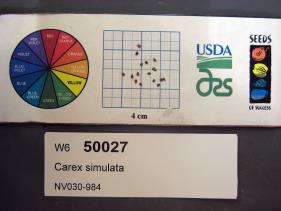 | | 2015 | | | | | | | Wild material | | 1927049 | W6 50027 |
| 53 | W6 50031 | NV030-988 | Carex simulata Mack. | Nevada, United States | W6 |  | | 2015 | | | | | | | Wild material | | 1927052 | W6 50031 |
| 54 | Ames 30681 | JDC/FP/2010/068/338 | Fraxinus pennsylvanica Marshall | Wisconsin, United States | NC7 |  | | 2010 | COLLECTED | 09/28/2010 | East side of Lower Turtle Lake, north of boat ramp on 4th Street, SE 1/4 of NE 1/4 of Section 34, T34N R14W, Almena Quad, east of Turtle Lake, Barron County. | 45.38861000, -92.07153000 | 358 | | Uncertain improvement status | | 1853839 | Ames 30681 |
| 55 | Ames 30148 | JDC/FP/2009/045/195 | Fraxinus pennsylvanica Marshall | Wisconsin, United States | NC7 |  | | 2009 | COLLECTED | 09/23/2009 | South side of Chub Lake, SE 1/4 of NE 1/4 of Section 25, T9N, R13E, Waterloo Quad, Dodge County. | 43.21944444, -88.89388889 | 239 | Crawfish River watershed. Wet, open woodland. | Wild material | | 1819729 | Ames 30148 |
| 56 | Ames 30164 | LQ/PV/2009/004/004 | Prunella vulgaris L. | Wisconsin, United States | NC7 |  | | 2009 | COLLECTED | 09/23/2009 | South side of Chub Lake, SE 1/4 of NE 1/4 of Section 25, T9N, R13E, Waterloo Quad, Dodge County. | 43.21944444, -88.89388889 | 239 | Crawfish River watershed. Wet, open woodland. | Wild material | | 1819745 | Ames 30164 |
| 57 | W6 35266 | NV030-210 | Ericameria nauseosa (Pall. ex Pursh) G. L. Nesom & G. I. Baird subsp. consimilis (Greene) G. L. Nesom & G. I. Baird var. oreophila (A. Nelson) G. L. Nesom & G. I. Baird | Nevada, United States | W6 |  | | 2009 | | | | | | | Wild material | | 1802242 | W6 35266 |
| 58 | W6 35285 | UT931-BEND71 | Schoenoplectus pungens (Vahl) Palla var. longispicatus (Britton) S. G. Sm. | Utah, United States | W6 |  | | 2009 | | | | | | | Wild material | | 1802291 | W6 35285 |
| 59 | W6 35301 | WY030-30 | Leymus cinereus (Scribn. & Merr.) Á. Löve | Wyoming, United States | W6 | 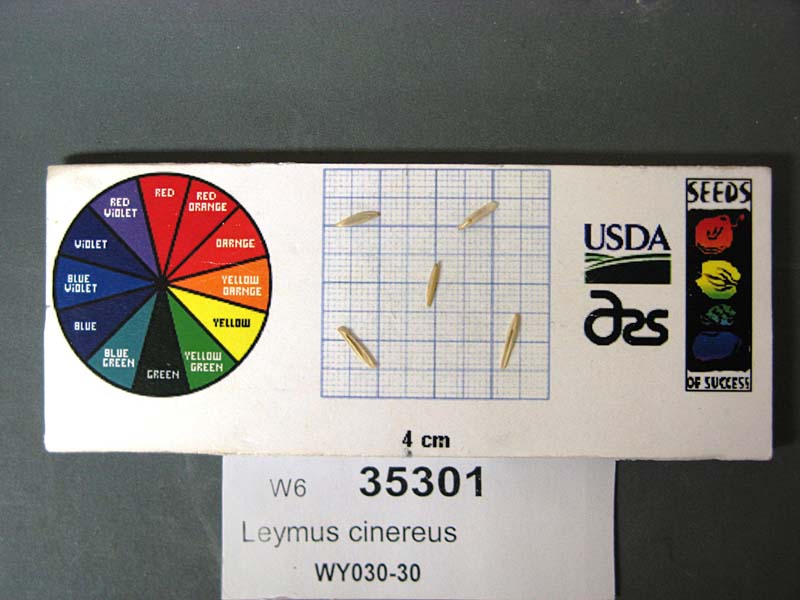 | | 2009 | | | | | | | Wild material | | 1802277 | W6 35301 |
| 60 | WLP 2343 | UT931-119 | Prunus virginiana L. | Utah, United States | NA |  | | 2009 | COLLECTED | 10/15/2008 | U.S. Forest Service land; three-mile-long stretch along White River bottom and side of White River turn off (Reservation Ridge Road, FR81), after right hand fork. | 39.95836000, -111.01903000 | 2337 | Riparian/mountain brush community in mountain river bottom; land used for rangeland, recreation; soil color is white, texture clay. | Wild material | | 1802258 | WLP 2343 |
| 61 | Ames 29938 | 172200 | Shepherdia argentea (Pursh) Nutt. | Utah, United States | NC7 |  | | 2005 | COLLECTED | 07/31/2002 | Colorado Plateau. Garfield County. South side of Highway 12, mile marker 36, next to Henrieville Creek. | 37.60194000, -111.91500000 | 1976 | Wash floodplain. | Wild material | Shrub 1.5-3 meters tall. | 1673919 | Ames 29938 |
| 62 | OPGC 6983 | GSENM-002 | Typha angustifolia L. | Utah, United States | OPGC | 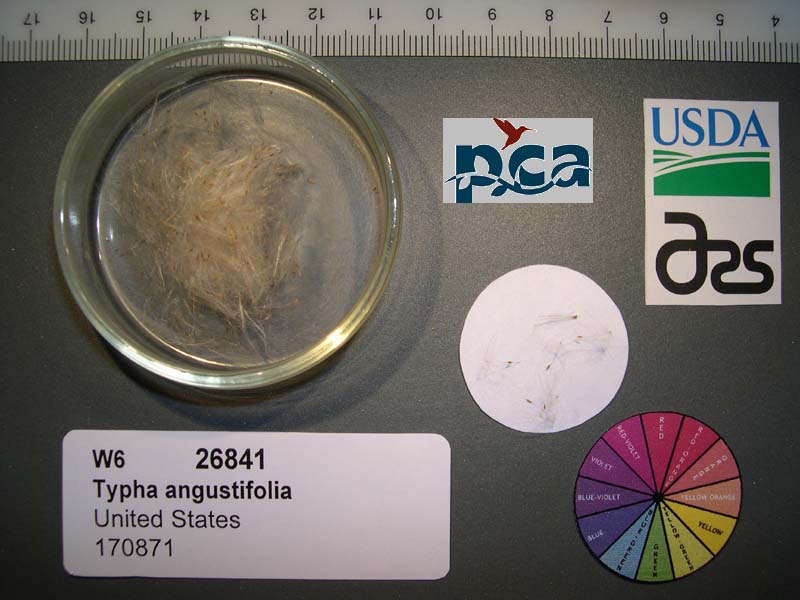 | | 2005 | | | | | | | Wild material | | 1673880 | OPGC 6983 |
| 63 | W6 26848 | GSENM-017 | Schoenoplectus pungens (Vahl) Palla var. longispicatus (Britton) S. G. Sm. | Utah, United States | W6 |  | | 2005 | | | | | | | Wild material | Grasslike 0.3-0.6 meters tall. | 1673887 | W6 26848 |
| 64 | W6 26879 | GSENM-027 | Carex pellita Muhl. ex Willd. | Utah, United States | W6 |  | | 2005 | | | | | | | Wild material | Grasslike .3-.45 meters tall. | 1673918 | W6 26879 |
| 65 | W6 26905 | GSENM-029 | Carex nebrascensis Dewey | Utah, United States | W6 |  | | 2005 | | | | | | | Wild material | Grasslike 0.3-0.6 meters tall. | 1673944 | W6 26905 |
| 66 | W6 26916 | GSENM-040 | Juncus alpinoarticulatus Chaix | Utah, United States | W6 |  | | 2005 | | | | | | | Wild material | Grasslike 0.15-0.3 meters tall. | 1673955 | W6 26916 |