| 0 | PI 710429 | 02L1059 | Solanum lycopersicum L. | Maryland, United States | NE9 | | | 2026 | DEVELOPED | 2002 | Beltsville | | | | Breeding material | Tomato breeding line 02L1059 was developed from an initial cross between the fresh-market tomato cultivar Flora-Dade and Solanum galapagense, accession LA317. The interspecific hybrid was sequentially backcrossed three times to ‘Flora-Dade’ and once to the processing cultivar Spectrum 579. Line 02L1059 is a small-fruited F7 selection from a subsequent backcross to the North Carolina State University cherry tomato breeding line NC 1C. Early generation selections focused on plant habit and fruit carotenoid content, followed by selection in later generations for horticultural quality.
Breeding line 02L1059 produces fruit with high β-carotene content and is intended for use as breeding material in the development of new specialty cherry tomato cultivars. Line 02L1059 was selected for its determinate (sp gene) growth habit and concentrated set of cherry size fruit with high β-carotene content. Plant growth is compact. Fruit of 02L1059 contain two to three locules, ripen uniformly (u gene) and have jointless pedicels (j-2 gene). Fruit shape of 02L1059 is round with average fruit fresh weight of 23.5 ± 0.9 g. High fruit β-carotene content in these breeding lines is attributed to introgression of the dominant Beta (B) gene from the wild tomato species Solanum galapagense, accession LA317. Line 02L1059 is homozygous BB MoB MoB, and hence fruit accumulate predominantly β-carotene and are orange- pigmented. Fruit β-carotene content averaged 41.8 μg·g–1 tissue fresh weight (94.6% of total colored carotenoids). Average fruit soluble solids content of 7.5% and titratable acidity of 0.41% citric acid equivalents were observed. Line 02L1059 had total fruit sugar content of 36.6 mg·g–1 fresh tissue weight. | 2197529 | PI 710429 |
| 1 | PI 710430 | 97L97 | Solanum lycopersicum L. | Maryland, United States | NE9 | | | 2026 | DEVELOPED | 1997 | Beltsville | | | | Breeding material | USDA breeding line 97L97 is derived from an initial interspecific cross between Solanum lycopersicum cv. Floradade and the wild tomato relative S. galapagense, accession LA317. Line 97L97 is a bulk of selected plants in the F5 generation of the second backcross to the processing type tomato cultivar Ohio 8245.
USDA breeding line 97L97 has a compact, determinate (sp gene) growth habit with concentrated fruit set. Plants are adapted for production in the Eastern and Midwestern United States and have good canopy cover. Line 97L97 exhibited semideterminate growth habit under California growing conditions. Solanum galapagense, accession LA317, was the donor parent for the dominant Beta (B) gene which conditions accumulation of high beta-carotene levels relative to other colored carotenoids, namely lycopene, in ripe fruit. Line 97L97 is homozygous BB MoB MoB, resulting in orange-pigmented fruit. Fruit beta-carotene content averaged 55.5 μg·g–1 tissue fresh weight, approximately 16 times the concentration present in the recurrent parent Ohio 8245. Fruit are firm, crack-resistant, pear shaped, have two to three locules, ripen uniformly (u), and have jointed pedicels. Fruit weight of 97L97 averaged 57.7 g, comparable to that of Ohio 8245. Fruit soluble solids content averaged 4.4% for 97L97, similar to that of Ohio 8245. Line 97L97 is best suited for development of cultivars for processing applications, including juice or sauce production. Processed product of high betacarotene-containing tomato fruit may be utilized alone or in blends for juice and sauce production. Ripe fruit may also be utilized for diced product or fresh saladette applications. | 2197532 | PI 710430 |
| 2 | PI 701136 | M-82 | Solanum lycopersicum L. | California, United States | NE9 | 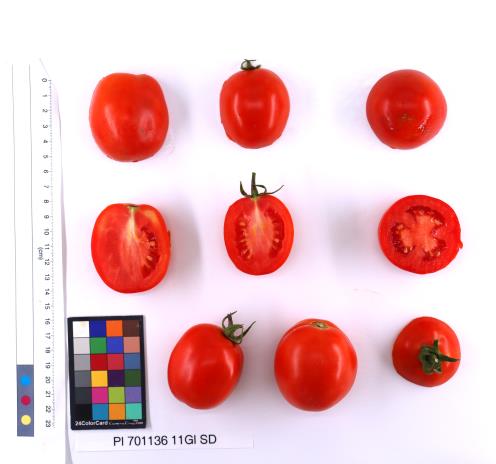 | | 1996 | DONATED | 01/04/1996 | | | | | Cultivar | M-82, l,obv,sp,u,Ve | 1901561 | PI 701136 |
| 3 | PI 586946 | ROD 2571 | Solanum stoloniferum Schltdl. | Jalisco, Mexico | NR6 | | | 1995 | COLLECTED | 08/25/1993 | La Ermita, Municipality of Lagos de Moreno; road from Lagos de Moreno to Leon. | 21.28333333, -101.85000000 | 1940 | Mesquite-grassland. Under Opuntia sp. and Acacia sp. | Wild material | Plants 60cm tall. Corolla rotate-substellate, white. Fruit globose. Seeds and tubers collected. | 1485728 | PI 586946 |
| 4 | PI 586947 | ROD 2558 | Solanum stoloniferum Schltdl. | Querétaro, Mexico | NR6 | | | 1995 | COLLECTED | 08/22/1993 | Highway from Mexico city to Queretaro city, just on the Queretaro-Mexico states border. | 20.28333333, -99.90000000 | 2174 | Mesquite-grassland with Opuntia sp and Acacia sp. | Wild material | Corolla rotate-substellate, white. Fruit globose. Seeds and tubers collected. | 1485729 | PI 586947 |
| 5 | PI 647499 | 'Libohova' | Solanum lycopersicum L. | Albania | NE9 | | | 1994 | COLLECTED | | | | | | Cultivar | lge sp., lgs flat oblate, good flavor | 1102613 | PI 647499 |
| 6 | PI 647500 | 'Saniollas' | Solanum lycopersicum L. | Albania | NE9 | | | 1994 | COLLECTED | | | | | | Cultivar | lge sp. | 1102614 | PI 647500 |
| 7 | PI 595465 | ROD 2529 | Solanum cardiophyllum Lindl. | Puebla, Mexico | NR6 | | | 1993 | COLLECTED | 08/15/1993 | San Antonio del Rio, municipality of San Miguel Ixitlan; on the Huajuanpan de Leon-Tehuacan road. | 18.00000000, -97.70000000 | 1930 | In cornfields, near by a small stream and Taxodium mucronatum and Ipomoea sp. | Wild material | Plants 40 cm tall. Corolla stellate, creamy white. | 1103258 | PI 595465 |
| 8 | PI 595473 | ROD 2548 | Solanum bulbocastanum Dunal | Morelos, Mexico | NR6 | | | 1993 | COLLECTED | 08/20/1993 | La Pera, highway from Mexico city to Cuernavaca. | 19.00000000, -99.15000000 | 2225 | Along the highway and among volcanic rocks with Agave sp. and crasulaceas. | Wild material | Plants 50 cm tall. Corolla stellate, creamy white. | 1103271 | PI 595473 |
| 9 | PI 595478 | ROD 2563 | Solanum ×sambucinum Rydb. | Querétaro, Mexico | NR6 | | | 1993 | COLLECTED | 08/23/1993 | Foot hills of "El Buey" mountains of Queretaro-San Luis Potosi and Mexico city-San Luis Potosi roads junction. | 20.80000000, -100.43333333 | 2050 | Mesquite-grassland with Myrtilocactus sp., Opuntia sp., Acacia sp., and Karwinskia sp. Growing along cornfields. | Wild material | Collected wild species accession which resists botanical seed increase. Corolla stellate, white. | 1103277 | PI 595478 |
| 10 | PI 561626 | SCLp 5005 | Solanum colombianum Dunal | Pichincha, Ecuador | NR6 | | | 1991 | COLLECTED | 04/18/1991 | Nevado Cayambe. Canton Pedro Maoncayo, 4.1 km west of guardhouse at south end of Laguna San Marcos. | 0.11666667, -77.96666667 | 3680 | In mucky soil, on steep bank growing among Rumex sp. and Stipa sp. | Wild material | In mucky soil, on steep bank growing among Rumex sp. and Stipa sp. Corolla white, slightly tinged with blue. Leaves with 2-3 laterals. Some leaves with interjected leaflets, some without. Leaves shiny. | 1456598 | PI 561626 |
| 11 | PI 545884 | HAO 22 | Solanum microdontum Bitter | Cochabamba, Bolivia | NR6 |  | | 1986 | COLLECTED | 03/05/1986 | Prov. Carrasco. 23 km from turn-off from the Cochabamba-Santa Cruz road. l km out of the upper side of Pocona on the road to Huallapampa. Along the oil pipeline. On Felix Zuaznava's (sp.?) property. | -17.66666667, -65.30000000 | 2740 | Among stones of a stone wall around a farmyard. | Wild material | | 1440820 | PI 545884 |
| 12 | PI 545902 | HAO 23 | Solanum microdontum Bitter | Cochabamba, Bolivia | NR6 |  | | 1986 | COLLECTED | 03/05/1986 | Prov. Carrasco. 23 km from turn-off from the Cochabamba-Santa Cruz road. 1 km out of the upper side of Pocona on the road to Huallapampa. Along the oil pipeline. On Felix Zuaznava (sp.?) property. | -17.66666667, -65.30000000 | 2740 | In shade of dense bushes and trees by stone wall surrounding a farmyard. | Wild material | | 1440838 | PI 545902 |
| 13 | PI 435949 | Cross 1027/5 | Solanum lycopersicum L. | Former, Soviet Union | NE9 |  | | 1979 | DONATED | 10/01/1979 | | | | | Cultivated material | Genetic lines presented by R. Hardin, Geary, Okla. Component of PI 19952 from Afghanistan. Vigorous, large, herbaceous legume; leaves pinnately compound. Annual outdoors io Cross, but perennial indoors. Pedicels jointless; fruit red; genes (j sp u). Fruit type: processing, average fruit size: medium | 1330885 | PI 435949 |
| 14 | PI 370064 | V-671 | Solanum lycopersicum L. | Canada | NE9 | | | 1972 | DONATED | 12/15/1972 | | | | | Uncertain improvement status | Determinate plant supporting heavy crop of red flesh, smooth, globe fruits, 2.5 to 4 cm. in diameter, segregating for green shoulder with moderate concentric slight radial cracking. V-671. Breeding No. G 3-2. | 1277195 | PI 370064 |
| 15 | PI 370066 | V-673 | Solanum lycopersicum L. | Canada | NE9 | | | 1972 | DONATED | 12/15/1972 | | | | | Uncertain improvement status | Determinate vine, heavy crop of 2.5 to 4 cm., smooth globe, red flesh, green shoulder with slight cracking. V-673. Breeding No. I 14-2. | 1277197 | PI 370066 |
| 16 | PI 370067 | V-674 | Solanum lycopersicum L. | Canada | NE9 | | | 1972 | DONATED | 12/15/1972 | | | | | Uncertain improvement status | Determinate vine, good crop, 2.5 to 3 cm.,globe, red fruit, green shoulder, slight cracking, 2 locules. V-674. Breeding No. I 14-5. | 1277198 | PI 370067 |
| 17 | PI 370068 | V-675 | Solanum lycopersicum L. | Canada | NE9 | | | 1972 | DONATED | 12/15/1972 | | | | | Uncertain improvement status | Indeterminate vine with heavy crop of red flesh, medium size, 2.5 to 4cm., ovate, uniform fruits, unripe fruit color. V-675. Breeding No. L 21-4. Early, very firm, crack resistant, easy stemming fruit. | 1277199 | PI 370068 |
| 18 | PI 370069 | V-676 | Solanum lycopersicum L. | Canada | NE9 | | | 1972 | DONATED | 12/15/1972 | | | | | Uncertain improvement status | Indeterminate vine with heavy crop of red fleshed, medium-sized, 2.5 to 3cm., uniform unripe fruit color, early maturing fruit. V-676. Bredding No. L 40-1A. Early ,firm, crack resistant, thick walled fruit. | 1277200 | PI 370069 |
| 19 | PI 370070 | V-679 | Solanum lycopersicum L. | Canada | NE9 | | | 1972 | DONATED | 12/15/1972 | | | | | Uncertain improvement status | Medium size, indterminate vine with medium heavy crop of early red flesh, uniform, unripe fruit color, 5 to 6.5 cm., globe fruit. V-679. Breeding No. I 63. Early, firm, much cracked fruit. | 1277201 | PI 370070 |
| 20 | PI 370071 | V-6710 | Solanum lycopersicum L. | Canada | NE9 | | | 1972 | DONATED | 12/15/1972 | | | | | Uncertain improvement status | Medium sized, indeterminate vine with medium set red flesh, green shoulder, 5 to 6.5 cm., ovate fruit. V-6710. Breeding No. L 28-2. Medium early, large egg-shaped, excellent color, good internal structure, rather soft, some split fruit. | 1277202 | PI 370071 |
| 21 | PI 370073 | V-6716 | Solanum lycopersicum L. | Canada | NE9 | | | 1972 | DONATED | 12/15/1972 | | | | | Uncertain improvement status | Medium sized indterminate vine with light set of 4 to 6.5 cm, red flesh, green shouldered, globe fruits. V-6716. Breeding No. H 4-43. Vitamin C 78. Midseason, firm, fairly smooth, severe cracking. | 1277204 | PI 370073 |
| 22 | PI 370074 | V-6719 | Solanum lycopersicum L. | Canada | NE9 | | | 1972 | DONATED | 12/15/1972 | | | | | Uncertain improvement status | Medium sized indeterminate vine with medium set of red flesh, uniform unripe fruit color, 4 to 6 cm., globe fruits with slight fasciation. V-6719. Breeding No. J 3-6B. Midseason, Vitamin C 48. Smooth, cracked fruit. | 1277205 | PI 370074 |
| 23 | PI 370076 | V-6722 | Solanum lycopersicum L. | Canada | NE9 | | | 1972 | DONATED | 12/15/1972 | | | | | Uncertain improvement status | Medium large indeterminate vine with medium set of red flesh, uniform unripe fruit color, 2.3 cm., globe fruits crackless and smooth. V-6722. Breeding No. K 22-7. Late midseason. Vitamin C 80. Smooth, firm fruit. | 1277207 | PI 370076 |
| 24 | PI 370077 | V-6725 | Solanum lycopersicum L. | Canada | NE9 | | | 1972 | DONATED | 12/15/1972 | | | | | Uncertain improvement status | Medium large indeterminate vine with light medium set of red flesh, green shoulder, 5 to 6.5 cm., oblate fruits. V-6725. Breeding No. N 47-2. Midseason, smooth, fairly firm fruit with cracks. Vitamin C 55. | 1277208 | PI 370077 |
| 25 | PI 370078 | V-6726 | Solanum lycopersicum L. | Canada | NE9 | | | 1972 | DONATED | 12/15/1972 | | | | | Uncertain improvement status | Small medium indeterminate vine with medium set of red flesh, green shoulder, 2 to 2.5 cm., globe fruits, smooth and no cracks. V-6726. Breeding No. M 48-2. Early, firm fruit, Vitamin C 78. | 1277209 | PI 370078 |
| 26 | PI 370079 | V-6727 | Solanum lycopersicum L. | Canada | NE9 | | | 1972 | DONATED | 12/15/1972 | | | | | Uncertain improvement status | Medium sized indeterminate vine with medium set, red flesh, green shoulder, 5 to 7.5 cm., globe and ovate fruits, slight cracking, but no fasciation. V-6727. Breeding No. M 67-2. Midseason, smooth, fairly firm fruit. Vitamin C 54. | 1277210 | PI 370079 |
| 27 | PI 370088 | 'Farthest North' | Solanum lycopersicum L. | Canada | NE9 | | | 1972 | DONATED | 12/15/1972 | | | | | Uncertain improvement status | Small determinate vine with early, heavy set, red flesh, green shoulder, 1 to 2 cm., globe fruits with concentric cracks. sp. Determinate growth habit, very early. | 1277219 | PI 370088 |
| 28 | PI 370089 | Rideau | Solanum lycopersicum L. | Canada | NE9 |  | | 1972 | DONATED | 12/15/1972 | | | | | Uncertain improvement status | Small medium indeterminate vine with heavy set of red flesh, uniform unripe fruit color, 4 to 7.5 cm., globe, fruit smooth, and slight cracks. u, sp. Early. | 1277220 | PI 370089 |
| 29 | PI 370090 | New Hampshire No. 50 | Solanum lycopersicum L. | Canada | NE9 | | | 1972 | DONATED | 12/15/1972 | | | | | Uncertain improvement status | Medium indeterminate vine with medium heavy set, red flesh, uniform unripe fruit color, 4 to 5cm., globe with 3 locules. u, sp. Early, high ascorbic acid. | 1277221 | PI 370090 |
| 30 | PI 370129 | V-6724 | Solanum lycopersicum L. | Canada | NE9 | | | 1971 | DONATED | 12/15/1971 | | | | | Uncertain improvement status | Medium large indeterminate vine with medium set of red flesh, green shoulder, 5 to 6.5 cm., globe with slight cracking and no fasciation. V-6724. Breeding No. K 27-6. Late midseason, smooth, firm, fruit. Vitamin C 54. | 1277226 | PI 370129 |
| 31 | PI 316636 | L.826 | Solanum lycopersicum L. | Poland | NE9 |  | | 1966 | DONATED | 09/22/1966 | | | | | Uncertain improvement status | Bm/Bm,sp/sp,u/u. High in beta carotene. | 1235969 | PI 316636 |
| 32 | PI 303715 | Cluster Mato | Solanum lycopersicum L. | United States | NE9 |  | | 1965 | COLLECTED | | From Gleckler Seed, Metamora, Ohio. | | | | Uncertain improvement status | Genetic lines presented by A. Hardin, Geary, Okla. Component of PI 99952 from Afghanistan. Vigorous, large, herbaceous legume; leaves pinnately compound. Annual outdoors at Cluster Mato, but perennial indoors. Pedicels jointless; fruit red; genes (j sp u). Fruit type: fresh market, average fruit size: small. | 1227994 | PI 303715 |
| 33 | PI 296364 | No. 33 | Solanum lycopersicum L. | United States | NE9 | | | 1964 | DONATED | 03/23/1964 | | | | | Uncertain improvement status | Genetic lines presented by M. Hardin, Geary, Okla. Component of PI 239952 from Afghanistan. Vigorous, large, herbaceous legume; leaves pinnately compound. Annual outdoors at Ames, but perennial indoors. Pedicels jointless; fruit red; genes (d sp j). | 1224331 | PI 296364 |
| 34 | PI 296365 | No. 34 | Solanum lycopersicum L. | United States | NE9 | | | 1964 | DONATED | 03/23/1964 | | | | | Uncertain improvement status | Genetic lines presented by M. Hardin, Geary, Okla. Component of PI 239952 from Afghanistan. Vigorous, large, herbaceous legume; leaves pinnately compound. Annual outdoors at Ames, but perennial indoors. Pedicels jointless; fruit red; genes (j sp u). Fruit type: fresh market, average fruit size: small | 1224332 | PI 296365 |
| 35 | PI 296366 | No. 35 | Solanum lycopersicum L. | United States | NE9 | | | 1964 | DONATED | 03/23/1964 | | | | | Uncertain improvement status | Genetic lines presented by M. Hardin, Geary, Okla. Component of PI 239952 from Afghanistan. Vigorous, large, herbaceous legume; leaves pinnately compound. Annual outdoors at Ames, but perennial indoors. Pedicel jointless; wind resistant, tree; genes ( d j sp t). | 1224333 | PI 296366 |
| 36 | PI 296367 | Dura Red | Solanum lycopersicum L. | United States | NE9 | | | 1964 | DONATED | 03/23/1964 | | | | | Uncertain improvement status | Genetic lines presented by M. Hardin, Geary, Okla. Component of PI 239952 from Afghanistan. Vigorous, large, herbaceous legume; leaves pinnately compound. Annual outdoors at Ames, but perennial indoors. Fruit heart shaped; genes ( d sp c U). | 1224334 | PI 296367 |
| 37 | PI 296368 | MXD-2 | Solanum lycopersicum L. | United States | NE9 | | | 1964 | DONATED | 03/23/1964 | | | | | Uncertain improvement status | Genetic lines presented by M. Hardin, Geary, Okla. Component of PI 239952 from Afghanistan. Vigorous, large, herbaceous legume; leaves pinnately compound. Annual outdoors at Ames, but perennial indoors. Ovared; genes (d sp u). Fruit type: processing, average fruit size: medium | 1224335 | PI 296368 |
| 38 | PI 296369 | Low Bush | Solanum lycopersicum L. | United States | NE9 | | | 1964 | DONATED | 03/23/1964 | | | | | Uncertain improvement status | Genetic lines presented by M. Hardin, Geary, Okla. Component of PI 239952 from Afghanistan. Vigorous, large, herbaceous legume; leaves pinnately compound. Annual outdoors at Ames, but perennial indoors. Plant low bush; fruit red; genes (sp u). | 1224336 | PI 296369 |
| 39 | PI 296370 | 'Summer Bearing' | Solanum lycopersicum L. | United States | NE9 | | | 1964 | DONATED | 03/23/1964 | | | | | Uncertain improvement status | Genetic lines presented by M. Hardin, Geary, Okla. Component of PI 239952 from Afghanistan. Vigorous, large, herbaceous legume; leaves pinnately compound. Annual outdoors at Ames, but perennial indoors. Plant summer bearing; fruit pink; genes (Sp U). | 1224337 | PI 296370 |
| 40 | PI 294638 | 'Devon Surprise' | Solanum lycopersicum L. | United Kingdom | NE9 |  | | 1964 | DONATED | 01/14/1964 | | | | | Uncertain improvement status | Genetic lines presented by U. Hardin, Geary, Okla. Component of PI 149952 from Afghanistan. Vigorous, large, herbaceous legume; leaves pinnately compound. Annual outdoors Devon Surprise, but perennial indoors. Pedicels jointless; fruit red; genes (j sp u). Fruit type: fresh market, average fruit size: small | 1222983 | PI 294638 |
| 41 | PI 294439 | 544 | Solanum lycopersicum L. | Israel | NE9 |  | | 1964 | DONATED | 01/02/1964 | | | | | Uncertain improvement status | Bushy, determinate type, sp, d.u. | 1222834 | PI 294439 |
| 42 | PI 294440 | 553 | Solanum lycopersicum L. | Israel | NE9 | _thumbnail.jpg "Click for 2 image(s) for this accession.") | | 1964 | DONATED | 01/02/1964 | | | | | Uncertain improvement status | Bushy, indeterminate type, sp+, d,u+, F7. | 1222835 | PI 294440 |
| 43 | PI 289763 | 'Pinkdeal' | Solanum lycopersicum L. | United States | NE9 |  | | 1963 | DONATED | 05/05/1963 | | | | | Uncertain improvement status | Has genes R, cr. Y, A, C, D, Sp, lc, S, and ug. | 1219332 | PI 289763 |
| 44 | W6 62661 | CA180A-7 | Solanum americanum Mill. | California, United States | W6 |  | | 2025 | | | | | | | Wild material | Flower white with yellow anthers & style, style 2.5-4mm, leaving some room for S. nigrum ID instead - key characters were mixed. Site: Steep hillside with stinging nettle present (berm or bank in low area). Leaves being eaten by insects; plants occasionally browsed by cows or other animals. Average 64 fruit per plant, avg 40 seeds per fruit, 80% viability. | 2192879 | W6 62661 |
| 45 | PI 702699 | NM080-227 | Chloris cucullata Bisch. | New Mexico, United States | S9 | | | 2020 | | | | | | | Wild material | SOS 92nd Shipment | 2104994 | PI 702699 |
| 46 | PI 686961 | ky y' | Capsicum baccatum L. var. baccatum | Paraguarí, Paraguay | S9 | | | 1998 | COLLECTED | 05/09/1998 | Calistro, Compania Canete Cue, Carapegua Calistro, 2,000 m from Cerro Acahay. | -25.84500000, -57.19666667 | 180 | Hill, wooded, burned grassland. Slope 15 deg., slope aspect N. Soil drainage moderate, soil fine sand, acidic, light brown, medium stoniness. Dominant plant species: Solanum granulosum leprosum, Trichilia, Acacia sp. | Wild material | Plants erect, 80-100 cm tall, branches in zig zag. Flowers white with yellowish spots at the base of the petals. Fruits erect, 0.8 to 1.0 cm long and 0.5 cm wide, blackish green before maturity and shiny red at maturity. Leaves 2 cm by 2.5 cm toward the base with acuminate apex, light green, pilose. Leaves very small. Infested with galls. No other populations could be found in the adjacent areas. | 1559207 | PI 686961 |
| 47 | PI 631909 | CTM 12 | Medicago ruthenica (L.) Trautv. | Nei Mongol Zizhiqu, China | W6 | | | 1992 | COLLECTED | 08/23/1991 | Rolling dunes and hills. Sand, few stones, good drainage, pH 6.8. Full sun to par. shade, 15 deg. slope, 194 deg. aspect. Shiao Qing Valley, nr elm grove, many shrubs, sparse under veg., many open spaces. 30% ground cover. 80km S of Tonglia | 42.91666667, 122.33333333 | 183 | | Wild material | Roots demonstrate characteristic darkening of the stele indicating crown and root rot. Plants most likely quite old. Associated with Filifolium sibericum, Artemisia sp., Rubus sp., Setaria sp., Agrostis sp., Stipa sp., Agropyron cristatum, Solanum sp. 2 M. ruthenica/m | 1050621 | PI 631909 |
| 48 | PI 691230 | 'Shoghori 1' | Pyrus pyrifolia (Burm. f.) Nakai | Pakistan | COR | | | 1988 | COLLECTED | | Gilgit district, Gulmit (Hunza) village/town, On farm of Abdullah in Dar Ghulam section of Gulmit | 36.40000000, 74.86667000 | 2523 | drained, assocated vegetation Malus sp., Solanum tuberosum, drained, assocated vegetation Malus sp., Solanum tuberosum, Prunus Armeniaca | Cultivar | Pyrus sp. 'Shoghori I'. The name refers to its origin in the village of Shoghor in Chitral. Scions collected from cultivated tree by M. Thompson and D. Brenner on 4 November, 1988 in Pakistan (Northern Areas, Gilgit District) on the farm of Abdullah in Dar Ghulam section of Gulmit. Farm is in a river valley at 2523 m elevation; Latitude 36 24' N, Longitude 74 52' E. Collectors note 'This is the best pear in Pakistan! Leaves and fruit are typical Pyrus pyrifolia. Fruit is pyriform, medium-large size, firm, crisp, sweet and juicy; very long storage (several months). May be good enough for direct use (in U.S.), stone cells fairly prominent, but overall quality may compensate for this weakness. May be same as Shorhori II.' - Collection notebook, 1988. | 1094814 | PI 691230 |
| 49 | W6 62564 RE | NM080-392 | Bouteloua curtipendula (Michx.) Torr. | New Mexico, United States | W6 |  | | 2025 | | | | | | | Wild material | RECOLLECTION of NM080-11: A perennial grass which may be cespitose or not and may or may not be rhizomatous. Leaf blades are 2 to 30 cm long and 2.5 to 7 mm wide, and scabrous towards the center of the blade axis, while smooth on the far edges. Ligules are membranous, ciliate, and 0.3 to 0.5 mm long. Panicles may be 13 to 30 cm long, with short, hanging branches. Each panicle had 30 to 80 branches, each 10 to 30 mm long, with 2 to 7 spikelets. | 2192262 | W6 62564 RE |
| 50 | W6 62565 | NM080-407 | Verbesina encelioides (Cav.) Benth. & Hook. f. ex A. Gray | New Mexico, United States | W6 |  | | 2025 | | | | | | | Wild material | Annual sunflower-like forb, 20-100 cm tall and branched throughout when well developed. Flowers are showy, yellow (rays and center), and on peduncles up to 10 cm long; involucres hemispheric to nearly flat with bracts (phyllaries) 12-18 in 2-3 series, narrow, and outer phyllary rows longer than inner rows. Leaves can be basally opposite, but alternate along the stem. Leaves are a distinct gray-green, with the underside being more hairy than the upper. | 2192263 | W6 62565 |
| 51 | NA 89114 | TLM25-03 | Zanthoxylum clava-herculis L. | Texas, United States | NA | | | 2025 | COLLECTED | 07/09/2025 | Jackson County Road 113, Bergston Road, approximately 2.1 kilometers north of the junction with Jackson County Road 234; growing on the west side of the road along a fenceline running parallel to the road. | 29.00576600, -96.76298500 | 24 | Plants are growing in full sun to light shade along a fence line near where cattle graze and the dirt road. The area is disturbed, but somewhat overgrown since there is very little traffic on the road that is primarily used by farmers and ranchers to access their fields. Slope: 0 to 1 percent. Aspect: N/A. Soils: The soils of this area sampled are classified as Laewest clay, 0 to 1 percent slopes (LaA). The Laewest Series consists of very deep, moderately well drained soils that formed in clayey flood basin deposits on alluvial plains or deltas of the Beaumont Formation of Pleistocene Age. These nearly level to gently sloping soils are on broad flat coastal plains. Slope ranges from 0 to 8 percent. The solum thickness is more than 200 cm and ranges from slightly acidic on the surface to neutral in deeper pedons. This is a cyclic soil and undisturbed areas have gilgai microrelief with microhighs 15 to 30 cm higher than microlows. Distance from the center of the microhighs to the center of the microlows ranges from about 1.2 to 4.9 m. The microhigh makes up about 20 percent, the intermediate, or area between the knoll and depression about 50 percent, and the microlow about 30 percent. The amplitude of waviness between mollic colored materials in the upper part of the solum and the higher value colors in the lower part ranges from about 30 to 150 cm. When dry, the soil has cracks 1 to 5 cm wide at the surface and commonly 1 cm wide cracks extend to a depth of 1.2 m during the summer. The cracks remain open for less than 90 cumulative days in most years. Some pedons have an overwash of calcareous clay or silty clay 20 to 51 cm thick. (Source: California Soil Resource Lab/NRCS Official Soil Series Descriptions). Geology: The underlying geology of this area is Lizzie Formation of Quaternary, Middle Pleistocene age. It is comprised of sand, silt, clay, and minor amount of gravel. Iron oxide and iron-manganese nodules are common in zones of weathering; locally calcareous. Surface is fairly flat and featureless except for many shallow depressions and pimple mounds. Moore and Wermund (1993a) mapped three units--(1) alluvium undifferentiated as to texture and origin--includes meander belt, levee, crevasse splay, and distributary sand, and flood-basin mud deposits, about 60 m thick, (2) fine-grained channel facies (alluvial sand, silt, and clay) about 10-25 m thick, thicker seaward, and (3) fine-grained overbank facies (alluvial silt and clay) about 55-65 m thick, thicker seaward. Together, these deposits form a deltaic plain that parallels the Gulf Coast. Unit contains Pleistocene vertebrate fauna, dips seaward beneath the Beaumont Fm. and disconformably overlies deposits of the Pliocene and early Pleistocene Willis Formation. The deltaic plain is entrenched as much as 7 m by streams. In Hidalgo County (southernmost part of Texas) the unit underlies a semiarid plain, widely irrigated and cultivated. Unit is locally veneered with thin, discontinuous stabilized eolian sand. (Source: USGS Texas Geologic Map Data). | Wild material | | 2191653 | NA 89114 |
| 52 | NA 89194 | DLSP-WB | Hamamelis virginiana L. | Wisconsin, United States | NA | | | 2025 | COLLECTED | 08/21/2024 | Devil's Lake State Park: West Bluff. | 43.41418510, -89.73993600 | 332 | Shade to part shade/sun to full sun in thin layer of clayey organic matter on boulder field. Slope: 60 degrees. Aspect: East. Red oak-sugar maple-linden vegetative community. | Wild material | | 2171015 | NA 89194 |
| 53 | W6 61479 | CA160-65 | Dudleya cespitosa (Haw.) Britton & Rose | California, United States | W6 |  | | 2024 | | | | | | | | | 2167578 | W6 61479 |
| 54 | W6 61481 | CA160-67 | Helianthus annuus L. | California, United States | W6 |  | | 2024 | | | | | | | | | 2167580 | W6 61481 |
| 55 | W6 61211 | NM930-541 | Sporobolus contractus Hitchc. | New Mexico, United States | W6 |  | | 2023 | | | | | | | Wild material | Yellow bunch grass, tall slender stalks, branches are parallel/pressed close to the rachis. Seeds are very small, light colored with red/brown spot. Stalks are green when flowering. | 2142166 | W6 61211 |
| 56 | W6 61387 | CBG- 10812 | Chamaecrista fasciculata (Michx.) Greene | Illinois, United States | W6 |  | | 2023 | | | | | | | Wild material | | 2142269 | W6 61387 |
| 57 | NA 89037 | RJL2022KS-004 | Fraxinus pennsylvanica Marshall | Kansas, United States | NA |  for this accession.") | | 2022 | COLLECTED | 09/21/2022 | Coronado Heights Park, Smoky View, Kansas hillsides surrounding the historic WPA circa 1932 Coronado Heights Castle located about 91 meters above the surrounding land. This plant is scattered and infrequent on the slopes of this site. | 38.61065700, -97.70408300 | 448 | Plants growing in full sun, under extreme exposure, rocky, dry and thin soils of this short grass prairie habitat on the slopes surrounding the summit of Coronado Heights Park. Plants tend
Soils: The underlying geology of this area is of Upper Cretaceous origin and comprised of Kiowa Shale or FM- light -gray to black illitic shale with thin coquinoidal limestone beds at the base; sandstone lenses are common. Cheyenne Sandstone-massive to cross-bedded, light-gray to buff fine-grained sandstone with lenses to be found in runoff zones where moisture is temporarily more abundant.of gray sandy shale and conglomerate.
Source: USGS Kansas Geologic Map Data (https://mrdata.usgs.gov/geology/state/sgmc-unit.php?unit=KSKkc%3B0)
The surface soil profile of this area is Lancaster-Hedville complex, 3 to 20 percent slopes. The Lancaster series consists of moderately deep, well drained soils that formed in residuum from sandstone and sandy shales; it can be up to 200 cm deep. Slopes range from 1-20%. Hedville soils have bedrock within 50 centimeters of the surface and occur on similar hillslope positions.
Source: NRCS Web Soil Survey (https://websoilsurvey.sc.egov.usda.gov/App/WebSoilSurvey.aspx) | Wild material | | 2139602 | NA 89037 |
| 58 | NA 89036 | RJL2022KS-003 | Cornus drummondii C. A. Mey. | Kansas, United States | NA | | | 2022 | COLLECTED | 09/21/2022 | Coronado Heights Park, Smoky View, Kansas hillsides surrounding the historic WPA circa 1932 Coronado Heights Castle located about 91 meters above the surrounding land. This plant is common and abundant on the slopes of this site. | 38.61348400, -97.70343100 | 475 | Plants growing in part shade to full sun, under extreme exposure, rocky, dry and thin soils of this short grass prairie habitat on the slopes surrounding the summit of Coronado Heights Park. The underlying geology of this area is of Upper Cretaceous origin and comprised of Kiowa Shale or FM- light -gray to black illitic shale with thin coquinoidal limestone beds at the base; sandstone lenses are common. Cheyenne Sandstone-massive to cross-bedded, light-gray to buff fine-grained sandstone with lenses of gray sandy shale and conglomerate.
Source: USGS Kansas Geologic Map Data (https://mrdata.usgs.gov/geology/state/sgmc-unit.php?unit=KSKkc%3B0)
The surface soil profile of this area is Lancaster-Hedville complex, 3 to 20 percent slopes. The Lancaster series consists of moderately deep, well drained soils that formed in residuum from sandstone and sandy shales; it can be up to 200 cm deep. Slopes range from 1-20%. Hedville soils have bedrock within 50 centimeters of the surface and occur on similar hillslope positions.
Source: NRCS Web Soil Survey (https://websoilsurvey.sc.egov.usda.gov/App/WebSoilSurvey.aspx)
Slope: 5-20% Aspect: all | Wild material | | 2139601 | NA 89036 |
| 59 | NA 89035 | RJL2022KS-002 | Rosa arkansana Porter | Kansas, United States | NA | | | 2022 | COLLECTED | 09/20/2022 | Coronado Heights Park, Smoky View, Kansas hillsides surrounding the historic WPA circa 1932 Coronado Heights Castle located about 91 meters above the surrounding land. This plant is quite abundant on the slopes of this site and highly competitive. | 38.61158800, -97.70427000 | 475 | Plants growing in part-sun to full sun, under extreme exposure, rocky, dry and thin soils of this short grass prairie habitat on the slopes surrounding the summit of Coronado Heights Park.
The underlying geology of this area is of Upper Cretaceous origin and comprised of Kiowa Shale or FM- light -gray to black illitic shale with thin coquinoidal limestone beds at the base; sandstone lenses are common. Cheyenne Sandstone-massive to cross-bedded, light-gray to buff fine-grained sandstone with lenses of gray sandy shale and conglomerate.
Source: USGS Kansas Geologic Map Data (https://mrdata.usgs.gov/geology/state/sgmc-unit.php?unit=KSKkc%3B0)
The surface soil profile of this area is Lancaster-Hedville complex, 3 to 20 percent slopes. The Lancaster series consists of moderately deep, well drained soils that formed in residuum from sandstone and sandy shales; it can be up to 200 cm deep. Slopes range from 1-20%. Hedville soils have bedrock within 50 centimeters of the surface and occur on similar hillslope positions.
Source: NRCS Web Soil Survey (https://websoilsurvey.sc.egov.usda.gov/App/WebSoilSurvey.aspx) | Wild material | | 2139600 | NA 89035 |
| 60 | NA 89034 | RJL2022KS-001 | Baptisia australis (L.) R. Br. var. minor (Lehm.) Fernald | Kansas, United States | NA | | | 2022 | COLLECTED | 09/20/2022 | Coronado Heights Park, Smoky View, Kansas hillsides surrounding the historic WPA circa 1932 Coronado Heights Castle located about 91 meters above the surrounding land. This plant is sporadic to common on the slopes of this site. | 38.61349700, -97.70303900 | 487 | This plant is sporadic to common on the slopes of this site.
Habitat Notes: Plants growing in full sun, under extreme exposure, rocky, dry and thin soils of this short grass prairie habitat on the slopes surrounding the summit of Coronado Heights Park.
The underlying geology of this area is of Upper Cretaceous origin and comprised of Kiowa Shale or FM- light -gray to black illitic shale with thin coquinoidal limestone beds at the base; sandstone lenses are common. Cheyenne Sandstone-massive to cross-bedded, light-gray to buff fine-grained sandstone with lenses of gray sandy shale and conglomerate.
Source: USGS Kansas Geologic Map Data (https://mrdata.usgs.gov/geology/state/sgmc-unit.php?unit=KSKkc%3B0)
The surface soil profile of this area is Lancaster-Hedville complex, 3 to 20 percent slopes. The Lancaster series consists of moderately deep, well drained soils that formed in residuum from sandstone and sandy shales; it can be up to 200 cm deep. Slopes range from 1-20%. Hedville soils have bedrock within 50 centimeters of the surface and occur on similar hillslope positions.
Source: NRCS Web Soil Survey (https://websoilsurvey.sc.egov.usda.gov/App/WebSoilSurvey.aspx) | Wild material | received as Baptisia minor | 2139599 | NA 89034 |
| 61 | W6 60364 | NM080-296 | Sartwellia flaveriae A. Gray | New Mexico, United States | W6 |  | | 2022 | | | | | | | Wild material | Perennial herb with erect stems, branching from near the base. Leaves opposite and linear, surfaces glabrous. Flowerheads yellow and radiate, clustered and tight, flat-topped panicles. | 2138302 | W6 60364 |
| 62 | W6 60090 | MARSB-410 | Tridens flavus (L.) Hitchc. | New York, United States | W6 | | | 2021 | | | | | | | Wild material | | 2137175 | W6 60090 |
| 63 | OPGC 8391 | NM080-267 | Ratibida columnifera (Nutt.) Wooton & Standl. | New Mexico, United States | OPGC | | | 2021 | | | | | | | Wild material | Alternately arranged, deeply dissected foliage (pinnatifid), terminal inflorescence both ray and disc flowers developing seed in cone shape, conspicuous sepals, many inflorescences/ plant | 2120643 | OPGC 8391 |
| 64 | OPGC 8394 | NM080-272 | Ratibida columnifera (Nutt.) Wooton & Standl. | New Mexico, United States | OPGC | | | 2021 | | | | | | | Wild material | Inflorescence columniferous 1/2-1 inch, composite flower with yellow/maroon ray flowers | 2120648 | OPGC 8394 |
| 65 | W6 59469 | NM080-260 | Physaria fendleri (A. Gray) OʼKane & Al-Shehbaz | New Mexico, United States | W6 | | | 2021 | | | | | | | Wild material | 4 petaled yellow flower, clustered inflorescence stems with younger flowers at top, to older flowers/seed pods lower. | 2120636 | W6 59469 |
| 66 | W6 59491 | NM080-282 | Sartwellia flaveriae A. Gray | New Mexico, United States | W6 | | | 2021 | | | | | | | Wild material | Yellow aster, similar in appearance to snakeweed with small flower heads. Stems turning red or yellow at maturity. Foliage threadlike and 1-2 inches long. | 2120658 | W6 59491 |
| 67 | W6 59494 | NM080-285 | Sartwellia flaveriae A. Gray | New Mexico, United States | W6 | | | 2021 | | | | | | | Wild material | Yellow aster, similar in appearance to snakeweed with small flower heads. Stems turning red or yellow at maturity. Foliage threadlike and 1-2 inches long. | 2120661 | W6 59494 |
| 68 | WLP 3443 | NM080-279 | Chilopsis linearis (Cav.) Sweet | New Mexico, United States | NA | | | 2021 | | | | | | | Wild material | Shrubby tree with opposite, linear leaves and pink flowers, occasionally with white stripes, classic of Bignoniaceae, bearing a yellow throat, borne in a terminal raceme | 2120655 | WLP 3443 |
| 69 | OPGC 8024 | CA930A-779 | Eriastrum signatum D. Gowen | California, United States | OPGC | | | 2020 | | | | | | | Wild material | | 2106518 | OPGC 8024 |
| 70 | OPGC 8009 | NM080-226 | Ratibida columnifera (Nutt.) Wooton & Standl. | New Mexico, United States | OPGC | 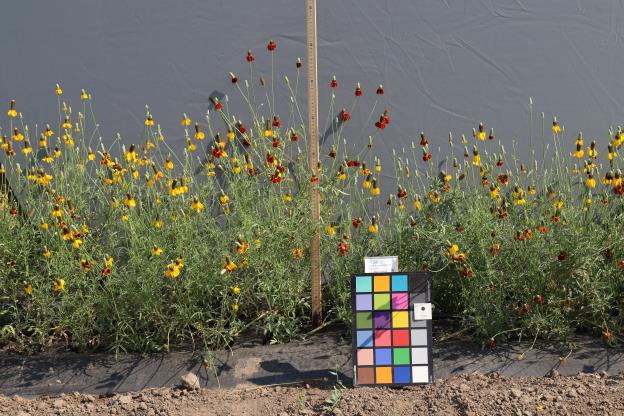 | | 2020 | | | | | | | Wild material | SOS 92nd Shipment | 2104993 | OPGC 8009 |
| 71 | OPGC 8010 | NM080-228 | Ratibida tagetes (E. James) Barnhart | New Mexico, United States | OPGC | | | 2020 | | | | | | | Wild material | SOS 92nd Shipment | 2104995 | OPGC 8010 |
| 72 | OPGC 8011 | NM080-231 | Ratibida columnifera (Nutt.) Wooton & Standl. | New Mexico, United States | OPGC | | | 2020 | | | | | | | Wild material | SOS 92nd Shipment | 2104997 | OPGC 8011 |
| 73 | OPGC 8012 | NM080-238 | Thelesperma megapotamicum (Spreng.) Kuntze | New Mexico, United States | OPGC | | | 2020 | | | | | | | Wild material | SOS 92nd Shipment | 2105002 | OPGC 8012 |
| 74 | OPGC 8013 | NM930-504 | Ratibida tagetes (E. James) Barnhart | New Mexico, United States | OPGC | | | 2020 | | | | | | | Wild material | SOS 92nd Shipment | 2105010 | OPGC 8013 |
| 75 | W6 57692 | NM080-223 | Setaria leucopila (Scribn. & Merr.) K. Schum. | New Mexico, United States | W6 | | | 2020 | | | | | | | Wild material | SOS 92nd Shipment | 2104990 | W6 57692 |
| 76 | W6 57698 | NM080-230 | Xanthisma spinulosum (Pursh) D. R. Morgan & R. L. Hartm. var. spinulosum | New Mexico, United States | W6 | | | 2020 | | | | | | | Wild material | SOS 92nd Shipment | 2104996 | W6 57698 |
| 77 | W6 57700 | NM080-232 | Verbesina encelioides (Cav.) Benth. & Hook. f. ex A. Gray | New Mexico, United States | W6 | | | 2020 | | | | | | | Wild material | SOS 92nd Shipment | 2104998 | W6 57700 |
| 78 | W6 57702 | NM080-235 | Setaria leucopila (Scribn. & Merr.) K. Schum. | New Mexico, United States | W6 | | | 2020 | | | | | | | Wild material | SOS 92nd Shipment | 2105000 | W6 57702 |
| 79 | NA 88091 | NM080-170 | Chilopsis linearis (Cav.) Sweet subsp. linearis | New Mexico, United States | NA |  | | 2019 | | | | | | | Wild material | | 2096944 | NA 88091 |
| 80 | W6 56979 | NM080-151 | Sphaeralcea hastulata A. Gray | New Mexico, United States | W6 |  | | 2019 | | | | | | | Wild material | | 2096926 | W6 56979 |
| 81 | W6 56993 | NM080-165 | Verbesina encelioides (Cav.) Benth. & Hook. f. ex A. Gray | New Mexico, United States | W6 |  | | 2019 | | | | | | | Wild material | | 2096940 | W6 56993 |
| 82 | W6 57008 | NM080-186 | Sporobolus airoides (Torr.) Torr. | New Mexico, United States | W6 |  | | 2019 | | | | | | | Wild material | | 2096955 | W6 57008 |
| 83 | W6 57016 | NM080-195 | Verbesina encelioides (Cav.) Benth. & Hook. f. ex A. Gray | New Mexico, United States | W6 |  | | 2019 | | | | | | | Wild material | | 2096963 | W6 57016 |
| 84 | W6 57018 | NM080-197 | Xanthisma spinulosum (Pursh) D. R. Morgan & R. L. Hartm. var. spinulosum | New Mexico, United States | W6 |  | | 2019 | | | | | | | Wild material | | 2096965 | W6 57018 |
| 85 | W6 56847 | NM030-122 | Sporobolus cryptandrus (Torr.) A. Gray | New Mexico, United States | W6 |  | | 2019 | | | | | | | Wild material | | 2094653 | W6 56847 |
| 86 | W6 56848 | NM030-123 | Sporobolus cryptandrus (Torr.) A. Gray | New Mexico, United States | W6 |  | | 2019 | | | | | | | Wild material | | 2094654 | W6 56848 |
| 87 | W6 56852 | NM030-127 | Sporobolus flexuosus (Thurb. ex Vasey) Rydb. | New Mexico, United States | W6 |  | | 2019 | | | | | | | Wild material | | 2094658 | W6 56852 |
| 88 | W6 56856 | NM030-131 | Sporobolus contractus Hitchc. | New Mexico, United States | W6 |  | | 2019 | | | | | | | Wild material | | 2094662 | W6 56856 |
| 89 | W6 56857 | NM030-132 | Sporobolus flexuosus (Thurb. ex Vasey) Rydb. | New Mexico, United States | W6 |  | | 2019 | | | | | | | Wild material | | 2094663 | W6 56857 |
| 90 | W6 56508 | CA930A-785 | Nicotiana attenuata Torr. ex S. Watson | California, United States | W6 |  | | 2019 | | | | | | | Wild material | | 2092011 | W6 56508 |
| 91 | W6 55544 | NM030-87 | Eschscholzia californica Cham. subsp. mexicana (Greene) C. Clark | New Mexico, United States | W6 |  | | 2018 | | | | | | | Wild material | | 1970255 | W6 55544 |
| 92 | W6 55557 | NM080-100 | Sporobolus airoides (Torr.) Torr. | New Mexico, United States | W6 |  | | 2018 | | | | | | | Wild material | | 1970268 | W6 55557 |
| 93 | W6 53463 | NM030-61 | Bromus ciliatus L. | New Mexico, United States | W6 | | | 2018 | | | | | | | Wild material | | 1958198 | W6 53463 |
| 94 | W6 53464 | NM030-62 | Elymus elymoides (Raf.) Swezey subsp. brevifolius (J. G. Sm.) Barkworth | New Mexico, United States | W6 | | | 2018 | | | | | | | Wild material | | 1958199 | W6 53464 |
| 95 | W6 52151 | NM080-12 | Nassella tenuissima (Trin.) Barkworth | New Mexico, United States | W6 | | | 2017 | | | | | | | Wild material | | 1947286 | W6 52151 |
| 96 | W6 35312 | AZ930-246 | Plagiobothrys arizonicus (A. Gray) Greene ex A. Gray | Arizona, United States | W6 |  | | 2009 | | | | | | | Wild material | Plant height: 12-15 inches | 1808144 | W6 35312 |
| 97 | DLEG 900370 | DLEG 900370 | Sesbania drummondii (Rydb.) Cory | Texas, United States | | | Historic | 1990 | COLLECTED | 07/09/1992 | Cameron Co., Hwy 4, 16.3 mi. W of Boca Chica (E of Brownsville). | | | Coastal prairie with coarse grasses, Cyperus sp., Argemone sp., Solanum eleagnifolium. | Wild material | Tree-like plants to 4 m tall; showy yellow flowers; winged pods. M. Johnson 90-104. | 1528055 | DLEG 900370 |