| 0 | PI 702728 | MARSB-630 | Sorghastrum nutans (L.) Nash | New York, United States | S9 | | | 2020 | | | | | | | Wild material | Round stem, flower branches arranged vertically in a straight, narrow infloresence where branches hug stem. Flowers have small twisted awn. | 2106463 | PI 702728 |
| 1 | PI 702727 | NCBG-638 | Sorghastrum nutans (L.) Nash | Virginia, United States | S9 |  | | 2019 | | | | | | | Wild material | | 2098497 | PI 702727 |
| 2 | PI 702726 | MARSB-613 | Sorghastrum nutans (L.) Nash | New York, United States | S9 |  | | 2019 | | | | | | | Wild material | | 2097664 | PI 702726 |
| 3 | PI 707046 | CSP-020 | Sorghastrum nutans (L.) Nash | Virginia, United States | S9 | | | 2017 | COLLECTED | 09/26/2016 | In the vicinity of Gun Barrel Road (Highway 340), White Post, VA | 39.05927000, -78.12605000 | 653 | | Wild material | | 1947618 | PI 707046 |
| 4 | PI 674989 | CBG-1875 | Sorghastrum nutans (L.) Nash | Illinois, United States | S9 |  | | 2013 | COLLECTED | 10/06/2011 | | | 138 | loess bluff/hill prairie | Wild material | | 1908965 | PI 674989 |
| 5 | PI 674990 | CBG-1880 | Sorghastrum nutans (L.) Nash | Illinois, United States | S9 |  | | 2013 | COLLECTED | 10/12/2011 | | | 243 | Mesic prairie | Wild material | | 1908966 | PI 674990 |
| 6 | PI 674991 | CBG-1927 | Sorghastrum nutans (L.) Nash | Illinois, United States | S9 |  | | 2013 | COLLECTED | 10/27/2011 | | | 184 | Hill prairie | Wild material | | 1908967 | PI 674991 |
| 7 | PI 674719 | SE2012-021 | Sorghastrum nutans (L.) Nash | Georgia, United States | S9 | | | 2013 | COLLECTED | 11/29/2012 | Dooly County. Vicinity of 1164 County Line Road Right of Way, Cordele, GA | 32.02821667, -83.66005000 | 420 | Right of way along treeline on both sides of dirt road. Associated vegetation: In front of pine forest with bamboo, little bluestem, broomsedge, switchgrass . | Wild material | Plants 3 to 4 feet tall | 1907556 | PI 674719 |
| 8 | PI 666197 | 'Newberry Indiangrass' | Sorghastrum nutans (L.) Nash | | S9 | | | 2012 | DEVELOPED | PRE 10/03/2012 | | | | | Wild material | Typical yellow indiangrass with no breeding procedures. Newberry is a source identified class of natural germplasm. | 1905442 | PI 666197 |
| 9 | PI 674987 | 210270 | Sorghastrum nutans (L.) Nash | United States | S9 |  | | 2011 | COLLECTED | 10/27/2003 | | | | Gently rolling terrain | Wild material | | 1895371 | PI 674987 |
| 10 | PI 667029 | PP-59 | Sorghastrum nutans (L.) Nash | South Carolina, United States | S9 | | | 2011 | COLLECTED | 11/15/2011 | Richland County, 100 David Goodwin Road, Gadsden, SC | 33.84986700, -80.79033300 | 40 | 250 plants found, 300m2 site size, afternoon shade from pine trees, weedy grasses under power line where not mowed | Wild material | 1-2 m tall plants | 1897711 | PI 667029 |
| 11 | PI 667030 | PP-61 | Sorghastrum nutans (L.) Nash | Georgia, United States | S9 | | | 2011 | COLLECTED | 12/15/2011 | Carroll County, 3055 N. Hwy 16, Whitesburg, GA | 33.52573300, -84.97670000 | 353 | 60 plants found, 100m2 site size, steep roadside, occasional irregular population | Wild material | | 1897712 | PI 667030 |
| 12 | PI 667031 | PP-62 | Sorghastrum nutans (L.) Nash | Georgia, United States | S9 | | | 2011 | COLLECTED | 12/19/2011 | Talbot County, Ingram Road, Talbotten, GA | 32.64056700, -84.48543300 | 177 | 50 plants found, 60m2 site size, partial sun, side of road along treeline, occasional irregular population | Wild material | 1.2 m tall plants, sparse foliage | 1897713 | PI 667031 |
| 13 | PI 674718 | PP-58 | Sorghastrum nutans (L.) Nash | Alabama, United States | S9 | | | 2011 | COLLECTED | 11/01/2011 | Blount County, 60969 US 231, Oneonta, AL | 33.98415000, -86.55203300 | 155 | 35 plants found, 100m2 site size, roadside along fence line of pasture, recently mowed, population abundance frequent. | Wild material | 1-1.2 m tall plants, green foliage | 1897710 | PI 674718 |
| 14 | PI 674986 | NYCDPR-BBG-090 | Sorghastrum nutans (L.) Nash | United States | S9 |  | | 2011 | COLLECTED | PRE 09/2011 | | | | | Wild material | | 1889668 | PI 674986 |
| 15 | PI 666196 | Grif 17142 | Sorghastrum nutans (L.) Nash | Texas, United States | S9 |  | | 2010 | COLLECTED | 11/17/2009 | Tarrant County, Fort Worth. West of downtown near intersection of Interstate 30 and US 183 at intersection of Greenoaks Road and Ridgmar Boulevard | 32.74250000, -97.43222222 | | Site is a prairie remnant on urbanland unaltered by construction. It is shallow to very shallow and gently sloping to sloping on convex ridgtops underlain by fractured limestone. Plant community is a prairie of mid and tall grasses interspersed with an abundance of forbs. | Wild material | This native perennial grass is 3-7' tall and unbranched. It typically consists of tight bunches of flowering culms and their leaves. The blades of the alternate leaves are up to 2' long and 1/2" across; they are dull green to dark green, flat, and hairless. The blade of each leaf ascends upward from the culm and spreads outward towards its tip. The leaf sheaths are dull green, hairless, and open. This panicle is up to 14" long and it has several ascending branchlets that are individually up to 4" long. The branchlets are some shade of golden brown or tan, mostly glabrous, and slender. | 1834205 | PI 666196 |
| 16 | PI 666195 | 'Suther' | Sorghastrum nutans (L.) Nash | North Carolina, United States | S9 |  | | 2010 | COLLECTED | 2000 | Cabarras County | | | | Cultivar | | 1831652 | PI 666195 |
| 17 | PI 655523 | 'WARRIOR' | Sorghastrum nutans (L.) Nash | Nebraska, United States | S9 | | | 2008 | DEVELOPED | 2008 | | | | | Cultivar | Warrior was developed by the Agricultural Research Service (ARS), United States Department of Agriculture (USDA) and jointly released by USDA-ARS and the Agricultural Research Division, Institute of Agriculture and Natural Resources, University of Nebraska-Lincoln (UNL) Warrior indiangrass [Sorghastrum nutans (L.) Nash] is a cultivar that is adapted to USDA Plant Hardiness Zone 5 (HZ 5) and the upper part of Plant Hardiness Zone 6 in the Great Plains and Midwest, USA and potentially other regions where it has not been tested to date. It produces forage with high in vitro dry matter digestibility (IVDMD) that results in improved animal gains when utilized by beef cattle in well managed grazing systems in regions where it is adapted. In the same regions, Warrior could be used in mixtures with other grasses to produce biomass for bioenergy. Warrior is similar in maturity to Oto and Scout in both swards and space-planted nurseries. It is about 7 days earlier in heading date (date when inflorescence is fully exerted from the boot) than Rumsey and Osage in swards. Warrior is about 6 days later than maturity than Nebraska 54 when evaluated in swards. Warrior is a stable, improved random mated population and will be maintained and increased accordingly. Breeder seed will be jointly maintained and produced by USDA-ARS and the University of Nebraska-Lincoln with random-mated, isolated increase fields originating from the Syn 2 breeder seed produced from the cycle 3 polycross nursery. Foundation seed production of Warrior will be managed by Husker Genetics, the Foundation Seed Division of the University of Nebraska-Lincoln, Lincoln, NE. Foundation seed will be made available for certified seed production on a non-exclusive basis to seed producers who contractually agree to produce and market the seed only as certified seed using the cultivar name Warrior. Certified seed production will be restricted to the USDA Plant Hardiness Zone 5 and 6 where the cultivar is adapted | 1791163 | PI 655523 |
| 18 | PI 655524 | 'SCOUT' | Sorghastrum nutans (L.) Nash | Nebraska, United States | S9 | | | 2008 | DEVELOPED | 2008 | | | | | Cultivar | Scout indiangrass was developed by the Agricultural Research Service (ARS), U.S. Dept. of Agriculture (USDA) and was jointly released by USDA-ARS and the Agricultural Research Division, Institute of Agriculture and Natural Resources, University of Nebraska-Lincoln. Scout is adapted to USDA Plant Hardiness Zone 5 (HZ 5) in the Great Plains and Midwest, USA and potentially other regions where it has not been tested to date. It produces greater forage yields than other adapted indiangrass cultivars when grown for hay in the western part of Plant Adaptation Region 251-5 (Prairie Parkland Temperate HZ 5). In comparisons to its parent cultivar, it produces improved animal gains when utilized by beef cattle in well managed grazing systems in regions where it is adapted. In the same regions, Scout could be used in mixtures with other grasses to produce biomass for bioenergy. Scout is 6 days earlier in heading date than Nebraska 54 in swards but is similar in maturity in space-planted nurseries. Scout is 8 days earlier in heading date than Rumsey and Osage, similar to Oto and Warrior, 20 days later than Holt, and 10 days later than Chief. Scout is a stable, improved random mated population and will be maintained and increased accordingly. Breeder seed will be jointly maintained and produced by USDA-ARS and the University of Nebraska-Lincoln with random-mated, isolated increase fields originating from the Syn 2 breeder seed produced from the cycle 2 polycross nursery. Foundation seed production of Scout will be managed by Husker Genetics, the Foundation Seed Division of the University of Nebraska-Lincoln, Lincoln, NE. Foundation seed will be made available for certified seed production on a non-exclusive basis to seed producers who contractually agree to produce and market the seed only as certified seed using the cultivar name Scout. Certified seed production will be restricted to the USDA Plant Hardiness Zone 5 where the cultivar is adapted | 1791164 | PI 655524 |
| 19 | PI 655525 | 'CHIEF' | Sorghastrum nutans (L.) Nash | Nebraska, United States | S9 | | | 2008 | DEVELOPED | 2008 | | | | | Cultivar | Chief indiangrass was developed by the Agricultural Research Service (ARS), U.S. Dept. of Agriculture (USDA) and was jointly released by USDA-ARS and the Agricultural Research Division, Institute of Agriculture and Natural Resources, University of Nebraska-Lincoln. Chief is adapted to USDA Plant Hardiness Zone 4 and the upper half of Zone 5 (HZ 5) in the Great Plains and Midwest, USA and potentially other regions where it has not been tested to date. It produces greater forage yields than the other available Hardiness Zone 4 cultivar. In the region of its adaptation, Chief could be used in mixtures with other grasses to produce biomass for forage or bioenergy. Chief is 10 days later in maturity as measured by heading date than Holt, a HZ 4 cultivar, and is 3 to 10 days earlier in maturity than Scout, Warrior, Nebraska 54, Pawnee, and Rumsey. Chief is a stable, improved random mated population and will be maintained and increased accordingly. Breeder seed will be jointly maintained and produced by USDA-ARS and the University of Nebraska-Lincoln with random-mated, isolated increase fields originating from the Syn 2 breeder seed produced from the cycle 2 polycross nursery. Foundation seed production of Scout will be managed by Husker Genetics, the Foundation Seed Division of the University of Nebraska-Lincoln, Lincoln, NE. Foundation seed will be made available for certified seed production on a non-exclusive basis to seed producers who contractually agree to produce and market the seed only as certified seed using the cultivar name Chief. Certified seed production will be restricted to the USDA Plant Hardiness Zones 4 and 5. | 1791165 | PI 655525 |
| 20 | PI 659339 | RSP #2 Indiangrass | Sorghastrum nutans (L.) Nash | Kansas, United States | S9 |  | | 2008 | COLLECTED | 2008 | | 38.08722222, -100.31833333 | | | Cultivated material | Possibly from Cheyenne parentage | 1792792 | PI 659339 |
| 21 | PI 674717 | GC 22 | Sorghastrum nutans (L.) Nash | Ohio, United States | S9 | | | 2005 | COLLECTED | 09/21/2005 | Green Camp Railroad Prairie, managed by the Marion County Historical Society, Marion County | 40.54833333, -83.19138889 | 284 | | Wild material | | 1691070 | PI 674717 |
| 22 | PI 642387 | 9086556 | Sorghastrum nutans (L.) Nash | Indiana, United States | S9 | | | 2005 | DEVELOPED | 04/2005 | | | | | Uncertain improvement status | Prairie View Indiana Germplasm indiangrass is a composite of 26 indiangrass collections and has features consistent with the species. It is a perennial, warm season bunch grass with short rhizomes and erect stems that reach a height of 6- to 8-ft at maturity. Leaf blades are rolled in the bud shoot. Sheaths are round, open and may be hairy at the base. The prominent, membranous clawlike ligules resemble a rifle sight. Indiangrass has a narrow plumlike seedhead that turns golden at maturity. | 1681208 | PI 642387 |
| 23 | PI 642396 | 9084513 | Sorghastrum nutans (L.) Nash | Michigan, United States | S9 | | | 2004 | COLLECTED | 1999 | | | | | Wild material | Perennial, warm-season bunch grass with short rhizomes and erect stems that reach a height of six feet. Leaf blades are rolled in the bud shoot. Sheaths are round, open and may be hairy at the base. Prominent, membranous, claw-like ligule resembles a rifle sight. Narrow plume-like seedhead that turns golden at maturity. Since undergoing no purposeful selection, it should not differ in rate of spread, seed production, vigor, or behavior from naturally occurring indiangrass in area. Anticipated uses include providing food/cover for wildlife, increasing species diversity, controlling erosion, and restoring native plant environments. | 1694877 | PI 642396 |
| 24 | PI 675551 | 9062313 | Sorghastrum nutans (L.) Nash | | S9 | | | 2004 | | | | | | | | | 1694873 | PI 675551 |
| 25 | PI 675552 | 9062318 | Sorghastrum nutans (L.) Nash | Iowa, United States | S9 | | | 2004 | COLLECTED | PRE 2001 | | | | | Wild material | | 1694874 | PI 675552 |
| 26 | PI 675553 | 9079036 | Sorghastrum nutans (L.) Nash | Missouri, United States | S9 | | | 2004 | COLLECTED | PRE 1998 | | | | | Wild material | | 1694875 | PI 675553 |
| 27 | PI 675554 | 9079037 | Sorghastrum nutans (L.) Nash | Missouri, United States | S9 | | | 2004 | COLLECTED | PRE 1998 | | | | | Wild material | | 1694876 | PI 675554 |
| 28 | PI 675555 | 9081282 | Sorghastrum nutans (L.) Nash | North Carolina, United States | S9 | | | 2004 | COLLECTED | PRE 2002 | | | | | Wild material | Suther Prairie Indiangrass is a native, perennial, warm-season bunchgrass and a major component of the tall grass vegetation which once dominated the prairies of the central and eastern United States. Indian grass grows 3-5 ft tall. Even as a young plant, it can be distinguished from other native grass species by the rifle-sight ligule at the point where the leaf attaches to the stem. The leaf blade also narrows at the point of attachment. The seed head is a single, narrow, plume-like panicle of a golden brown color. The seed is light and fluffy with small awns attached. Suther Germplasm Indian grass is recommended for roadside revegetation, critical area, wildlife habitat, parks, recreational areas, landscapes, and prairie restoration. Indiangrass can provide hay and forage to all classes of livestock. Its forage rates good to excellent if plants are utilized in the leafy stage and before seed head emergence. It is an important part of prairie pastures and is considered a long-lived perennial. This release is recommended for planting throughout the mid-Atlantic area of the Eastern United States. | 1694878 | PI 675555 |
| 29 | PI 659338 | SONU2 | Sorghastrum nutans (L.) Nash | New York, United States | S9 |  | | 1995 | DEVELOPED | 10/23/1995 | | | | | | Grows up to 1.5 m tall. The leaf color varies from green to blue. Early flowering, early to mid August, producing seed at Big Flats, NY. | 1509328 | PI 659338 |
| 30 | PI 591811 | 9051751 | Sorghastrum nutans (L.) Nash | New York, United States | S9 | | | 1995 | DONATED | | | | | | Cultivated material | Selected from a collection of 137 indiangrass accessions collected in the east and evaluated from 1986-1991. Selected for vigor, early flowering date, and source identified for eastern origin. Grows up to 1.5m tall. Leaf color varies from green to blue. Early flowering, early to mid August. For use in mid-summer rotational grazing systems in the Northeast and where eastern source identified plant material is desired. Soil adaption loam to sandy soils, will tolerate droughty soils. | 1499807 | PI 591811 |
| 31 | PI 648382 | EB1-WS | Sorghastrum nutans (L.) Nash | Colorado, United States | S9 | | | 1989 | DONATED | 1989 | | | | | | | 1187981 | PI 648382 |
| 32 | PI 648383 | EB10-WS | Sorghastrum nutans (L.) Nash | Colorado, United States | S9 | | | 1989 | DONATED | 1989 | | | | | | | 1187982 | PI 648383 |
| 33 | PI 648384 | EB15-WS | Sorghastrum nutans (L.) Nash | Colorado, United States | S9 | | | 1989 | DONATED | 1989 | | | | | | | 1187983 | PI 648384 |
| 34 | PI 648385 | EB4-WS | Sorghastrum nutans (L.) Nash | Colorado, United States | S9 | | | 1989 | DONATED | 1989 | | | | | | | 1187984 | PI 648385 |
| 35 | PI 648386 | EB5-WS | Sorghastrum nutans (L.) Nash | Colorado, United States | S9 | | | 1989 | DONATED | 1989 | | | | | | | 1187985 | PI 648386 |
| 36 | PI 648387 | EB9-WS | Sorghastrum nutans (L.) Nash | Colorado, United States | S9 | | | 1989 | DONATED | 1989 | | | | | | | 1187986 | PI 648387 |
| 37 | PI 514673 | Sonu 2 | Sorghastrum nutans (L.) Nash | Georgia, United States | S9 | | | 1987 | COLLECTED | | Barbour Co., AL; Sumter Co., GA; Houston Co., AL; Terrell Co., GA. | | | | Cultivated material | Plants erect. Rhizomes short. Growth, vigor, adaptability and stand good. Susceptible to rust in humid weather. Mature seed late October, early November. Can be used for conversion of marginal cropland for pasture and hay production. Adaptable to Southeast US. | 1409609 | PI 514673 |
| 38 | PI 477006 | T 2936 | Sorghastrum nutans (L.) Nash | United States | S9 |  | | 1983 | COLLECTED | 10/1966 | East, 1.6km of Arlington, Virginia | | | | | Collected by P. Trew. Plants 1.6m tall, leafy. Warm season forage. | 1371942 | PI 477006 |
| 39 | PI 478006 | 'TOMAHAWK' | Sorghastrum nutans (L.) Nash | United States | S9 | | | 1983 | COLLECTED | 09/1961 | Marshall County, South Dakota | | | | Cultivar | Collected by J. D. McDermand. Selected for forage production and surface mine reclamation. | 1372942 | PI 478006 |
| 40 | PI 476999 | Llano | Sorghastrum nutans (L.) Nash | United States | S9 | | | 1983 | COLLECTED | 1956 | Sandy plains, near Hudson and Portales in eastern New Mexico | | 1200 | | Cultivar | Released in 1963. Adapted to southwestern Great Plains with low, erratic rainfall. Produces good yields of high quality seed. | 1371935 | PI 476999 |
| 41 | PI 476279 | T 17052 | Sorghastrum nutans (L.) Nash | New Mexico, United States | S9 | | | 1983 | DONATED | 01/1983 | | | | | | Tested under Los Lunas PMC Number NM-160. | 1371215 | PI 476279 |
| 42 | PI 434350 | Cheyenne | Sorghastrum nutans (L.) Nash | Mississippi, United States | S9 | | | 1979 | DONATED | 03/1979 | | | | | Landrace | | 1329286 | PI 434350 |
| 43 | PI 434362 | 'Lometa' | Sorghastrum nutans (L.) Nash | United States | S9 | | | 1979 | COLLECTED | | Lampasas Co., Texas | | 311 | | Cultivar | Collected by H. Schofield. | 1329298 | PI 434362 |
| 44 | PI 421594 | 'Osage' | Sorghastrum nutans (L.) Nash | Kansas, United States | S9 | | | 1977 | DONATED | 11/30/1977 | | | | | | Osage is a perennial warm season grass that is tall, vigorous, leafy, late maturing, and rust resistant. It is adapted to eastern Kansas, western Missouri and northeastern Oklahoma. It is a good seed producer. It was cooperatively released in 1966 by the Kansas AES, Plant Science Division of SCS, and Plant Science Research Division of ARS. | 1621249 | PI 421594 |
| 45 | PI 648380 | OSAGE | Sorghastrum nutans (L.) Nash | Kansas, United States | S9 | | | 1972 | DONATED | 1972 | | | | | | | 1105519 | PI 648380 |
| 46 | PI 648381 | 'OTO' | Sorghastrum nutans (L.) Nash | Nebraska, United States | S9 | | | 1970 | DONATED | 1970 | | | | | Cultivar | | 1116927 | PI 648381 |
| 47 | PI 315742 | BN 9054 61 | Sorghastrum nutans (L.) Nash | West Virginia, United States | S9 | | | 1966 | COLLECTED | | Route 119, near Brown Chapel, Monongalia County, WV | | | | | | 1235520 | PI 315742 |
| 48 | PI 315743 | BN-10804-61 | Sorghastrum nutans (L.) Nash | Maryland, United States | S9 |  | | 1966 | COLLECTED | | Along Beaver Dam Road, Agricultural Research Center, Beltsville, MD | | | | | | 1235521 | PI 315743 |
| 49 | PI 315744 | BN 11509 61 | Sorghastrum nutans (L.) Nash | West Virginia, United States | S9 | | | 1966 | COLLECTED | | Route 29, two miles north of forks of Cacapon River, Hampshire | | 305 | | | Soil Letrece; associated with broomsedge plants | 1235522 | PI 315744 |
| 50 | PI 315746 | BN-14671-65 | Sorghastrum nutans (L.) Nash | Maryland, United States | S9 | | | 1966 | DONATED | 06/29/1966 | | | | | | | 1235524 | PI 315746 |
| 51 | PI 315747 | 'Rumsey' | Sorghastrum nutans (L.) Nash | Illinois, United States | S9 | | | 1966 | COLLECTED | | Jefferson County | | | | | | 1235525 | PI 315747 |
| 52 | PI 648378 | KANSAS EXPERIMENTAL STRAIN 1 | Sorghastrum nutans (L.) Nash | Kansas, United States | S9 | | | 1966 | DONATED | 1966 | | | | | | | 1087703 | PI 648378 |
| 53 | PI 434347 | 'Holt' | Sorghastrum nutans (L.) Nash | Nebraska, United States | S9 | | | 1961 | DONATED | 1961 | | | | | Cultivar | Released in 1960 by the Nebraska Agricultural Experiment Station and Plant Science Research Division, ARS. | 1329283 | PI 434347 |
| 54 | PI 648377 | NEBRASKA 54 | Sorghastrum nutans (L.) Nash | Nebraska, United States | S9 | | | 1961 | DONATED | 1961 | | | | | | | 1037795 | PI 648377 |
| 55 | W6 62513 | FWS0300-102 | Sorghastrum nutans (L.) Nash | Michigan, United States | W6 |  | | 2025 | | | | | | | Wild material | Near active artillery range | 2192211 | W6 62513 |
| 56 | W6 59994 | NCBG-388 | Sorghastrum nutans (L.) Nash | Maryland, United States | W6 | | | 2021 | | | | | | | Wild material | | 2132876 | W6 59994 |
| 57 | W6 59996 | NCBG-391 | Sorghastrum nutans (L.) Nash | North Carolina, United States | W6 | | | 2021 | | | | | | | Wild material | | 2132878 | W6 59996 |
| 58 | W6 60001 | NCBG-399 | Sorghastrum nutans (L.) Nash | Virginia, United States | W6 | | | 2021 | | | | | | | Wild material | | 2132883 | W6 60001 |
| 59 | W6 60086 | MARSB-387 | Sorghastrum nutans (L.) Nash | Delaware, United States | W6 | | | 2021 | | | | | | | Wild material | | 2137171 | W6 60086 |
| 60 | W6 59035 | NCBG-589 | Sorghastrum nutans (L.) Nash | Virginia, United States | W6 | | | 2021 | | | | | | | Wild material | | 2116351 | W6 59035 |
| 61 | W6 59041 | NCBG-623 | Sorghastrum nutans (L.) Nash | North Carolina, United States | W6 | | | 2021 | | | | | | | Wild material | | 2116357 | W6 59041 |
| 62 | W6 58581 | MARSB-368 | Sorghastrum nutans (L.) Nash | New Jersey, United States | W6 | | | 2021 | | | | | | | Wild material | | 2113511 | W6 58581 |
| 63 | W6 58660 | MARSB-694 | Sorghastrum nutans (L.) Nash | Delaware, United States | W6 | | | 2021 | | | | | | | Wild material | Tall grass with bright yellow and orange flowers. It has a "rifle-sight" ligule where the leaf blade attaches to the leaf sheath. It grows pretty straight with branching panicles. | 2113590 | W6 58660 |
| 64 | Grif 16055 | 'Northern Iowa Germplasm' | Sorghastrum nutans (L.) Nash | Missouri, United States | S9 | | | 2005 | DEVELOPED | 2003 | | | | | Uncertain improvement status | Seed has not been altered or modified. For a complete plant description and characteristics refer to the USDA Plant Database. | 1676889 | Grif 16055 |
| 65 | PI 704864 sos | F. virginiana CBG-10530 | Fragaria virginiana Mill. | Illinois, United States | COR | | | 2021 | | | | | | | Wild material | PI assigned before phyical inventory of W6 shipment and is missing. Maintain COR as site in case seeds are recovered. Plant numbers estimated. | 2120138 | PI 704864 sos |
| 66 | PI 702725 | NCBG-428 | Schizachyrium scoparium (Michx.) Nash | Maryland, United States | S9 |  | | 2019 | | | | | | | Wild material | | 2098447 | PI 702725 |
| 67 | PI 702700 | MARSB-195 | Dichanthelium clandestinum (L.) Gould | Delaware, United States | S9 |  | | 2019 | | | | | | | Wild material | | 2097514 | PI 702700 |
| 68 | PI 702708 | MARSB-314 | Panicum virgatum L. | New Jersey, United States | S9 |  | | 2019 | | | | | | | Wild material | | 2097568 | PI 702708 |
| 69 | PI 710486 | CBG-9082 | Desmodium canadense (L.) DC. | Wisconsin, United States | S9 |  | | 2019 | | | | | | | Wild material | | 2092756 | PI 710486 |
| 70 | PI 710493 | CBG-9354 | Lespedeza capitata Michx. | Wisconsin, United States | S9 |  | | 2019 | | | | | | | Wild material | | 2092784 | PI 710493 |
| 71 | PI 710480 | NCBG-700 | Chamaecrista nictitans (L.) Moench | North Carolina, United States | S9 |  | | 2018 | | | | | | | Wild material | | 1966014 | PI 710480 |
| 72 | PI 710485 | CBG-7324 | Desmodium canadense (L.) DC. | Wisconsin, United States | S9 |  | | 2017 | | | | | | | Wild material | | 1954800 | PI 710485 |
| 73 | PI 710487 | CBG-7395 | Desmodium illinoense A. Gray | Illinois, United States | S9 |  | | 2017 | | | | | | | Wild material | | 1954802 | PI 710487 |
| 74 | PI 699722 | OPGC 5069 | Rudbeckia missouriensis Engelm. ex C. L. Boynton & Beadle | Missouri, United States | OPGC | | | 2016 | COLLECTED | 10/16/2016 | Private property approximately 5 miles east, southeast of Eminence, T29N R3W SE 1/4 Sec. 33 | 37.13475800, -91.27128100 | 261 | Glade featuring Eminence Dolomite bedrock, outcropping. Shallow, dolomite with cherty residuum. Growing in association with Schizachryium scoparium, Sporobolus clandestinus, Sorghastrum nutans, Solidago radula, and Coreopsis lanceolata. | Wild material | | 1943160 | PI 699722 |
| 75 | PI 710500 | CBG-5006 | Strophostyles helvola (L.) Elliott | Illinois, United States | S9 | | | 2016 | | | | | | | Wild material | | 1942760 | PI 710500 |
| 76 | PI 710503 | CBG-4508 | Tephrosia virginiana (L.) Pers. | Illinois, United States | S9 | | | 2016 | | | | | | | Wild material | | 1942747 | PI 710503 |
| 77 | PI 710504 | CBG-5562 | Tephrosia virginiana (L.) Pers. | Illinois, United States | S9 | | | 2016 | | | | | | | Wild material | | 1942792 | PI 710504 |
| 78 | PI 664805 | JDC/HX/2010/035/305 | Helianthus mollis Lam. | Kansas, United States | NC7 | | | 2010 | COLLECTED | 09/14/2010 | Roadside along Kansas Rd, west of Hwy 3 south of Uniontown, Bourbon County. | 37.81978000, -94.98685000 | 325 | Uplands. Associated with Andropogon gerardii, Bidens polylepis, Chamaechrista fasciculata, Cornus, Diospyros virginiana, Gleditsia triacanthos, Juglans nigra, Maclura pomifera, Monarda, Pycnanthemum virginianum, Quercus, Rhus glabra, and Sorghastrum nutans. | Wild material | | 1848907 | PI 664805 |
| 79 | PI 674689 | 9106219 | Panicum virgatum L. | New York, United States | S9 | | | 2009 | COLLECTED | 10/04/2008 | South end of Island and along southwest edge of island; Graminoid dominated meadow immediately off of river, Saratoga County. | 42.77694444, -73.69000000 | | Scattered trees at the base of steep cliffs; thin alluvial soils; also wrack from the Mohawk river. Associated vegetation: Andropogon gerardi, Cornusamomum, C. racemosa, Solidago gigantea, Sorghastrum nutans. | Wild material | | 1798152 | PI 674689 |
| 80 | PI 674698 | 9106232 | Panicum virgatum L. | Pennsylvania, United States | S9 | | | 2009 | COLLECTED | 10/10/2008 | Along Clarion River near bridge which crosses Gravel Lick; some were found south along the east side of river, Clarion County. | 41.30694444, -79.24388889 | | Narrow graminoid dominated strip on riverbank and edge of forest. Sandy soil over cobbles, full exposure. Growing in association are Phalaris arundinacea, Helenium autumnale, Sorghastrum nutans, Spartina pectinata, Andropogon gerardi. | Wild material | | 1798163 | PI 674698 |
| 81 | PI 674705 | 9106240 | Panicum virgatum L. | Pennsylvania, United States | S9 | | | 2009 | COLLECTED | 10/14/2009 | Just west of Route 381 on north shore of Youghiogheny River, upstream from Ohiopyle Falls, Fayette County. | 39.87111111, -79.49361111 | | Edge of major river with large exposed horizontal bedrock. Unvegetated in part, and in other areas herbs dominate. Thin soil over bedrock, full exposure. Growing are Andropogon gerardi, Sorghastrum nutans, Salix nigra, Coreopsis tripteris. | Wild material | | 1798170 | PI 674705 |
| 82 | PI 678567 | 9106253 | Andropogon gerardi Vitman | Pennsylvania, United States | S9 | | | 2009 | COLLECTED | 10/16/2008 | York County. Susquehanna River, west side of river northwest from bridge on Route 372 crossing. River scour area of major river below hydroelectric dam. | 39.81500000, -76.32861100 | | Cracks with small amounts of soil and plants in the bedrock outcrops jutting into the river. Growing in association are Panicum virgatum, Betula nigra, Solidago simplex ssp. randiivar, Coreopsis tripteris, Sorghastrum nutans, Schizachyrium scoparium, Arabidopsis lyrata. | Wild material | | 1831766 | PI 678567 |
| 83 | PI 664901 | JM20061003 | Teucrium canadense L. | Missouri, United States | NC7 | | | 2006 | COLLECTED | 09/25/2006 | Mile marker 222.1, Route 66 off of Interstate 44, southwest of Meramec State Park, West Sullivan, Crawford County. | 38.18194444, -91.20194444 | 301 | Roadside prairie remnant (between railroad and state road). Ambrosia artemisiifolia, Andropogon gerardii, Celtis laevigata, Elaeagnus angustifolia, Eryngium, Helianthus mollus, Rhus glabra, Schrankia nuttallianum, and Sorghastrum nutans. | Wild material | | 1715759 | PI 664901 |
| 84 | PI 656839 | 1 | Prunella vulgaris L. | Iowa, United States | NC7 | | | 2006 | COLLECTED | 09/19/2006 | 200 yards southwest of Whitetail parking lot, Don Williams County Park, near western border of park, SE 1/4 of NW 1/4 of SW 1/4 of Section 5, T84N, R27W, Yell Township, Boone County. | 42.11166667, -94.02388889 | 313 | Native prairie remnant. Afternoon sun. Moist-west mesic soil. | Wild material | Plants up to 18 inches tall. | 1712923 | PI 656839 |
| 85 | PI 664878 | JM20060801 | Prunella vulgaris L. | Iowa, United States | NC7 | | | 2006 | COLLECTED | 08/31/2006 | 1 mile north of 150th on 560th Avenue (1 mile west of Interstate 35 and 1 mile south of County Road E-18), Doolittle Prairie State Preserve, Story County. | 42.14910000, -93.58920000 | 255 | Mesic prairie (pothole). 0-10 degrees of slope. | Wild material | Plants 25-30 cm in height. | 1707772 | PI 664878 |
| 86 | PI 649038 | 32 | Echinacea pallida (Nutt.) Nutt. | Missouri, United States | NC7 |  | | 2004 | COLLECTED | 10/20/2004 | Woods Prairie Preserve (Ozark Regional Land Trust) located approximately 4.85 miles west of Mt. Vernon off Farm Road 2125, T28N R26W NE 1/4 SW 1/4 Sec. 36, Lawrence County. | 37.09245000, -93.73056600 | 394 | 5-10 degrees of slope with a northern aspect. | Wild material | | 1668182 | PI 649038 |
| 87 | PI 649026 | Ames 26428 | Echinacea angustifolia DC. | Minnesota, United States | NC7 |  | | 2001 | COLLECTED | NEAR 09/2001 | West 1/2 of Section 6, Solem township, T127N, R40W, Douglas County. | 45.83333333, -95.75000000 | | Abandoned pasture. | Wild material | | 1624207 | PI 649026 |
| 88 | PI 633665 | 074 | Echinacea purpurea (L.) Moench | Arkansas, United States | NC7 |  | | 1998 | COLLECTED | 10/05/1998 | Terre Noire, Arkadelphia, Clark County. | 34.08562700, -93.17510700 | 170 | Blackland prairie and savannah under restoration. Partial to full sun on a gentle slope. Sandy, well drained soil with low stoniness. | Wild material | Plants were 2-3 feet tall (shorter than other wild Echinacea purpurea populations), relatively abundant where occurred (but did not occur throughout the site), with frequent branching at upper stem rather than from base. Plants have purple flowers with bright orange palea, providing ornamental potential. | 1567331 | PI 633665 |
| 89 | PI 633666 | 075 | Echinacea purpurea (L.) Moench | Arkansas, United States | NC7 |  | | 1998 | COLLECTED | 10/05/1998 | Terre Noire, Arkadelphia, Clark County. | 34.08549300, -93.17501600 | 170 | Blackland prairie and savannah under restoration. Partial to full sun on a gentle slope. Sandy, well drained soil with low stoniness. | Wild material | Plants were relatively abundant where occurred (but did not occur throughout the site) with purple flowers with bright orange palea. | 1567332 | PI 633666 |
| 90 | PI 631317 | 069 | Echinacea angustifolia DC. var. angustifolia | Kansas, United States | NC7 |  | | 1997 | COLLECTED | 08/26/1997 | Near Manhattan, Pottawatomie County. Please contact curator for specific site location. | 39.26666667, -96.58333333 | 385 | Native mixed prairie; not grazed or harvested (burned in the spring). Full exposure on nearly 0 to 20% slope with a western aspect. Clime-Sogn silty clay loam (calcareous), well drained with a limestone outcrop and stones on the surface. | Wild material | Plants were 3-5 dm tall, few branched, relatively abundant with about 1 flowering plant/square meter, and an overall population estimated at 2-3000. | 1549457 | PI 631317 |
| 91 | PI 631313 | 061 | Echinacea purpurea (L.) Moench | North Carolina, United States | NC7 |  | | 1997 | COLLECTED | 09/01/1997 | Near Hot Springs | 35.91666667, -82.88333333 | 490 | Fairly steep roadside and wooded hill/prairie remnant. ~80% exposure, 30 degrees of slope with a southern aspect. Well drained soil with low stoniness. | Wild material | Plants noted in nature measuring up to ~2 feet tall, abundant, and occasionally branched with purple and pale purple flowers. Very close in floral phenotype to E. laevigata. Noted ~250 flowering stems. | 1548385 | PI 631313 |
| 92 | PI 631280 | 033 | Echinacea pallida (Nutt.) Nutt. | Arkansas, United States | NC7 |  | | 1997 | COLLECTED | 08/15/1997 | Near Arkadelphia, Clark County. Please contact curator for specific site location. | 34.08333333, -93.16666667 | 220 | Blackland prairie remnant. Full exposure on nearly level ground. Calcareous soil with low stoniness, poor drainage, and a high holding capacity. | Wild material | Plants were up to ~2 feet high, relatively abundant, and seldom branched with light purple flowers and small cones. | 1547345 | PI 631280 |
| 93 | PI 631281 | 034 | Echinacea pallida (Nutt.) Nutt. | Arkansas, United States | NC7 |  | | 1997 | COLLECTED | 08/16/1997 | Near Carlisle, Lonoke County. Please contact curator for specific site location. | 34.78333333, -91.68333333 | 170 | Lowland prairie remnant. Full exposure on level ground. Calcareous, hard packed soil with fair drainage and no stones. | Wild material | Plants were up to 3 feet tall and in frequent abundance with large cones, frequent branching at base, and no lodging despite height. | 1547346 | PI 631281 |
| 94 | PI 633658 | 035 | Echinacea pallida (Nutt.) Nutt. | Arkansas, United States | NC7 |  | | 1997 | COLLECTED | 08/17/1997 | Near Harrison, Boone County. Please contact curator for specific site location. | 36.23333333, -93.13333333 | 430 | Osage tallgrass prairie remnant. Full exposure with a gentle slope and an eastern aspect. Cherty, well drained soil. | Wild material | Plants were up to ~2 feet tall, relatively abundant, and seldom branched with light pink flowers. | 1547347 | PI 633658 |
| 95 | PI 631256 | 002 | Echinacea pallida (Nutt.) Nutt. | Missouri, United States | NC7 |  | | 1997 | COLLECTED | 08/03/1997 | Near Sedalia, Pettis County. Please contact curator for specific site location. | 38.55000000, -93.26666667 | 380 | Open prairie. Full sun with a nearly flat slope. Fine, sandy, hard packed soil with high stoniness and fair drainage. | Wild material | Plants were 2-3 feet tall, unbranched, and in frequent abundance with no lodging. | 1547193 | PI 631256 |
| 96 | PI 662027 | Ames 7873 | Rhus copallinum L. | Kansas, United States | NC7 | | | 1987 | COLLECTED | 09/16/1987 | North of Douglas Lake Dam, T14S R20E NW 1/4 of SW 1/4 of Sec. 26, Baldwin City Quad, Douglas County | 38.80000000, -95.16666667 | 302 | South-facing slope. | Wild material | | 1041574 | PI 662027 |
| 97 | PI 649686 | 15 | Monarda fistulosa L. | Kansas, United States | NC7 |  | | 1985 | COLLECTED | 09/23/1985 | Chase County State Fishing Lake,T19S R8E W1/4 of SW 1/4 of Sec. 30, Cottonwood Falls Quad, Chase County | 38.36277600, -96.59551200 | 402 | Southeast facing slope on limestone. | Wild material | Lemon-scented plants noted in this population. | 1028672 | PI 649686 |
| 98 | Ames 36698 | Smith Cemetery NP | Echinacea simulata McGregor | Indiana, United States | NC7 |  | | 2025 | COLLECTED | 08/25/2025 | Smith Cemetery Nature Preserve located approximately 2.0 miles southwest of Perrysville on the southwest corner of SR 63 and a private lane, T18N R9W NE 1/4 NE 1/4 NE 1/4 Sec. 8. | 40.02625000, -87.45092000 | 167 | Prairie remnant (cemetery). | Wild material | Specimens at collection site in nature with drooping, pink to rose colored rays measuring 3.0-5.2 mm in width and 30.00-41.00 mm in length with bright yellow pollen. Plants measuring approximately 30" (762 mm) in height. Note: seed heads during threshing were extremely difficult to work with in order to extract seeds. | 2192821 | Ames 36698 |
| 99 | W6 62515 | FWS0300-105 | Helianthus occidentalis Riddell | Michigan, United States | W6 |  | | 2025 | | | | | | | Wild material | Northeast subpopulation not producing viable seeds, but the rest of the subpopulations are | 2192213 | W6 62515 |
| 100 | W6 62523 | FWS0300-116 | Doellingeria umbellata (Mill.) Nees | Michigan, United States | W6 |  | | 2025 | | | | | | | Wild material | Poison sumac present | 2192221 | W6 62523 |
| 101 | W6 62525 | FWS0300-125 | Lysimachia quadriflora Sims | Michigan, United States | W6 |  | | 2025 | | | | | | | Wild material | | 2192223 | W6 62525 |
| 102 | W6 62531 | FWS0300-137 | Eutrochium maculatum (L.) E. E. Lamont | Michigan, United States | W6 |  | | 2025 | | | | | | | Wild material | The above acreage and population size are for the dense patch near the gate, including the portion of the patch not on sanctuary property. | 2192229 | W6 62531 |
| 103 | W6 62533 | FWS0300-143 | Helenium autumnale L. | Michigan, United States | W6 |  | | 2025 | | | | | | | Wild material | The vegetative part of the population is likely dormant, though it is not possible to discern dormant individuals. Consequently, the above population size may be an underestimate. | 2192231 | W6 62533 |
| 104 | W6 62534 | FWS0300-144 | Solidago riddellii Frank | Michigan, United States | W6 |  | | 2025 | | | | | | | Wild material | The vegetative part of the population is likely dormant, though it is not possible to discern dormant individuals. Consequently, the above population size may be an underestimate. | 2192232 | W6 62534 |
| 105 | W6 62536 | FWS0300-150 | Solidago ohioensis Riddell | Michigan, United States | W6 |  | | 2025 | | | | | | | Wild material | Poison sumac present | 2192234 | W6 62536 |
| 106 | W6 62537 | FWS0300-151 | Lespedeza capitata Michx. | Michigan, United States | W6 | 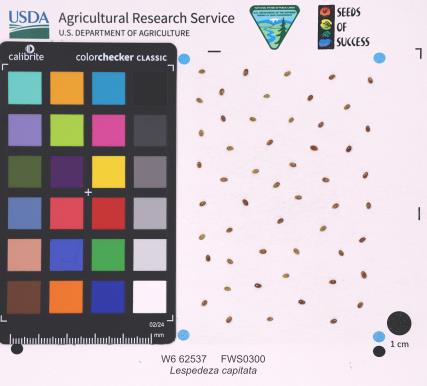 | | 2025 | | | | | | | Wild material | | 2192235 | W6 62537 |
| 107 | W6 62538 | FWS0300-153 | Monarda punctata L. | Michigan, United States | W6 |  | | 2025 | | | | | | | Wild material | | 2192236 | W6 62538 |
| 108 | W6 62539 | FWS0300-154 | Liatris cylindracea Michx. | Michigan, United States | W6 |  | | 2025 | | | | | | | Wild material | The vegetative part of the population is likely dormant, though it is not possible to discern dormant individuals. Consequently, the above population size may be an underestimate. | 2192237 | W6 62539 |
| 109 | W6 62540 | FWS0300-161 | Solidago riddellii Frank | Michigan, United States | W6 |  | | 2025 | | | | | | | Wild material | The vegetative part of the population is likely dormant, though it is not possible to discern dormant individuals. Consequently, the above population size may be an underestimate. | 2192238 | W6 62540 |
| 110 | Ames 36255 | Kothenbeutel Prairie | Delphinium carolinianum Walter subsp. virescens (Nutt.) R. E. Brooks | Iowa, United States | NC7 | 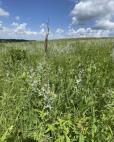 | | 2024 | COLLECTED | 07/08/2024 | Kothenbeutel Prairie Preserve located approximately 4.24 miles east, southeast of Sheffield just north of 240th Street, T93 R19W SW 1/4 SE 1/4 Sec. 7. | 42.87887400, -93.13261500 | 332 | Prairie remnant on south and southwestern aspects of 15-25 degree slopes. | Wild material | Plants in nature measuring approximately 30-38" in height. | 2168178 | Ames 36255 |
| 111 | Ames 36250 | Liverpool Nature Preserve | Salix myricoides Muhl. | Indiana, United States | NC7 |  | | 2024 | COLLECTED | 06/03/2024 | Liverpool Nature Preserve located just east of Liverpool, T36N R8W W 1/2 NW 1/4 SE 1/4 Sec. 24. | 41.55597400, -87.28701600 | 189 | Savanna and prairie remnant with high water-table on sandy soils. | Wild material | Bayberry willow is native to areas of the northeastern U.S. and north into Canada, localized around the Great Lakes region. Known to occur on shorelines/dunes but also in swamps, fens, and on talus (Haines 2004) with the potential to reach six meters in height (Dorn 1995). Ornamental characteristics include glaucous lower leaf blades that appear chalky white. Staminate flowering occurs before or during leaf expansion with purple-turning-yellow anthers (Haines 2004). This accession represents a large amount of phenotypic variability observed at the time of collection. This included variation in leaf size, shape, margins and presence of stipules. All plants sampled have very glaucus undersides of the leaves. Winter stem colors vary widely from yellowish-orange; greenish-grey; mahogany; and reddish-brown. | 2167952 | Ames 36250 |
| 112 | NA 88670 | TXWL2023-013 | Maclura pomifera (Raf.) C. K. Schneid. | Texas, United States | NA | | | 2023 | COLLECTED | 2023 | Caddo National Grasslands: C-6 near Telephone, Texas [Note: C-6 may refer to Hunter Camp 6 along FM (Farm to Market Road) 409 north of Coffee Mill Lake.] | | | | Wild material | | 2159045 | NA 88670 |
| 113 | Ames 36132 | Prairie Valley Preserve | Delphinium carolinianum Walter subsp. virescens (Nutt.) R. E. Brooks | Iowa, United States | NC7 |  | | 2023 | COLLECTED | 07/14/2023 | Prairie Valley Preserve located 2.5 miles west of Gilbert on the southeast corner of Y Avenue and 170th, T84N R24W NW ¼ NW ¼ Sec. 7. | 42.10528000, -93.69776000 | 288 | Prairie remnant. Historically grazed for estimated 75 years. Mid-upper slopes on slightly north, northwest-facing slopes. | Wild material | Plants in nature reaching (max) up to 75 cm in height. | 2158217 | Ames 36132 |
| 114 | OPGC 8817 | CBG- 10792 | Lobelia spicata Lam. | Illinois, United States | OPGC | | | 2023 | | | | | | | Wild material | | 2142254 | OPGC 8817 |
| 115 | OPGC 8823 | CBG- 10813 | Physostegia virginiana (L.) Benth. | Illinois, United States | OPGC | | | 2023 | | | | | | | Wild material | | 2142270 | OPGC 8823 |
| 116 | OPGC 8827 | CBG- 10825 | Physostegia virginiana (L.) Benth. | Illinois, United States | OPGC | | | 2023 | | | | | | | Wild material | | 2142279 | OPGC 8827 |
| 117 | OPGC 8828 | CBG- 10831 | Senega sanguinea (L.) J. F. B. Pastore & J. R. Abbott | Illinois, United States | OPGC | | | 2023 | | | | | | | Wild material | | 2142281 | OPGC 8828 |
| 118 | OPGC 8830 | CBG- 10835 | Solidago riddellii Frank | Illinois, United States | OPGC | | | 2023 | | | | | | | Wild material | | 2142284 | OPGC 8830 |
| 119 | OPGC 8844 | CBG- 10855 | Symphyotrichum ericoides (L.) G. L. Nesom | Illinois, United States | OPGC | | | 2023 | | | | | | | Wild material | | 2142302 | OPGC 8844 |
| 120 | OPGC 8845 | CBG- 10856 | Symphyotrichum laeve (L.) Á. Löve & D. Löve | Illinois, United States | OPGC | | | 2023 | | | | | | | Wild material | | 2142303 | OPGC 8845 |
| 121 | OPGC 8846 | CBG- 10857 | Gentiana puberulenta J. S. Pringle | Illinois, United States | OPGC | | | 2023 | | | | | | | Wild material | | 2142304 | OPGC 8846 |
| 122 | W6 61364 | CBG- 10780 | Ceanothus americanus L. | Illinois, United States | W6 |  | | 2023 | | | | | | | Wild material | | 2142246 | W6 61364 |
| 123 | W6 61367 | CBG- 10785 | Elymus canadensis L. | Illinois, United States | W6 |  | | 2023 | | | | | | | Wild material | | 2142249 | W6 61367 |
| 124 | W6 61386 | CBG- 10811 | Parthenium integrifolium L. | Illinois, United States | W6 |  | | 2023 | | | | | | | Wild material | | 2142268 | W6 61386 |
| 125 | W6 61389 | CBG- 10814 | Panicum virgatum L. | Illinois, United States | W6 |  | | 2023 | | | | | | | Wild material | | 2142271 | W6 61389 |
| 126 | W6 61390 | CBG- 10815 | Pycnanthemum virginianum (L.) T. Durand & B. D. Jacks. ex B. L. Rob. & Fernald | Illinois, United States | W6 |  | | 2023 | | | | | | | Wild material | | 2142272 | W6 61390 |
| 127 | W6 61391 | CBG- 10816 | Crocanthemum canadense (L.) Britton | Illinois, United States | W6 |  | | 2023 | | | | | | | Wild material | | 2142273 | W6 61391 |
| 128 | W6 61417 | CBG- 10852 | Verbesina alternifolia (L.) Britton ex Kearney | Illinois, United States | W6 |  | | 2023 | | | | | | | Wild material | | 2142299 | W6 61417 |
| 129 | W6 61418 | CBG- 10853 | Agastache scrophulariifolia (Willd.) Kuntze | Illinois, United States | W6 |  | | 2023 | | | | | | | Wild material | | 2142300 | W6 61418 |
| 130 | Ames 36032 | Dinesen Prairie | Ceanothus americanus L. | Iowa, United States | NC7 |  | | 2023 | COLLECTED | 09/02/2022 | Dinesen Prairie State Preserve located 4.55 miles northeast of Harlan, T80N R38W SW 1/4 Sec. 28 | 41.70870400, -95.28059000 | 408 | Prairie remnant. | Wild material | | 2141746 | Ames 36032 |
| 131 | Ames 36033 | Dinesen Prairie | Ceanothus herbaceus Raf. | Iowa, United States | NC7 |  | | 2023 | COLLECTED | 07/03/2022 | Dinesen Prairie State Preserve located 4.55 miles northeast of Harlan, T80N R38W SW 1/4 Sec. 28 | 41.70770400, -95.28059000 | 408 | Prairie remnant. | Wild material | | 2141747 | Ames 36033 |
| 132 | W6 63340 | Anderson Prairie | Amorpha canescens Pursh | Iowa, United States | W6 | | | 2023 | COLLECTED | 09/23/2022 | Anderson Prairie State Preserve located approximately 2.0 miles north of Estherville, T100N R34W NW 1/4 Sec. 36. | 43.43906800, -94.87472300 | 412 | Diverse remnant prairie with rolling hills and mesic soil. | Wild material | | 2141750 | W6 63340 |
| 133 | NA 88530 | RJLSEUS2022-001 | Oxydendrum arboreum (L.) DC. | North Carolina, United States | NA | | | 2023 | COLLECTED | 12/06/2022 | Plants growing around a wetland on both sides of Scotland Lake Road, approximately 1.1 kilometers southwest of the junction with Hoffman Road (Scotland Co. Road 1328) in the Sandhills Game Lands. This plant is a common component along the mesic/moist boundary on the upper edge of the understory shrub in the moist woodland habitat not far from the wetland. | 34.98402000, -79.54267200 | 116 | Plants are growing in full sun to part-shade in the moist, well-drained, mesic conditions just above a wetland area occupied by obligate wetland species. The underlying geology of this area is of Tertiary origin and characterized as Pinehurst Formation. It is composed of medium- to coarse-grained sand as well as cross-bedding and rhythmic bands of clayey sand that are unconsolidated.
Source: USGS North Carolina Geologic Map Data (https://mrdata.usgs.gov/geology/state/sgmc-unit.php?unit=NCTp%3B11)
The primary soil type in the collection area is Pelion Loamy Sand soil (6 to 10 percent slopes). The Pelion Loamy Sand series consists of very deep, moderately well-drained marine deposits, fluviomarine deposits, and sand sheets. Permeability is moderately slow or slow. Surface layers 0-25 cm deep are comprised of loamy sand with a weak fine granular structure and are very friable. Deeper horizons are comprised of sandy loam, sandy clay loam, or clay loam in the upper part and include sandy clay or clay in the deepest strata. Soils are extremely acid to strongly acid.
Source: NRCS Web Soil Survey (https://websoilsurvey.sc.egov.usda.gov/App/WebSoilSurvey.aspx) | Wild material | | 2140759 | NA 88530 |
| 134 | NA 88531 | RJLSEUS2022-002 | Cyrilla racemiflora L. | North Carolina, United States | NA | | | 2023 | COLLECTED | 12/06/2022 | Plants growing around a wetland on both sides of Scotland Lake Road, approximately 1.1 kilometers southwest of the junction with Hoffman Road (Scotland Co. Road 1328) in the Sandhills Game Lands. This plant is a common component of moist to wet areas of the wetland habitats in this area. | 34.98418000, -79.54079800 | 120 | Plants are growing in part-shade to sun in a wetland habitat as well as nearby seasonally drier mesic habitat.
Soils: The underlying geology of this area is of Tertiary origin and characterized as Pinehurst Formation. It is comprised of medium- to coarse-grained sand as well as cross-bedding and rhythmic bands of clayey sand that are unconsolidated.
Source: USGS North Carolina Geologic Map Data (https://mrdata.usgs.gov/geology/state/sgmc-unit.php?unit=NCTp%3B11)
The primary soil type in the collection area is classified as Johnston Series soils (0 to 2 percent slopes, frequently flooded). The Johnston series consists of very deep, very poorly drained soils that are occasionally to frequently flooded for short to extended periods. Permeability is moderate to rapid. These nearly level soils are alluvial in origin and typical of floodplains and swamp. Slopes range from 0 to 2 percent. Johnston Series soils are comprised of mucky loam that is friable with siliceous elements in the upper 0-75 cm. Lower strata range in percentages of mucky loam and loamy fine sand.
Source: NRCS Web Soil Survey (https://websoilsurvey.sc.egov.usda.gov/App/WebSoilSurvey.aspx) | Wild material | | 2140760 | NA 88531 |
| 135 | NA 88532 | RJLSEUS2022-003 | Alnus serrulata (Aiton) Willd. | North Carolina, United States | NA | | | 2023 | COLLECTED | 12/06/2022 | Plants growing around a wetland on both sides of Scotland Lake Road, approximately 1.1 kilometers southwest of the junction with Hoffman Road (Scotland Co. Road 1328) in the Sandhills Game Lands. This plant is a common component of the moist to wet areas of the wetland habitats in this area. | 34.98413200, -79.54196300 | 118 | Plants are growing in part-shade to sun in a wet to inundated habitat that contains standing water and/or significant moisture year-round.
Soils: The underlying geology of this area is of Tertiary origin and characterized as Pinehurst Formation. It is comprised of medium- to coarse-grained sand as well as cross-bedding and rhythmic bands of clayey sand that are unconsolidated.
Source: USGS North Carolina Geologic Map Data (https://mrdata.usgs.gov/geology/state/sgmc-unit.php?unit=NCTp%3B11)
The primary soil type in the collection area is classified as Johnston Series soils (0 to 2 percent slopes, frequently flooded). The Johnston series consists of very deep, very poorly drained soils that are occasionally to frequently flooded for short to extended periods. Permeability is moderate to rapid. These nearly level soils are alluvial in origin and typical of floodplains and swamp. Slopes range from 0 to 2 percent. Johnston Series soils are comprised of mucky loam that is friable with siliceous elements in the upper 0-75 cm. Lower strata range in percentages of mucky loam and loamy fine sand.
Source: NRCS Web Soil Survey (https://websoilsurvey.sc.egov.usda.gov/App/WebSoilSurvey.aspx) | Wild material | | 2140761 | NA 88532 |
| 136 | NA 88533 | RJLSEUS2022-004 | Zenobia pulverulenta (W. Bartram ex Willd.) Pollard | North Carolina, United States | NA | | | 2023 | COLLECTED | 12/06/2022 | Plants growing in the wetlands and moist depressions along Scotland Co. Road 1328 in the Sandhills Game Lands. This plant is somewhat infrequent and sporadic, but abundant in places with moist to wet habitats in this area. | 34.95510000, -79.51769700 | 112 | Plants are growing in part-shade to sun in an acidic wetland habitat rich in sphagnum and other obligate wetland species. The habitat is moist to wet year-round and periodically has surface runoff occurring; even so, this habitat can become quite dry during seasonal periods without rainfall.
Soils: The underlying geology of this area is of Tertiary origin and characterized as Pinehurst Formation. It is comprised of medium- to coarse-grained sand as well as cross-bedding and rhythmic bands of clayey sand that are unconsolidated.
Source: USGS North Carolina Geologic Map Data (https://mrdata.usgs.gov/geology/state/sgmc-unit.php?unit=NCTp%3B11)
The primary soil type in the collection area is classified as Pelion Loamy Sand (2 to 6 percent slopes). The Pelion Loamy Sand series consists of very deep, moderately well-drained marine deposits, fluviomarine deposits, and sand sheets. Permeability is moderately slow or slow. Surface layers 0-25 cm deep are comprised of loamy sand with a weak fine granular structure and are very friable. Deeper horizons are comprised of sandy loam, sandy clay loam, or clay loam in the upper part and includes sandy clay or clay in the deepest part. Soils are extremely acid to strongly acid.
Source: NRCS Web Soil Survey (https://websoilsurvey.sc.egov.usda.gov/App/WebSoilSurvey.aspx) | Wild material | | 2140762 | NA 88533 |
| 137 | Ames 35901 | Blazing Star Prairie | Stachys pilosa Nutt. | Iowa, United States | NC7 |  | | 2022 | COLLECTED | 07/29/2022 | Blazing Star Prairie located 2.00 miles southeast of Rowley, T87N R8W S ¼ NW ¼ NW ¼ Sec. 17. | 42.35365800, -91.81099000 | 286 | Mesic prairie remnant. | Wild material | Plants sampled in nature varied substantially in height and leaf size, where this variation could possibly be due to multiple ploidy levels existing in the population. Species is extremely vigorous and can aggressively spread via rhizomes especially under moist, wet soil conditions. Plants averaging 50-60 cm in height with minimal to no branching. Foliage and stems are densely covered in hairs. Flowers are faint pinkish-white in color with pink-light purple spots/splotches. Peak flowering generally occurs in mid-June (central Iowa) and can extend for almost four weeks. Genetics of this accession originated from eastern-central Iowa. Species is frequently visited by a plethora of pollinators, especially bumblebees. | 2138298 | Ames 35901 |
| 138 | OPGC 7588 | Blazing Star Prairie | Phlox maculata L. | Iowa, United States | OPGC |  | | 2022 | COLLECTED | 07/29/2022 | Blazing Star Prairie located 2.00 miles southeast of Rowley, T87N R8W S ¼ NW ¼ NW ¼ Sec. 17. | 42.35365800, -91.81099000 | 286 | Mesic prairie remnant. | Wild material | Plants in nature ranged in height from two to three feet. Some variation was noted for degree of branching in the inflorescence with a small number of plants having highly branched inflorescences. Peak flowering and fruiting in nature at collection site peaked 20 June and 26 July, respectively. | 2138297 | OPGC 7588 |
| 139 | Ames 35882 | Blazing Star Prairie | Heuchera richardsonii R. Br. | Iowa, United States | NC7 |  | | 2022 | COLLECTED | 06/23/2022 | Blazing Star Prairie located 2.00 miles southeast of Rowley, T87N R8W S ¼ NW ¼ NW ¼ Sec. 17. | 42.35383100, -91.81185600 | 286 | Mesic prairie remnant. | Wild material | | 2138181 | Ames 35882 |
| 140 | Ames 35881 | Reichelt Unit | Heuchera richardsonii R. Br. | Iowa, United States | NC7 |  | | 2022 | COLLECTED | 06/30/2022 | Reichelt Unit of Rock Creek State Park on south side of US highway 6 located 7.70 miles west, southwest of Grinnell, T80N R17W SE ¼ SE ¼ Sec. 30. | 41.70311300, -92.86569100 | 274 | Prairie remnant. Hilltop/knoll. | Wild material | Plants in nature measuring approximately six to eight inches in height with flowering stalks reaching up to three feet in height. | 2138180 | Ames 35881 |
| 141 | Ames 35806 | Reichelt Prairie | Salix humilis Marshall var. tristis (Aiton) Griggs | Iowa, United States | NC7 |  | | 2022 | COLLECTED | 05/16/2022 | Reichelt Unit of Rock Creek State Park on south side of US highway 6 approximately 7.70 miles west, southwest of Grinnell, T80N R17W SE ¼ SE ¼ Sec. 30. | 41.70311300, -92.86569100 | 274 | Xeric prairie remnant. Hilltop/knoll. | Wild material | Plants sampled in nature measuring 2.0-4.0 feet in height. Specimens noted during peak flowering and seed dispersal on 21 April and 17 May (2022), respectively. Some plants upright and some rather prostrate. Site was mowed in winter 2020/2021 winter resulting in significant flowering in 2022. In cultivation (central Iowa), plants are extremely short and compact where after two field seasons plants are rather uniform and topping out at a height of 2.5'. Dense suckering immediately surrounding clump/base of plant. Peak fall color (central Iowa) occurring in mid-November. | 2137912 | Ames 35806 |
| 142 | Ames 35803 | Turtlehead Fen | Salix eriocephala Michx. | Iowa, United States | NC7 |  | | 2022 | COLLECTED | 04/21/2022 | Turtlehead Fen (Chichaqua Bottoms Greenbelt) located 1.75 miles southeast of Farrar just north of highway 65, T81N R21W SW ¼ NW ¼ Sec. 31. | 41.78612100, -93.34726000 | 290 | Extremely high-quality remnant fen. Extremely wet, spongy soils with surface water visible at time of collection. | Wild material | Plants in nature averaging 20' in height. Bright red buds on nearly all genotypes with stem colors ranging from yellow/bronze, brownish-green, brown and green at time of sampling (21 April 2022). Some specimens are rather open, wide spreading and some are rather upright. Salix eriocephala at this site is one of the more dominant species of willow. | 2137909 | Ames 35803 |
| 143 | OPGC 7580 | Coopers Cove | Liatris aspera Michx. | Iowa, United States | OPGC | | | 2022 | COLLECTED | 09/20/2021 | Coopers Cove located approximately 7.0 miles east of Palmer on C56, T90N R31W extreme west edge of Sec. 12. | 42.62416400, -94.46270000 | 365 | Roadside remnant. | Wild material | | 2133089 | OPGC 7580 |
| 144 | OPGC 7585 | Pleggenkuhle Prairie | Liatris pycnostachya Michx. | Iowa, United States | OPGC | | | 2022 | COLLECTED | 09/29/2021 | Pleggenkuhle Prairie located 2.11 miles northwest of Hawkeye, T94N R10W Sec. 14. | 42.95783800, -91.98405900 | 341 | Wet-mesic prairie remnant on Clyde Silty Clay Loam and Floyd Loam soils. | Wild material | | 2133094 | OPGC 7585 |
| 145 | W6 60002 | NCBG-405 | Andropogon gerardi Vitman | Virginia, United States | W6 | | | 2021 | | | | | | | Wild material | Received as: Adropogon gerardii | 2132884 | W6 60002 |
| 146 | W6 60012 | NCBG-512 | Cyperus strigosus L. | North Carolina, United States | W6 | | | 2021 | | | | | | | Wild material | | 2132894 | W6 60012 |
| 147 | W6 60028 | NCBG-537 | Phytolacca americana L. | Virginia, United States | W6 | | | 2021 | | | | | | | Wild material | | 2132910 | W6 60028 |
| 148 | W6 60052 | NCBG-597 | Schizachyrium scoparium (Michx.) Nash | Virginia, United States | W6 | | | 2021 | | | | | | | Wild material | | 2132933 | W6 60052 |
| 149 | Ames 36051 | CBG-10689 | Helianthus occidentalis Riddell | Illinois, United States | NC7 | | | 2021 | | | | | | | Wild material | | 2132538 | Ames 36051 |
| 150 | OPGC 8490 | CBG-10706 | Symphyotrichum sericeum (Vent.) G. L. Nesom | Illinois, United States | OPGC | | | 2021 | | | | | | | Wild material | | 2132552 | OPGC 8490 |
| 151 | W6 59931 | CBG-10654 | Cyperus schweinitzii Torr. | Illinois, United States | W6 | | | 2021 | | | | | | | Wild material | | 2132510 | W6 59931 |
| 152 | W6 59943 | CBG-10667 | Sporobolus rigidus (Buckley) P. M. Peterson var. rigidus | Illinois, United States | W6 |  | | 2021 | | | | | | | Wild material | | 2132521 | W6 59943 |
| 153 | W6 59948 | CBG-10673 | Liatris cylindracea Michx. | Illinois, United States | W6 | | | 2021 | | | | | | | Wild material | | 2132526 | W6 59948 |
| 154 | W6 59954 | CBG-10682 | Panicum virgatum L. | Illinois, United States | W6 | | | 2021 | | | | | | | Wild material | | 2132532 | W6 59954 |
| 155 | W6 59966 | CBG-10696 | Dalea purpurea Vent. | Illinois, United States | W6 | | | 2021 | | | | | | | Wild material | | 2132544 | W6 59966 |
| 156 | OPGC 8599 | CBG-10745 | Symphyotrichum oblongifolium (Nutt.) G. L. Nesom | | OPGC |  | | 2021 | | | | | | | Wild material | | 2137993 | OPGC 8599 |
| 157 | NA 88421 | CBG-10737 | Prunus americana Marshall | | NA |  | | 2021 | | | | | | | Wild material | Spatially discreet collection for a clonal species. Counts made approximately every 6 feet. Fruits collected from the plant and the ground. | 2137989 | NA 88421 |
| 158 | Ames 35734 | Ledges State Park | Teucrium canadense L. | Iowa, United States | NC7 |  | | 2021 | COLLECTED | 08/23/2021 | Ledges State Park located approximately 4.75 miles south of Boone T83N R26W Sec. 16 & 21 | 41.99262400, -93.87724800 | 330 | Edges of woods | Wild material | | 2120338 | Ames 35734 |
| 159 | Ames 36049 | CBG-9991 | Helianthus mollis Lam. | Illinois, United States | NC7 | | | 2021 | | | | | | | Wild material | | 2120041 | Ames 36049 |
| 160 | NA 88326 | CBG-10490 | Hypericum gentianoides (L.) Britton et al. | Illinois, United States | NA | | | 2021 | | | | | | | Wild material | | 2120115 | NA 88326 |
| 161 | NA 88439 | CBG-10597 | Rosa setigera Michx. | Illinois, United States | NA | | | 2021 | | | | | | | Wild material | Plant numbers sampled estimated. | 2120182 | NA 88439 |
| 162 | OPGC 8284 | CBG-9989 | Rhexia virginica L. | Illinois, United States | OPGC | | | 2021 | | | | | | | Wild material | | 2120039 | OPGC 8284 |
| 163 | OPGC 8309 | CBG-10450 | Heuchera richardsonii R. Br. | Wisconsin, United States | OPGC | | | 2021 | | | | | | | Wild material | | 2120089 | OPGC 8309 |
| 164 | OPGC 8320 | CBG-10493 | Vernonia missurica Raf. | Illinois, United States | OPGC | | | 2021 | | | | | | | Wild material | | 2120118 | OPGC 8320 |
| 165 | OPGC 8347 | CBG-10579 | Helenium flexuosum Raf. | Illinois, United States | OPGC | | | 2021 | | | | | | | Wild material | Plant numbers sampled estimated. | 2120170 | OPGC 8347 |
| 166 | W6 59091 | CBG-9708 | Carex scoparia Schkuhr ex Willd. | Illinois, United States | W6 | | | 2021 | | | | | | | Wild material | grass, grasslike | 2120020 | W6 59091 |
| 167 | W6 59098 | CBG-9772 | Carex swanii (Fernald) Mack. | Illinois, United States | W6 | | | 2021 | | | | | | | Wild material | | 2120027 | W6 59098 |
| 168 | W6 59135 | CBG-10230 | Eupatorium perfoliatum L. | Illinois, United States | W6 | | | 2021 | | | | | | | Wild material | | 2120061 | W6 59135 |
| 169 | W6 59182 | CBG-10473 | Echinacea pallida (Nutt.) Nutt. | Illinois, United States | W6 | | | 2021 | | | | | | | Wild material | | 2120103 | W6 59182 |
| 170 | W6 59186 | CBG-10477 | Juncus greenei Oakes & Tuck. | Illinois, United States | W6 | | | 2021 | | | | | | | Wild material | | 2120105 | W6 59186 |
| 171 | W6 59188 | CBG-10479 | Crocanthemum bicknellii (Fernald) Janch. | Illinois, United States | W6 | | | 2021 | | | | | | | Wild material | | 2120107 | W6 59188 |
| 172 | W6 59234 | CBG-10548 | Dasistoma macrophyllum (Nutt.) Raf. | Illinois, United States | W6 | | | 2021 | | | | | | | Wild material | Received as Dasistoma macrophylla. Plant numbers estimated. Few this year; abundant other years in numerous locations. | 2120206 | W6 59234 |
| 173 | W6 59267 | CBG-10590 | Muhlenbergia glabrifloris Scribn. | Illinois, United States | W6 | | | 2021 | | | | | | | Wild material | Received as: Muhlenbergia glabriflora. Plant numbers sampled estimated. | 2120210 | W6 59267 |
| 174 | W6 59284 | CBG-10609 | Sporobolus compositus (Poir.) Merr. | Illinois, United States | W6 | | | 2021 | | | | | | | Wild material | Plant numbers sampled estimated. | 2120229 | W6 59284 |
| 175 | W6 59062 | NCBG-676 | Andropogon gerardi Vitman | Virginia, United States | W6 | | | 2021 | | | | | | | Wild material | | 2116376 | W6 59062 |
| 176 | W6 58579 | MARSB-349 | Eupatorium hyssopifolium L. | New Jersey, United States | W6 | | | 2021 | | | | | | | Wild material | | 2113509 | W6 58579 |
| 177 | W6 58654 | MARSB-668 | Rhus copallinum L. | Delaware, United States | W6 | | | 2021 | | | | | | | Wild material | Woody plant with compound leaves and wings along rachis. Leaves are dark green and bark is dark brown. Terminal panicle with showy red flower cluster and later sticky, dark red fruit. | 2113584 | W6 58654 |
| 178 | OPGC 7554 | Liska-Stanek State Preserve | Liatris pycnostachya Michx. | Iowa, United States | OPGC | 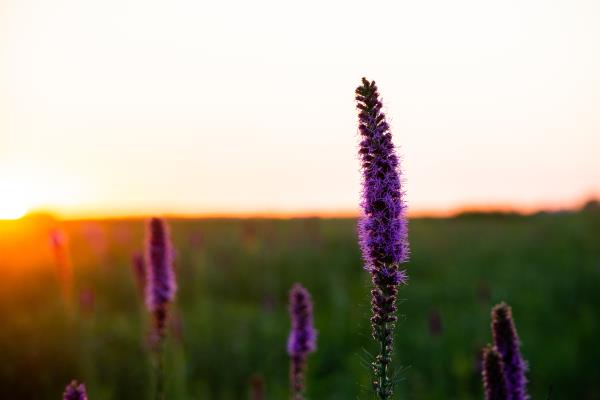 | | 2020 | COLLECTED | 09/21/2020 | Liska-Stanek Prairie located approximately 6.0 miles southwest of Fort Dodge on County Road P-51, Webster County | 42.41349000, -94.22404400 | 317 | Mesic prairie with potholes. | Wild material | Plants sampled in nature were approximately 4 feet in height with peak flowering occurring around the 25 of July (2020). | 2107745 | OPGC 7554 |
| 179 | OPGC 7559 | AS/VH/2020/023/098 | Verbena hastata L. | Iowa, United States | OPGC |  | | 2020 | COLLECTED | 10/07/2020 | Private property adjacent to (east of) Cedar Hills Sand Prairie, 7 miles northwest of Cedar Falls, Black Hawk County | 42.59408000, -92.54784000 | 288 | Former cattle pasture, restored via natural succession with seed from adjacent remnant prairie. | Wild material | Plants sampled in nature were approximately 2.5 to 4 feet in height. | 2107746 | OPGC 7559 |
| 180 | Ames 35545 | Kish-Ke-Kosh Prairie | Drymocallis arguta (Pursh) Rydb. | Iowa, United States | NC7 |  | | 2020 | COLLECTED | 08/14/2020 | Kish-Ke-Kosh Prairie State Preserve located 1.1 miles southeast of Reasnor, T78N R19W NE 1/4 NW 1/4 NE 1/4 Sec. 14, Jasper County | 41.56461900, -93.01285900 | 259 | Sandy prairie remnant. | Wild material | | 2106724 | Ames 35545 |
| 181 | NA 88163 | NCBG-423 | Chamaecyparis thyoides (L.) Britton et al. | North Carolina, United States | NA |  | | 2019 | | | | | | | Wild material | | 2098444 | NA 88163 |
| 182 | OPGC 7976 | NCBG-426 | Oenothera biennis L. | Maryland, United States | OPGC |  | | 2019 | | | | | | | Wild material | | 2098445 | OPGC 7976 |
| 183 | W6 57555 | NCBG-598 | Andropogon gerardi Vitman | Virginia, United States | W6 |  | | 2019 | | | | | | | Wild material | | 2098479 | W6 57555 |
| 184 | W6 57160 | MARSB-367 | Tridens flavus (L.) Hitchc. | New Jersey, United States | W6 |  | | 2019 | | | | | | | Wild material | | 2097599 | W6 57160 |
| 185 | W6 57230 | MARSB-629 | Pseudognaphalium obtusifolium (L.) Hilliard & B. L. Burtt | New York, United States | W6 |  | | 2019 | | | | | | | Wild material | | 2097669 | W6 57230 |
| 186 | W6 57237 | MARSB-669 | Scirpus cyperinus (L.) Kunth | Delaware, United States | W6 |  | | 2019 | | | | | | | Wild material | | 2097676 | W6 57237 |
| 187 | W6 57244 | MARSB-689 | Andropogon gerardi Vitman | Delaware, United States | W6 |  | | 2019 | | | | | | | Wild material | | 2097683 | W6 57244 |
| 188 | WLP 1685 | JDC/RS/2019/036/915 | Rosa setigera Michx. | Iowa, United States | NA |  | | 2019 | COLLECTED | 10/17/2019 | Ledges State Park located approximately 4.75 miles south of Boone, just south of the Oakwoods Shelter/Picnic area, T83N R26W NE1/4 NE1/4 and also NW1/4 NE1/4 Sec. 21, Boone County | 41.99262400, -93.87724800 | 330 | Edges of woods (adjacent to prairie) and also within 20-25 yards from woods in prairie. Noted in east, west, and south-facing edges of woods (no specimens noted on north-facing woodland edges) | Wild material | Woody shrub/vine stretching up to 12' in length. Alternate compound leaves usually consisting of five lealets. Leaf rachis and stipule margins glandular. Mature hypanthium and pedicel with stipitate glandular hairs. Mature hypanthium mostly bright to dark red in color with a few dark orange noted at time of harvest (17 October 2019). Leaves rather to somewhat glossy. This collection represents genetics from the northwestern edge of the species range, likely suggesting good cold-hardiness (USDA Zone 5a). | 2097769 | WLP 1685 |
| 189 | Ames 35225 | JDC/MF/2019/035/914 | Monarda fistulosa L. | Minnesota, United States | NC7 |  | | 2019 | COLLECTED | 09/17/2019 | Iron Horse Prairie Scientific Natural Area located approximately 1.5 miles south of Hayfield, T105N R17W NW1/4 SE1/4 and NE1/4 SW1/4 Sec. 27, Dodge County | 43.86750030, -92.84861000 | 399 | High-quality prairie remnant with various habitats from dry, short-grass type vegetation to rather wet, thick vegetation. | Wild material | Plants in nature ranging from 2' to 4.5' in height. Variability in mildew resistance noted at time of harvest (17 September) ranging from plants with no leaves to plants with persistent leaves with minimal to substantial mildew. | 2097761 | Ames 35225 |
| 190 | W6 56575 | CBG-8192 | Carex garberi Fernald | Illinois, United States | W6 |  | | 2019 | | | | | | | Wild material | | 2092674 | W6 56575 |
| 191 | OPGC 7465 | CBG-8632 | Coreopsis lanceolata L. | Illinois, United States | OPGC |  | | 2019 | | | | | | | Wild material | | 2092686 | OPGC 7465 |
| 192 | OPGC 7474 | CBG-9084 | Liatris pycnostachya Michx. | Wisconsin, United States | OPGC |  | | 2019 | | | | | | | Wild material | | 2092758 | OPGC 7474 |
| 193 | OPGC 7475 | CBG-9130 | Verbena stricta Vent. | Wisconsin, United States | OPGC |  | | 2019 | | | | | | | Wild material | | 2092769 | OPGC 7475 |
| 194 | OPGC 7476 | CBG-9132 | Solidago juncea Aiton | Wisconsin, United States | OPGC |  | | 2019 | | | | | | | Wild material | | 2092771 | OPGC 7476 |
| 195 | OPGC 7491 | CBG-9486 | Symphyotrichum ericoides (L.) G. L. Nesom | Wisconsin, United States | OPGC |  | | 2019 | | | | | | | Wild material | | 2092805 | OPGC 7491 |
| 196 | W6 56591 | CBG-8639 | Erigeron strigosus Muhl. ex Willd. | Wisconsin, United States | W6 |  | | 2019 | | | | | | | Wild material | | 2092690 | W6 56591 |
| 197 | W6 56619 | CBG-8834 | Drymocallis arguta (Pursh) Rydb. | Wisconsin, United States | W6 |  | | 2019 | | | | | | | Wild material | | 2092718 | W6 56619 |
| 198 | W6 56648 | CBG-9070 | Amorpha canescens Pursh | Wisconsin, United States | W6 |  | | 2019 | | | | | | | Wild material | | 2092747 | W6 56648 |
| 199 | W6 56656 | CBG-9081 | Zizia aptera (A. Gray) Fernald | Wisconsin, United States | W6 |  | | 2019 | | | | | | | Wild material | | 2092755 | W6 56656 |
| 200 | W6 56671 | CBG-9131 | Dalea purpurea Vent. | Wisconsin, United States | W6 |  | | 2019 | | | | | | | Wild material | | 2092770 | W6 56671 |
| 201 | W6 56673 | CBG-9133 | Sporobolus heterolepis (A. Gray) A. Gray | Wisconsin, United States | W6 |  | | 2019 | | | | | | | Wild material | | 2092772 | W6 56673 |
| 202 | Ames 34725 | NM930-440 | Helianthus annuus L. | New Mexico, United States | NC7 |  | | 2018 | | | | | | | Wild material | Helianthus annuus | 1966169 | Ames 34725 |
| 203 | OPGC 7801 | NCBG-737 | Aletris farinosa L. | North Carolina, United States | OPGC |  | | 2018 | | | | | | | Wild material | Aletris farinosa | 1966038 | OPGC 7801 |
| 204 | OPGC 5468 | OPGC 5468 | Phlox pilosa L. subsp. fulgida (Wherry) Wherry | Iowa, United States | OPGC | | | 2018 | COLLECTED | 06/28/2018 | Located approximately 1.92 miles east, northeast of Cambridge, T82N R23W NE ¼ NE ¼ NW ¼ Sec. 23, Story County. Locally known as Harker Prairie. | 41.90590000, -93.49310000 | 89 | High-quality, small (5 acre) prairie remnant. Soils classified (USDA Soils Web Survey) as Canisteo clay loam and Webster Clay loam ranging from 0-6 percent slopes, mostly east or northeast facing. | Wild material | Phlox pilosa subsp. pilosa was at peak maturity (abundant seed production) at the time of collection with a few seed capsules already dispersed, a few still green, and majority ready to disperse in the next 1-3 days. Plants typically reaching approximately 1’ in height. | 1964607 | OPGC 5468 |
| 205 | NA 88423 | CBG-7101 | Rosa arkansana Porter | Nebraska, United States | NA |  | | 2017 | | | | | | | Wild material | | 1954860 | NA 88423 |
| 206 | OPGC 6374 | CBG-7306 | Anemone cylindrica A. Gray | Illinois, United States | OPGC |  | | 2017 | | | | | | | Wild material | | 1954751 | OPGC 6374 |
| 207 | OPGC 6381 | CBG-7500 | Brickellia eupatorioides (L.) Shinners | Iowa, United States | OPGC |  | | 2017 | | | | | | | Wild material | | 1954766 | OPGC 6381 |
| 208 | OPGC 6387 | CBG-6659 | Heuchera americana L. | Illinois, United States | OPGC |  | | 2017 | | | | | | | Wild material | | 1954813 | OPGC 6387 |
| 209 | OPGC 6401 | CBG-8086 | Solidago rigida L. | Illinois, United States | OPGC |  | | 2017 | | | | | | | Wild material | | 1954839 | OPGC 6401 |
| 210 | OPGC 6406 | CBG-7501 | Ratibida pinnata (Vent.) Barnhart | Iowa, United States | OPGC |  | | 2017 | | | | | | | Wild material | | 1954855 | OPGC 6406 |
| 211 | W6 52992 | CBG-7307 | Amorpha canescens Pursh | Illinois, United States | W6 |  | | 2017 | | | | | | | Wild material | | 1954743 | W6 52992 |
| 212 | W6 52994 | CBG-7338 | Amorpha canescens Pursh | Illinois, United States | W6 |  | | 2017 | | | | | | | Wild material | | 1954745 | W6 52994 |
| 213 | W6 53018 | CBG-7563 | Sporobolus rigidus (Buckley) P. M. Peterson var. rigidus | Nebraska, United States | W6 |  | | 2017 | | | | | | | Wild material | | 1954769 | W6 53018 |
| 214 | W6 53039 | CBG-8026 | Dysphania atriplicifolia (Spreng.) G. Kadereit et al. | Nebraska, United States | W6 |  | | 2017 | | | | | | | Wild material | | 1954790 | W6 53039 |
| 215 | W6 53040 | CBG-7155 | Cyperus lupulinus (Spreng.) Marcks | Washington, United States | W6 |  | | 2017 | | | | | | | Wild material | Cyperus lupulinus ssp. lupulinus | 1954791 | W6 53040 |
| 216 | W6 53042 | CBG-7320 | Dalea candida Willd. | Wisconsin, United States | W6 |  | | 2017 | | | | | | | Wild material | | 1954793 | W6 53042 |
| 217 | W6 53080 | CBG-7502 | Monarda fistulosa L. | Iowa, United States | W6 |  | | 2017 | | | | | | | Wild material | | 1954831 | W6 53080 |
| 218 | W6 53112 | CBG-7288 | Schoenoplectus acutus (Muhl. ex Bigelow) Á. Löve & D. Löve var. acutus | Iowa, United States | W6 |  | | 2017 | | | | | | | Wild material | | 1954863 | W6 53112 |
| 219 | W6 53126 | CBG-6895 | Sphenopholis obtusata (Michx.) Scribn. | Illinois, United States | W6 |  | | 2017 | | | | | | | Wild material | | 1954877 | W6 53126 |
| 220 | W6 53129 | CBG-7293 | Stenaria nigricans (Lam.) Terrell | Iowa, United States | W6 |  | | 2017 | | | | | | | Wild material | | 1954880 | W6 53129 |
| 221 | Ames 34154 | Ames 34154 | Monarda punctata L. | Wisconsin, United States | NC7 |  | | 2017 | COLLECTED | 12/15/2017 | Between Boscobel and Blue River along State Road 133 including T8N R3W Sec. 24, T8N R2W Sec. 17, and T8N R2W Sec. 11, Grant County. | 43.16997000, -90.63607800 | 205 | Roadside, sandy sparse vegetation. | Wild material | Average plant height at collection site in nature approximately 25-35 cm. | 1954954 | Ames 34154 |
| 222 | Ames 34038 | Ames 34038 | Monarda punctata L. | Illinois, United States | NC7 |  | | 2017 | COLLECTED | 10/29/2017 | Nachusa Grasslands located approximately 4.17 miles northwest of Franklin Grove just west of Lowden Road, T22N R10E NW 1/4 NW 1/4 SE 1/4 Sec. 16, Ogle County. | 41.89120000, -89.34490000 | 225 | Newly disturbed ground (fenceline installation 2015) consisting of almost level sandy soil with a very slight slope. | Wild material | Plants ranging between 16-22" in height, branched with numerous seed heads. | 1954327 | Ames 34038 |
| 223 | Ames 34002 | JDC/CA/2017/050/804 | Ceanothus americanus L. | Iowa, United States | NC7 |  | | 2017 | COLLECTED | 08/18/2017 | Locally known as Harker Prairie located approximately 1.92 miles east, northeast of Cambridge, T82N R23W NE ¼ NE ¼ NW ¼ Sec. 23 | 41.90590000, -93.49310000 | 291 | High-quality, small (5 acre) prairie remnant. Soils classified (USDA Soils Web Survey) as Canisteo clay loam and Webster Clay loam ranging from 0-6 percent slopes, mostly east or northeast facing. | Wild material | Ceanothus americanus was at peak maturity (abundant seed production) at the time of collection with a few seed capsules already dispersed, a few still green, and majority ready to disperse in the next 1-3 days. Plants measuring approximately 2’ in height. | 1953754 | Ames 34002 |
| 224 | Ames 33748 | JDC/MP/2016/029/744 | Monarda punctata L. | Iowa, United States | NC7 | | | 2016 | COLLECTED | 09/15/2016 | Along NW 121st Street just 3.10 miles southeast of Granger, T80N R25W SW 1/4 NE 1/4 Sec. 20 Polk County. | 41.72657200, -93.78501500 | 245 | Dry, roadside. Sandy soils. | Wild material | | 1942858 | Ames 33748 |
| 225 | Ames 34290 | CBG-5008 | Rhus copallinum L. | Illinois, United States | NC7 |  | | 2016 | COLLECTED | 09/23/2015 | Carl Becker Nature Preserve Kankakee County | 41.01462000, -87.53932000 | 227 | Sand savanna | Wild material | | 1942762 | Ames 34290 |
| 226 | Ames 34803 | CBG-5442 | Spiraea tomentosa L. | Illinois, United States | NC7 |  | | 2016 | COLLECTED | 09/30/2015 | Iroquois County Conservation Area | 40.99082000, -87.56577000 | 199 | Wet prairie, sedge meadow. | Wild material | | 1942778 | Ames 34803 |
| 227 | OPGC 6247 | CBG-5862 | Verbena stricta Vent. | Iowa, United States | OPGC | | | 2016 | | | | | | | Wild material | | 1942799 | OPGC 6247 |
| 228 | OPGC 7744 | CBG-6301 | Agalinis auriculata (Michx.) S. F. Blake | Illinois, United States | OPGC | | | 2016 | | | | | | | Wild material | | 1942816 | OPGC 7744 |
| 229 | OPGC 4242 | JDC/LS/2015/055/712 | Lobelia siphilitica L. | Iowa, United States | OPGC | | | 2015 | COLLECTED | 10/02/2015 | Approximatley 4.25 miles northwest of Ames, T84N R25W SE 1/4 SE 1/4 SE 1/4 Sec. 25. | 42.04909700, -93.70113000 | | Roadside, rather wet. Shallow areas with standing water. Growing in association with Ambrosia trifida, Bromus inermis, Chamaecrista fasciculata, Juniperus virginiana, Prunella vulgaris, Carex molesta, Sorghastrum nutans, Cannabis sativa, Solidago, and Monarda fistulosa. | Wild material | Abundant occurrence. Peak bloom occurred first week in September (2015). Peak harvest first week in October (2015). Plants ranging from 1-2.5' in height. | 1927776 | OPGC 4242 |
| 230 | Ames 34281 | CBG-2812 | Monarda fistulosa L. | Illinois, United States | NC7 |  | | 2015 | COLLECTED | 09/07/2013 | IDNR RR prairie between Litchfield and Gillespie along IL Route 16, Macoupin County | 39.16025000, -89.76463900 | 202 | Mesic prairie. | Wild material | | 1926147 | Ames 34281 |
| 231 | W6 49519 | CBG-2454 | Lomatium foeniculaceum (Nutt.) J. M. Coult. & Rose | Kansas, United States | W6 |  | | 2015 | | | | | | | Wild material | | 1925999 | W6 49519 |
| 232 | W6 49677 | CBG-2794 | Penthorum sedoides L. | Illinois, United States | W6 |  | | 2015 | | | | | | | Wild material | | 1926136 | W6 49677 |
| 233 | W6 48852 | MARSB-30 | Elymus glabriflorus (Vasey ex L. H. Dewey) Scribn. & C. R. Ball | Maryland, United States | W6 |  | | 2015 | | | | | | | Wild material | | 1922856 | W6 48852 |
| 234 | W6 48855 | MARSB-31 | Eragrostis spectabilis (Pursh) Steud. | Maryland, United States | W6 |  | | 2015 | | | | | | | Wild material | | 1922858 | W6 48855 |
| 235 | W6 48883 | MARSB-40 | Pseudognaphalium obtusifolium (L.) Hilliard & B. L. Burtt | Maryland, United States | W6 | 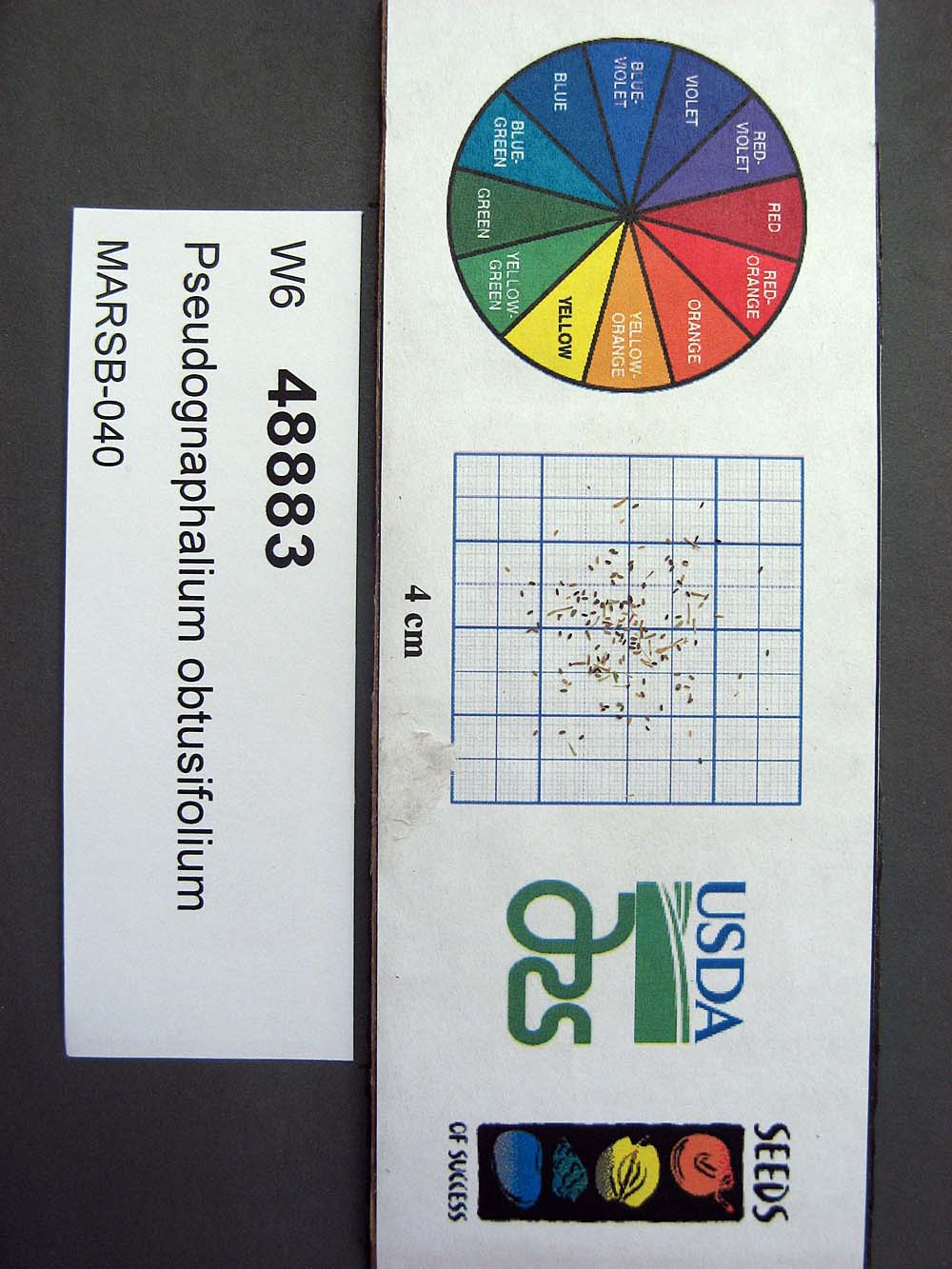 | | 2015 | | | | | | | Wild material | | 1922873 | W6 48883 |
| 236 | W6 48904 | MARSB-036 | Tridens flavus (L.) Hitchc. | Maryland, United States | W6 |  | | 2015 | | | | | | | Wild material | | 1922890 | W6 48904 |
| 237 | Ames 32766 | JDC/MF/2014/042/544 | Monarda fistulosa L. | Iowa, United States | NC7 | | | 2014 | COLLECTED | 09/03/2014 | Private property, located approximately 2 miles south of Sumner, Bremer County. | 42.80924300, -92.10579900 | 324 | Remnant wet prairie. | Wild material | | 1921314 | Ames 32766 |
| 238 | W6 45891 | CBG-1865 | Amorpha canescens Pursh | Illinois, United States | W6 |  | | 2013 | | | | | | | Wild material | | 1908759 | W6 45891 |
| 239 | Ames 32526 | 210742 | Helianthus maximiliani Schrad. | Texas, United States | NC7 |  | | 2011 | COLLECTED | 11/04/2003 | River Fern Court (generalizided locality information; more detail available upon request) | | | Creekside. Associated with Andropogon glomeratus, Eupatorium serotinum, Juniperus ashei, Lobelia cardinalis, Quercus buckleyi, Q. fusiformis, Smilax bona-nox, Sorghastrum nutans, and Toxicodendron radicans. | Wild material | | 1895289 | Ames 32526 |
| 240 | Ames 32736 | 245522 | Viguiera dentata (Cav.) Spreng. | United States | NC7 |  | | 2011 | COLLECTED | 10/05/2004 | | | | Gently rolling terrain. Associated with Juniperus ashei, Mahonia trifoliolata, Malvaviscus arboreus var. drummondii, Nassella leucotricha, Panicum virgatum, Quercus fusiformis, Schizachyrium scoparium, and Sorghastrum nutans. | Wild material | | 1895396 | Ames 32736 |
| 241 | NA 87906 | LBJWC-0630A | Ageratina havanensis (Kunth) R. M. King & H. Rob. | Texas, United States | NA |  | | 2011 | | | | | | | Wild material | | 1895194 | NA 87906 |
| 242 | NA 87909 | LBJWC-0660 | Garrya ovata Benth. | Texas, United States | NA |  | | 2011 | | | | | | | Wild material | | 1895274 | NA 87909 |
| 243 | NA 87911 | LBJWC-0636 | Taxodium distichum (L.) Rich. | Texas, United States | NA |  | | 2011 | | | | | | | Wild material | | 1895379 | NA 87911 |
| 244 | W6 42778 | MSB245717 | Daucosma laciniata Engelm. & A. Gray | Texas, United States | W6 |  | | 2011 | | | | | | | Wild material | | 1895419 | W6 42778 |
| 245 | W6 42854 | MSB283979 | Marshallia caespitosa Nutt. ex DC. | Texas, United States | W6 |  | | 2011 | | | | | | | Wild material | | 1895314 | W6 42854 |
| 246 | W6 42953 | MSB286408 | Yucca pallida McKelvey | Texas, United States | W6 |  | | 2011 | | | | | | | Wild material | | 1895402 | W6 42953 |
| 247 | WLP 2186 | 245566 | Clematis texensis Buckley | Texas, United States | NA |  | | 2011 | COLLECTED | 07/20/2004 | Edwards Plateau: Travis County, River Fern Court. | 30.58380000, -97.99076000 | 303 | Growing in tan silt-sand-gravel mix over limestone. | Wild material | | 1895238 | WLP 2186 |
| 248 | WLP 2479 | 245533 | Malvaviscus arboreus Cav. | Texas, United States | NA |  | | 2011 | COLLECTED | 10/05/2004 | | | | Gently rolling terrain | Wild material | | 1895313 | WLP 2479 |
| 249 | Ames 30596 | JDC/EL/2010/032/302 | Eryngium leavenworthii Torr. & A. Gray | Kansas, United States | NC7 |  | | 2010 | COLLECTED | 09/14/2010 | Just west of Cato, Crawford County. | 37.65974000, -94.78652000 | 301 | Road ditch. Associated with Andropogon geradii, Daucus carota, Maclura pomifera, Setaria, Monarda, Celastrus, Cornus, Allium, Schyzachrium scoparium, and Sorghastrum nutans. | Wild material | Showy purplish plants, approximately 1-2 feet in height. | 1848891 | Ames 30596 |
| 250 | OPGC 3498 | JDC/RH/2010/042/312 | Rudbeckia missouriensis Engelm. ex C. L. Boynton & Beadle | Missouri, United States | OPGC | | | 2010 | COLLECTED | 09/15/2010 | Near Cass and CR38 intersection, just east of Duncan, Wright County. | 37.26659000, -92.65054000 | 425 | Associated with Bidens polylepis, Corylus americana, Daucus carota, Pycnanthemum virginianum, Rudbeckia hirta, Sorghastrum nutans, and Toxicodendron radicans. | Wild material | | 1848911 | OPGC 3498 |
| 251 | Ames 30161 | JDC/MP/2009/072/222 | Monarda punctata L. | Illinois, United States | NC7 |  | | 2009 | COLLECTED | 09/25/2009 | Savanna Army Depot, SW 1/4 of SE 1/4 of Section 3, T25N, R2E, Green Island Quad, Carroll County. | 42.18277778, -90.26055556 | 196 | Roadside. Very dry, sandy soil. | Wild material | | 1819742 | Ames 30161 |
| 252 | Grif 17087 | 9106211 | Andropogon gerardi Vitman | New York, United States | S9 | | | 2009 | COLLECTED | 10/04/2008 | Rensselaer County. Follow road south of Hoosic River going west from Route 40. Road eventually crosses Hoosic. Plants were collected between bridge area to the north on east side of river. | 42.89805600, -73.60027800 | | Plants avoid scoured area and also get into adjacent floodplain forest. River is damned upstream and clearly has large flow at times. Growing in association are Panicum virgatum, Sorghastrum nutans, Symphyotrichum lanceolatum, Xanthium, Desmodium canadense. Heliopsis; clearly native. | Wild material | | 1831747 | Grif 17087 |
| 253 | Grif 17115 | 9106263 | Andropogon gerardi Vitman | Pennsylvania, United States | S9 | | | 2009 | COLLECTED | 10/09/2008 | Clinton County. Northeast side of Sinnemahoning Creek about 2 miles west of Keating. | 41.27638900, -77.94888900 | | Gorgeous herb dominated riverside bank. A bit seepy in places. Slopes gently to creek and up hill it is forested. Growing are panic virgatum, Phalaris arundinacea, Euthamia graminifolia, Eupatorium perfoliatum, Betula nigra. Lysimachia. (No Suggestions), Sorghastrum nutans, Spartina pectinata. | Wild material | | 1831775 | Grif 17115 |