| 0 | PI 701488 | 'KS148A' | Sorghum bicolor (L.) Moench | Kansas, United States | S9 | | | 2022 | DEVELOPED | | | | | | | Four sorghum [Sorghum bicolor (L.) Moench] seed parents male sterile A and four male fertile B maintainer lines [KS148A (Reg. No….), KS148B (Reg. No…), KS149A (Reg. No....), KS149B (Reg. No…), KS150A (Reg. No…), KS150B (Reg. No.…), KS151A (Reg. No.…), KS151B (Reg. No…)] and six pollinator parents [KS152R (Reg. No…), KS153R (Reg. No…), KS154R (Reg. No…), KS155R (Reg. No…), KS156R (Reg. No…) and KS157R (Reg. No…) from the Kansas Sta8te State University, Agricultural Research Center, Hays (KSU-ARCH), KS, were approved for release by the Kansas State University in July 2021. These ten lines were from different populations and were developed through recurrent selection (random mating) followed by pedigree and backcross breeding methods between the selected germplasms (PI574562, PI550610, PI574599, PI574560, PI 550607 and IS1269C), adapted breeding lines and different genetic male-sterile (GMS) ms3 lines (KP 8B, N310B, B06-41701-167, B9614, BHF14, BH8606-6) in different combinations. Parent lines KS148A&B, KS149A&B, KS152R and KS153R are tolerant to chilling stress and KS150A&B, KS151A&B, KS154R, KS155R, KS156R and KS157R are tolerant to drought stress and are recommended to develop hybrids respectively for early (end of April to first week of May) and regular (end of May to first week of June) planting for the Central Great Plains (CGP). Preliminary screening of all ten lines showed tolerance to nine post-emergence herbicides. These ten parent lines are early to medium maturity, three-dwarf (dw1, Dw2, dw3, dw4) in height, photoperiod-insensitive, and possess unique combinations of plant and seed color. All ten parent lines are tannin free with acceptable grain quality, short peduncle length, compact or semi-compact panicles, and combining ability for yield and standability. | 2140717 | PI 701488 |
| 1 | PI 701490 | 'KS149A' | Sorghum bicolor (L.) Moench | Kansas, United States | S9 | | | 2022 | DEVELOPED | | | | | | | Four sorghum [Sorghum bicolor (L.) Moench] seed parents male sterile A and four male fertile B maintainer lines [KS148A (Reg. No….), KS148B (Reg. No…), KS149A (Reg. No....), KS149B (Reg. No…), KS150A (Reg. No…), KS150B (Reg. No.…), KS151A (Reg. No.…), KS151B (Reg. No…)] and six pollinator parents [KS152R (Reg. No…), KS153R (Reg. No…), KS154R (Reg. No…), KS155R (Reg. No…), KS156R (Reg. No…) and KS157R (Reg. No…) from the Kansas Sta8te State University, Agricultural Research Center, Hays (KSU-ARCH), KS, were approved for release by the Kansas State University in July 2021. These ten lines were from different populations and were developed through recurrent selection (random mating) followed by pedigree and backcross breeding methods between the selected germplasms (PI574562, PI550610, PI574599, PI574560, PI 550607 and IS1269C), adapted breeding lines and different genetic male-sterile (GMS) ms3 lines (KP 8B, N310B, B06-41701-167, B9614, BHF14, BH8606-6) in different combinations. Parent lines KS148A&B, KS149A&B, KS152R and KS153R are tolerant to chilling stress and KS150A&B, KS151A&B, KS154R, KS155R, KS156R and KS157R are tolerant to drought stress and are recommended to develop hybrids respectively for early (end of April to first week of May) and regular (end of May to first week of June) planting for the Central Great Plains (CGP). Preliminary screening of all ten lines showed tolerance to nine post-emergence herbicides. These ten parent lines are early to medium maturity, three-dwarf (dw1, Dw2, dw3, dw4) in height, photoperiod-insensitive, and possess unique combinations of plant and seed color. All ten parent lines are tannin free with acceptable grain quality, short peduncle length, compact or semi-compact panicles, and combining ability for yield and standability. | 2140719 | PI 701490 |
| 2 | PI 701491 | 'KS149B' | Sorghum bicolor (L.) Moench | Kansas, United States | S9 | | | 2022 | DEVELOPED | | | | | | | Four sorghum [Sorghum bicolor (L.) Moench] seed parents male sterile A and four male fertile B maintainer lines [KS148A (Reg. No….), KS148B (Reg. No…), KS149A (Reg. No....), KS149B (Reg. No…), KS150A (Reg. No…), KS150B (Reg. No.…), KS151A (Reg. No.…), KS151B (Reg. No…)] and six pollinator parents [KS152R (Reg. No…), KS153R (Reg. No…), KS154R (Reg. No…), KS155R (Reg. No…), KS156R (Reg. No…) and KS157R (Reg. No…) from the Kansas Sta8te State University, Agricultural Research Center, Hays (KSU-ARCH), KS, were approved for release by the Kansas State University in July 2021. These ten lines were from different populations and were developed through recurrent selection (random mating) followed by pedigree and backcross breeding methods between the selected germplasms (PI574562, PI550610, PI574599, PI574560, PI 550607 and IS1269C), adapted breeding lines and different genetic male-sterile (GMS) ms3 lines (KP 8B, N310B, B06-41701-167, B9614, BHF14, BH8606-6) in different combinations. Parent lines KS148A&B, KS149A&B, KS152R and KS153R are tolerant to chilling stress and KS150A&B, KS151A&B, KS154R, KS155R, KS156R and KS157R are tolerant to drought stress and are recommended to develop hybrids respectively for early (end of April to first week of May) and regular (end of May to first week of June) planting for the Central Great Plains (CGP). Preliminary screening of all ten lines showed tolerance to nine post-emergence herbicides. These ten parent lines are early to medium maturity, three-dwarf (dw1, Dw2, dw3, dw4) in height, photoperiod-insensitive, and possess unique combinations of plant and seed color. All ten parent lines are tannin free with acceptable grain quality, short peduncle length, compact or semi-compact panicles, and combining ability for yield and standability. | 2140720 | PI 701491 |
| 3 | PI 701493 | 'KS150B' | Sorghum bicolor (L.) Moench | Kansas, United States | S9 | | | 2022 | DEVELOPED | | | | | | | Four sorghum [Sorghum bicolor (L.) Moench] seed parents male sterile A and four male fertile B maintainer lines [KS148A (Reg. No….), KS148B (Reg. No…), KS149A (Reg. No....), KS149B (Reg. No…), KS150A (Reg. No…), KS150B (Reg. No.…), KS151A (Reg. No.…), KS151B (Reg. No…)] and six pollinator parents [KS152R (Reg. No…), KS153R (Reg. No…), KS154R (Reg. No…), KS155R (Reg. No…), KS156R (Reg. No…) and KS157R (Reg. No…) from the Kansas Sta8te State University, Agricultural Research Center, Hays (KSU-ARCH), KS, were approved for release by the Kansas State University in July 2021. These ten lines were from different populations and were developed through recurrent selection (random mating) followed by pedigree and backcross breeding methods between the selected germplasms (PI574562, PI550610, PI574599, PI574560, PI 550607 and IS1269C), adapted breeding lines and different genetic male-sterile (GMS) ms3 lines (KP 8B, N310B, B06-41701-167, B9614, BHF14, BH8606-6) in different combinations. Parent lines KS148A&B, KS149A&B, KS152R and KS153R are tolerant to chilling stress and KS150A&B, KS151A&B, KS154R, KS155R, KS156R and KS157R are tolerant to drought stress and are recommended to develop hybrids respectively for early (end of April to first week of May) and regular (end of May to first week of June) planting for the Central Great Plains (CGP). Preliminary screening of all ten lines showed tolerance to nine post-emergence herbicides. These ten parent lines are early to medium maturity, three-dwarf (dw1, Dw2, dw3, dw4) in height, photoperiod-insensitive, and possess unique combinations of plant and seed color. All ten parent lines are tannin free with acceptable grain quality, short peduncle length, compact or semi-compact panicles, and combining ability for yield and standability. | 2140722 | PI 701493 |
| 4 | PI 701498 | 'KS154R' | Sorghum bicolor (L.) Moench | Kansas, United States | S9 | | | 2022 | DEVELOPED | | | | | | | Four sorghum [Sorghum bicolor (L.) Moench] seed parents male sterile A and four male fertile B maintainer lines [KS148A (Reg. No….), KS148B (Reg. No…), KS149A (Reg. No....), KS149B (Reg. No…), KS150A (Reg. No…), KS150B (Reg. No.…), KS151A (Reg. No.…), KS151B (Reg. No…)] and six pollinator parents [KS152R (Reg. No…), KS153R (Reg. No…), KS154R (Reg. No…), KS155R (Reg. No…), KS156R (Reg. No…) and KS157R (Reg. No…) from the Kansas Sta8te State University, Agricultural Research Center, Hays (KSU-ARCH), KS, were approved for release by the Kansas State University in July 2021. These ten lines were from different populations and were developed through recurrent selection (random mating) followed by pedigree and backcross breeding methods between the selected germplasms (PI574562, PI550610, PI574599, PI574560, PI 550607 and IS1269C), adapted breeding lines and different genetic male-sterile (GMS) ms3 lines (KP 8B, N310B, B06-41701-167, B9614, BHF14, BH8606-6) in different combinations. Parent lines KS148A&B, KS149A&B, KS152R and KS153R are tolerant to chilling stress and KS150A&B, KS151A&B, KS154R, KS155R, KS156R and KS157R are tolerant to drought stress and are recommended to develop hybrids respectively for early (end of April to first week of May) and regular (end of May to first week of June) planting for the Central Great Plains (CGP). Preliminary screening of all ten lines showed tolerance to nine post-emergence herbicides. These ten parent lines are early to medium maturity, three-dwarf (dw1, Dw2, dw3, dw4) in height, photoperiod-insensitive, and possess unique combinations of plant and seed color. All ten parent lines are tannin free with acceptable grain quality, short peduncle length, compact or semi-compact panicles, and combining ability for yield and standability. | 2140727 | PI 701498 |
| 5 | PI 701499 | 'KS155R' | Sorghum bicolor (L.) Moench | Kansas, United States | S9 | | | 2022 | DEVELOPED | | | | | | | Four sorghum [Sorghum bicolor (L.) Moench] seed parents male sterile A and four male fertile B maintainer lines [KS148A (Reg. No….), KS148B (Reg. No…), KS149A (Reg. No....), KS149B (Reg. No…), KS150A (Reg. No…), KS150B (Reg. No.…), KS151A (Reg. No.…), KS151B (Reg. No…)] and six pollinator parents [KS152R (Reg. No…), KS153R (Reg. No…), KS154R (Reg. No…), KS155R (Reg. No…), KS156R (Reg. No…) and KS157R (Reg. No…) from the Kansas Sta8te State University, Agricultural Research Center, Hays (KSU-ARCH), KS, were approved for release by the Kansas State University in July 2021. These ten lines were from different populations and were developed through recurrent selection (random mating) followed by pedigree and backcross breeding methods between the selected germplasms (PI574562, PI550610, PI574599, PI574560, PI 550607 and IS1269C), adapted breeding lines and different genetic male-sterile (GMS) ms3 lines (KP 8B, N310B, B06-41701-167, B9614, BHF14, BH8606-6) in different combinations. Parent lines KS148A&B, KS149A&B, KS152R and KS153R are tolerant to chilling stress and KS150A&B, KS151A&B, KS154R, KS155R, KS156R and KS157R are tolerant to drought stress and are recommended to develop hybrids respectively for early (end of April to first week of May) and regular (end of May to first week of June) planting for the Central Great Plains (CGP). Preliminary screening of all ten lines showed tolerance to nine post-emergence herbicides. These ten parent lines are early to medium maturity, three-dwarf (dw1, Dw2, dw3, dw4) in height, photoperiod-insensitive, and possess unique combinations of plant and seed color. All ten parent lines are tannin free with acceptable grain quality, short peduncle length, compact or semi-compact panicles, and combining ability for yield and standability. | 2140728 | PI 701499 |
| 6 | PI 701500 | 'KS156R' | Sorghum bicolor (L.) Moench | Kansas, United States | S9 | | | 2022 | DEVELOPED | | | | | | | Four sorghum [Sorghum bicolor (L.) Moench] seed parents male sterile A and four male fertile B maintainer lines [KS148A (Reg. No….), KS148B (Reg. No…), KS149A (Reg. No....), KS149B (Reg. No…), KS150A (Reg. No…), KS150B (Reg. No.…), KS151A (Reg. No.…), KS151B (Reg. No…)] and six pollinator parents [KS152R (Reg. No…), KS153R (Reg. No…), KS154R (Reg. No…), KS155R (Reg. No…), KS156R (Reg. No…) and KS157R (Reg. No…) from the Kansas Sta8te State University, Agricultural Research Center, Hays (KSU-ARCH), KS, were approved for release by the Kansas State University in July 2021. These ten lines were from different populations and were developed through recurrent selection (random mating) followed by pedigree and backcross breeding methods between the selected germplasms (PI574562, PI550610, PI574599, PI574560, PI 550607 and IS1269C), adapted breeding lines and different genetic male-sterile (GMS) ms3 lines (KP 8B, N310B, B06-41701-167, B9614, BHF14, BH8606-6) in different combinations. Parent lines KS148A&B, KS149A&B, KS152R and KS153R are tolerant to chilling stress and KS150A&B, KS151A&B, KS154R, KS155R, KS156R and KS157R are tolerant to drought stress and are recommended to develop hybrids respectively for early (end of April to first week of May) and regular (end of May to first week of June) planting for the Central Great Plains (CGP). Preliminary screening of all ten lines showed tolerance to nine post-emergence herbicides. These ten parent lines are early to medium maturity, three-dwarf (dw1, Dw2, dw3, dw4) in height, photoperiod-insensitive, and possess unique combinations of plant and seed color. All ten parent lines are tannin free with acceptable grain quality, short peduncle length, compact or semi-compact panicles, and combining ability for yield and standability. | 2140729 | PI 701500 |
| 7 | PI 701501 | 'KS157R' | Sorghum bicolor (L.) Moench | Kansas, United States | S9 | | | 2022 | DEVELOPED | | | | | | | Four sorghum [Sorghum bicolor (L.) Moench] seed parents male sterile A and four male fertile B maintainer lines [KS148A (Reg. No….), KS148B (Reg. No…), KS149A (Reg. No....), KS149B (Reg. No…), KS150A (Reg. No…), KS150B (Reg. No.…), KS151A (Reg. No.…), KS151B (Reg. No…)] and six pollinator parents [KS152R (Reg. No…), KS153R (Reg. No…), KS154R (Reg. No…), KS155R (Reg. No…), KS156R (Reg. No…) and KS157R (Reg. No…) from the Kansas Sta8te State University, Agricultural Research Center, Hays (KSU-ARCH), KS, were approved for release by the Kansas State University in July 2021. These ten lines were from different populations and were developed through recurrent selection (random mating) followed by pedigree and backcross breeding methods between the selected germplasms (PI574562, PI550610, PI574599, PI574560, PI 550607 and IS1269C), adapted breeding lines and different genetic male-sterile (GMS) ms3 lines (KP 8B, N310B, B06-41701-167, B9614, BHF14, BH8606-6) in different combinations. Parent lines KS148A&B, KS149A&B, KS152R and KS153R are tolerant to chilling stress and KS150A&B, KS151A&B, KS154R, KS155R, KS156R and KS157R are tolerant to drought stress and are recommended to develop hybrids respectively for early (end of April to first week of May) and regular (end of May to first week of June) planting for the Central Great Plains (CGP). Preliminary screening of all ten lines showed tolerance to nine post-emergence herbicides. These ten parent lines are early to medium maturity, three-dwarf (dw1, Dw2, dw3, dw4) in height, photoperiod-insensitive, and possess unique combinations of plant and seed color. All ten parent lines are tannin free with acceptable grain quality, short peduncle length, compact or semi-compact panicles, and combining ability for yield and standability. | 2140730 | PI 701501 |
| 8 | PI 687867 | KS142R | Sorghum bicolor (L.) Moench | Kansas, United States | S9 | | | 2018 | DEVELOPED | | | | | | | The released six pollinator (R) lines have been evaluated in hybrid combinations over several environments for agronomic and yield traits. These lines were selected for release based on their agronomic desirability and unique combination of drought and stalk rots tolerance, grain quality traits, and high yield potential in hybrid combinations of importance to sorghum breeders. All six R-lines can be used as male parents to develop potential high yielding drought tolerant hybrids with seed parents having A1 cytoplasmic male sterility background. These pollinator lines are three-dwarf ( dw1, Dw2, dw3, dw4) with a range of 88 to 107 cm in plant height. Except for KS146R, the other five pollinators are early in 50% flowering (55-60 days). KS146R recorded 60-65 days for days to 50% flowering. All six lines are stay-green and panicle exsertion is in the acceptable range from 4.7 to 11.3 cm for peduncle length. | 1964029 | PI 687867 |
| 9 | PI 687868 | KS143R | Sorghum bicolor (L.) Moench | Kansas, United States | S9 | | | 2018 | DEVELOPED | | | | | | | The released six pollinator (R) lines have been evaluated in hybrid combinations over several environments for agronomic and yield traits. These lines were selected for release based on their agronomic desirability and unique combination of drought and stalk rots tolerance, grain quality traits, and high yield potential in hybrid combinations of importance to sorghum breeders. All six R-lines can be used as male parents to develop potential high yielding drought tolerant hybrids with seed parents having A1 cytoplasmic male sterility background. These pollinator lines are three-dwarf ( dw1, Dw2, dw3, dw4) with a range of 88 to 107 cm in plant height. Except for KS146R, the other five pollinators are early in 50% flowering (55-60 days). KS146R recorded 60-65 days for days to 50% flowering. All six lines are stay-green and panicle exsertion is in the acceptable range from 4.7 to 11.3 cm for peduncle length. | 1964030 | PI 687868 |
| 10 | PI 687869 | KS144R | Sorghum bicolor (L.) Moench | Kansas, United States | S9 | | | 2018 | DEVELOPED | | | | | | | The released six pollinator (R) lines have been evaluated in hybrid combinations over several environments for agronomic and yield traits. These lines were selected for release based on their agronomic desirability and unique combination of drought and stalk rots tolerance, grain quality traits, and high yield potential in hybrid combinations of importance to sorghum breeders. All six R-lines can be used as male parents to develop potential high yielding drought tolerant hybrids with seed parents having A1 cytoplasmic male sterility background. These pollinator lines are three-dwarf ( dw1, Dw2, dw3, dw4) with a range of 88 to 107 cm in plant height. Except for KS146R, the other five pollinators are early in 50% flowering (55-60 days). KS146R recorded 60-65 days for days to 50% flowering. All six lines are stay-green and panicle exsertion is in the acceptable range from 4.7 to 11.3 cm for peduncle length. | 1964031 | PI 687869 |
| 11 | PI 687870 | KS145R | Sorghum bicolor (L.) Moench | Kansas, United States | S9 | | | 2018 | DEVELOPED | | | | | | | The released six pollinator (R) lines have been evaluated in hybrid combinations over several environments for agronomic and yield traits. These lines were selected for release based on their agronomic desirability and unique combination of drought and stalk rots tolerance, grain quality traits, and high yield potential in hybrid combinations of importance to sorghum breeders. All six R-lines can be used as male parents to develop potential high yielding drought tolerant hybrids with seed parents having A1 cytoplasmic male sterility background. These pollinator lines are three-dwarf ( dw1, Dw2, dw3, dw4) with a range of 88 to 107 cm in plant height. Except for KS146R, the other five pollinators are early in 50% flowering (55-60 days). KS146R recorded 60-65 days for days to 50% flowering. All six lines are stay-green and panicle exsertion is in the acceptable range from 4.7 to 11.3 cm for peduncle length. | 1964032 | PI 687870 |
| 12 | PI 687871 | KS146R | Sorghum bicolor (L.) Moench | Kansas, United States | S9 | | | 2018 | DEVELOPED | | | | | | | The released six pollinator (R) lines have been evaluated in hybrid combinations over several environments for agronomic and yield traits. These lines were selected for release based on their agronomic desirability and unique combination of drought and stalk rots tolerance, grain quality traits, and high yield potential in hybrid combinations of importance to sorghum breeders. All six R-lines can be used as male parents to develop potential high yielding drought tolerant hybrids with seed parents having A1 cytoplasmic male sterility background. These pollinator lines are three-dwarf ( dw1, Dw2, dw3, dw4) with a range of 88 to 107 cm in plant height. Except for KS146R, the other five pollinators are early in 50% flowering (55-60 days). KS146R recorded 60-65 days for days to 50% flowering. All six lines are stay-green and panicle exsertion is in the acceptable range from 4.7 to 11.3 cm for peduncle length. | 1964033 | PI 687871 |
| 13 | PI 687872 | KS147R | Sorghum bicolor (L.) Moench | Kansas, United States | S9 | | | 2018 | DEVELOPED | | | | | | | The released six pollinator (R) lines have been evaluated in hybrid combinations over several environments for agronomic and yield traits. These lines were selected for release based on their agronomic desirability and unique combination of drought and stalk rots tolerance, grain quality traits, and high yield potential in hybrid combinations of importance to sorghum breeders. All six R-lines can be used as male parents to develop potential high yielding drought tolerant hybrids with seed parents having A1 cytoplasmic male sterility background. These pollinator lines are three-dwarf ( dw1, Dw2, dw3, dw4) with a range of 88 to 107 cm in plant height. Except for KS146R, the other five pollinators are early in 50% flowering (55-60 days). KS146R recorded 60-65 days for days to 50% flowering. All six lines are stay-green and panicle exsertion is in the acceptable range from 4.7 to 11.3 cm for peduncle length. | 1964034 | PI 687872 |
| 14 | PI 687244 | R.LBK1 | Sorghum bicolor (L.) Moench | Texas, United States | S9 | | | 2018 | DEVELOPED | | | | | | Breeding material | The sorghum germplasm lines R.LBK1 and R.LBK2 were developed and released by the United States Department of Agriculture in Lubbock, TX, in 2017 because of their high degree of resistance to the sugarcane aphid (SCA) [Melanaphis Sachari (Zehntner) (Hemiptera: Aphidae)]. Both lines were developed using the pedigree method of plant breeding and are confirmed to be restorer lines. Evaluation for SCA resistance was conducted in two field locations in Texas in 2016, as well as a greenhouse experiment at the USDA-ARS lab in Lubbock TX. Both lines express strong resistance to SCA pressures at both seedling and mature plant stages. Preliminary hybrids using highly susceptible seed parents (A-lines) have also shown strong resistance to the SCA, indicating that the resistance is dominantly expressed in F1 hybrids using these two lines. R.LBK1 and R.LBK2 are not completely immune to the SCA, but damage is greatly reduced and resistance is drastically apparent when compared to other susceptible sorghum lines and hybrids. | 1962778 | PI 687244 |
| 15 | PI 687245 | R.LBK2 | Sorghum bicolor (L.) Moench | Texas, United States | S9 | | | 2018 | DEVELOPED | | | | | | Breeding material | The sorghum germplasm lines R.LBK1 and R.LBK2 were developed and released by the United States Department of Agriculture in Lubbock, TX, in 2017 because of their high degree of resistance to the sugarcane aphid (SCA) [Melanaphis Sachari (Zehntner) (Hemiptera: Aphidae)]. Both lines were developed using the pedigree method of plant breeding and are confirmed to be restorer lines. Evaluation for SCA resistance was conducted in two field locations in Texas in 2016, as well as a greenhouse experiment at the USDA-ARS lab in Lubbock TX. Both lines express strong resistance to SCA pressures at both seedling and mature plant stages. Preliminary hybrids using highly susceptible seed parents (A-lines) have also shown strong resistance to the SCA, indicating that the resistance is dominantly expressed in F1 hybrids using these two lines. R.LBK1 and R.LBK2 are not completely immune to the SCA, but damage is greatly reduced and resistance is drastically apparent when compared to other susceptible sorghum lines and hybrids. | 1962779 | PI 687245 |
| 16 | PI 672151 | 'B N641' | Sorghum bicolor (L.) Moench | Nebraska, United States | S9 | | | 2014 | DEVELOPED | | | | | | Breeding material | Wild-type waxy (Wx) encodes granule-bound starch synthase enzyme (GBSS), which synthesizes amylose starch. The loss of GBSS activity results in grain lacking nearly all amylose. Release of this germplasm makes the two different waxy (wx) alleles, wxa and wxb, available in elite backgrounds used for hybrid grain production. wxa lacks GBSS (-) and wxb encodes a nonfunctional version of GBSS (+). The starch from both wxa and wxb grain contains nearly all amylopectin. Advantages of using waxy grain over normal grain for biofuel production include improved ethanol conversion efficiency. Waxy starch is used by the food industry to improve the shelf life of breads and cakes, and to create more stable pastes. Release of this germplasm will facilitate the production of elite waxy sorghum hybrids to provision the biofuel and food industries. | 1919319 | PI 672151 |
| 17 | PI 670135 | N620 | Sorghum bicolor (L.) Moench subsp. bicolor | Nebraska, United States | S9 | | | 2014 | DEVELOPED | | | | | | Breeding material | Wild-type waxy (Wx) encodes granule-bound starch synthase enzyme (GBSS), which synthesizes amylase starch. The loss of GBSS activity results in grain lacking nearly all amylase. Release of this germplasm makes the two different waxy (wx) alleles, wxa and wxb, available in elite near-isogenic backgrounds. wxa lacks GBSS (-)and wxb encodes a nonfunctional version of GBSS (+). The starch from both wxa and wxb grain contains nearly all amylopectin. Advantages of using waxy grain over normal grain for ethanol production include lower gelalinizalion temperatures and lower viscosity during liquefaction, which leads to shorter fermentation times. The release of this germplasm also will facilitate the production of elite waxy sorghum hybrids. | 1917296 | PI 670135 |
| 18 | PI 670136 | N621 | Sorghum bicolor (L.) Moench subsp. bicolor | Nebraska, United States | S9 | | | 2014 | DEVELOPED | | | | | | Breeding material | Wild-type waxy (Wx) encodes granule-bound starch synthase enzyme (GBSS), which synthesizes amylase starch. The loss of GBSS activity results in grain lacking nearly all amylase. Release of this germplasm makes the two different waxy (wx) alleles, wxa and wxb, available in elite near-isogenic backgrounds. wxa lacks GBSS (-)and wxb encodes a nonfunctional version of GBSS (+). The starch from both wxa and wxb grain contains nearly all amylopectin. Advantages of using waxy grain over normal grain for ethanol production include lower gelalinizalion temperatures and lower viscosity during liquefaction, which leads to shorter fermentation times. The release of this germplasm also will facilitate the production of elite waxy sorghum hybrids. | 1917298 | PI 670136 |
| 19 | PI 670137 | N622 | Sorghum bicolor (L.) Moench subsp. bicolor | Nebraska, United States | S9 | | | 2014 | DEVELOPED | | | | | | Breeding material | Wild-type waxy (Wx) encodes granule-bound starch synthase enzyme (GBSS), which synthesizes amylase starch. The loss of GBSS activity results in grain lacking nearly all amylase. Release of this germplasm makes the two different waxy (wx) alleles, wxa and wxb, available in elite near-isogenic backgrounds. wxa lacks GBSS (-)and wxb encodes a nonfunctional version of GBSS (+). The starch from both wxa and wxb grain contains nearly all amylopectin. Advantages of using waxy grain over normal grain for ethanol production include lower gelalinizalion temperatures and lower viscosity during liquefaction, which leads to shorter fermentation times. The release of this germplasm also will facilitate the production of elite waxy sorghum hybrids. | 1917300 | PI 670137 |
| 20 | PI 670140 | N625 | Sorghum bicolor (L.) Moench subsp. bicolor | Nebraska, United States | S9 | | | 2014 | DEVELOPED | | | | | | Breeding material | Wild-type waxy (Wx) encodes granule-bound starch synthase enzyme (GBSS), which synthesizes amylase starch. The loss of GBSS activity results in grain lacking nearly all amylase. Release of this germplasm makes the two different waxy (wx) alleles, wxa and wxb, available in elite near-isogenic backgrounds. wxa lacks GBSS (-)and wxb encodes a nonfunctional version of GBSS (+). The starch from both wxa and wxb grain contains nearly all amylopectin. Advantages of using waxy grain over normal grain for ethanol production include lower gelalinizalion temperatures and lower viscosity during liquefaction, which leads to shorter fermentation times. The release of this germplasm also will facilitate the production of elite waxy sorghum hybrids. | 1917306 | PI 670140 |
| 21 | PI 670141 | N626 | Sorghum bicolor (L.) Moench subsp. bicolor | Nebraska, United States | S9 | | | 2014 | DEVELOPED | | | | | | Breeding material | Wild-type waxy (Wx) encodes granule-bound starch synthase enzyme (GBSS), which synthesizes amylase starch. The loss of GBSS activity results in grain lacking nearly all amylase. Release of this germplasm makes the two different waxy (wx) alleles, wxa and wxb, available in elite near-isogenic backgrounds. wxa lacks GBSS (-)and wxb encodes a nonfunctional version of GBSS (+). The starch from both wxa and wxb grain contains nearly all amylopectin. Advantages of using waxy grain over normal grain for ethanol production include lower gelalinizalion temperatures and lower viscosity during liquefaction, which leads to shorter fermentation times. The release of this germplasm also will facilitate the production of elite waxy sorghum hybrids. | 1917308 | PI 670141 |
| 22 | PI 670142 | N627 | Sorghum bicolor (L.) Moench subsp. bicolor | Nebraska, United States | S9 | | | 2014 | DEVELOPED | | | | | | Breeding material | Wild-type waxy (Wx) encodes granule-bound starch synthase enzyme (GBSS), which synthesizes amylase starch. The loss of GBSS activity results in grain lacking nearly all amylase. Release of this germplasm makes the two different waxy (wx) alleles, wxa and wxb, available in elite near-isogenic backgrounds. wxa lacks GBSS (-)and wxb encodes a nonfunctional version of GBSS (+). The starch from both wxa and wxb grain contains nearly all amylopectin. Advantages of using waxy grain over normal grain for ethanol production include lower gelalinizalion temperatures and lower viscosity during liquefaction, which leads to shorter fermentation times. The release of this germplasm also will facilitate the production of elite waxy sorghum hybrids. | 1917310 | PI 670142 |
| 23 | PI 670143 | N628 | Sorghum bicolor (L.) Moench subsp. bicolor | Nebraska, United States | S9 | | | 2014 | DEVELOPED | | | | | | Breeding material | Wild-type waxy (Wx) encodes granule-bound starch synthase enzyme (GBSS), which synthesizes amylase starch. The loss of GBSS activity results in grain lacking nearly all amylase. Release of this germplasm makes the two different waxy (wx) alleles, wxa and wxb, available in elite near-isogenic backgrounds. wxa lacks GBSS (-)and wxb encodes a nonfunctional version of GBSS (+). The starch from both wxa and wxb grain contains nearly all amylopectin. Advantages of using waxy grain over normal grain for ethanol production include lower gelalinizalion temperatures and lower viscosity during liquefaction, which leads to shorter fermentation times. The release of this germplasm also will facilitate the production of elite waxy sorghum hybrids. | 1917312 | PI 670143 |
| 24 | PI 670144 | N629 | Sorghum bicolor (L.) Moench subsp. bicolor | Nebraska, United States | S9 | | | 2014 | DEVELOPED | | | | | | Breeding material | Wild-type waxy (Wx) encodes granule-bound starch synthase enzyme (GBSS), which synthesizes amylase starch. The loss of GBSS activity results in grain lacking nearly all amylase. Release of this germplasm makes the two different waxy (wx) alleles, wxa and wxb, available in elite near-isogenic backgrounds. wxa lacks GBSS (-)and wxb encodes a nonfunctional version of GBSS (+). The starch from both wxa and wxb grain contains nearly all amylopectin. Advantages of using waxy grain over normal grain for ethanol production include lower gelalinizalion temperatures and lower viscosity during liquefaction, which leads to shorter fermentation times. The release of this germplasm also will facilitate the production of elite waxy sorghum hybrids. | 1917314 | PI 670144 |
| 25 | PI 670147 | N632 | Sorghum bicolor (L.) Moench subsp. bicolor | Nebraska, United States | S9 | | | 2014 | DEVELOPED | | | | | | Breeding material | Wild-type waxy (Wx) encodes granule-bound starch synthase enzyme (GBSS), which synthesizes amylase starch. The loss of GBSS activity results in grain lacking nearly all amylase. Release of this germplasm makes the two different waxy (wx) alleles, wxa and wxb, available in elite near-isogenic backgrounds. wxa lacks GBSS (-)and wxb encodes a nonfunctional version of GBSS (+). The starch from both wxa and wxb grain contains nearly all amylopectin. Advantages of using waxy grain over normal grain for ethanol production include lower gelalinizalion temperatures and lower viscosity during liquefaction, which leads to shorter fermentation times. The release of this germplasm also will facilitate the production of elite waxy sorghum hybrids. | 1917320 | PI 670147 |
| 26 | PI 670148 | N633 | Sorghum bicolor (L.) Moench subsp. bicolor | Nebraska, United States | S9 | | | 2014 | DEVELOPED | | | | | | Breeding material | Wild-type waxy (Wx) encodes granule-bound starch synthase enzyme (GBSS), which synthesizes amylase starch. The loss of GBSS activity results in grain lacking nearly all amylase. Release of this germplasm makes the two different waxy (wx) alleles, wxa and wxb, available in elite near-isogenic backgrounds. wxa lacks GBSS (-)and wxb encodes a nonfunctional version of GBSS (+). The starch from both wxa and wxb grain contains nearly all amylopectin. Advantages of using waxy grain over normal grain for ethanol production include lower gelalinizalion temperatures and lower viscosity during liquefaction, which leads to shorter fermentation times. The release of this germplasm also will facilitate the production of elite waxy sorghum hybrids. | 1917322 | PI 670148 |
| 27 | PI 670149 | N634 | Sorghum bicolor (L.) Moench subsp. bicolor | Nebraska, United States | S9 | | | 2014 | DEVELOPED | | | | | | Breeding material | Wild-type waxy (Wx) encodes granule-bound starch synthase enzyme (GBSS), which synthesizes amylase starch. The loss of GBSS activity results in grain lacking nearly all amylase. Release of this germplasm makes the two different waxy (wx) alleles, wxa and wxb, available in elite near-isogenic backgrounds. wxa lacks GBSS (-)and wxb encodes a nonfunctional version of GBSS (+). The starch from both wxa and wxb grain contains nearly all amylopectin. Advantages of using waxy grain over normal grain for ethanol production include lower gelalinizalion temperatures and lower viscosity during liquefaction, which leads to shorter fermentation times. The release of this germplasm also will facilitate the production of elite waxy sorghum hybrids. | 1917324 | PI 670149 |
| 28 | PI 670150 | N635 | Sorghum bicolor (L.) Moench subsp. bicolor | Nebraska, United States | S9 | | | 2014 | DEVELOPED | | | | | | Breeding material | Wild-type waxy (Wx) encodes granule-bound starch synthase enzyme (GBSS), which synthesizes amylase starch. The loss of GBSS activity results in grain lacking nearly all amylase. Release of this germplasm makes the two different waxy (wx) alleles, wxa and wxb, available in elite near-isogenic backgrounds. wxa lacks GBSS (-)and wxb encodes a nonfunctional version of GBSS (+). The starch from both wxa and wxb grain contains nearly all amylopectin. Advantages of using waxy grain over normal grain for ethanol production include lower gelalinizalion temperatures and lower viscosity during liquefaction, which leads to shorter fermentation times. The release of this germplasm also will facilitate the production of elite waxy sorghum hybrids. | 1917326 | PI 670150 |
| 29 | PI 670151 | N636 | Sorghum bicolor (L.) Moench subsp. bicolor | Nebraska, United States | S9 | | | 2014 | DEVELOPED | | | | | | Breeding material | Wild-type waxy (Wx) encodes granule-bound starch synthase enzyme (GBSS), which synthesizes amylase starch. The loss of GBSS activity results in grain lacking nearly all amylase. Release of this germplasm makes the two different waxy (wx) alleles, wxa and wxb, available in elite near-isogenic backgrounds. wxa lacks GBSS (-)and wxb encodes a nonfunctional version of GBSS (+). The starch from both wxa and wxb grain contains nearly all amylopectin. Advantages of using waxy grain over normal grain for ethanol production include lower gelalinizalion temperatures and lower viscosity during liquefaction, which leads to shorter fermentation times. The release of this germplasm also will facilitate the production of elite waxy sorghum hybrids. | 1917328 | PI 670151 |
| 30 | PI 670152 | N637 | Sorghum bicolor (L.) Moench subsp. bicolor | Nebraska, United States | S9 | | | 2014 | DEVELOPED | | | | | | Breeding material | Wild-type waxy (Wx) encodes granule-bound starch synthase enzyme (GBSS), which synthesizes amylase starch. The loss of GBSS activity results in grain lacking nearly all amylase. Release of this germplasm makes the two different waxy (wx) alleles, wxa and wxb, available in elite near-isogenic backgrounds. wxa lacks GBSS (-)and wxb encodes a nonfunctional version of GBSS (+). The starch from both wxa and wxb grain contains nearly all amylopectin. Advantages of using waxy grain over normal grain for ethanol production include lower gelalinizalion temperatures and lower viscosity during liquefaction, which leads to shorter fermentation times. The release of this germplasm also will facilitate the production of elite waxy sorghum hybrids. | 1917330 | PI 670152 |
| 31 | PI 670153 | N638 | Sorghum bicolor (L.) Moench subsp. bicolor | Nebraska, United States | S9 | | | 2014 | DEVELOPED | | | | | | Breeding material | Wild-type waxy (Wx) encodes granule-bound starch synthase enzyme (GBSS), which synthesizes amylase starch. The loss of GBSS activity results in grain lacking nearly all amylase. Release of this germplasm makes the two different waxy (wx) alleles, wxa and wxb, available in elite near-isogenic backgrounds. wxa lacks GBSS (-)and wxb encodes a nonfunctional version of GBSS (+). The starch from both wxa and wxb grain contains nearly all amylopectin. Advantages of using waxy grain over normal grain for ethanol production include lower gelalinizalion temperatures and lower viscosity during liquefaction, which leads to shorter fermentation times. The release of this germplasm also will facilitate the production of elite waxy sorghum hybrids. | 1917331 | PI 670153 |
| 32 | PI 670154 | N639 | Sorghum bicolor (L.) Moench subsp. bicolor | Nebraska, United States | S9 | | | 2014 | DEVELOPED | | | | | | Breeding material | Wild-type waxy (Wx) encodes granule-bound starch synthase enzyme (GBSS), which synthesizes amylase starch. The loss of GBSS activity results in grain lacking nearly all amylase. Release of this germplasm makes the two different waxy (wx) alleles, wxa and wxb, available in elite near-isogenic backgrounds. wxa lacks GBSS (-)and wxb encodes a nonfunctional version of GBSS (+). The starch from both wxa and wxb grain contains nearly all amylopectin. Advantages of using waxy grain over normal grain for ethanol production include lower gelalinizalion temperatures and lower viscosity during liquefaction, which leads to shorter fermentation times. The release of this germplasm also will facilitate the production of elite waxy sorghum hybrids. | 1917332 | PI 670154 |
| 33 | PI 670155 | N640 | Sorghum bicolor (L.) Moench subsp. bicolor | Nebraska, United States | S9 | | | 2014 | DEVELOPED | | | | | | Breeding material | Wild-type waxy (Wx) encodes granule-bound starch synthase enzyme (GBSS), which synthesizes amylase starch. The loss of GBSS activity results in grain lacking nearly all amylase. Release of this germplasm makes the two different waxy (wx) alleles, wxa and wxb, available in elite near-isogenic backgrounds. wxa lacks GBSS (-)and wxb encodes a nonfunctional version of GBSS (+). The starch from both wxa and wxb grain contains nearly all amylopectin. Advantages of using waxy grain over normal grain for ethanol production include lower gelalinizalion temperatures and lower viscosity during liquefaction, which leads to shorter fermentation times. The release of this germplasm also will facilitate the production of elite waxy sorghum hybrids. | 1917333 | PI 670155 |
| 34 | PI 671777 | N619 | Sorghum bicolor (L.) Moench subsp. bicolor | Nebraska, United States | S9 | | | 2014 | DEVELOPED | | | | | | Breeding material | Wild-type waxy (Wx) encodes granule-bound starch synthase enzyme (GBSS), which synthesizes amylase starch. The loss of GBSS activity results in grain lacking nearly all amylase. Release of this germplasm makes the two different waxy (wx) alleles, wxa and wxb, available in elite near-isogenic backgrounds. wxa lacks GBSS (-)and wxb encodes a nonfunctional version of GBSS (+). The starch from both wxa and wxb grain contains nearly all amylopectin. Advantages of using waxy grain over normal grain for ethanol production include lower gelalinizalion temperatures and lower viscosity during liquefaction, which leads to shorter fermentation times. The release of this germplasm also will facilitate the production of elite waxy sorghum hybrids. | 1917295 | PI 671777 |
| 35 | PI 671778 | N620 | Sorghum bicolor (L.) Moench subsp. bicolor | Nebraska, United States | S9 | | | 2014 | DEVELOPED | | | | | | Breeding material | Wild-type waxy (Wx) encodes granule-bound starch synthase enzyme (GBSS), which synthesizes amylase starch. The loss of GBSS activity results in grain lacking nearly all amylase. Release of this germplasm makes the two different waxy (wx) alleles, wxa and wxb, available in elite near-isogenic backgrounds. wxa lacks GBSS (-)and wxb encodes a nonfunctional version of GBSS (+). The starch from both wxa and wxb grain contains nearly all amylopectin. Advantages of using waxy grain over normal grain for ethanol production include lower gelalinizalion temperatures and lower viscosity during liquefaction, which leads to shorter fermentation times. The release of this germplasm also will facilitate the production of elite waxy sorghum hybrids. | 1917297 | PI 671778 |
| 36 | PI 671779 | N621 | Sorghum bicolor (L.) Moench subsp. bicolor | Nebraska, United States | S9 | | | 2014 | DEVELOPED | | | | | | Breeding material | Wild-type waxy (Wx) encodes granule-bound starch synthase enzyme (GBSS), which synthesizes amylase starch. The loss of GBSS activity results in grain lacking nearly all amylase. Release of this germplasm makes the two different waxy (wx) alleles, wxa and wxb, available in elite near-isogenic backgrounds. wxa lacks GBSS (-)and wxb encodes a nonfunctional version of GBSS (+). The starch from both wxa and wxb grain contains nearly all amylopectin. Advantages of using waxy grain over normal grain for ethanol production include lower gelalinizalion temperatures and lower viscosity during liquefaction, which leads to shorter fermentation times. The release of this germplasm also will facilitate the production of elite waxy sorghum hybrids. | 1917299 | PI 671779 |
| 37 | PI 671780 | N622 | Sorghum bicolor (L.) Moench subsp. bicolor | Nebraska, United States | S9 | | | 2014 | DEVELOPED | | | | | | Breeding material | Wild-type waxy (Wx) encodes granule-bound starch synthase enzyme (GBSS), which synthesizes amylase starch. The loss of GBSS activity results in grain lacking nearly all amylase. Release of this germplasm makes the two different waxy (wx) alleles, wxa and wxb, available in elite near-isogenic backgrounds. wxa lacks GBSS (-)and wxb encodes a nonfunctional version of GBSS (+). The starch from both wxa and wxb grain contains nearly all amylopectin. Advantages of using waxy grain over normal grain for ethanol production include lower gelalinizalion temperatures and lower viscosity during liquefaction, which leads to shorter fermentation times. The release of this germplasm also will facilitate the production of elite waxy sorghum hybrids. | 1917301 | PI 671780 |
| 38 | PI 671781 | N623 | Sorghum bicolor (L.) Moench subsp. bicolor | Nebraska, United States | S9 | | | 2014 | DEVELOPED | | | | | | Breeding material | Wild-type waxy (Wx) encodes granule-bound starch synthase enzyme (GBSS), which synthesizes amylase starch. The loss of GBSS activity results in grain lacking nearly all amylase. Release of this germplasm makes the two different waxy (wx) alleles, wxa and wxb, available in elite near-isogenic backgrounds. wxa lacks GBSS (-)and wxb encodes a nonfunctional version of GBSS (+). The starch from both wxa and wxb grain contains nearly all amylopectin. Advantages of using waxy grain over normal grain for ethanol production include lower gelalinizalion temperatures and lower viscosity during liquefaction, which leads to shorter fermentation times. The release of this germplasm also will facilitate the production of elite waxy sorghum hybrids. | 1917303 | PI 671781 |
| 39 | PI 671782 | N624 | Sorghum bicolor (L.) Moench subsp. bicolor | Nebraska, United States | S9 | | | 2014 | DEVELOPED | | | | | | Breeding material | Wild-type waxy (Wx) encodes granule-bound starch synthase enzyme (GBSS), which synthesizes amylase starch. The loss of GBSS activity results in grain lacking nearly all amylase. Release of this germplasm makes the two different waxy (wx) alleles, wxa and wxb, available in elite near-isogenic backgrounds. wxa lacks GBSS (-)and wxb encodes a nonfunctional version of GBSS (+). The starch from both wxa and wxb grain contains nearly all amylopectin. Advantages of using waxy grain over normal grain for ethanol production include lower gelalinizalion temperatures and lower viscosity during liquefaction, which leads to shorter fermentation times. The release of this germplasm also will facilitate the production of elite waxy sorghum hybrids. | 1917305 | PI 671782 |
| 40 | PI 671783 | N625 | Sorghum bicolor (L.) Moench subsp. bicolor | Nebraska, United States | S9 | | | 2014 | DEVELOPED | | | | | | Breeding material | Wild-type waxy (Wx) encodes granule-bound starch synthase enzyme (GBSS), which synthesizes amylase starch. The loss of GBSS activity results in grain lacking nearly all amylase. Release of this germplasm makes the two different waxy (wx) alleles, wxa and wxb, available in elite near-isogenic backgrounds. wxa lacks GBSS (-)and wxb encodes a nonfunctional version of GBSS (+). The starch from both wxa and wxb grain contains nearly all amylopectin. Advantages of using waxy grain over normal grain for ethanol production include lower gelalinizalion temperatures and lower viscosity during liquefaction, which leads to shorter fermentation times. The release of this germplasm also will facilitate the production of elite waxy sorghum hybrids. | 1917307 | PI 671783 |
| 41 | PI 671784 | N626 | Sorghum bicolor (L.) Moench subsp. bicolor | Nebraska, United States | S9 | | | 2014 | DEVELOPED | | | | | | Breeding material | Wild-type waxy (Wx) encodes granule-bound starch synthase enzyme (GBSS), which synthesizes amylase starch. The loss of GBSS activity results in grain lacking nearly all amylase. Release of this germplasm makes the two different waxy (wx) alleles, wxa and wxb, available in elite near-isogenic backgrounds. wxa lacks GBSS (-)and wxb encodes a nonfunctional version of GBSS (+). The starch from both wxa and wxb grain contains nearly all amylopectin. Advantages of using waxy grain over normal grain for ethanol production include lower gelalinizalion temperatures and lower viscosity during liquefaction, which leads to shorter fermentation times. The release of this germplasm also will facilitate the production of elite waxy sorghum hybrids. | 1917309 | PI 671784 |
| 42 | PI 671786 | N628 | Sorghum bicolor (L.) Moench subsp. bicolor | Nebraska, United States | S9 | | | 2014 | DEVELOPED | | | | | | Breeding material | Wild-type waxy (Wx) encodes granule-bound starch synthase enzyme (GBSS), which synthesizes amylase starch. The loss of GBSS activity results in grain lacking nearly all amylase. Release of this germplasm makes the two different waxy (wx) alleles, wxa and wxb, available in elite near-isogenic backgrounds. wxa lacks GBSS (-)and wxb encodes a nonfunctional version of GBSS (+). The starch from both wxa and wxb grain contains nearly all amylopectin. Advantages of using waxy grain over normal grain for ethanol production include lower gelalinizalion temperatures and lower viscosity during liquefaction, which leads to shorter fermentation times. The release of this germplasm also will facilitate the production of elite waxy sorghum hybrids. | 1917313 | PI 671786 |
| 43 | PI 671787 | N629 | Sorghum bicolor (L.) Moench subsp. bicolor | Nebraska, United States | S9 | | | 2014 | DEVELOPED | | | | | | Breeding material | Wild-type waxy (Wx) encodes granule-bound starch synthase enzyme (GBSS), which synthesizes amylase starch. The loss of GBSS activity results in grain lacking nearly all amylase. Release of this germplasm makes the two different waxy (wx) alleles, wxa and wxb, available in elite near-isogenic backgrounds. wxa lacks GBSS (-)and wxb encodes a nonfunctional version of GBSS (+). The starch from both wxa and wxb grain contains nearly all amylopectin. Advantages of using waxy grain over normal grain for ethanol production include lower gelalinizalion temperatures and lower viscosity during liquefaction, which leads to shorter fermentation times. The release of this germplasm also will facilitate the production of elite waxy sorghum hybrids. | 1917315 | PI 671787 |
| 44 | PI 671788 | N630 | Sorghum bicolor (L.) Moench subsp. bicolor | Nebraska, United States | S9 | | | 2014 | DEVELOPED | | | | | | Breeding material | Wild-type waxy (Wx) encodes granule-bound starch synthase enzyme (GBSS), which synthesizes amylase starch. The loss of GBSS activity results in grain lacking nearly all amylase. Release of this germplasm makes the two different waxy (wx) alleles, wxa and wxb, available in elite near-isogenic backgrounds. wxa lacks GBSS (-)and wxb encodes a nonfunctional version of GBSS (+). The starch from both wxa and wxb grain contains nearly all amylopectin. Advantages of using waxy grain over normal grain for ethanol production include lower gelalinizalion temperatures and lower viscosity during liquefaction, which leads to shorter fermentation times. The release of this germplasm also will facilitate the production of elite waxy sorghum hybrids. | 1917317 | PI 671788 |
| 45 | PI 671789 | N631 | Sorghum bicolor (L.) Moench subsp. bicolor | Nebraska, United States | S9 | | | 2014 | DEVELOPED | | | | | | Breeding material | Wild-type waxy (Wx) encodes granule-bound starch synthase enzyme (GBSS), which synthesizes amylase starch. The loss of GBSS activity results in grain lacking nearly all amylase. Release of this germplasm makes the two different waxy (wx) alleles, wxa and wxb, available in elite near-isogenic backgrounds. wxa lacks GBSS (-)and wxb encodes a nonfunctional version of GBSS (+). The starch from both wxa and wxb grain contains nearly all amylopectin. Advantages of using waxy grain over normal grain for ethanol production include lower gelalinizalion temperatures and lower viscosity during liquefaction, which leads to shorter fermentation times. The release of this germplasm also will facilitate the production of elite waxy sorghum hybrids. | 1917319 | PI 671789 |
| 46 | PI 671790 | N632 | Sorghum bicolor (L.) Moench subsp. bicolor | Nebraska, United States | S9 | | | 2014 | DEVELOPED | | | | | | Breeding material | Wild-type waxy (Wx) encodes granule-bound starch synthase enzyme (GBSS), which synthesizes amylase starch. The loss of GBSS activity results in grain lacking nearly all amylase. Release of this germplasm makes the two different waxy (wx) alleles, wxa and wxb, available in elite near-isogenic backgrounds. wxa lacks GBSS (-)and wxb encodes a nonfunctional version of GBSS (+). The starch from both wxa and wxb grain contains nearly all amylopectin. Advantages of using waxy grain over normal grain for ethanol production include lower gelalinizalion temperatures and lower viscosity during liquefaction, which leads to shorter fermentation times. The release of this germplasm also will facilitate the production of elite waxy sorghum hybrids. | 1917321 | PI 671790 |
| 47 | PI 671791 | N633 | Sorghum bicolor (L.) Moench subsp. bicolor | Nebraska, United States | S9 | | | 2014 | DEVELOPED | | | | | | Breeding material | Wild-type waxy (Wx) encodes granule-bound starch synthase enzyme (GBSS), which synthesizes amylase starch. The loss of GBSS activity results in grain lacking nearly all amylase. Release of this germplasm makes the two different waxy (wx) alleles, wxa and wxb, available in elite near-isogenic backgrounds. wxa lacks GBSS (-)and wxb encodes a nonfunctional version of GBSS (+). The starch from both wxa and wxb grain contains nearly all amylopectin. Advantages of using waxy grain over normal grain for ethanol production include lower gelalinizalion temperatures and lower viscosity during liquefaction, which leads to shorter fermentation times. The release of this germplasm also will facilitate the production of elite waxy sorghum hybrids. | 1917323 | PI 671791 |
| 48 | PI 671792 | N634 | Sorghum bicolor (L.) Moench subsp. bicolor | Nebraska, United States | S9 | | | 2014 | DEVELOPED | | | | | | Breeding material | Wild-type waxy (Wx) encodes granule-bound starch synthase enzyme (GBSS), which synthesizes amylase starch. The loss of GBSS activity results in grain lacking nearly all amylase. Release of this germplasm makes the two different waxy (wx) alleles, wxa and wxb, available in elite near-isogenic backgrounds. wxa lacks GBSS (-)and wxb encodes a nonfunctional version of GBSS (+). The starch from both wxa and wxb grain contains nearly all amylopectin. Advantages of using waxy grain over normal grain for ethanol production include lower gelalinizalion temperatures and lower viscosity during liquefaction, which leads to shorter fermentation times. The release of this germplasm also will facilitate the production of elite waxy sorghum hybrids. | 1917325 | PI 671792 |
| 49 | PI 671793 | N635 | Sorghum bicolor (L.) Moench subsp. bicolor | Nebraska, United States | S9 | | | 2014 | DEVELOPED | | | | | | Breeding material | Wild-type waxy (Wx) encodes granule-bound starch synthase enzyme (GBSS), which synthesizes amylase starch. The loss of GBSS activity results in grain lacking nearly all amylase. Release of this germplasm makes the two different waxy (wx) alleles, wxa and wxb, available in elite near-isogenic backgrounds. wxa lacks GBSS (-)and wxb encodes a nonfunctional version of GBSS (+). The starch from both wxa and wxb grain contains nearly all amylopectin. Advantages of using waxy grain over normal grain for ethanol production include lower gelalinizalion temperatures and lower viscosity during liquefaction, which leads to shorter fermentation times. The release of this germplasm also will facilitate the production of elite waxy sorghum hybrids. | 1917327 | PI 671793 |
| 50 | PI 671794 | N636 | Sorghum bicolor (L.) Moench subsp. bicolor | Nebraska, United States | S9 | | | 2014 | DEVELOPED | | | | | | Breeding material | Wild-type waxy (Wx) encodes granule-bound starch synthase enzyme (GBSS), which synthesizes amylase starch. The loss of GBSS activity results in grain lacking nearly all amylase. Release of this germplasm makes the two different waxy (wx) alleles, wxa and wxb, available in elite near-isogenic backgrounds. wxa lacks GBSS (-)and wxb encodes a nonfunctional version of GBSS (+). The starch from both wxa and wxb grain contains nearly all amylopectin. Advantages of using waxy grain over normal grain for ethanol production include lower gelalinizalion temperatures and lower viscosity during liquefaction, which leads to shorter fermentation times. The release of this germplasm also will facilitate the production of elite waxy sorghum hybrids. | 1917329 | PI 671794 |
| 51 | PI 632253 | RN583 | Sorghum bicolor (L.) Moench subsp. bicolor | Nebraska, United States | S9 | | | 2002 | DEVELOPED | | | | | | Breeding material | Higher grain yields than the low hydrocyanic acid (HCN)-potential check N97 at Ithaca, NE. Seedling HCN content varied from 170 ppm to 1248 ppm in three greenhouse experiments. Within individual experiments HCN content was equivalent to that of N97, and was approx. one-half the HCN content of Redlan or RTx430. Plant color purple, white seed, restores fertility in A1 cytoplasm and no pigmented testa. Averages 137 cm in ht. at Ithaca, NE, and produces hybrids 135 cm in ht. when crossed to ACK60. Average time to 50% anthesis 83 d which is equivalent to Redlan, and 6 d earlier than RTx430. A low incidence of male-sterility probably due to ms3 has been observed. | 1640538 | PI 632253 |
| 52 | PI 612413 | KS 108R | Sorghum bicolor (L.) Moench subsp. bicolor | Kansas, United States | S9 | | | 1999 | DEVELOPED | | | | | | Breeding material | Biotype l greenbug (Schizaphis graminum) resistant seed parent. Seed white, black glumes, no pigmented testa, and is awned. Plant color purple, 3-dwarf height, and flowers in approx. 69 days from planting. Restores fertility to hybrids with the A1 cytoplasmic-genic male sterility system. | 1588743 | PI 612413 |
| 53 | PI 612414 | KS 109R | Sorghum bicolor (L.) Moench subsp. bicolor | Kansas, United States | S9 | 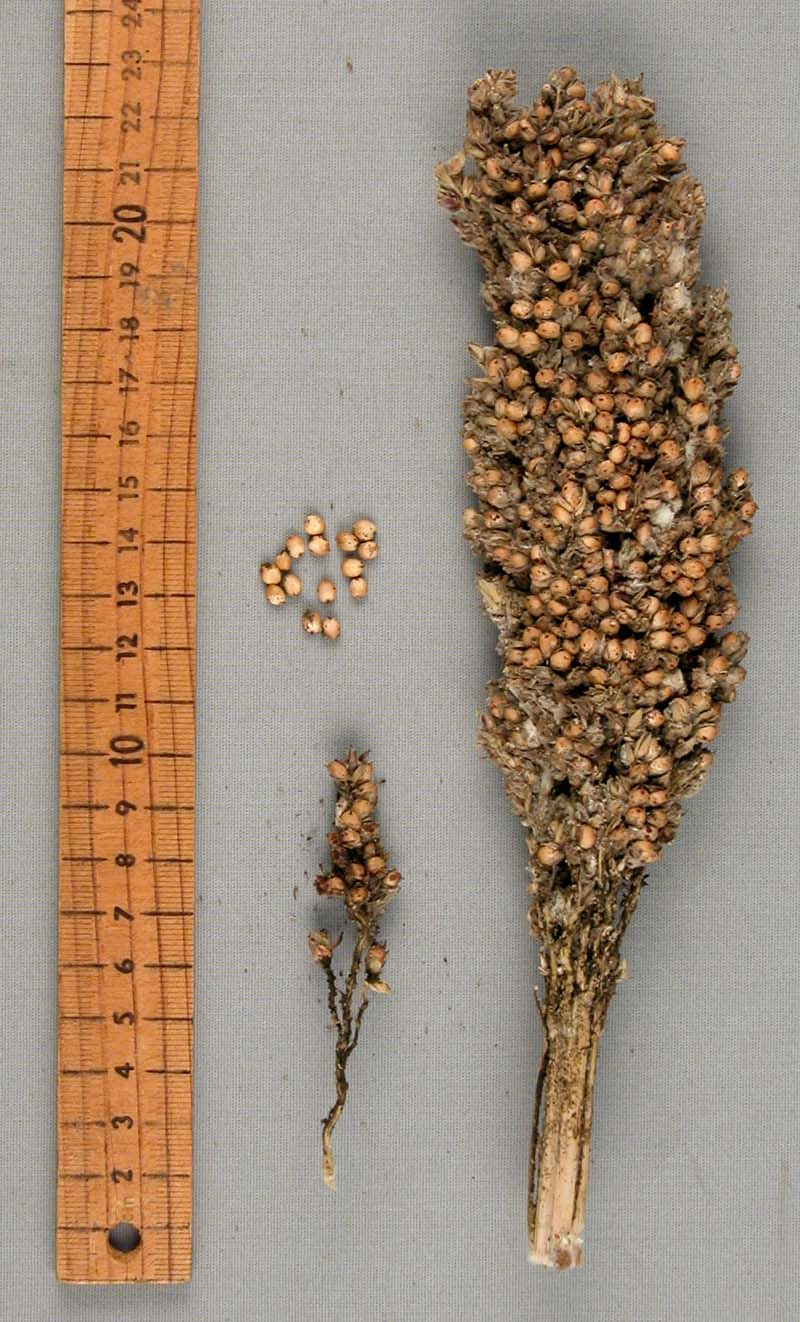 | | 1999 | DEVELOPED | | | | | | Breeding material | Biotype l greenbug (Schizaphis graminum) resistant seed parent. Seed white, black glumes, no pigmented testa, and is awned. Plant color purple, 3-dwarf height, and flowers in approx. 67 days from planting. Restores fertility to hybrids with the A1 cytoplasmic-genic male sterility system. | 1588744 | PI 612414 |
| 54 | PI 612415 | KS 110R | Sorghum bicolor (L.) Moench subsp. bicolor | Kansas, United States | S9 | | | 1999 | DEVELOPED | | | | | | Breeding material | Biotype l greenbug (Schizaphis graminum) resistant seed parent. Seed red, black glumes, no pigmented testa, and is awnless. Plant color purple, tall, 3-dwarf height, and flowers in approx. 74 days from planting. Restores fertility to hybrids with the A1 cytoplasmic-genic male sterility system. | 1588746 | PI 612415 |
| 55 | PI 612416 | KS 111R | Sorghum bicolor (L.) Moench subsp. bicolor | Kansas, United States | S9 | 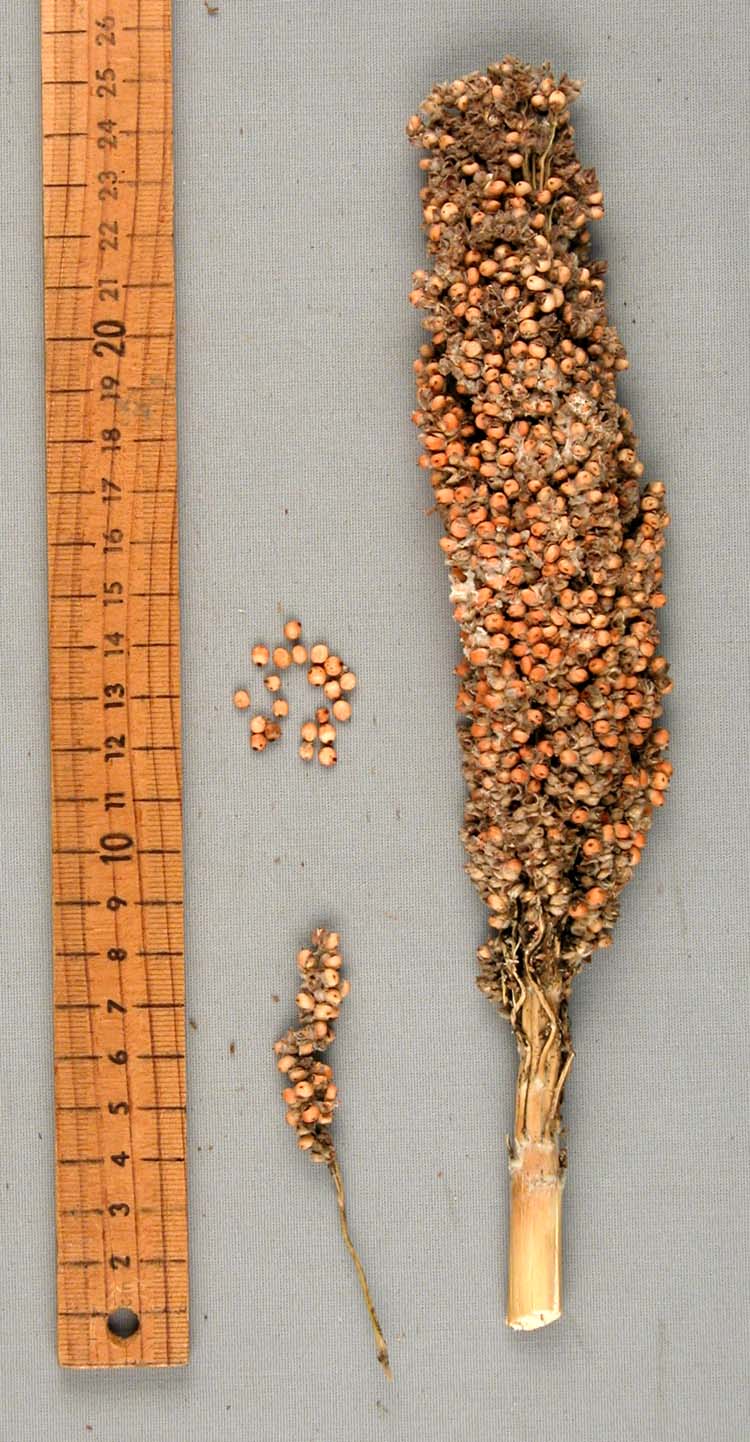 | | 1999 | DEVELOPED | | | | | | Breeding material | Biotype l greenbug (Schizaphis graminum) resistant seed parent. Seed red, black glumes, no pigmented testa, and is awnless. Plant color purple, short, 3-dwarf height, and flowers in appprox. 68 days from planting. Restores fertility to hybrids with the A1 cytoplasmic-genic male sterility system. | 1588747 | PI 612416 |
| 56 | PI 612417 | KS 112R | Sorghum bicolor (L.) Moench subsp. bicolor | Kansas, United States | S9 | 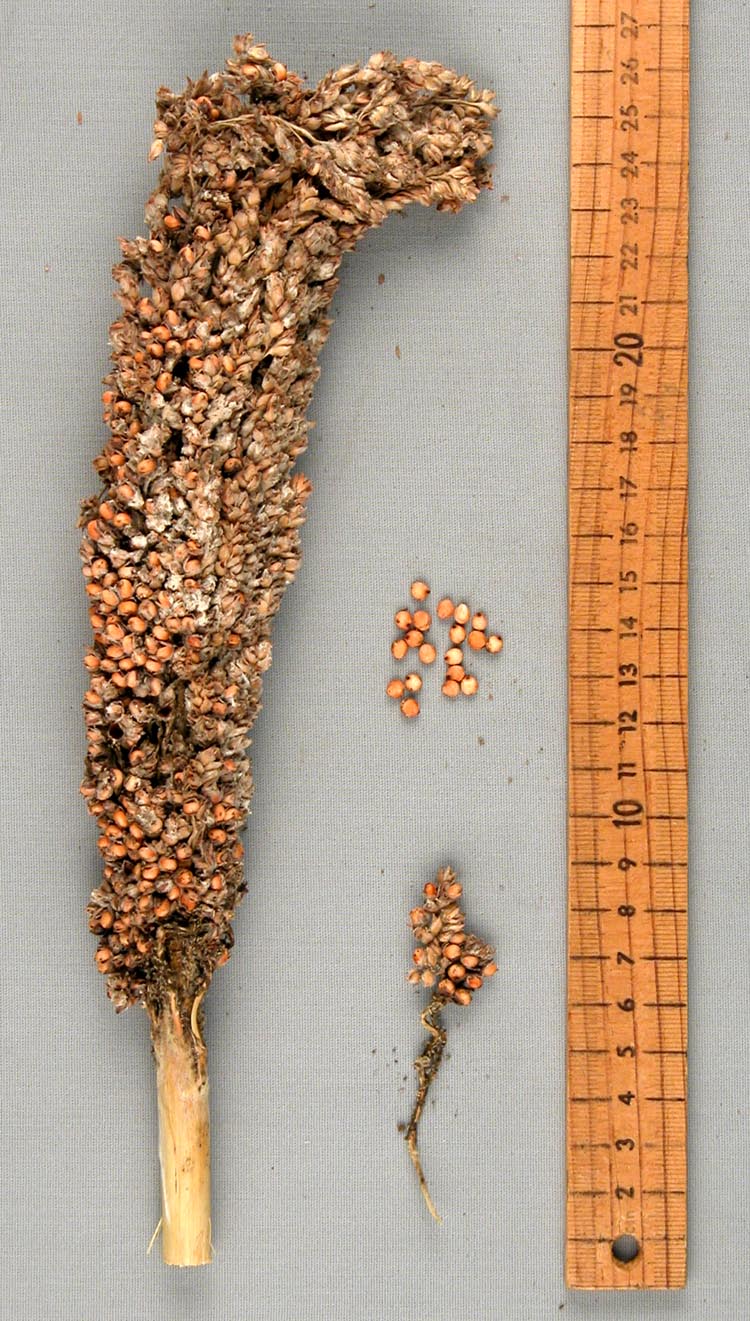 | | 1999 | DEVELOPED | | | | | | Breeding material | Biotype l greenbug (Schizaphis graminum) resistant seed parent. Seed red, black glumes, no pigmented testa, and is awnless. Plant color purple, short, 3-dwarf height, and flowers in approx. 73 days from planting. Restores fertility to hybrids with the A1 cytoplasmic-genic male sterility system. | 1588748 | PI 612417 |
| 57 | PI 612418 | KS 113R | Sorghum bicolor (L.) Moench subsp. bicolor | Kansas, United States | S9 | | | 1999 | DEVELOPED | | | | | | Breeding material | Biotype l greenbug (Schizaphis graminum) resistant seed parent. Seed white, straw colored glumes, no pigmented testa, and is awned. Plant color tan, 3-dwarf height, and flowers in approx. 73 days from planting. Restores fertility to hybrids with the A1 cytoplasmic-genic male sterility system. | 1588751 | PI 612418 |
| 58 | PI 612419 | KS 114R | Sorghum bicolor (L.) Moench subsp. bicolor | Kansas, United States | S9 | | | 1999 | DEVELOPED | | | | | | Breeding material | Biotype l greenbug (Schizaphis graminum) resistant seed parent. Seed white, sienna glumes, no pigmented testa, and is awnless. Plant color tan, 3-dwarf height, and flowers in approx. 76 days from planting. Restores fertility to hybrids with the A1 cytoplasmic-genic male sterility system. | 1588752 | PI 612419 |
| 59 | PI 607901 | KS 98 | Sorghum bicolor (L.) Moench subsp. bicolor | Kansas, United States | S9 | | | 1999 | DEVELOPED | 1999 | | | | | Breeding material | Elite, grain-sorghum pollinator that restores male fertility in A1 cytoplasm. Good general combining ability and hybrids produced are well-adapted to the dryland environments commonly found in the Central Great Plains. 3-dwarf genotype that flowers in 76 days and grows to a height of 100 cm. Possesses purple plant color and seeds have yellow endosperm and unpigmented testa. | 1578324 | PI 607901 |
| 60 | PI 606744 | N244 | Sorghum bicolor (L.) Moench subsp. bicolor | Nebraska, United States | S9 | | | 1998 | DEVELOPED | 11/09/1998 | | | | | Breeding material | R-line with potential to give high yielding hybrids. Anthesis in 86 days, averages 115 cm in height, purple plant color, white seed, and no pigmented testa. | 1571503 | PI 606744 |
| 61 | PI 606745 | N245 | Sorghum bicolor (L.) Moench subsp. bicolor | Nebraska, United States | S9 |  | | 1998 | DEVELOPED | 1998 | | | | | Breeding material | R-line with the potential to give high yielding hybrids. Anthesis in 72 days, averaged 95 cm in height, tan plant color, white seed, and no pigmented testa. | 1571504 | PI 606745 |
| 62 | PI 592505 | ICSB 88019 | Sorghum bicolor (L.) Moench subsp. bicolor | India | S9 | | | 1995 | DEVELOPED | | | | | | Breeding material | Midge-resistant seed parents based on A1 cytoplasmic-genetic male-sterility system. Flower 59-60 days. Good potential for producing midge-resistant hybrids in combination with midge-resistant restorers. Less susceptible to rust, leaf blight, zonate leaf spot, anthracnose and moderately susceptible to grain molds. | 1506765 | PI 592505 |
| 63 | PI 592506 | ICSB 88020 | Sorghum bicolor (L.) Moench subsp. bicolor | India | S9 | | | 1995 | DEVELOPED | | | | | | Breeding material | Midge-resistant seed parents based on A1 cytoplasmic-genetic male-sterility system. Flower 59-60 days. Good potential for producing midge-resistant hybrids in combination with midge-resistant restorers. Less susceptible to rust, leaf blight, zonate leaf spot, anthracnose, and moderately susceptible to grain molds. | 1506766 | PI 592506 |
| 64 | PI 574455 | BTx638 | Sorghum bicolor (L.) Moench subsp. bicolor | Texas, United States | S9 |  | | 1993 | DONATED | 10/25/1993 | | | | | Breeding material | 3dwarf (dw1DW2dw3dw4) with height of approx. 80cm. Plant color purplish-red. Seed color bright red-translucent, no pigmented testa. Awnless lemma, 8-10cm exsertion. Leaves broad, very erect with juicy midribs, few to no tillers. Strongly tropically adapted. Unusually uniform in height. Resistance to root lodging. Excellent general combining ability. Produces F1 hybrids unusually uniform in height and shorter than expected. F1 hybrids have intense red color grain on well exserted semi-compact panicles. Produce abund. pollen to maint. female or prod. other single-cross steriles | 1469426 | PI 574455 |
| 65 | PI 561072 | A/BTxARG-1 | Sorghum bicolor (L.) Moench subsp. bicolor | Texas, United States | S9 |  | | 1992 | DEVELOPED | | | | | | Breeding material | 3-dwarf (dw1DW2dw3dw4) with excellent exsertion. Kernel size medium. Seed color white translucent. Testa non-pigmented. Lemma awnless. Glumes straw colored. Inbred parent tan plant color, juicy midrib, non-erect leaves. Caryopses round, no mesocarp and intermediate vitreous waxy endosperm. Maturity medium. Weathering resistance good. Produces hybrids with good food quality | 1456044 | PI 561072 |
| 66 | PI 555675 | R LINE AR 3024 | Sorghum bicolor (L.) Moench subsp. bicolor | United States | S9 | | | 1991 | COLLECTED | | | | | | Breeding material | 3-dwarf R line that restores pollen to A(1) cytoplasm. Grain has a brownish white pericarp, brown testa, and straw glumes. Seed small and thresh freely from the glumes. Panicle exertion above the flag leaf (10cm), panicle type open. Plant averages 107cm in height. Flowers approximately 76 days after emergence. The head type resembles the shallus. This brown sorghum line gives hybrids excellent bird resistance. Leaves clean of diseases at midanthesis but deteriorate rapidly at maturity. Released in 1981. | 1450647 | PI 555675 |
| 67 | PI 552527 | A2/B2Tx636 | Sorghum bicolor (L.) Moench subsp. bicolor | Texas, United States | S9 | | | 1991 | DEVELOPED | | | | | | Breeding material | Pair of cytoplasmic-genetic male-sterile, maintainer lines. Genetically 3-dwarf (dw1Dw2dw3dw4). Resistant to insecticide phytotoxic reactions. Necrotic plant color red (PPqq). Seed color translucent red. Glumes non-clasping non-persistent. Endosperm normal, hard, intermediate. Excellent male sterility under environmental conditions tested. Combining ability good. Hybrid comparison trials with currently used commercial hybrids were non-significantly different in yield. Tolerance to downy mildew, head smut, leaf blight, leaf spot, and anthracnose. | 1447499 | PI 552527 |
| 68 | PI 552528 | A2/B2Tx637 | Sorghum bicolor (L.) Moench subsp. bicolor | Texas, United States | S9 | | | 1991 | DEVELOPED | | | | | | Breeding material | Pair of cytoplasmic-genetic male-sterile, maintainer lines. Genetically 3-dwarf (dw1Dw2dw3dw4). Resistant to insecticide phytotoxic reactions. Necrotic plant color purple (PPQQ). Seed color translucent red, size small. Glumes non-clasping non-persistent. Endosperm normal, hard, intermediate. Combining ability good. Hybrid comparison trials with currently used commercial hybrids were non-significantly different in yield. Tolerance to downy mildew, head smut leaf blight, leaf spot and anthracnose. | 1447500 | PI 552528 |
| 69 | PI 552851 | 7035S | Sorghum bicolor (L.) Moench subsp. bicolor | Nebraska, United States | S9 | | | 1991 | DEVELOPED | | | | | | Breeding material | Maturity medium early. Glume cream-colored. Awned. Seed color red. Sudangrass, low HCN level. Produces sorghum/sudangrass hybrids with grain sorghum female lines. Relatively low HCN level | 1447823 | PI 552851 |
| 70 | PI 542998 | B LINE AR 3028 | Sorghum bicolor (L.) Moench subsp. bicolor | United States | S9 | | | 1990 | DONATED | 08/03/1990 | | | | | Breeding material | Pericarp brownish pink, mesocarp starchy, testa brown, and glumes mahogany. Panicle exerted above the flag leaf. Panicle open. Plant height approximately 127cm. Flowers approximately 75 days. Stalks are sturdy and juicy. Produce few tillers. Hybrids have excellent blackbird resistance. | 1437934 | PI 542998 |
| 71 | PI 542999 | B LINE AR 3029 | Sorghum bicolor (L.) Moench subsp. bicolor | United States | S9 |  | | 1990 | DONATED | 08/03/1990 | | | | | Breeding material | 3-dwarf B line that is sterilized by A1 cytoplasm. Line developed as a B line for late silage sorghum hybrids. Percarp white, mesocarp starchy, glumes black. Does not thresh freely of glumes and contains a brown spot. Panicle exerted above the flag leaf (5cm). Panicle compact. Plant height approximately 85 days after emergence. | 1437935 | PI 542999 |
| 72 | PI 543002 | B LINE AR 3003 | Sorghum bicolor (L.) Moench subsp. bicolor | United States | S9 | | | 1990 | DONATED | 08/03/1990 | | | | | Breeding material | 3-dwarf B line that is sterilized with A1 cytoplasm. Percarp brownish pink, mesocarp starchy, testa brown, and glumes black. Panicle does not clear sheath (4cm). Panicle open. Plant height approximately 92cm. Flowers approximately 76 days after emergence. Hybrids extremely bird resistance. | 1437938 | PI 543002 |
| 73 | PI 543005 | B LINE AR 3013 | Sorghum bicolor (L.) Moench subsp. bicolor | United States | S9 | | | 1990 | DONATED | 08/03/1990 | | | | | Breeding material | Line developed as seed parent for leafy and late silage sorghum hybrids. Pericarp white and pearly, glumes black. Grain contains a brown spot. Panicle exerted above the flag leaf (3cm). Panicle semi-open. Plant height approximately 119cm. Flowers approximately 78 days. | 1437941 | PI 543005 |
| 74 | PI 543256 | R LINE AR 3010 | Sorghum bicolor (L.) Moench subsp. bicolor | United States | S9 | | | 1990 | COLLECTED | | | | | | Breeding material | 3-dwarf restorer line for A1 cytoplasm. Pericarp brownish white, mesocarp pearly, testa purple, and glumes mahogany (B1 B1 B2 B2 SSRRyyiiZZtp tp). Panicle exerted above the flag leaf (6cm). Panicle open. Plant height is approximately 120cm. Flowers approximately 74 days after emergence. The grain threshes extremely free of glumes. Resistant to Contarinia sorghicola. Hybrids KS57/ AR3010 and TX2755/ AR 3010 have little tannin and no bird resistance. These hybrids are 2-dwarf (Dw2 dw2 DW3 dw3). | 1438192 | PI 543256 |
| 75 | PI 536632 | A3Tx430 | Sorghum bicolor (L.) Moench subsp. bicolor | Texas, United States | S9 | | | 1989 | DONATED | 12/15/1989 | | | | | Genetic material | Male-sterile genetic stock for use in producing completely male-sterile hybrids for early testing as females in crosses with maintainer lines of other cytoplasmic-nuclear male-sterile systems to determine the potential vigor of hybrides made with RTx430. Maintainers RTx430 and RTx7000 selections. Anthers large, yellow and pointed. | 1431568 | PI 536632 |
| 76 | PI 536633 | A3Tx7000 | Sorghum bicolor (L.) Moench subsp. bicolor | Texas, United States | S9 | | | 1989 | DONATED | 12/15/1989 | | | | | Genetic material | Male-sterile genetic stock for use in producing completely male-sterile hybrids for early testing as females in crosses with maintainer lines of other cytoplasmic-nuclear male-sterile systems to determine the potential vigor of hybrides made with RTx7000. Maintainers are RTx7000 and RTx430. Anthers large, yellow, and pointed. | 1431569 | PI 536633 |
| 77 | PI 536016 | RTx2858 | Sorghum bicolor (L.) Moench subsp. bicolor | Texas, United States | S9 |  | | 1989 | DONATED | 10/12/1989 | | | | | Breeding material | Germplasm restorer line which carries resistance to maize dwarf mosaic virus (MDMV-A) and restores fertility to hybrids with A1-cytoplasmic genetic male-sterility system. Plant height 100cm. Panicles slightly oval,semi-open and erect. Exsertion excellent. Glumes purple. Midrib juicy. Pollen amount large. Seeds white translucent, medium in size size. Testa non pigmented. ZZ (no starch granules). | 1430952 | PI 536016 |
| 78 | PI 535781 | NP37 | Sorghum bicolor (L.) Moench subsp. bicolor | Nebraska, United States | S9 | | | 1989 | DONATED | 09/15/1989 | | | | | Breeding material | Population source using ms3 of reduced dhurrin content and A- and B- lines, for use in producing low-dhurrin sorghum- sudangrass or forage sorghum hybrids, with bmr-6 gene for brown midrib. Plant height average at maturity 110cm. Plants purple. Midrib brown. Caryopsis white. Segregates for genetic male-sterility (ms3). HCN-p mean 597mg per kg fresh weight for male-sterile bulk. | 1430717 | PI 535781 |
| 79 | PI 535786 | N101 | Sorghum bicolor (L.) Moench subsp. bicolor | Nebraska, United States | S9 | | | 1989 | DONATED | 09/15/1989 | | | | | Breeding material | Combine-height grain type germplasm with lower HCN-p for use in producing low HCN-p sorghum-sudangrass hybrids or grain sorghums with reduced HCN-p. Height 120cm. Plant color purple. Midrib green. Caryopsis white. HCN-p mean 442mg per kg fresh weight. | 1430722 | PI 535786 |
| 80 | PI 535787 | N102 | Sorghum bicolor (L.) Moench subsp. bicolor | Nebraska, United States | S9 | | | 1989 | DONATED | 09/15/1989 | | | | | Breeding material | Combine-height grain type germplasm with lower HCN-p for use in producing low HCN-p sorghum-sudangrass hybrids or grain sorghums with reduced HCN-p. Height 120cm. Plant color purple. Midrib green. Caryopsis white. | 1430723 | PI 535787 |
| 81 | PI 535788 | N103 | Sorghum bicolor (L.) Moench subsp. bicolor | Nebraska, United States | S9 | | | 1989 | DONATED | 09/15/1989 | | | | | Breeding material | Combine-height grain type permplasm with lower HCN-p from RP2B population for use in producing low HCN-p sorghum-sudangrass hybrids or source of grain sorghum with reduced HCN-p. Height average 150cm. Plants purple. Midribs brown. Caryopsis white. HCN-p mean 677mg. per kg fresh weight. | 1430724 | PI 535788 |
| 82 | PI 535789 | N104 | Sorghum bicolor (L.) Moench subsp. bicolor | Nebraska, United States | S9 |  | | 1989 | DONATED | 09/15/1989 | | | | | Breeding material | Germplasm source for use in production of hybrids, breeding programs and studies in which the bloomless and brown midrib traits effect forage quality and other agronomic traits. Plant height 120cm. Plants purple with bloom. Midrib green. Caryopsis light brown. Similar to Redlan, except presence of bloomless and/or brown midrib traits. | 1430725 | PI 535789 |
| 83 | PI 535790 | N105 | Sorghum bicolor (L.) Moench subsp. bicolor | Nebraska, United States | S9 |  | | 1989 | DONATED | 09/15/1989 | | | | | Breeding material | Germplasm source for use in production of hybrids, breeding programs and studies in which the bloomless and brown midrib traits effect forage quality and other agronomic traits. Plant height 115cm. Plants purple with bloom. Midrib brown. Caryopsis light brown. Similar to Redlan, except presence of bloomless and/or brown midrib traits. | 1430726 | PI 535790 |
| 84 | PI 535791 | N106 | Sorghum bicolor (L.) Moench subsp. bicolor | Nebraska, United States | S9 | | | 1989 | DONATED | 09/15/1989 | | | | | Breeding material | Germplasm source of for use in production of hybrids, breeding programs and studies in which the bloomless and brown midrib traits effect forage quality and other agronomic traits. Plant height 130cm. Plants purple, bloomless. Midrib green. Caryopsis light brown. Similar to Redlan, except presence of bloomless and/or brown midrib traits. | 1430727 | PI 535791 |
| 85 | PI 535793 | N108 | Sorghum bicolor (L.) Moench subsp. bicolor | Nebraska, United States | S9 |  | | 1989 | DONATED | 09/15/1989 | | | | | Breeding material | Inbred germplasm source of sweet sorghum female parent for use in hybrids and breeding programs. Days to bloom 75. Plant height 162cm. Plants tan. Midribs green. Caryopsis light tan. Brix (sugar) 17%. | 1430729 | PI 535793 |
| 86 | PI 535794 | N109 | Sorghum bicolor (L.) Moench subsp. bicolor | Nebraska, United States | S9 | 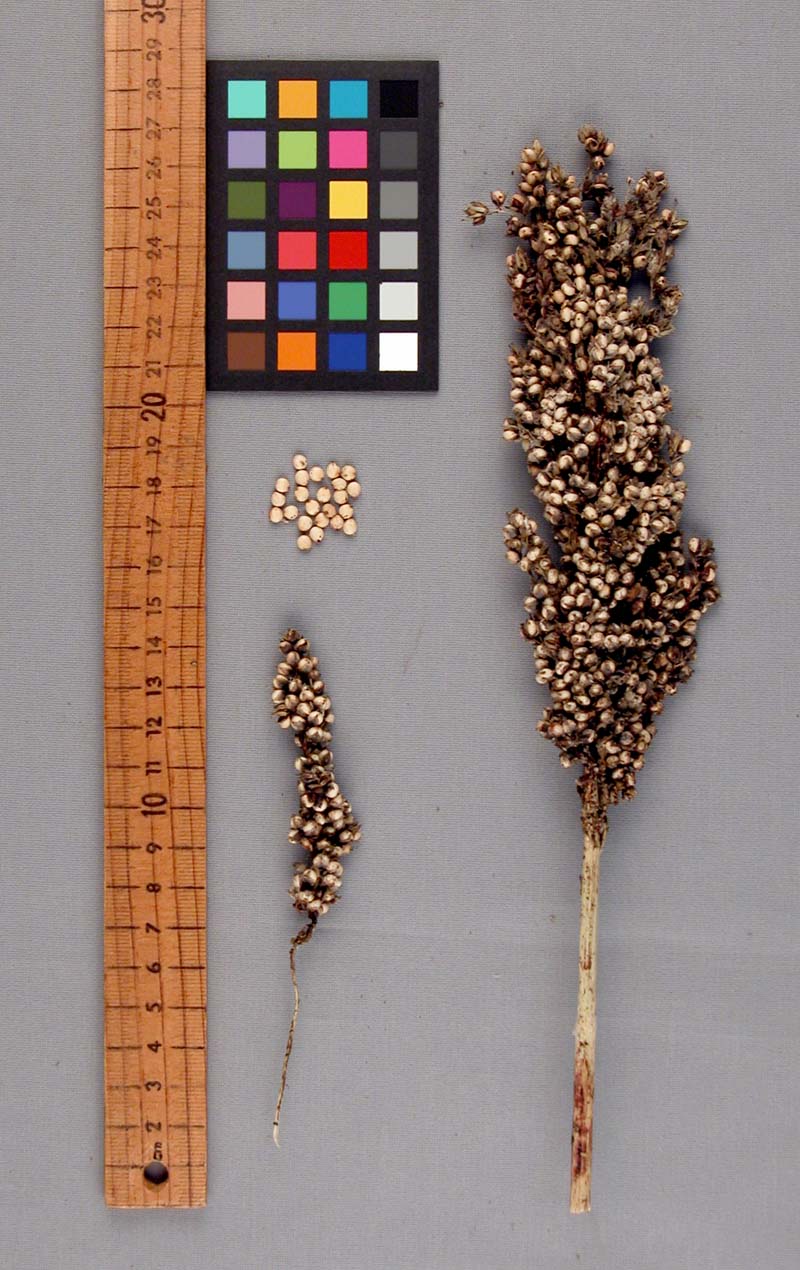 | | 1989 | DONATED | 09/15/1989 | | | | | Breeding material | inbred germplasm source of sweet sorghum female parent for use in hybrids and breeding programs. Days to bloom 75. Plant height 143cm. Plants purple. Midrib green. Caryopsis w white. Brix (sugar) 19%. | 1430730 | PI 535794 |
| 87 | PI 535795 | N110 | Sorghum bicolor (L.) Moench subsp. bicolor | Nebraska, United States | S9 | | | 1989 | DONATED | 09/15/1989 | | | | | Breeding material | Inbred germplasm source of sweet sorghum female parent for use in hybrids and breeding programs. Days to bloom 73. Plant height 256cm. Plants purple. Midrib green. Caryopsis brown. Brix (sugar)20%. | 1430731 | PI 535795 |
| 88 | PI 535796 | N111 | Sorghum bicolor (L.) Moench subsp. bicolor | Nebraska, United States | S9 | | | 1989 | DONATED | 09/15/1989 | | | | | Breeding material | Inbred germplasm source of sweet sorghum female parent for use in hybrids and breeding programs. Days to bloom 75. Plant height 260cm. Plants purple. Midrib green. Caryopsis brown. Brix (swugar) 20%. | 1430732 | PI 535796 |
| 89 | PI 533606 | IA59 | Sorghum bicolor (L.) Moench subsp. bicolor | United States | S9 | | | 1989 | COLLECTED | | | | | | Breeding material | Inbred pollen fertility restorer in A1 cytoplasm. Potential use in population development, production of new inbreds, and parents of hybrids. Plants short. Maturity medium-early. Panicle medium compact. Glumes mahogany. Awned. Seeds light red. | 1428542 | PI 533606 |
| 90 | PI 533607 | IA60 | Sorghum bicolor (L.) Moench subsp. bicolor | United States | S9 | | | 1989 | COLLECTED | | | | | | Breeding material | Inbred pollen fertility restorer in A1 cytoplasm. Potential use in population development, production of new inbreds, and parents of hybrids. Plants medium tall. Maturity medium-early. Panicle medium compact. Glumes sienna. Awned. Seed light red. | 1428543 | PI 533607 |
| 91 | PI 533608 | IA61 | Sorghum bicolor (L.) Moench subsp. bicolor | United States | S9 | | | 1989 | COLLECTED | | | | | | Breeding material | Inbred pollen fertility restorer in A1 cytoplasm. Potential use in population development, production of new inbreds, and parents of hybrids. Plants medium short. Maturity medium-late. Panicle medium open. Glumes mahogany color. Awnless. Seed light red. B-Line. | 1428544 | PI 533608 |
| 92 | PI 533609 | IA62 | Sorghum bicolor (L.) Moench subsp. bicolor | United States | S9 | | | 1989 | COLLECTED | | | | | | Breeding material | Inbred pollen fertility restorer in A1 cytoplasm. Potential use in population development, production of new hybrids, and parents of hybrids. Plant height medium. Maturity medium late. Panicle medium open. Glumes mahogany color. Awnless. Seeds dark red. | 1428545 | PI 533609 |
| 93 | PI 533610 | IA63 | Sorghum bicolor (L.) Moench subsp. bicolor | United States | S9 | | | 1989 | COLLECTED | | | | | | Breeding material | Inbred pollen fertility restorer in A1 cytoplasm. Potential use in population development, production of new inbreds, and parents of hybrids. Plant height medium. Maturity medium late. Panicle medium open. Glumes sienna color. Awnless. Seed color red. | 1428546 | PI 533610 |
| 94 | PI 533611 | IA64 | Sorghum bicolor (L.) Moench subsp. bicolor | United States | S9 | | | 1989 | COLLECTED | | | | | | Breeding material | Inbred pollen fertility restorer in A1 cytoplasm. Potential use in population development, production of new inbreds, and parents of hybrids. Plant height medium tall. Maturity medium late. Panicle medium compact. Glumes straw color. Awnless. Seeds red. | 1428547 | PI 533611 |
| 95 | PI 533612 | IA65 | Sorghum bicolor (L.) Moench subsp. bicolor | United States | S9 | | | 1989 | COLLECTED | | | | | | Breeding material | Inbred pollen fertility restorer in A1 cytoplasm. Potential use in population development, production of new inbreds, and parents of hybrids. Plant height medium. Maturity medium late. Panicle medium compact. Glumes mahogany color. Awnless. Seeds light red. | 1428548 | PI 533612 |
| 96 | PI 533613 | IA66 | Sorghum bicolor (L.) Moench subsp. bicolor | United States | S9 | | | 1989 | COLLECTED | | | | | | Breeding material | Inbred pollen fertility restorer in A1 cytoplasm. Potential use in population development, production of new inbreds, and parents of hybrids. Plant height medium short. Maturity late. Panicle medium open. Glumes sienna color. Awnless. Seeds light red. | 1428549 | PI 533613 |
| 97 | PI 533614 | IA67 | Sorghum bicolor (L.) Moench subsp. bicolor | United States | S9 | | | 1989 | COLLECTED | | | | | | Breeding material | Inbred pollen fertility restorer in A1 cytoplasm. Potential use in population development, production of new inbreds, and parents of hybrids. Plant height medium short. Maturity late. Panicle medium open. Glumes mahogany color, Awnless. Seeds light red. | 1428550 | PI 533614 |
| 98 | PI 533615 | IA68 | Sorghum bicolor (L.) Moench subsp. bicolor | United States | S9 | | | 1989 | COLLECTED | | | | | | Breeding material | Inbred pollen fertility restorer in A1 cytoplasm. Potential use in population development, production of new inbreds, and parents of hybrids. Plant height medium tall. Maturity Medium late. Panicle medium open. Glumes sienna color. Awned. Seeds light red. | 1428551 | PI 533615 |
| 99 | PI 533616 | IA69 | Sorghum bicolor (L.) Moench subsp. bicolor | United States | S9 | | | 1989 | COLLECTED | | | | | | Breeding material | Inbred pollen fertility restorer in A1 cytoplasm. Potential use in population development, production of new inbreds, and parents of hybrids. Plant height medium. Maturity medium. Panicle medium compact. Glumes mahogany color. Awned. Seeds light red. | 1428552 | PI 533616 |
| 100 | PI 533617 | IA70 | Sorghum bicolor (L.) Moench subsp. bicolor | United States | S9 | | | 1989 | COLLECTED | | | | | | Breeding material | Inbred pollen fertility restorer in A1 cytoplasm. Potential use in population development, production of new inbreds, and parents of hybrids. Plant height medium. Maturity medium. Panicle medium open. Glumes mahogany color. Awned. Seeds light red. | 1428553 | PI 533617 |
| 101 | PI 533618 | IA71 | Sorghum bicolor (L.) Moench subsp. bicolor | United States | S9 | | | 1989 | COLLECTED | | | | | | Breeding material | Inbred pollen fertility restorer in A1 cytoplasm. Potential use in population development, production of new inbreds, and parents of hybrids. Plant height medium tall. Maturity medium early. Panicle medium open. Glumes straw color. Awned. Seeds light red. | 1428554 | PI 533618 |
| 102 | PI 533619 | IA72 | Sorghum bicolor (L.) Moench subsp. bicolor | United States | S9 | | | 1989 | COLLECTED | | | | | | Breeding material | Inbred pollen fertility restorer in A1 cytoplasm. Potential use in population development, production of new inbreds, and parents of hybrids. Plant height medium tall. Maturity medium late. Panicle medium open. Glumes straw color. Awnless. Seeds light red. | 1428555 | PI 533619 |
| 103 | PI 533620 | IA73 | Sorghum bicolor (L.) Moench subsp. bicolor | United States | S9 | | | 1989 | COLLECTED | | | | | | Breeding material | Inbred pollen fertility restorer in A1 cytoplasm. Potential use in population development, production of new inbreds. and parents of hybrids. Plant height medium. Maturity medium early. Panicle open. Glumes straw color. Awnless. Seed dark red. | 1428556 | PI 533620 |
| 104 | PI 533621 | IA74 | Sorghum bicolor (L.) Moench subsp. bicolor | United States | S9 | | | 1989 | COLLECTED | | | | | | Breeding material | Inbred pollen fertility restorer in A1 cytoplasm. Potential use in population development, production of new inbreds, and parents of hybrids. Plant height medium tall. Maturity early. Panicle medium open. Glumes sienna color. Awnless. Seed red. | 1428557 | PI 533621 |
| 105 | PI 533622 | IA75 | Sorghum bicolor (L.) Moench subsp. bicolor | United States | S9 | | | 1989 | COLLECTED | | | | | | Breeding material | Inbred pollen fertility restorer in A1 cytoplasm. Potential use in population development, production of new inbreds, and parents of hybrids. Plant height short. Maturity medium. Panicle medium open. Glumes straw color. Awnless. Seeds light red. | 1428558 | PI 533622 |
| 106 | PI 533623 | IA76 | Sorghum bicolor (L.) Moench subsp. bicolor | United States | S9 | | | 1989 | COLLECTED | | | | | | Breeding material | Inbred pollen fertility restorer in A1 cytoplasm. Potential use in population development, production of new inbreds, and parents of hybrids. Plant height short. Maturity medium. Panicle open. Glumes straw color. Awned. | 1428559 | PI 533623 |
| 107 | PI 676787 | NP21R(M)C4 | Sorghum bicolor (L.) Moench subsp. bicolor | Nebraska, United States | S9 | | | 1985 | DONATED | 1985 | | | | | | Info. from Crop Sci. 27(3):614 (1987) -- random-mating populations. Diversity useful for either inbred line development or continued recurrent selection. Good agronomic traits. High yield. Stiff stalk. Moderate frequency plants with white seeds and seeds with yellow endosperm. Cultivated. | 1167940 | PI 676787 |
| 108 | PI 676788 | AOK8 BM | Sorghum bicolor (L.) Moench subsp. bicolor | Oklahoma, United States | S9 | | | 1985 | DONATED | 1985 | | | | | | Info. from Crop Sci. 26(4):842 (1986) -- bloomless. Resistant greenbug. Both biotypes C and E of the greenbug exhibit nonpreference for bloomless sorghum. Potential use in producing resistant hybrids. Cultivated. | 1168749 | PI 676788 |
| 109 | PI 676789 | BOK8 BM | Sorghum bicolor (L.) Moench subsp. bicolor | Oklahoma, United States | S9 | | | 1985 | DONATED | 1985 | | | | | | Info. from Crop Sci. 26(4):842 (1986) -- bloomless. Resistant greenbug. Both biotypes C and E of the greenbug exhibit nonpreference for bloomless sorghum. Potential use in producing resistant hybrids. Cultivated. | 1168750 | PI 676789 |
| 110 | PI 676790 | AOK11 BM | Sorghum bicolor (L.) Moench subsp. bicolor | Oklahoma, United States | S9 | | | 1985 | DONATED | 1985 | | | | | | Info. from Crop Sci. 26(4):842 (1986) -- bloomless. Resistant greenbug. Both biotypes C and E of the greenbug exhibit nonpreference for bloomless sorghum. Potential use in producing resistant hybrids. Cultivated. | 1168751 | PI 676790 |
| 111 | PI 676791 | BOK11 BM | Sorghum bicolor (L.) Moench subsp. bicolor | Oklahoma, United States | S9 | | | 1985 | DONATED | 1985 | | | | | | Info. from Crop Sci. 26(4):842 (1986) -- bloomless. Resistant greenbug. Both biotypes C and E of the greenbug exhibit nonpreference for bloomless sorghum. Potential use in producing resistant hybrids. Cultivated. | 1168752 | PI 676791 |
| 112 | PI 676792 | AWheatland bm | Sorghum bicolor (L.) Moench subsp. bicolor | Oklahoma, United States | S9 | | | 1985 | DONATED | 1985 | | | | | | Info. from Crop Sci. 26(4):842 (1986) -- bloomless. Resistant greenbug. Both biotypes C and E of the greenbug exhibit nonpreference for bloomless sorghum. Potential use in producing resistant hybrids. Cultivated. | 1168755 | PI 676792 |
| 113 | PI 676793 | BWheatland bm | Sorghum bicolor (L.) Moench subsp. bicolor | Oklahoma, United States | S9 | | | 1985 | DONATED | 1985 | | | | | | Info. Crop Sci. 26(4):842 (1986) -- bloomless sorghum. Used to produce hybrids resistant to greenbug (Schizaphis graminum). Cultivated. | 1168756 | PI 676793 |
| 114 | PI 676794 | ARedlan bm | Sorghum bicolor (L.) Moench subsp. bicolor | Oklahoma, United States | S9 | | | 1985 | DONATED | 1985 | | | | | | Info. from Crop Sci. 26(4):842 (1986) -- bloomless. Resistant greenbug. Both biotypes C and E of the greenbug exhibit nonpreference for bloomless sorghum. Potential use in producing resistant hybrids. Cultivated. | 1168757 | PI 676794 |
| 115 | PI 676795 | BRedlan bm | Sorghum bicolor (L.) Moench subsp. bicolor | Oklahoma, United States | S9 | | | 1985 | DONATED | 1985 | | | | | | Info. Crop Sci. 26(4):842 (1986) -- bloomless sorghum. Used to produce hybrids resistant to greenbug (Schizaphis graminum). Cultivated. | 1168758 | PI 676795 |
| 116 | PI 656003 | B AZ9504 | Sorghum bicolor (L.) Moench subsp. bicolor | Arizona, United States | S9 | 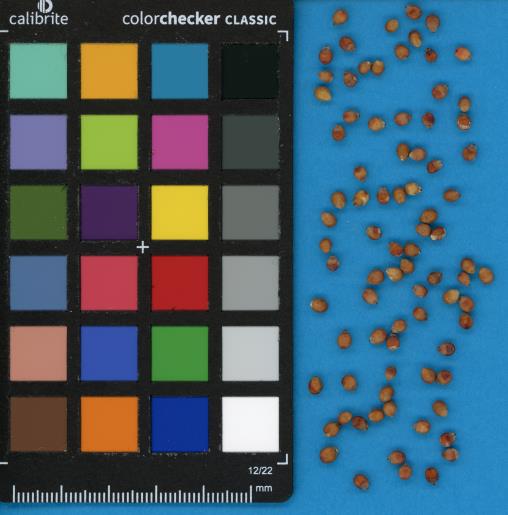 | | 1984 | DONATED | 1984 | | | | | | Info. from Crop Sci. 23(3):601 (1983) -- germplasm with milo cytoplasmic-genic sterility (A1) system. Used to produce high yielding forage type hybrids. Plant height 120 to 150 cm. Stalk medium size. Medium sweet and juicy. Leaves medium to narrow width. Opaque midribs. Panicles semicompact. Small dark brown seeds enclosed in dark brown awnless glumes. Cultivated. | 1161809 | PI 656003 |
| 117 | PI 700696 | 83BL2104 | Sorghum bicolor (L.) Moench subsp. bicolor | Georgia, United States | S9 | | | 1984 | DONATED | 1984 | | | | | | Info. Crop Sci. 24(5):1006 (1984) -- tolerant acid soil stress conditions. Has A1 (milo) cytoplasm. Medium to late maturity. Probable male-fertility restorers. Probable good yield potential and adaptation southeastern U.S. Can be used as source for developing inbreds/hybrids that tolerate more toxic (A1 and/or Mn saturation) acid soil stress conditions. Cultivated. | 1160136 | PI 700696 |
| 118 | PI 656000 | RTx432 | Sorghum bicolor (L.) Moench subsp. bicolor | Texas, United States | S9 |  | | 1983 | DONATED | 1983 | | | | | Breeding material | Info. from Crop Sci. 24(2):392 (1984) -- non-senescing. Adapted tropics. 3-dwarf. Food quality grain. High yield potential. Panicle rhomboid. Semicompact to open. Erect. Necrotic plant color red. Glume color red to light straw. Nonpersistent. Dull white or translucent medium size seeds. No pigmented testa. Thin mesocarp. Caryopses intermediate hardness. Normal starchy endosperm. Resistant anthracnose, downy mildew, rust, foliage disease, stem rotting organisms and head smut. Potential as male in hybrids. Cultivated. | 1157693 | PI 656000 |
| 119 | PI 655999 | TX2784 | Sorghum bicolor (L.) Moench subsp. bicolor | Texas, United States | S9 |  | | 1982 | DONATED | 1982 | | | | | | Info. from Crop Sci 23(2):405 (1983) -- resistant downy mildew pathotypes 1 and 2. Susceptible pathotype 3. Useful in production downy mildew resistant sorghum-sudangrass hybrids. Fertility restorer in A1 cytoplasm. Flowers in approx. 89 days. Sweet, juicy culms. Tan plant color. 220 cm tall. Erect leaf habit and panicles. Resistant downy mildew. Cultivated. | 1152631 | PI 655999 |
| 120 | PI 679464 | N30 | Sorghum bicolor (L.) Moench subsp. bicolor | Nebraska, United States | S9 | | | 1980 | DONATED | 1980 | | | | | | Info. from Crop Sci. 20(6):834 (1980) -- maintainer inbred line. Used for producing grain and forage sorghum hybrids. Early maturity. Red seed. Comparative data available (compared Redlan). Cultivated. | 1129421 | PI 679464 |
| 121 | PI 679466 | N32 | Sorghum bicolor (L.) Moench subsp. bicolor | Nebraska, United States | S9 | | | 1980 | DONATED | 1980 | | | | | | Info. from Crop Sci. 20(6):834 (1980) -- maintainer inbred line. Used for producing grain and forage sorghum hybrids. Genetic height tester stock. Heavily seeded. Juicy, non-sweet stem. White seed. Cultivated. | 1129423 | PI 679466 |
| 122 | PI 679468 | N39 | Sorghum bicolor (L.) Moench subsp. bicolor | Nebraska, United States | S9 | | | 1980 | DONATED | 1980 | | | | | | Info. from Crop Sci. 20(6):834 (1980) -- maintainer inbred line. Used for producing grain and forage sorghum hybrids. Stalks sweet and juicy. White seed. Cultivated. | 1129428 | PI 679468 |
| 123 | PI 679470 | N48 | Sorghum bicolor (L.) Moench subsp. bicolor | Nebraska, United States | S9 | | | 1980 | DONATED | 1980 | | | | | | Info. from Crop Sci. 20(6):834 (1980) -- maintainer inbred line. Used for producing grain and forage sorghum hybrids. Two dominant height genes. White seed. Cultivated. | 1129430 | PI 679470 |
| 124 | PI 685436 | N36 | Sorghum bicolor (L.) Moench subsp. bicolor | Nebraska, United States | S9 | | | 1980 | DONATED | 1980 | | | | | | Info. from Crop Sci. 20(6):834 (1980) -- maintainer inbred line. Used for producing grain and forage sorghum hybrids. Stalks sweet and juicy. White seed. Cultivated. | 1129426 | PI 685436 |
| 125 | PI 685437 | N38 | Sorghum bicolor (L.) Moench subsp. bicolor | Nebraska, United States | S9 | | | 1980 | DONATED | 1980 | | | | | | Info. from Crop Sci. 20(6):834 (1980) -- maintainer inbred line. Used for producing grain and forage sorghum hybrids. Stalks sweet and juicy. Waxy endosperm. White seed. Cultivated. | 1129427 | PI 685437 |
| 126 | PI 682504 | AZ9504 | Sorghum bicolor (L.) Moench subsp. bicolor | Arizona, United States | S9 | | | 1970 | DONATED | 1970 | | | | | | Info. from Crop Sci. 23(3):601 (1983) -- germplasm with milo cytoplasmic-genic sterility (A1) system. Used to produce high yielding forage type hybrids. Plant height 120 to 150 cm. Stalk medium size. Medium sweet and juicy. Leaves medium to narrow width. Opaque midribs. Panicles semicompact. Small dark brown seeds enclosed in dark brown awnless glumes. Cultivated. | 1116931 | PI 682504 |
| 127 | PI 685148 | TX 415 | Sorghum bicolor (L.) Moench subsp. bicolor | Texas, United States | S9 | | | 1965 | DONATED | 1965 | | | | | | Three-dwarf restorer line. Awned. Glumes brownish-black. Completely resistant head smut. Stalks juicy. Dull midribs. Used to produce head smut resistant hybrids. Some resistance chinch bugs. Cultivated. | 1098391 | PI 685148 |
| 128 | PI 655991 | TX 378 (REDLAN) B LINE | Sorghum bicolor (L.) Moench subsp. bicolor | Texas, United States | S9 |  | | 1962 | DONATED | 1962 | | | | | | Literature reference -- Texas AES MP-510 Publication, April 1961 "An Evaluation of Parents of Grain Sorghum Hybrids". | 1045183 | PI 655991 |
| 129 | PI 655992 | TX 3197 (COMB KAFIR 60) B LINE | Sorghum bicolor (L.) Moench subsp. bicolor | Texas, United States | S9 |  | | 1962 | DONATED | 1962 | | | | | | Literature reference -- Texas AES MP-510 April 1961 publication "An Evaluation of Parents of Grain Sorghum Hybrids". | 1045193 | PI 655992 |
| 130 | PI 655993 | TX 399(DALHART RES WHTLND)B LN | Sorghum bicolor (L.) Moench subsp. bicolor | Texas, United States | S9 |  | | 1962 | DONATED | 1962 | | | | | | Literature reference -- Texas AES MP-510 Publication, April 1961 "An Evaluation of Parents of Grain Sorghum Hybrids". | 1045213 | PI 655993 |
| 131 | PI 685141 A | TX 407 (2931) A LINE | Sorghum bicolor (L.) Moench subsp. bicolor | Texas, United States | S9 | | | 1962 | DONATED | 1962 | | | | | | Literature reference -- Texas AES MP-510 Publication, April 1961 "An Evaluation of Parents of Grain Sorghum Hybrids". | 1045115 | PI 685141 A |
| 132 | PI 685142 B | TX 407 (2931) B LINE | Sorghum bicolor (L.) Moench subsp. bicolor | Texas, United States | S9 | | | 1962 | DONATED | 1962 | | | | | | Literature reference -- Texas AES MP-510 Publication, April 1961 "An Evaluation of Parents of Grain Sorghum Hybrids". | 1045136 | PI 685142 B |
| 133 | PI 685143 A | TX 3197 (COMB KAFIR 60) A LINE | Sorghum bicolor (L.) Moench subsp. bicolor | Texas, United States | S9 | | | 1962 | DONATED | 1962 | | | | | | Literature reference -- Texas AES MP-510 April 1961 publication "An Evaluation of Parents of Grain Sorghum Hybrids". | 1045192 | PI 685143 A |
| 134 | PI 685144 A | TX 36 (605) A LINE | Sorghum bicolor (L.) Moench subsp. bicolor | Texas, United States | S9 | | | 1962 | DONATED | 1962 | | | | | | Literature reference -- Texas AES MP-510 Publication, April 1961 "An Evaluation of Parents of Grain Sorghum Hybrids". | 1045200 | PI 685144 A |
| 135 | PI 685145 B | TX 36 (605) B LINE | Sorghum bicolor (L.) Moench subsp. bicolor | Texas, United States | S9 | | | 1962 | DONATED | 1962 | | | | | | Literature reference -- Texas AES MP-510 Publication, April 1961 "An Evaluation of Parents of Grain Sorghum Hybrids". | 1045203 | PI 685145 B |
| 136 | PI 685292 | REDBINE 60 (R LINE) | Sorghum bicolor (L.) Moench subsp. bicolor | Texas, United States | S9 | | | 1962 | DONATED | 1962 | | | | | | Literature references -- 1) Texas AES MP-510 April 1961 publication 2) "An Evaluation of Parents of Grain Sorghum Hybrids". | 1045143 | PI 685292 |
| 137 | PI 685293 | COMBINE 7078 (R LINE) | Sorghum bicolor (L.) Moench subsp. bicolor | Texas, United States | S9 | | | 1962 | DONATED | 1962 | | | | | | Literature reference -- Texas AES MP-510, April 1961. "An Evaluation of Parents of Grain Sorghum Hybrids". | 1045152 | PI 685293 |
| 138 | PI 685294 | TX 9 (R LINE) | Sorghum bicolor (L.) Moench subsp. bicolor | Texas, United States | S9 | | | 1962 | DONATED | 1962 | | | | | | Literature reference -- Texas AES MP-510 Publication, April 1961 "An Evaluation of Parents of Grain Sorghum Hybrids". | 1045153 | PI 685294 |
| 139 | PI 685295 | CAPROCK (R LINE) | Sorghum bicolor (L.) Moench subsp. bicolor | Texas, United States | S9 | | | 1962 | DONATED | 1962 | | | | | | Literature reference -- Texas AES MP-510 Publication April 1961. "An Evaluation of Parents of Grain Sorghum Hybrids". | 1045162 | PI 685295 |
| 140 | PI 685296 | TX 404 (R LINE) | Sorghum bicolor (L.) Moench subsp. bicolor | Texas, United States | S9 | | | 1962 | DONATED | 1962 | | | | | | Literature reference -- Texas AES MP-510 Publication, April 1961 "An Evaluation of Parents of Grain Sorghum Hybrids". | 1045163 | PI 685296 |
| 141 | PI 685297 | TX 378 (REDLAN) A LINE | Sorghum bicolor (L.) Moench subsp. bicolor | Texas, United States | S9 | | | 1962 | DONATED | 1962 | | | | | | Literature reference -- Texas AES MP-510 Publication, April 1961 "An Evaluation of Parents of Grain Sorghum Hybrids". | 1045182 | PI 685297 |
| 142 | PI 685298 | TX 399(DALHART RES WHTLND)A LN | Sorghum bicolor (L.) Moench subsp. bicolor | Texas, United States | S9 | | | 1962 | DONATED | 1962 | | | | | | Literature reference -- Texas AES MP-510 Publication, April 1961 "An Evaluation of Parents of Grain Sorghum Hybrids". | 1045210 | PI 685298 |
| 143 | PI 685299 | REDBINE 58 (R LINE) | Sorghum bicolor (L.) Moench subsp. bicolor | Texas, United States | S9 | | | 1962 | DONATED | 1962 | | | | | | Literature reference -- 1) Texas AES Publication MP-510 April 1961 2) "An Evaluation of Parents of Grain Sorghum Hybrids". | 1045220 | PI 685299 |
| 144 | PI 669312 | 'BONITA' | Sorghum bicolor (L.) Moench subsp. bicolor | United States | S9 | | | 1960 | DEVELOPED | | | | | | | Info from Agron. J. 41(11):537, 1949. The heads of Bonita are compact and the leaf midribs are white; otherwise, the variety bears a close resemblance to Hegari. Bonita is early in maturity and, on account of its early maturity, it is shorter in stature than Hegari, although it is genetically dwarf. The seed is very similar to that of Hegari and has a white pericarp and a brown testa. Genetic studies have shown that only a few genes differentiate Bonita from Hegari. First generation hybrids of Bonita and Hegari parentage cannot be distinguished from Hegari, but are a few days later in maturity. Bonita has consistently produced high yields of grain. It is dwarf enough to be harvested with the combine although it has an unfortunate tendency to produce sidebranches and tillers that sometimes interfere with the timely harvesting of dry grain. It grows tall enough to be harvested with the row binder. Grain production with Bonita has been above that of other varieties of double dwarf stature in the Rolling Plains area of Texas.Cultivated. | 1026533 | PI 669312 |
| 145 | PI 608766 | B79 | Zea mays L. subsp. mays | Iowa, United States | NC7 |  | | 1992 | DEVELOPED | | | | | | Breeding material | B79 is a yellow dent inbred line selected from Iowa Two-ear Synthetic No. 1 (PI 550446 registered in Crop Sci.11:140-141), a synthetic developed by intermating 10 inbred lines of USA North Central Corn Belt maturity that had strong potential to develop two ears/plant. Iowa Two-ear Synthetic No. 1 [BS10(FR)C0] was used as one of the populations for the reciprocal full-sib selection program described by Hallauer (Crop Sci. 7:192-195; Crop Sci. 14:341-342). Selection and self pollination in the ear-to-row system for several generations has given a genotype that produces a high frequency of harvestable second ears at moderate plant densities. The date of silk emergence of B79 is 3 to 4 days later than inbred B14A. Pollen production is satisfactory; silks emerge about 2 days after the first shedding of pollen; and seed set is good on both ears. The seed has intermediate size with a reddish color, and seed yield is relatively high. The line has intermediate resistance to broods of the European corn leaf blight, first and second broods of the European corn borer, but it is susceptible to sorghum downy mildew. Yield data from single-cross evaluations for 4 years in Iowa show that B79 had the highest average yield of the lines tested in single crosses with Mo17. Although the line is late in silk emergence, this lateness is not evident in single crosses on the basis of grain moisture at harvest. The inbred contributes a strong root system to hybrids; its contribution for stalk strength is adequate, but not outstanding. Extensive evaluation has shown that B79 is adapted to southern and south-central Iowa. Maturity classification is late AES800. | 1082039 | PI 608766 |
| 146 | PI 608774 | B75 | Zea mays L. subsp. mays | Iowa, United States | NC7 |  | | 1992 | DEVELOPED | | | | | | Breeding material | B75 is a yellow dent germplasm line selected from BSCB3 (PI 550450 registered in Crop Sci. 11:140-141) which is a synthetic developed by intermating l6 inbred lines of USA North Central Corn Belt maturity that had good resistance to leaf feeding by the European corn borer. This single-eared line has been developed by selection and self pollination in the ear-to-row system for eight generations. The tassel has only one or two lateral branches, but the pollen production is satisfactory. Silk emergence, which occurs 2 to 3 days after the first shedding of pollen, is 2 to 3 days earlier than that of inbred Bl4A. The seed is relatively large and yield is good. It is highly resistant to leaf feeding by first-brood European corn borer, but is moderately susceptible to leaf-sheath and collar feeding by second brood. It has good field resistance to sorghum downy mildew, moderate resistance to southern corn leaf blight (race O) and northern corn leaf blight, and low-level resistance to maize dwarf mosaic virus and maize chlorotic dwarf virus. Evaluations in single-crosses have shown that B75 contributes average yield to hybrids, but does not contribute good root strength. Although it has good resistance to stalk rots, stalk strengths in hybrids is only average. Maturity classification is late AES700. | 1082037 | PI 608774 |