| 0 | PI 687369 | V. tenellum DBS 18-15 | Vaccinium tenellum Aiton | North Carolina, United States | COR | | | 2018 | COLLECTED | | | | | | Wild material | | 1963375 | PI 687369 |
| 1 | PI 679668 | V. tenellum Carolina Beach St. Pk. | Vaccinium tenellum Aiton | North Carolina, United States | COR | | | 2015 | COLLECTED | 06/20/2015 | Carolina Beach State Park | | | | Wild material | open pollinated seed from about 20 fruits. Fruit diameter from 0.5 to 0.75 cm. Fruit dark purple to black. Pedicel persistent. | 1926904 | PI 679668 |
| 2 | PI 657222 | V. tenellum HD-2007-013 | Vaccinium tenellum Aiton | North Carolina, United States | COR | 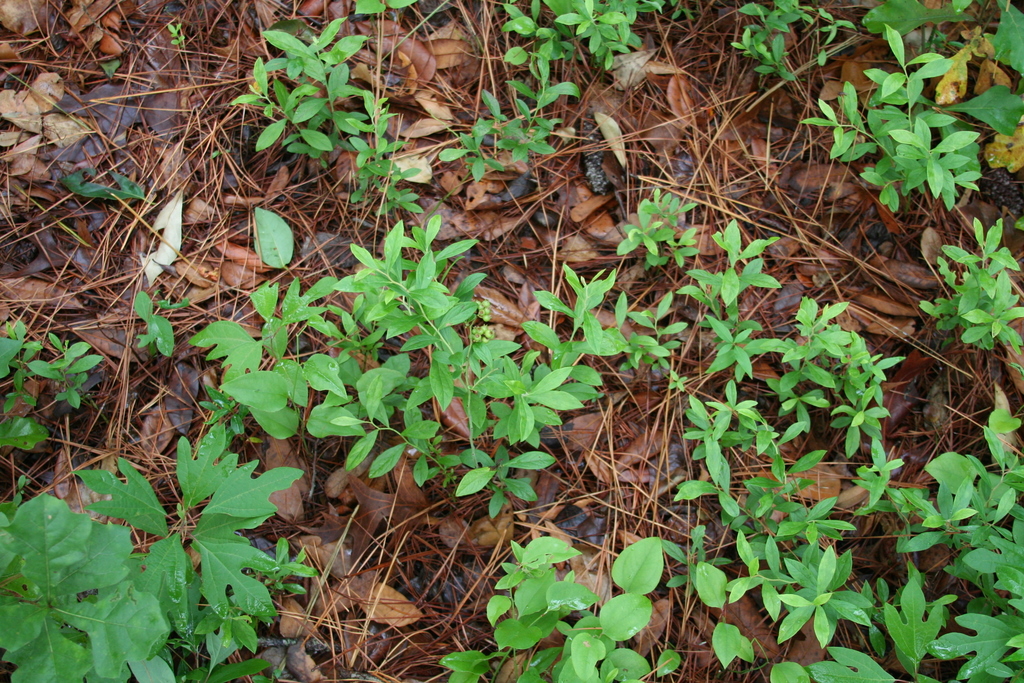 | | 2007 | COLLECTED | 06/02/2007 | Wahoo Willy's restaurant northeast of Willmington on US 17 (Market Street), New Hanover County. Woody forest to right (southwest) of the restaurant. | 34.28500000, -77.80620000 | 7 | Associated with: Smilax, Dryopterus, Castanea, Pinus and Vaccinium arboreum. | Wild material | Kim Hummer, Michael Dossett collected from North Carolina.
| 1730113 | PI 657222 |
| 3 | PI 638386 | V. tenellum NJ 88-31-55 | Vaccinium tenellum Aiton | Georgia, United States | COR | | | 2003 | COLLECTED | 1988 | Turner County | 31.70740000, -83.62180000 | | | Wild material | Nick Vorsa USDA collection. V. tennellum hybrid | 1646443 | PI 638386 |
| 4 | PI 618184 | V. tenellum NC 96-2-2 | Vaccinium tenellum Aiton | North Carolina, United States | COR |  | | 1997 | COLLECTED | 05/13/1997 | Lake Waccamaw State Park, Columbus county. | 34.25944000, -78.47750000 | 15 | Mostly vicinity of parking lot and restrooms. Poccsin type vegetation, around woods edges. | Wild material | Jim Ballington collection
| 1559888 | PI 618184 |
| 5 | PI 555333 | V. tenellum NJ 87-52 # 18 | Vaccinium tenellum Aiton | Virginia, United States | COR | 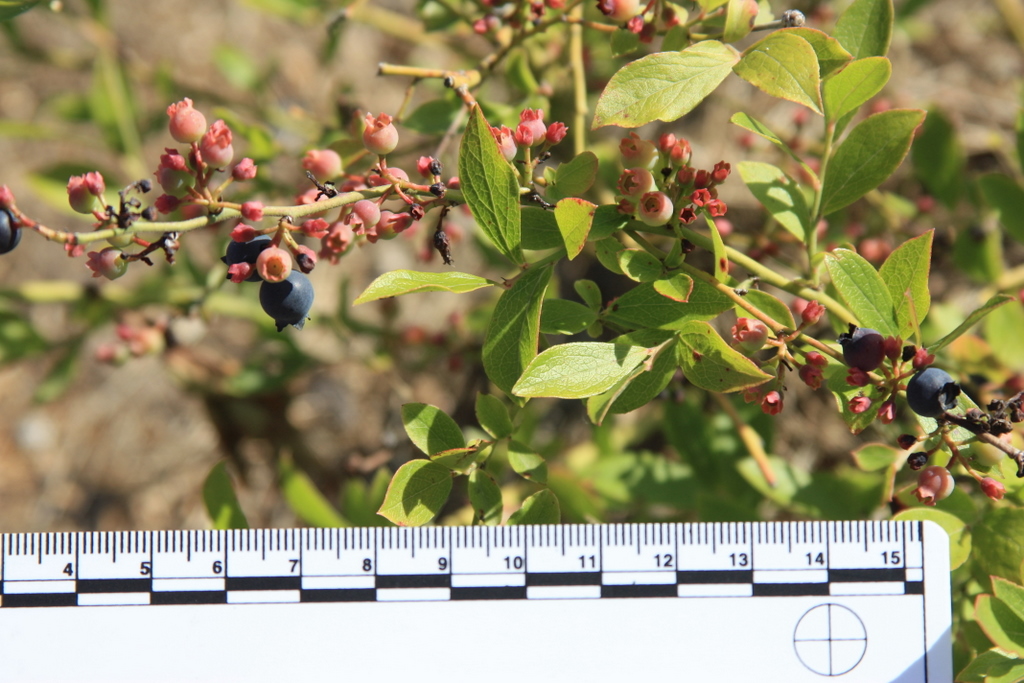 | | 1990 | COLLECTED | 10/12/1987 | Along Highway 614 in Southampton county about 0.3 miles from landmark west of Zuni, Isle of Wight county. | | 0 | Well-drained sloping with wooded stream. Variable, but contiguous wooded area with Vacciniuim pallidum and V. elliottii. | Wild material | | 1450305 | PI 555333 |
| 6 | PI 555328 | V. tenellum B-52-1 | Vaccinium tenellum Aiton | United States | COR | | | 1983 | COLLECTED | | Lexington County | 34.00000000, -81.16667000 | | Lexington County | Wild material | | 1450300 | PI 555328 |
| 7 | PI 555330 | V. tenellum 1974 | Vaccinium tenellum Aiton | South Carolina, United States | COR | | | 1983 | COLLECTED | | Berkeley County | 33.16667000, -80.00000000 | | | Wild material | Jim Ballington collection
| 1450302 | PI 555330 |
| 8 | PI 618033 | 'Bladen' | Vaccinium hybr. | North Carolina, United States | COR |  | | 1992 | DEVELOPED | 1994 | | | | | Cultivar | Berry: size medium (about the same as Croatan); dark blue; scar, firmness, and flavor good. Flowers a few days before Croatan in eastern North Carolina, and ripens about the same time as Reveille and O'Neal and somewhat before Croatan. Bush: upright; vigoruous; good productiveity; not completely self-fruitful and should be interplanted with another clone, such as Reveille; resistant to cane canker; field tolerance to stem blight. - Brooks and Olmo Register of Fruit and Nut Varieties. 1997. ASHS Press. p. 175.Tetraploid 'southern highbush' type involving 3 species of Southern origin: V. darrowi, V. ashei, and V. tenellum This blueberry genotype is intended for release as a complementary cultivar to 'Reveille'. 'Bladen' is superior to 'Reveille, in fruit color development at harvest and for resistance to fruit cracking in wet weather.'Bladen' is early ripening (generally a little earlier than 'Reveille' and 'O'Neal') with good productivity, quality, fruit color, firmness, picking scar, and modest fruit size. It is the second highbush blueberry cultivar developed in North Carolina that is adapted to mechanical harvesting for fresh market outlets.Mechanically harvested fruit of 'Bladen' is equal or superior to hand harvested fruit of 'Croatan' for both fruit color and firmness. Picking ease is similar to 'Croatan', placing it in the desirable range for mechanical harvesting. The soluble solids/acids ration of the ripe fruit is significantly lower than 'Croatan' and similar to 'Bounty', indicating good potential for extended shelf life. Fruit storage studies also indicate that the shelf life of machine and hand-harvested fruit of 'Bladen' is generally superior to 'Croatan'.'Bladen' bushes are upright and vigorous with a slightly wider canopy than 'Reveille'. In greenhouse studies, the blossoms were not completely self fruitful. Planting a pollinator cultivar such as 'Reveille' or 'O'Neal' in every 5th row will insure adequate cross-pollination. Ripening is 4 to 5 days earlier than 'Reveille' if no freeze damage occurs to blossoms. Blossoming is also earlier than 'Reveille' -thus making freeze-protection irrigation absolutely essential for reliable cropping. 'Bladen' roots readily from either softwood or hardwood cuttings. It has shown excellent field resistance to stem canker, and some tolerance to stem blight and mummy berry.
S. D. Rooks, J. R. Ballington, and C. M. Mainland cultivar release; selected at Castle Hayne, North Carolina N. C. Foundation Seed provided plant material to NCGR
| 1010739 | PI 618033 |
| 9 | PI 616689 | F. virginiana subsp. virginiana NC 95-4-1 | Fragaria virginiana Mill. subsp. virginiana | South Carolina, United States | COR | | Out of Season | 1995 | COLLECTED | 06/12/1995 | South Carolina, Williamsburg county, Creel Farm, Henry community. South from Hemingway on SC 41 to county road 121 , left on 121 for 4.5 miles to SC 512 in Henry. Just across SC 512 on 121, to Creel farm. | 34.32111000, -79.28556000 | 0 | Woodland, currently w/ a heavy canopy of mostly deciduous trees. V. tenellum, R. trivialis and R. flagellans occasionally in the woods and along the field edge. | Wild material | South Carolina was extremely frustrating, by the middle of the week we had only verified the existence of one location for Fragaria virginiana in the Coastal Plain, so we moved over into the southern piedmont. Three accessions were located in the Edgefield District of Sumter National Forest and four in Greenwood State Park. The one verified Coastal Plain location is in a garden near Lexington, SC. Twelve accessions of Vaccinium spp., four of Gaylussacia frondosa, and one of Rubus argutus were also collected. Southeastern Louisiana and Mississippi were more successful, but not abundant in these areas either. No accessions were found south of Starkville, MS. Specific previous sites were visited near Hattisburg and Laurel, MS, but F. virginiana was no longer present. A total 33 accessions of F. virginiana were collected from east central and northeastern MS, occurring in small outcroppings of prairie; characterized by a very thin layer of 'usually' sticky black soil over decaying limestone with scattered to dense overstory of Juniperus virginiana. Fragaria virginiana was often found growing directly under J. virginiana where little other vegetation occurred. Dr. Sidney McDaniel of Mississippi State University refers to these areas as 'cedar prairie woodlands'. In addition to F. virginiana, 14 accessions of Vaccinium spp. and two accessions Rubus flagellaris were also collected. These trips raise serious questions concerning the status of Fragaria virginiana in the southeastern US. Is it really as rare as it appears to be? In Greenwood State Park in South Carolina, the species was pioneering on bare ground two years after clearcutting. In Mississippi it was not found in such areas, although one herbarium specimen came from the edged of wildlife food plot. People in almost every area told us how abundant wild strawberries were on their property or in their region, but these almost always turned out to be either Duchesnea indica, or Potentilla canadensis. | 1507705 | PI 616689 |