| 0 | PI 293109 | b 41-11 M21 | Vitis arizonica Engelm. | Mexico | DAV | | | 1983 | COLLECTED | 08/1961 | Rain forest 5.5 miles west of Naranjo, San Luis Potosi. | | | | | Per PI book: "Vine in trees, fruitful; leaves large; shoots tomentose; fruit dull black, currant size, in short pyramidal clusters; 2 clusters per shoot." Type = species. DVIT 1871 flower type = male. DVIT 1872 flower type = female. | 1564021 | PI 293109 |
| 1 | DVIT 3209 | AZ 0423 Site 7 | Vitis arizonica Engelm. | Arizona, United States | DAV | | | 2004 | COLLECTED | 10/13/2004 | Collected from Coronado National Forest in the Chiricahua Mountains, AZ, at the mouth of a canyon. Hwy 191 north to Hwy 181, then east toward the Chiracahua National Monument. Turn up Pinery Canyon Road into National Forest. | 31.94500000, -109.29972222 | 1903 | Surrounding vegetation: Sedium stelliforme Pine-oak woodland with Pinus engelmannii, Pinus leiophylla var. chihuahuana, Pseudotsuga menziesii, Quercus arizonica, Quercus hypoleucoides, Quercus rugosa, Yucca schottii, herbaceous taxa | Wild material | Type = Species. | 1688583 | DVIT 3209 |
| 2 | DVIT 1269 | DVIT 1269 | Vitis arizonica Engelm. | California, United States | DAV | | | 1981 | DONATED | 01/01/1981 | | | | | Uncertain improvement status | Type = species. Flower = female. | 1012579 | DVIT 1269 |
| 3 | PI 588410 | GVIT 727 | Vitis hybr. | Unknown | GEN |  | | 1987 | DONATED | 03/10/1987 | | | | | Cultivated material | Small blue berries. | 1008393 | PI 588410 |
| 4 | PI 588413 | GVIT 730 | Vitis hybr. | Unknown | GEN |  | | 1987 | DONATED | 03/10/1987 | | | | | Cultivated material | Small blue berries. | 1008422 | PI 588413 |
| 5 | DVIT 2840 | 'Olmo 16-167' | Vitis hybr. | California, United States | DAV | | | 1999 | COLLECTED | | | | | | Breeding material | Fruit type: Interspecific hybrid grape | 1619809 | DVIT 2840 |
| 6 | DVIT 2841 | 'Olmo 16-172' | Vitis hybr. | California, United States | DAV | | | 1999 | COLLECTED | | | | | | Breeding material | Fruit type: Interspecific hybrid grape | 1619871 | DVIT 2841 |
| 7 | DVIT 2885 | 'Olmo q9-65' | Vitis hybr. | California, United States | DAV | | | 1999 | COLLECTED | | | | | | Breeding material | Fruit type: Interspecific hybrid grape | 1619846 | DVIT 2885 |
| 8 | DVIT 2886 | 'Olmo q9-70' | Vitis hybr. | California, United States | DAV | | | 1999 | COLLECTED | | | | | | Breeding material | Fruit type: Interspecific hybrid grape | 1619847 | DVIT 2886 |
| 9 | DVIT 1149 | DVIT 1149 | Vitis treleasei Munson ex L. H. Bailey | California, United States | DAV | | | 1983 | DONATED | 01/01/1983 | | | | | Wild material | Type = American hybrid. Per Hedrick (see citation): [About V. treleasei] "1. Bailey, Gray's Syn. Fl., I:243. 1897 2. Munson, Tex. Sta. Bul., 56:230, 239. 1900. Smooth Canyon Grape.Plant shrubby and much branched, climbing little, the small and mostly short (generally shorter than the leaves) tendrils deciduous the first year unless finding support, internodes short, the diaphragms twice thicker (about 1/16 inch) than in the V. riparia and shallow-biconcave; stipules less than one quarter as large as in V. riparia; leaves thin, glabrous and shining on both surfaces, the basal sinus very broad and open making no distinct angle with the petiole, the margin unequally notch-toothed (not jagged as in V. riparia) and indistinctly three-lobed, the apex much shorter than in V. riparia; cluster small (2 to 3 inches long): the berries 1/3 inch or less thick, black with a thin bloom, ripening three weeks later than V. riparia when grown in the same and possibly a dry country form of V. riparia. In habit it suggests V. arizonica var. glabra, from which it is distinguished, among other things, by its decidedly earlier flowering and larger leaves with coarser teeth and less pointed apex. According to Munson Vitis treleasei inhabits 'ravines and gulches of western New Mexico, Arizona and southern Utah.' This species was named by Munson but the only description we have been able to find is that of Bailey given above in which we have changed his 'vulpina' to 'riparia.' The species is of no importance horticulturally." | 1011740 | DVIT 1149 |
| 10 | DVIT 1198 | 'OLMO d16 (d1-100)' | Vitis hybr. | California, United States | DAV | | | 1983 | DEVELOPED | | | | | | Breeding material | Type = interspecific hybrid. Flower = male. | 1012090 | DVIT 1198 |
| 11 | DVIT 1377 | R67-45 | Vitis treleasei Munson ex L. H. Bailey | California, United States | DAV | | | 1983 | DONATED | 01/01/1983 | | | | | Wild material | Type = American Hybrid. Per Hedrick (see citation): [About V. treleasei] "1. Bailey, Gray's Syn. Fl., I:243. 1897 2. Munson, Tex. Sta. Bul., 56:230, 239. 1900. Smooth Canyon Grape.Plant shrubby and much branched, climbing little, the small and mostly short (generally shorter than the leaves) tendrils deciduous the first year unless finding support, internodes short, the diaphragms twice thicker (about 1/16 inch) than in the V. riparia and shallow-biconcave; stipules less than one quarter as large as in V. riparia; leaves thin, glabrous and shining on both surfaces, the basal sinus very broad and open making no distinct angle with the petiole, the margin unequally notch-toothed (not jagged as in V. riparia) and indistinctly three-lobed, the apex much shorter than in V. riparia; cluster small (2 to 3 inches long): the berries 1/3 inch or less thick, black with a thin bloom, ripening three weeks later than V. riparia when grown in the same and possibly a dry country form of V. riparia. In habit it suggests V. arizonica var. glabra, from which it is distinguished, among other things, by its decidedly earlier flowering and larger leaves with coarser teeth and less pointed apex. According to Munson Vitis treleasei inhabits 'ravines and gulches of western New Mexico, Arizona and southern Utah.' This species was named by Munson but the only description we have been able to find is that of Bailey given above in which we have changed his 'vulpina' to 'riparia.' The species is of no importance horticulturally." | 1013383 | DVIT 1377 |
| 12 | DVIT 1378 | R67-50 | Vitis treleasei Munson ex L. H. Bailey | California, United States | DAV | | | 1983 | DONATED | 01/01/1983 | | | | | Wild material | Type = American Hybrid. Per Hedrick (see citation): [About V. treleasei] "1. Bailey, Gray's Syn. Fl., I:243. 1897 2. Munson, Tex. Sta. Bul., 56:230, 239. 1900. Smooth Canyon Grape.Plant shrubby and much branched, climbing little, the small and mostly short (generally shorter than the leaves) tendrils deciduous the first year unless finding support, internodes short, the diaphragms twice thicker (about 1/16 inch) than in the V. riparia and shallow-biconcave; stipules less than one quarter as large as in V. riparia; leaves thin, glabrous and shining on both surfaces, the basal sinus very broad and open making no distinct angle with the petiole, the margin unequally notch-toothed (not jagged as in V. riparia) and indistinctly three-lobed, the apex much shorter than in V. riparia; cluster small (2 to 3 inches long): the berries 1/3 inch or less thick, black with a thin bloom, ripening three weeks later than V. riparia when grown in the same and possibly a dry country form of V. riparia. In habit it suggests V. arizonica var. glabra, from which it is distinguished, among other things, by its decidedly earlier flowering and larger leaves with coarser teeth and less pointed apex. According to Munson Vitis treleasei inhabits 'ravines and gulches of western New Mexico, Arizona and southern Utah.' This species was named by Munson but the only description we have been able to find is that of Bailey given above in which we have changed his 'vulpina' to 'riparia.' The species is of no importance horticulturally." | 1013389 | DVIT 1378 |
| 13 | DVIT 1410 | DVIT 1410 | Vitis treleasei Munson ex L. H. Bailey | California, United States | DAV | | | 1983 | DONATED | 01/01/1981 | | | | | Wild material | Type = species. Flower = female. Per Hedrick (see citation): [About V. treleasei] "1. Bailey, Gray's Syn. Fl., I:243. 1897 2. Munson, Tex. Sta. Bul., 56:230, 239. 1900. Smooth Canyon Grape.Plant shrubby and much branched, climbing little, the small and mostly short (generally shorter than the leaves) tendrils deciduous the first year unless finding support, internodes short, the diaphragms twice thicker (about 1/16 inch) than in the V. riparia and shallow-biconcave; stipules less than one quarter as large as in V. riparia; leaves thin, glabrous and shining on both surfaces, the basal sinus very broad and open making no distinct angle with the petiole, the margin unequally notch-toothed (not jagged as in V. riparia) and indistinctly three-lobed, the apex much shorter than in V. riparia; cluster small (2 to 3 inches long): the berries 1/3 inch or less thick, black with a thin bloom, ripening three weeks later than V. riparia when grown in the same and possibly a dry country form of V. riparia. In habit it suggests V. arizonica var. glabra, from which it is distinguished, among other things, by its decidedly earlier flowering and larger leaves with coarser teeth and less pointed apex. According to Munson Vitis treleasei inhabits 'ravines and gulches of western New Mexico, Arizona and southern Utah.' This species was named by Munson but the only description we have been able to find is that of Bailey given above in which we have changed his 'vulpina' to 'riparia.' The species is of no importance horticulturally." | 1013593 | DVIT 1410 |
| 14 | DVIT 1186 | 'OLMO d14 (d1-68)' | Vitis hybr. | California, United States | DAV | | | 1981 | DEVELOPED | | | | | | Breeding material | Type = interspecific hybrid. Flower = female. | 1012007 | DVIT 1186 |
| 15 | DVIT 1188 | 'OLMO d11 (d1-14)' | Vitis hybr. | California, United States | DAV | | | 1981 | DONATED | | | | | | Breeding material | Type = interspecific hybrid. Flower = male. | 1012022 | DVIT 1188 |
| 16 | DVIT 1189 | 'OLMO d11 (d1-15)' | Vitis hybr. | California, United States | DAV | | | 1981 | DEVELOPED | | | | | | Breeding material | Type = interspecific hybrid. Flower = male. | 1012023 | DVIT 1189 |
| 17 | DVIT 1190 | 'OLMO d12 (d1-37)' | Vitis hybr. | California, United States | DAV | | | 1981 | DEVELOPED | | | | | | Breeding material | Type = interspecific hybrid. Flower = female. | 1012036 | DVIT 1190 |
| 18 | DVIT 1191 | OLMO (d1-38) | Vitis hybr. | California, United States | DAV | | | 1981 | DEVELOPED | | | | | | Uncertain improvement status | Type = interspecific hybrid. | 1012037 | DVIT 1191 |
| 19 | DVIT 1192 | 'OLMO d13 (d1-46)' | Vitis hybr. | California, United States | DAV | | | 1981 | DEVELOPED | | | | | | Breeding material | Type = interspecific hybrid. Flower = female. | 1012050 | DVIT 1192 |
| 20 | DVIT 1193 | 'OLMO d13 (d1-44)' | Vitis hybr. | California, United States | DAV | | | 1981 | DEVELOPED | | | | | | Breeding material | Type = interspecific hybrid. Flower = male. | 1012051 | DVIT 1193 |
| 21 | DVIT 1194 | 'OLMO Y73 (Y14-106)' | Vitis hybr. | California, United States | DAV | | | 1981 | DEVELOPED | | | | | | Breeding material | Type = interspecific hybrid. Flower = female. | 1012063 | DVIT 1194 |
| 22 | DVIT 1200 | 'OLMO d17 (d1-113)' | Vitis hybr. | California, United States | DAV | | | 1981 | DEVELOPED | | | | | | Breeding material | Type = interspecific hybrid. Flower = male. | 1012103 | DVIT 1200 |
| 23 | DVIT 1201 | 'OLMO Y75 (Y14-108)' | Vitis hybr. | California, United States | DAV | | | 1981 | DEVELOPED | | | | | | Breeding material | Type = interspecific hybrid. Flower = male. | 1012104 | DVIT 1201 |
| 24 | DVIT 1202 | 'OLMO Y75 (Y14-110)' | Vitis hybr. | California, United States | DAV | | | 1981 | DEVELOPED | | | | | | Breeding material | Type = interspecific hybrid. Type = female. | 1012117 | DVIT 1202 |
| 25 | DVIT 1204 | 'OLMO Y77 (Y15-3)' | Vitis hybr. | California, United States | DAV | | | 1981 | DEVELOPED | | | | | | Breeding material | Type = interspecific hybrid. Flower = female. | 1012132 | DVIT 1204 |
| 26 | DVIT 1187 | 'OLMO d14 (d1-69)' | Vitis hybr. | California, United States | DAV | | | 1900 | DEVELOPED | | | | | | Breeding material | Type = interspecific hybrid. Flower = male. | 1012008 | DVIT 1187 |
| 27 | Ames 35909 | Prescott National Forest | Fraxinus velutina Torr. | Arizona, United States | NC7 |  | | 2022 | COLLECTED | 09/03/2022 | Collected from four areas in the Prescott National Forest with the greatest distance between samples being 13 miles. Along Wolf Creek near crossing of Groom Creek Loop trail (single plant sample, 185-1, T13N R2W N 1/2 SW 1/4 Sec. 35); along Miller Creek approximately 0.5 miles southwest of the Thumb Butte Picnic Area (single plant sample, 185-2, T14N R3W NE 1/4 SW 1/4 Sec. 36); along Garden Grove Trail (FS 392) approximately 0.2 miles south of Thumb Butte Road (single plant sample, 185-3, T14N R3W SE 1/4 SE 1/4 Sec. 35); along Mint Wash starting approximately 0.5 miles northeast of Granite Basin Lake (three plants sampled, 185-4, T14N R3W SW 1/4 NE 1/4 Sec. 2). Coordinates listed refer to Mint Wash (highest density of velvet ash observed), but coordinates of the other samples may be provided upon request. | 34.62345000, -112.54277700 | 1910 | Floodplain and along creeks. | Wild material | Variation was noted for leaf pubescence and leaflet shape (nearly rounded to lanceolate). | 2139671 | Ames 35909 |
| 28 | Ames 35910 | AS/FV/2022/056/186 | Fraxinus velutina Torr. | New Mexico, United States | NC7 |  | | 2022 | COLLECTED | 09/05/2022 | Floodplain in North Fork Clark Canyon near intersection of Bald Knoll Road and McCauley Road (single plant sample, 186-1, T16S R17W NW 1/4 NW 1/4 Sec. 21); also floodplain of Gila River in Spring Canyon along Bill Evans Road (single plant sample, 186-2, T16S R17W SE 1/4 SW 1/4 Sec. 27). Coordinates listed refer to ash in North Fork Clark Canyon; coordinates for other specimens in the area may be provided upon request. | 32.88105000, -108.58808100 | 1349 | Floodplains. | Wild material | | 2139672 | Ames 35910 |
| 29 | W6 61431 | WCBA-2021-0054 | Phaseolus acutifolius A. Gray | Arizona, United States | W6 | | | 2021 | COLLECTED | 09/28/2021 | The Coronado National Forest: Wild Chile Botanical Area. Take road into WCBA, then the left at the fork to enter Rock Corral Canyon. Population along road at the bottom of canyon | 31.54791552, -111.09892814 | 1190 | Atascosa Mountains: Semidesert Grassland/Shrubland: Along the road in a riparian canyon in transition between semidesert grassland/shribland and Madrean oak woodland. Growing over mimosa and other shrubs: Upper Santa Cruz Watershed | Wild material | This germplasm was collected with the support of the USDA-ARS National Germplasm Resources Laboratory in cooperation with the Borderlands Restoration Network and the US Forest Service for a project to document the native crop wild relatives in the Wild Chile Botanical Area of the Coronado National Forest, Arizona. | 2159004 | W6 61431 |
| 30 | OPGC 8022 | AZ040-205 | Penstemon parryi (A. Gray) A. Gray | Arizona, United States | OPGC | | | 2020 | | | | | | | Wild material | | 2106429 | OPGC 8022 |
| 31 | OPGC 7310 | AZ930-362 | Penstemon barbatus (Cav.) Roth | Arizona, United States | OPGC |  | | 2018 | | | | | | | Wild material | | 1970378 | OPGC 7310 |
| 32 | OPGC 7311 | AZ930-363 | Aquilegia chrysantha A. Gray | Arizona, United States | OPGC |  | | 2018 | | | | | | | Wild material | | 1970379 | OPGC 7311 |
| 33 | NA 87983 | AZ930-330 | Baccharis salicifolia (Ruiz & Pav.) Pers. | Arizona, United States | NA |  | | 2018 | | | | | | | Wild material | | 1964298 | NA 87983 |
| 34 | Ames 34024 | Ames 34024 | Monarda fistulosa L. | New Mexico, United States | NC7 |  | | 2017 | COLLECTED | 09/19/2017 | North of Cherry Creek Campground in the Gila National Forest along highway NM-15 (west side of road), T16S R13W Sec. 17, Grant County. | 32.91992700, -108.21901900 | 2105 | Roadside. Mixed habitat including woody and herbaceous vegetation. | Wild material | | 1953996 | Ames 34024 |
| 35 | Ames 31397 | 389491 | Noccaea montana (L.) F. K. Mey. | United States | NC7 | | | 2009 | COLLECTED | 06/12/2007 | | | 2020 | Petran montane conifer forest. Associated with Pinus ponderosa, Quercu gambelii, Robinia neomexicana, Rosa woodsii, Vitis arizonica, Lotus wrightii, Achillea millefolium, Verbascum thapsis. | Wild material | | 1826876 | Ames 31397 |
| 36 | WLP 2126 | AZ930-271 | Frangula californica (Eschsch.) A. Gray subsp. californica | Arizona, United States | NA | 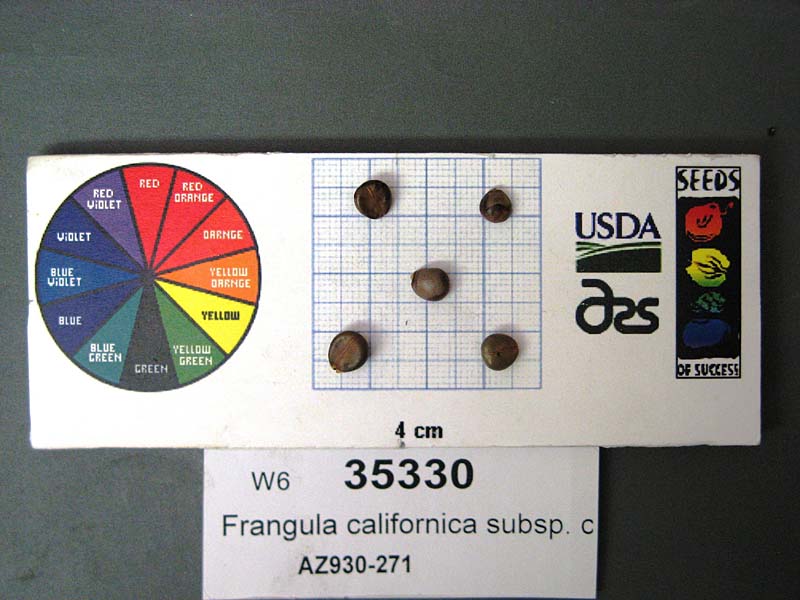 | | 2009 | COLLECTED | 10/07/2008 | Tonto National Forest, north of Payson. Forest Service Trail 290, 1 mile north of junction with Forest Service Road 32. | 34.44138000, -111.26141000 | 1935 | Riparian land form in Petran Montane Conifer Forest biome; land used for recreation; soil color 5YR 6/6. Slope 0 - 30 degrees. | Wild material | Height: 4 feet | 1808280 | WLP 2126 |
| 37 | WLP 1111 | LBJWC-PM-017 | Crataegus tracyi Ashe ex Eggl. | Texas, United States | NA | | | 2007 | COLLECTED | 10/22/2006 | Cherry Canyon Ranch, north end of Davis Mountains, ca Toyahvale. Approximately 8 miles south of FM 3078. In Cherry Canyon several miles south of ranch headquarters. | 30.87006000, -104.06260000 | 1453 | Broad canyon/riparian corridor of brush and hardwoods. | Wild material | | 1726976 | WLP 1111 |