| 0 | PI 588722 | SO4-Germany | Vitis hybr. | Germany | GEN |  | | 1993 | DONATED | 03/19/1993 | | | | | Rootstock | | 1014268 | PI 588722 |
| 1 | PI 588723 | SO4-California | Vitis hybr. | California, United States | GEN |  | | 1993 | DONATED | 03/19/1993 | | | | | Rootstock | | 1014279 | PI 588723 |
| 2 | PI 588724 | SO4-France | Vitis hybr. | France | GEN |  | | 1993 | DONATED | 03/19/1993 | | | | | Rootstock | | 1014282 | PI 588724 |
| 3 | PI 588596 | BR 11 | Vitis hybr. | Maryland, United States | GEN |  | | 1989 | DEVELOPED | | | | | | Cultivated material | Hermaphrodite. Very small, black, seedless berries, flavor slightly wild; clusters large of berlandieri appearance; crop large; good vine vigor; black rot resistant with trace of powdery mildew. | 1012086 | PI 588596 |
| 4 | PI 588602 | BR 9 | Vitis hybr. | Maryland, United States | GEN |  | | 1989 | DEVELOPED | | | | | | Cultivated material | Hermaphrodite. Black rot resistant; crop large, vigor very good, foliage moderate, trace of powdery mildew; clusters moderate; berries black, small; ripens mid to late September flavor neutral to slightly wild. | 1012128 | PI 588602 |
| 5 | PI 588605 | BR 23 | Vitis hybr. | Maryland, United States | GEN | 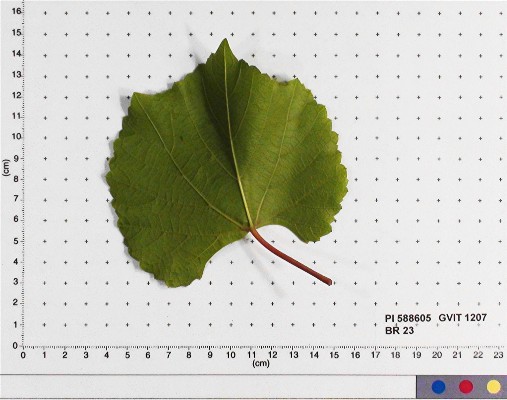 | | 1989 | DEVELOPED | | | | | | Cultivated material | Female. Black rot resistant; crop medium small, vigor very good, foliage very good, no diseases noted; cluster small; berries black, small; ripens late September; flavor wild. | 1012149 | PI 588605 |
| 6 | PI 597274 | BR 10 | Vitis hybr. | Maryland, United States | GEN |  | | 1989 | DEVELOPED | | | | | | Cultivated material | Hermaphrodite. Small, black, seeded berried, flower slightly wild; clusters moderate, small crop, good vine vigor, ripens late September; black rot resistant (trace one year). | 1012068 | PI 597274 |
| 7 | PI 588494 | NY 66.791.1 | Vitis hybr. | New York, United States | GEN | 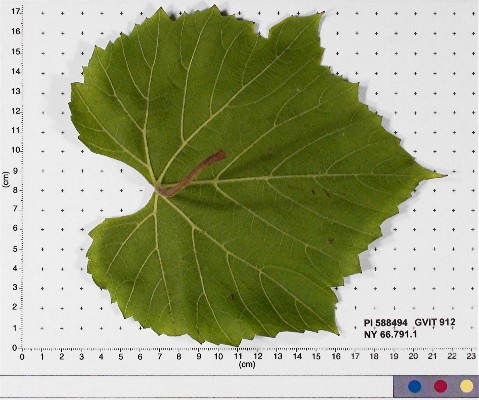 | | 1988 | DONATED | 01/26/1988 | | | | | Cultivated material | Small, blue berries lacking in soluble solids; large loose cluster; vigorous vine; winter hardy. | 1009958 | PI 588494 |
| 8 | PI 588523 | NY 66.793.1 | Vitis hybr. | New York, United States | GEN |  | | 1988 | DONATED | 01/26/1988 | | | | | Cultivated material | Small to medium, round, blue berries; medium to large loose cluster; medium to high vine vigor; disease resistant. | 1010404 | PI 588523 |
| 9 | PI 588527 | NY 65.004.1 | Vitis hybr. | United States | GEN | 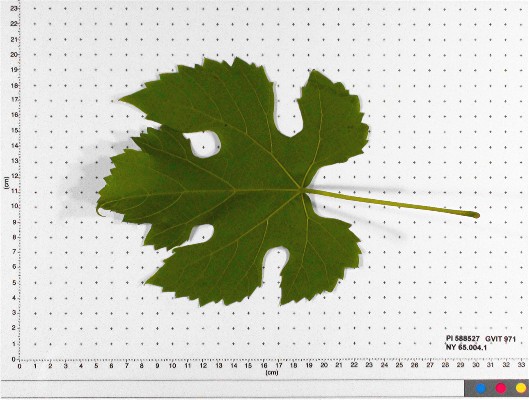 | | 1988 | DONATED | 01/26/1988 | | | | | Cultivated material | Small, reddish-blue oval berries; medium to large clusters; small vine; winter tender. | 1010447 | PI 588527 |
| 10 | PI 588532 | Couderc 157-11 | Vitis hybr. | France | GEN |  | | 1988 | DEVELOPED | 01/01/1989 | | | | | Rootstock | Female rootstock. Very vigorous. Roots poorly, grafts easily; highly resistant to lime; prefers fresh deep soil; berries round, black, fleshy; very small clusters. | 1010510 | PI 588532 |
| 11 | PI 597258 | Ill 879-5 | Vitis hybr. | Illinois, United States | GEN | 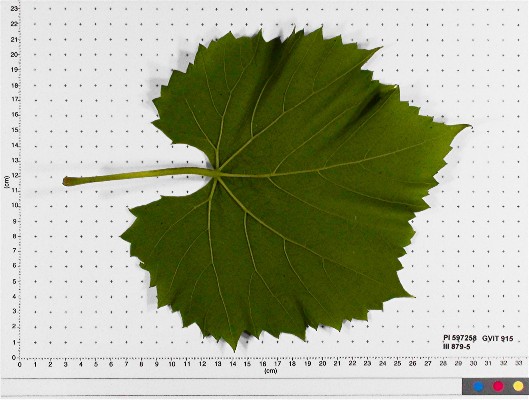 | | 1988 | DEVELOPED | | | | | | Cultivated material | Female. Small, blue, round berry; medium size loose cluster vigorous vine; winter hardy. | 1009981 | PI 597258 |
| 12 | PI 588493 | NY 65.586.1 | Vitis hybr. | New York, United States | GEN | 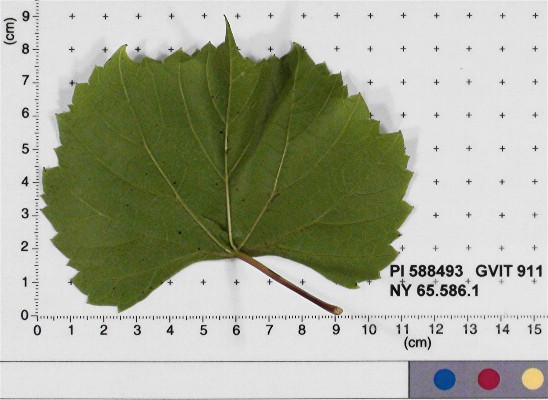 | | 1988 | DONATED | 01/25/1988 | | | | | Cultivated material | | 1009943 | PI 588493 |
| 13 | PI 588375 | GVIT 679 | Vitis hybr. | Unknown | GEN | 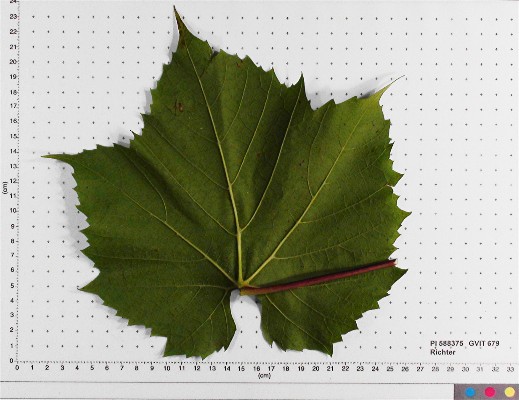 | | 1987 | DEVELOPED | 01/01/1989 | | | | | Rootstock | Male, but will set fruit. Virus free. Does not root well, grafts readily. Medium drought tolerance; highly resistant to phylloxera; rootstock. | 1008015 | PI 588375 |
| 14 | PI 588379 | Teleki 5C | Vitis hybr. | California, United States | GEN |  | | 1987 | DEVELOPED | 01/01/1922 | | | | | Rootstock | Male. Virus free rootstock; flower sterile. Early maturity than other berlandieri x riparia's. A consideration for use in more northerly areas. Good lime and nematode resistance. Roots and grafts well. | 1008077 | PI 588379 |
| 15 | PI 588381 | Teleki 8B | Vitis hybr. | Hungary | GEN |  | | 1987 | DEVELOPED | | | | | | Rootstock | Virus free rootstock. male, sterile. Not as good as 5BB. Lime resistant. Nematode resistant. Roots poorly, grafts well. Good wood producer. | 1008093 | PI 588381 |
| 16 | PI 588348 | Ill 878-2 | Vitis hybr. | Illinois, United States | GEN |  | | 1987 | DONATED | 02/01/1987 | | | | | Cultivated material | Male. Vigorous vine, late bloom. | 1007562 | PI 588348 |
| 17 | PI 597219 | Joannes Seyve 9-149 | Vitis hybr. | France | GEN |  | | 1987 | DEVELOPED | 05/10/1949 | | | | | Cultivated material | Black berries, small to medium. Medium size, compact clusters. Fruit cracking. Vigorous vine. Somewhat winter tender. | 1007094 | PI 597219 |
| 18 | PI 597221 | Joannes Seyve 14-982 | Vitis hybr. | France | GEN |  | | 1987 | DEVELOPED | 05/10/1949 | | | | | Cultivated material | Blue fruit, medium. Medium to large loose cluster. Small to average vine size. Winter hardy. | 1007114 | PI 597221 |
| 19 | PI 177208 | Landot 244 | Vitis hybr. | France | GEN |  | | 1986 | DEVELOPED | 03/23/1949 | | | | | Cultivated material | Virus free. Berries blue-black, oval, small .7cm, very pulpy; cluster medium, 10-15 cm, cylindrical; vigorous vine, very productive. Maturity is early midseason; susceptible to diseases. | 1481925 | PI 177208 |
| 20 | PI 588215 | Richter 110 | Vitis hybr. | New York, United States | GEN |  | | 1986 | DONATED | 02/05/1986 | | | | | Rootstock | Male. Rootstock. Flowers always sterile. Very vigorous, delays maturity. Lime and drought resistant. Poor rooting. Average grafting. Produces small wood quantities. Late defoliation, very long vegetative cycle. | 1004886 | PI 588215 |
| 21 | PI 213335 | Teleki 5G (Clone 6) | Vitis hybr. | Germany | GEN |  | | 1985 | DONATED | | | | | | Rootstock | Male. Early bloom. Downy mildew resistance. | 1175791 | PI 213335 |
| 22 | PI 257015 | Millardet 41B | Vitis hybr. | France | GEN |  | | 1985 | DEVELOPED | | | | | | Rootstock | Female - Rootstock, very small clusters with small round black berries. Short vegetative cycle. Excellent high-lime resistance. Hastens ripening of certain grapes. Sufficient phylloxera resistance. Roots poorly, grafts average. | 1196453 | PI 257015 |
| 23 | PI 279899 | Kober 5BB | Vitis hybr. | Austria | GEN |  | | 1985 | DEVELOPED | 03/26/1962 | | | | | Rootstock | Female - Rootstock. Small clusters with small round black berries. Short vegatative life cycle, can be grown in Northern climates. Suited to wet clay soils. Not drought tolerant. Lime and nematode resistance. Good wood producer. Grafts poorly. | 1208535 | PI 279899 |
| 24 | PI 588063 | Teleki 5 | Vitis hybr. | Unknown | GEN | 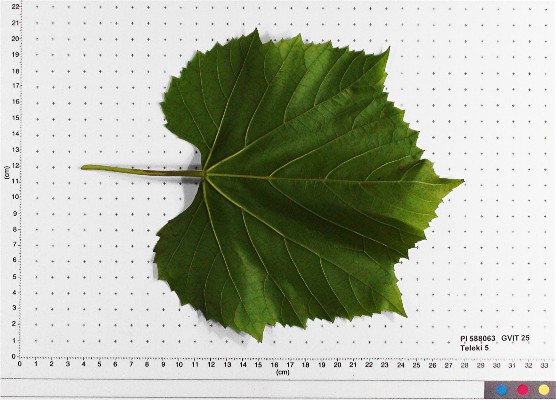 | | 1985 | DONATED | 03/01/1985 | | | | | Rootstock | Male with some fruit set, small, blue berry. Very small loose cluster. Very vigorous vine. True-to-type? | 1000906 | PI 588063 |
| 25 | PI 588082 | Teleki 5A | Vitis hybr. | Unknown | GEN |  | | 1985 | DONATED | 03/01/1985 | | | | | Rootstock | Female. Hungarian rootstock. Small blue berry, small loose cluster. | 1001886 | PI 588082 |
| 26 | PI 588091 | Cosmo 10 | Vitis hybr. | Unknown | GEN |  | | 1985 | DONATED | 03/01/1985 | | | | | Cultivated material | Small. Late maturity. Green berries. | 1002173 | PI 588091 |
| 27 | PI 588115 | Richter 99 | Vitis hybr. | Unknown | GEN |  | | 1985 | DONATED | 03/01/1985 | | | | | Rootstock | Male. Rootstock. Occasionally fruitful. Small, black, oblate berries. Very vigorous. Not recommended in Northerly regions - delays ripening. Good phylloxera resistance. Lime tolerant, but not salt tolerant. Less drought resistance than 110 R. Some nematode resistance. Good rooting, average grafting. | 1002989 | PI 588115 |
| 28 | PI 588119 | Cosmo 2 | Vitis hybr. | Unknown | GEN |  | | 1985 | DONATED | 03/01/1985 | | | | | Cultivated material | Small, blue berries. | 1003116 | PI 588119 |
| 29 | PI 597106 | Ill 882-7 | Vitis hybr. | Illinois, United States | GEN | 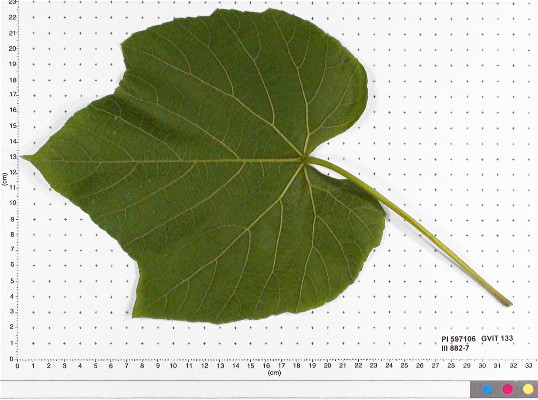 | | 1985 | DEVELOPED | | | | | | Cultivated material | Male. Vigorous vine. Very late bloom. | 1003307 | PI 597106 |
| 30 | PI 129648 | MONTPELLIER 333 EM | Vitis hybr. | South Africa | DAV | | | 1983 | DONATED | 07/1938 | | | | | | Type = rootstock | 1133793 | PI 129648 |
| 31 | PI 237623 | D'ANJAC | Vitis cinerea (Engelm.) Millardet var. helleri (L. H. Bailey) M. O. Moore | France | DAV | | | 1981 | DONATED | 03/04/1957 | | | | | | Type = Species. Flower = Male. | 1186295 | PI 237623 |
| 32 | PI 237625 | Berlandieri Resseguier | Vitis cinerea (Engelm.) Millardet var. helleri (L. H. Bailey) M. O. Moore | Texas, United States | DAV | | | 1981 | COLLECTED | 1888 | | | | | | Type = species. Flower = Male. Per Galet (see citation): "Growing tip: felty, white with rose margin, flat, open. Young leaves: downy, bronze. Leaf: cuneiform, 136 to 146-3-24 to 57, medium, barely three-lobed (10 or 11), often with convex edges, underside cobwebby-pubescent; teeth nearly flat, convex; petiolar sinus lyre-shaped; petioles medium, green, cobwebby. Shoot: ribbed, soft, easily broken or detatched from vine, downy, sometimes lightly pubescent. Flower clusters: medium or large, winged with numerous lateral branches; male and female. Cluster: medium-large, conical, many lateral branches; berries round, small, with very little pink, acid, juice. Seeds: medium, yellowish brown to dark mahogany; very swollen dorsal side; small chalaza, posiiton .49, oval; beak short and thick; very shallow sometimes nonexistant indentations. Growth habit: vigorous, climbing...Along with V. cinerea this is the latest ripening of the American species; its vegetative cycle is approximately a month later than riparia. Budbreak is in mid-April, bloom around June 25, maturity in mid-October and leaf fall around November 20. Its resistance to phylloxera is good (16/20); the leaves carry a few galls...its resistance to lime-induced chlorosis is good...good resistance to fungus diseases and Pierce's disease." | 1186296 | PI 237625 |
| 33 | PI 344094 | Hermitage | Vitis vinifera L. subsp. vinifera | Transvaal, South Africa | DAV | | | 1969 | DONATED | 08/27/1969 | | | | | | Per Galet (see citation): "Growing tip: feltym wgute wutg rise margin. Young leaves: downy, bullate, reddish-yellow, five lobed. Leaf: medium, orbicular 035-2-58;...lateral sinuses 64....; clear green, soft, contorted, webby tufts below or pubescent depending on the clone; petiolar sinus lyre-shaped more or less closed; teeth pointed, very narryow. Shoot: ribbed, clear green, glabrous, large tendrils. Cane: clear pale beige or pale pink with abundant bloom, dark brown nodes; large buds with white bud down. Cluster: large, cylindrical-conical, compact; berries ellipsoidal, large, blue-black, bloomed; firm skin and pulp. Growth habit: spreading. A productive, moderately vigorous variety, Cinsaut has nearly doubled its acreage in France since 1958 as growers are trying to improve the quality of Medterranean region wines. Cinsaut is considered to add softness and bouqet and blends well with Grenache and Carignane. Budbreak is late and maturity is mid-season. Trials in southern France have shown that production is more regular on vines with high trunks than those with low ones because there seems to be less coulure (poor fruit set). For hillside vineyards where quality and early ripening are desired, it is better to graft on less vigorous rootstocks such as 3309C or 44-53M. On the Berlandieri-rupestris varieties, the vines are too vigorous and the grapes remain red. In other locaitons, Cinsaut may be grafted on 99R, 110R, Rupestris St. George, and SO4. The yield is influenced by the health of the wood also since infectious degeneration (fanleaf virus) can greatly limit production. Cinsaut is sensitive to downy and powdery mildew and botrytis, and it has a tendency to drop its berries at maturity. It is severely affected by yellow spider mitees, and the clusters are very susceptible to the grape berry moth. On the other hand, in Algeria it showed some resistance to very hot, dry conditions." | 1256740 | PI 344094 |
| 34 | PI 279502 | Olivette Noir | Vitis vinifera L. subsp. vinifera | France | DAV | | | 1962 | DONATED | 03/09/1962 | | | | | | Type = table grape. Per Galet (see citation): "Originally from southern Russia. DESCRIPTION: Growing tip: open, cobwebby, yellow. Young leaves: shiny, glabrous, yellowish-green with bronze patches. Leaf: medium, orbicular-reniform 025-2-46, lateral sinuses 31 to 53 very narrow, clear green, smooth, dull, thick, concave glabrous below; petiolar sinus lyre shaped more or less closed; teeth pointed, small very narrow. Shoot: very ribbed, clear green with faint red streaking in sun, glabrous. Cane: straw yellow to clear orange brown with darker streaking and nodes, rather abundant bloom covering. Cluster: fairly large 15 to 20 cm, conical, loose; berries very large 30 by 20mm, ellipsoidal or olive shaped, attractive blue-black, thick, skin, fleshy pulp, firm, neutral flavor. APTITUDES: Due to its very late ripening, Olivette noire is limited to the hottest regions of France. It is the last black grape on the market and the olive shaped berries with their abundant bloom are most attractive to the consumer. It is considered to a "luxery" variety. Since it is not very fertile and the clusters are sometimes rather short, cane pruning and a vigorous rootstock (Berlandieri rupestris) are advised. While it has some resistance to phomopsis, botrytis, and the grape berry moth, it is sensitive to downy mildew and winter cold. Care should be taken to avoid plants infected with fanleaf virus. Production is often irregular. Olivette blanche is not a white form of Olivette noire." | 1208343 | PI 279502 |
| 35 | DVIT 1104 | Kober 125AA | Vitis hybr. | California, United States | DAV | | | 1983 | DONATED | 01/01/1983 | | | | | Breeding material | | 1011382 | DVIT 1104 |
| 36 | DVIT 1112 | Oppenheim 4 | Vitis hybr. | California, United States | DAV | | | 1983 | DONATED | 01/01/1983 | | | | | Breeding material | Type = rootsock. Per Winkler (see citation): "The phylloxera rootstock, SOc, is one of the seedlings arising from crosses by Teleki between V. berlandieri and V. riparia. In some respects it is similiar to the other Teleki hybrids, such as Teleki 5A, 5BB, etc. One principal difference, however, is its somewhat lower vigor. This underlies its popularity with growers in Northern Europe. It is quite tolerant to lime, is highly resistant to phylloxera, and roots fairly readily and grafts with ease. SO4 has only recently been placed in field trials in California vineyards. The moderate vigor of its scions indicates that it may not be suitable on high stress sites. For example, in a non-irrigated trial in Napa Valley, it has developed slowly, producing relatively small vines during the first few years. On the other hand, it may be quite satisfactory on irrigated, more fertile sites. This new stock to California deserves a thorough and intensive study in phylloxerated districts." | 1011445 | DVIT 1112 |
| 37 | DVIT 1115 | Paulsen 1447 | Vitis hybr. | Italy | DAV | | | 1983 | DONATED | 01/01/1983 | | | | | Breeding material | Type = rootstock. Per Pongracz (see citation): "ORIGIN:...obtained by Paulsen in 1896. DESCRIPTION: Tip of the growing shoot erect, small, flat, ovoid, more Berlandieri than Rupestris, downy, whitish-green with some bronze; axis green, downy. Upper young leaf slightly folded, round, shiny clear green, downy on the upper surface, veins covered with brush-like hairs on the upper surface, veins covered with brush-like hairs on the lower surface. Lower young leaf round,entire, green with some bronze reflection; veins covered with brush-like hairs on the lower surface; petiolar sinus V-U shaped. Fully-grown leaf small, orbiculo-reniform, entire, dark fairly shiny green, bullate, wrinkled near the petiolar junction...Petile short, green with bronze tint, pubescent...Flower female according to Cosmo et al, but hermaphrodite, bearing three small clusters per shoot, according to Mottard et al and Galet...APTITUDES The cuttings of 1447 P do not root and graft easilty. For this reason in Sicily, its country of origin, its use is limited to siliceous or calcero-siliceous soils which are permeable and which have fresh subsoils. It is not recommended for badly-drained soils." | 1011461 | DVIT 1115 |
| 38 | DVIT 1143 | Teleki 5c | Vitis hybr. | California, United States | DAV | | | 1983 | DONATED | 01/01/1983 | | | | | Breeding material | interspecific hybrid | 1011689 | DVIT 1143 |
| 39 | DVIT 1147 | Richter 57 | Vitis hybr. | California, United States | DAV | | | 1983 | DONATED | 01/01/1983 | | | | | Breeding material | Type = interspecific hybrid | 1011722 | DVIT 1147 |
| 40 | DVIT 1605 | ILL.882-10 | Vitis hybr. | California, United States | DAV | | | 1983 | DONATED | 01/01/1983 | | | | | Breeding material | Type = interspecific hybrid. Flower type = female. | 1015013 | DVIT 1605 |
| 41 | DVIT 1632 | ILL.879-5 | Vitis hybr. | California, United States | DAV | | | 1983 | DONATED | 01/01/1983 | | | | | Breeding material | Type = interspecific hybrid. Flower type = female. | 1015169 | DVIT 1632 |
| 42 | DVIT 1634 | ILL.882-3 | Vitis hybr. | California, United States | DAV | | | 1983 | DONATED | 01/01/1983 | | | | | Breeding material | Type = interspecific hybrid. Flower type = male. | 1015182 | DVIT 1634 |
| 43 | DVIT 1635 | ILL.882-6 | Vitis hybr. | California, United States | DAV | | | 1983 | DONATED | 01/01/1983 | | | | | Breeding material | Type = interspecific hybrid. Flower type = female. | 1015186 | DVIT 1635 |
| 44 | DVIT 1673 | Seyve Villard 18-315 4X | Vitis hybr. | Illinois, United States | DAV | | | 1983 | DONATED | 02/14/1968 | | | | | Breeding material | Type = Tetraploid. Per Galet (see citation): "DESCRIPTION: Growing tip: cobwebby, folded. Young leaves: glabrous, lightly copper. Leaf: cuneiform, 135-3-56, entire, lateral sinsues 11, very concave, slightly pubescent below, very crimped around the petiolar junction; petiolar sinus V-shaped with overlapping edges; teeth pointed, deep. Shoot: glabrous, finely ribbed. Cluster: medium, cylindrical-conical, compact; berries oval, black with thick skin, pulpy. APTITUDES: Villard Noir has replaced Chancellor (which was not authorized) as the most planted red HDP in France. It is a fruitful, productive vine of medium vigor. Budbreak is average and the fruit ripens in early midseason. It produces a wine of good color and alcohol, which is sometimes herbaceous and astringent. Villard noir is practically resistant to downy mildew and somewhat sensitive to powdery mildew and botrytis. It is moderately winter hardy and produces a good secondary crop after a late frost. In France, it is considered to do better grafted on the Berlandieri hybrids than on Rupestris St. George or 3309 C." | 1015415 | DVIT 1673 |
| 45 | DVIT 1675 | SO-4 4X | Vitis hybr. | Illinois, United States | DAV | | | 1983 | DONATED | 02/14/1968 | | | | | Breeding material | Type = Tetraploid. Per Galet (see citation): "ORIGIN: This rootstock was selected by the viticulture school of Oppenheim, Germany, from Teleki's Berlandieri-riparia No. 4 (see origin 5 BB); SO 4 is an abbreviation of Selection Oppenheim No. 4. DESCRIPTION: Growing tip: downy, white with rose margin. Young leaves: cobwebby, green, more or less copper. Leaf: cuneiform, 136-3-24, entire, lateral sinuses 10, dull, yellowish, wavy, with upturned edges; petiolar sinus with a narrow V on narrow leaves which becomes an open U when adult; teeth convex, nearly flat; petiolar junction pink; petiole and veins pubescent. Flower: always sterile, male. Shoot: ribbed, purple nodes, slightly pubescent especially on the nodes. Cane: finely ribbed, glabrous with a few pubescent hairs on the nodes, dark chocolate brown, nodes inconspicuous; small, pointed buds. APTITUDES: This is a vigorous rootstock which develops especially rapidly at the start and, like Riparia tends to favor fruit set and advance maturity. In field trials in the Champagne district, the vines grafted on SO 4 had a greater average production than those on 161-49 C or 41 B, but slightly less than on 5 BB. In the Mediterranean region, SO 4 has been criticized for its slender trunk, which may fail to support a nontrelised, head-pruned vine with a heavy crop. Suited to humid, clay soils, it is not recommended for very dry conditions. Its resistance to active lime is approximately 17 to 18 percent and it has a good resistance to nematodes. According to Vidal and Marcelin (1968), it accepts up to 0.4g/kg salt content. SO 4 roots well. It field grafts well and bench grafts satisfactorily. It produces a large amount of propagating wood. Introduced in France in 1941, there was an extensive planting of mother vines mainly to satisfy the demand for graftable cuttings in Germany. It is now the number one rootstock variety in France." Per Winkler (see citation): "SO 4 has only recently been placed in field trials in California vineyards. The moderate vigor of its scions indicates that it may not be suitable on high stress sites. For example, in a non-irrigated trial in Napa Valley, it has developed slowly, producing relatively small vines during the first few years. On the other hand, it may be quite satisfactory on irrigated, more fertile sites. This new stock to California deserves a thorough and intensive study in phylloxerated districts." | 1015425 | DVIT 1675 |
| 46 | DVIT 1677 | Barrett 65-20 | Vitis cinerea (Engelm.) Millardet var. helleri (L. H. Bailey) M. O. Moore | Illinois, United States | DAV | | | 1983 | DONATED | 02/14/1968 | | | | | Breeding material | Type = Species. Per Galet (see citation): "DESCRIPTION: Growing tip: felty, white with rose margin, flat, open. Young leaves: downy, bronze. Leaf: cuneiform, 136 to 146-3-24 to 57, medium, barely three-lobed (10 or 11), often with convex edges, underside cobwebby-pubescent; teeth nearly flat, convex; petiolar sinus lyre-shaped; petioles medium, green, cobwebby. Shoot: ribbed, soft, easily broken or detached from vine, downy, sometimes lightly pubescent. Flower clusters: medium or large, winged with numerous lateral branches; male or female. Cluster: medium-large, conical, many lateral branches; berries round, small, with very little pink, acid, juice. Seeds: medium, yellowish brown to dark mahogany; very swollen dorsal side; small chalaza, position .49, oval; beak short and thick; very shallow sometimes nonexistant indentations. Growth habit: vigorous climbing. APTITUDES: Along with V. Cinerea this is the latest ripening of the American species; its vegetative cycle is approximately a month later than riparia. Budbreak is in mid-April, bloom around June 25, maturity is mid-October and leaf fall around November 20. Its resistance to phylloxera is good (16/20); the leaves carry a few galls. Since its resistance to lime-induced chlorosis is very good, V. Berlandieri should have played a great role in replanting the European vineyards. Unfortunately, it is so difficult to root that hybridization is the only way to obtain commercially viable rootstocks incorporating its lime tolerance. It has a good resistance to fungus diseases and Pierce's disease." | 1015437 | DVIT 1677 |
| 47 | DVIT 1684 | 882-7C | Vitis sp. | Illinois, United States | DAV | | | 1983 | DONATED | 02/06/1969 | | | | | Uncertain improvement status | Type = Species | 1015479 | DVIT 1684 |
| 48 | DVIT 1685 | La Font 9C | Vitis cinerea (Engelm.) Millardet var. helleri (L. H. Bailey) M. O. Moore | Illinois, United States | DAV | | | 1983 | DONATED | 02/06/1969 | | | | | Cultivated material | Type = species. Flower = Male. Per Galet (see citation): "Growing tip: felty, white with rose margin, flat, open. Young leaves: downy, bronze. Leaf: cuneiform, 136 to 146-3-24 to 57, medium, barely three-lobed (10 or 11), often with convex edges, underside cobwebby-pubescent; teeth nearly flat, convex; petiolar sinus lyre-shaped; petioles medium, green, cobwebby. Shoot: ribbed, soft, easily broken or detatched from vine, downy, sometimes lightly pubescent. Flower clusters: medium or large, winged with numerous lateral branches; male and female. Cluster: medium-large, conical, many lateral branches; berries round, small, with very little pink, acid, juice. Seeds: medium, yellowish brown to dark mahogany; very swollen dorsal side; small chalaza, posiiton .49, oval; beak short and thick; very shallow sometimes nonexistant indentations. Growth habit: vigorous, climbing...Along with V. cinerea this is the latest ripening of the American species; its vegetative cycle is approximately a month later than riparia. Budbreak is in mid-April, bloom around June 25, maturity in mid-October and leaf fall around November 20. Its resistance to phylloxera is good (16/20); the leaves carry a few galls...its resistance to lime-induced chlorosis is good...good resistance to fungus diseases and Pierce's disease."Type = species. Flower = Male. Per Galet (see citation): "Growing tip: felty, white with rose margin, flat, open. Young leaves: downy, bronze. Leaf: cuneiform, 136 to 146-3-24 to 57, medium, barely three-lobed (10 or 11), often with convex edges, underside cobwebby-pubescent; teeth nearly flat, convex; petiolar sinus lyre-shaped; petioles medium, green, cobwebby. Shoot: ribbed, soft, easily broken or detatched from vine, downy, sometimes lightly pubescent. Flower clusters: medium or large, winged with numerous lateral branches; male and female. Cluster: medium-large, conical, many lateral branches; berries round, small, with very little pink, acid, juice. Seeds: medium, yellowish brown to dark mahogany; very swollen dorsal side; small chalaza, posiiton .49, oval; beak short and thick; very shallow sometimes nonexistant indentations. Growth habit: vigorous, climbing...Along with V. cinerea this is the latest ripening of the American species; its vegetative cycle is approximately a month later than riparia. Budbreak is in mid-April, bloom around June 25, maturity in mid-October and leaf fall around November 20. Its resistance to phylloxera is good (16/20); the leaves carry a few galls...its resistance to lime-induced chlorosis is good...good resistance to fungus diseases and Pierce's disease." | 1015485 | DVIT 1685 |
| 49 | DVIT 1984 | Couderc 157-11 | Vitis hybr. | California, United States | DAV | | | 1983 | DONATED | 01/01/1983 | | | | | Breeding material | Type = rootstock. | 1017419 | DVIT 1984 |
| 50 | DVIT 1985 | Couderc 161-49 | Vitis hybr. | California, United States | DAV | | | 1983 | DONATED | 01/01/1983 | | | | | Breeding material | Type = rootstock | 1017423 | DVIT 1985 |
| 51 | DVIT 1999 | Richter 44R | Vitis hybr. | California, United States | DAV | | | 1983 | DONATED | 01/01/1983 | | | | | Breeding material | Per Winkler (see citation): "...very resistant to phylloxera, root [its] cuttings readily, and, according to Jacob (1942), graft with ease except with a few varieties of little importance in California." Per Pongracz (see citation): "ORIGIN: A hybrid of Berlandieri Ressequier no. 1 X Rupestris Martin, obtained by Richter in 1889. DESCRIPTION: Fully grown leaf below medium in size, orbiculo-reniform, entire but deeply 3 lobed at the base of the shoot; shining dark green, thick, finely bullate, petiolar sinus U-shaped, wide open. Flower male-hermaphrodite according to Galet (9), but female according to Cosmo et al (8)." | 1017518 | DVIT 1999 |
| 52 | DVIT 2000 | Richter 57R | Vitis hybr. | California, United States | DAV | | | 1983 | DONATED | 01/01/1983 | | | | | Breeding material | Type = Rootstock | 1017528 | DVIT 2000 |
| 53 | DVIT 2001 | Teleki 8B | Vitis hybr. | California, United States | DAV | | | 1983 | DONATED | 01/01/1983 | | | | | Cultivated material | Type = Rootstock. Per Galet (see citation): "ORIGIN: This is a cross [...] was made by Ressuguier and sold to Teleki. Teleki made the selection but the wood of five neighboring vines was mixed in with the original 8 B; this explains the existance of "the 8 B's" with female flowers in Vaucluse, Germany and Italy. DESCRIPTION: Growing tip: downy, white with rose margin. Young leaves: cobwebby, bronze. Leaf: very large, 20 cm (squared), cuneiform, 135-3-35, entire 00, soft, edges turned down, bullate, crimped around petiolar junction, pubescent below; petiolar sinus V-shaped; teeth convex, wide, obvious mucrones; petioles pubescent. Flowers: male, always sterile. Shoot: ribbed, pubescent, soft, nodes purple except at tip. Cane: reddish-brown to chocolate with darker nodes; velvety pubescence; ong internodes; inconspicuous nodes, fairly large buds. APTITUDES: 8 B is not an important variety in France. There are very few mother vines or vineyards planted on it since 5 BB is generally considered more satisfactory. While it may be a little more resistant to drought than 5 BB, it is still less so than the Berlandieri-rupestris varieties. It is sensitive to lime over 17 percent. Boubals and Huglin (1950) cite it as being among the varieties resistant to nematodes. 8 B produces a large amount of wood which grafts well, but roots less well." Per D.P. Pongracz, Rootstocks for Grape-vines pp. 100-101: "Selected by Teleki in 1902 from his group 'B'. APTITUDES: Cuttings of 8 B do not root well, but once rooted they graft readily on the spot. [...] Its tolerance of soluable salts in saline soils is nil. It is classified as resistant to nematodes. Because 8 B is very vigorous and tough rootstock, it was widely used in central and south-eastern Europe as a rootstock, but it has been replaced there with better hybrids of the group mainly 5 BB and 5 C. Cosmo in 1931 selected from Teleki's 8 B his 'Teleki-Cosmo 10', and Ferrari in 1921 his 'Teleki-Ferrari' | 1017531 | DVIT 2001 |
| 54 | DVIT 2102 | Couderc 161-49 | Vitis hybr. | California, United States | DAV | | | 1983 | DONATED | 01/01/1983 | | | | | Breeding material | Type = Inter-species Hybrid. | 1018230 | DVIT 2102 |
| 55 | DVIT 1209 | 'OLMO Q104 (Q38-62)' | Vitis hybr. | California, United States | DAV | | | 1981 | DEVELOPED | | | | | | Breeding material | Type = interspecific hybrid. Flower = female. | 1012162 | DVIT 1209 |
| 56 | DVIT 1210 | 'OLMO Q105 (Q38-65)' | Vitis hybr. | California, United States | DAV | | | 1981 | DEVELOPED | | | | | | Breeding material | Type = interspecific hybrid. | 1012171 | DVIT 1210 |
| 57 | DVIT 1302 | R68-49 | Vitis monticola Buckley | California, United States | DAV | | | 1981 | DONATED | 01/01/1981 | | | | | Wild material | Type = Species. Flower = male. Per Hedrick (see citation): "Vine of moderate vigor, climbing, or,in the absence of support, frequently shrubby...Leaves with stipules short, broad...Clusters short and broad, compact, with medium to short peduncle. Berries medium to below in size, black or gray with thin bloom. Seeds large, usually slightly notched; chalaza rather narrow; raphe a groove. Leafing, flowering, and ripening fruit very late. Vitis monticola was named and described by Buckley in 1861. Monticola inhabits the limestone hills of central and southwestern Texas. The fruit of this species has a very sweet and somewhat peculiar flavor. The vines can be propagated from cuttings only with difficulty. The spoecies is adapted to a hot, dry climate and limestone land. It is found to be very resistant to phylloxera and is sometimes recommended as a stock for Vinifera but is not generally considered as valuable in this respect as Berlandieri. It is without value for its fruit and is of no horticultural importance to the eastern American grape-grower." | 1012800 | DVIT 1302 |