| 0 | W6 61593 | CA360-230 | Vitis californica Benth. | | W6 |  | | 2024 | | | | | | | Wild material | | 2168041 | W6 61593 |
| 1 | DVIT 3707 | Walker Ridge | Vitis californica Benth. | California, United States | DAV | | | 2012 | DONATED | 08/15/2012 | | | | | | Red fall leaf selection. | 1911877 | DVIT 3707 |
| 2 | W6 27366 | CA330-63 | Vitis californica Benth. | California, United States | W6 |  | | 2005 | | | | | | | Wild material | Shrub 1.5-6 meters tall. | 1674397 | W6 27366 |
| 3 | DVIT 3070 | Roger's Red | Vitis californica Benth. | California, United States | DAV | | | 2002 | DONATED | 03/06/2002 | | | | | Cultivated material | This is a cultivar of V. californica that is used as a horticultural plant because of it's leaf color. | 1640862 | DVIT 3070 |
| 4 | DVIT 1360 | #1 Hybrid | Vitis californica Benth. | California, United States | DAV | | | 1983 | DONATED | 01/01/1983 | | | | | Wild material | Type = American hybrid. Per Munson (see citation): "North California grape. Plant: Climbing moderately, or vigorously, as seen by the writer in Santa Rosa and Napa Valleys at Chico and at Redding in Sacramento Valley, also at Grant's Pass, Rogue River, Oregon; branches tapering; growing tips little enveloped in expanding leaves; often the vines are seen completely enveloping small trees with a dense canopy of leaves. Roots: Fibrous, rather soft, transversely wrinkled. Wood: When young reddish or pale green, angled and somewhat covered with long whitish hairs, becoming floccose and remaining into the winter, or in Eldorado County specimens, covered with short brown pubescence, similar to V. cinerea; when mature, brownish or grayish, finely striated, soft, sectional view circular or often oval, rays distinct, pores open; nodes large and little bent; diaphragm nearly plane, medium thin; bark the second year easily loosening in fibrous plates, on old woody finely striately checked and persistent as in V. cinerea; buds small, sub-pyramidal, ovoid or acute, covered with whitish or brownish wool at the summit, when opening in spring grayish-violet or nearly white, becoming greenish-violet; tendrils mostly once forked, sometimes twice, 3' to 5' to fork, intermittent, wooly when young, persistent, internodes medium in length, 3' to 6' or more, variable in same branch; pith large, light brown, abruptly and broadly terminating above, narrow and gradually terminating below the diaphragm, especially so in Sierra Nevada Mountain specimens. Leaves: Stipules small to medium, cordate, membranaceous, hairy; petiole generally about half as long as blade is wide, narrowly grooved on upper side, disctinctly striated; thinly covered with white cottony hairs and velvety pubescence, color violet or crimson; blade medium to large, varies in size from 2' to 4' in length by 3' to 5' or more in width; [ ... ] Cluster: Fertile, --small 3' to 4' or more long; shouldered heavily, similar to many V. vulpina; compact; peduncle very short; rachis usually simple or little compounded, thinly cottony; clear reddish-violet; pedicels 1/4' or less long, rather thick, enlarging rapidly toward the recepticle, warty. Berries: 1/3' to 1/2' in diameter, round or little oblate, black, with heavy prunose bloom; persistant; skin rather thick, pulp seedy with little juice, very sugary and pleasantly flavored." | 1013269 | DVIT 1360 |
| 5 | DVIT 1361 | '#2' | Vitis californica Benth. | California, United States | DAV | | | 1983 | DONATED | 01/01/1983 | | | | | Wild material | Type = American hybrid. Per Munson (see citation): "North California grape. Plant: Climbing moderately, or vigorously, as seen by the writer in Santa Rosa and Napa Valleys at Chico and at Redding in Sacramento Valley, also at Grant's Pass, Rogue River, Oregon; branches tapering; growing tips little enveloped in expanding leaves; often the vines are seen completely enveloping small trees with a dense canopy of leaves. Roots: Fibrous, rather soft, transversely wrinkled. Wood: When young reddish or pale green, angled and somewhat covered with long whitish hairs, becoming floccose and remaining into the winter, or in Eldorado County specimens, covered with short brown pubescence, similar to V. cinerea; when mature, brownish or grayish, finely striated, soft, sectional view circular or often oval, rays distinct, pores open; nodes large and little bent; diaphragm nearly plane, medium thin; bark the second year easily loosening in fibrous plates, on old woody finely striately checked and persistent as in V. cinerea; buds small, sub-pyramidal, ovoid or acute, covered with whitish or brownish wool at the summit, when opening in spring grayish-violet or nearly white, becoming greenish-violet; tendrils mostly once forked, sometimes twice, 3' to 5' to fork, intermittent, wooly when young, persistent, internodes medium in length, 3' to 6' or more, variable in same branch; pith large, light brown, abruptly and broadly terminating above, narrow and gradually terminating below the diaphragm, especially so in Sierra Nevada Mountain specimens. Leaves: Stipules small to medium, cordate, membranaceous, hairy; petiole generally about half as long as blade is wide, narrowly grooved on upper side, disctinctly striated; thinly covered with white cottony hairs and velvety pubescence, color violet or crimson; blade medium to large, varies in size from 2' to 4' in length by 3' to 5' or more in width; [ ... ] Cluster: Fertile, --small 3' to 4' or more long; shouldered heavily, similar to many V. vulpina; compact; peduncle very short; rachis usually simple or little compounded, thinly cottony; clear reddish-violet; pedicels 1/4' or less long, rather thick, enlarging rapidly toward the recepticle, warty. Berries: 1/3' to 1/2' in diameter, round or little oblate, black, with heavy prunose bloom; persistant; skin rather thick, pulp seedy with little juice, very sugary and pleasantly flavored." | 1013283 | DVIT 1361 |
| 6 | DVIT 1836 | Gold Hill #1 | Vitis californica Benth. | California, United States | DAV | | | 1983 | DONATED | 01/01/1983 | | | | | Wild material | Type = species | 1016390 | DVIT 1836 |
| 7 | DVIT 1837 | Gold Hill #2 | Vitis californica Benth. | California, United States | DAV | | | 1983 | DONATED | 01/01/1983 | | | | | Wild material | Type = species | 1016400 | DVIT 1837 |
| 8 | DVIT 1838 | Gold Hill #4 | Vitis californica Benth. | California, United States | DAV | | | 1983 | DONATED | 01/01/1983 | | | | | Wild material | Type = species | 1016406 | DVIT 1838 |
| 9 | DVIT 1839 | Gold Hill #5 | Vitis californica Benth. | California, United States | DAV | | | 1983 | DONATED | 01/01/1983 | | | | | Wild material | Type = species | 1016413 | DVIT 1839 |
| 10 | DVIT 1275 | DVIT 1275 | Vitis californica Benth. | California, United States | DAV | | | 1981 | DONATED | 01/01/1981 | | | | | Uncertain improvement status | Type = species. Flower = Male. | 1012617 | DVIT 1275 |
| 11 | DVIT 1387 | Redlands | Vitis girdiana Munson | California, United States | DAV | | | 1983 | DONATED | 01/01/1983 | | | | | Cultivated material | Type = American Hybrid. Per Munson (see citation): [About V. girdiana] "Southern California Grape. Plant: climbing high, robust, in its native regions often forming dense masses, or canopies on undergrowth and small trees, the foliage presenting a light greyish-green aspect. Roots: rather soft, penetrating, not fully resistant to Phylloxera. Wood: young, densely whitish wooly, the wool becoming flocculent and shedding at maturity; cylindrical or little angled, finely and regularly striated; bark at maturity cinnamon, or reddish-brown; rays thin, wide apart, pores numerous; rather soft; internodes of medium length, 1 1/2 to' to 4' or 5' [ ... ] Leaves: stipules small to medium, rounded, 1/8' long or less, membranaceous, scatteringly hairy, pale; petiole, slender, 1' to 3' long, woolly, or pubescent or both, having a distinct narrow groove along upper side; blade generally long cordate in outline, rarely lobed length of midrib 3' to 4' or more, width of blade 4 1/2' to 6', or more; [ ... ] Cluster: fertile,--medium to large, 5' to 8' or more long, forked into two nearly equal parts, at an obtuse or broad angle, each fork generally compounded divided, peduncle 1' to 2' long and with the pale bluish-green or whitish-green rachis, thinly covered with cottony hairs; pedicel long, 1/6' to 1/4', slender, little or not at all warty, pale yellowish-white, enlarging very little upward, cluster difficult to detach from vine. Sterile cluster very large and compound. Flowers: staminate, on long slender pedicels, stamens large, erect; fertile,--stamens small, reflexed, short; pistil delicate; slender short style; small stigma. Berry: small, 1/4' to 1/3' in diameter, spherical, black with little or no bloom, persistant, skin thin, tough, and pungent to taste, pulp juicy, melting, very acid till very ripe when it is agreeably sweet, but chemical analysis (Prof. E.W. Hilgarde, in report of Experimental Station, Berkeley, California) shows it deficient in sugar, tataric acid and tannin, as compared with V. californica (Bethem), from the Sacramento Valley. Seeds: 1 to 3 obovate or broadly obcordate; 1/6' to 1/5' long by 1/8' to 1/6' broad, pale pinkish; beak short, blunt or sometimes small and acute, raphe slender, hair-like from beak to notch in top of seed; where it becomes obscure; chalaza, in center of back of seed, narrow, depressed, often a mere rim or crescent in a rather deep basin; ventral depression short, wide apart, shallow." | 1013450 | DVIT 1387 |
| 12 | WLP 2126 | AZ930-271 | Frangula californica (Eschsch.) A. Gray subsp. californica | Arizona, United States | NA | 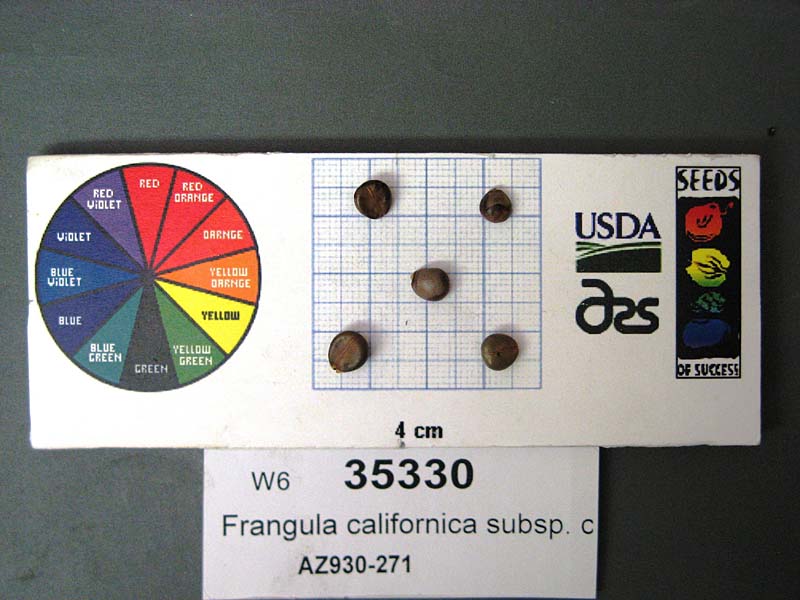 | | 2009 | COLLECTED | 10/07/2008 | Tonto National Forest, north of Payson. Forest Service Trail 290, 1 mile north of junction with Forest Service Road 32. | 34.44138000, -111.26141000 | 1935 | Riparian land form in Petran Montane Conifer Forest biome; land used for recreation; soil color 5YR 6/6. Slope 0 - 30 degrees. | Wild material | Height: 4 feet | 1808280 | WLP 2126 |
| 13 | W6 62704 | CA360-234 | Rumex salicifolius Weinm. | California, United States | W6 |  | | 2025 | | | | | | | Wild material | Plants either in low densities along riparian corridor, or in periodic high density parches. | 2192922 | W6 62704 |
| 14 | W6 62713 | CA360A-12 | Erythranthe guttata (DC.) G. L. Nesom | California, United States | W6 |  | | 2025 | | | | | | | Wild material | Received as Mimulus guttatus. In rocky driftstone wash. Persistent fruits. In July is paired with flowering Calycadenia truncata. Lightly interspersed with presumably E. nutans. Plants were thoroughly dessicated, preventing voucher collection. | 2192931 | W6 62713 |
| 15 | W6 62719 | CA360A-18 | Madia elegans D. Don | California, United States | W6 |  | | 2025 | | | | | | | Wild material | In a field immediately to left of entering Reading Island Trail; matted in its grasses and lots of dry Vitchia. Larger plants in anthesis, seeds collected from smaller plants. Some variation in seed progress of development; also some variation in seed type produced. Mostly large black ligulate seeds, however a very few seem to only have central achenes, and one had tiny almost guitar shaped seeds. Confirmed it was the same plant and species as others. We will be using the black ligulate seeds as our target for this collection. Collection is (of now 07/24/2024/) only from smaller plants that have already gone to seed. | 2192937 | W6 62719 |
| 16 | W6 62720 | CA360A-19 | Perideridia kelloggii (A. Gray) Mathias | California, United States | W6 |  | | 2025 | | | | | | | Wild material | Interspersed in drainage and washes. Only some umbels are ready for fruit and seed harvesting. | 2192938 | W6 62720 |
| 17 | W6 61559 | CA340-48 | Cercis occidentalis Torr. ex A. Gray | California, United States | W6 |  | | 2024 | | | | | | | Wild material | (Received as C. orbiculata) | 2168008 | W6 61559 |
| 18 | W6 61025 | CA360-196 | Cyperus eragrostis Lam. | California, United States | W6 |  | | 2023 | | | | | | | Wild material | grows in tussocks, seedheads axillary | 2142664 | W6 61025 |
| 19 | W6 60456 | CA180-249 | Thysanocarpus curvipes Hook. | California, United States | W6 |  | | 2022 | | | | | | | Wild material | Small white to purple flowers born on a raceme; styles <.7mm. Leaves lanceolate, bases lobed, clasping. Stems fuzzy. Winged fruit pedicels in a continuous 1.5-12mm arc. Fruit, <6mm, entire, crenate or perforated. | 2138394 | W6 60456 |
| 20 | W6 60459 | CA180-241 | Alnus rhombifolia Nutt. | California, United States | W6 |  | | 2022 | | | | | | | Wild material | Deciduous tree not forming thickets. Bark is pale gray. Leaves are alternate, rhombic to elliptic with serrate margins, acute tip, not rolled under. Monoecieous. Males long & slender. females 1.5cm cones. | 2138397 | W6 60459 |
| 21 | OPGC 8370 | CA180-220 | Clarkia purpurea (Curtis) A. Nelson & J. F. Macbr. subsp. quadrivulnera (Douglas ex Lindl.) F. H. Lewis & M. E. Lewis | California, United States | OPGC | | | 2021 | | | | | | | Wild material | Petals purple to wine red often with a contrasting purple spot in center or edge but highly variable. | 2120361 | OPGC 8370 |
| 22 | OPGC 8375 | CA180-228 | Keckiella breviflora (Lindl.) Straw subsp. breviflora | California, United States | OPGC | | | 2021 | | | | | | | Wild material | Herbaceous shrub leans over. Panicles of two-lipped flowers yield two- chambered capsules with >100 tiny brown seeds. Leaves opposite, toothed, lanceolate. Pointed capsules turn from green to brown when ripe. | 2120369 | OPGC 8375 |
| 23 | OPGC 8377 | CA180-235 | Oenothera elata Kunth subsp. hirsutissima (A. Gray ex S. Watson) W. Dietr. | California, United States | OPGC | | | 2021 | | | | | | | Wild material | Bright yellow flowers fade to peach. 4 sepals are reflexed. 8 stamens are shorter than single stigma. Stigma tip is four-lobed, about 4cm long. Four yellow petals are smooth, not crepey. Stem has hairs; red to green. | 2120371 | OPGC 8377 |
| 24 | OPGC 7310 | AZ930-362 | Penstemon barbatus (Cav.) Roth | Arizona, United States | OPGC |  | | 2018 | | | | | | | Wild material | | 1970378 | OPGC 7310 |
| 25 | OPGC 7311 | AZ930-363 | Aquilegia chrysantha A. Gray | Arizona, United States | OPGC |  | | 2018 | | | | | | | Wild material | | 1970379 | OPGC 7311 |