| 0 | DVIT 2230 | DVIT 2230 | Vitis monticola Buckley | Texas, United States | DAV | | | 1987 | COLLECTED | | | | | | Wild material | Type = Species. | 1019034 | DVIT 2230 |
| 1 | DVIT 2231 | DVIT 2231 | Vitis monticola Buckley | Texas, United States | DAV | | | 1987 | COLLECTED | | | | | | Wild material | Type = Species. | 1019048 | DVIT 2231 |
| 2 | DVIT 1369 | R68-17 | Vitis monticola Buckley | California, United States | DAV | | | 1983 | DONATED | 01/01/1983 | | | | | Wild material | Type = American hybrid. Per Galet (see citation): [about V. monticola Buckley] "Growing tip: flat, open; stem downy, rose; tiny leaves slightly downy, pinkish. Young leaves: glabrous, copper, very shiny. Leaf: between cuneiform and truncate, small, 236 to 246-3 to 4-46 to 58, contorted, slightly crimped around the petiole, entire 11, glabrous on both sides, highly glossy (varnished looking), bright green, thick; lyre-shaped petiolar sinus; teeth convex. symmetrical, pointed making leaves seem prickly. Shoot: green, sometimes violet, finely ribbed, cobwebby, rust-colored especially at tip; stipules reddish; tendrils intermittent, strong, red. Flower cluster: short; male or femal depending on cultivar. Cluster: very small, cylindrical, fairly compact; small, round berries 5 to 10 mm, black, little juice, neutral or herbaceous flavor. Wine made in Montpellier is rich in alcohol, low in acid, low in color, with bitter taste. Seeds: medium, swollen, nearly round, clear brown to reddish brown; beak short, almost nonexistent; chalaza in position 0.56. Growth habit: thin, not very leafy. In Montpellier, the shoots remained fairly short. According to T.V. Munson, it may climb from 10 to 30 feet. In any case it is not noted for its vigor or luscious growth. This species, sometimes known as the Sweet Mountain or Sugar grape, is late ripening; budbreak is at the beginning of April, bloom in the first part of June, and maturation at the beginning of October. The roots have only a fair resistance to phyloxera (9/20), but the leaves show no signs of galls. It appears to have a medium resistance to Pierce's disease (8 to 10 years, according to Loomis). V. monticola was first noticed because of its high tolerance to lime. Unfortunately, its cuttings do not take root, and it is very difficult ot graft successfully which limits its viability as a rootstock. None of its descendants has been commercially successful." | 1013335 | DVIT 1369 |
| 3 | DVIT 1370 | R68-27 | Vitis monticola Buckley | France | DAV | | | 1983 | COLLECTED | | | | | | Wild material | Type = American hybrid. Per Galet (see citation): [about V. monticola Buckley] "Growing tip: flat, open; stem downy, rose; tiny leaves slightly downy, pinkish. Young leaves: glabrous, copper, very shiny. Leaf: between cuneiform and truncate, small, 236 to 246-3 to 4-46 to 58, contorted, slightly crimped around the petiole, entire 11, glabrous on both sides, highly glossy (varnished looking), bright green, thick; lyre-shaped petiolar sinus; teeth convex. symmetrical, pointed making leaves seem prickly. Shoot: green, sometimes violet, finely ribbed, cobwebby, rust-colored especially at tip; stipules reddish; tendrils intermittent, strong, red. Flower cluster: short; male or femal depending on cultivar. Cluster: very small, cylindrical, fairly compact; small, round berries 5 to 10 mm, black, little juice, neutral or herbaceous flavor. Wine made in Montpellier is rich in alcohol, low in acid, low in color, with bitter taste. Seeds: medium, swollen, nearly round, clear brown to reddish brown; beak short, almost nonexistent; chalaza in position 0.56. Growth habit: thin, not very leafy. In Montpellier, the shoots remained fairly short. According to T.V. Munson, it may climb from 10 to 30 feet. In any case it is not noted for its vigor or luscious growth. This species, sometimes known as the Sweet Mountain or Sugar grape, is late ripening; budbreak is at the beginning of April, bloom in the first part of June, and maturation at the beginning of October. The roots have only a fair resistance to phyloxera (9/20), but the leaves show no signs of galls. It appears to have a medium resistance to Pierce's disease (8 to 10 years, according to Loomis). V. monticola was first noticed because of its high tolerance to lime. Unfortunately, its cuttings do not take root, and it is very difficult ot graft successfully which limits its viability as a rootstock. None of its descendants has been commercially successful." | 1013343 | DVIT 1370 |
| 4 | DVIT 1371 | R68-23 | Vitis monticola Buckley | Belgium | DAV | | | 1983 | COLLECTED | | | | | | Wild material | Type = American hybrid. Per Galet (see citation): [about V. monticola Buckley] "Growing tip: flat, open; stem downy, rose; tiny leaves slightly downy, pinkish. Young leaves: glabrous, copper, very shiny. Leaf: between cuneiform and truncate, small, 236 to 246-3 to 4-46 to 58, contorted, slightly crimped around the petiole, entire 11, glabrous on both sides, highly glossy (varnished looking), bright green, thick; lyre-shaped petiolar sinus; teeth convex. symmetrical, pointed making leaves seem prickly. Shoot: green, sometimes violet, finely ribbed, cobwebby, rust-colored especially at tip; stipules reddish; tendrils intermittent, strong, red. Flower cluster: short; male or femal depending on cultivar. Cluster: very small, cylindrical, fairly compact; small, round berries 5 to 10 mm, black, little juice, neutral or herbaceous flavor. Wine made in Montpellier is rich in alcohol, low in acid, low in color, with bitter taste. Seeds: medium, swollen, nearly round, clear brown to reddish brown; beak short, almost nonexistent; chalaza in position 0.56. Growth habit: thin, not very leafy. In Montpellier, the shoots remained fairly short. According to T.V. Munson, it may climb from 10 to 30 feet. In any case it is not noted for its vigor or luscious growth. This species, sometimes known as the Sweet Mountain or Sugar grape, is late ripening; budbreak is at the beginning of April, bloom in the first part of June, and maturation at the beginning of October. The roots have only a fair resistance to phyloxera (9/20), but the leaves show no signs of galls. It appears to have a medium resistance to Pierce's disease (8 to 10 years, according to Loomis). V. monticola was first noticed because of its high tolerance to lime. Unfortunately, its cuttings do not take root, and it is very difficult ot graft successfully which limits its viability as a rootstock. None of its descendants has been commercially successful." | 1013346 | DVIT 1371 |
| 5 | DVIT 1372 | R67-94 | Vitis monticola Buckley | California, United States | DAV | | | 1983 | DONATED | 01/01/1983 | | | | | Wild material | Type = American hybrid. Per Galet (see citation): [about V. monticola Buckley] "Growing tip: flat, open; stem downy, rose; tiny leaves slightly downy, pinkish. Young leaves: glabrous, copper, very shiny. Leaf: between cuneiform and truncate, small, 236 to 246-3 to 4-46 to 58, contorted, slightly crimped around the petiole, entire 11, glabrous on both sides, highly glossy (varnished looking), bright green, thick; lyre-shaped petiolar sinus; teeth convex. symmetrical, pointed making leaves seem prickly. Shoot: green, sometimes violet, finely ribbed, cobwebby, rust-colored especially at tip; stipules reddish; tendrils intermittent, strong, red. Flower cluster: short; male or femal depending on cultivar. Cluster: very small, cylindrical, fairly compact; small, round berries 5 to 10 mm, black, little juice, neutral or herbaceous flavor. Wine made in Montpellier is rich in alcohol, low in acid, low in color, with bitter taste. Seeds: medium, swollen, nearly round, clear brown to reddish brown; beak short, almost nonexistent; chalaza in position 0.56. Growth habit: thin, not very leafy. In Montpellier, the shoots remained fairly short. According to T.V. Munson, it may climb from 10 to 30 feet. In any case it is not noted for its vigor or luscious growth. This species, sometimes known as the Sweet Mountain or Sugar grape, is late ripening; budbreak is at the beginning of April, bloom in the first part of June, and maturation at the beginning of October. The roots have only a fair resistance to phyloxera (9/20), but the leaves show no signs of galls. It appears to have a medium resistance to Pierce's disease (8 to 10 years, according to Loomis). V. monticola was first noticed because of its high tolerance to lime. Unfortunately, its cuttings do not take root, and it is very difficult ot graft successfully which limits its viability as a rootstock. None of its descendants has been commercially successful." | 1013354 | DVIT 1372 |
| 6 | DVIT 1373 | R68-19 | Vitis monticola Buckley | California, United States | DAV | | | 1983 | DONATED | 01/01/1983 | | | | | Wild material | Type = American hybrid. Per Galet (see citation): [about V. monticola Buckley] "Growing tip: flat, open; stem downy, rose; tiny leaves slightly downy, pinkish. Young leaves: glabrous, copper, very shiny. Leaf: between cuneiform and truncate, small, 236 to 246-3 to 4-46 to 58, contorted, slightly crimped around the petiole, entire 11, glabrous on both sides, highly glossy (varnished looking), bright green, thick; lyre-shaped petiolar sinus; teeth convex. symmetrical, pointed making leaves seem prickly. Shoot: green, sometimes violet, finely ribbed, cobwebby, rust-colored especially at tip; stipules reddish; tendrils intermittent, strong, red. Flower cluster: short; male or femal depending on cultivar. Cluster: very small, cylindrical, fairly compact; small, round berries 5 to 10 mm, black, little juice, neutral or herbaceous flavor. Wine made in Montpellier is rich in alcohol, low in acid, low in color, with bitter taste. Seeds: medium, swollen, nearly round, clear brown to reddish brown; beak short, almost nonexistent; chalaza in position 0.56. Growth habit: thin, not very leafy. In Montpellier, the shoots remained fairly short. According to T.V. Munson, it may climb from 10 to 30 feet. In any case it is not noted for its vigor or luscious growth. This species, sometimes known as the Sweet Mountain or Sugar grape, is late ripening; budbreak is at the beginning of April, bloom in the first part of June, and maturation at the beginning of October. The roots have only a fair resistance to phyloxera (9/20), but the leaves show no signs of galls. It appears to have a medium resistance to Pierce's disease (8 to 10 years, according to Loomis). V. monticola was first noticed because of its high tolerance to lime. Unfortunately, its cuttings do not take root, and it is very difficult ot graft successfully which limits its viability as a rootstock. None of its descendants has been commercially successful." | 1013357 | DVIT 1373 |
| 7 | DVIT 1376 | R68-35 | Vitis monticola Buckley | California, United States | DAV | | | 1983 | DONATED | 01/01/1983 | | | | | Wild material | Type = American hybrid. Per Galet (see citation): [about V. monticola Buckley] "Growing tip: flat, open; stem downy, rose; tiny leaves slightly downy, pinkish. Young leaves: glabrous, copper, very shiny. Leaf: between cuneiform and truncate, small, 236 to 246-3 to 4-46 to 58, contorted, slightly crimped around the petiole, entire 11, glabrous on both sides, highly glossy (varnished looking), bright green, thick; lyre-shaped petiolar sinus; teeth convex. symmetrical, pointed making leaves seem prickly. Shoot: green, sometimes violet, finely ribbed, cobwebby, rust-colored especially at tip; stipules reddish; tendrils intermittent, strong, red. Flower cluster: short; male or femal depending on cultivar. Cluster: very small, cylindrical, fairly compact; small, round berries 5 to 10 mm, black, little juice, neutral or herbaceous flavor. Wine made in Montpellier is rich in alcohol, low in acid, low in color, with bitter taste. Seeds: medium, swollen, nearly round, clear brown to reddish brown; beak short, almost nonexistent; chalaza in position 0.56. Growth habit: thin, not very leafy. In Montpellier, the shoots remained fairly short. According to T.V. Munson, it may climb from 10 to 30 feet. In any case it is not noted for its vigor or luscious growth. This species, sometimes known as the Sweet Mountain or Sugar grape, is late ripening; budbreak is at the beginning of April, bloom in the first part of June, and maturation at the beginning of October. The roots have only a fair resistance to phyloxera (9/20), but the leaves show no signs of galls. It appears to have a medium resistance to Pierce's disease (8 to 10 years, according to Loomis). V. monticola was first noticed because of its high tolerance to lime. Unfortunately, its cuttings do not take root, and it is very difficult ot graft successfully which limits its viability as a rootstock. None of its descendants has been commercially successful." | 1013379 | DVIT 1376 |
| 8 | DVIT 1594 | 7623 | Vitis monticola Buckley | California, United States | DAV | | | 1983 | DONATED | 01/01/1983 | | | | | Uncertain improvement status | Type = species. FLower type = female. | 1014935 | DVIT 1594 |
| 9 | DVIT 1847 | DVIT 1847 | Vitis monticola Buckley | California, United States | DAV | | | 1983 | DONATED | 01/01/1983 | | | | | Wild material | Type = species | 1016474 | DVIT 1847 |
| 10 | DVIT 1854 | R68-49 | Vitis monticola Buckley | California, United States | DAV | | | 1983 | DONATED | 01/01/1893 | | | | | Wild material | Type = species. Flower type = male | 1016518 | DVIT 1854 |
| 11 | DVIT 1302 | R68-49 | Vitis monticola Buckley | California, United States | DAV | | | 1981 | DONATED | 01/01/1981 | | | | | Wild material | Type = Species. Flower = male. Per Hedrick (see citation): "Vine of moderate vigor, climbing, or,in the absence of support, frequently shrubby...Leaves with stipules short, broad...Clusters short and broad, compact, with medium to short peduncle. Berries medium to below in size, black or gray with thin bloom. Seeds large, usually slightly notched; chalaza rather narrow; raphe a groove. Leafing, flowering, and ripening fruit very late. Vitis monticola was named and described by Buckley in 1861. Monticola inhabits the limestone hills of central and southwestern Texas. The fruit of this species has a very sweet and somewhat peculiar flavor. The vines can be propagated from cuttings only with difficulty. The spoecies is adapted to a hot, dry climate and limestone land. It is found to be very resistant to phylloxera and is sometimes recommended as a stock for Vinifera but is not generally considered as valuable in this respect as Berlandieri. It is without value for its fruit and is of no horticultural importance to the eastern American grape-grower." | 1012800 | DVIT 1302 |
| 12 | DVIT 1303 | R68-50 | Vitis monticola Buckley | California, United States | DAV | | | 1981 | DONATED | 01/01/1981 | | | | | Wild material | Type = species. Flower = female. | 1012804 | DVIT 1303 |
| 13 | PI 588384 | GVIT 692 | Vitis rupestris Scheele | Unknown | GEN | 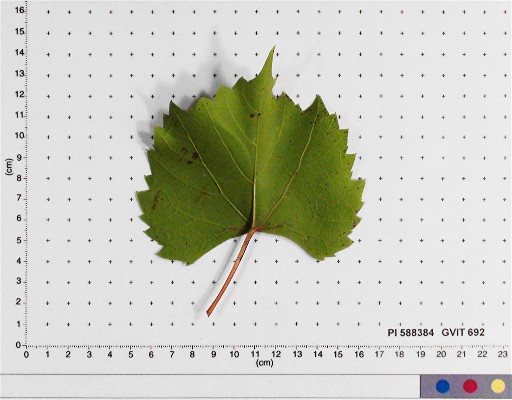 | | 1987 | DONATED | 03/10/1987 | | | | | Uncertain improvement status | Virus free. | 1008120 | PI 588384 |
| 14 | PI 588335 | GV 25-8-114 | Vitis rupestris Scheele | United States | GEN |  | | 1987 | DONATED | 02/01/1987 | | | | | Cultivated material | Male. Vigorous vine. | 1007429 | PI 588335 |
| 15 | DVIT 2843 | 'Olmo m6-119' | Vitis hybr. | California, United States | DAV | | | 1999 | COLLECTED | | | | | | Breeding material | Fruit type: Interspecific hybrid grape | 1619811 | DVIT 2843 |
| 16 | DVIT 2844 | 'Olmo m6-116' | Vitis hybr. | California, United States | DAV | | | 1999 | COLLECTED | | | | | | Breeding material | Fruit type: Interspecific hybrid grape | 1619886 | DVIT 2844 |
| 17 | DVIT 2845 | 'Olmo m6-120' | Vitis hybr. | California, United States | DAV | | | 1999 | COLLECTED | | | | | | Breeding material | Fruit type: Interspecific hybrid grape | 1619812 | DVIT 2845 |
| 18 | DVIT 2848 | 'Olmo m6-55' | Vitis hybr. | California, United States | DAV | | | 1999 | COLLECTED | | | | | | Breeding material | Fruit type: Interspecific hybrid grape | 1619815 | DVIT 2848 |
| 19 | DVIT 2859 | 'Olmo n3-155' | Vitis hybr. | California, United States | DAV | | | 1999 | COLLECTED | | | | | | Breeding material | Fruit type: Interspecific hybrid grape | 1619873 | DVIT 2859 |
| 20 | DVIT 2862 | 'Olmo n4-18' | Vitis hybr. | California, United States | DAV | | | 1999 | COLLECTED | | | | | | Breeding material | Fruit type: Interspecific hybrid grape | 1619888 | DVIT 2862 |
| 21 | DVIT 2893 | 'Olmo q9-146' | Vitis hybr. | California, United States | DAV | | | 1999 | COLLECTED | | | | | | Breeding material | Fruit type: Interspecific hybrid grape | 1619854 | DVIT 2893 |
| 22 | DVIT 2894 | 'Olmo q9-150' | Vitis hybr. | California, United States | DAV | | | 1999 | COLLECTED | | | | | | Breeding material | Fruit type: Interspecific hybrid grape | 1619855 | DVIT 2894 |
| 23 | DVIT 2895 | 'Olmo q10-6' | Vitis hybr. | California, United States | DAV | | | 1999 | COLLECTED | | | | | | Breeding material | Fruit type: Interspecific hybrid grape | 1619856 | DVIT 2895 |
| 24 | DVIT 1141 | Monticola x Rupestris | Vitis hybr. | California, United States | DAV | | | 1983 | DONATED | 01/01/1983 | | | | | Cultivated material | | 1011672 | DVIT 1141 |
| 25 | W6 48940 | AK930-464 | Chamaenerion angustifolium (L.) Scop. subsp. angustifolium | Alaska, United States | W6 |  | | 2015 | | | | | | | Wild material | | 1923855 | W6 48940 |