| 0 | PI 588514 | NY 65.563.1 | Vitis hybr. | New York, United States | GEN | 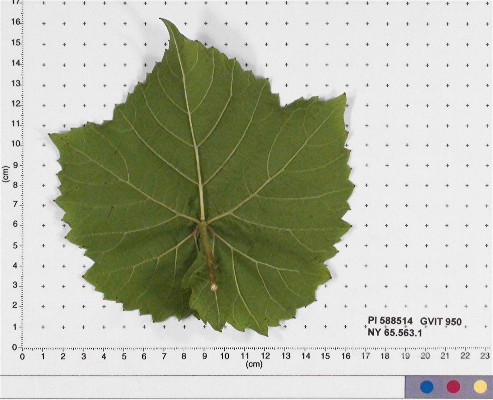 | | 1988 | DONATED | 01/26/1988 | | | | | Cultivated material | Medium, blue berries; small loose clusters; medium vine vigor; winter tender. | 1010312 | PI 588514 |
| 1 | PI 588172 | 'Lomanto' | Vitis hybr. | Texas, United States | GEN |  | | 1985 | DEVELOPED | 01/01/1902 | | | | | Cultivar | Hermophrodite - Black berries, round, medium-large. Medium, well-filled cluster. Very vigorous vine. Winter hardy. | 1004242 | PI 588172 |
| 2 | PI 588388 | GVIT 697 | Vitis hybr. | California, United States | GEN |  | | 1981 | DEVELOPED | | | | | | Cultivated material | Type = interspecific hybrd. Flower = female. Small blue berries. | 1008152 | PI 588388 |
| 3 | DVIT 2771 | 'Olmo j23-38' | Vitis hybr. | California, United States | DAV | | | 1999 | COLLECTED | | | | | | Breeding material | Fruit type: Interspecific hybrid grape | 1619757 | DVIT 2771 |
| 4 | DVIT 2870 | 'Olmo q9 78-92' | Vitis hybr. | California, United States | DAV | | | 1999 | COLLECTED | | | | | | Breeding material | Fruit type: Interspecific hybrid grape | 1619831 | DVIT 2870 |
| 5 | DVIT 2887 | 'Olmo q9-79' | Vitis hybr. | California, United States | DAV | | | 1999 | COLLECTED | | | | | | Breeding material | Fruit type: Interspecific hybrid grape | 1619848 | DVIT 2887 |
| 6 | DVIT 2069 | Miss Blue | Vitis hybr. | Mississippi, United States | DAV | | | 1983 | DEVELOPED | POST 1937 | | | | | Cultivated material | Type = Hybrid. Per J.P. Overcash, et. al. (see citation): "ORIGIN: Grape research at the USDA Horticultural Field Station near Meridian, Mississippi was in initiated in 1937 with the objectives of testing and developing bunch grapes that could be grown in home gardens. Most standard grape varieties of all origins were found to be short-lived, but good progress was made in breeding vigorous and productive (Meridian) lines. Meridian M20-3C (MidSouth) and Meridian M18 (MissBlue) were grown in vineyards at Mississippi State University in 1965. Own-rooted plants of each variety were set in the research vineyards at Beaumont, Crystal Springs, Stoneville and Verona in 1974 and have lived and grown vigorously when adjacent vines of other varieties have died. MidSouth and MissBlue have not shown symptoms of Pierce's Disease, and their vigor and productivity have indicated resistance have indicated resistance to the disease. [...] MissBlue is a cross of Dog Ridge is a V champini selected from the wild in Bell County, Texas in the late 1800s and has been distributed worldwide as a vigorous rootstock. It roots from cuttings and is exceedingly vigorous. It is resistant to Pierce's Disease, lime, drought and nematodes and is moderately resistant to phylloxera. It has a pistillate flower type and very small clusters of berries of medium size and low quality. J.B. Moore of Concord, Massachusetts developed Moore Early from an open-pollinated seed of Concord in 1872, and the variety was named in 1877. It is self-fertile, has purple berries and is typical of V. labrusca x V. vinifera varieties. It tolerates black rot but is susceptible to Pierce's Disease. MissBlue is highly susceptible to anthracnose, but a persistent fungicide program has kept this disease under control. [...] Harvest dates of MidSouth and MissBlue in our research vineyards have been from late July to mid-August. Yields have been higher for MidSouth than for MissBlue, and both have been more reproductive than Blue Lake. Yields have varied directly with vine size, which often is expressed as pounds removed per vine by the balanced pruning arrangement used in our vineyards. Average pruning weights for three years at three locations were the same for MidSouth and MissBlue, and Blue Lake vines were less vigorous. MidSouth and MissBlue berries are larger than those of Blue Lake and Lake Emerald, but Lake Emerald clusters are heavier than clusters of MidSouth and MissBlue. MissBlue clusters are compact. Sugar content (percent soluble solids measured by a hand refractometer over a three locations) was comparable for Blue Lake, MidSouth and MissBlue. Soluble solids content of Lake Emerald was 4-5% higher. Fully-ripe MidSouth and MissBlue berries have a mild and slight "foxy" flavor (due to methylanthranilate) but do not complete for fresh eating with high-quality Concord grapes from areas where that variety is well adapted; however, they are superior to Concord grapes grown in central and southern Mississippi where concord is poorly adapted." | 1018003 | DVIT 2069 |
| 7 | DVIT 2105 | MidSouth | Vitis hybr. | Mississippi, United States | DAV | | | 1983 | DEVELOPED | PRE 1965 | | | | | Cultivated material | Type = Hybrid. Per Overcash, et. al. (see citation): "ORIGIN: Grape research at the USDA Horticultrual Field Station near Meridian, Mississippi was initiated in 1937 with the objectives of testing and developing bunch graps that could be grown in home gardens. Most standard grape varieties of all origins were found to be short-lived, but good progress was made in breeding progress was made in breeding vigorous and productive (Meridian) lines. Meridian M20-3C (MidSouth) [was] grown in vineyards at Mississippi State University in the late 1940s and early 1950s and were planted in a new vineyard at the University in 1965. MidSouth and MissBlue have not been shown symptoms of Pierce's Disease, and their vigor and productivity have indicated resistance to the disease. Parents of MidSouth were DeGrasset x Galibert 255-5. DeGrasset is a pistillate Vitis champini variety that was discovered in Llano Couty, Texas by T.V. Munson (7), a nurseryman and grape breeder from Denison, Texas. It is black fruited and has small clusters. Galibert, 255-5 is a French-American hybrid, probably of Villard blanc x Muscat Hamburg parentage and is susceptible to fungi and Pierce's Disesase. MidSouth is highly susceptible to root know nematodes when grown in infected soil. [APTITUDES]: MidSouth and MissBlue are self-fertile, and vines have been more vigorous and longer lived in Mississippi tests than those of varieties such as Concord, Delaware, Moore Early and Niagra. Vigor of both resembles that of V. champini and both appear to have resistance to Pierce's Disease. Harvest dates of MidSouth and MissBlue in our research vineyards have been from late July to mid-August. Yields have been higher for MidSouth than for MissBlue, and both have been more productive than Blue Lake. Yields have varied directly with vine size, which often is expressed as pounds removed per vine by the balanced pruning arrangement used in our vineyards. Average pruning weights for three years at three locations were the same for MidSouth and MissBlue, and Blue Lake vines were less vigorous. MidSouth and MissBlue berries are larger than those of Blue Lake and Lake Emerald, but Lake Emerald clusters are heavier than clusters of MidSouth and MissBlue. MissBlue clusters are compact, and those of MidSouth are more open. Sugar content (percent soluble solids measured by a hand refractometer over a three- to four-year period at three locations) was comparable for Blue Lake, MidSouth and MissBlue. Soluble solids content of Lake Emerald was 4-5% higher. Fully-ripe MidSouth and MissBlue berries have a mild and slight "foxy" flavor (due to methylanthranilate) but do not compete for fresh eating with high-quality Concord grapes from areas where that variety is well adapted; however, they are superior to Concord grapes grown in central and southern Mississippi where Concord is poorly adapted. Seven-year-old MidSouth and MissBlue vines produced from 26 to 77 lbs/vine while Concord vines in the same vineyard had only 7 lbs/vine. Berries from the MidSouth and MissBlue vines were dark blue and uniformly ripe while berries on each Concord cluster ranged from light blue and hully ripe to full green color with very low sugar and high acid content." | 1018257 | DVIT 2105 |
| 8 | DVIT 29 | Champanel | Vitis hybr. | Texas, United States | DAV | | | 1983 | DEVELOPED | 1893 | | | | | Cultivated material | Type = American Hybrid. Per T.V. Munson (see citation): "Growth rampant, exceedingly resistant to heat and drought, growing well in limy black soils. Clusters large, conical, with long peducle, rather open. Berries globular, large, black, with white bloom, persistent; skin thin, tough; pulp tender, juicy, very sprightly, acid unless well ripened, then quite agreeable; seeds rather large, easily leaving the pulp. Ripe about with Concord, which it resembles very much in cluster and berry. Does well in any soil, but valuable for black waxy lands of the South where few other varieties will grow. Ripens evenly and not given to cracking or dropping as is the Concord or Worden in the South. Ten to twelve feet. Long arm pruning." Per U.P. Hedrick (see citation): "Vigorous, clusters large, conical; berries globular, large, black; season with Concord." Per R.L. Chadha and G.S. Randhawa (see citation): "Vines medium in vigour. Leaves cordate, 3-lobed or entire, large, thin, rough; cob-webby above and felted below. Flowers hermaphrodite, stamens upright, anthers much higher than stigma. Bunches small, short, globular to short conical, neither shouldered nor winged, loose or well filled. Berries bluish black or purple, spherical or obovoid, small, size less variable; bloom thick, easily removable; apex truncate, adherence weak. Skin thick, slip skin type, tough, transparency very poor. Pulp tender, melting, leathery, foxy in flavour, veins prominant. Juice turbid, slightly acidic. Ripening late, not uniform. Ripening middle of March to end of March. T.S.S. 17-18%. Light cropper. Not susceptible to cracking. It is susceptible to downy mildew and rust and resistant to anthracnose, powdery mildew and Cercospora leaf-spot." Per P.Wagner (see citation): "Fruit is strongly foxy and worthless for wine. Yet the vine has remarkable characteristics; it is ultra-vigorous, accepts grafts easily, and survives in the South where most American hybrids quickly sicken and dies of root troubles." | 1001037 | DVIT 29 |
| 9 | DVIT 95 | 'Lukfata' | Vitis hybr. | Texas, United States | DAV | | | 1983 | DEVELOPED | 1893 | | | | | Cultivated material | Type = American Hybrid. Per Munson (see citation): "Growth strong. Endures heat, drought and cold remarkably well. Succeeds in black, limy soils. Not injured by mildew. Cluster medium, ovate, sometimes shouldered, compact; berries globular, large, persistent; does not crack; pulp about same as Moore Early, more juicy and very sweet and agreeable. Ripens early and evenly. Sells in the market as well or better than Concord and ships far better. Little attacked by rot. A good market and a fair table grape. Flowers have reflexed stamens, hence it must be grown near some variety with erect stamens flowering at same time, such as Ives; then it bears well. Plant 10 to 12 feet apart. Give long pruning." Per Hedrick (see citation): "Vigorous, hardy; cluster medium, ovate, compact; berries globular, large, black, persistent; juicy, very sweet and agreeable; good; early; stamens reflexed." | 1002604 | DVIT 95 |